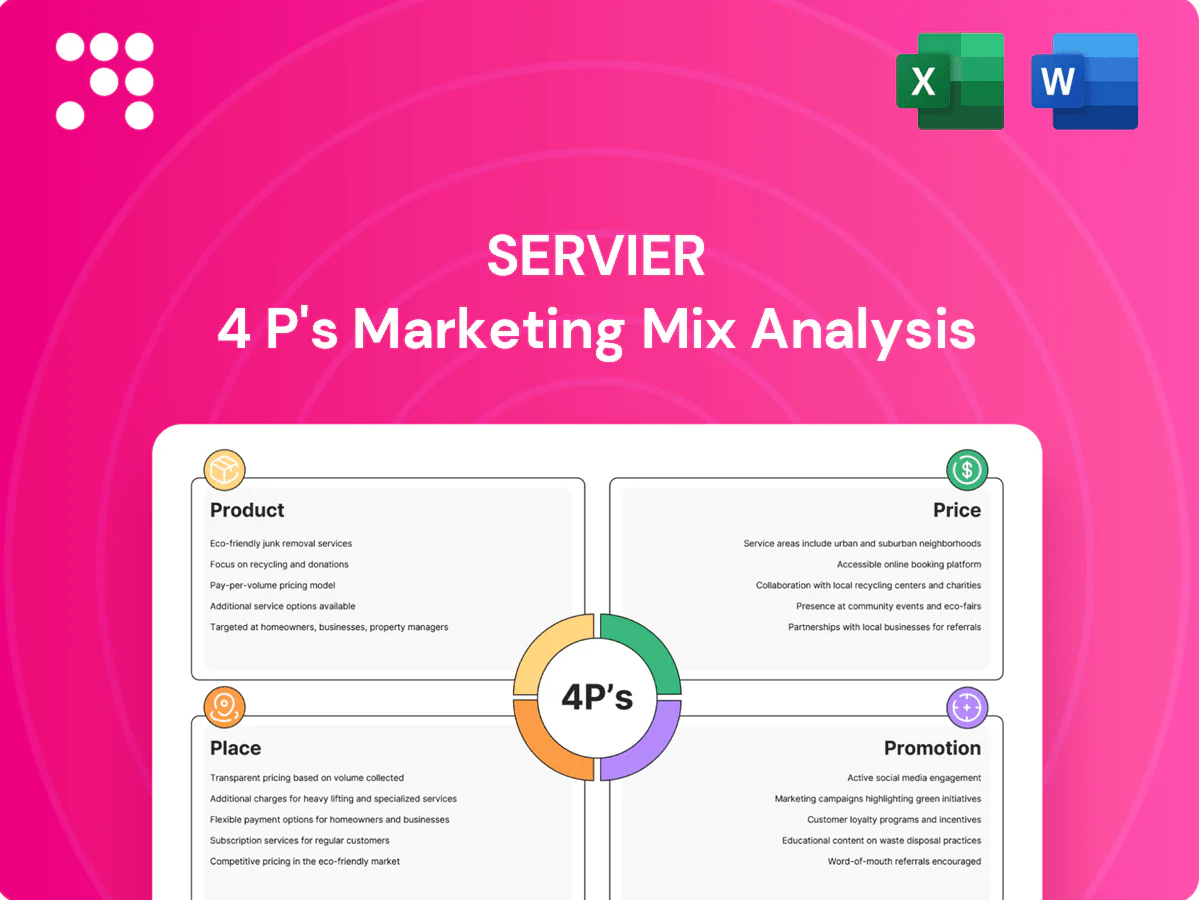
Servier Marketing Mix

Go Beyond the Snapshot—Get the Full Strategy
Discover how Servier’s product portfolio, pricing architecture, distribution channels, and promotional mix combine to drive competitive advantage; this snapshot highlights strengths and gaps. Purchase the full 4P’s Marketing Mix Analysis for a ready-made, editable report with data-driven insights, strategic recommendations, and presentation-ready slides to save research time and boost decision-making.
Product

Innovative Rx portfolio
Servier offers prescription medicines across cardiology, oncology, immuno-inflammation, neuroscience and diabetes, marketed in 150+ countries. The Innovative Rx portfolio emphasizes clinically validated outcomes and real-world effectiveness, supported by over 40 clinical development programs and 20+ real-world studies. Lifecycle management focuses on new indications, formulations and delivery systems, while quality-by-design ensures consistent safety, efficacy and global compliance.
Oncology pipeline focus
Servier accelerates investment in targeted therapies and immuno-oncology, aligning with a global oncology drugs market that exceeded $180 billion in 2023. Companion diagnostics and biomarker-driven trials underpin precision medicine, with the companion diagnostics market near $7 billion in 2024. Early access and compassionate-use pathways are used where allowed, and partnerships with biotech and academia broaden modality breadth.

Patient-centric design
Formulations prioritize adherence through fixed-dose combinations, modified-release formats and intuitive packaging—measures shown to raise adherence by up to 30% versus multi-pill regimens, addressing the WHO estimate that chronic disease adherence averages ~50%. Patient support materials cover dosing, side-effect management and disease education, while pharmacovigilance and post-marketing studies drive iterative product improvements. Accessibility measures include multilingual labeling and plain-language instructions across Servier’s ~150-country footprint.

R&D-driven differentiation
Servier’s R&D-driven differentiation rests on sustained reinvestment to maintain scientific leadership and drive therapeutic progress, prioritizing portfolio choices toward high-burden diseases with major unmet needs. Evidence generation spans Phase I–IV trials and HEOR programs to prove clinical and economic value, while open innovation and co-development partnerships shorten time-to-innovation and de-risk pipelines. This integrated R&D strategy underpins positioning and pricing in the 4P mix.
- R&D reinvestment → scientific leadership
- Portfolio focus → high-burden, unmet-need diseases
- Evidence generation → Phase I–IV + HEOR
- Open innovation → faster, de-risked co-development
Manufacturing excellence
Manufacturing excellence: Servier leverages global GMP facilities across more than 150 countries and ~22,000 employees to ensure reliable supply, quality, and scalability; robust QA/QC frameworks and technology transfers shorten launch timelines and minimize shortages and recalls.
- GMP-certified global network
- Technology transfers for launch readiness
- Sustainability: waste, energy, sourcing targets
- Strong QA/QC to reduce recalls/shortages
R&D-led prescription portfolio fueling global advances in cardiology, oncology and neuroscience
Servier’s product strategy centers on prescription medicines across cardiology, oncology, immuno‑inflammation, neuroscience and diabetes, marketed in 150+ countries. R&D-backed portfolios (40+ development programs, 20+ real‑world studies) drive lifecycle extensions, precision therapies and adherence-focused formulations. Quality-by-design and global GMP supply ensure safety, scalability and regulatory compliance.
| Metric | Value |
|---|---|
| Countries | 150+ |
| Employees | ~22,000 |
| R&D programs | 40+ |
| Real-world studies | 20+ |
| Oncology market (2023) | $180B+ |
What is included in the product
 Detailed Word Document
Delivers a company-specific deep dive into Servier’s Product, Price, Place, and Promotion strategies, using real brand practices and competitive context to provide actionable positioning, examples, and strategic implications for managers and consultants.

 Customizable Excel Spreadsheet
Condenses Servier's 4Ps into a high-level, at-a-glance view to relieve time pressure and align leadership; easily customizable for presentations, workshops, cross-brand comparisons, and quick stakeholder briefings.
Place

Global market presence
Servier distributes medicines in over 150 countries through affiliates and partner networks, supported by about 22,000 employees. Local regulatory and market-access teams drive market entry and reimbursement, leveraging an R&D reinvestment rate near 20% of sales. Portfolios are tailored to national formularies and clinical practice, while demand planning aligns supply with local epidemiology and seasonality.
Multi-channel distribution
Servier deploys multi-channel distribution via hospital systems, specialty pharmacies and wholesalers to optimize reach; specialty pharmacies handle cold-chain logistics and limited-distribution oncology products. With specialty medicines accounting for roughly 50% of US drug spend (IQVIA 2023), e-procurement integrates with payer and provider purchasing platforms to streamline ordering and compliance. Direct-to-hospital tenders secure institutional access and formulary placement.

Supply chain resilience
Dual sourcing and regional manufacturing reduce disruption risk and allow Servier to reroute supply quickly; inventory buffers and S&OP raise service levels and fill rates across markets. Serialization and track-and-trace meet global compliance such as EU FMD (in force since 2019) and US DSCSA unit-level requirements effective 27 Nov 2023. Continuous cold-chain monitoring preserves product integrity to point of care.

Market access alignment
Market access alignment prioritizes launch sequencing in markets with clear HTA pathways (EU5, Canada, Australia) to accelerate reimbursement; Servier reported group sales ~€4.9bn and ~22,000 employees in 2023 which informs resource allocation to high-priority markets. Local evidence packages and real-world data are prepared to support formulary inclusion, and outcomes-based agreements are pursued where national frameworks exist (Italy, UK, Germany). Stakeholder mapping targets clinicians, hospital pharmacists, and payers to optimize uptake and tender success.
- HTA-first launches: focus on EU5/Canada/Australia
- Local evidence: RWE dossiers, health economic models
- Outcomes-based agreements: used in Italy/UK/DE
- Stakeholders: clinicians, pharmacists, payers
Healthcare ecosystem integration
Servier's healthcare-ecosystem integration mobilizes medical affairs to partner with KOLs and centers of excellence, while patient organizations shape access programs and support services; WHO estimates adherence for long-term therapies averages about 50% in developed countries, highlighting the need for HCP education to improve appropriate use and adherence. Real-world data networks increasingly inform post-launch insights following FDA's 2018 RWE framework.
- Medical affairs: KOLs & COEs
- Patient orgs: access & support
- HCP education: improves adherence (~50% WHO)
- RWD networks: post-launch insights (RWE framework 2018)
Global biopharma reach in 150+ countries with €4.9bn sales
Servier distributes in 150+ countries via affiliates, partners and multi-channel networks (hospitals, wholesalers, specialty pharmacies), prioritizing HTA-first launches (EU5/CA/AU), dual sourcing, serialization and cold-chain. Group sales €4.9bn (2023), ~22,000 employees, R&D ~20% of sales; outcomes-based deals and RWE support formulary access.
| Metric | Value |
|---|---|
| Countries | 150+ |
| 2023 sales | €4.9bn |
| Employees | 22,000 |
| R&D reinvestment | ~20% |
| US specialty spend | ~50% (IQVIA 2023) |
What You See Is What You Get
Servier 4P's Marketing Mix Analysis
The preview shown here is the actual Servier 4P's Marketing Mix Analysis you’ll receive instantly after purchase—fully complete and ready to use. This is not a sample or demo; it’s the exact editable document included with your order. Buy with confidence knowing the file you see is the file you’ll download.

Go Beyond the Snapshot—Get the Full Strategy
Discover how Servier’s product portfolio, pricing architecture, distribution channels, and promotional mix combine to drive competitive advantage; this snapshot highlights strengths and gaps. Purchase the full 4P’s Marketing Mix Analysis for a ready-made, editable report with data-driven insights, strategic recommendations, and presentation-ready slides to save research time and boost decision-making.
Product
Innovative Rx portfolio
Servier offers prescription medicines across cardiology, oncology, immuno-inflammation, neuroscience and diabetes, marketed in 150+ countries. The Innovative Rx portfolio emphasizes clinically validated outcomes and real-world effectiveness, supported by over 40 clinical development programs and 20+ real-world studies. Lifecycle management focuses on new indications, formulations and delivery systems, while quality-by-design ensures consistent safety, efficacy and global compliance.
Oncology pipeline focus
Servier accelerates investment in targeted therapies and immuno-oncology, aligning with a global oncology drugs market that exceeded $180 billion in 2023. Companion diagnostics and biomarker-driven trials underpin precision medicine, with the companion diagnostics market near $7 billion in 2024. Early access and compassionate-use pathways are used where allowed, and partnerships with biotech and academia broaden modality breadth.
Patient-centric design
Formulations prioritize adherence through fixed-dose combinations, modified-release formats and intuitive packaging—measures shown to raise adherence by up to 30% versus multi-pill regimens, addressing the WHO estimate that chronic disease adherence averages ~50%. Patient support materials cover dosing, side-effect management and disease education, while pharmacovigilance and post-marketing studies drive iterative product improvements. Accessibility measures include multilingual labeling and plain-language instructions across Servier’s ~150-country footprint.
R&D-driven differentiation
Servier’s R&D-driven differentiation rests on sustained reinvestment to maintain scientific leadership and drive therapeutic progress, prioritizing portfolio choices toward high-burden diseases with major unmet needs. Evidence generation spans Phase I–IV trials and HEOR programs to prove clinical and economic value, while open innovation and co-development partnerships shorten time-to-innovation and de-risk pipelines. This integrated R&D strategy underpins positioning and pricing in the 4P mix.
- R&D reinvestment → scientific leadership
- Portfolio focus → high-burden, unmet-need diseases
- Evidence generation → Phase I–IV + HEOR
- Open innovation → faster, de-risked co-development
Manufacturing excellence
Manufacturing excellence: Servier leverages global GMP facilities across more than 150 countries and ~22,000 employees to ensure reliable supply, quality, and scalability; robust QA/QC frameworks and technology transfers shorten launch timelines and minimize shortages and recalls.
- GMP-certified global network
- Technology transfers for launch readiness
- Sustainability: waste, energy, sourcing targets
- Strong QA/QC to reduce recalls/shortages
R&D-led prescription portfolio fueling global advances in cardiology, oncology and neuroscience
Servier’s product strategy centers on prescription medicines across cardiology, oncology, immuno‑inflammation, neuroscience and diabetes, marketed in 150+ countries. R&D-backed portfolios (40+ development programs, 20+ real‑world studies) drive lifecycle extensions, precision therapies and adherence-focused formulations. Quality-by-design and global GMP supply ensure safety, scalability and regulatory compliance.
| Metric | Value |
|---|---|
| Countries | 150+ |
| Employees | ~22,000 |
| R&D programs | 40+ |
| Real-world studies | 20+ |
| Oncology market (2023) | $180B+ |
What is included in the product
Detailed Word Document
Delivers a company-specific deep dive into Servier’s Product, Price, Place, and Promotion strategies, using real brand practices and competitive context to provide actionable positioning, examples, and strategic implications for managers and consultants.
Customizable Excel Spreadsheet
Condenses Servier's 4Ps into a high-level, at-a-glance view to relieve time pressure and align leadership; easily customizable for presentations, workshops, cross-brand comparisons, and quick stakeholder briefings.
Place
Global market presence
Servier distributes medicines in over 150 countries through affiliates and partner networks, supported by about 22,000 employees. Local regulatory and market-access teams drive market entry and reimbursement, leveraging an R&D reinvestment rate near 20% of sales. Portfolios are tailored to national formularies and clinical practice, while demand planning aligns supply with local epidemiology and seasonality.
Multi-channel distribution
Servier deploys multi-channel distribution via hospital systems, specialty pharmacies and wholesalers to optimize reach; specialty pharmacies handle cold-chain logistics and limited-distribution oncology products. With specialty medicines accounting for roughly 50% of US drug spend (IQVIA 2023), e-procurement integrates with payer and provider purchasing platforms to streamline ordering and compliance. Direct-to-hospital tenders secure institutional access and formulary placement.
Supply chain resilience
Dual sourcing and regional manufacturing reduce disruption risk and allow Servier to reroute supply quickly; inventory buffers and S&OP raise service levels and fill rates across markets. Serialization and track-and-trace meet global compliance such as EU FMD (in force since 2019) and US DSCSA unit-level requirements effective 27 Nov 2023. Continuous cold-chain monitoring preserves product integrity to point of care.
Market access alignment
Market access alignment prioritizes launch sequencing in markets with clear HTA pathways (EU5, Canada, Australia) to accelerate reimbursement; Servier reported group sales ~€4.9bn and ~22,000 employees in 2023 which informs resource allocation to high-priority markets. Local evidence packages and real-world data are prepared to support formulary inclusion, and outcomes-based agreements are pursued where national frameworks exist (Italy, UK, Germany). Stakeholder mapping targets clinicians, hospital pharmacists, and payers to optimize uptake and tender success.
- HTA-first launches: focus on EU5/Canada/Australia
- Local evidence: RWE dossiers, health economic models
- Outcomes-based agreements: used in Italy/UK/DE
- Stakeholders: clinicians, pharmacists, payers
Healthcare ecosystem integration
Servier's healthcare-ecosystem integration mobilizes medical affairs to partner with KOLs and centers of excellence, while patient organizations shape access programs and support services; WHO estimates adherence for long-term therapies averages about 50% in developed countries, highlighting the need for HCP education to improve appropriate use and adherence. Real-world data networks increasingly inform post-launch insights following FDA's 2018 RWE framework.
- Medical affairs: KOLs & COEs
- Patient orgs: access & support
- HCP education: improves adherence (~50% WHO)
- RWD networks: post-launch insights (RWE framework 2018)
Global biopharma reach in 150+ countries with €4.9bn sales
Servier distributes in 150+ countries via affiliates, partners and multi-channel networks (hospitals, wholesalers, specialty pharmacies), prioritizing HTA-first launches (EU5/CA/AU), dual sourcing, serialization and cold-chain. Group sales €4.9bn (2023), ~22,000 employees, R&D ~20% of sales; outcomes-based deals and RWE support formulary access.
| Metric | Value |
|---|---|
| Countries | 150+ |
| 2023 sales | €4.9bn |
| Employees | 22,000 |
| R&D reinvestment | ~20% |
| US specialty spend | ~50% (IQVIA 2023) |
What You See Is What You Get
Servier 4P's Marketing Mix Analysis
The preview shown here is the actual Servier 4P's Marketing Mix Analysis you’ll receive instantly after purchase—fully complete and ready to use. This is not a sample or demo; it’s the exact editable document included with your order. Buy with confidence knowing the file you see is the file you’ll download.
Original: $10.00
-65%$10.00
$3.50Description
Go Beyond the Snapshot—Get the Full Strategy
Discover how Servier’s product portfolio, pricing architecture, distribution channels, and promotional mix combine to drive competitive advantage; this snapshot highlights strengths and gaps. Purchase the full 4P’s Marketing Mix Analysis for a ready-made, editable report with data-driven insights, strategic recommendations, and presentation-ready slides to save research time and boost decision-making.
Product
Innovative Rx portfolio
Servier offers prescription medicines across cardiology, oncology, immuno-inflammation, neuroscience and diabetes, marketed in 150+ countries. The Innovative Rx portfolio emphasizes clinically validated outcomes and real-world effectiveness, supported by over 40 clinical development programs and 20+ real-world studies. Lifecycle management focuses on new indications, formulations and delivery systems, while quality-by-design ensures consistent safety, efficacy and global compliance.
Oncology pipeline focus
Servier accelerates investment in targeted therapies and immuno-oncology, aligning with a global oncology drugs market that exceeded $180 billion in 2023. Companion diagnostics and biomarker-driven trials underpin precision medicine, with the companion diagnostics market near $7 billion in 2024. Early access and compassionate-use pathways are used where allowed, and partnerships with biotech and academia broaden modality breadth.
Patient-centric design
Formulations prioritize adherence through fixed-dose combinations, modified-release formats and intuitive packaging—measures shown to raise adherence by up to 30% versus multi-pill regimens, addressing the WHO estimate that chronic disease adherence averages ~50%. Patient support materials cover dosing, side-effect management and disease education, while pharmacovigilance and post-marketing studies drive iterative product improvements. Accessibility measures include multilingual labeling and plain-language instructions across Servier’s ~150-country footprint.
R&D-driven differentiation
Servier’s R&D-driven differentiation rests on sustained reinvestment to maintain scientific leadership and drive therapeutic progress, prioritizing portfolio choices toward high-burden diseases with major unmet needs. Evidence generation spans Phase I–IV trials and HEOR programs to prove clinical and economic value, while open innovation and co-development partnerships shorten time-to-innovation and de-risk pipelines. This integrated R&D strategy underpins positioning and pricing in the 4P mix.
- R&D reinvestment → scientific leadership
- Portfolio focus → high-burden, unmet-need diseases
- Evidence generation → Phase I–IV + HEOR
- Open innovation → faster, de-risked co-development
Manufacturing excellence
Manufacturing excellence: Servier leverages global GMP facilities across more than 150 countries and ~22,000 employees to ensure reliable supply, quality, and scalability; robust QA/QC frameworks and technology transfers shorten launch timelines and minimize shortages and recalls.
- GMP-certified global network
- Technology transfers for launch readiness
- Sustainability: waste, energy, sourcing targets
- Strong QA/QC to reduce recalls/shortages
R&D-led prescription portfolio fueling global advances in cardiology, oncology and neuroscience
Servier’s product strategy centers on prescription medicines across cardiology, oncology, immuno‑inflammation, neuroscience and diabetes, marketed in 150+ countries. R&D-backed portfolios (40+ development programs, 20+ real‑world studies) drive lifecycle extensions, precision therapies and adherence-focused formulations. Quality-by-design and global GMP supply ensure safety, scalability and regulatory compliance.
| Metric | Value |
|---|---|
| Countries | 150+ |
| Employees | ~22,000 |
| R&D programs | 40+ |
| Real-world studies | 20+ |
| Oncology market (2023) | $180B+ |
What is included in the product
Detailed Word Document
Delivers a company-specific deep dive into Servier’s Product, Price, Place, and Promotion strategies, using real brand practices and competitive context to provide actionable positioning, examples, and strategic implications for managers and consultants.
Customizable Excel Spreadsheet
Condenses Servier's 4Ps into a high-level, at-a-glance view to relieve time pressure and align leadership; easily customizable for presentations, workshops, cross-brand comparisons, and quick stakeholder briefings.
Place
Global market presence
Servier distributes medicines in over 150 countries through affiliates and partner networks, supported by about 22,000 employees. Local regulatory and market-access teams drive market entry and reimbursement, leveraging an R&D reinvestment rate near 20% of sales. Portfolios are tailored to national formularies and clinical practice, while demand planning aligns supply with local epidemiology and seasonality.
Multi-channel distribution
Servier deploys multi-channel distribution via hospital systems, specialty pharmacies and wholesalers to optimize reach; specialty pharmacies handle cold-chain logistics and limited-distribution oncology products. With specialty medicines accounting for roughly 50% of US drug spend (IQVIA 2023), e-procurement integrates with payer and provider purchasing platforms to streamline ordering and compliance. Direct-to-hospital tenders secure institutional access and formulary placement.
Supply chain resilience
Dual sourcing and regional manufacturing reduce disruption risk and allow Servier to reroute supply quickly; inventory buffers and S&OP raise service levels and fill rates across markets. Serialization and track-and-trace meet global compliance such as EU FMD (in force since 2019) and US DSCSA unit-level requirements effective 27 Nov 2023. Continuous cold-chain monitoring preserves product integrity to point of care.
Market access alignment
Market access alignment prioritizes launch sequencing in markets with clear HTA pathways (EU5, Canada, Australia) to accelerate reimbursement; Servier reported group sales ~€4.9bn and ~22,000 employees in 2023 which informs resource allocation to high-priority markets. Local evidence packages and real-world data are prepared to support formulary inclusion, and outcomes-based agreements are pursued where national frameworks exist (Italy, UK, Germany). Stakeholder mapping targets clinicians, hospital pharmacists, and payers to optimize uptake and tender success.
- HTA-first launches: focus on EU5/Canada/Australia
- Local evidence: RWE dossiers, health economic models
- Outcomes-based agreements: used in Italy/UK/DE
- Stakeholders: clinicians, pharmacists, payers
Healthcare ecosystem integration
Servier's healthcare-ecosystem integration mobilizes medical affairs to partner with KOLs and centers of excellence, while patient organizations shape access programs and support services; WHO estimates adherence for long-term therapies averages about 50% in developed countries, highlighting the need for HCP education to improve appropriate use and adherence. Real-world data networks increasingly inform post-launch insights following FDA's 2018 RWE framework.
- Medical affairs: KOLs & COEs
- Patient orgs: access & support
- HCP education: improves adherence (~50% WHO)
- RWD networks: post-launch insights (RWE framework 2018)
Global biopharma reach in 150+ countries with €4.9bn sales
Servier distributes in 150+ countries via affiliates, partners and multi-channel networks (hospitals, wholesalers, specialty pharmacies), prioritizing HTA-first launches (EU5/CA/AU), dual sourcing, serialization and cold-chain. Group sales €4.9bn (2023), ~22,000 employees, R&D ~20% of sales; outcomes-based deals and RWE support formulary access.
| Metric | Value |
|---|---|
| Countries | 150+ |
| 2023 sales | €4.9bn |
| Employees | 22,000 |
| R&D reinvestment | ~20% |
| US specialty spend | ~50% (IQVIA 2023) |
What You See Is What You Get
Servier 4P's Marketing Mix Analysis
The preview shown here is the actual Servier 4P's Marketing Mix Analysis you’ll receive instantly after purchase—fully complete and ready to use. This is not a sample or demo; it’s the exact editable document included with your order. Buy with confidence knowing the file you see is the file you’ll download.











