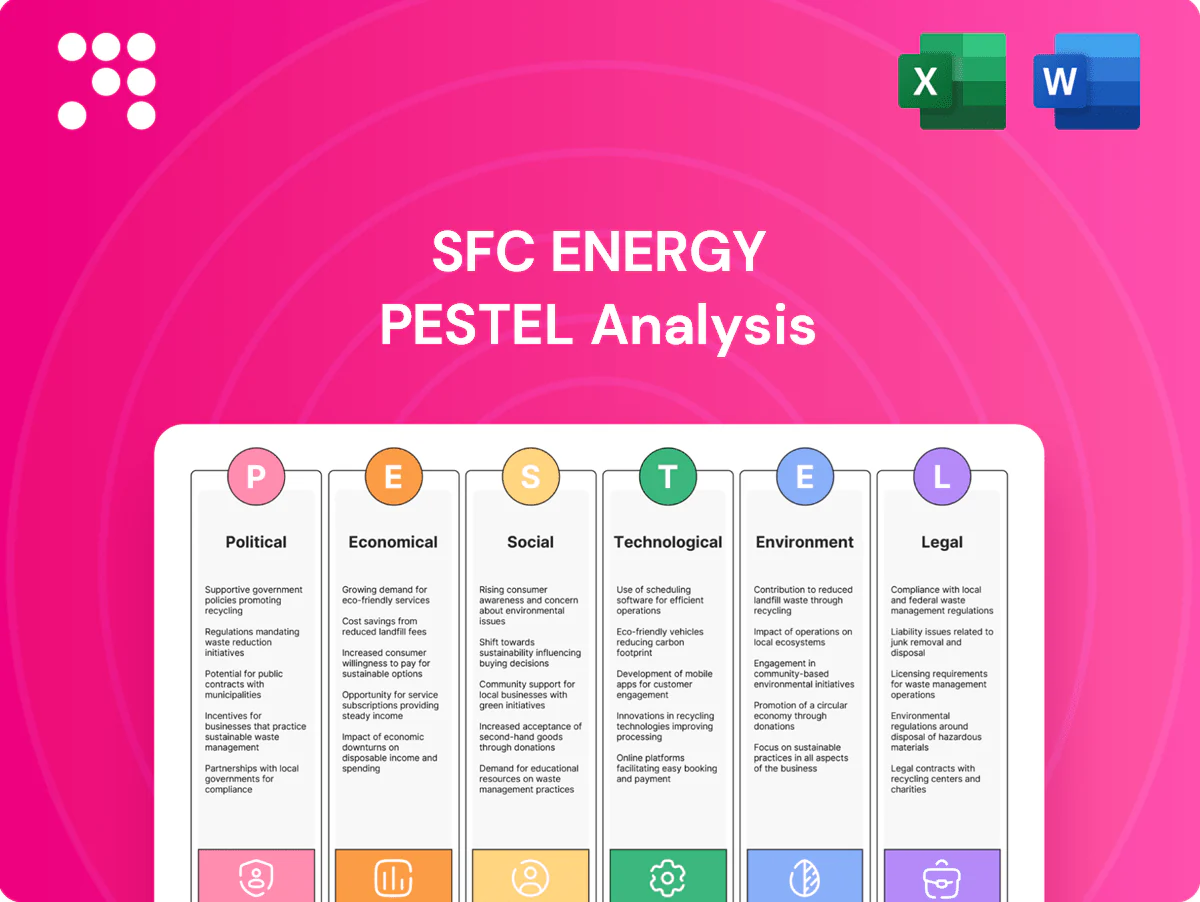
SFC Energy PESTLE Analysis

Make Smarter Strategic Decisions with a Complete PESTEL View
Discover how political, economic, social, technological, legal, and environmental forces are reshaping SFC Energy’s prospects in our concise PESTLE snapshot—perfect for investors and strategists seeking clear external-risk signals. This expert analysis highlights regulatory pressures, market opportunities, and tech trends that could alter valuation and strategy. Purchase the full PESTLE for the complete, actionable breakdown and forecasting tools.
Political factors

Energy transition policies
Government decarbonization strategies and hydrogen roadmaps shape funding, pilots and public procurement for SFC Energy fuel cells; the EU targets 10 million tonnes of renewable hydrogen by 2030 while the US Inflation Reduction Act mobilized roughly 369 billion USD for clean energy incentives. Strong policy backing accelerates adoption in off‑grid, telecom and municipal uses and unlocks public tenders. Shifts in administration priorities can redirect incentives or favor competing technologies, so monitoring EU, North American and Asian programs is critical for demand visibility.
Defense spending and procurement
Rising defense budgets — global military spending surpassed about 2.4 trillion USD in 2024 per SIPRI — boost demand for silent, reliable power for mission-critical use. Long procurement cycles (commonly 3–7 years) and stringent certifications delay revenue recognition. Geopolitical tensions increase portable/remote power needs but complicate export approvals (ITAR/EAR delays often 6–18 months). Offset and local-content rules (frequently 20–50%) reshape contract structure.

Subsidies and tax incentives
Production and investment tax credits such as the US Inflation Reduction Act's $369 billion clean-energy package and the Section 45V hydrogen credit (up to $3/kg for low‑carbon hydrogen) materially lower SFC Energy's total cost of ownership for customers, while Germany's €9 billion national hydrogen strategy boosts market demand. Grant programs de‑risk pilot deployments in early markets, but capex versus opex design shifts payback profiles in off‑grid and industrial niches and sunset clauses plus compliance audits increase administrative overhead.

Trade policy and supply chains
Tariffs on components, rare materials and electronics squeeze SFC Energy margins and force price pass-through or redesign of fuel-cell stacks to maintain competitiveness.
Regionalization policies drive localized manufacturing and after-sales footprints, increasing fixed costs but reducing exposure to export volatility; cross-border logistics for hazardous hydrogen and metal hydride cartridges require special permits and add lead times, prompting multi-sourcing and higher inventory buffers.
- Tariffs: increase COGS and pricing pressure
- Regionalization: higher fixed costs, localized service
- Hazardous logistics: permits, longer lead times
- Export volatility: multi-sourcing, inventory buffers
Public infrastructure planning
- EU Hydrogen Bank €3bn
- Rural off‑grid funding: hundreds of millions (2023–24)
- Grid resilience → recurring emergency demand
- Approval delays: 6–18 months
Hydrogen roadmaps and IRA incentives spur off-grid and defense power demand; tariffs raise COGS
Government hydrogen roadmaps (EU 10 Mt by 2030) and clean‑energy incentives (US IRA ~369 bn USD) accelerate SFC Energy demand in off‑grid, telecom and municipal segments; rising defense spend (~2.4 tn USD in 2024) drives military power needs while export controls and tariffs raise approval times and COGS.
| Metric | Value | Implication |
|---|---|---|
| EU target | 10 Mt H2 by 2030 | Market scale |
| US IRA | ~369 bn USD | Incentives |
| Defense spend | ~2.4 tn USD (2024) | Procurement demand |
| EU Hydrogen Bank | ~3 bn EUR | Supply scaling |
What is included in the product
 Detailed Word Document
Explores how macro-environmental factors affect SFC Energy across Political, Economic, Social, Technological, Environmental and Legal dimensions, with data-backed insights tailored to its fuel-cell and hydrogen-tech markets. Designed for executives and investors, it highlights threats, opportunities and forward-looking scenarios aligned to regional market and regulatory dynamics.

 Customizable Excel Spreadsheet
A concise, visually segmented PESTLE summary for SFC Energy that relieves briefing pain points by enabling quick interpretation, easy sharing across teams, and simple edits for regional or business-line notes—ideal for presentations and strategic planning sessions.
Economic factors

Input costs and commodity volatility
Prices for methanol (~$450/t in Europe 2024), renewable hydrogen premiums (~$2–4/kg vs grey in 2024–25), platinum‑group metals (PGMs up ~12% in 2024) and power‑electronics costs (SiC adoption lowering unit costs ~10% in 2024) directly affect SFC Energy unit economics; logistics inflation (~6–8% in 2024) and labor inflation (3–5%) raise total system costs, while hedging and multi‑year supply contracts help stabilize gross margins.
Total cost of ownership dynamics
Competing with generators and batteries depends heavily on fuel representing 30–60% of OPEX, service intervals and uptime (targeting >99% in defense/industrial use); hybrid fuel-cell + battery systems have shown lifecycle cost reductions of 15–30% by right-sizing storage and fuel consumption. Leasing and pay-per-use models cut upfront costs and broaden adoption in industrial and defense procurement. Proven field reliability lowers perceived risk and can compress discount rates by several percentage points.

Macroeconomic cycles
Macroeconomic slowdowns can defer capex in telecom, oil & gas and industrial projects, reducing near‑term demand for SFC Energy fuel‑cell and hydrogen solutions; US CPI slowed to 3.4% in 2024, signalling softer investment. Conversely, energy price spikes (eg 2022) boost appetite for clean off‑grid power. Currency swings affect export competitiveness and component import costs. Public stimulus — US Inflation Reduction Act (~369 billion USD) and EU NextGenerationEU (~750–800 billion EUR) — supports green tech and can offset cyclical weakness.

Market maturation and scale
As volumes rise, learning curves compress cost per watt and service expense, lifting gross margins and operating leverage for SFC Energy.
Platform standardization accelerates scale benefits; channel partnerships expand verticals and geographies with materially lower customer-acquisition costs.
Aftermarket and recurring service revenue—often double-digit percent of sales in fuel-cell markets—boosts resilience and valuation multiples.
- Lower cost per watt
- Faster scale from standardization
- Lower CAC via channels
- Recurring aftermarket revenue
Customer concentration and mix
Large defense and telecom contracts drive lumpy revenue for SFC Energy, while diversification across industrial, security and remote monitoring reduces cyclic exposure; emerging markets present growth opportunities but raise credit and logistics risk, and balanced regional exposure mitigates dependency on single-policy changes.
- Customer mix: defense, telecom, industrial, security, remote monitoring
- Revenue profile: concentrated contract-driven spikes
- Risk: emerging markets = higher credit/logistics risk
- Mitigation: regional diversification lowers single-policy dependency
Hydrogen roadmaps and IRA incentives spur off-grid and defense power demand; tariffs raise COGS
Methanol ~450 USD/t (EU 2024), renewable H2 premium ~2–4 USD/kg (2024–25) and PGMs +12% (2024) drive input costs; logistics inflation 6–8% and labor 3–5% raise system OPEX while hedges/multi‑year contracts protect margins. Energy price spikes lift demand for off‑grid clean power; US CPI 3.4% (2024) softens capex, IRA ~369bn USD supports green adoption.
| Metric | 2024 |
|---|---|
| Methanol | ~450 USD/t |
| H2 premium | 2–4 USD/kg |
| PGMs | +12% |
| Logistics inflation | 6–8% |
| US CPI | 3.4% |
Same Document Delivered
SFC Energy PESTLE Analysis
The SFC Energy PESTLE Analysis shown here is the exact, fully formatted document you’ll receive after purchase. It includes complete political, economic, social, technological, legal and environmental insights—no placeholders or excerpts. Download the final file immediately after checkout and begin using the ready-to-use analysis as displayed.

Make Smarter Strategic Decisions with a Complete PESTEL View
Discover how political, economic, social, technological, legal, and environmental forces are reshaping SFC Energy’s prospects in our concise PESTLE snapshot—perfect for investors and strategists seeking clear external-risk signals. This expert analysis highlights regulatory pressures, market opportunities, and tech trends that could alter valuation and strategy. Purchase the full PESTLE for the complete, actionable breakdown and forecasting tools.
Political factors
Energy transition policies
Government decarbonization strategies and hydrogen roadmaps shape funding, pilots and public procurement for SFC Energy fuel cells; the EU targets 10 million tonnes of renewable hydrogen by 2030 while the US Inflation Reduction Act mobilized roughly 369 billion USD for clean energy incentives. Strong policy backing accelerates adoption in off‑grid, telecom and municipal uses and unlocks public tenders. Shifts in administration priorities can redirect incentives or favor competing technologies, so monitoring EU, North American and Asian programs is critical for demand visibility.
Defense spending and procurement
Rising defense budgets — global military spending surpassed about 2.4 trillion USD in 2024 per SIPRI — boost demand for silent, reliable power for mission-critical use. Long procurement cycles (commonly 3–7 years) and stringent certifications delay revenue recognition. Geopolitical tensions increase portable/remote power needs but complicate export approvals (ITAR/EAR delays often 6–18 months). Offset and local-content rules (frequently 20–50%) reshape contract structure.
Subsidies and tax incentives
Production and investment tax credits such as the US Inflation Reduction Act's $369 billion clean-energy package and the Section 45V hydrogen credit (up to $3/kg for low‑carbon hydrogen) materially lower SFC Energy's total cost of ownership for customers, while Germany's €9 billion national hydrogen strategy boosts market demand. Grant programs de‑risk pilot deployments in early markets, but capex versus opex design shifts payback profiles in off‑grid and industrial niches and sunset clauses plus compliance audits increase administrative overhead.
Trade policy and supply chains
Tariffs on components, rare materials and electronics squeeze SFC Energy margins and force price pass-through or redesign of fuel-cell stacks to maintain competitiveness.
Regionalization policies drive localized manufacturing and after-sales footprints, increasing fixed costs but reducing exposure to export volatility; cross-border logistics for hazardous hydrogen and metal hydride cartridges require special permits and add lead times, prompting multi-sourcing and higher inventory buffers.
- Tariffs: increase COGS and pricing pressure
- Regionalization: higher fixed costs, localized service
- Hazardous logistics: permits, longer lead times
- Export volatility: multi-sourcing, inventory buffers
Public infrastructure planning
- EU Hydrogen Bank €3bn
- Rural off‑grid funding: hundreds of millions (2023–24)
- Grid resilience → recurring emergency demand
- Approval delays: 6–18 months
Hydrogen roadmaps and IRA incentives spur off-grid and defense power demand; tariffs raise COGS
Government hydrogen roadmaps (EU 10 Mt by 2030) and clean‑energy incentives (US IRA ~369 bn USD) accelerate SFC Energy demand in off‑grid, telecom and municipal segments; rising defense spend (~2.4 tn USD in 2024) drives military power needs while export controls and tariffs raise approval times and COGS.
| Metric | Value | Implication |
|---|---|---|
| EU target | 10 Mt H2 by 2030 | Market scale |
| US IRA | ~369 bn USD | Incentives |
| Defense spend | ~2.4 tn USD (2024) | Procurement demand |
| EU Hydrogen Bank | ~3 bn EUR | Supply scaling |
What is included in the product
Detailed Word Document
Explores how macro-environmental factors affect SFC Energy across Political, Economic, Social, Technological, Environmental and Legal dimensions, with data-backed insights tailored to its fuel-cell and hydrogen-tech markets. Designed for executives and investors, it highlights threats, opportunities and forward-looking scenarios aligned to regional market and regulatory dynamics.
Customizable Excel Spreadsheet
A concise, visually segmented PESTLE summary for SFC Energy that relieves briefing pain points by enabling quick interpretation, easy sharing across teams, and simple edits for regional or business-line notes—ideal for presentations and strategic planning sessions.
Economic factors
Input costs and commodity volatility
Prices for methanol (~$450/t in Europe 2024), renewable hydrogen premiums (~$2–4/kg vs grey in 2024–25), platinum‑group metals (PGMs up ~12% in 2024) and power‑electronics costs (SiC adoption lowering unit costs ~10% in 2024) directly affect SFC Energy unit economics; logistics inflation (~6–8% in 2024) and labor inflation (3–5%) raise total system costs, while hedging and multi‑year supply contracts help stabilize gross margins.
Total cost of ownership dynamics
Competing with generators and batteries depends heavily on fuel representing 30–60% of OPEX, service intervals and uptime (targeting >99% in defense/industrial use); hybrid fuel-cell + battery systems have shown lifecycle cost reductions of 15–30% by right-sizing storage and fuel consumption. Leasing and pay-per-use models cut upfront costs and broaden adoption in industrial and defense procurement. Proven field reliability lowers perceived risk and can compress discount rates by several percentage points.
Macroeconomic cycles
Macroeconomic slowdowns can defer capex in telecom, oil & gas and industrial projects, reducing near‑term demand for SFC Energy fuel‑cell and hydrogen solutions; US CPI slowed to 3.4% in 2024, signalling softer investment. Conversely, energy price spikes (eg 2022) boost appetite for clean off‑grid power. Currency swings affect export competitiveness and component import costs. Public stimulus — US Inflation Reduction Act (~369 billion USD) and EU NextGenerationEU (~750–800 billion EUR) — supports green tech and can offset cyclical weakness.
Market maturation and scale
As volumes rise, learning curves compress cost per watt and service expense, lifting gross margins and operating leverage for SFC Energy.
Platform standardization accelerates scale benefits; channel partnerships expand verticals and geographies with materially lower customer-acquisition costs.
Aftermarket and recurring service revenue—often double-digit percent of sales in fuel-cell markets—boosts resilience and valuation multiples.
- Lower cost per watt
- Faster scale from standardization
- Lower CAC via channels
- Recurring aftermarket revenue
Customer concentration and mix
Large defense and telecom contracts drive lumpy revenue for SFC Energy, while diversification across industrial, security and remote monitoring reduces cyclic exposure; emerging markets present growth opportunities but raise credit and logistics risk, and balanced regional exposure mitigates dependency on single-policy changes.
- Customer mix: defense, telecom, industrial, security, remote monitoring
- Revenue profile: concentrated contract-driven spikes
- Risk: emerging markets = higher credit/logistics risk
- Mitigation: regional diversification lowers single-policy dependency
Hydrogen roadmaps and IRA incentives spur off-grid and defense power demand; tariffs raise COGS
Methanol ~450 USD/t (EU 2024), renewable H2 premium ~2–4 USD/kg (2024–25) and PGMs +12% (2024) drive input costs; logistics inflation 6–8% and labor 3–5% raise system OPEX while hedges/multi‑year contracts protect margins. Energy price spikes lift demand for off‑grid clean power; US CPI 3.4% (2024) softens capex, IRA ~369bn USD supports green adoption.
| Metric | 2024 |
|---|---|
| Methanol | ~450 USD/t |
| H2 premium | 2–4 USD/kg |
| PGMs | +12% |
| Logistics inflation | 6–8% |
| US CPI | 3.4% |
Same Document Delivered
SFC Energy PESTLE Analysis
The SFC Energy PESTLE Analysis shown here is the exact, fully formatted document you’ll receive after purchase. It includes complete political, economic, social, technological, legal and environmental insights—no placeholders or excerpts. Download the final file immediately after checkout and begin using the ready-to-use analysis as displayed.
Description
Make Smarter Strategic Decisions with a Complete PESTEL View
Discover how political, economic, social, technological, legal, and environmental forces are reshaping SFC Energy’s prospects in our concise PESTLE snapshot—perfect for investors and strategists seeking clear external-risk signals. This expert analysis highlights regulatory pressures, market opportunities, and tech trends that could alter valuation and strategy. Purchase the full PESTLE for the complete, actionable breakdown and forecasting tools.
Political factors
Energy transition policies
Government decarbonization strategies and hydrogen roadmaps shape funding, pilots and public procurement for SFC Energy fuel cells; the EU targets 10 million tonnes of renewable hydrogen by 2030 while the US Inflation Reduction Act mobilized roughly 369 billion USD for clean energy incentives. Strong policy backing accelerates adoption in off‑grid, telecom and municipal uses and unlocks public tenders. Shifts in administration priorities can redirect incentives or favor competing technologies, so monitoring EU, North American and Asian programs is critical for demand visibility.
Defense spending and procurement
Rising defense budgets — global military spending surpassed about 2.4 trillion USD in 2024 per SIPRI — boost demand for silent, reliable power for mission-critical use. Long procurement cycles (commonly 3–7 years) and stringent certifications delay revenue recognition. Geopolitical tensions increase portable/remote power needs but complicate export approvals (ITAR/EAR delays often 6–18 months). Offset and local-content rules (frequently 20–50%) reshape contract structure.
Subsidies and tax incentives
Production and investment tax credits such as the US Inflation Reduction Act's $369 billion clean-energy package and the Section 45V hydrogen credit (up to $3/kg for low‑carbon hydrogen) materially lower SFC Energy's total cost of ownership for customers, while Germany's €9 billion national hydrogen strategy boosts market demand. Grant programs de‑risk pilot deployments in early markets, but capex versus opex design shifts payback profiles in off‑grid and industrial niches and sunset clauses plus compliance audits increase administrative overhead.
Trade policy and supply chains
Tariffs on components, rare materials and electronics squeeze SFC Energy margins and force price pass-through or redesign of fuel-cell stacks to maintain competitiveness.
Regionalization policies drive localized manufacturing and after-sales footprints, increasing fixed costs but reducing exposure to export volatility; cross-border logistics for hazardous hydrogen and metal hydride cartridges require special permits and add lead times, prompting multi-sourcing and higher inventory buffers.
- Tariffs: increase COGS and pricing pressure
- Regionalization: higher fixed costs, localized service
- Hazardous logistics: permits, longer lead times
- Export volatility: multi-sourcing, inventory buffers
Public infrastructure planning
- EU Hydrogen Bank €3bn
- Rural off‑grid funding: hundreds of millions (2023–24)
- Grid resilience → recurring emergency demand
- Approval delays: 6–18 months
Hydrogen roadmaps and IRA incentives spur off-grid and defense power demand; tariffs raise COGS
Government hydrogen roadmaps (EU 10 Mt by 2030) and clean‑energy incentives (US IRA ~369 bn USD) accelerate SFC Energy demand in off‑grid, telecom and municipal segments; rising defense spend (~2.4 tn USD in 2024) drives military power needs while export controls and tariffs raise approval times and COGS.
| Metric | Value | Implication |
|---|---|---|
| EU target | 10 Mt H2 by 2030 | Market scale |
| US IRA | ~369 bn USD | Incentives |
| Defense spend | ~2.4 tn USD (2024) | Procurement demand |
| EU Hydrogen Bank | ~3 bn EUR | Supply scaling |
What is included in the product
Detailed Word Document
Explores how macro-environmental factors affect SFC Energy across Political, Economic, Social, Technological, Environmental and Legal dimensions, with data-backed insights tailored to its fuel-cell and hydrogen-tech markets. Designed for executives and investors, it highlights threats, opportunities and forward-looking scenarios aligned to regional market and regulatory dynamics.
Customizable Excel Spreadsheet
A concise, visually segmented PESTLE summary for SFC Energy that relieves briefing pain points by enabling quick interpretation, easy sharing across teams, and simple edits for regional or business-line notes—ideal for presentations and strategic planning sessions.
Economic factors
Input costs and commodity volatility
Prices for methanol (~$450/t in Europe 2024), renewable hydrogen premiums (~$2–4/kg vs grey in 2024–25), platinum‑group metals (PGMs up ~12% in 2024) and power‑electronics costs (SiC adoption lowering unit costs ~10% in 2024) directly affect SFC Energy unit economics; logistics inflation (~6–8% in 2024) and labor inflation (3–5%) raise total system costs, while hedging and multi‑year supply contracts help stabilize gross margins.
Total cost of ownership dynamics
Competing with generators and batteries depends heavily on fuel representing 30–60% of OPEX, service intervals and uptime (targeting >99% in defense/industrial use); hybrid fuel-cell + battery systems have shown lifecycle cost reductions of 15–30% by right-sizing storage and fuel consumption. Leasing and pay-per-use models cut upfront costs and broaden adoption in industrial and defense procurement. Proven field reliability lowers perceived risk and can compress discount rates by several percentage points.
Macroeconomic cycles
Macroeconomic slowdowns can defer capex in telecom, oil & gas and industrial projects, reducing near‑term demand for SFC Energy fuel‑cell and hydrogen solutions; US CPI slowed to 3.4% in 2024, signalling softer investment. Conversely, energy price spikes (eg 2022) boost appetite for clean off‑grid power. Currency swings affect export competitiveness and component import costs. Public stimulus — US Inflation Reduction Act (~369 billion USD) and EU NextGenerationEU (~750–800 billion EUR) — supports green tech and can offset cyclical weakness.
Market maturation and scale
As volumes rise, learning curves compress cost per watt and service expense, lifting gross margins and operating leverage for SFC Energy.
Platform standardization accelerates scale benefits; channel partnerships expand verticals and geographies with materially lower customer-acquisition costs.
Aftermarket and recurring service revenue—often double-digit percent of sales in fuel-cell markets—boosts resilience and valuation multiples.
- Lower cost per watt
- Faster scale from standardization
- Lower CAC via channels
- Recurring aftermarket revenue
Customer concentration and mix
Large defense and telecom contracts drive lumpy revenue for SFC Energy, while diversification across industrial, security and remote monitoring reduces cyclic exposure; emerging markets present growth opportunities but raise credit and logistics risk, and balanced regional exposure mitigates dependency on single-policy changes.
- Customer mix: defense, telecom, industrial, security, remote monitoring
- Revenue profile: concentrated contract-driven spikes
- Risk: emerging markets = higher credit/logistics risk
- Mitigation: regional diversification lowers single-policy dependency
Hydrogen roadmaps and IRA incentives spur off-grid and defense power demand; tariffs raise COGS
Methanol ~450 USD/t (EU 2024), renewable H2 premium ~2–4 USD/kg (2024–25) and PGMs +12% (2024) drive input costs; logistics inflation 6–8% and labor 3–5% raise system OPEX while hedges/multi‑year contracts protect margins. Energy price spikes lift demand for off‑grid clean power; US CPI 3.4% (2024) softens capex, IRA ~369bn USD supports green adoption.
| Metric | 2024 |
|---|---|
| Methanol | ~450 USD/t |
| H2 premium | 2–4 USD/kg |
| PGMs | +12% |
| Logistics inflation | 6–8% |
| US CPI | 3.4% |
Same Document Delivered
SFC Energy PESTLE Analysis
The SFC Energy PESTLE Analysis shown here is the exact, fully formatted document you’ll receive after purchase. It includes complete political, economic, social, technological, legal and environmental insights—no placeholders or excerpts. Download the final file immediately after checkout and begin using the ready-to-use analysis as displayed.











