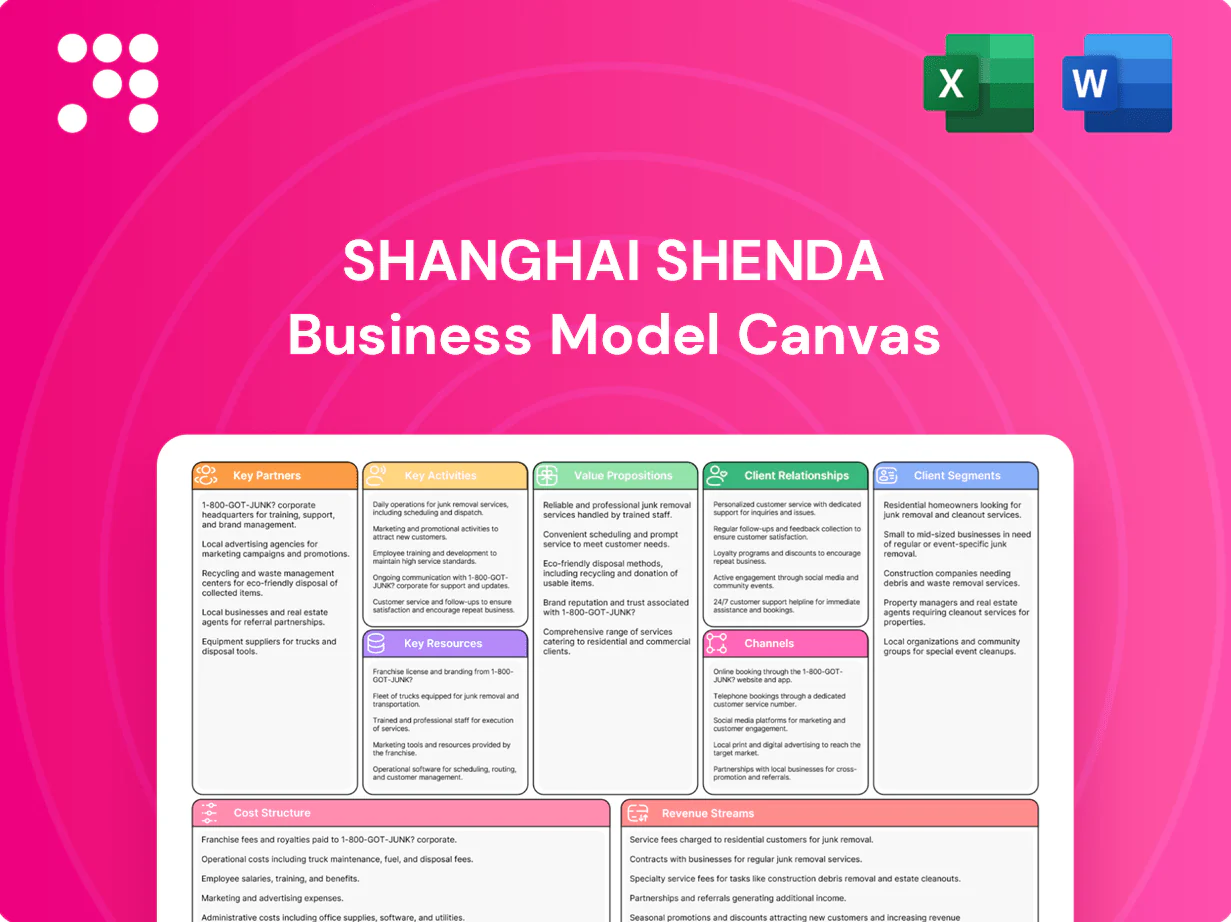
Shanghai Shenda Business Model Canvas

Business Model Canvas: Value, Channels & Revenue Streams for Textile and Apparel Growth
Explore Shanghai Shenda’s Business Model Canvas to see how its value propositions, channels, and revenue streams align to drive growth in competitive textile and apparel markets. This concise snapshot highlights key partners, cost structure, and customer segments to inform strategic decisions. Purchase the full, editable Canvas for a complete, actionable blueprint you can use for benchmarking, planning, or investment analysis.
Partnerships

Global fabric and yarn suppliers
Partnering with tier-1 mills ensures steady access to quality fibers, yarns and finished fabrics, with Shanghai Shenda locking core inputs under multi-year (typically 3-year) contracts covering cotton, synthetics and blends; long-term deals stabilize pricing and secure ~70% of annual volumes. Strategic sourcing hubs in China (≈60%), Southeast Asia (≈25%) and South Asia (≈15%) diversify risk, while supplier development programs have driven ~30% fewer quality defects and stronger compliance and innovation capacity.
Cut-and-sew and finishing subcontractors
Flexible capacity is achieved through a network of qualified subcontractors handling dyeing, printing, washing, and garment assembly, enabling rapid scaling without fixed-capacity investment. SLAs, periodic audits, and documented corrective actions preserve lead times, quality, and social compliance across the supplier base. Load balancing across partners evens throughput during peaks, while joint process-improvement programs reduce defects and rework.

Logistics, freight forwarders, and customs brokers
International trade relies on multimodal logistics networks for on-time delivery; Shanghai Shenda partners with carriers and inland operators to leverage Shanghai port scale (≈47 million TEU in 2023) and global corridors. Partnerships optimize routing, container utilization and customs clearance, cutting transit time and delays. Preferential rates can lower landed costs by 5–15%, improving competitiveness. Real-time tracking integration (≈65% shipper adoption in 2024) boosts visibility and customer communication.

Brand, retailer, and distributor alliances
Co-development with brands and retailers aligns assortments to market demand in Shanghai (population ~24.9 million in 2023). Distribution partners extend reach into new geographies and channels across the Yangtze River Delta and national e-commerce. Collaborative forecasting improves inventory turns and replenishment. Joint marketing builds brand awareness in priority markets.
- Co-development: alignment to local demand
- Distribution: geographic and channel reach
- Forecasting: faster turns, better replenishment
- Marketing: joint campaigns in priority markets
Compliance, testing labs, and sustainability bodies
Third-party ISO/IEC 17025–accredited and AATCC labs certify product safety, colorfastness, and performance, enabling Shanghai Shenda to meet technical specifications for enterprise contracts. Partnerships with GOTS, Higg and Textile Exchange frameworks support traceability and substantiated ESG claims. Compliance advisors monitor EU REACH, US CPSIA and China customs rules to ensure evolving import/export and product regulations are met, strengthening buyer trust.
- ISO/IEC 17025 labs
- AATCC, GOTS, Higg partnerships
- REACH, CPSIA, China customs compliance
- Certifications = enterprise trust
Tier-1 contracts cover ≈70% volumes; China 60%/SEA 25%/S Asia 15%
Tier-1 mill contracts secure ~70% of annual volumes under 3-year agreements; sourcing mix China 60%/SEA 25%/S Asia 15% reduces supply risk. Flexible subcontractor network and SLAs enable peak scaling and cut defects ~30%; logistics leverage Shanghai port (≈47M TEU 2023) with 65% real-time tracking adoption (2024) and 5–15% landed-cost savings. Certification partnerships (GOTS, Higg, ISO17025) underpin compliance for export markets.
| Metric | Value | Year |
|---|---|---|
| Volume under contract | ≈70% | 2024 |
| Sourcing mix | 60/25/15 | 2024 |
| Port throughput | ≈47M TEU | 2023 |
What is included in the product
 Detailed Word Document
A concise, pre-written Business Model Canvas for Shanghai Shenda covering 9 classic blocks with detailed customer segments, channels, value propositions and revenue streams aligned to real-world operations. Ideal for presentations, investor discussions and strategic analysis with linked SWOT and competitive advantages to support decision-making.

 Customizable Excel Spreadsheet
Condenses Shanghai Shenda’s strategy into a digestible one-page canvas with editable cells, saving hours of formatting and enabling rapid team collaboration for strategy, comparisons, and executive summaries.
Activities

Global sourcing and vendor management
Identify, qualify, and negotiate with mills and component suppliers through structured RFQs and capability assessments, targeting supplier acceptance rates above 70% and contract cost savings of 3–8% per sourcing cycle. Manage supplier scorecards tracking quality, cost, delivery and compliance with targets such as 95% on-time delivery and defect rates under 1%. Conduct annual audits and capability upgrades to ensure resilience, and maintain multi-sourcing strategies with at least three qualified suppliers for each critical material.
Textile manufacturing and process engineering
Operate in-house production for select processes and SKUs, optimizing dyeing, weaving/knitting and finishing parameters to target OEE improvement from 60% to 80% and throughput gains of ~25%; implement lean practices and OEE tracking to cut cycle time, and invest in automation plus digital QC to reduce defects by an estimated 30% and lower rework costs.

Merchandising, design, and sample development
Translate buyer briefs into detailed tech packs and BOMs to lock materials and costs, with BOM accuracy targets near 99% for MOQ forecasting. Rapid prototyping and sampling in Shanghai clusters deliver line-ready samples in 7–10 days, accelerating buyer adoption and reducing lead time. Seasonal planning runs on four core lines per year, balancing trend, unit cost, and factory capacity. Coordinate approvals within 48–72 hours to finalize specs and timelines.

International trade operations
Shanghai Shenda manages contracts, Incoterms, export/import documentation and letters of credit (letters of credit remain ~15% of trade finance per ICC 2024), enforces compliance with tariffs and origin rules, and coordinates consolidation, shipments and delivery schedules. Treasury monitors FX exposure and implements hedges aligned to the order book to protect margins.
- Contracts & Incoterms
- Docs & LCs (~15% usage, ICC 2024)
- Compliance: tariffs/origin
- Consolidation & scheduling
- FX exposure & hedging
Brand building and market expansion
Shanghai Shenda will develop owned and licensed labels to boost gross margins, run targeted B2B marketing, trade fairs and digital campaigns, and forge distribution partnerships in Southeast Asia and Europe to expand market share; channel and assortment choices will be driven by consumer data, leveraging China’s 1.07 billion internet users in 2024 for digital reach.
- owned/licensed labels
- B2B marketing & fairs
- digital campaigns
- strategic partnerships
- data-led channel & assortment
Achieve 95% OTD, <1% defects, 70% supplier acceptance, and OEE 60→80%
Identify and qualify suppliers (70% acceptance), target 3–8% sourcing savings and 95% on-time delivery with defects <1%. Improve in-house OEE from 60% to 80%, cut defects ~30% and boost throughput ~25%. Lock BOMs at 99% accuracy, sample in 7–10 days; LCs ~15% of trade finance (ICC 2024) and China internet users 1.07B (2024).
| Metric | Target/2024 |
|---|---|
| Supplier acceptance | 70% |
| Sourcing savings | 3–8% |
| OTD | 95% |
| Defects | <1% |
| OEE | 60→80% |
Full Version Awaits
Business Model Canvas
The Shanghai Shenda Business Model Canvas you’re previewing is the exact deliverable—not a mockup or sample—and the content shown is taken directly from the final file you’ll receive. After purchase you’ll instantly download this same, fully editable document ready for presenting, editing, or sharing in Word and Excel formats with all sections included.

Business Model Canvas: Value, Channels & Revenue Streams for Textile and Apparel Growth
Explore Shanghai Shenda’s Business Model Canvas to see how its value propositions, channels, and revenue streams align to drive growth in competitive textile and apparel markets. This concise snapshot highlights key partners, cost structure, and customer segments to inform strategic decisions. Purchase the full, editable Canvas for a complete, actionable blueprint you can use for benchmarking, planning, or investment analysis.
Partnerships
Global fabric and yarn suppliers
Partnering with tier-1 mills ensures steady access to quality fibers, yarns and finished fabrics, with Shanghai Shenda locking core inputs under multi-year (typically 3-year) contracts covering cotton, synthetics and blends; long-term deals stabilize pricing and secure ~70% of annual volumes. Strategic sourcing hubs in China (≈60%), Southeast Asia (≈25%) and South Asia (≈15%) diversify risk, while supplier development programs have driven ~30% fewer quality defects and stronger compliance and innovation capacity.
Cut-and-sew and finishing subcontractors
Flexible capacity is achieved through a network of qualified subcontractors handling dyeing, printing, washing, and garment assembly, enabling rapid scaling without fixed-capacity investment. SLAs, periodic audits, and documented corrective actions preserve lead times, quality, and social compliance across the supplier base. Load balancing across partners evens throughput during peaks, while joint process-improvement programs reduce defects and rework.
Logistics, freight forwarders, and customs brokers
International trade relies on multimodal logistics networks for on-time delivery; Shanghai Shenda partners with carriers and inland operators to leverage Shanghai port scale (≈47 million TEU in 2023) and global corridors. Partnerships optimize routing, container utilization and customs clearance, cutting transit time and delays. Preferential rates can lower landed costs by 5–15%, improving competitiveness. Real-time tracking integration (≈65% shipper adoption in 2024) boosts visibility and customer communication.
Brand, retailer, and distributor alliances
Co-development with brands and retailers aligns assortments to market demand in Shanghai (population ~24.9 million in 2023). Distribution partners extend reach into new geographies and channels across the Yangtze River Delta and national e-commerce. Collaborative forecasting improves inventory turns and replenishment. Joint marketing builds brand awareness in priority markets.
- Co-development: alignment to local demand
- Distribution: geographic and channel reach
- Forecasting: faster turns, better replenishment
- Marketing: joint campaigns in priority markets
Compliance, testing labs, and sustainability bodies
Third-party ISO/IEC 17025–accredited and AATCC labs certify product safety, colorfastness, and performance, enabling Shanghai Shenda to meet technical specifications for enterprise contracts. Partnerships with GOTS, Higg and Textile Exchange frameworks support traceability and substantiated ESG claims. Compliance advisors monitor EU REACH, US CPSIA and China customs rules to ensure evolving import/export and product regulations are met, strengthening buyer trust.
- ISO/IEC 17025 labs
- AATCC, GOTS, Higg partnerships
- REACH, CPSIA, China customs compliance
- Certifications = enterprise trust
Tier-1 contracts cover ≈70% volumes; China 60%/SEA 25%/S Asia 15%
Tier-1 mill contracts secure ~70% of annual volumes under 3-year agreements; sourcing mix China 60%/SEA 25%/S Asia 15% reduces supply risk. Flexible subcontractor network and SLAs enable peak scaling and cut defects ~30%; logistics leverage Shanghai port (≈47M TEU 2023) with 65% real-time tracking adoption (2024) and 5–15% landed-cost savings. Certification partnerships (GOTS, Higg, ISO17025) underpin compliance for export markets.
| Metric | Value | Year |
|---|---|---|
| Volume under contract | ≈70% | 2024 |
| Sourcing mix | 60/25/15 | 2024 |
| Port throughput | ≈47M TEU | 2023 |
What is included in the product
Detailed Word Document
A concise, pre-written Business Model Canvas for Shanghai Shenda covering 9 classic blocks with detailed customer segments, channels, value propositions and revenue streams aligned to real-world operations. Ideal for presentations, investor discussions and strategic analysis with linked SWOT and competitive advantages to support decision-making.
Customizable Excel Spreadsheet
Condenses Shanghai Shenda’s strategy into a digestible one-page canvas with editable cells, saving hours of formatting and enabling rapid team collaboration for strategy, comparisons, and executive summaries.
Activities
Global sourcing and vendor management
Identify, qualify, and negotiate with mills and component suppliers through structured RFQs and capability assessments, targeting supplier acceptance rates above 70% and contract cost savings of 3–8% per sourcing cycle. Manage supplier scorecards tracking quality, cost, delivery and compliance with targets such as 95% on-time delivery and defect rates under 1%. Conduct annual audits and capability upgrades to ensure resilience, and maintain multi-sourcing strategies with at least three qualified suppliers for each critical material.
Textile manufacturing and process engineering
Operate in-house production for select processes and SKUs, optimizing dyeing, weaving/knitting and finishing parameters to target OEE improvement from 60% to 80% and throughput gains of ~25%; implement lean practices and OEE tracking to cut cycle time, and invest in automation plus digital QC to reduce defects by an estimated 30% and lower rework costs.
Merchandising, design, and sample development
Translate buyer briefs into detailed tech packs and BOMs to lock materials and costs, with BOM accuracy targets near 99% for MOQ forecasting. Rapid prototyping and sampling in Shanghai clusters deliver line-ready samples in 7–10 days, accelerating buyer adoption and reducing lead time. Seasonal planning runs on four core lines per year, balancing trend, unit cost, and factory capacity. Coordinate approvals within 48–72 hours to finalize specs and timelines.
International trade operations
Shanghai Shenda manages contracts, Incoterms, export/import documentation and letters of credit (letters of credit remain ~15% of trade finance per ICC 2024), enforces compliance with tariffs and origin rules, and coordinates consolidation, shipments and delivery schedules. Treasury monitors FX exposure and implements hedges aligned to the order book to protect margins.
- Contracts & Incoterms
- Docs & LCs (~15% usage, ICC 2024)
- Compliance: tariffs/origin
- Consolidation & scheduling
- FX exposure & hedging
Brand building and market expansion
Shanghai Shenda will develop owned and licensed labels to boost gross margins, run targeted B2B marketing, trade fairs and digital campaigns, and forge distribution partnerships in Southeast Asia and Europe to expand market share; channel and assortment choices will be driven by consumer data, leveraging China’s 1.07 billion internet users in 2024 for digital reach.
- owned/licensed labels
- B2B marketing & fairs
- digital campaigns
- strategic partnerships
- data-led channel & assortment
Achieve 95% OTD, <1% defects, 70% supplier acceptance, and OEE 60→80%
Identify and qualify suppliers (70% acceptance), target 3–8% sourcing savings and 95% on-time delivery with defects <1%. Improve in-house OEE from 60% to 80%, cut defects ~30% and boost throughput ~25%. Lock BOMs at 99% accuracy, sample in 7–10 days; LCs ~15% of trade finance (ICC 2024) and China internet users 1.07B (2024).
| Metric | Target/2024 |
|---|---|
| Supplier acceptance | 70% |
| Sourcing savings | 3–8% |
| OTD | 95% |
| Defects | <1% |
| OEE | 60→80% |
Full Version Awaits
Business Model Canvas
The Shanghai Shenda Business Model Canvas you’re previewing is the exact deliverable—not a mockup or sample—and the content shown is taken directly from the final file you’ll receive. After purchase you’ll instantly download this same, fully editable document ready for presenting, editing, or sharing in Word and Excel formats with all sections included.
Original: $10.00
-65%$10.00
$3.50Description
Business Model Canvas: Value, Channels & Revenue Streams for Textile and Apparel Growth
Explore Shanghai Shenda’s Business Model Canvas to see how its value propositions, channels, and revenue streams align to drive growth in competitive textile and apparel markets. This concise snapshot highlights key partners, cost structure, and customer segments to inform strategic decisions. Purchase the full, editable Canvas for a complete, actionable blueprint you can use for benchmarking, planning, or investment analysis.
Partnerships
Global fabric and yarn suppliers
Partnering with tier-1 mills ensures steady access to quality fibers, yarns and finished fabrics, with Shanghai Shenda locking core inputs under multi-year (typically 3-year) contracts covering cotton, synthetics and blends; long-term deals stabilize pricing and secure ~70% of annual volumes. Strategic sourcing hubs in China (≈60%), Southeast Asia (≈25%) and South Asia (≈15%) diversify risk, while supplier development programs have driven ~30% fewer quality defects and stronger compliance and innovation capacity.
Cut-and-sew and finishing subcontractors
Flexible capacity is achieved through a network of qualified subcontractors handling dyeing, printing, washing, and garment assembly, enabling rapid scaling without fixed-capacity investment. SLAs, periodic audits, and documented corrective actions preserve lead times, quality, and social compliance across the supplier base. Load balancing across partners evens throughput during peaks, while joint process-improvement programs reduce defects and rework.
Logistics, freight forwarders, and customs brokers
International trade relies on multimodal logistics networks for on-time delivery; Shanghai Shenda partners with carriers and inland operators to leverage Shanghai port scale (≈47 million TEU in 2023) and global corridors. Partnerships optimize routing, container utilization and customs clearance, cutting transit time and delays. Preferential rates can lower landed costs by 5–15%, improving competitiveness. Real-time tracking integration (≈65% shipper adoption in 2024) boosts visibility and customer communication.
Brand, retailer, and distributor alliances
Co-development with brands and retailers aligns assortments to market demand in Shanghai (population ~24.9 million in 2023). Distribution partners extend reach into new geographies and channels across the Yangtze River Delta and national e-commerce. Collaborative forecasting improves inventory turns and replenishment. Joint marketing builds brand awareness in priority markets.
- Co-development: alignment to local demand
- Distribution: geographic and channel reach
- Forecasting: faster turns, better replenishment
- Marketing: joint campaigns in priority markets
Compliance, testing labs, and sustainability bodies
Third-party ISO/IEC 17025–accredited and AATCC labs certify product safety, colorfastness, and performance, enabling Shanghai Shenda to meet technical specifications for enterprise contracts. Partnerships with GOTS, Higg and Textile Exchange frameworks support traceability and substantiated ESG claims. Compliance advisors monitor EU REACH, US CPSIA and China customs rules to ensure evolving import/export and product regulations are met, strengthening buyer trust.
- ISO/IEC 17025 labs
- AATCC, GOTS, Higg partnerships
- REACH, CPSIA, China customs compliance
- Certifications = enterprise trust
Tier-1 contracts cover ≈70% volumes; China 60%/SEA 25%/S Asia 15%
Tier-1 mill contracts secure ~70% of annual volumes under 3-year agreements; sourcing mix China 60%/SEA 25%/S Asia 15% reduces supply risk. Flexible subcontractor network and SLAs enable peak scaling and cut defects ~30%; logistics leverage Shanghai port (≈47M TEU 2023) with 65% real-time tracking adoption (2024) and 5–15% landed-cost savings. Certification partnerships (GOTS, Higg, ISO17025) underpin compliance for export markets.
| Metric | Value | Year |
|---|---|---|
| Volume under contract | ≈70% | 2024 |
| Sourcing mix | 60/25/15 | 2024 |
| Port throughput | ≈47M TEU | 2023 |
What is included in the product
Detailed Word Document
A concise, pre-written Business Model Canvas for Shanghai Shenda covering 9 classic blocks with detailed customer segments, channels, value propositions and revenue streams aligned to real-world operations. Ideal for presentations, investor discussions and strategic analysis with linked SWOT and competitive advantages to support decision-making.
Customizable Excel Spreadsheet
Condenses Shanghai Shenda’s strategy into a digestible one-page canvas with editable cells, saving hours of formatting and enabling rapid team collaboration for strategy, comparisons, and executive summaries.
Activities
Global sourcing and vendor management
Identify, qualify, and negotiate with mills and component suppliers through structured RFQs and capability assessments, targeting supplier acceptance rates above 70% and contract cost savings of 3–8% per sourcing cycle. Manage supplier scorecards tracking quality, cost, delivery and compliance with targets such as 95% on-time delivery and defect rates under 1%. Conduct annual audits and capability upgrades to ensure resilience, and maintain multi-sourcing strategies with at least three qualified suppliers for each critical material.
Textile manufacturing and process engineering
Operate in-house production for select processes and SKUs, optimizing dyeing, weaving/knitting and finishing parameters to target OEE improvement from 60% to 80% and throughput gains of ~25%; implement lean practices and OEE tracking to cut cycle time, and invest in automation plus digital QC to reduce defects by an estimated 30% and lower rework costs.
Merchandising, design, and sample development
Translate buyer briefs into detailed tech packs and BOMs to lock materials and costs, with BOM accuracy targets near 99% for MOQ forecasting. Rapid prototyping and sampling in Shanghai clusters deliver line-ready samples in 7–10 days, accelerating buyer adoption and reducing lead time. Seasonal planning runs on four core lines per year, balancing trend, unit cost, and factory capacity. Coordinate approvals within 48–72 hours to finalize specs and timelines.
International trade operations
Shanghai Shenda manages contracts, Incoterms, export/import documentation and letters of credit (letters of credit remain ~15% of trade finance per ICC 2024), enforces compliance with tariffs and origin rules, and coordinates consolidation, shipments and delivery schedules. Treasury monitors FX exposure and implements hedges aligned to the order book to protect margins.
- Contracts & Incoterms
- Docs & LCs (~15% usage, ICC 2024)
- Compliance: tariffs/origin
- Consolidation & scheduling
- FX exposure & hedging
Brand building and market expansion
Shanghai Shenda will develop owned and licensed labels to boost gross margins, run targeted B2B marketing, trade fairs and digital campaigns, and forge distribution partnerships in Southeast Asia and Europe to expand market share; channel and assortment choices will be driven by consumer data, leveraging China’s 1.07 billion internet users in 2024 for digital reach.
- owned/licensed labels
- B2B marketing & fairs
- digital campaigns
- strategic partnerships
- data-led channel & assortment
Achieve 95% OTD, <1% defects, 70% supplier acceptance, and OEE 60→80%
Identify and qualify suppliers (70% acceptance), target 3–8% sourcing savings and 95% on-time delivery with defects <1%. Improve in-house OEE from 60% to 80%, cut defects ~30% and boost throughput ~25%. Lock BOMs at 99% accuracy, sample in 7–10 days; LCs ~15% of trade finance (ICC 2024) and China internet users 1.07B (2024).
| Metric | Target/2024 |
|---|---|
| Supplier acceptance | 70% |
| Sourcing savings | 3–8% |
| OTD | 95% |
| Defects | <1% |
| OEE | 60→80% |
Full Version Awaits
Business Model Canvas
The Shanghai Shenda Business Model Canvas you’re previewing is the exact deliverable—not a mockup or sample—and the content shown is taken directly from the final file you’ll receive. After purchase you’ll instantly download this same, fully editable document ready for presenting, editing, or sharing in Word and Excel formats with all sections included.











