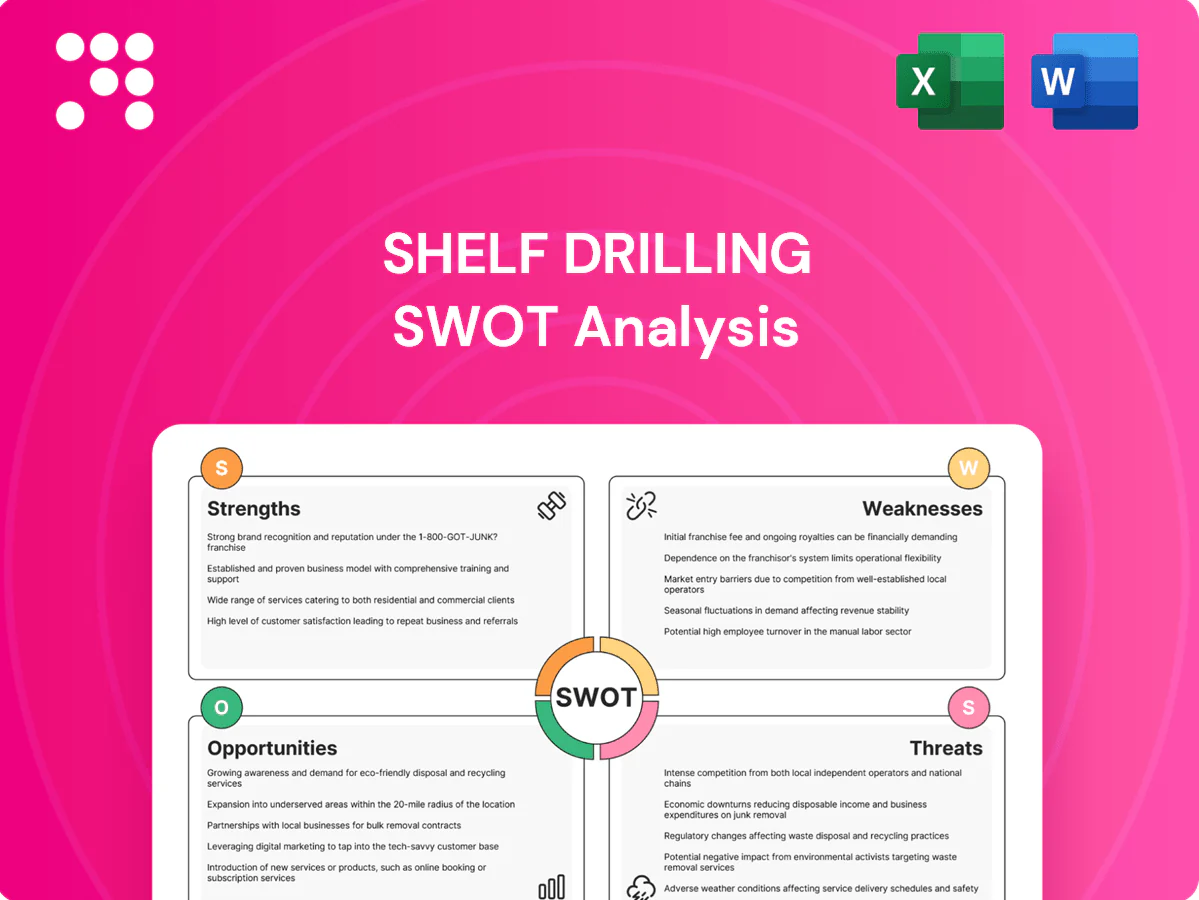
Shelf Drilling SWOT Analysis

Elevate Your Analysis with the Complete SWOT Report
Shelf Drilling faces operational scale and fleet specialization strengths but must navigate market cyclicality, offshore demand shifts, and capital intensity; our full SWOT unpacks how these factors affect valuation and risk. Want the full strategic picture and editable tools to plan or pitch with confidence? Purchase the complete SWOT analysis for a professionally formatted Word report and Excel matrix.
Strengths

Focused jack-up specialization
Concentration on shallow-water jack-ups sharpens Shelf Drilling’s operational expertise and cost discipline, enabling repeatable execution across similar assets. Standardized procedures shorten learning curves across its 57-rig fleet, cutting mobilization time and OPEX. This focus supports higher utilization in target markets (often >80%) and differentiates the company from diversified offshore peers.
Lean cost base and efficient reactivations
Scaled maintenance programs across Shelf Drilling's fleet of over 30 high-spec jackups and repeatable mobilization processes lower operating costs by shortening downtime and reducing mobilization spend. Efficient reactivation of stacked units allows rapid capture of upcycles, often bringing rigs back to work within weeks. Cost agility enables competitive day-rate bidding while preserving margins and helps sustain cash flow through market troughs.

Global footprint in key shallow basins
Presence across established and emerging basins, with over 30 jackups operating in 10+ shallow-water regions, diversifies revenue and reduces single‑market exposure. Proximity to customers enables faster deployment and often mobilization under 30 days, improving rig utilization. Local content know-how boosts bid competitiveness in markets like West Africa and the Middle East. Geographic spread helps offset cyclical swings between regions.

Strong NOC/IOC relationships
Recurring contracts with national and international oil companies give Shelf Drilling clear backlog visibility, with firm backlog reported at about $1.0 billion as of mid‑2024. Multi‑well, multi‑year programs drive steady fleet utilization and reduce idle days. Proven on‑time delivery builds client trust, lowering contracting friction and enabling references to unlock tenders in adjacent markets.
- Backlog ~ $1.0B (mid‑2024)
- Higher utilization from multi‑year programs
- Proven delivery reduces contracting time
- References open adjacent‑market tenders
Safety culture and uptime performance
High operational uptime is critical to customer economics; Shelf Drilling’s sustained high-spec jackup availability supports contractors’ project margins and easier mobilization. Robust HSE systems reduce non-productive time and incident risk, preserving utilization and reputation in competitive tenders. Reliable performance enables premium day-rates on high-spec units and long-term client relationships.
- Uptime focus: enhances client economics
- HSE: lowers NPT and incident exposure
- Pricing power: supports premium day-rates
- Reputation: wins competitive tenders
Shallow-water jackup fleet: >80% utilization, ~$1.0B backlog
Shelf Drilling’s focus on shallow‑water jackups (57‑rig fleet, 30+ high‑spec) drives repeatable operations, >80% utilization in target markets and strong cost discipline. Scaled maintenance and fast reactivation cut OPEX and downtime, enabling competitive day‑rate bids. Geographic presence in 10+ basins and firm backlog ~ $1.0B (mid‑2024) supports steady cash flow.
| Metric | Value |
|---|---|
| Fleet | 57 rigs |
| High‑spec jackups | 30+ |
| Utilization | >80% |
| Backlog | ~$1.0B (mid‑2024) |
| Regions | 10+ |
What is included in the product
 Detailed Word Document
Delivers a strategic overview of Shelf Drilling’s internal and external business factors, outlining core strengths and operational weaknesses while highlighting market opportunities and industry threats that shape its competitive position.

 Customizable Excel Spreadsheet
Provides a focused SWOT matrix tailored to Shelf Drilling for rapid strategic alignment and clear identification of operational risks and market opportunities.
Weaknesses

Narrow segment exposure
Shelf Drilling’s narrow focus on shallow-water jack-ups—a fleet of over 50 units—limits diversification versus operators with deepwater or onshore assets. Demand shocks in this niche can disproportionately cut utilization, historically swinging 15–20% in downturns and compressing dayrates. Product-mix flexibility is constrained, so revenue resilience often lags more diversified peers during cyclic stress.
Day-rate and utilization volatility
Contract drilling is highly cyclical and tender-driven, so gaps between assignments and soft day-rates materially compress Shelf Drilling margins. Shorter contract tenors, often under 12 months, raise rollover risk and expose fleets to spot-market pricing. Resulting lumpy cash flows complicate capital planning, debt service timing and investment prioritization.

Capital-intensive fleet needs
Periodic SPS inspections (typically every five years) plus upgrades and reactivations drive substantial capex, commonly in the range of $5–30m per jackup depending on scope. Aging units face rising maintenance and obsolescence costs, with life‑extension works often exceeding $10m per unit. Elevated balance sheet leverage amplifies cycle risk and mistimed investments can materially erode returns.

Exposure to frontier and political risk
Operating in emerging markets exposes Shelf Drilling to regulatory uncertainty and weak contract enforceability, which can delay projects and escalate legal costs. Currency controls and payment delays have periodically impaired cash conversion for offshore contractors in 2024, squeezing working capital. Sudden sanctions or permit shifts can halt operations, while security and logistics challenges in frontier regions increase mobilization and insurance expenses.
- Regulatory uncertainty: contract enforceability risk
- Currency controls: cash conversion delays
- Sanctions/permits: project disruptions
- Security/logistics: higher operating costs
Limited technology breadth
Compared with integrated majors, Shelf Drilling's digital, automation and low‑carbon offerings remain narrower, limiting scope for value‑added services. Heavy reliance on third‑party tech vendors reduces differentiation and control over upgrades. Customers increasingly prefer rigs with advanced drilling systems, putting pricing pressure on legacy assets and compressing dayrates.
- Dependency on vendors
- Narrow tech stack
- Customer preference for advanced rigs
- Pricing pressure on legacy fleet
Shallow-water jack-up: 15–20% utilization, capex $5–30m
Shelf Drilling’s narrow shallow‑water jack‑up focus (fleet >50) concentrates demand risk; utilization can swing 15–20% in downturns, compressing dayrates. Short contract tenors (often <12 months) create rollover and cash‑flow volatility. Aging fleet drives SPS/reactivation capex of $5–30m per unit, straining cash and leverage.
| Metric | Value |
|---|---|
| Fleet size | >50 rigs |
| Utilization swing | 15–20% |
| Capex per rig | $5–30m |
Full Version Awaits
Shelf Drilling SWOT Analysis
This is the actual Shelf Drilling SWOT analysis document you’ll receive upon purchase—no surprises, just professional quality. The preview below is taken directly from the full report and reflects the same structured, editable file available after checkout. Buy to unlock the complete, in-depth version with all strengths, weaknesses, opportunities and threats fully detailed.

Elevate Your Analysis with the Complete SWOT Report
Shelf Drilling faces operational scale and fleet specialization strengths but must navigate market cyclicality, offshore demand shifts, and capital intensity; our full SWOT unpacks how these factors affect valuation and risk. Want the full strategic picture and editable tools to plan or pitch with confidence? Purchase the complete SWOT analysis for a professionally formatted Word report and Excel matrix.
Strengths
Focused jack-up specialization
Concentration on shallow-water jack-ups sharpens Shelf Drilling’s operational expertise and cost discipline, enabling repeatable execution across similar assets. Standardized procedures shorten learning curves across its 57-rig fleet, cutting mobilization time and OPEX. This focus supports higher utilization in target markets (often >80%) and differentiates the company from diversified offshore peers.
Lean cost base and efficient reactivations
Scaled maintenance programs across Shelf Drilling's fleet of over 30 high-spec jackups and repeatable mobilization processes lower operating costs by shortening downtime and reducing mobilization spend. Efficient reactivation of stacked units allows rapid capture of upcycles, often bringing rigs back to work within weeks. Cost agility enables competitive day-rate bidding while preserving margins and helps sustain cash flow through market troughs.
Global footprint in key shallow basins
Presence across established and emerging basins, with over 30 jackups operating in 10+ shallow-water regions, diversifies revenue and reduces single‑market exposure. Proximity to customers enables faster deployment and often mobilization under 30 days, improving rig utilization. Local content know-how boosts bid competitiveness in markets like West Africa and the Middle East. Geographic spread helps offset cyclical swings between regions.
Strong NOC/IOC relationships
Recurring contracts with national and international oil companies give Shelf Drilling clear backlog visibility, with firm backlog reported at about $1.0 billion as of mid‑2024. Multi‑well, multi‑year programs drive steady fleet utilization and reduce idle days. Proven on‑time delivery builds client trust, lowering contracting friction and enabling references to unlock tenders in adjacent markets.
- Backlog ~ $1.0B (mid‑2024)
- Higher utilization from multi‑year programs
- Proven delivery reduces contracting time
- References open adjacent‑market tenders
Safety culture and uptime performance
High operational uptime is critical to customer economics; Shelf Drilling’s sustained high-spec jackup availability supports contractors’ project margins and easier mobilization. Robust HSE systems reduce non-productive time and incident risk, preserving utilization and reputation in competitive tenders. Reliable performance enables premium day-rates on high-spec units and long-term client relationships.
- Uptime focus: enhances client economics
- HSE: lowers NPT and incident exposure
- Pricing power: supports premium day-rates
- Reputation: wins competitive tenders
Shallow-water jackup fleet: >80% utilization, ~$1.0B backlog
Shelf Drilling’s focus on shallow‑water jackups (57‑rig fleet, 30+ high‑spec) drives repeatable operations, >80% utilization in target markets and strong cost discipline. Scaled maintenance and fast reactivation cut OPEX and downtime, enabling competitive day‑rate bids. Geographic presence in 10+ basins and firm backlog ~ $1.0B (mid‑2024) supports steady cash flow.
| Metric | Value |
|---|---|
| Fleet | 57 rigs |
| High‑spec jackups | 30+ |
| Utilization | >80% |
| Backlog | ~$1.0B (mid‑2024) |
| Regions | 10+ |
What is included in the product
Detailed Word Document
Delivers a strategic overview of Shelf Drilling’s internal and external business factors, outlining core strengths and operational weaknesses while highlighting market opportunities and industry threats that shape its competitive position.
Customizable Excel Spreadsheet
Provides a focused SWOT matrix tailored to Shelf Drilling for rapid strategic alignment and clear identification of operational risks and market opportunities.
Weaknesses
Narrow segment exposure
Shelf Drilling’s narrow focus on shallow-water jack-ups—a fleet of over 50 units—limits diversification versus operators with deepwater or onshore assets. Demand shocks in this niche can disproportionately cut utilization, historically swinging 15–20% in downturns and compressing dayrates. Product-mix flexibility is constrained, so revenue resilience often lags more diversified peers during cyclic stress.
Day-rate and utilization volatility
Contract drilling is highly cyclical and tender-driven, so gaps between assignments and soft day-rates materially compress Shelf Drilling margins. Shorter contract tenors, often under 12 months, raise rollover risk and expose fleets to spot-market pricing. Resulting lumpy cash flows complicate capital planning, debt service timing and investment prioritization.
Capital-intensive fleet needs
Periodic SPS inspections (typically every five years) plus upgrades and reactivations drive substantial capex, commonly in the range of $5–30m per jackup depending on scope. Aging units face rising maintenance and obsolescence costs, with life‑extension works often exceeding $10m per unit. Elevated balance sheet leverage amplifies cycle risk and mistimed investments can materially erode returns.
Exposure to frontier and political risk
Operating in emerging markets exposes Shelf Drilling to regulatory uncertainty and weak contract enforceability, which can delay projects and escalate legal costs. Currency controls and payment delays have periodically impaired cash conversion for offshore contractors in 2024, squeezing working capital. Sudden sanctions or permit shifts can halt operations, while security and logistics challenges in frontier regions increase mobilization and insurance expenses.
- Regulatory uncertainty: contract enforceability risk
- Currency controls: cash conversion delays
- Sanctions/permits: project disruptions
- Security/logistics: higher operating costs
Limited technology breadth
Compared with integrated majors, Shelf Drilling's digital, automation and low‑carbon offerings remain narrower, limiting scope for value‑added services. Heavy reliance on third‑party tech vendors reduces differentiation and control over upgrades. Customers increasingly prefer rigs with advanced drilling systems, putting pricing pressure on legacy assets and compressing dayrates.
- Dependency on vendors
- Narrow tech stack
- Customer preference for advanced rigs
- Pricing pressure on legacy fleet
Shallow-water jack-up: 15–20% utilization, capex $5–30m
Shelf Drilling’s narrow shallow‑water jack‑up focus (fleet >50) concentrates demand risk; utilization can swing 15–20% in downturns, compressing dayrates. Short contract tenors (often <12 months) create rollover and cash‑flow volatility. Aging fleet drives SPS/reactivation capex of $5–30m per unit, straining cash and leverage.
| Metric | Value |
|---|---|
| Fleet size | >50 rigs |
| Utilization swing | 15–20% |
| Capex per rig | $5–30m |
Full Version Awaits
Shelf Drilling SWOT Analysis
This is the actual Shelf Drilling SWOT analysis document you’ll receive upon purchase—no surprises, just professional quality. The preview below is taken directly from the full report and reflects the same structured, editable file available after checkout. Buy to unlock the complete, in-depth version with all strengths, weaknesses, opportunities and threats fully detailed.
Description
Elevate Your Analysis with the Complete SWOT Report
Shelf Drilling faces operational scale and fleet specialization strengths but must navigate market cyclicality, offshore demand shifts, and capital intensity; our full SWOT unpacks how these factors affect valuation and risk. Want the full strategic picture and editable tools to plan or pitch with confidence? Purchase the complete SWOT analysis for a professionally formatted Word report and Excel matrix.
Strengths
Focused jack-up specialization
Concentration on shallow-water jack-ups sharpens Shelf Drilling’s operational expertise and cost discipline, enabling repeatable execution across similar assets. Standardized procedures shorten learning curves across its 57-rig fleet, cutting mobilization time and OPEX. This focus supports higher utilization in target markets (often >80%) and differentiates the company from diversified offshore peers.
Lean cost base and efficient reactivations
Scaled maintenance programs across Shelf Drilling's fleet of over 30 high-spec jackups and repeatable mobilization processes lower operating costs by shortening downtime and reducing mobilization spend. Efficient reactivation of stacked units allows rapid capture of upcycles, often bringing rigs back to work within weeks. Cost agility enables competitive day-rate bidding while preserving margins and helps sustain cash flow through market troughs.
Global footprint in key shallow basins
Presence across established and emerging basins, with over 30 jackups operating in 10+ shallow-water regions, diversifies revenue and reduces single‑market exposure. Proximity to customers enables faster deployment and often mobilization under 30 days, improving rig utilization. Local content know-how boosts bid competitiveness in markets like West Africa and the Middle East. Geographic spread helps offset cyclical swings between regions.
Strong NOC/IOC relationships
Recurring contracts with national and international oil companies give Shelf Drilling clear backlog visibility, with firm backlog reported at about $1.0 billion as of mid‑2024. Multi‑well, multi‑year programs drive steady fleet utilization and reduce idle days. Proven on‑time delivery builds client trust, lowering contracting friction and enabling references to unlock tenders in adjacent markets.
- Backlog ~ $1.0B (mid‑2024)
- Higher utilization from multi‑year programs
- Proven delivery reduces contracting time
- References open adjacent‑market tenders
Safety culture and uptime performance
High operational uptime is critical to customer economics; Shelf Drilling’s sustained high-spec jackup availability supports contractors’ project margins and easier mobilization. Robust HSE systems reduce non-productive time and incident risk, preserving utilization and reputation in competitive tenders. Reliable performance enables premium day-rates on high-spec units and long-term client relationships.
- Uptime focus: enhances client economics
- HSE: lowers NPT and incident exposure
- Pricing power: supports premium day-rates
- Reputation: wins competitive tenders
Shallow-water jackup fleet: >80% utilization, ~$1.0B backlog
Shelf Drilling’s focus on shallow‑water jackups (57‑rig fleet, 30+ high‑spec) drives repeatable operations, >80% utilization in target markets and strong cost discipline. Scaled maintenance and fast reactivation cut OPEX and downtime, enabling competitive day‑rate bids. Geographic presence in 10+ basins and firm backlog ~ $1.0B (mid‑2024) supports steady cash flow.
| Metric | Value |
|---|---|
| Fleet | 57 rigs |
| High‑spec jackups | 30+ |
| Utilization | >80% |
| Backlog | ~$1.0B (mid‑2024) |
| Regions | 10+ |
What is included in the product
Detailed Word Document
Delivers a strategic overview of Shelf Drilling’s internal and external business factors, outlining core strengths and operational weaknesses while highlighting market opportunities and industry threats that shape its competitive position.
Customizable Excel Spreadsheet
Provides a focused SWOT matrix tailored to Shelf Drilling for rapid strategic alignment and clear identification of operational risks and market opportunities.
Weaknesses
Narrow segment exposure
Shelf Drilling’s narrow focus on shallow-water jack-ups—a fleet of over 50 units—limits diversification versus operators with deepwater or onshore assets. Demand shocks in this niche can disproportionately cut utilization, historically swinging 15–20% in downturns and compressing dayrates. Product-mix flexibility is constrained, so revenue resilience often lags more diversified peers during cyclic stress.
Day-rate and utilization volatility
Contract drilling is highly cyclical and tender-driven, so gaps between assignments and soft day-rates materially compress Shelf Drilling margins. Shorter contract tenors, often under 12 months, raise rollover risk and expose fleets to spot-market pricing. Resulting lumpy cash flows complicate capital planning, debt service timing and investment prioritization.
Capital-intensive fleet needs
Periodic SPS inspections (typically every five years) plus upgrades and reactivations drive substantial capex, commonly in the range of $5–30m per jackup depending on scope. Aging units face rising maintenance and obsolescence costs, with life‑extension works often exceeding $10m per unit. Elevated balance sheet leverage amplifies cycle risk and mistimed investments can materially erode returns.
Exposure to frontier and political risk
Operating in emerging markets exposes Shelf Drilling to regulatory uncertainty and weak contract enforceability, which can delay projects and escalate legal costs. Currency controls and payment delays have periodically impaired cash conversion for offshore contractors in 2024, squeezing working capital. Sudden sanctions or permit shifts can halt operations, while security and logistics challenges in frontier regions increase mobilization and insurance expenses.
- Regulatory uncertainty: contract enforceability risk
- Currency controls: cash conversion delays
- Sanctions/permits: project disruptions
- Security/logistics: higher operating costs
Limited technology breadth
Compared with integrated majors, Shelf Drilling's digital, automation and low‑carbon offerings remain narrower, limiting scope for value‑added services. Heavy reliance on third‑party tech vendors reduces differentiation and control over upgrades. Customers increasingly prefer rigs with advanced drilling systems, putting pricing pressure on legacy assets and compressing dayrates.
- Dependency on vendors
- Narrow tech stack
- Customer preference for advanced rigs
- Pricing pressure on legacy fleet
Shallow-water jack-up: 15–20% utilization, capex $5–30m
Shelf Drilling’s narrow shallow‑water jack‑up focus (fleet >50) concentrates demand risk; utilization can swing 15–20% in downturns, compressing dayrates. Short contract tenors (often <12 months) create rollover and cash‑flow volatility. Aging fleet drives SPS/reactivation capex of $5–30m per unit, straining cash and leverage.
| Metric | Value |
|---|---|
| Fleet size | >50 rigs |
| Utilization swing | 15–20% |
| Capex per rig | $5–30m |
Full Version Awaits
Shelf Drilling SWOT Analysis
This is the actual Shelf Drilling SWOT analysis document you’ll receive upon purchase—no surprises, just professional quality. The preview below is taken directly from the full report and reflects the same structured, editable file available after checkout. Buy to unlock the complete, in-depth version with all strengths, weaknesses, opportunities and threats fully detailed.











