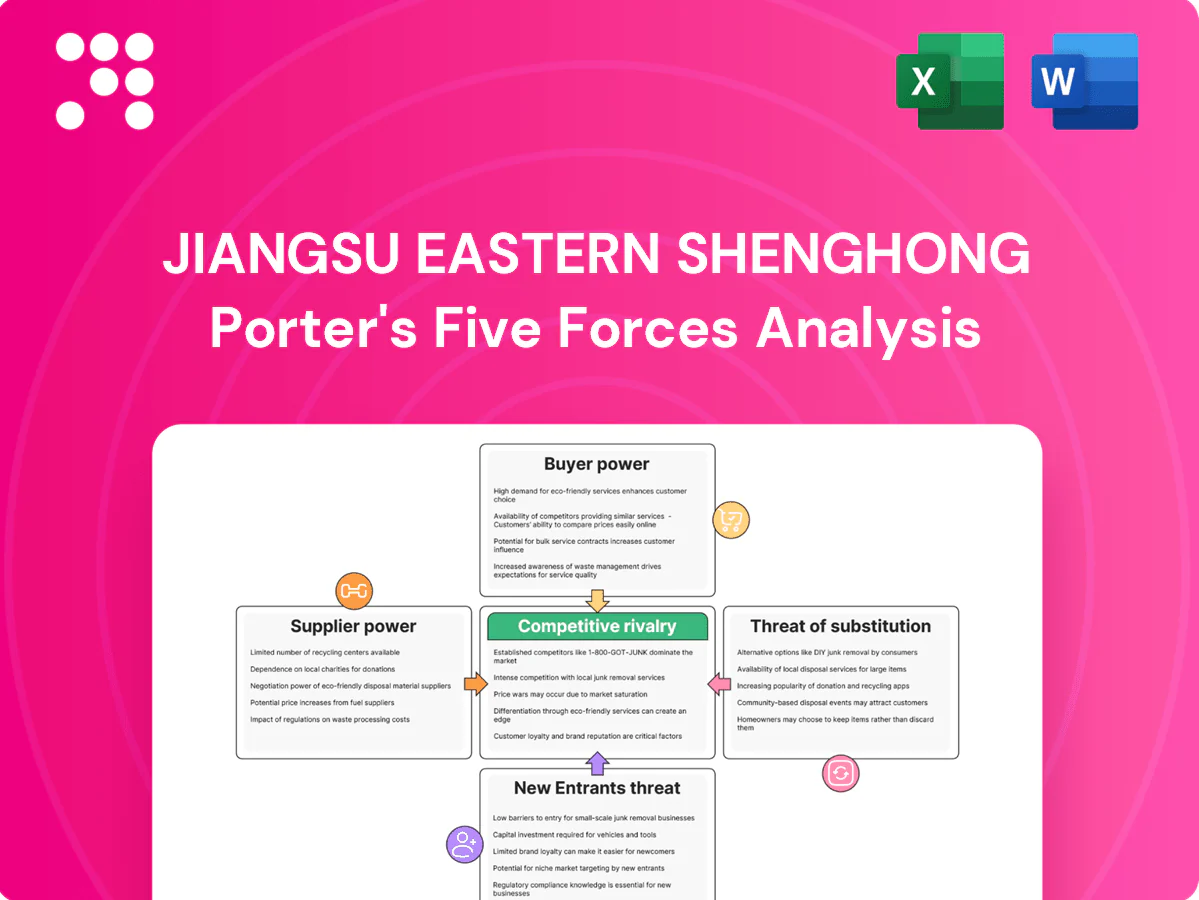
Jiangsu Eastern Shenghong Porter's Five Forces Analysis

Go Beyond the Preview—Access the Full Strategic Report
Jiangsu Eastern Shenghong faces moderate supplier power, steady buyer demand, and rising rivalry from regional refiners, while substitutes and new entrants pose limited near-term threats. This snapshot highlights strategic pressure points and resilience factors for the company. Unlock the full Porter's Five Forces Analysis to explore force-by-force ratings, visuals, and actionable insights for smarter decisions.
Suppliers Bargaining Power

Backward integration into PX/PTA reduces reliance
Owning refining, aromatics and PTA assets cuts Jiangsu Eastern Shenghong’s reliance on external feedstock, aligning with China’s PTA capacity of about 56 Mtpa in 2024 and regional feedstock dynamics. Internalizing feedstock-to-pta flows captures upstream margins and reduces price pass-through risk, weakening supplier leverage across key inputs. Integration also enhances planning certainty and supply security through controllable feedstock volumes and scheduling.
Crude oil and naphtha are global commodities
Upstream crude and naphtha trade as global commodities with world crude output near 100 million barrels per day in 2024, limiting power of any single supplier. Traders are interchangeable for Jiangsu Eastern Shenghong, though logistics, port slots and quality specs create switching frictions. Price volatility is driven by market forces rather than specific suppliers; hedging programs can buffer shocks but cannot remove market risk entirely.

Specialty catalysts and additives from few vendors
Process catalysts, spinning oils and modifiers typically come from 3–5 qualified vendors, creating supplier concentration; technical switching costs and licensing constraints increase dependence. In 2024 vendors exerted moderate pricing power, driving refresh-cycle input cost increases of roughly 5–12%. Long qualification timelines of 6–12 months add further stickiness to supplier relationships.

Equipment and maintenance OEM concentration
Equipment markets for polymerization, spinning and PTA are oligopolistic, with a few OEMs dominating supply and embedding parts and long-term service contracts that create vendor lock-in. This produces episodic supplier bargaining power, peaking during outages, turnarounds or capacity upgrades when OEM support is critical. Multi-sourcing is constrained by proprietary specs, certifications and warranty conditions.
- Oligopoly: concentrated OEM supply
- Locked-in: parts + service contracts
- Peak leverage: outages/upgrades
In-house utilities and logistics dampen leverage
In-house power generation and integrated logistics at Jiangsu Eastern Shenghong reduce exposure to third-party rate hikes, with site clustering and dedicated pipelines lowering delivered feedstock costs and improving cost predictability. This vertical integration curbs negotiating power of external utility and transport providers and enhances plant uptime through secured supply routes.
- Lower third-party dependency
- Reduced delivered cost via pipelines
- Improved uptime and predictability
Vertical integration cuts feedstock risk vs China PTA 56 Mtpa and global crude ~100 mbpd
Vertical integration (refining, aromatics, PTA) cuts feedstock exposure versus China PTA capacity ~56 Mtpa (2024) and global crude ~100 mbpd (2024), capturing upstream margins and reducing supplier pass-through. Catalysts from 3–5 vendors drove 2024 input increases ~5–12%; OEMs create episodic leverage at outages; in-house power/logistics lower third-party rate risk.
| Metric | 2024 |
|---|---|
| China PTA capacity | 56 Mtpa |
| Global crude output | ~100 mbpd |
| Catalyst cost rise | 5–12% |
What is included in the product
 Detailed Word Document
Tailored Porter’s Five Forces analysis for Jiangsu Eastern Shenghong uncovering competitive rivalry, supplier and buyer power, threat of substitutes, and barriers to entry, with strategic insights on pricing, margin pressure, and market entry risks. Ideal for investors and managers seeking targeted guidance on threats, opportunities, and defensive positioning.

 Customizable Excel Spreadsheet
A clear one-sheet Porter's Five Forces for Jiangsu Eastern Shenghong—condensing supplier, buyer, rivalry, entrant, and substitute pressures into actionable insights for swift decisions. Swap in your own data or toggle scenarios to relieve analysis bottlenecks and export clean visuals for decks or reports.
Customers Bargaining Power

Large-volume textile and packaging buyers are price-sensitive
Polyester and nylon are largely commoditized with converters operating on tight margins often below 5%, while global polyester output is roughly 74 million tonnes (2024), increasing buyers leverage. Big mills, brands and bottle-preform makers routinely push for discounts; volume commitments commonly secure 3–8% price and service concessions. Index-linked pricing (PX/PTA or spot PET indices) is standard across contracts.
Low switching costs for standard grades
For staple PET/PA grades, qualifying alternative suppliers is straightforward given a global PET demand near 30 million tonnes in 2024, so buyers readily pivot on price and availability. This intensifies price competition and has compressed industry margins, with commodity players reporting single-digit gross margins in 2024. As a result, service and delivery reliability become key tie-breakers for Jiangsu Eastern Shenghong.

Specialty and high-tenacity fibers raise stickiness
Functional yarns and industrial filaments for specialty and high-tenacity applications require co-development, with qualification cycles typically spanning 6–18 months and significant performance risk that deters frequent supplier switches. This stickiness reduces buyer leverage and allows premiums often in the 10–20% range versus commodity grades. Technical support and joint testing become integral to the value proposition, reinforcing long-term contracts for Jiangsu Eastern Shenghong.

Export exposure and brand compliance demands
Export exposure forces Jiangsu Eastern Shenghong to meet global brands' quality, ESG and traceability standards; non-certified suppliers face exclusion or deeper price concessions. Trade policy shifts (tariff changes, regional trade deals in 2024) can swing buyer leverage, while RMB volatility in 2024 altered importers' purchasing power.
- Certification levels raise negotiation leverage
- Non-compliance → price pressure/exclusion
- 2024 trade policy shifts changed regional buyer power
- Currency swings affected buyer purchasing power in 2024
Buyer fragmentation in domestic market
China’s downstream base is highly fragmented: in 2024 small- and medium-sized enterprises made up roughly 99.8% of registered firms and contributed about 60% of GDP, diluting aggregate buyer clout for Jiangsu Eastern Shenghong outside major accounts; tiered pricing and channel management can optimize product mix and margins, while differentiated credit terms remain an active negotiation lever.
- Buyer fragmentation: 99.8% SMEs (2024)
- Economic weight: ~60% GDP from SMEs (2024)
- Commercial levers: tiered pricing, channel mix, credit terms
Commoditization boosts buyer leverage; specialty yarns command 10-20% premiums in fragmented China
Commoditization gives buyers strong leverage: global polyester output ~74 million t (2024) and typical volume concessions of 3–8%. Specialty yarns reduce switching, enabling 10–20% premiums and 6–18 month qualification cycles. China downstream is fragmented (99.8% SMEs, ~60% GDP in 2024), diluting aggregate bargaining power outside major accounts.
| Metric | Value (2024) |
|---|---|
| Global polyester output | ~74 Mt |
| PET demand | ~30 Mt |
| Buyer concessions | 3–8% |
| Specialty premium | 10–20% |
| SME share | 99.8% |
| SME GDP contribution | ~60% |
Full Version Awaits
Jiangsu Eastern Shenghong Porter's Five Forces Analysis
This Porter's Five Forces analysis for Jiangsu Eastern Shenghong presents a concise, professional assessment of competitive rivalry, supplier and buyer power, threats of entry and substitution tailored to the company’s port operations. The preview you see is the exact, fully formatted document you’ll receive immediately after purchase—no samples or placeholders. It’s ready for download and use the moment you buy.

Go Beyond the Preview—Access the Full Strategic Report
Jiangsu Eastern Shenghong faces moderate supplier power, steady buyer demand, and rising rivalry from regional refiners, while substitutes and new entrants pose limited near-term threats. This snapshot highlights strategic pressure points and resilience factors for the company. Unlock the full Porter's Five Forces Analysis to explore force-by-force ratings, visuals, and actionable insights for smarter decisions.
Suppliers Bargaining Power
Backward integration into PX/PTA reduces reliance
Owning refining, aromatics and PTA assets cuts Jiangsu Eastern Shenghong’s reliance on external feedstock, aligning with China’s PTA capacity of about 56 Mtpa in 2024 and regional feedstock dynamics. Internalizing feedstock-to-pta flows captures upstream margins and reduces price pass-through risk, weakening supplier leverage across key inputs. Integration also enhances planning certainty and supply security through controllable feedstock volumes and scheduling.
Crude oil and naphtha are global commodities
Upstream crude and naphtha trade as global commodities with world crude output near 100 million barrels per day in 2024, limiting power of any single supplier. Traders are interchangeable for Jiangsu Eastern Shenghong, though logistics, port slots and quality specs create switching frictions. Price volatility is driven by market forces rather than specific suppliers; hedging programs can buffer shocks but cannot remove market risk entirely.
Specialty catalysts and additives from few vendors
Process catalysts, spinning oils and modifiers typically come from 3–5 qualified vendors, creating supplier concentration; technical switching costs and licensing constraints increase dependence. In 2024 vendors exerted moderate pricing power, driving refresh-cycle input cost increases of roughly 5–12%. Long qualification timelines of 6–12 months add further stickiness to supplier relationships.
Equipment and maintenance OEM concentration
Equipment markets for polymerization, spinning and PTA are oligopolistic, with a few OEMs dominating supply and embedding parts and long-term service contracts that create vendor lock-in. This produces episodic supplier bargaining power, peaking during outages, turnarounds or capacity upgrades when OEM support is critical. Multi-sourcing is constrained by proprietary specs, certifications and warranty conditions.
- Oligopoly: concentrated OEM supply
- Locked-in: parts + service contracts
- Peak leverage: outages/upgrades
In-house utilities and logistics dampen leverage
In-house power generation and integrated logistics at Jiangsu Eastern Shenghong reduce exposure to third-party rate hikes, with site clustering and dedicated pipelines lowering delivered feedstock costs and improving cost predictability. This vertical integration curbs negotiating power of external utility and transport providers and enhances plant uptime through secured supply routes.
- Lower third-party dependency
- Reduced delivered cost via pipelines
- Improved uptime and predictability
Vertical integration cuts feedstock risk vs China PTA 56 Mtpa and global crude ~100 mbpd
Vertical integration (refining, aromatics, PTA) cuts feedstock exposure versus China PTA capacity ~56 Mtpa (2024) and global crude ~100 mbpd (2024), capturing upstream margins and reducing supplier pass-through. Catalysts from 3–5 vendors drove 2024 input increases ~5–12%; OEMs create episodic leverage at outages; in-house power/logistics lower third-party rate risk.
| Metric | 2024 |
|---|---|
| China PTA capacity | 56 Mtpa |
| Global crude output | ~100 mbpd |
| Catalyst cost rise | 5–12% |
What is included in the product
Detailed Word Document
Tailored Porter’s Five Forces analysis for Jiangsu Eastern Shenghong uncovering competitive rivalry, supplier and buyer power, threat of substitutes, and barriers to entry, with strategic insights on pricing, margin pressure, and market entry risks. Ideal for investors and managers seeking targeted guidance on threats, opportunities, and defensive positioning.
Customizable Excel Spreadsheet
A clear one-sheet Porter's Five Forces for Jiangsu Eastern Shenghong—condensing supplier, buyer, rivalry, entrant, and substitute pressures into actionable insights for swift decisions. Swap in your own data or toggle scenarios to relieve analysis bottlenecks and export clean visuals for decks or reports.
Customers Bargaining Power
Large-volume textile and packaging buyers are price-sensitive
Polyester and nylon are largely commoditized with converters operating on tight margins often below 5%, while global polyester output is roughly 74 million tonnes (2024), increasing buyers leverage. Big mills, brands and bottle-preform makers routinely push for discounts; volume commitments commonly secure 3–8% price and service concessions. Index-linked pricing (PX/PTA or spot PET indices) is standard across contracts.
Low switching costs for standard grades
For staple PET/PA grades, qualifying alternative suppliers is straightforward given a global PET demand near 30 million tonnes in 2024, so buyers readily pivot on price and availability. This intensifies price competition and has compressed industry margins, with commodity players reporting single-digit gross margins in 2024. As a result, service and delivery reliability become key tie-breakers for Jiangsu Eastern Shenghong.
Specialty and high-tenacity fibers raise stickiness
Functional yarns and industrial filaments for specialty and high-tenacity applications require co-development, with qualification cycles typically spanning 6–18 months and significant performance risk that deters frequent supplier switches. This stickiness reduces buyer leverage and allows premiums often in the 10–20% range versus commodity grades. Technical support and joint testing become integral to the value proposition, reinforcing long-term contracts for Jiangsu Eastern Shenghong.
Export exposure and brand compliance demands
Export exposure forces Jiangsu Eastern Shenghong to meet global brands' quality, ESG and traceability standards; non-certified suppliers face exclusion or deeper price concessions. Trade policy shifts (tariff changes, regional trade deals in 2024) can swing buyer leverage, while RMB volatility in 2024 altered importers' purchasing power.
- Certification levels raise negotiation leverage
- Non-compliance → price pressure/exclusion
- 2024 trade policy shifts changed regional buyer power
- Currency swings affected buyer purchasing power in 2024
Buyer fragmentation in domestic market
China’s downstream base is highly fragmented: in 2024 small- and medium-sized enterprises made up roughly 99.8% of registered firms and contributed about 60% of GDP, diluting aggregate buyer clout for Jiangsu Eastern Shenghong outside major accounts; tiered pricing and channel management can optimize product mix and margins, while differentiated credit terms remain an active negotiation lever.
- Buyer fragmentation: 99.8% SMEs (2024)
- Economic weight: ~60% GDP from SMEs (2024)
- Commercial levers: tiered pricing, channel mix, credit terms
Commoditization boosts buyer leverage; specialty yarns command 10-20% premiums in fragmented China
Commoditization gives buyers strong leverage: global polyester output ~74 million t (2024) and typical volume concessions of 3–8%. Specialty yarns reduce switching, enabling 10–20% premiums and 6–18 month qualification cycles. China downstream is fragmented (99.8% SMEs, ~60% GDP in 2024), diluting aggregate bargaining power outside major accounts.
| Metric | Value (2024) |
|---|---|
| Global polyester output | ~74 Mt |
| PET demand | ~30 Mt |
| Buyer concessions | 3–8% |
| Specialty premium | 10–20% |
| SME share | 99.8% |
| SME GDP contribution | ~60% |
Full Version Awaits
Jiangsu Eastern Shenghong Porter's Five Forces Analysis
This Porter's Five Forces analysis for Jiangsu Eastern Shenghong presents a concise, professional assessment of competitive rivalry, supplier and buyer power, threats of entry and substitution tailored to the company’s port operations. The preview you see is the exact, fully formatted document you’ll receive immediately after purchase—no samples or placeholders. It’s ready for download and use the moment you buy.
Original: $10.00
-65%$10.00
$3.50Description
Go Beyond the Preview—Access the Full Strategic Report
Jiangsu Eastern Shenghong faces moderate supplier power, steady buyer demand, and rising rivalry from regional refiners, while substitutes and new entrants pose limited near-term threats. This snapshot highlights strategic pressure points and resilience factors for the company. Unlock the full Porter's Five Forces Analysis to explore force-by-force ratings, visuals, and actionable insights for smarter decisions.
Suppliers Bargaining Power
Backward integration into PX/PTA reduces reliance
Owning refining, aromatics and PTA assets cuts Jiangsu Eastern Shenghong’s reliance on external feedstock, aligning with China’s PTA capacity of about 56 Mtpa in 2024 and regional feedstock dynamics. Internalizing feedstock-to-pta flows captures upstream margins and reduces price pass-through risk, weakening supplier leverage across key inputs. Integration also enhances planning certainty and supply security through controllable feedstock volumes and scheduling.
Crude oil and naphtha are global commodities
Upstream crude and naphtha trade as global commodities with world crude output near 100 million barrels per day in 2024, limiting power of any single supplier. Traders are interchangeable for Jiangsu Eastern Shenghong, though logistics, port slots and quality specs create switching frictions. Price volatility is driven by market forces rather than specific suppliers; hedging programs can buffer shocks but cannot remove market risk entirely.
Specialty catalysts and additives from few vendors
Process catalysts, spinning oils and modifiers typically come from 3–5 qualified vendors, creating supplier concentration; technical switching costs and licensing constraints increase dependence. In 2024 vendors exerted moderate pricing power, driving refresh-cycle input cost increases of roughly 5–12%. Long qualification timelines of 6–12 months add further stickiness to supplier relationships.
Equipment and maintenance OEM concentration
Equipment markets for polymerization, spinning and PTA are oligopolistic, with a few OEMs dominating supply and embedding parts and long-term service contracts that create vendor lock-in. This produces episodic supplier bargaining power, peaking during outages, turnarounds or capacity upgrades when OEM support is critical. Multi-sourcing is constrained by proprietary specs, certifications and warranty conditions.
- Oligopoly: concentrated OEM supply
- Locked-in: parts + service contracts
- Peak leverage: outages/upgrades
In-house utilities and logistics dampen leverage
In-house power generation and integrated logistics at Jiangsu Eastern Shenghong reduce exposure to third-party rate hikes, with site clustering and dedicated pipelines lowering delivered feedstock costs and improving cost predictability. This vertical integration curbs negotiating power of external utility and transport providers and enhances plant uptime through secured supply routes.
- Lower third-party dependency
- Reduced delivered cost via pipelines
- Improved uptime and predictability
Vertical integration cuts feedstock risk vs China PTA 56 Mtpa and global crude ~100 mbpd
Vertical integration (refining, aromatics, PTA) cuts feedstock exposure versus China PTA capacity ~56 Mtpa (2024) and global crude ~100 mbpd (2024), capturing upstream margins and reducing supplier pass-through. Catalysts from 3–5 vendors drove 2024 input increases ~5–12%; OEMs create episodic leverage at outages; in-house power/logistics lower third-party rate risk.
| Metric | 2024 |
|---|---|
| China PTA capacity | 56 Mtpa |
| Global crude output | ~100 mbpd |
| Catalyst cost rise | 5–12% |
What is included in the product
Detailed Word Document
Tailored Porter’s Five Forces analysis for Jiangsu Eastern Shenghong uncovering competitive rivalry, supplier and buyer power, threat of substitutes, and barriers to entry, with strategic insights on pricing, margin pressure, and market entry risks. Ideal for investors and managers seeking targeted guidance on threats, opportunities, and defensive positioning.
Customizable Excel Spreadsheet
A clear one-sheet Porter's Five Forces for Jiangsu Eastern Shenghong—condensing supplier, buyer, rivalry, entrant, and substitute pressures into actionable insights for swift decisions. Swap in your own data or toggle scenarios to relieve analysis bottlenecks and export clean visuals for decks or reports.
Customers Bargaining Power
Large-volume textile and packaging buyers are price-sensitive
Polyester and nylon are largely commoditized with converters operating on tight margins often below 5%, while global polyester output is roughly 74 million tonnes (2024), increasing buyers leverage. Big mills, brands and bottle-preform makers routinely push for discounts; volume commitments commonly secure 3–8% price and service concessions. Index-linked pricing (PX/PTA or spot PET indices) is standard across contracts.
Low switching costs for standard grades
For staple PET/PA grades, qualifying alternative suppliers is straightforward given a global PET demand near 30 million tonnes in 2024, so buyers readily pivot on price and availability. This intensifies price competition and has compressed industry margins, with commodity players reporting single-digit gross margins in 2024. As a result, service and delivery reliability become key tie-breakers for Jiangsu Eastern Shenghong.
Specialty and high-tenacity fibers raise stickiness
Functional yarns and industrial filaments for specialty and high-tenacity applications require co-development, with qualification cycles typically spanning 6–18 months and significant performance risk that deters frequent supplier switches. This stickiness reduces buyer leverage and allows premiums often in the 10–20% range versus commodity grades. Technical support and joint testing become integral to the value proposition, reinforcing long-term contracts for Jiangsu Eastern Shenghong.
Export exposure and brand compliance demands
Export exposure forces Jiangsu Eastern Shenghong to meet global brands' quality, ESG and traceability standards; non-certified suppliers face exclusion or deeper price concessions. Trade policy shifts (tariff changes, regional trade deals in 2024) can swing buyer leverage, while RMB volatility in 2024 altered importers' purchasing power.
- Certification levels raise negotiation leverage
- Non-compliance → price pressure/exclusion
- 2024 trade policy shifts changed regional buyer power
- Currency swings affected buyer purchasing power in 2024
Buyer fragmentation in domestic market
China’s downstream base is highly fragmented: in 2024 small- and medium-sized enterprises made up roughly 99.8% of registered firms and contributed about 60% of GDP, diluting aggregate buyer clout for Jiangsu Eastern Shenghong outside major accounts; tiered pricing and channel management can optimize product mix and margins, while differentiated credit terms remain an active negotiation lever.
- Buyer fragmentation: 99.8% SMEs (2024)
- Economic weight: ~60% GDP from SMEs (2024)
- Commercial levers: tiered pricing, channel mix, credit terms
Commoditization boosts buyer leverage; specialty yarns command 10-20% premiums in fragmented China
Commoditization gives buyers strong leverage: global polyester output ~74 million t (2024) and typical volume concessions of 3–8%. Specialty yarns reduce switching, enabling 10–20% premiums and 6–18 month qualification cycles. China downstream is fragmented (99.8% SMEs, ~60% GDP in 2024), diluting aggregate bargaining power outside major accounts.
| Metric | Value (2024) |
|---|---|
| Global polyester output | ~74 Mt |
| PET demand | ~30 Mt |
| Buyer concessions | 3–8% |
| Specialty premium | 10–20% |
| SME share | 99.8% |
| SME GDP contribution | ~60% |
Full Version Awaits
Jiangsu Eastern Shenghong Porter's Five Forces Analysis
This Porter's Five Forces analysis for Jiangsu Eastern Shenghong presents a concise, professional assessment of competitive rivalry, supplier and buyer power, threats of entry and substitution tailored to the company’s port operations. The preview you see is the exact, fully formatted document you’ll receive immediately after purchase—no samples or placeholders. It’s ready for download and use the moment you buy.











