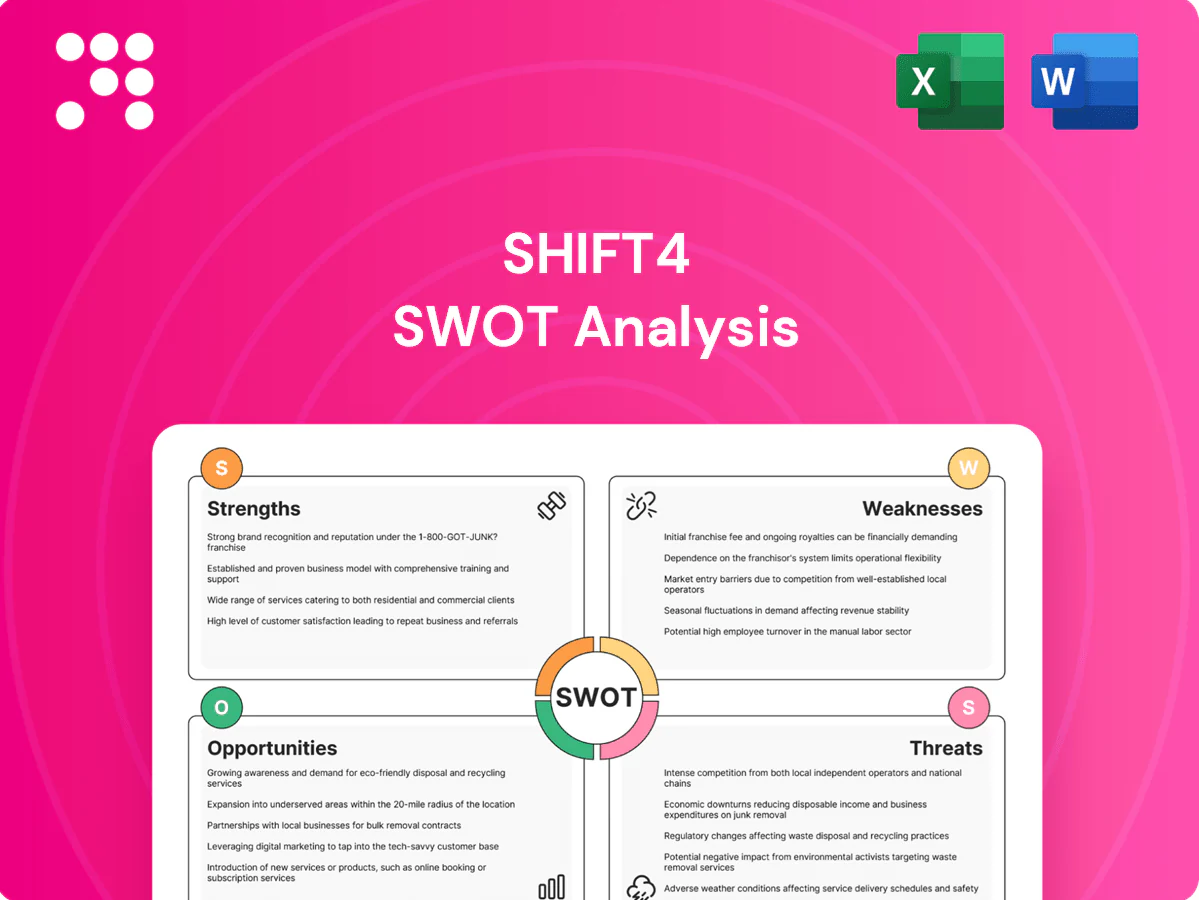
Shift4 SWOT Analysis

Elevate Your Analysis with the Complete SWOT Report
Unlock a concise SWOT snapshot of Shift4—highlighting its payment processing scale, integrated POS strengths, competitive risks, and growth catalysts in ecommerce and hospitality. Want deeper, actionable analysis? Purchase the full SWOT for a research-backed, editable report and Excel tools to plan, pitch, or invest with confidence.
Strengths

End-to-end integrated platform
Shift4’s end-to-end stack—gateway, POS, and processing in one—reduces vendor sprawl and streamlines reconciliation through unified data and reporting, supporting back-office efficiency for its network of over 200,000 merchants. The tightly integrated platform improves uptime and troubleshooting, lowering operational friction and support costs. Integration also boosts customer stickiness and cross-sell potential, increasing lifetime value per merchant.
Deep vertical expertise
Shift4's deep vertical expertise in hospitality, retail and restaurants delivers purpose-built features, tailored workflows, device support and compliance handling that match operator needs. This focus accelerates deployments and improves win rates while enabling premium pricing in complex environments. Shift4 completed its IPO in June 2020 and acquired VenueNext in 2021 to bolster venue and hospitality capabilities.

Secure, compliant transactions
Shift4 enforces tokenization, end-to-end encryption and is PCI-validated, securing transactions across 200,000+ merchant locations; robust fraud defenses lower chargeback exposure for merchants, preserving revenue and brand trust. This reliable security posture eases regulatory implementation for clients in hospitality and gaming, reducing onboarding friction and compliance cost.

Omnichannel acceptance
Omnichannel acceptance lets Shift4 support in-store, online and mobile payments, enabling unified commerce and consistent customer experiences across touchpoints; as of 2024 Shift4 serves 200,000+ merchants and processes over $200B in annual payment volume, helping capture incremental transactions. Centralized settlement and analytics streamline reporting and improve decision-making for merchants.
- 200,000+ merchants (2024)
- >$200B annual volume (2024)
- Unified commerce; centralized settlement
- Increases transaction capture
Value-added ecosystem
Shift4s value-added ecosystem—integrated POS (hospitality-grade), gift/loyalty, analytics and ancillary services—broadens revenue beyond payments, driving higher ARPU and retention through bundled offerings and creating defensible differentiation versus pure processors while opening ongoing upsell paths across the customer lifecycle.
- Integrated POS and services widen revenue mix
- Bundling yields higher ARPU and retention
- Creates moat vs. standalone processors
- Enables lifecycle upsells
Integrated gateway + POS lowers vendor sprawl, boosts stickiness for 200,000+ merchants and $200B+
Shift4’s integrated gateway, POS and processing reduces vendor sprawl and raises merchant stickiness, serving 200,000+ merchants and processing >$200B annual volume (2024). Vertical focus in hospitality, retail and restaurants enables faster deployments and premium pricing. PCI-validated tokenization and fraud tools lower chargebacks and compliance burden. Bundled POS, loyalty and analytics increase ARPU and retention.
| Metric | Value |
|---|---|
| Merchants (2024) | 200,000+ |
| Annual Volume (2024) | >$200B |
| IPO | June 2020 |
| Notable M&A | VenueNext (2021) |
| Security | PCI-validated, tokenization |
What is included in the product
 Detailed Word Document
Provides a concise SWOT analysis of Shift4, outlining internal strengths and weaknesses alongside external opportunities and threats to assess its competitive position, growth drivers, and strategic risks.

 Customizable Excel Spreadsheet
Provides a focused SWOT snapshot of Shift4 to accelerate strategy alignment and quickly surface strengths, weaknesses, opportunities, and threats for decision-makers.
Weaknesses

Vertical concentration risk
Shift4’s revenue remains heavily skewed to hospitality and restaurants, with the company reporting over 50% of processing volume tied to those verticals as of 2023, increasing cyclicality exposure. Seasonal swings and macro shocks can materially dent volumes; diversification into new verticals is still a work in progress. This concentration can compress pricing power during downturns, amplifying margin pressure.
Intense competitive landscape
Shift4 faces intense competition from Block (Square), Toast, Adyen, Stripe, Fiserv and Global Payments, making pricing and software bundles a frequent tactic to win merchants. With Shift4 reporting roughly $1.0B revenue in FY2023 and rivals like Block at ~$19B, competitors can undercut fees or bundle services aggressively. Feature‑parity battles raise R&D and sales spend, while commoditization makes differentiation hard to convey to merchants.

Pricing and margin pressure
Interchange-plus competition is compressing Shift4s take rates, as large acquirers and software-focused entrants push pricing lower. Major merchants demand reduced fees and bespoke incentives, pressuring revenue per transaction. Hardware subsidies and onboarding costs erode unit economics, making sustaining margins dependent on growing a higher-margin, value-added services mix.

Complex integrations and legacy tails
Supporting diverse POS hardware and legacy systems — spanning hundreds of device variants — adds integration complexity and raises engineering and support burden. Older deployments can delay feature rollouts by months and increase failure points; enterprise integrations are delayed or overrun in roughly 70% of projects.
- High hardware diversity: hundreds of variants
- Increased maintenance and support costs
- Slower rollouts: months of delay
- Higher implementation failure risk (~70%)
Regulatory and compliance load
Evolving PCI, data-privacy and network rules force continuous security and certification investment; IBM 2024 reports average breach cost $4.45M, underscoring downside. Compliance overhead can outpace SMB-derived revenue and margins. Fines or assessments pose direct financial risk and regulatory uncertainty complicates product roadmaps and pricing.
- PCI/DLP spend growth
- Avg breach cost $4.45M (IBM 2024)
- SMB revenue vs compliance pressure
- Roadmap/pricing uncertainty
Hospitality >50% exposure, hardware subsidies and low scale compress margins
Shift4 is highly concentrated in hospitality/restaurants (>50% of volume as of 2023), raising cyclicality and pricing pressure; FY2023 revenue was roughly $1.0B versus Block at ~19B, limiting competitive leverage. Interchange‑plus and hardware subsidies compress take rates and margins while supporting diverse legacy POS (hundreds of variants) increases integration, support costs and delayed rollouts.
| Metric | Value |
|---|---|
| Hospitality share | >50% (2023) |
| Revenue | $1.0B (FY2023) |
| Block revenue | ~$19B |
| Avg breach cost | $4.45M (IBM 2024) |
Full Version Awaits
Shift4 SWOT Analysis
This is a live preview of the actual Shift4 SWOT analysis document you’ll receive upon purchase—no samples or placeholders, just the real, professionally formatted report. The excerpt below is taken directly from the full file; buying unlocks the complete, editable version with in-depth strengths, weaknesses, opportunities, and threats. Purchase to download the entire analysis immediately.

Elevate Your Analysis with the Complete SWOT Report
Unlock a concise SWOT snapshot of Shift4—highlighting its payment processing scale, integrated POS strengths, competitive risks, and growth catalysts in ecommerce and hospitality. Want deeper, actionable analysis? Purchase the full SWOT for a research-backed, editable report and Excel tools to plan, pitch, or invest with confidence.
Strengths
End-to-end integrated platform
Shift4’s end-to-end stack—gateway, POS, and processing in one—reduces vendor sprawl and streamlines reconciliation through unified data and reporting, supporting back-office efficiency for its network of over 200,000 merchants. The tightly integrated platform improves uptime and troubleshooting, lowering operational friction and support costs. Integration also boosts customer stickiness and cross-sell potential, increasing lifetime value per merchant.
Deep vertical expertise
Shift4's deep vertical expertise in hospitality, retail and restaurants delivers purpose-built features, tailored workflows, device support and compliance handling that match operator needs. This focus accelerates deployments and improves win rates while enabling premium pricing in complex environments. Shift4 completed its IPO in June 2020 and acquired VenueNext in 2021 to bolster venue and hospitality capabilities.
Secure, compliant transactions
Shift4 enforces tokenization, end-to-end encryption and is PCI-validated, securing transactions across 200,000+ merchant locations; robust fraud defenses lower chargeback exposure for merchants, preserving revenue and brand trust. This reliable security posture eases regulatory implementation for clients in hospitality and gaming, reducing onboarding friction and compliance cost.
Omnichannel acceptance
Omnichannel acceptance lets Shift4 support in-store, online and mobile payments, enabling unified commerce and consistent customer experiences across touchpoints; as of 2024 Shift4 serves 200,000+ merchants and processes over $200B in annual payment volume, helping capture incremental transactions. Centralized settlement and analytics streamline reporting and improve decision-making for merchants.
- 200,000+ merchants (2024)
- >$200B annual volume (2024)
- Unified commerce; centralized settlement
- Increases transaction capture
Value-added ecosystem
Shift4s value-added ecosystem—integrated POS (hospitality-grade), gift/loyalty, analytics and ancillary services—broadens revenue beyond payments, driving higher ARPU and retention through bundled offerings and creating defensible differentiation versus pure processors while opening ongoing upsell paths across the customer lifecycle.
- Integrated POS and services widen revenue mix
- Bundling yields higher ARPU and retention
- Creates moat vs. standalone processors
- Enables lifecycle upsells
Integrated gateway + POS lowers vendor sprawl, boosts stickiness for 200,000+ merchants and $200B+
Shift4’s integrated gateway, POS and processing reduces vendor sprawl and raises merchant stickiness, serving 200,000+ merchants and processing >$200B annual volume (2024). Vertical focus in hospitality, retail and restaurants enables faster deployments and premium pricing. PCI-validated tokenization and fraud tools lower chargebacks and compliance burden. Bundled POS, loyalty and analytics increase ARPU and retention.
| Metric | Value |
|---|---|
| Merchants (2024) | 200,000+ |
| Annual Volume (2024) | >$200B |
| IPO | June 2020 |
| Notable M&A | VenueNext (2021) |
| Security | PCI-validated, tokenization |
What is included in the product
Detailed Word Document
Provides a concise SWOT analysis of Shift4, outlining internal strengths and weaknesses alongside external opportunities and threats to assess its competitive position, growth drivers, and strategic risks.
Customizable Excel Spreadsheet
Provides a focused SWOT snapshot of Shift4 to accelerate strategy alignment and quickly surface strengths, weaknesses, opportunities, and threats for decision-makers.
Weaknesses
Vertical concentration risk
Shift4’s revenue remains heavily skewed to hospitality and restaurants, with the company reporting over 50% of processing volume tied to those verticals as of 2023, increasing cyclicality exposure. Seasonal swings and macro shocks can materially dent volumes; diversification into new verticals is still a work in progress. This concentration can compress pricing power during downturns, amplifying margin pressure.
Intense competitive landscape
Shift4 faces intense competition from Block (Square), Toast, Adyen, Stripe, Fiserv and Global Payments, making pricing and software bundles a frequent tactic to win merchants. With Shift4 reporting roughly $1.0B revenue in FY2023 and rivals like Block at ~$19B, competitors can undercut fees or bundle services aggressively. Feature‑parity battles raise R&D and sales spend, while commoditization makes differentiation hard to convey to merchants.
Pricing and margin pressure
Interchange-plus competition is compressing Shift4s take rates, as large acquirers and software-focused entrants push pricing lower. Major merchants demand reduced fees and bespoke incentives, pressuring revenue per transaction. Hardware subsidies and onboarding costs erode unit economics, making sustaining margins dependent on growing a higher-margin, value-added services mix.
Complex integrations and legacy tails
Supporting diverse POS hardware and legacy systems — spanning hundreds of device variants — adds integration complexity and raises engineering and support burden. Older deployments can delay feature rollouts by months and increase failure points; enterprise integrations are delayed or overrun in roughly 70% of projects.
- High hardware diversity: hundreds of variants
- Increased maintenance and support costs
- Slower rollouts: months of delay
- Higher implementation failure risk (~70%)
Regulatory and compliance load
Evolving PCI, data-privacy and network rules force continuous security and certification investment; IBM 2024 reports average breach cost $4.45M, underscoring downside. Compliance overhead can outpace SMB-derived revenue and margins. Fines or assessments pose direct financial risk and regulatory uncertainty complicates product roadmaps and pricing.
- PCI/DLP spend growth
- Avg breach cost $4.45M (IBM 2024)
- SMB revenue vs compliance pressure
- Roadmap/pricing uncertainty
Hospitality >50% exposure, hardware subsidies and low scale compress margins
Shift4 is highly concentrated in hospitality/restaurants (>50% of volume as of 2023), raising cyclicality and pricing pressure; FY2023 revenue was roughly $1.0B versus Block at ~19B, limiting competitive leverage. Interchange‑plus and hardware subsidies compress take rates and margins while supporting diverse legacy POS (hundreds of variants) increases integration, support costs and delayed rollouts.
| Metric | Value |
|---|---|
| Hospitality share | >50% (2023) |
| Revenue | $1.0B (FY2023) |
| Block revenue | ~$19B |
| Avg breach cost | $4.45M (IBM 2024) |
Full Version Awaits
Shift4 SWOT Analysis
This is a live preview of the actual Shift4 SWOT analysis document you’ll receive upon purchase—no samples or placeholders, just the real, professionally formatted report. The excerpt below is taken directly from the full file; buying unlocks the complete, editable version with in-depth strengths, weaknesses, opportunities, and threats. Purchase to download the entire analysis immediately.
Description
Elevate Your Analysis with the Complete SWOT Report
Unlock a concise SWOT snapshot of Shift4—highlighting its payment processing scale, integrated POS strengths, competitive risks, and growth catalysts in ecommerce and hospitality. Want deeper, actionable analysis? Purchase the full SWOT for a research-backed, editable report and Excel tools to plan, pitch, or invest with confidence.
Strengths
End-to-end integrated platform
Shift4’s end-to-end stack—gateway, POS, and processing in one—reduces vendor sprawl and streamlines reconciliation through unified data and reporting, supporting back-office efficiency for its network of over 200,000 merchants. The tightly integrated platform improves uptime and troubleshooting, lowering operational friction and support costs. Integration also boosts customer stickiness and cross-sell potential, increasing lifetime value per merchant.
Deep vertical expertise
Shift4's deep vertical expertise in hospitality, retail and restaurants delivers purpose-built features, tailored workflows, device support and compliance handling that match operator needs. This focus accelerates deployments and improves win rates while enabling premium pricing in complex environments. Shift4 completed its IPO in June 2020 and acquired VenueNext in 2021 to bolster venue and hospitality capabilities.
Secure, compliant transactions
Shift4 enforces tokenization, end-to-end encryption and is PCI-validated, securing transactions across 200,000+ merchant locations; robust fraud defenses lower chargeback exposure for merchants, preserving revenue and brand trust. This reliable security posture eases regulatory implementation for clients in hospitality and gaming, reducing onboarding friction and compliance cost.
Omnichannel acceptance
Omnichannel acceptance lets Shift4 support in-store, online and mobile payments, enabling unified commerce and consistent customer experiences across touchpoints; as of 2024 Shift4 serves 200,000+ merchants and processes over $200B in annual payment volume, helping capture incremental transactions. Centralized settlement and analytics streamline reporting and improve decision-making for merchants.
- 200,000+ merchants (2024)
- >$200B annual volume (2024)
- Unified commerce; centralized settlement
- Increases transaction capture
Value-added ecosystem
Shift4s value-added ecosystem—integrated POS (hospitality-grade), gift/loyalty, analytics and ancillary services—broadens revenue beyond payments, driving higher ARPU and retention through bundled offerings and creating defensible differentiation versus pure processors while opening ongoing upsell paths across the customer lifecycle.
- Integrated POS and services widen revenue mix
- Bundling yields higher ARPU and retention
- Creates moat vs. standalone processors
- Enables lifecycle upsells
Integrated gateway + POS lowers vendor sprawl, boosts stickiness for 200,000+ merchants and $200B+
Shift4’s integrated gateway, POS and processing reduces vendor sprawl and raises merchant stickiness, serving 200,000+ merchants and processing >$200B annual volume (2024). Vertical focus in hospitality, retail and restaurants enables faster deployments and premium pricing. PCI-validated tokenization and fraud tools lower chargebacks and compliance burden. Bundled POS, loyalty and analytics increase ARPU and retention.
| Metric | Value |
|---|---|
| Merchants (2024) | 200,000+ |
| Annual Volume (2024) | >$200B |
| IPO | June 2020 |
| Notable M&A | VenueNext (2021) |
| Security | PCI-validated, tokenization |
What is included in the product
Detailed Word Document
Provides a concise SWOT analysis of Shift4, outlining internal strengths and weaknesses alongside external opportunities and threats to assess its competitive position, growth drivers, and strategic risks.
Customizable Excel Spreadsheet
Provides a focused SWOT snapshot of Shift4 to accelerate strategy alignment and quickly surface strengths, weaknesses, opportunities, and threats for decision-makers.
Weaknesses
Vertical concentration risk
Shift4’s revenue remains heavily skewed to hospitality and restaurants, with the company reporting over 50% of processing volume tied to those verticals as of 2023, increasing cyclicality exposure. Seasonal swings and macro shocks can materially dent volumes; diversification into new verticals is still a work in progress. This concentration can compress pricing power during downturns, amplifying margin pressure.
Intense competitive landscape
Shift4 faces intense competition from Block (Square), Toast, Adyen, Stripe, Fiserv and Global Payments, making pricing and software bundles a frequent tactic to win merchants. With Shift4 reporting roughly $1.0B revenue in FY2023 and rivals like Block at ~$19B, competitors can undercut fees or bundle services aggressively. Feature‑parity battles raise R&D and sales spend, while commoditization makes differentiation hard to convey to merchants.
Pricing and margin pressure
Interchange-plus competition is compressing Shift4s take rates, as large acquirers and software-focused entrants push pricing lower. Major merchants demand reduced fees and bespoke incentives, pressuring revenue per transaction. Hardware subsidies and onboarding costs erode unit economics, making sustaining margins dependent on growing a higher-margin, value-added services mix.
Complex integrations and legacy tails
Supporting diverse POS hardware and legacy systems — spanning hundreds of device variants — adds integration complexity and raises engineering and support burden. Older deployments can delay feature rollouts by months and increase failure points; enterprise integrations are delayed or overrun in roughly 70% of projects.
- High hardware diversity: hundreds of variants
- Increased maintenance and support costs
- Slower rollouts: months of delay
- Higher implementation failure risk (~70%)
Regulatory and compliance load
Evolving PCI, data-privacy and network rules force continuous security and certification investment; IBM 2024 reports average breach cost $4.45M, underscoring downside. Compliance overhead can outpace SMB-derived revenue and margins. Fines or assessments pose direct financial risk and regulatory uncertainty complicates product roadmaps and pricing.
- PCI/DLP spend growth
- Avg breach cost $4.45M (IBM 2024)
- SMB revenue vs compliance pressure
- Roadmap/pricing uncertainty
Hospitality >50% exposure, hardware subsidies and low scale compress margins
Shift4 is highly concentrated in hospitality/restaurants (>50% of volume as of 2023), raising cyclicality and pricing pressure; FY2023 revenue was roughly $1.0B versus Block at ~19B, limiting competitive leverage. Interchange‑plus and hardware subsidies compress take rates and margins while supporting diverse legacy POS (hundreds of variants) increases integration, support costs and delayed rollouts.
| Metric | Value |
|---|---|
| Hospitality share | >50% (2023) |
| Revenue | $1.0B (FY2023) |
| Block revenue | ~$19B |
| Avg breach cost | $4.45M (IBM 2024) |
Full Version Awaits
Shift4 SWOT Analysis
This is a live preview of the actual Shift4 SWOT analysis document you’ll receive upon purchase—no samples or placeholders, just the real, professionally formatted report. The excerpt below is taken directly from the full file; buying unlocks the complete, editable version with in-depth strengths, weaknesses, opportunities, and threats. Purchase to download the entire analysis immediately.











