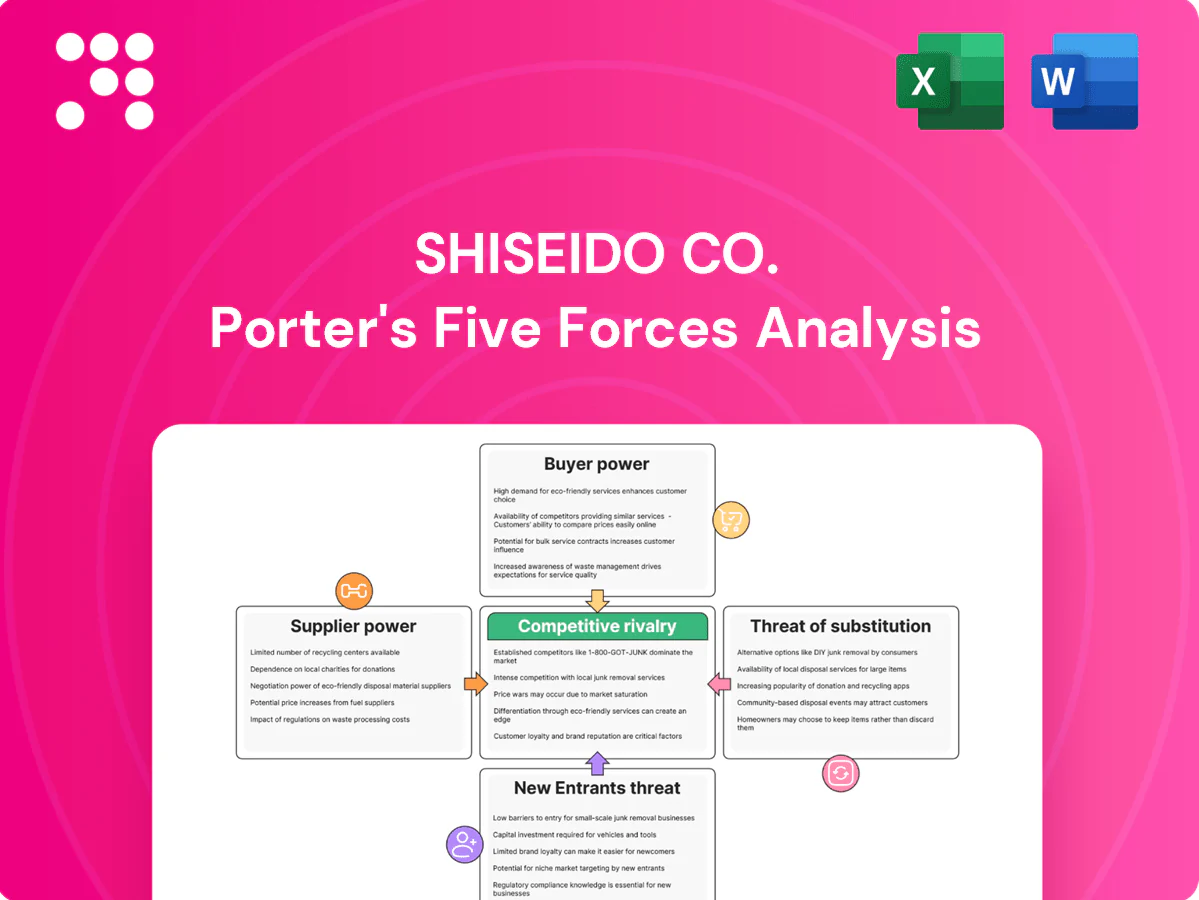
Shiseido Co. Porter's Five Forces Analysis

From Overview to Strategy Blueprint
Shiseido faces moderate rivalry driven by premium branding and global scale, while buyer power is mixed as loyal luxury consumers coexist with price‑sensitive segments. Supplier power remains low, but substitutes and agile new entrants via e‑commerce elevate threat levels. This brief snapshot only scratches the surface. Unlock the full Porter's Five Forces Analysis to explore Shiseido Co.’s competitive dynamics, market pressures, and strategic advantages in detail.
Suppliers Bargaining Power

Specialized actives and botanicals
High-performance skincare depends on patented actives, rare botanicals and biotech ingredients held by a limited supplier pool, creating price pressure and extended lead times for Shiseido. The company reduces exposure through multi-sourcing and long-term supplier partnerships, though switching costs for hero formulas remain meaningful. Dependence is assessed as moderate-to-high for cutting-edge 2024 launches.
Packaging and sustainable materials
Premium packaging, airless pumps and recyclable materials are concentrated among a few high-quality converters, giving suppliers elevated leverage as sustainability specs and complex designs tighten technical barriers. Shiseido’s global scale improves negotiating power, but regulatory ESG requirements and narrow vetted supplier pools limit alternatives. Any supplier disruption can delay launches and increase COGS significantly, squeezing margins.

Contract manufacturing and capacity
Peak-season capacity and specialized filling lines can be tight, raising supplier power for Shiseido as demand surges across prestige and mass channels. Shiseido balances in-house manufacturing across sites in Japan, France, China and the US with contract partners to smooth bottlenecks; FY2023 net sales were ¥1,012.9 billion. Qualification and tech-transfer create switching frictions, and capacity constraints can delay speed-to-market and promotional rollouts.

Logistics, FX, and geopolitics
Global sourcing ties Shiseido’s input costs to freight rates, tariffs and currency swings; freight rates remain roughly 50% below 2021 peaks as of 2024 but volatility persists, amplifying short-term cost swings. Volatile logistics markets and regional reshoring lift bargaining power of logistics providers and local suppliers. Shiseido’s FX hedging and regionalized supply chains materially reduce exposure but do not remove it, and critical SKUs still face timetable and cost pressure during disruptions.
- Freight volatility: elevated supplier leverage
- Hedging/regioning: lowers but not eliminates FX/logistics risk
- Critical SKUs: highest exposure to delays and cost spikes
Digital and media ecosystem
- Google+Meta ~52% of digital ad spend (2023)
- Influencer market ~21.1B USD (2023)
- Portfolio equity = leverage vs platforms
- Diversify channels to mitigate algorithm risk
Supplier leverage plus ad-platform concentration heighten cost and timing risk
Suppliers hold moderate-to-high leverage for patented actives, premium packaging and peak-season capacity, creating price and timing risk for Shiseido. Multi-sourcing, in-house sites and long-term contracts reduce but do not eliminate exposure. Logistics, tariffs and platform ad concentration (Google+Meta ~52% of digital spend 2023) amplify cost volatility.
| Factor | Impact | Data |
|---|---|---|
| Sales | Scale aid | ¥1,012.9B FY2023 |
| Freight | Volatility | ~50% below 2021 peaks (2024) |
| Ad platforms | Concentration | Google+Meta ~52% (2023) |
What is included in the product
 Detailed Word Document
Tailored exclusively for Shiseido Co., this Porter's Five Forces overview uncovers key drivers of competition, buyer and supplier power, and substitution threats shaping its cosmetic and skincare markets. It identifies disruptive entrants and substitutes, evaluates pricing influence and profitability pressures, and highlights market dynamics that deter new competitors and protect incumbents like Shiseido.

 Customizable Excel Spreadsheet
Clear one-sheet Porter's Five Forces for Shiseido—instantly visualize competitive pressure with a spider chart, customize threat levels for new entrants or regulation scenarios, and drop it straight into pitch decks or executive slides for quick strategic decisions.
Customers Bargaining Power

Retailer consolidation
Department stores, specialty beauty chains and drugstore groups (Sephora ≈2,900 stores, Ulta ≈1,300 stores in 2024) command shelf space and shopper data, enabling them to press suppliers on trade terms, slotting fees and promotional funding. Their scale pushes down margins and raises promotional intensity. Shiseido’s global brands boost negotiating leverage, but rising retailer private labels erode supplier pricing power. Joint business planning with key accounts partially aligns incentives.
E-commerce platforms and transparency
Marketplaces and DTC channels boost price visibility and review-driven choices, with global beauty e-commerce surpassing ~30% of retail sales in 2024, increasing consumer price sensitivity and cross-brand comparison. Shiseido defends margins via differentiated formulations, exclusive gift sets and a loyalty program; dynamic pricing and seamless omnichannel integration remain crucial to retain margin and lifetime value.

Low switching costs for consumers
Shoppers readily trial new brands in makeup and fragrance, keeping bargaining power high as novelty and price promotions drive switching. Skincare shows stronger brand loyalty, yet claims, clinical data and KOL endorsements can still sway customers. Shiseido offsets this by investing in efficacy proof and extensive sampling programs to anchor repeat purchases. Overall switching costs remain low-to-moderate for the category.

Regional preference diversity
APAC skincare sophistication and local nuances shape demand, with the APAC skincare market estimated at about $83.5 billion in 2024, driving demand for localized textures, shades and routines. Buyers expect customization, raising adaptation costs that give consumers indirect bargaining power despite Shiseido’s J-beauty heritage. Shiseido’s broad portfolio (luxury to mass) buffers regional swings but increases SKU complexity and cost.
- Regional APAC demand: $83.5B (2024)
- Customization raises adaptation cost, increasing buyer power
- Portfolio breadth mitigates but adds complexity
Demand for clean and ethical products
Demand for clean and ethical products drives buyer leverage: 67% of consumers in 2024 favored sustainable beauty, pushing ingredient transparency, cruelty-free claims and sustainability certifications; buyers pressure reformulation or certification while Shiseido’s R&D can respond but faces material compliance timelines and costs. Credible ESG storytelling lowers defection risk and preserves premium pricing.
- Ingredient transparency
- Cruelty-free
- Sustainability certification
30% ecom, 67% sustainability tilt squeeze premium beauty
Retailers and marketplaces (Sephora ~2,900; Ulta ~1,300) and ~30% beauty e‑commerce share in 2024 exert strong pricing/promotional pressure on Shiseido, offset by brand strength and loyalty programs. Low switching costs in makeup and 67% 2024 preference for sustainable beauty increase buyer leverage. APAC skincare ($83.5B 2024) demands localization, raising adaptation costs.
| Metric | 2024 |
|---|---|
| Sephora stores | ~2,900 |
| Ulta stores | ~1,300 |
| Beauty e‑commerce share | ~30% |
| APAC skincare | $83.5B |
Full Version Awaits
Shiseido Co. Porter's Five Forces Analysis
This preview is the exact, professionally formatted Porter's Five Forces analysis for Shiseido Co. you'll receive instantly after purchase—no placeholders or samples. The report examines competitive rivalry, supplier and buyer power, threats from new entrants and substitutes, and strategic implications for Shiseido's cosmetics and skincare markets. It's ready for immediate use.

From Overview to Strategy Blueprint
Shiseido faces moderate rivalry driven by premium branding and global scale, while buyer power is mixed as loyal luxury consumers coexist with price‑sensitive segments. Supplier power remains low, but substitutes and agile new entrants via e‑commerce elevate threat levels. This brief snapshot only scratches the surface. Unlock the full Porter's Five Forces Analysis to explore Shiseido Co.’s competitive dynamics, market pressures, and strategic advantages in detail.
Suppliers Bargaining Power
Specialized actives and botanicals
High-performance skincare depends on patented actives, rare botanicals and biotech ingredients held by a limited supplier pool, creating price pressure and extended lead times for Shiseido. The company reduces exposure through multi-sourcing and long-term supplier partnerships, though switching costs for hero formulas remain meaningful. Dependence is assessed as moderate-to-high for cutting-edge 2024 launches.
Packaging and sustainable materials
Premium packaging, airless pumps and recyclable materials are concentrated among a few high-quality converters, giving suppliers elevated leverage as sustainability specs and complex designs tighten technical barriers. Shiseido’s global scale improves negotiating power, but regulatory ESG requirements and narrow vetted supplier pools limit alternatives. Any supplier disruption can delay launches and increase COGS significantly, squeezing margins.
Contract manufacturing and capacity
Peak-season capacity and specialized filling lines can be tight, raising supplier power for Shiseido as demand surges across prestige and mass channels. Shiseido balances in-house manufacturing across sites in Japan, France, China and the US with contract partners to smooth bottlenecks; FY2023 net sales were ¥1,012.9 billion. Qualification and tech-transfer create switching frictions, and capacity constraints can delay speed-to-market and promotional rollouts.
Logistics, FX, and geopolitics
Global sourcing ties Shiseido’s input costs to freight rates, tariffs and currency swings; freight rates remain roughly 50% below 2021 peaks as of 2024 but volatility persists, amplifying short-term cost swings. Volatile logistics markets and regional reshoring lift bargaining power of logistics providers and local suppliers. Shiseido’s FX hedging and regionalized supply chains materially reduce exposure but do not remove it, and critical SKUs still face timetable and cost pressure during disruptions.
- Freight volatility: elevated supplier leverage
- Hedging/regioning: lowers but not eliminates FX/logistics risk
- Critical SKUs: highest exposure to delays and cost spikes
Digital and media ecosystem
- Google+Meta ~52% of digital ad spend (2023)
- Influencer market ~21.1B USD (2023)
- Portfolio equity = leverage vs platforms
- Diversify channels to mitigate algorithm risk
Supplier leverage plus ad-platform concentration heighten cost and timing risk
Suppliers hold moderate-to-high leverage for patented actives, premium packaging and peak-season capacity, creating price and timing risk for Shiseido. Multi-sourcing, in-house sites and long-term contracts reduce but do not eliminate exposure. Logistics, tariffs and platform ad concentration (Google+Meta ~52% of digital spend 2023) amplify cost volatility.
| Factor | Impact | Data |
|---|---|---|
| Sales | Scale aid | ¥1,012.9B FY2023 |
| Freight | Volatility | ~50% below 2021 peaks (2024) |
| Ad platforms | Concentration | Google+Meta ~52% (2023) |
What is included in the product
Detailed Word Document
Tailored exclusively for Shiseido Co., this Porter's Five Forces overview uncovers key drivers of competition, buyer and supplier power, and substitution threats shaping its cosmetic and skincare markets. It identifies disruptive entrants and substitutes, evaluates pricing influence and profitability pressures, and highlights market dynamics that deter new competitors and protect incumbents like Shiseido.
Customizable Excel Spreadsheet
Clear one-sheet Porter's Five Forces for Shiseido—instantly visualize competitive pressure with a spider chart, customize threat levels for new entrants or regulation scenarios, and drop it straight into pitch decks or executive slides for quick strategic decisions.
Customers Bargaining Power
Retailer consolidation
Department stores, specialty beauty chains and drugstore groups (Sephora ≈2,900 stores, Ulta ≈1,300 stores in 2024) command shelf space and shopper data, enabling them to press suppliers on trade terms, slotting fees and promotional funding. Their scale pushes down margins and raises promotional intensity. Shiseido’s global brands boost negotiating leverage, but rising retailer private labels erode supplier pricing power. Joint business planning with key accounts partially aligns incentives.
E-commerce platforms and transparency
Marketplaces and DTC channels boost price visibility and review-driven choices, with global beauty e-commerce surpassing ~30% of retail sales in 2024, increasing consumer price sensitivity and cross-brand comparison. Shiseido defends margins via differentiated formulations, exclusive gift sets and a loyalty program; dynamic pricing and seamless omnichannel integration remain crucial to retain margin and lifetime value.
Low switching costs for consumers
Shoppers readily trial new brands in makeup and fragrance, keeping bargaining power high as novelty and price promotions drive switching. Skincare shows stronger brand loyalty, yet claims, clinical data and KOL endorsements can still sway customers. Shiseido offsets this by investing in efficacy proof and extensive sampling programs to anchor repeat purchases. Overall switching costs remain low-to-moderate for the category.
Regional preference diversity
APAC skincare sophistication and local nuances shape demand, with the APAC skincare market estimated at about $83.5 billion in 2024, driving demand for localized textures, shades and routines. Buyers expect customization, raising adaptation costs that give consumers indirect bargaining power despite Shiseido’s J-beauty heritage. Shiseido’s broad portfolio (luxury to mass) buffers regional swings but increases SKU complexity and cost.
- Regional APAC demand: $83.5B (2024)
- Customization raises adaptation cost, increasing buyer power
- Portfolio breadth mitigates but adds complexity
Demand for clean and ethical products
Demand for clean and ethical products drives buyer leverage: 67% of consumers in 2024 favored sustainable beauty, pushing ingredient transparency, cruelty-free claims and sustainability certifications; buyers pressure reformulation or certification while Shiseido’s R&D can respond but faces material compliance timelines and costs. Credible ESG storytelling lowers defection risk and preserves premium pricing.
- Ingredient transparency
- Cruelty-free
- Sustainability certification
30% ecom, 67% sustainability tilt squeeze premium beauty
Retailers and marketplaces (Sephora ~2,900; Ulta ~1,300) and ~30% beauty e‑commerce share in 2024 exert strong pricing/promotional pressure on Shiseido, offset by brand strength and loyalty programs. Low switching costs in makeup and 67% 2024 preference for sustainable beauty increase buyer leverage. APAC skincare ($83.5B 2024) demands localization, raising adaptation costs.
| Metric | 2024 |
|---|---|
| Sephora stores | ~2,900 |
| Ulta stores | ~1,300 |
| Beauty e‑commerce share | ~30% |
| APAC skincare | $83.5B |
Full Version Awaits
Shiseido Co. Porter's Five Forces Analysis
This preview is the exact, professionally formatted Porter's Five Forces analysis for Shiseido Co. you'll receive instantly after purchase—no placeholders or samples. The report examines competitive rivalry, supplier and buyer power, threats from new entrants and substitutes, and strategic implications for Shiseido's cosmetics and skincare markets. It's ready for immediate use.
Original: $10.00
-65%$10.00
$3.50Description
From Overview to Strategy Blueprint
Shiseido faces moderate rivalry driven by premium branding and global scale, while buyer power is mixed as loyal luxury consumers coexist with price‑sensitive segments. Supplier power remains low, but substitutes and agile new entrants via e‑commerce elevate threat levels. This brief snapshot only scratches the surface. Unlock the full Porter's Five Forces Analysis to explore Shiseido Co.’s competitive dynamics, market pressures, and strategic advantages in detail.
Suppliers Bargaining Power
Specialized actives and botanicals
High-performance skincare depends on patented actives, rare botanicals and biotech ingredients held by a limited supplier pool, creating price pressure and extended lead times for Shiseido. The company reduces exposure through multi-sourcing and long-term supplier partnerships, though switching costs for hero formulas remain meaningful. Dependence is assessed as moderate-to-high for cutting-edge 2024 launches.
Packaging and sustainable materials
Premium packaging, airless pumps and recyclable materials are concentrated among a few high-quality converters, giving suppliers elevated leverage as sustainability specs and complex designs tighten technical barriers. Shiseido’s global scale improves negotiating power, but regulatory ESG requirements and narrow vetted supplier pools limit alternatives. Any supplier disruption can delay launches and increase COGS significantly, squeezing margins.
Contract manufacturing and capacity
Peak-season capacity and specialized filling lines can be tight, raising supplier power for Shiseido as demand surges across prestige and mass channels. Shiseido balances in-house manufacturing across sites in Japan, France, China and the US with contract partners to smooth bottlenecks; FY2023 net sales were ¥1,012.9 billion. Qualification and tech-transfer create switching frictions, and capacity constraints can delay speed-to-market and promotional rollouts.
Logistics, FX, and geopolitics
Global sourcing ties Shiseido’s input costs to freight rates, tariffs and currency swings; freight rates remain roughly 50% below 2021 peaks as of 2024 but volatility persists, amplifying short-term cost swings. Volatile logistics markets and regional reshoring lift bargaining power of logistics providers and local suppliers. Shiseido’s FX hedging and regionalized supply chains materially reduce exposure but do not remove it, and critical SKUs still face timetable and cost pressure during disruptions.
- Freight volatility: elevated supplier leverage
- Hedging/regioning: lowers but not eliminates FX/logistics risk
- Critical SKUs: highest exposure to delays and cost spikes
Digital and media ecosystem
- Google+Meta ~52% of digital ad spend (2023)
- Influencer market ~21.1B USD (2023)
- Portfolio equity = leverage vs platforms
- Diversify channels to mitigate algorithm risk
Supplier leverage plus ad-platform concentration heighten cost and timing risk
Suppliers hold moderate-to-high leverage for patented actives, premium packaging and peak-season capacity, creating price and timing risk for Shiseido. Multi-sourcing, in-house sites and long-term contracts reduce but do not eliminate exposure. Logistics, tariffs and platform ad concentration (Google+Meta ~52% of digital spend 2023) amplify cost volatility.
| Factor | Impact | Data |
|---|---|---|
| Sales | Scale aid | ¥1,012.9B FY2023 |
| Freight | Volatility | ~50% below 2021 peaks (2024) |
| Ad platforms | Concentration | Google+Meta ~52% (2023) |
What is included in the product
Detailed Word Document
Tailored exclusively for Shiseido Co., this Porter's Five Forces overview uncovers key drivers of competition, buyer and supplier power, and substitution threats shaping its cosmetic and skincare markets. It identifies disruptive entrants and substitutes, evaluates pricing influence and profitability pressures, and highlights market dynamics that deter new competitors and protect incumbents like Shiseido.
Customizable Excel Spreadsheet
Clear one-sheet Porter's Five Forces for Shiseido—instantly visualize competitive pressure with a spider chart, customize threat levels for new entrants or regulation scenarios, and drop it straight into pitch decks or executive slides for quick strategic decisions.
Customers Bargaining Power
Retailer consolidation
Department stores, specialty beauty chains and drugstore groups (Sephora ≈2,900 stores, Ulta ≈1,300 stores in 2024) command shelf space and shopper data, enabling them to press suppliers on trade terms, slotting fees and promotional funding. Their scale pushes down margins and raises promotional intensity. Shiseido’s global brands boost negotiating leverage, but rising retailer private labels erode supplier pricing power. Joint business planning with key accounts partially aligns incentives.
E-commerce platforms and transparency
Marketplaces and DTC channels boost price visibility and review-driven choices, with global beauty e-commerce surpassing ~30% of retail sales in 2024, increasing consumer price sensitivity and cross-brand comparison. Shiseido defends margins via differentiated formulations, exclusive gift sets and a loyalty program; dynamic pricing and seamless omnichannel integration remain crucial to retain margin and lifetime value.
Low switching costs for consumers
Shoppers readily trial new brands in makeup and fragrance, keeping bargaining power high as novelty and price promotions drive switching. Skincare shows stronger brand loyalty, yet claims, clinical data and KOL endorsements can still sway customers. Shiseido offsets this by investing in efficacy proof and extensive sampling programs to anchor repeat purchases. Overall switching costs remain low-to-moderate for the category.
Regional preference diversity
APAC skincare sophistication and local nuances shape demand, with the APAC skincare market estimated at about $83.5 billion in 2024, driving demand for localized textures, shades and routines. Buyers expect customization, raising adaptation costs that give consumers indirect bargaining power despite Shiseido’s J-beauty heritage. Shiseido’s broad portfolio (luxury to mass) buffers regional swings but increases SKU complexity and cost.
- Regional APAC demand: $83.5B (2024)
- Customization raises adaptation cost, increasing buyer power
- Portfolio breadth mitigates but adds complexity
Demand for clean and ethical products
Demand for clean and ethical products drives buyer leverage: 67% of consumers in 2024 favored sustainable beauty, pushing ingredient transparency, cruelty-free claims and sustainability certifications; buyers pressure reformulation or certification while Shiseido’s R&D can respond but faces material compliance timelines and costs. Credible ESG storytelling lowers defection risk and preserves premium pricing.
- Ingredient transparency
- Cruelty-free
- Sustainability certification
30% ecom, 67% sustainability tilt squeeze premium beauty
Retailers and marketplaces (Sephora ~2,900; Ulta ~1,300) and ~30% beauty e‑commerce share in 2024 exert strong pricing/promotional pressure on Shiseido, offset by brand strength and loyalty programs. Low switching costs in makeup and 67% 2024 preference for sustainable beauty increase buyer leverage. APAC skincare ($83.5B 2024) demands localization, raising adaptation costs.
| Metric | 2024 |
|---|---|
| Sephora stores | ~2,900 |
| Ulta stores | ~1,300 |
| Beauty e‑commerce share | ~30% |
| APAC skincare | $83.5B |
Full Version Awaits
Shiseido Co. Porter's Five Forces Analysis
This preview is the exact, professionally formatted Porter's Five Forces analysis for Shiseido Co. you'll receive instantly after purchase—no placeholders or samples. The report examines competitive rivalry, supplier and buyer power, threats from new entrants and substitutes, and strategic implications for Shiseido's cosmetics and skincare markets. It's ready for immediate use.











