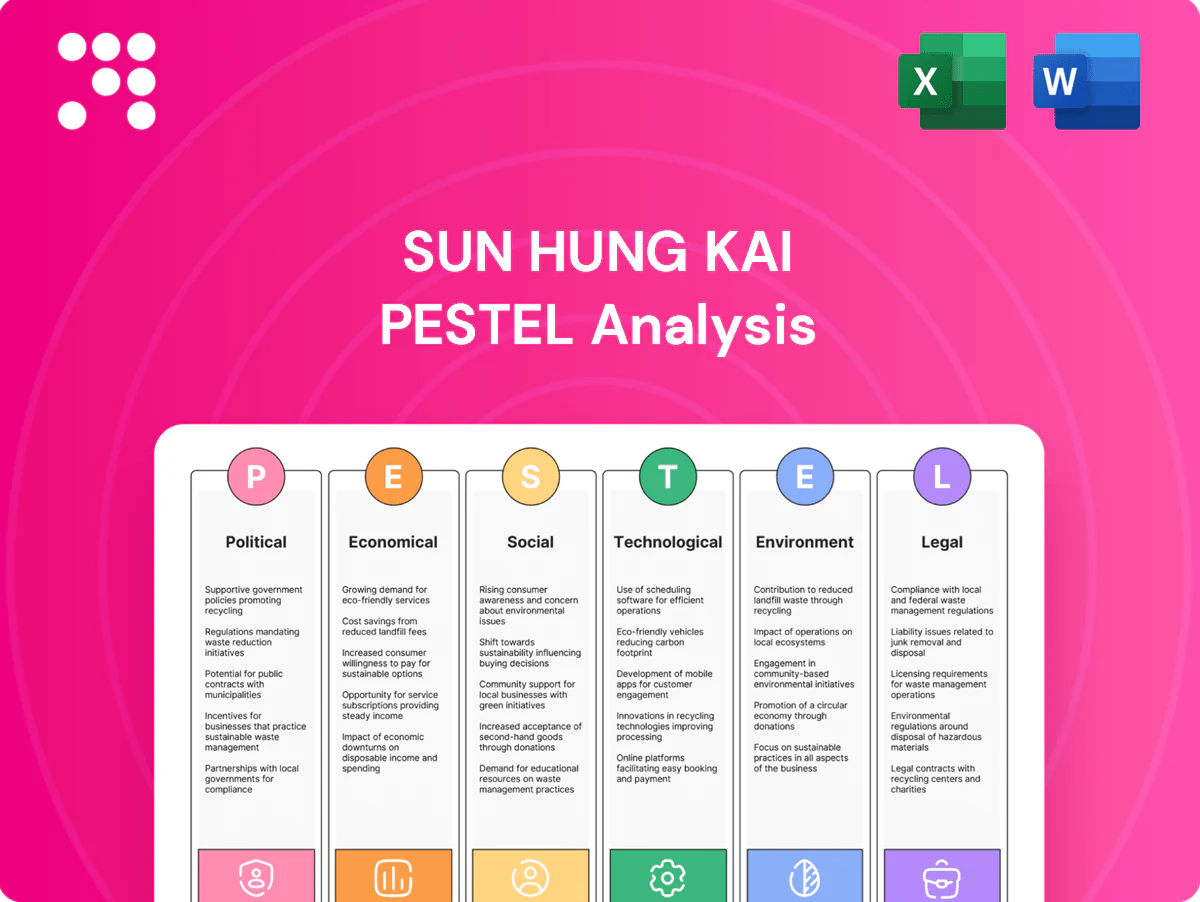
Sun Hung Kai PESTLE Analysis

Skip the Research. Get the Strategy.
Discover how political shifts, economic cycles, and rising ESG expectations shape Sun Hung Kai’s strategic outlook in our concise PESTLE snapshot. This expert analysis highlights regulatory risks, market drivers, and technological opportunities relevant to investors and planners. Purchase the full PESTLE to access deep-dive insights, Excel-ready data, and actionable recommendations for confident decision-making.
Political factors

HK–Mainland policy alignment and GBA integration
Closer HK–Mainland policy alignment is reshaping capital flows, licensing and product access, with Stock Connect northbound daily turnover averaging about HK$70 billion in 2023, increasing cross-border liquidity. Greater Bay Area initiatives, whose combined GDP exceeds US$1.8 trillion, expand client pools and deal sourcing for private markets. Policy shifts can change settlement, custody and tax treatments, so Sun Hung Kai & Co. must adapt offerings to capture cross-border wealth and private-market opportunities.
US–China geopolitical tensions and sanctions risk
US–China tensions have hit technology, healthcare and financial investments as expanded US export controls on advanced semiconductors (October 2022) and allied measures in 2023 tightened access to key inputs. Sanctions and export controls can constrict portfolio companies’ supply chains and China market access, forcing operational shifts. Investors demand higher risk premia on China-exposed assets, so active screening and contingency planning are essential for compliance and valuation resilience.

HK government financial-market development agenda
HK government policy support for asset management, family offices and alternatives—backed by tax concessions and market‑connect enhancements—creates tailwinds for Sun Hung Kai; Hong Kong hosted over 1,000 family offices by 2024. Incentives and product‑opening via Stock Connect and Bond Connect boost distribution. HKMA and SFC regulatory sandboxes accelerate brokerage and wealth‑tech innovation, aligning Sun Hung Kai with priority growth channels.

Political stability and governance perceptions
Perceptions of rule-of-law and institutional robustness shape foreign capital appetite for Sun Hung Kai, with global FDI flows down 12% in 2023 per UNCTAD, highlighting sensitivity to governance signals. Political stability supports long-duration property investment and RE exposures; negative headlines can spark outflows and valuation compression. Proactive disclosure and strong governance practices sustain investor confidence.
- Rule-of-law sensitivity: impacts foreign capital
- Stability: supports longer-duration real estate bets
- Risks: headlines → outflows, valuation pressure
- Mitigation: proactive communication & governance
Regional competition from Singapore and others
Jurisdictional competition shapes fund domiciles, listings and family‑office hubs: Singapore hosted over 700 family offices by 2024 while Hong Kong counted roughly 300 after incentive measures. Policy gaps on tax, visas and regulation drive talent and client migration; fee pressure has cut average hedge fund management fees to about 1.1% in 2024. Strong alternatives and cross‑border platforms can defend market share.
- 700+ family offices: Singapore (2024)
- ~300 family offices: Hong Kong (2024)
- Avg hedge fund fee ~1.1% (2024)
- Tax/visa differentials drive migration
HK–Mainland policy, Stock Connect and GBA lift cross‑border wealth; compliance and FDI risks persist
Closer HK–Mainland policy alignment (Stock Connect ~HK$70bn daily turnover in 2023) and GBA scale (GDP >US$1.8tn) expand cross‑border wealth and private‑market pools, while US–China export controls (since 2022) raise compliance and repricing needs. HK incentives grew family offices to ~300 by 2024 vs Singapore 700+, pressuring domicile competition and fees (avg hedge fund mgmt fee ~1.1% in 2024). Rule‑of‑law perceptions and a 12% drop in global FDI (UNCTAD 2023) keep capital flows sensitive.
| Indicator | Value |
|---|---|
| Stock Connect daily turnover (2023) | HK$70bn |
| GBA combined GDP | US$1.8tn+ |
| Family offices (2024) | HK ~300; SG 700+ |
| Avg hedge fund fee (2024) | ~1.1% |
| Global FDI change (2023) | -12% |
What is included in the product
 Detailed Word Document
Explores how Political, Economic, Social, Technological, Environmental and Legal forces uniquely affect Sun Hung Kai, with data-backed insights and region-specific trends. Designed for executives and investors, it highlights forward-looking risks and opportunities to inform strategy, financing and scenario planning.

 Customizable Excel Spreadsheet
Concise, visually segmented PESTLE summary of Sun Hung Kai that saves time in meetings and presentations by highlighting key external risks and opportunities, is easily customizable with region- or business-specific notes, and produces shareable slides or handouts for quick alignment across teams.
Economic factors

Interest-rate cycle and funding costs
Global rate moves — US fed funds at 5.25–5.50% and 10-year yields near 4.0% in 2024–25 — lift discount rates, raise carry and slow deal activity, compressing valuations across Sun Hung Kai’s portfolio. Higher financing costs strain leveraged strategies and cap-rate expansion pressures; lower rates historically revive IPO/M&A exits and offshore wealth flows. Dynamic duration and liquidity management are critical to protect NAV and refinancing risk.
HKD–USD peg and currency dynamics
HKD peg at 7.75–7.85/USD anchors local rates to US policy, transmitting higher US policy rates (above 5% in 2024) into lending and margin financing costs. Stable HKD supports cross‑border client confidence; RMB experienced several percent swings vs USD in 2024, affecting Mainland‑linked cash flows. Hedging and multicurrency products can mitigate FX risk.

Equity/credit market cycles and volatility
Public market swings in 2024–25 materially affected brokerage volumes and wealth AUM flows, reducing equity trading in risk-off phases and shifting client allocations toward cash and fixed income; spread widening since late 2023 tightened financing for private deals and property, slowing new LBO and development activity. Volatility created short-term trading opportunities for Sun Hung Kai’s brokerage desks while elevating margin and compliance controls, and portfolio diversification across sectors helped smooth returns amid market gyrations.

China growth trajectory and sector rotations
Healthcare, financial services and real estate remain highly sensitive to China growth and policy pulses; Beijing set a 2024 GDP target near 5%, and property markets saw continued price pressure and weak transactions in 2024 while selective fiscal/credit support re-rated some developers. Slower growth shifts focus to resilient cash‑flow assets; policy-led pockets can re-rate rapidly, so bottom-up underwriting must reflect wide macro dispersion and exit volatility.
- Healthcare: policy-sensitive reimbursement and pricing
- Financials: NPL risk vs. policy support
- Real estate: post-2021 stress, selective recoveries
- Underwriting: granular macro scenario stress
Capital formation and exit environment
IPO windows and secondary markets drive liquidity for Sun Hung Kai’s private holdings; global private equity dry powder exceeded $2.0 trillion at end-2024, supporting deal flow and alternative strategies, while tighter exit markets can extend holding periods and delay IRR realization.
- IPO/secondaries: liquidity pulse
- Dry powder: >$2.0 trillion (end-2024)
- Tight exits: longer hold, delayed IRR
- Flexible routes: trade sale, buybacks, secondaries
HK–Mainland policy, Stock Connect and GBA lift cross‑border wealth; compliance and FDI risks persist
Higher global rates (US ff 5.25–5.50% and 10y ~4.0% in 2024) raise discount rates and financing costs, compressing valuations; HKD peg (7.75–7.85/USD) transmits US policy to local lending; China 2024 GDP target ~5% and weak property activity shift allocations to cash/defensive assets; private equity dry powder >$2.0tn (end-2024) sustains deal competition but lengthens exits.
| Metric | Value (2024/25) |
|---|---|
| US fed funds | 5.25–5.50% |
| US 10y | ~4.0% |
| HKD peg | 7.75–7.85/USD |
| China GDP target | ~5% |
| PE dry powder | >$2.0tn |
Full Version Awaits
Sun Hung Kai PESTLE Analysis
The preview shown here is the exact document you'll receive after purchase—fully formatted and ready to use. The Sun Hung Kai PESTLE Analysis content, layout, and structure visible in this preview are identical to the final file you'll download. No placeholders or teasers—this is the real, professionally structured report you'll own immediately after checkout.

Skip the Research. Get the Strategy.
Discover how political shifts, economic cycles, and rising ESG expectations shape Sun Hung Kai’s strategic outlook in our concise PESTLE snapshot. This expert analysis highlights regulatory risks, market drivers, and technological opportunities relevant to investors and planners. Purchase the full PESTLE to access deep-dive insights, Excel-ready data, and actionable recommendations for confident decision-making.
Political factors
HK–Mainland policy alignment and GBA integration
Closer HK–Mainland policy alignment is reshaping capital flows, licensing and product access, with Stock Connect northbound daily turnover averaging about HK$70 billion in 2023, increasing cross-border liquidity. Greater Bay Area initiatives, whose combined GDP exceeds US$1.8 trillion, expand client pools and deal sourcing for private markets. Policy shifts can change settlement, custody and tax treatments, so Sun Hung Kai & Co. must adapt offerings to capture cross-border wealth and private-market opportunities.
US–China geopolitical tensions and sanctions risk
US–China tensions have hit technology, healthcare and financial investments as expanded US export controls on advanced semiconductors (October 2022) and allied measures in 2023 tightened access to key inputs. Sanctions and export controls can constrict portfolio companies’ supply chains and China market access, forcing operational shifts. Investors demand higher risk premia on China-exposed assets, so active screening and contingency planning are essential for compliance and valuation resilience.
HK government financial-market development agenda
HK government policy support for asset management, family offices and alternatives—backed by tax concessions and market‑connect enhancements—creates tailwinds for Sun Hung Kai; Hong Kong hosted over 1,000 family offices by 2024. Incentives and product‑opening via Stock Connect and Bond Connect boost distribution. HKMA and SFC regulatory sandboxes accelerate brokerage and wealth‑tech innovation, aligning Sun Hung Kai with priority growth channels.
Political stability and governance perceptions
Perceptions of rule-of-law and institutional robustness shape foreign capital appetite for Sun Hung Kai, with global FDI flows down 12% in 2023 per UNCTAD, highlighting sensitivity to governance signals. Political stability supports long-duration property investment and RE exposures; negative headlines can spark outflows and valuation compression. Proactive disclosure and strong governance practices sustain investor confidence.
- Rule-of-law sensitivity: impacts foreign capital
- Stability: supports longer-duration real estate bets
- Risks: headlines → outflows, valuation pressure
- Mitigation: proactive communication & governance
Regional competition from Singapore and others
Jurisdictional competition shapes fund domiciles, listings and family‑office hubs: Singapore hosted over 700 family offices by 2024 while Hong Kong counted roughly 300 after incentive measures. Policy gaps on tax, visas and regulation drive talent and client migration; fee pressure has cut average hedge fund management fees to about 1.1% in 2024. Strong alternatives and cross‑border platforms can defend market share.
- 700+ family offices: Singapore (2024)
- ~300 family offices: Hong Kong (2024)
- Avg hedge fund fee ~1.1% (2024)
- Tax/visa differentials drive migration
HK–Mainland policy, Stock Connect and GBA lift cross‑border wealth; compliance and FDI risks persist
Closer HK–Mainland policy alignment (Stock Connect ~HK$70bn daily turnover in 2023) and GBA scale (GDP >US$1.8tn) expand cross‑border wealth and private‑market pools, while US–China export controls (since 2022) raise compliance and repricing needs. HK incentives grew family offices to ~300 by 2024 vs Singapore 700+, pressuring domicile competition and fees (avg hedge fund mgmt fee ~1.1% in 2024). Rule‑of‑law perceptions and a 12% drop in global FDI (UNCTAD 2023) keep capital flows sensitive.
| Indicator | Value |
|---|---|
| Stock Connect daily turnover (2023) | HK$70bn |
| GBA combined GDP | US$1.8tn+ |
| Family offices (2024) | HK ~300; SG 700+ |
| Avg hedge fund fee (2024) | ~1.1% |
| Global FDI change (2023) | -12% |
What is included in the product
Detailed Word Document
Explores how Political, Economic, Social, Technological, Environmental and Legal forces uniquely affect Sun Hung Kai, with data-backed insights and region-specific trends. Designed for executives and investors, it highlights forward-looking risks and opportunities to inform strategy, financing and scenario planning.
Customizable Excel Spreadsheet
Concise, visually segmented PESTLE summary of Sun Hung Kai that saves time in meetings and presentations by highlighting key external risks and opportunities, is easily customizable with region- or business-specific notes, and produces shareable slides or handouts for quick alignment across teams.
Economic factors
Interest-rate cycle and funding costs
Global rate moves — US fed funds at 5.25–5.50% and 10-year yields near 4.0% in 2024–25 — lift discount rates, raise carry and slow deal activity, compressing valuations across Sun Hung Kai’s portfolio. Higher financing costs strain leveraged strategies and cap-rate expansion pressures; lower rates historically revive IPO/M&A exits and offshore wealth flows. Dynamic duration and liquidity management are critical to protect NAV and refinancing risk.
HKD–USD peg and currency dynamics
HKD peg at 7.75–7.85/USD anchors local rates to US policy, transmitting higher US policy rates (above 5% in 2024) into lending and margin financing costs. Stable HKD supports cross‑border client confidence; RMB experienced several percent swings vs USD in 2024, affecting Mainland‑linked cash flows. Hedging and multicurrency products can mitigate FX risk.
Equity/credit market cycles and volatility
Public market swings in 2024–25 materially affected brokerage volumes and wealth AUM flows, reducing equity trading in risk-off phases and shifting client allocations toward cash and fixed income; spread widening since late 2023 tightened financing for private deals and property, slowing new LBO and development activity. Volatility created short-term trading opportunities for Sun Hung Kai’s brokerage desks while elevating margin and compliance controls, and portfolio diversification across sectors helped smooth returns amid market gyrations.
China growth trajectory and sector rotations
Healthcare, financial services and real estate remain highly sensitive to China growth and policy pulses; Beijing set a 2024 GDP target near 5%, and property markets saw continued price pressure and weak transactions in 2024 while selective fiscal/credit support re-rated some developers. Slower growth shifts focus to resilient cash‑flow assets; policy-led pockets can re-rate rapidly, so bottom-up underwriting must reflect wide macro dispersion and exit volatility.
- Healthcare: policy-sensitive reimbursement and pricing
- Financials: NPL risk vs. policy support
- Real estate: post-2021 stress, selective recoveries
- Underwriting: granular macro scenario stress
Capital formation and exit environment
IPO windows and secondary markets drive liquidity for Sun Hung Kai’s private holdings; global private equity dry powder exceeded $2.0 trillion at end-2024, supporting deal flow and alternative strategies, while tighter exit markets can extend holding periods and delay IRR realization.
- IPO/secondaries: liquidity pulse
- Dry powder: >$2.0 trillion (end-2024)
- Tight exits: longer hold, delayed IRR
- Flexible routes: trade sale, buybacks, secondaries
HK–Mainland policy, Stock Connect and GBA lift cross‑border wealth; compliance and FDI risks persist
Higher global rates (US ff 5.25–5.50% and 10y ~4.0% in 2024) raise discount rates and financing costs, compressing valuations; HKD peg (7.75–7.85/USD) transmits US policy to local lending; China 2024 GDP target ~5% and weak property activity shift allocations to cash/defensive assets; private equity dry powder >$2.0tn (end-2024) sustains deal competition but lengthens exits.
| Metric | Value (2024/25) |
|---|---|
| US fed funds | 5.25–5.50% |
| US 10y | ~4.0% |
| HKD peg | 7.75–7.85/USD |
| China GDP target | ~5% |
| PE dry powder | >$2.0tn |
Full Version Awaits
Sun Hung Kai PESTLE Analysis
The preview shown here is the exact document you'll receive after purchase—fully formatted and ready to use. The Sun Hung Kai PESTLE Analysis content, layout, and structure visible in this preview are identical to the final file you'll download. No placeholders or teasers—this is the real, professionally structured report you'll own immediately after checkout.
Original: $10.00
-65%$10.00
$3.50Description
Skip the Research. Get the Strategy.
Discover how political shifts, economic cycles, and rising ESG expectations shape Sun Hung Kai’s strategic outlook in our concise PESTLE snapshot. This expert analysis highlights regulatory risks, market drivers, and technological opportunities relevant to investors and planners. Purchase the full PESTLE to access deep-dive insights, Excel-ready data, and actionable recommendations for confident decision-making.
Political factors
HK–Mainland policy alignment and GBA integration
Closer HK–Mainland policy alignment is reshaping capital flows, licensing and product access, with Stock Connect northbound daily turnover averaging about HK$70 billion in 2023, increasing cross-border liquidity. Greater Bay Area initiatives, whose combined GDP exceeds US$1.8 trillion, expand client pools and deal sourcing for private markets. Policy shifts can change settlement, custody and tax treatments, so Sun Hung Kai & Co. must adapt offerings to capture cross-border wealth and private-market opportunities.
US–China geopolitical tensions and sanctions risk
US–China tensions have hit technology, healthcare and financial investments as expanded US export controls on advanced semiconductors (October 2022) and allied measures in 2023 tightened access to key inputs. Sanctions and export controls can constrict portfolio companies’ supply chains and China market access, forcing operational shifts. Investors demand higher risk premia on China-exposed assets, so active screening and contingency planning are essential for compliance and valuation resilience.
HK government financial-market development agenda
HK government policy support for asset management, family offices and alternatives—backed by tax concessions and market‑connect enhancements—creates tailwinds for Sun Hung Kai; Hong Kong hosted over 1,000 family offices by 2024. Incentives and product‑opening via Stock Connect and Bond Connect boost distribution. HKMA and SFC regulatory sandboxes accelerate brokerage and wealth‑tech innovation, aligning Sun Hung Kai with priority growth channels.
Political stability and governance perceptions
Perceptions of rule-of-law and institutional robustness shape foreign capital appetite for Sun Hung Kai, with global FDI flows down 12% in 2023 per UNCTAD, highlighting sensitivity to governance signals. Political stability supports long-duration property investment and RE exposures; negative headlines can spark outflows and valuation compression. Proactive disclosure and strong governance practices sustain investor confidence.
- Rule-of-law sensitivity: impacts foreign capital
- Stability: supports longer-duration real estate bets
- Risks: headlines → outflows, valuation pressure
- Mitigation: proactive communication & governance
Regional competition from Singapore and others
Jurisdictional competition shapes fund domiciles, listings and family‑office hubs: Singapore hosted over 700 family offices by 2024 while Hong Kong counted roughly 300 after incentive measures. Policy gaps on tax, visas and regulation drive talent and client migration; fee pressure has cut average hedge fund management fees to about 1.1% in 2024. Strong alternatives and cross‑border platforms can defend market share.
- 700+ family offices: Singapore (2024)
- ~300 family offices: Hong Kong (2024)
- Avg hedge fund fee ~1.1% (2024)
- Tax/visa differentials drive migration
HK–Mainland policy, Stock Connect and GBA lift cross‑border wealth; compliance and FDI risks persist
Closer HK–Mainland policy alignment (Stock Connect ~HK$70bn daily turnover in 2023) and GBA scale (GDP >US$1.8tn) expand cross‑border wealth and private‑market pools, while US–China export controls (since 2022) raise compliance and repricing needs. HK incentives grew family offices to ~300 by 2024 vs Singapore 700+, pressuring domicile competition and fees (avg hedge fund mgmt fee ~1.1% in 2024). Rule‑of‑law perceptions and a 12% drop in global FDI (UNCTAD 2023) keep capital flows sensitive.
| Indicator | Value |
|---|---|
| Stock Connect daily turnover (2023) | HK$70bn |
| GBA combined GDP | US$1.8tn+ |
| Family offices (2024) | HK ~300; SG 700+ |
| Avg hedge fund fee (2024) | ~1.1% |
| Global FDI change (2023) | -12% |
What is included in the product
Detailed Word Document
Explores how Political, Economic, Social, Technological, Environmental and Legal forces uniquely affect Sun Hung Kai, with data-backed insights and region-specific trends. Designed for executives and investors, it highlights forward-looking risks and opportunities to inform strategy, financing and scenario planning.
Customizable Excel Spreadsheet
Concise, visually segmented PESTLE summary of Sun Hung Kai that saves time in meetings and presentations by highlighting key external risks and opportunities, is easily customizable with region- or business-specific notes, and produces shareable slides or handouts for quick alignment across teams.
Economic factors
Interest-rate cycle and funding costs
Global rate moves — US fed funds at 5.25–5.50% and 10-year yields near 4.0% in 2024–25 — lift discount rates, raise carry and slow deal activity, compressing valuations across Sun Hung Kai’s portfolio. Higher financing costs strain leveraged strategies and cap-rate expansion pressures; lower rates historically revive IPO/M&A exits and offshore wealth flows. Dynamic duration and liquidity management are critical to protect NAV and refinancing risk.
HKD–USD peg and currency dynamics
HKD peg at 7.75–7.85/USD anchors local rates to US policy, transmitting higher US policy rates (above 5% in 2024) into lending and margin financing costs. Stable HKD supports cross‑border client confidence; RMB experienced several percent swings vs USD in 2024, affecting Mainland‑linked cash flows. Hedging and multicurrency products can mitigate FX risk.
Equity/credit market cycles and volatility
Public market swings in 2024–25 materially affected brokerage volumes and wealth AUM flows, reducing equity trading in risk-off phases and shifting client allocations toward cash and fixed income; spread widening since late 2023 tightened financing for private deals and property, slowing new LBO and development activity. Volatility created short-term trading opportunities for Sun Hung Kai’s brokerage desks while elevating margin and compliance controls, and portfolio diversification across sectors helped smooth returns amid market gyrations.
China growth trajectory and sector rotations
Healthcare, financial services and real estate remain highly sensitive to China growth and policy pulses; Beijing set a 2024 GDP target near 5%, and property markets saw continued price pressure and weak transactions in 2024 while selective fiscal/credit support re-rated some developers. Slower growth shifts focus to resilient cash‑flow assets; policy-led pockets can re-rate rapidly, so bottom-up underwriting must reflect wide macro dispersion and exit volatility.
- Healthcare: policy-sensitive reimbursement and pricing
- Financials: NPL risk vs. policy support
- Real estate: post-2021 stress, selective recoveries
- Underwriting: granular macro scenario stress
Capital formation and exit environment
IPO windows and secondary markets drive liquidity for Sun Hung Kai’s private holdings; global private equity dry powder exceeded $2.0 trillion at end-2024, supporting deal flow and alternative strategies, while tighter exit markets can extend holding periods and delay IRR realization.
- IPO/secondaries: liquidity pulse
- Dry powder: >$2.0 trillion (end-2024)
- Tight exits: longer hold, delayed IRR
- Flexible routes: trade sale, buybacks, secondaries
HK–Mainland policy, Stock Connect and GBA lift cross‑border wealth; compliance and FDI risks persist
Higher global rates (US ff 5.25–5.50% and 10y ~4.0% in 2024) raise discount rates and financing costs, compressing valuations; HKD peg (7.75–7.85/USD) transmits US policy to local lending; China 2024 GDP target ~5% and weak property activity shift allocations to cash/defensive assets; private equity dry powder >$2.0tn (end-2024) sustains deal competition but lengthens exits.
| Metric | Value (2024/25) |
|---|---|
| US fed funds | 5.25–5.50% |
| US 10y | ~4.0% |
| HKD peg | 7.75–7.85/USD |
| China GDP target | ~5% |
| PE dry powder | >$2.0tn |
Full Version Awaits
Sun Hung Kai PESTLE Analysis
The preview shown here is the exact document you'll receive after purchase—fully formatted and ready to use. The Sun Hung Kai PESTLE Analysis content, layout, and structure visible in this preview are identical to the final file you'll download. No placeholders or teasers—this is the real, professionally structured report you'll own immediately after checkout.











