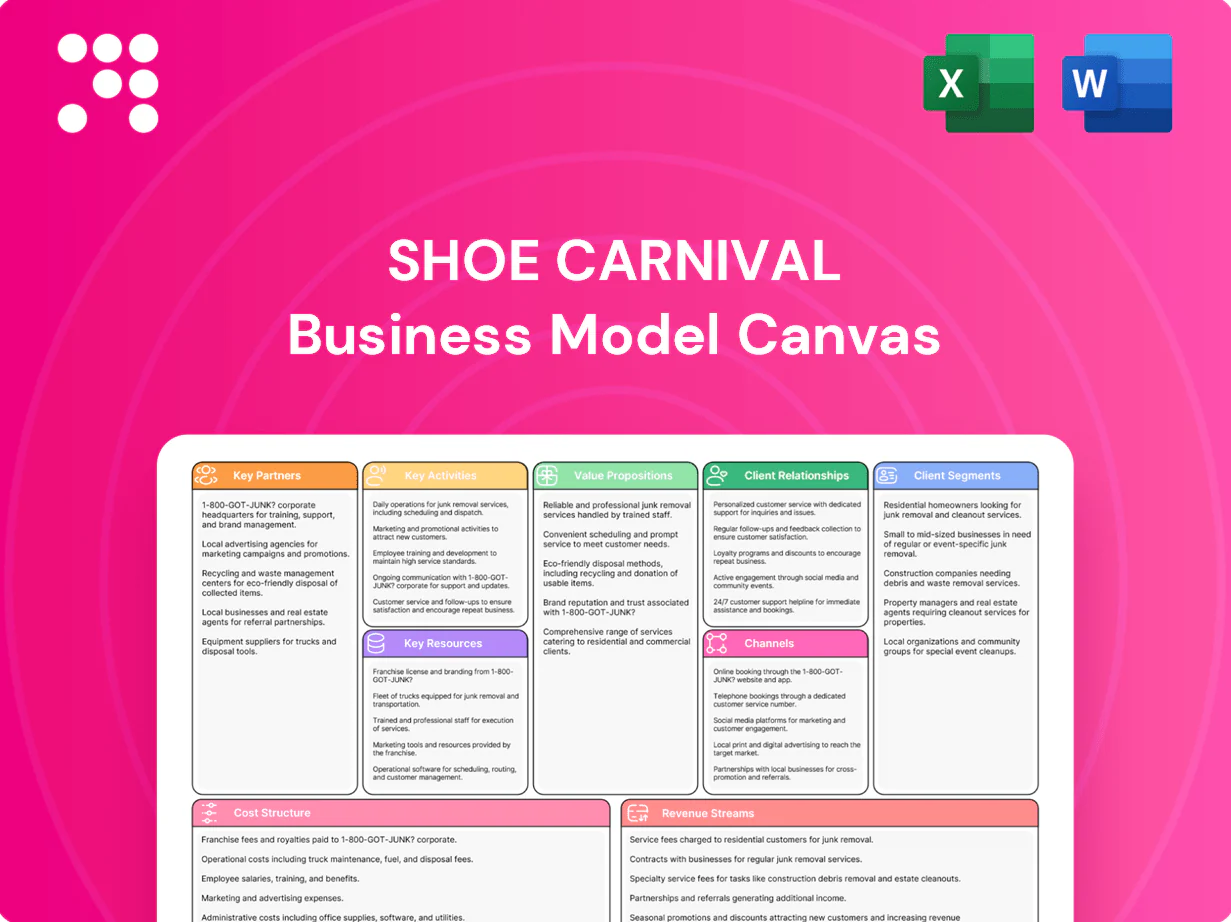
Shoe Carnival Business Model Canvas

Unlock the footwear retail playbook with a concise Business Model Canvas overview
Unlock Shoe Carnival's strategic playbook with our concise Business Model Canvas overview. This snapshot explains value propositions, customer segments, key partners and revenue levers that drive store and digital growth. Download the full, editable Canvas in Word/Excel to benchmark, adapt, and implement these insights.
Partnerships

Branded footwear suppliers
In 2024 Shoe Carnival’s relationships with major brands including Nike, Adidas and Skechers ensure breadth, authenticity and trend-right assortments across athletic, casual and dress categories. Priority access to vendor allocations supports timely product drops and fast replenishment. Collaborative planning enables co-op marketing and exclusive SKUs. Reliable branded supply underpins margin and store traffic.
Third-party logistics providers
Regional carriers and 3PLs enable efficient inbound freight, store replenishment, and last-mile e-commerce delivery for Shoe Carnival's ~350 stores; SLAs balance speed and cost—targeting 1–2 day store replenishment and 2–4 day e-commerce delivery. Seasonal flex capacity scales for holiday peaks, often doubling pick/ship capacity, while data sharing with 3PL partners improves routing and inventory turns.

Technology and e-commerce platforms
Partners for POS, OMS, CRM and site search power Shoe Carnival’s omnichannel execution, tying in-store and online inventory as US e-commerce reached about 16% of retail sales in 2023. Robust integrations enable buy-online-pickup-in-store and ship-from-store fulfilment to shorten fulfillment times and improve SKU visibility. Analytics vendors drive personalization and conversion, often boosting revenues 10–15%. Cybersecurity partners mitigate risks, with the average breach cost $4.45M (IBM 2023).

Real estate and mall landlords
Landlords provide access to high-traffic centers in target regions and lease negotiations secure favorable rents plus co-tenancy protections. Co-promotions with mall partners drive footfall during key retail events, aided by 2024 mall traffic at about 88% of 2019 levels per ICSC. Strategic locations anchor brand visibility and convenience, supporting store-level revenue recovery.
- Access: high-traffic malls in target regions
- Lease terms: favorable rents and co-tenancy protections
- Marketing: co-promotions boost event footfall (~88% of 2019 traffic in 2024)
Marketing and payments partners
Marketing partners — media agencies, social platforms and loyalty tech — amplify Shoe Carnival’s promotions and community outreach across its ~360 stores (2024) and digital channels; loyalty-driven campaigns improve repeat purchase rates. Payment networks and BNPL providers broaden tender options and lift average order value by about 20% (industry 2024). Co-op funds with brands extend campaign reach; fraud and chargeback partners reduce loss and lower dispute rates.
- media-agencies
- social-platforms
- loyalty-tech
- payment-networks
- BNPL-providers
- brand-co-op-funds
- fraud-chargeback-partners
Omnichannel partnerships: ~360 stores, ~16% e-comm
Key partnerships with brands, 3PLs/carriers, tech vendors, landlords and marketing/payment partners secure assortments, fast replenishment, omnichannel fulfillment and promotional reach across ~360 stores (2024) and e‑commerce (~16% sales in 2023).
| Partner | Role | KPI |
|---|---|---|
| Brands | Supply/allocations | Exclusive SKUs |
| 3PLs | Fulfillment | 2–4d e‑comm |
| Payments | Checkout | +20% AOV |
What is included in the product
 Detailed Word Document
A comprehensive Business Model Canvas for Shoe Carnival outlining customer segments, channels, value propositions, revenue streams, key resources, partners, activities, cost structure and customer relationships in full narrative form. Ideal for presentations and investor discussions, it links competitive advantages and SWOT insights to real-world retail operations.

 Customizable Excel Spreadsheet
High-level view of Shoe Carnival’s business model with editable cells — quickly surface how its value proposition, discount-driven assortment, and store-plus-online network relieve customers’ deal-seeking, selection, and convenience pain points.
Activities

Merchandising and assortment planning
Curating family footwear across price points and styles aligns assortments to regional demand and supports Shoe Carnival's roughly 300-store footprint (2024). Open-to-buy disciplines drive seasonal breadth/depth control and protect inventory turns. Close vendor collaboration secures exclusive SKUs and margin support, while continuous line reviews trim slow movers to improve sell-through and gross margin performance.
Omnichannel retail operations
Running stores and e-commerce in sync delivers a seamless shopping journey for shoppers across more than 300 stores (2024), unifying inventory, pricing and customer data. BOPIS, BORIS and ship-from-store improve convenience and lift inventory utilization by enabling faster fulfillment and higher turnover. Regular store events and a targeted promotional cadence drive in-store traffic and omnichannel conversion. Consistent service standards preserve Shoe Carnival’s signature fun shopping experience.

Inventory and supply chain management
Forecasting and allocation balance store and online demand for Shoe Carnival (ticker SCVL), which operates approximately 360 stores, ensuring assortments match local demand. Efficient DC operations, replenishment and reverse logistics cut stockouts and markdowns while improving on-shelf availability. Active lead-time management mitigates supplier and transportation disruptions. Data-driven inventory decisions boost turns and free cash flow.

Marketing and loyalty engagement
Marketing and loyalty engagement uses promotions, digital ads and email/SMS to nurture repeat purchases; loyalty offers, coupons and gamified events raise visit frequency, social content showcases new arrivals and deals, and local outreach targets families and back-to-school seasons. Shoe Carnival (NASDAQ: SCVL) operates ~330 stores in 2024.
- Promos + email/SMS: repeat sales
- Loyalty & gamification: increase visits
- Social: product discovery & deals
- Local outreach: family & back-to-school
Store experience and workforce training
Associates deliver energetic, value-focused service that drives in-store conversion and average transaction value; Shoe Carnival operated approximately 360 stores in 2024 supporting this model. Product knowledge and fit assistance elevate conversion and reduce returns, while visual merchandising spotlights deals and newness to accelerate turnover. Safety, loss prevention, and service KPIs (shrink, incident rates, NPS) sustain consistent performance.
- Stores: ~360 (2024)
- Focus: conversion, ATV, returns
- Merch: deals + newness
- KPIs: shrink, incidents, NPS
Omnichannel family footwear strategy increases turns, fulfillment speed and margin protection
Curating family footwear across price points and regions supports Shoe Carnival’s omnichannel assortments and inventory turns, anchored by vendor exclusives and open-to-buy discipline (stores ~360 in 2024).
Synchronizing stores and e-commerce (BOPIS, ship-from-store) raises fulfillment speed and turnover while events and promotions drive traffic and conversion.
Data-driven forecasting, DC efficiency and returns management reduce stockouts and markdowns, protecting gross margin.
| Metric | 2024 |
|---|---|
| Stores | ~360 |
| Ticker | SCVL |
| Channels | Stores + e-commerce + BOPIS |
Preview Before You Purchase
Business Model Canvas
The document you're previewing is a genuine excerpt of the Shoe Carnival Business Model Canvas, not a mockup or sample; it shows the exact structure and content you'll receive. After purchase you'll download the full, editable file formatted identically for immediate use in presentations, analysis, or sharing.

Unlock the footwear retail playbook with a concise Business Model Canvas overview
Unlock Shoe Carnival's strategic playbook with our concise Business Model Canvas overview. This snapshot explains value propositions, customer segments, key partners and revenue levers that drive store and digital growth. Download the full, editable Canvas in Word/Excel to benchmark, adapt, and implement these insights.
Partnerships
Branded footwear suppliers
In 2024 Shoe Carnival’s relationships with major brands including Nike, Adidas and Skechers ensure breadth, authenticity and trend-right assortments across athletic, casual and dress categories. Priority access to vendor allocations supports timely product drops and fast replenishment. Collaborative planning enables co-op marketing and exclusive SKUs. Reliable branded supply underpins margin and store traffic.
Third-party logistics providers
Regional carriers and 3PLs enable efficient inbound freight, store replenishment, and last-mile e-commerce delivery for Shoe Carnival's ~350 stores; SLAs balance speed and cost—targeting 1–2 day store replenishment and 2–4 day e-commerce delivery. Seasonal flex capacity scales for holiday peaks, often doubling pick/ship capacity, while data sharing with 3PL partners improves routing and inventory turns.
Technology and e-commerce platforms
Partners for POS, OMS, CRM and site search power Shoe Carnival’s omnichannel execution, tying in-store and online inventory as US e-commerce reached about 16% of retail sales in 2023. Robust integrations enable buy-online-pickup-in-store and ship-from-store fulfilment to shorten fulfillment times and improve SKU visibility. Analytics vendors drive personalization and conversion, often boosting revenues 10–15%. Cybersecurity partners mitigate risks, with the average breach cost $4.45M (IBM 2023).
Real estate and mall landlords
Landlords provide access to high-traffic centers in target regions and lease negotiations secure favorable rents plus co-tenancy protections. Co-promotions with mall partners drive footfall during key retail events, aided by 2024 mall traffic at about 88% of 2019 levels per ICSC. Strategic locations anchor brand visibility and convenience, supporting store-level revenue recovery.
- Access: high-traffic malls in target regions
- Lease terms: favorable rents and co-tenancy protections
- Marketing: co-promotions boost event footfall (~88% of 2019 traffic in 2024)
Marketing and payments partners
Marketing partners — media agencies, social platforms and loyalty tech — amplify Shoe Carnival’s promotions and community outreach across its ~360 stores (2024) and digital channels; loyalty-driven campaigns improve repeat purchase rates. Payment networks and BNPL providers broaden tender options and lift average order value by about 20% (industry 2024). Co-op funds with brands extend campaign reach; fraud and chargeback partners reduce loss and lower dispute rates.
- media-agencies
- social-platforms
- loyalty-tech
- payment-networks
- BNPL-providers
- brand-co-op-funds
- fraud-chargeback-partners
Omnichannel partnerships: ~360 stores, ~16% e-comm
Key partnerships with brands, 3PLs/carriers, tech vendors, landlords and marketing/payment partners secure assortments, fast replenishment, omnichannel fulfillment and promotional reach across ~360 stores (2024) and e‑commerce (~16% sales in 2023).
| Partner | Role | KPI |
|---|---|---|
| Brands | Supply/allocations | Exclusive SKUs |
| 3PLs | Fulfillment | 2–4d e‑comm |
| Payments | Checkout | +20% AOV |
What is included in the product
Detailed Word Document
A comprehensive Business Model Canvas for Shoe Carnival outlining customer segments, channels, value propositions, revenue streams, key resources, partners, activities, cost structure and customer relationships in full narrative form. Ideal for presentations and investor discussions, it links competitive advantages and SWOT insights to real-world retail operations.
Customizable Excel Spreadsheet
High-level view of Shoe Carnival’s business model with editable cells — quickly surface how its value proposition, discount-driven assortment, and store-plus-online network relieve customers’ deal-seeking, selection, and convenience pain points.
Activities
Merchandising and assortment planning
Curating family footwear across price points and styles aligns assortments to regional demand and supports Shoe Carnival's roughly 300-store footprint (2024). Open-to-buy disciplines drive seasonal breadth/depth control and protect inventory turns. Close vendor collaboration secures exclusive SKUs and margin support, while continuous line reviews trim slow movers to improve sell-through and gross margin performance.
Omnichannel retail operations
Running stores and e-commerce in sync delivers a seamless shopping journey for shoppers across more than 300 stores (2024), unifying inventory, pricing and customer data. BOPIS, BORIS and ship-from-store improve convenience and lift inventory utilization by enabling faster fulfillment and higher turnover. Regular store events and a targeted promotional cadence drive in-store traffic and omnichannel conversion. Consistent service standards preserve Shoe Carnival’s signature fun shopping experience.
Inventory and supply chain management
Forecasting and allocation balance store and online demand for Shoe Carnival (ticker SCVL), which operates approximately 360 stores, ensuring assortments match local demand. Efficient DC operations, replenishment and reverse logistics cut stockouts and markdowns while improving on-shelf availability. Active lead-time management mitigates supplier and transportation disruptions. Data-driven inventory decisions boost turns and free cash flow.
Marketing and loyalty engagement
Marketing and loyalty engagement uses promotions, digital ads and email/SMS to nurture repeat purchases; loyalty offers, coupons and gamified events raise visit frequency, social content showcases new arrivals and deals, and local outreach targets families and back-to-school seasons. Shoe Carnival (NASDAQ: SCVL) operates ~330 stores in 2024.
- Promos + email/SMS: repeat sales
- Loyalty & gamification: increase visits
- Social: product discovery & deals
- Local outreach: family & back-to-school
Store experience and workforce training
Associates deliver energetic, value-focused service that drives in-store conversion and average transaction value; Shoe Carnival operated approximately 360 stores in 2024 supporting this model. Product knowledge and fit assistance elevate conversion and reduce returns, while visual merchandising spotlights deals and newness to accelerate turnover. Safety, loss prevention, and service KPIs (shrink, incident rates, NPS) sustain consistent performance.
- Stores: ~360 (2024)
- Focus: conversion, ATV, returns
- Merch: deals + newness
- KPIs: shrink, incidents, NPS
Omnichannel family footwear strategy increases turns, fulfillment speed and margin protection
Curating family footwear across price points and regions supports Shoe Carnival’s omnichannel assortments and inventory turns, anchored by vendor exclusives and open-to-buy discipline (stores ~360 in 2024).
Synchronizing stores and e-commerce (BOPIS, ship-from-store) raises fulfillment speed and turnover while events and promotions drive traffic and conversion.
Data-driven forecasting, DC efficiency and returns management reduce stockouts and markdowns, protecting gross margin.
| Metric | 2024 |
|---|---|
| Stores | ~360 |
| Ticker | SCVL |
| Channels | Stores + e-commerce + BOPIS |
Preview Before You Purchase
Business Model Canvas
The document you're previewing is a genuine excerpt of the Shoe Carnival Business Model Canvas, not a mockup or sample; it shows the exact structure and content you'll receive. After purchase you'll download the full, editable file formatted identically for immediate use in presentations, analysis, or sharing.
Original: $10.00
-65%$10.00
$3.50Description
Unlock the footwear retail playbook with a concise Business Model Canvas overview
Unlock Shoe Carnival's strategic playbook with our concise Business Model Canvas overview. This snapshot explains value propositions, customer segments, key partners and revenue levers that drive store and digital growth. Download the full, editable Canvas in Word/Excel to benchmark, adapt, and implement these insights.
Partnerships
Branded footwear suppliers
In 2024 Shoe Carnival’s relationships with major brands including Nike, Adidas and Skechers ensure breadth, authenticity and trend-right assortments across athletic, casual and dress categories. Priority access to vendor allocations supports timely product drops and fast replenishment. Collaborative planning enables co-op marketing and exclusive SKUs. Reliable branded supply underpins margin and store traffic.
Third-party logistics providers
Regional carriers and 3PLs enable efficient inbound freight, store replenishment, and last-mile e-commerce delivery for Shoe Carnival's ~350 stores; SLAs balance speed and cost—targeting 1–2 day store replenishment and 2–4 day e-commerce delivery. Seasonal flex capacity scales for holiday peaks, often doubling pick/ship capacity, while data sharing with 3PL partners improves routing and inventory turns.
Technology and e-commerce platforms
Partners for POS, OMS, CRM and site search power Shoe Carnival’s omnichannel execution, tying in-store and online inventory as US e-commerce reached about 16% of retail sales in 2023. Robust integrations enable buy-online-pickup-in-store and ship-from-store fulfilment to shorten fulfillment times and improve SKU visibility. Analytics vendors drive personalization and conversion, often boosting revenues 10–15%. Cybersecurity partners mitigate risks, with the average breach cost $4.45M (IBM 2023).
Real estate and mall landlords
Landlords provide access to high-traffic centers in target regions and lease negotiations secure favorable rents plus co-tenancy protections. Co-promotions with mall partners drive footfall during key retail events, aided by 2024 mall traffic at about 88% of 2019 levels per ICSC. Strategic locations anchor brand visibility and convenience, supporting store-level revenue recovery.
- Access: high-traffic malls in target regions
- Lease terms: favorable rents and co-tenancy protections
- Marketing: co-promotions boost event footfall (~88% of 2019 traffic in 2024)
Marketing and payments partners
Marketing partners — media agencies, social platforms and loyalty tech — amplify Shoe Carnival’s promotions and community outreach across its ~360 stores (2024) and digital channels; loyalty-driven campaigns improve repeat purchase rates. Payment networks and BNPL providers broaden tender options and lift average order value by about 20% (industry 2024). Co-op funds with brands extend campaign reach; fraud and chargeback partners reduce loss and lower dispute rates.
- media-agencies
- social-platforms
- loyalty-tech
- payment-networks
- BNPL-providers
- brand-co-op-funds
- fraud-chargeback-partners
Omnichannel partnerships: ~360 stores, ~16% e-comm
Key partnerships with brands, 3PLs/carriers, tech vendors, landlords and marketing/payment partners secure assortments, fast replenishment, omnichannel fulfillment and promotional reach across ~360 stores (2024) and e‑commerce (~16% sales in 2023).
| Partner | Role | KPI |
|---|---|---|
| Brands | Supply/allocations | Exclusive SKUs |
| 3PLs | Fulfillment | 2–4d e‑comm |
| Payments | Checkout | +20% AOV |
What is included in the product
Detailed Word Document
A comprehensive Business Model Canvas for Shoe Carnival outlining customer segments, channels, value propositions, revenue streams, key resources, partners, activities, cost structure and customer relationships in full narrative form. Ideal for presentations and investor discussions, it links competitive advantages and SWOT insights to real-world retail operations.
Customizable Excel Spreadsheet
High-level view of Shoe Carnival’s business model with editable cells — quickly surface how its value proposition, discount-driven assortment, and store-plus-online network relieve customers’ deal-seeking, selection, and convenience pain points.
Activities
Merchandising and assortment planning
Curating family footwear across price points and styles aligns assortments to regional demand and supports Shoe Carnival's roughly 300-store footprint (2024). Open-to-buy disciplines drive seasonal breadth/depth control and protect inventory turns. Close vendor collaboration secures exclusive SKUs and margin support, while continuous line reviews trim slow movers to improve sell-through and gross margin performance.
Omnichannel retail operations
Running stores and e-commerce in sync delivers a seamless shopping journey for shoppers across more than 300 stores (2024), unifying inventory, pricing and customer data. BOPIS, BORIS and ship-from-store improve convenience and lift inventory utilization by enabling faster fulfillment and higher turnover. Regular store events and a targeted promotional cadence drive in-store traffic and omnichannel conversion. Consistent service standards preserve Shoe Carnival’s signature fun shopping experience.
Inventory and supply chain management
Forecasting and allocation balance store and online demand for Shoe Carnival (ticker SCVL), which operates approximately 360 stores, ensuring assortments match local demand. Efficient DC operations, replenishment and reverse logistics cut stockouts and markdowns while improving on-shelf availability. Active lead-time management mitigates supplier and transportation disruptions. Data-driven inventory decisions boost turns and free cash flow.
Marketing and loyalty engagement
Marketing and loyalty engagement uses promotions, digital ads and email/SMS to nurture repeat purchases; loyalty offers, coupons and gamified events raise visit frequency, social content showcases new arrivals and deals, and local outreach targets families and back-to-school seasons. Shoe Carnival (NASDAQ: SCVL) operates ~330 stores in 2024.
- Promos + email/SMS: repeat sales
- Loyalty & gamification: increase visits
- Social: product discovery & deals
- Local outreach: family & back-to-school
Store experience and workforce training
Associates deliver energetic, value-focused service that drives in-store conversion and average transaction value; Shoe Carnival operated approximately 360 stores in 2024 supporting this model. Product knowledge and fit assistance elevate conversion and reduce returns, while visual merchandising spotlights deals and newness to accelerate turnover. Safety, loss prevention, and service KPIs (shrink, incident rates, NPS) sustain consistent performance.
- Stores: ~360 (2024)
- Focus: conversion, ATV, returns
- Merch: deals + newness
- KPIs: shrink, incidents, NPS
Omnichannel family footwear strategy increases turns, fulfillment speed and margin protection
Curating family footwear across price points and regions supports Shoe Carnival’s omnichannel assortments and inventory turns, anchored by vendor exclusives and open-to-buy discipline (stores ~360 in 2024).
Synchronizing stores and e-commerce (BOPIS, ship-from-store) raises fulfillment speed and turnover while events and promotions drive traffic and conversion.
Data-driven forecasting, DC efficiency and returns management reduce stockouts and markdowns, protecting gross margin.
| Metric | 2024 |
|---|---|
| Stores | ~360 |
| Ticker | SCVL |
| Channels | Stores + e-commerce + BOPIS |
Preview Before You Purchase
Business Model Canvas
The document you're previewing is a genuine excerpt of the Shoe Carnival Business Model Canvas, not a mockup or sample; it shows the exact structure and content you'll receive. After purchase you'll download the full, editable file formatted identically for immediate use in presentations, analysis, or sharing.











