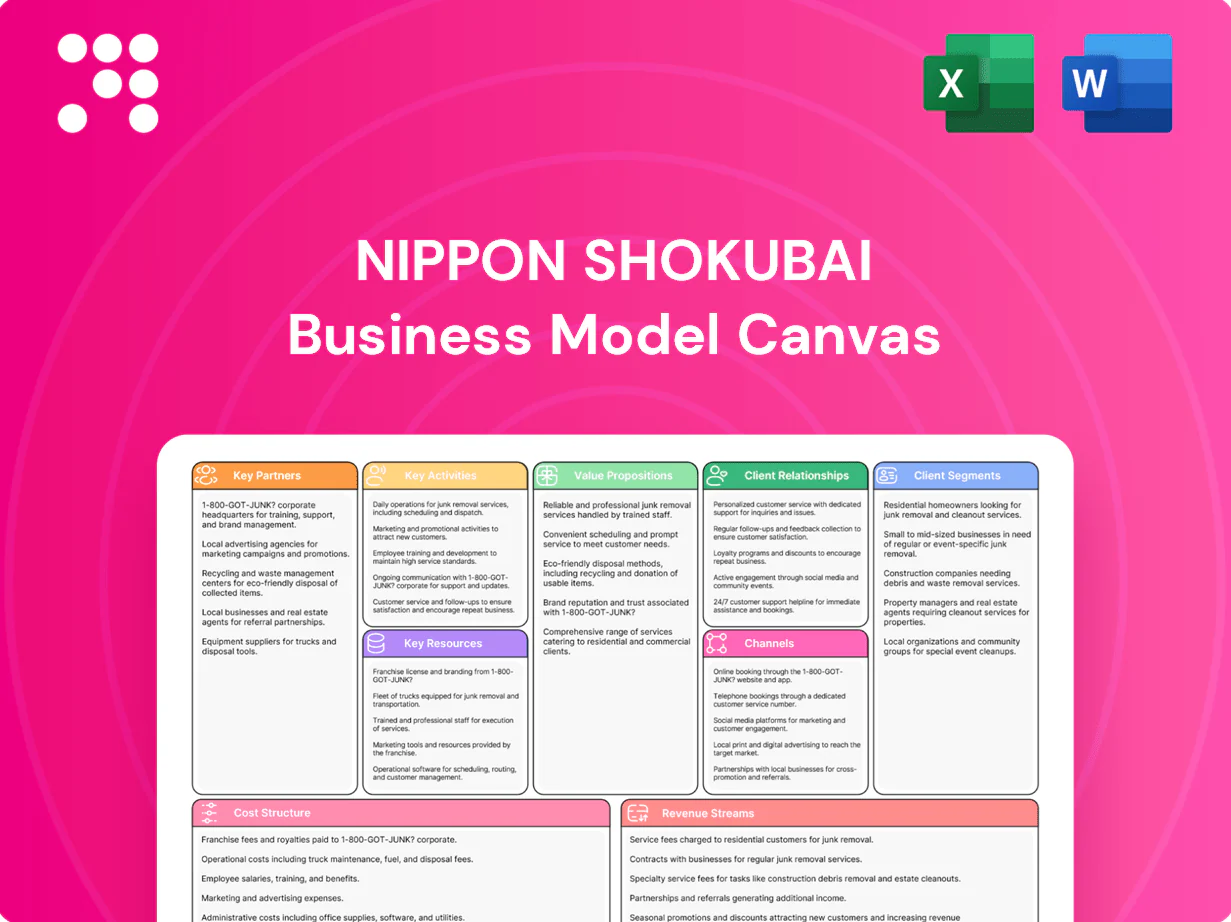
Nippon Shokubai Business Model Canvas

Unlock the strategic Business Model Canvas: value drivers, partners, and revenue levers
Unlock the full strategic blueprint behind Nippon Shokubai’s business model with our concise Business Model Canvas summary—covering value propositions, key partners, and revenue mechanics. This snapshot reveals how the company scales, mitigates risk, and captures market share. Purchase the full, editable Canvas for detailed, section-by-section insights ready for analysis or presentation.
Partnerships

Propylene and feedstock suppliers
Secure, diversified feedstock sourcing underpins acrylic acid and SAP production, with long-term contracts and hedging arrangements used to stabilize cost and availability. Close collaboration with propylene suppliers aligns specifications and sustainability standards to ensure continuity and regulatory compliance. Joint supply-risk mapping and contingency planning mitigate volatility and logistical disruptions across the value chain.
Global logistics and packaging providers
Specialized bulk, ISO-tank and palletized packaging partners ensure safe, UN-compliant shipment of chemicals and support temperature, moisture and contamination controls. Integrated logistics planning with these partners reduces lead times and inventory costs—Nippon Shokubai cites 15% faster delivery in pilot routes in 2024. Co-developing returnable packaging cut waste and packaging spend by ~20% in recent trials.

OEMs, converters, and formulators
Strategic ties with hygiene converters, adhesive makers and coatings formulators let Nippon Shokubai steer product specs to end-use needs, with early-stage design input aligning performance and shortening qualification. Joint trials cut time-to-qualification and lock in demand, supporting co-innovation agreements that raise switching costs and yield 3–5 year commitments; SAP demand grew about 6% in 2024.

Universities and research institutes
Academic collaborations extend frontier research in catalysis, polymer science and sustainability, enabling Nippon Shokubai to translate university discoveries into pilot processes.
Access to graduate talent and shared labs accelerates breakthrough development while IP co-creation frameworks balance speed with protection.
Government-backed consortia in 2024 continued unlocking grants and de-risking scale-up for joint commercialization.
- research focus: catalysis & polymers
- talent pipeline: grad students & postdocs
- IP: co-creation frameworks
- 2024: government consortia grants
Waste management and recycling partners
Partnerships trim lead times -15%, packaging costs -20%, lift SAP +6%
Key partnerships secure diversified feedstock (long-term contracts, hedges) for acrylic acid/SAP, supporting FY2023 revenue ¥359.3b and 6% SAP demand growth in 2024. Logistics and packaging partners cut lead times ~15% and packaging costs ~20% via returnable systems. Academic, gov't and waste-recycling partners accelerate R&D, grant-funded scale-up and circularity, improving VOC/waste compliance.
| Metric | Value |
|---|---|
| Delivery time | -15% |
| Packaging cost | -20% |
| SAP demand 2024 | +6% |
What is included in the product
 Detailed Word Document
A comprehensive, pre-written Business Model Canvas tailored to Nippon Shokubai, detailing customer segments, value propositions, channels, key activities, partners, resources, cost and revenue structures across the 9 BMC blocks. Includes SWOT, competitive advantages and polished narratives ideal for presentations, investor discussions and strategic validation.

 Customizable Excel Spreadsheet
High-level view of Nippon Shokubai's business model with editable cells, relieving pain by condensing complex chemical specialty value chains into a one-page, shareable snapshot for fast analysis and team alignment.
Activities

R&D in acrylics, SAP, and catalysts
R&D in new monomers, crosslinking systems and catalyst formulations drives product performance and scalability, with lab-to-pilot work scaled from gram to ~1,000 kg to validate manufacturability and cost targets. Lifecycle and LCA analysis steer eco-design, targeting 20–40% CO2 reductions versus legacy routes. Rigorous IP filing preserves differentiation and licensing upside.
Large-scale chemical manufacturing
Continuous continuous-process operations at Nippon Shokubai sustain product purity above 99% and stable yields, while advanced process control and debottlenecking raise throughput by about 15%. Predictive maintenance cuts unplanned downtime ~30% and lowers safety incidents; energy integration and heat recovery reduce unit energy costs 10–20% and carbon emissions ~15%.

Quality assurance and regulatory compliance
Batch analytics ensure tight spec adherence for sensitive applications, delivering traceable test results and lot release data as of 2024. ISO 9001 and ISO 14001 certifications and GMP-like controls at relevant sites enable healthcare and hygiene approvals. Global chemical regulations such as REACH and TSCA are actively managed across markets. Customer audits are supported with full traceability and comprehensive documentation.

Integrated supply chain and S&OP
Forecast-driven S&OP aligns Nippon Shokubai production to seasonal and regional demand, targeting OTIF rates near 98% and reducing stockouts during peak PTA and acrylic monomer seasons. Multi-sourcing and 2–4 weeks safety stock buffer feedstock volatility; vendor-managed inventory and consignment programs cut customer working capital by ~10–15%. Digital tracking delivers end-to-end visibility and real-time OTIF metrics.
- OTIF ~98%
- Safety stock 2–4 weeks
- Working capital reduction ~10–15%
- Real-time digital tracking
Technical service and application support
On-site trials and formulation tuning accelerate customer qualification and shorten time-to-market, while failure analysis and root-cause work cut scrap and downtime, improving yield and OEE. Training and handling guidance raise end-user performance and safety. Data sharing validates performance-in-use and enables co-marketing in 2024 partnerships.
- On-site trials
- Failure analysis
- Training & handling
- Data sharing & co-marketing
20–40% CO2 cut; >99% purity; +15% throughput
R&D scales novel monomers from gram-to-1,000 kg with IP protection and targets 20–40% CO2 reduction vs legacy routes (2024). Continuous processes sustain >99% purity, +15% throughput, ~30% less unplanned downtime and 10–20% lower unit energy costs. S&OP drives OTIF ~98%, 2–4 weeks safety stock and ~10–15% working capital reduction; on-site trials speed customer qualification.
| Metric | 2024 |
|---|---|
| Purity | >99% |
| Throughput | +15% |
| Downtime | -30% |
| Energy cost | -10–20% |
| CO2 reduction | 20–40% |
| OTIF | ~98% |
| Safety stock | 2–4 weeks |
| WC reduction | ~10–15% |
What You See Is What You Get
Business Model Canvas
The document previewed here is the actual Nippon Shokubai Business Model Canvas—not a mockup—and reflects the exact structure and content you’ll receive after purchase. Upon completing your order you’ll get the full, editable file in Word and Excel formats. No placeholders, no surprises, ready to present and customize.

Unlock the strategic Business Model Canvas: value drivers, partners, and revenue levers
Unlock the full strategic blueprint behind Nippon Shokubai’s business model with our concise Business Model Canvas summary—covering value propositions, key partners, and revenue mechanics. This snapshot reveals how the company scales, mitigates risk, and captures market share. Purchase the full, editable Canvas for detailed, section-by-section insights ready for analysis or presentation.
Partnerships
Propylene and feedstock suppliers
Secure, diversified feedstock sourcing underpins acrylic acid and SAP production, with long-term contracts and hedging arrangements used to stabilize cost and availability. Close collaboration with propylene suppliers aligns specifications and sustainability standards to ensure continuity and regulatory compliance. Joint supply-risk mapping and contingency planning mitigate volatility and logistical disruptions across the value chain.
Global logistics and packaging providers
Specialized bulk, ISO-tank and palletized packaging partners ensure safe, UN-compliant shipment of chemicals and support temperature, moisture and contamination controls. Integrated logistics planning with these partners reduces lead times and inventory costs—Nippon Shokubai cites 15% faster delivery in pilot routes in 2024. Co-developing returnable packaging cut waste and packaging spend by ~20% in recent trials.
OEMs, converters, and formulators
Strategic ties with hygiene converters, adhesive makers and coatings formulators let Nippon Shokubai steer product specs to end-use needs, with early-stage design input aligning performance and shortening qualification. Joint trials cut time-to-qualification and lock in demand, supporting co-innovation agreements that raise switching costs and yield 3–5 year commitments; SAP demand grew about 6% in 2024.
Universities and research institutes
Academic collaborations extend frontier research in catalysis, polymer science and sustainability, enabling Nippon Shokubai to translate university discoveries into pilot processes.
Access to graduate talent and shared labs accelerates breakthrough development while IP co-creation frameworks balance speed with protection.
Government-backed consortia in 2024 continued unlocking grants and de-risking scale-up for joint commercialization.
- research focus: catalysis & polymers
- talent pipeline: grad students & postdocs
- IP: co-creation frameworks
- 2024: government consortia grants
Waste management and recycling partners
Partnerships trim lead times -15%, packaging costs -20%, lift SAP +6%
Key partnerships secure diversified feedstock (long-term contracts, hedges) for acrylic acid/SAP, supporting FY2023 revenue ¥359.3b and 6% SAP demand growth in 2024. Logistics and packaging partners cut lead times ~15% and packaging costs ~20% via returnable systems. Academic, gov't and waste-recycling partners accelerate R&D, grant-funded scale-up and circularity, improving VOC/waste compliance.
| Metric | Value |
|---|---|
| Delivery time | -15% |
| Packaging cost | -20% |
| SAP demand 2024 | +6% |
What is included in the product
Detailed Word Document
A comprehensive, pre-written Business Model Canvas tailored to Nippon Shokubai, detailing customer segments, value propositions, channels, key activities, partners, resources, cost and revenue structures across the 9 BMC blocks. Includes SWOT, competitive advantages and polished narratives ideal for presentations, investor discussions and strategic validation.
Customizable Excel Spreadsheet
High-level view of Nippon Shokubai's business model with editable cells, relieving pain by condensing complex chemical specialty value chains into a one-page, shareable snapshot for fast analysis and team alignment.
Activities
R&D in acrylics, SAP, and catalysts
R&D in new monomers, crosslinking systems and catalyst formulations drives product performance and scalability, with lab-to-pilot work scaled from gram to ~1,000 kg to validate manufacturability and cost targets. Lifecycle and LCA analysis steer eco-design, targeting 20–40% CO2 reductions versus legacy routes. Rigorous IP filing preserves differentiation and licensing upside.
Large-scale chemical manufacturing
Continuous continuous-process operations at Nippon Shokubai sustain product purity above 99% and stable yields, while advanced process control and debottlenecking raise throughput by about 15%. Predictive maintenance cuts unplanned downtime ~30% and lowers safety incidents; energy integration and heat recovery reduce unit energy costs 10–20% and carbon emissions ~15%.
Quality assurance and regulatory compliance
Batch analytics ensure tight spec adherence for sensitive applications, delivering traceable test results and lot release data as of 2024. ISO 9001 and ISO 14001 certifications and GMP-like controls at relevant sites enable healthcare and hygiene approvals. Global chemical regulations such as REACH and TSCA are actively managed across markets. Customer audits are supported with full traceability and comprehensive documentation.
Integrated supply chain and S&OP
Forecast-driven S&OP aligns Nippon Shokubai production to seasonal and regional demand, targeting OTIF rates near 98% and reducing stockouts during peak PTA and acrylic monomer seasons. Multi-sourcing and 2–4 weeks safety stock buffer feedstock volatility; vendor-managed inventory and consignment programs cut customer working capital by ~10–15%. Digital tracking delivers end-to-end visibility and real-time OTIF metrics.
- OTIF ~98%
- Safety stock 2–4 weeks
- Working capital reduction ~10–15%
- Real-time digital tracking
Technical service and application support
On-site trials and formulation tuning accelerate customer qualification and shorten time-to-market, while failure analysis and root-cause work cut scrap and downtime, improving yield and OEE. Training and handling guidance raise end-user performance and safety. Data sharing validates performance-in-use and enables co-marketing in 2024 partnerships.
- On-site trials
- Failure analysis
- Training & handling
- Data sharing & co-marketing
20–40% CO2 cut; >99% purity; +15% throughput
R&D scales novel monomers from gram-to-1,000 kg with IP protection and targets 20–40% CO2 reduction vs legacy routes (2024). Continuous processes sustain >99% purity, +15% throughput, ~30% less unplanned downtime and 10–20% lower unit energy costs. S&OP drives OTIF ~98%, 2–4 weeks safety stock and ~10–15% working capital reduction; on-site trials speed customer qualification.
| Metric | 2024 |
|---|---|
| Purity | >99% |
| Throughput | +15% |
| Downtime | -30% |
| Energy cost | -10–20% |
| CO2 reduction | 20–40% |
| OTIF | ~98% |
| Safety stock | 2–4 weeks |
| WC reduction | ~10–15% |
What You See Is What You Get
Business Model Canvas
The document previewed here is the actual Nippon Shokubai Business Model Canvas—not a mockup—and reflects the exact structure and content you’ll receive after purchase. Upon completing your order you’ll get the full, editable file in Word and Excel formats. No placeholders, no surprises, ready to present and customize.
Original: $10.00
-65%$10.00
$3.50Description
Unlock the strategic Business Model Canvas: value drivers, partners, and revenue levers
Unlock the full strategic blueprint behind Nippon Shokubai’s business model with our concise Business Model Canvas summary—covering value propositions, key partners, and revenue mechanics. This snapshot reveals how the company scales, mitigates risk, and captures market share. Purchase the full, editable Canvas for detailed, section-by-section insights ready for analysis or presentation.
Partnerships
Propylene and feedstock suppliers
Secure, diversified feedstock sourcing underpins acrylic acid and SAP production, with long-term contracts and hedging arrangements used to stabilize cost and availability. Close collaboration with propylene suppliers aligns specifications and sustainability standards to ensure continuity and regulatory compliance. Joint supply-risk mapping and contingency planning mitigate volatility and logistical disruptions across the value chain.
Global logistics and packaging providers
Specialized bulk, ISO-tank and palletized packaging partners ensure safe, UN-compliant shipment of chemicals and support temperature, moisture and contamination controls. Integrated logistics planning with these partners reduces lead times and inventory costs—Nippon Shokubai cites 15% faster delivery in pilot routes in 2024. Co-developing returnable packaging cut waste and packaging spend by ~20% in recent trials.
OEMs, converters, and formulators
Strategic ties with hygiene converters, adhesive makers and coatings formulators let Nippon Shokubai steer product specs to end-use needs, with early-stage design input aligning performance and shortening qualification. Joint trials cut time-to-qualification and lock in demand, supporting co-innovation agreements that raise switching costs and yield 3–5 year commitments; SAP demand grew about 6% in 2024.
Universities and research institutes
Academic collaborations extend frontier research in catalysis, polymer science and sustainability, enabling Nippon Shokubai to translate university discoveries into pilot processes.
Access to graduate talent and shared labs accelerates breakthrough development while IP co-creation frameworks balance speed with protection.
Government-backed consortia in 2024 continued unlocking grants and de-risking scale-up for joint commercialization.
- research focus: catalysis & polymers
- talent pipeline: grad students & postdocs
- IP: co-creation frameworks
- 2024: government consortia grants
Waste management and recycling partners
Partnerships trim lead times -15%, packaging costs -20%, lift SAP +6%
Key partnerships secure diversified feedstock (long-term contracts, hedges) for acrylic acid/SAP, supporting FY2023 revenue ¥359.3b and 6% SAP demand growth in 2024. Logistics and packaging partners cut lead times ~15% and packaging costs ~20% via returnable systems. Academic, gov't and waste-recycling partners accelerate R&D, grant-funded scale-up and circularity, improving VOC/waste compliance.
| Metric | Value |
|---|---|
| Delivery time | -15% |
| Packaging cost | -20% |
| SAP demand 2024 | +6% |
What is included in the product
Detailed Word Document
A comprehensive, pre-written Business Model Canvas tailored to Nippon Shokubai, detailing customer segments, value propositions, channels, key activities, partners, resources, cost and revenue structures across the 9 BMC blocks. Includes SWOT, competitive advantages and polished narratives ideal for presentations, investor discussions and strategic validation.
Customizable Excel Spreadsheet
High-level view of Nippon Shokubai's business model with editable cells, relieving pain by condensing complex chemical specialty value chains into a one-page, shareable snapshot for fast analysis and team alignment.
Activities
R&D in acrylics, SAP, and catalysts
R&D in new monomers, crosslinking systems and catalyst formulations drives product performance and scalability, with lab-to-pilot work scaled from gram to ~1,000 kg to validate manufacturability and cost targets. Lifecycle and LCA analysis steer eco-design, targeting 20–40% CO2 reductions versus legacy routes. Rigorous IP filing preserves differentiation and licensing upside.
Large-scale chemical manufacturing
Continuous continuous-process operations at Nippon Shokubai sustain product purity above 99% and stable yields, while advanced process control and debottlenecking raise throughput by about 15%. Predictive maintenance cuts unplanned downtime ~30% and lowers safety incidents; energy integration and heat recovery reduce unit energy costs 10–20% and carbon emissions ~15%.
Quality assurance and regulatory compliance
Batch analytics ensure tight spec adherence for sensitive applications, delivering traceable test results and lot release data as of 2024. ISO 9001 and ISO 14001 certifications and GMP-like controls at relevant sites enable healthcare and hygiene approvals. Global chemical regulations such as REACH and TSCA are actively managed across markets. Customer audits are supported with full traceability and comprehensive documentation.
Integrated supply chain and S&OP
Forecast-driven S&OP aligns Nippon Shokubai production to seasonal and regional demand, targeting OTIF rates near 98% and reducing stockouts during peak PTA and acrylic monomer seasons. Multi-sourcing and 2–4 weeks safety stock buffer feedstock volatility; vendor-managed inventory and consignment programs cut customer working capital by ~10–15%. Digital tracking delivers end-to-end visibility and real-time OTIF metrics.
- OTIF ~98%
- Safety stock 2–4 weeks
- Working capital reduction ~10–15%
- Real-time digital tracking
Technical service and application support
On-site trials and formulation tuning accelerate customer qualification and shorten time-to-market, while failure analysis and root-cause work cut scrap and downtime, improving yield and OEE. Training and handling guidance raise end-user performance and safety. Data sharing validates performance-in-use and enables co-marketing in 2024 partnerships.
- On-site trials
- Failure analysis
- Training & handling
- Data sharing & co-marketing
20–40% CO2 cut; >99% purity; +15% throughput
R&D scales novel monomers from gram-to-1,000 kg with IP protection and targets 20–40% CO2 reduction vs legacy routes (2024). Continuous processes sustain >99% purity, +15% throughput, ~30% less unplanned downtime and 10–20% lower unit energy costs. S&OP drives OTIF ~98%, 2–4 weeks safety stock and ~10–15% working capital reduction; on-site trials speed customer qualification.
| Metric | 2024 |
|---|---|
| Purity | >99% |
| Throughput | +15% |
| Downtime | -30% |
| Energy cost | -10–20% |
| CO2 reduction | 20–40% |
| OTIF | ~98% |
| Safety stock | 2–4 weeks |
| WC reduction | ~10–15% |
What You See Is What You Get
Business Model Canvas
The document previewed here is the actual Nippon Shokubai Business Model Canvas—not a mockup—and reflects the exact structure and content you’ll receive after purchase. Upon completing your order you’ll get the full, editable file in Word and Excel formats. No placeholders, no surprises, ready to present and customize.











