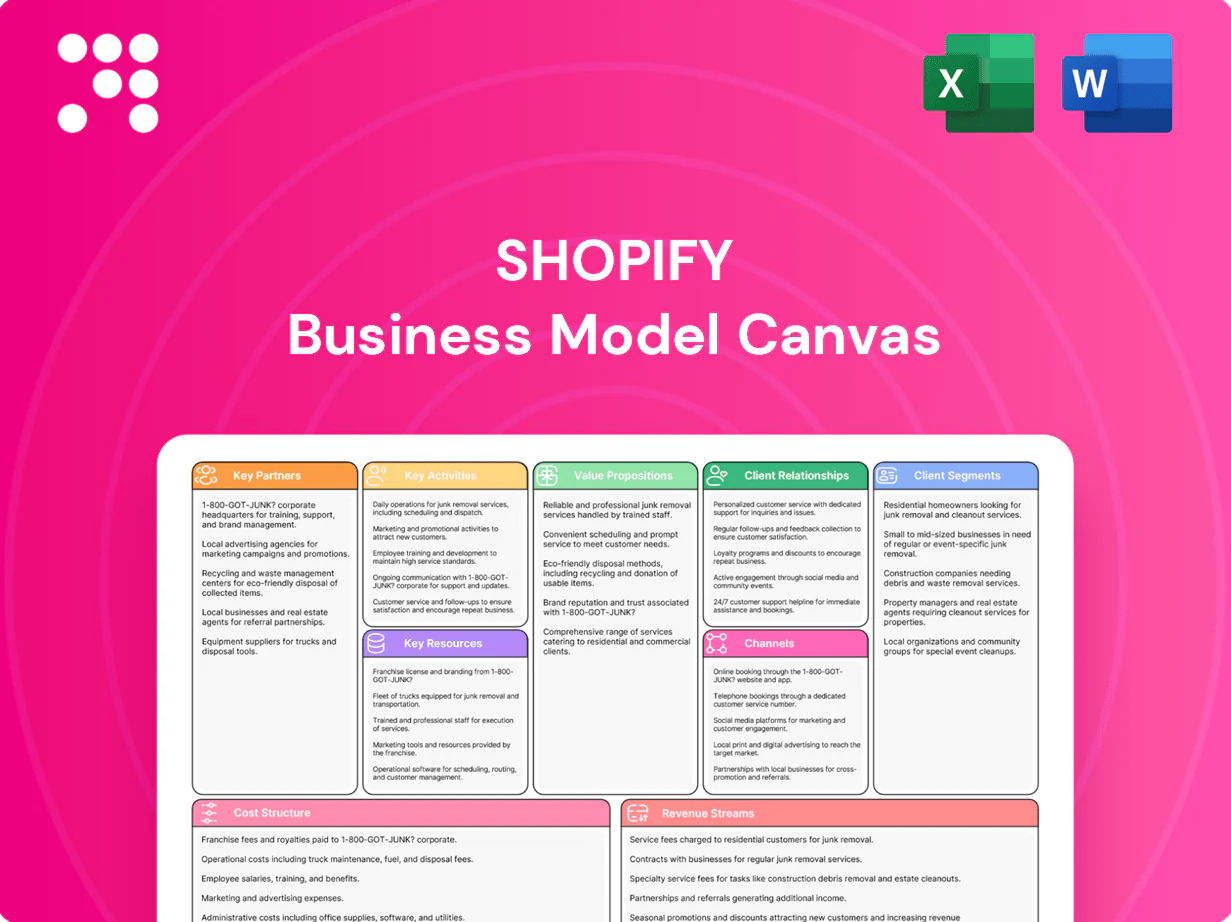
Shopify Business Model Canvas

Unlock a leading e-commerce platform's Business Model Canvas and growth playbook
Unlock Shopify’s strategic playbook with our concise Business Model Canvas—discover how it wins customers, scales merchant success, and monetizes ecosystem value. This ready-to-use, editable canvas is ideal for founders, consultants, and investors seeking a competitive edge—download the full version now to apply proven tactics to your strategy.
Partnerships

Global payment networks and acquiring banks
Global payment networks (Visa, Mastercard, AmEx) and acquiring banks enable secure card acceptance and alternative tenders across regions, with Visa and Mastercard accounting for over 80% of global card transaction volume. They help optimize authorization rates and reduce interchange where possible, improving checkout conversion by reducing declines. Close alignment and co-certifications (PCI DSS 4.0 effective March 2024) cut friction and ensure uptime.
Shipping carriers and logistics providers
Integrated carriers like USPS, UPS, DHL and local partners power real-time rates, labels, tracking and returns, improving conversion and post-purchase visibility. Aggregated volumes earn preferential rates—critical as global e-commerce exceeded $5.7 trillion in 2023—lowering merchant shipping costs. Reliable logistics integrations reduce post-purchase anxiety and enable cross-border trade, while partnerships expand fulfillment and last-mile flexibility.

App developers and technology ISVs
Third-party app developers and ISVs extend Shopify core via apps, integrations and automations, serving niche vertical needs and accelerating innovation without bloating the platform. As of 2024 Shopify’s App Store hosts thousands of apps, and revenue-sharing models align incentives for quality, support and recurring updates. A vibrant ISV ecosystem increases platform stickiness and merchant retention.

Marketing and marketplace platforms
Integrations with Google, Meta, TikTok, Amazon and others enable omnichannel selling and attribution, funneling traffic and measurable conversions to merchants; Shopify served over 2 million merchants by 2024, amplifying partner reach. Co-marketing and product integrations lower merchant acquisition costs while native connectors streamline catalog sync and ad campaign setup, driving incremental sales.
- Omnichannel attribution
- 2+M merchants (2024)
- Reduced acquisition costs
- Native catalog & ads sync
POS hardware and retail technology partners
Certified hardware vendors supply terminals, scanners and peripherals to thousands of retailers, while retail ISVs (inventory, workforce, loyalty) extend POS capabilities; Shopify supported over 2.1 million merchants in 2024 and its App Store listed 8,000+ apps, enabling joint roadmaps that ensure in‑store compatibility and performance and underpin unified online–offline experiences.
- Certified vendors: terminals, scanners, peripherals
- Retail ISVs: inventory, workforce, loyalty
- 2024 scale: 2.1M merchants, 8,000+ apps
- Outcome: unified online–offline experiences
Unified payments, carrier integrations and 8k+ apps fuel omnichannel e-commerce scale
Payment networks/acquirers (Visa/Mastercard >80% card volume) and PCI DSS 4.0 (Mar 2024) reduce declines and checkout friction.
Carrier integrations (USPS, UPS, DHL) plus volume discounts cut shipping costs as global e‑commerce hit $5.7T (2023).
App/ISV ecosystem (8,000+ apps, 2.1M merchants in 2024) and Google/Meta/TikTok integrations drive omnichannel reach.
| Metric | 2024 |
|---|---|
| Merchants | 2.1M |
| Apps | 8,000+ |
| Global e‑com GMV | $5.7T (2023) |
What is included in the product
 Detailed Word Document
A comprehensive, pre-written Business Model Canvas for Shopify that details customer segments, channels, value propositions, revenue streams, key activities, resources, partners, cost structure, and governance with real-world operational insights and investor-ready clarity. Ideal for entrepreneurs, analysts, and funding discussions, it includes competitive advantages and SWOT-linked implications for strategic decision-making.

 Customizable Excel Spreadsheet
Condenses Shopify’s commerce strategy into a single editable canvas, eliminating hours of formatting and helping teams quickly identify core components and pain-point solutions.
Activities

Platform engineering and product development
Continuous releases iterate storefronts, checkout, POS and admin tools to shrink cycle time and drive merchant value, supporting over 2.1 million merchants in 2024. Priorities focus on performance, mobile, internationalization and accessibility. Roadmaps balance core usability with advanced merchant features, while experimentation frameworks enable data-driven improvements and A/B testing at scale.
Cloud operations, scalability, and security
Operating Shopify’s global, high-availability commerce cloud depends on rigorous SRE practices to sustain merchant uptime and performance; Shopify reported roughly $197 billion GMV in 2023, underscoring scale demands. Security hardening, PCI compliance, and fraud mitigation are continuous priorities, with automated defenses and manual review workflows. Capacity planning scales for peak events like BFCM, where order volumes spike multiple-fold, and real-time monitoring plus incident response protect merchant revenue.

Merchant acquisition and onboarding
Growth teams drive trials via content, SEO, partnerships and paid channels, helping Shopify scale to over 4 million merchants by 2024. Onboarding flows are optimized to shorten time-to-first-sale, increasing early conversion and retention. Education, templates and starter themes cut setup complexity and time. Localization across 175+ countries supports multi-country adoption and cross-border growth.

Payments processing and risk management
Optimizing authorization, routing, and intelligent retries raises conversion by reducing declines and checkout friction; Shopify’s payments stack focuses on latency and issuer decisions to improve approval rates. Advanced risk models and machine-learning classifiers reduce fraud, chargebacks, and abuse while maintaining merchant authorization rates. Strict PCI compliance and adherence to regional regulations (PSD2, AML/KYC) are enforced; integrated dispute-management tools streamline representments and protect margins.
- Optimize auth/routing/retries: higher approvals
- Risk models: fewer frauds & chargebacks
- Compliance: PCI + regional regs
- Dispute tools: faster representments, preserved margins
Ecosystem curation and partner enablement
Shopify curates its ecosystem through rigorous app review, certification, and ranking to protect merchants and ensure quality; in 2024 the App Store exceeded 8,000 apps, tightening discoverability for top solutions. Developer tooling and robust APIs accelerate innovation and integrations, while partner training, co-selling programs and marketplace governance scale reach and preserve trust across tens of thousands of merchants.
- App review & ranking: quality control
- APIs & tooling: foster innovation
- Partner training & co-selling: expand reach
- Governance: maintain marketplace trust
Commerce platform serving ~4.0M merchants, processing $197B GMV, 8,000+ apps
Continuous product releases, SRE, payments optimization and ecosystem curation power Shopify’s commerce platform, serving ~4.0M merchants in 2024 and processing ~$197B GMV (2023). Priorities: performance, security/PCI, fraud reduction, localization (175+ countries) and partner enablement; App Store hosts 8,000+ apps. Experimentation and capacity planning enable peak-event resilience and higher conversion.
| Metric | Value |
|---|---|
| Merchants (2024) | ~4.0M |
| GMV (2023) | $197B |
| Apps (2024) | 8,000+ |
| Countries | 175+ |
Full Document Unlocks After Purchase
Business Model Canvas
The preview you see is the exact Shopify Business Model Canvas you’ll receive after purchase. It’s not a mockup—this live snapshot contains the same sections, structure and content. Upon ordering you’ll get the identical, fully editable file in Word and Excel, ready to present or customize.

Unlock a leading e-commerce platform's Business Model Canvas and growth playbook
Unlock Shopify’s strategic playbook with our concise Business Model Canvas—discover how it wins customers, scales merchant success, and monetizes ecosystem value. This ready-to-use, editable canvas is ideal for founders, consultants, and investors seeking a competitive edge—download the full version now to apply proven tactics to your strategy.
Partnerships
Global payment networks and acquiring banks
Global payment networks (Visa, Mastercard, AmEx) and acquiring banks enable secure card acceptance and alternative tenders across regions, with Visa and Mastercard accounting for over 80% of global card transaction volume. They help optimize authorization rates and reduce interchange where possible, improving checkout conversion by reducing declines. Close alignment and co-certifications (PCI DSS 4.0 effective March 2024) cut friction and ensure uptime.
Shipping carriers and logistics providers
Integrated carriers like USPS, UPS, DHL and local partners power real-time rates, labels, tracking and returns, improving conversion and post-purchase visibility. Aggregated volumes earn preferential rates—critical as global e-commerce exceeded $5.7 trillion in 2023—lowering merchant shipping costs. Reliable logistics integrations reduce post-purchase anxiety and enable cross-border trade, while partnerships expand fulfillment and last-mile flexibility.
App developers and technology ISVs
Third-party app developers and ISVs extend Shopify core via apps, integrations and automations, serving niche vertical needs and accelerating innovation without bloating the platform. As of 2024 Shopify’s App Store hosts thousands of apps, and revenue-sharing models align incentives for quality, support and recurring updates. A vibrant ISV ecosystem increases platform stickiness and merchant retention.
Marketing and marketplace platforms
Integrations with Google, Meta, TikTok, Amazon and others enable omnichannel selling and attribution, funneling traffic and measurable conversions to merchants; Shopify served over 2 million merchants by 2024, amplifying partner reach. Co-marketing and product integrations lower merchant acquisition costs while native connectors streamline catalog sync and ad campaign setup, driving incremental sales.
- Omnichannel attribution
- 2+M merchants (2024)
- Reduced acquisition costs
- Native catalog & ads sync
POS hardware and retail technology partners
Certified hardware vendors supply terminals, scanners and peripherals to thousands of retailers, while retail ISVs (inventory, workforce, loyalty) extend POS capabilities; Shopify supported over 2.1 million merchants in 2024 and its App Store listed 8,000+ apps, enabling joint roadmaps that ensure in‑store compatibility and performance and underpin unified online–offline experiences.
- Certified vendors: terminals, scanners, peripherals
- Retail ISVs: inventory, workforce, loyalty
- 2024 scale: 2.1M merchants, 8,000+ apps
- Outcome: unified online–offline experiences
Unified payments, carrier integrations and 8k+ apps fuel omnichannel e-commerce scale
Payment networks/acquirers (Visa/Mastercard >80% card volume) and PCI DSS 4.0 (Mar 2024) reduce declines and checkout friction.
Carrier integrations (USPS, UPS, DHL) plus volume discounts cut shipping costs as global e‑commerce hit $5.7T (2023).
App/ISV ecosystem (8,000+ apps, 2.1M merchants in 2024) and Google/Meta/TikTok integrations drive omnichannel reach.
| Metric | 2024 |
|---|---|
| Merchants | 2.1M |
| Apps | 8,000+ |
| Global e‑com GMV | $5.7T (2023) |
What is included in the product
Detailed Word Document
A comprehensive, pre-written Business Model Canvas for Shopify that details customer segments, channels, value propositions, revenue streams, key activities, resources, partners, cost structure, and governance with real-world operational insights and investor-ready clarity. Ideal for entrepreneurs, analysts, and funding discussions, it includes competitive advantages and SWOT-linked implications for strategic decision-making.
Customizable Excel Spreadsheet
Condenses Shopify’s commerce strategy into a single editable canvas, eliminating hours of formatting and helping teams quickly identify core components and pain-point solutions.
Activities
Platform engineering and product development
Continuous releases iterate storefronts, checkout, POS and admin tools to shrink cycle time and drive merchant value, supporting over 2.1 million merchants in 2024. Priorities focus on performance, mobile, internationalization and accessibility. Roadmaps balance core usability with advanced merchant features, while experimentation frameworks enable data-driven improvements and A/B testing at scale.
Cloud operations, scalability, and security
Operating Shopify’s global, high-availability commerce cloud depends on rigorous SRE practices to sustain merchant uptime and performance; Shopify reported roughly $197 billion GMV in 2023, underscoring scale demands. Security hardening, PCI compliance, and fraud mitigation are continuous priorities, with automated defenses and manual review workflows. Capacity planning scales for peak events like BFCM, where order volumes spike multiple-fold, and real-time monitoring plus incident response protect merchant revenue.
Merchant acquisition and onboarding
Growth teams drive trials via content, SEO, partnerships and paid channels, helping Shopify scale to over 4 million merchants by 2024. Onboarding flows are optimized to shorten time-to-first-sale, increasing early conversion and retention. Education, templates and starter themes cut setup complexity and time. Localization across 175+ countries supports multi-country adoption and cross-border growth.
Payments processing and risk management
Optimizing authorization, routing, and intelligent retries raises conversion by reducing declines and checkout friction; Shopify’s payments stack focuses on latency and issuer decisions to improve approval rates. Advanced risk models and machine-learning classifiers reduce fraud, chargebacks, and abuse while maintaining merchant authorization rates. Strict PCI compliance and adherence to regional regulations (PSD2, AML/KYC) are enforced; integrated dispute-management tools streamline representments and protect margins.
- Optimize auth/routing/retries: higher approvals
- Risk models: fewer frauds & chargebacks
- Compliance: PCI + regional regs
- Dispute tools: faster representments, preserved margins
Ecosystem curation and partner enablement
Shopify curates its ecosystem through rigorous app review, certification, and ranking to protect merchants and ensure quality; in 2024 the App Store exceeded 8,000 apps, tightening discoverability for top solutions. Developer tooling and robust APIs accelerate innovation and integrations, while partner training, co-selling programs and marketplace governance scale reach and preserve trust across tens of thousands of merchants.
- App review & ranking: quality control
- APIs & tooling: foster innovation
- Partner training & co-selling: expand reach
- Governance: maintain marketplace trust
Commerce platform serving ~4.0M merchants, processing $197B GMV, 8,000+ apps
Continuous product releases, SRE, payments optimization and ecosystem curation power Shopify’s commerce platform, serving ~4.0M merchants in 2024 and processing ~$197B GMV (2023). Priorities: performance, security/PCI, fraud reduction, localization (175+ countries) and partner enablement; App Store hosts 8,000+ apps. Experimentation and capacity planning enable peak-event resilience and higher conversion.
| Metric | Value |
|---|---|
| Merchants (2024) | ~4.0M |
| GMV (2023) | $197B |
| Apps (2024) | 8,000+ |
| Countries | 175+ |
Full Document Unlocks After Purchase
Business Model Canvas
The preview you see is the exact Shopify Business Model Canvas you’ll receive after purchase. It’s not a mockup—this live snapshot contains the same sections, structure and content. Upon ordering you’ll get the identical, fully editable file in Word and Excel, ready to present or customize.
Description
Unlock a leading e-commerce platform's Business Model Canvas and growth playbook
Unlock Shopify’s strategic playbook with our concise Business Model Canvas—discover how it wins customers, scales merchant success, and monetizes ecosystem value. This ready-to-use, editable canvas is ideal for founders, consultants, and investors seeking a competitive edge—download the full version now to apply proven tactics to your strategy.
Partnerships
Global payment networks and acquiring banks
Global payment networks (Visa, Mastercard, AmEx) and acquiring banks enable secure card acceptance and alternative tenders across regions, with Visa and Mastercard accounting for over 80% of global card transaction volume. They help optimize authorization rates and reduce interchange where possible, improving checkout conversion by reducing declines. Close alignment and co-certifications (PCI DSS 4.0 effective March 2024) cut friction and ensure uptime.
Shipping carriers and logistics providers
Integrated carriers like USPS, UPS, DHL and local partners power real-time rates, labels, tracking and returns, improving conversion and post-purchase visibility. Aggregated volumes earn preferential rates—critical as global e-commerce exceeded $5.7 trillion in 2023—lowering merchant shipping costs. Reliable logistics integrations reduce post-purchase anxiety and enable cross-border trade, while partnerships expand fulfillment and last-mile flexibility.
App developers and technology ISVs
Third-party app developers and ISVs extend Shopify core via apps, integrations and automations, serving niche vertical needs and accelerating innovation without bloating the platform. As of 2024 Shopify’s App Store hosts thousands of apps, and revenue-sharing models align incentives for quality, support and recurring updates. A vibrant ISV ecosystem increases platform stickiness and merchant retention.
Marketing and marketplace platforms
Integrations with Google, Meta, TikTok, Amazon and others enable omnichannel selling and attribution, funneling traffic and measurable conversions to merchants; Shopify served over 2 million merchants by 2024, amplifying partner reach. Co-marketing and product integrations lower merchant acquisition costs while native connectors streamline catalog sync and ad campaign setup, driving incremental sales.
- Omnichannel attribution
- 2+M merchants (2024)
- Reduced acquisition costs
- Native catalog & ads sync
POS hardware and retail technology partners
Certified hardware vendors supply terminals, scanners and peripherals to thousands of retailers, while retail ISVs (inventory, workforce, loyalty) extend POS capabilities; Shopify supported over 2.1 million merchants in 2024 and its App Store listed 8,000+ apps, enabling joint roadmaps that ensure in‑store compatibility and performance and underpin unified online–offline experiences.
- Certified vendors: terminals, scanners, peripherals
- Retail ISVs: inventory, workforce, loyalty
- 2024 scale: 2.1M merchants, 8,000+ apps
- Outcome: unified online–offline experiences
Unified payments, carrier integrations and 8k+ apps fuel omnichannel e-commerce scale
Payment networks/acquirers (Visa/Mastercard >80% card volume) and PCI DSS 4.0 (Mar 2024) reduce declines and checkout friction.
Carrier integrations (USPS, UPS, DHL) plus volume discounts cut shipping costs as global e‑commerce hit $5.7T (2023).
App/ISV ecosystem (8,000+ apps, 2.1M merchants in 2024) and Google/Meta/TikTok integrations drive omnichannel reach.
| Metric | 2024 |
|---|---|
| Merchants | 2.1M |
| Apps | 8,000+ |
| Global e‑com GMV | $5.7T (2023) |
What is included in the product
Detailed Word Document
A comprehensive, pre-written Business Model Canvas for Shopify that details customer segments, channels, value propositions, revenue streams, key activities, resources, partners, cost structure, and governance with real-world operational insights and investor-ready clarity. Ideal for entrepreneurs, analysts, and funding discussions, it includes competitive advantages and SWOT-linked implications for strategic decision-making.
Customizable Excel Spreadsheet
Condenses Shopify’s commerce strategy into a single editable canvas, eliminating hours of formatting and helping teams quickly identify core components and pain-point solutions.
Activities
Platform engineering and product development
Continuous releases iterate storefronts, checkout, POS and admin tools to shrink cycle time and drive merchant value, supporting over 2.1 million merchants in 2024. Priorities focus on performance, mobile, internationalization and accessibility. Roadmaps balance core usability with advanced merchant features, while experimentation frameworks enable data-driven improvements and A/B testing at scale.
Cloud operations, scalability, and security
Operating Shopify’s global, high-availability commerce cloud depends on rigorous SRE practices to sustain merchant uptime and performance; Shopify reported roughly $197 billion GMV in 2023, underscoring scale demands. Security hardening, PCI compliance, and fraud mitigation are continuous priorities, with automated defenses and manual review workflows. Capacity planning scales for peak events like BFCM, where order volumes spike multiple-fold, and real-time monitoring plus incident response protect merchant revenue.
Merchant acquisition and onboarding
Growth teams drive trials via content, SEO, partnerships and paid channels, helping Shopify scale to over 4 million merchants by 2024. Onboarding flows are optimized to shorten time-to-first-sale, increasing early conversion and retention. Education, templates and starter themes cut setup complexity and time. Localization across 175+ countries supports multi-country adoption and cross-border growth.
Payments processing and risk management
Optimizing authorization, routing, and intelligent retries raises conversion by reducing declines and checkout friction; Shopify’s payments stack focuses on latency and issuer decisions to improve approval rates. Advanced risk models and machine-learning classifiers reduce fraud, chargebacks, and abuse while maintaining merchant authorization rates. Strict PCI compliance and adherence to regional regulations (PSD2, AML/KYC) are enforced; integrated dispute-management tools streamline representments and protect margins.
- Optimize auth/routing/retries: higher approvals
- Risk models: fewer frauds & chargebacks
- Compliance: PCI + regional regs
- Dispute tools: faster representments, preserved margins
Ecosystem curation and partner enablement
Shopify curates its ecosystem through rigorous app review, certification, and ranking to protect merchants and ensure quality; in 2024 the App Store exceeded 8,000 apps, tightening discoverability for top solutions. Developer tooling and robust APIs accelerate innovation and integrations, while partner training, co-selling programs and marketplace governance scale reach and preserve trust across tens of thousands of merchants.
- App review & ranking: quality control
- APIs & tooling: foster innovation
- Partner training & co-selling: expand reach
- Governance: maintain marketplace trust
Commerce platform serving ~4.0M merchants, processing $197B GMV, 8,000+ apps
Continuous product releases, SRE, payments optimization and ecosystem curation power Shopify’s commerce platform, serving ~4.0M merchants in 2024 and processing ~$197B GMV (2023). Priorities: performance, security/PCI, fraud reduction, localization (175+ countries) and partner enablement; App Store hosts 8,000+ apps. Experimentation and capacity planning enable peak-event resilience and higher conversion.
| Metric | Value |
|---|---|
| Merchants (2024) | ~4.0M |
| GMV (2023) | $197B |
| Apps (2024) | 8,000+ |
| Countries | 175+ |
Full Document Unlocks After Purchase
Business Model Canvas
The preview you see is the exact Shopify Business Model Canvas you’ll receive after purchase. It’s not a mockup—this live snapshot contains the same sections, structure and content. Upon ordering you’ll get the identical, fully editable file in Word and Excel, ready to present or customize.











