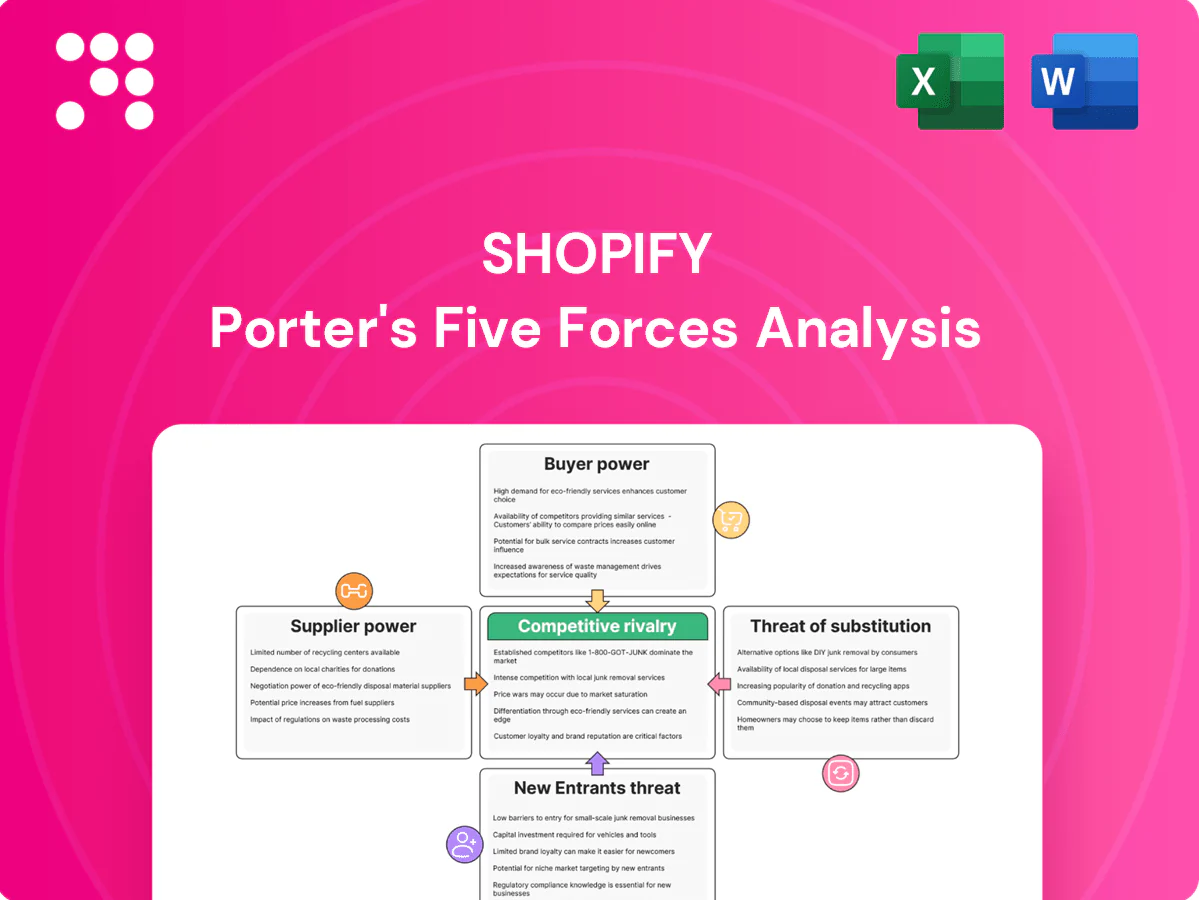
Shopify Porter's Five Forces Analysis

A Must-Have Tool for Decision-Makers
Shopify faces high competitive rivalry from commerce platforms, strong buyer bargaining due to low switching costs, moderate supplier influence, rising threats from integrated platforms and substitutes, and barriers that limit but don't block new entrants. This brief snapshot only scratches the surface. Unlock the full Porter's Five Forces Analysis to explore Shopify’s competitive dynamics, market pressures, and strategic advantages in detail.
Suppliers Bargaining Power

Concentrated cloud and payments vendors
Shopify relies on concentrated hyperscalers and payment rails—Canalys estimates 2024 cloud share: AWS ~32%, Microsoft ~23%, Google ~11%—and dominant card networks/PSPs, giving suppliers leverage on price and terms. Shopify offsets this with multi‑cloud deployments, in‑house orchestration and volume negotiations. Switching is feasible but entails significant cost and operational risk, so supplier power is moderate.
Shipping carriers and fulfillment partners
Rate structures and service levels from carriers materially affect merchant unit economics and Shopify’s fulfillment value proposition, influencing margins and shipping pass-throughs. Major carriers such as UPS, FedEx and USPS have scale and limited substitutes, raising supplier power. Shopify leverages aggregated volume across over 2 million merchants in 2024 to negotiate discounted rates and diversify partners. Service reliability, peak surcharges and dimensional pricing still constrain Shopify’s pricing flexibility.

App/theme developers and tech ecosystem
Third-party developers supply critical features; Shopify's app ecosystem exceeded 7,000 apps by 2024, broadening platform appeal. Fragmentation limits individual leverage, but marquee apps—often with ARR in the millions—can secure favorable economics or exclusivity. Platform policies, revenue-share models and discovery algorithms tilt bargaining power toward Shopify while dependency on top apps creates selective supplier influence.

Hardware and POS components
Shopify POS depends on certified terminals and peripherals from a limited set of hardware vendors, creating supplier leverage around certification, security standards, and chip supply cycles; chip lead times reached 20+ weeks during 2021–22. Shopify mitigates risk with multiple SKUs, white-label partners and forward inventory planning while serving over 2 million merchants (2024).
- Limited vendor pool increases leverage
- Chip lead times 20+ weeks (2021–22)
- Shopify: >2M merchants (2024)
- Mitigants: multiple SKUs, white-label, forward inventory
- Power spikes during component shortages
Advertising and traffic platforms
Merchants depend on ad networks and social platforms that supply the bulk of paid traffic to Shopify stores; in 2024 major platforms drove the majority of ad-driven visits, so shifts in pricing, attribution models or APIs directly hit conversion and app integrations. These platforms wield high power via strong network effects. Shopify offsets risk with first-party data tools and partnerships but cannot fully neutralize platform-driven shifts.
- Platform concentration: majority of paid traffic (2024)
- Impact: ad pricing/attribution changes reduce merchant ROI
- Power source: network effects and scale
- Shopify response: first-party data, partnerships; partial mitigation
Hyperscalers and carriers pressure platform margins; multi-cloud and volume deals mitigate
Suppliers exert moderate power: hyperscalers (AWS ~32%, Microsoft ~23%, Google ~11% in 2024) and card networks constrain price/terms, but multi‑cloud and volume deals mitigate. Carriers (UPS/FedEx/USPS) and chip vendors raise costs/lead times, despite Shopify's >2M merchants (2024) negotiating rates. App and hardware vendors (7,000+ apps, certified terminals) create selective leverage; platform policies favor Shopify.
| Supplier | Power | 2024 metric | Mitigant |
|---|---|---|---|
| Cloud | Moderate | AWS32%/MS23%/GCP11% | Multi‑cloud, volume deals |
| Carriers | High | Contract surcharges, dimensional pricing | Aggregated rates |
| Apps/Hardware | Selective | 7,000+ apps; >2M merchants | Platform policies |
What is included in the product
 Detailed Word Document
Uncovers key drivers of competition, customer influence, and market entry risks tailored to Shopify; evaluates supplier and buyer power, threat of substitutes, and rivalry, highlighting disruptive entrants, emerging threats, and incumbent defenses—fully editable Word format for reports, investor materials, and strategy decks.

 Customizable Excel Spreadsheet
A clear one-sheet Porter's Five Forces for Shopify—visual radar and editable pressure sliders to pinpoint competitive pain points and guide pricing, platform strategy, partner prioritization, and fast boardroom decisions.
Customers Bargaining Power

Fragmented SMB base with price sensitivity
Most of Shopify’s over 4 million merchants (2024) are small, cost-conscious SMBs, giving buyers some price leverage via churn risk; alternatives like WooCommerce, BigCommerce and Wix span low to premium price points. Choice is broad, yet switching costs from data migration, custom workflows and integrations—and the Shopify App Store hosting over 8,000 apps (2024)—temper exits. Net buyer power for SMBs is moderate.
Enterprise and Plus customers negotiate
Larger Shopify Plus and Enterprise merchants buy at scale and routinely demand custom terms, integrations, and SLAs, reflecting the segment’s high buyer power. In 2024 Shopify served roughly 4.4 million merchants, while Plus/enterprise clients disproportionately influence product roadmaps and pricing negotiations. These customers can pit Shopify against Adobe/Magento and Salesforce Commerce to extract discounts or features; switching costs are higher but justified when TCO savings or capability gaps exceed migration effort.

Low multi-homing friction across channels
Merchants can sell concurrently on marketplaces, social commerce and alternative storefronts, reducing reliance on any single platform and increasing their bargaining power. Shopify operates in over 175 countries and counters by integrating channels so its backend remains merchants’ system of record. When channel portability is low-friction, buyers retain negotiating leverage over platform-specific terms and fees.

Performance and ecosystem lock-in
- Implicit lock-in: checkout + payments + apps
- Recreation cost: months and five-figure integration spend
- 2024 scale: >4 million merchants
- Exit option: transparent, month-to-month pricing
Information transparency and reviews
Public pricing (Basic $39/mo, Shopify $105/mo, Advanced $399/mo since May 2022) plus benchmarks and community reviews let buyers make side-by-side feature and TCO comparisons, speeding purchase decisions and increasing negotiating leverage. This transparency raises buyer power, while Shopify offsets it with reliability, global scale and faster time-to-value for merchants.
- Public pricing: Basic $39/mo; Shopify $105/mo; Advanced $399/mo
- Effect: faster TCO/feature comparisons → more leverage
- Shopify offset: platform reliability, global scale, rapid time-to-value
Large SMB base and extensive app ecosystem create lock-in despite public pricing and buyer leverage
Most of Shopify’s ~4.4M merchants (2024) are SMBs, giving some price leverage via churn risk, while Shopify Plus customers exert high negotiating power. Platform switching costs—data migration, custom integrations and an 8,000+ app ecosystem (2024)—create implicit lock-in. Transparent public pricing (Basic $39, Shopify $105, Advanced $399) speeds comparisons and preserves buyer leverage.
| Metric | 2024 Value |
|---|---|
| Merchants | ~4.4M |
| Apps | 8,000+ |
| Public plans | Basic $39; Shopify $105; Advanced $399 |
Preview Before You Purchase
Shopify Porter's Five Forces Analysis
This Shopify Porter's Five Forces analysis evaluates industry rivalry, threat of entry, buyer and supplier power, and substitute threats, with clear implications for Shopify's competitive positioning and valuation. This preview shows the exact document you'll receive immediately after purchase—no surprises. It's fully formatted and ready for download and use.

A Must-Have Tool for Decision-Makers
Shopify faces high competitive rivalry from commerce platforms, strong buyer bargaining due to low switching costs, moderate supplier influence, rising threats from integrated platforms and substitutes, and barriers that limit but don't block new entrants. This brief snapshot only scratches the surface. Unlock the full Porter's Five Forces Analysis to explore Shopify’s competitive dynamics, market pressures, and strategic advantages in detail.
Suppliers Bargaining Power
Concentrated cloud and payments vendors
Shopify relies on concentrated hyperscalers and payment rails—Canalys estimates 2024 cloud share: AWS ~32%, Microsoft ~23%, Google ~11%—and dominant card networks/PSPs, giving suppliers leverage on price and terms. Shopify offsets this with multi‑cloud deployments, in‑house orchestration and volume negotiations. Switching is feasible but entails significant cost and operational risk, so supplier power is moderate.
Shipping carriers and fulfillment partners
Rate structures and service levels from carriers materially affect merchant unit economics and Shopify’s fulfillment value proposition, influencing margins and shipping pass-throughs. Major carriers such as UPS, FedEx and USPS have scale and limited substitutes, raising supplier power. Shopify leverages aggregated volume across over 2 million merchants in 2024 to negotiate discounted rates and diversify partners. Service reliability, peak surcharges and dimensional pricing still constrain Shopify’s pricing flexibility.
App/theme developers and tech ecosystem
Third-party developers supply critical features; Shopify's app ecosystem exceeded 7,000 apps by 2024, broadening platform appeal. Fragmentation limits individual leverage, but marquee apps—often with ARR in the millions—can secure favorable economics or exclusivity. Platform policies, revenue-share models and discovery algorithms tilt bargaining power toward Shopify while dependency on top apps creates selective supplier influence.
Hardware and POS components
Shopify POS depends on certified terminals and peripherals from a limited set of hardware vendors, creating supplier leverage around certification, security standards, and chip supply cycles; chip lead times reached 20+ weeks during 2021–22. Shopify mitigates risk with multiple SKUs, white-label partners and forward inventory planning while serving over 2 million merchants (2024).
- Limited vendor pool increases leverage
- Chip lead times 20+ weeks (2021–22)
- Shopify: >2M merchants (2024)
- Mitigants: multiple SKUs, white-label, forward inventory
- Power spikes during component shortages
Advertising and traffic platforms
Merchants depend on ad networks and social platforms that supply the bulk of paid traffic to Shopify stores; in 2024 major platforms drove the majority of ad-driven visits, so shifts in pricing, attribution models or APIs directly hit conversion and app integrations. These platforms wield high power via strong network effects. Shopify offsets risk with first-party data tools and partnerships but cannot fully neutralize platform-driven shifts.
- Platform concentration: majority of paid traffic (2024)
- Impact: ad pricing/attribution changes reduce merchant ROI
- Power source: network effects and scale
- Shopify response: first-party data, partnerships; partial mitigation
Hyperscalers and carriers pressure platform margins; multi-cloud and volume deals mitigate
Suppliers exert moderate power: hyperscalers (AWS ~32%, Microsoft ~23%, Google ~11% in 2024) and card networks constrain price/terms, but multi‑cloud and volume deals mitigate. Carriers (UPS/FedEx/USPS) and chip vendors raise costs/lead times, despite Shopify's >2M merchants (2024) negotiating rates. App and hardware vendors (7,000+ apps, certified terminals) create selective leverage; platform policies favor Shopify.
| Supplier | Power | 2024 metric | Mitigant |
|---|---|---|---|
| Cloud | Moderate | AWS32%/MS23%/GCP11% | Multi‑cloud, volume deals |
| Carriers | High | Contract surcharges, dimensional pricing | Aggregated rates |
| Apps/Hardware | Selective | 7,000+ apps; >2M merchants | Platform policies |
What is included in the product
Detailed Word Document
Uncovers key drivers of competition, customer influence, and market entry risks tailored to Shopify; evaluates supplier and buyer power, threat of substitutes, and rivalry, highlighting disruptive entrants, emerging threats, and incumbent defenses—fully editable Word format for reports, investor materials, and strategy decks.
Customizable Excel Spreadsheet
A clear one-sheet Porter's Five Forces for Shopify—visual radar and editable pressure sliders to pinpoint competitive pain points and guide pricing, platform strategy, partner prioritization, and fast boardroom decisions.
Customers Bargaining Power
Fragmented SMB base with price sensitivity
Most of Shopify’s over 4 million merchants (2024) are small, cost-conscious SMBs, giving buyers some price leverage via churn risk; alternatives like WooCommerce, BigCommerce and Wix span low to premium price points. Choice is broad, yet switching costs from data migration, custom workflows and integrations—and the Shopify App Store hosting over 8,000 apps (2024)—temper exits. Net buyer power for SMBs is moderate.
Enterprise and Plus customers negotiate
Larger Shopify Plus and Enterprise merchants buy at scale and routinely demand custom terms, integrations, and SLAs, reflecting the segment’s high buyer power. In 2024 Shopify served roughly 4.4 million merchants, while Plus/enterprise clients disproportionately influence product roadmaps and pricing negotiations. These customers can pit Shopify against Adobe/Magento and Salesforce Commerce to extract discounts or features; switching costs are higher but justified when TCO savings or capability gaps exceed migration effort.
Low multi-homing friction across channels
Merchants can sell concurrently on marketplaces, social commerce and alternative storefronts, reducing reliance on any single platform and increasing their bargaining power. Shopify operates in over 175 countries and counters by integrating channels so its backend remains merchants’ system of record. When channel portability is low-friction, buyers retain negotiating leverage over platform-specific terms and fees.
Performance and ecosystem lock-in
- Implicit lock-in: checkout + payments + apps
- Recreation cost: months and five-figure integration spend
- 2024 scale: >4 million merchants
- Exit option: transparent, month-to-month pricing
Information transparency and reviews
Public pricing (Basic $39/mo, Shopify $105/mo, Advanced $399/mo since May 2022) plus benchmarks and community reviews let buyers make side-by-side feature and TCO comparisons, speeding purchase decisions and increasing negotiating leverage. This transparency raises buyer power, while Shopify offsets it with reliability, global scale and faster time-to-value for merchants.
- Public pricing: Basic $39/mo; Shopify $105/mo; Advanced $399/mo
- Effect: faster TCO/feature comparisons → more leverage
- Shopify offset: platform reliability, global scale, rapid time-to-value
Large SMB base and extensive app ecosystem create lock-in despite public pricing and buyer leverage
Most of Shopify’s ~4.4M merchants (2024) are SMBs, giving some price leverage via churn risk, while Shopify Plus customers exert high negotiating power. Platform switching costs—data migration, custom integrations and an 8,000+ app ecosystem (2024)—create implicit lock-in. Transparent public pricing (Basic $39, Shopify $105, Advanced $399) speeds comparisons and preserves buyer leverage.
| Metric | 2024 Value |
|---|---|
| Merchants | ~4.4M |
| Apps | 8,000+ |
| Public plans | Basic $39; Shopify $105; Advanced $399 |
Preview Before You Purchase
Shopify Porter's Five Forces Analysis
This Shopify Porter's Five Forces analysis evaluates industry rivalry, threat of entry, buyer and supplier power, and substitute threats, with clear implications for Shopify's competitive positioning and valuation. This preview shows the exact document you'll receive immediately after purchase—no surprises. It's fully formatted and ready for download and use.
Original: $10.00
-65%$10.00
$3.50Description
A Must-Have Tool for Decision-Makers
Shopify faces high competitive rivalry from commerce platforms, strong buyer bargaining due to low switching costs, moderate supplier influence, rising threats from integrated platforms and substitutes, and barriers that limit but don't block new entrants. This brief snapshot only scratches the surface. Unlock the full Porter's Five Forces Analysis to explore Shopify’s competitive dynamics, market pressures, and strategic advantages in detail.
Suppliers Bargaining Power
Concentrated cloud and payments vendors
Shopify relies on concentrated hyperscalers and payment rails—Canalys estimates 2024 cloud share: AWS ~32%, Microsoft ~23%, Google ~11%—and dominant card networks/PSPs, giving suppliers leverage on price and terms. Shopify offsets this with multi‑cloud deployments, in‑house orchestration and volume negotiations. Switching is feasible but entails significant cost and operational risk, so supplier power is moderate.
Shipping carriers and fulfillment partners
Rate structures and service levels from carriers materially affect merchant unit economics and Shopify’s fulfillment value proposition, influencing margins and shipping pass-throughs. Major carriers such as UPS, FedEx and USPS have scale and limited substitutes, raising supplier power. Shopify leverages aggregated volume across over 2 million merchants in 2024 to negotiate discounted rates and diversify partners. Service reliability, peak surcharges and dimensional pricing still constrain Shopify’s pricing flexibility.
App/theme developers and tech ecosystem
Third-party developers supply critical features; Shopify's app ecosystem exceeded 7,000 apps by 2024, broadening platform appeal. Fragmentation limits individual leverage, but marquee apps—often with ARR in the millions—can secure favorable economics or exclusivity. Platform policies, revenue-share models and discovery algorithms tilt bargaining power toward Shopify while dependency on top apps creates selective supplier influence.
Hardware and POS components
Shopify POS depends on certified terminals and peripherals from a limited set of hardware vendors, creating supplier leverage around certification, security standards, and chip supply cycles; chip lead times reached 20+ weeks during 2021–22. Shopify mitigates risk with multiple SKUs, white-label partners and forward inventory planning while serving over 2 million merchants (2024).
- Limited vendor pool increases leverage
- Chip lead times 20+ weeks (2021–22)
- Shopify: >2M merchants (2024)
- Mitigants: multiple SKUs, white-label, forward inventory
- Power spikes during component shortages
Advertising and traffic platforms
Merchants depend on ad networks and social platforms that supply the bulk of paid traffic to Shopify stores; in 2024 major platforms drove the majority of ad-driven visits, so shifts in pricing, attribution models or APIs directly hit conversion and app integrations. These platforms wield high power via strong network effects. Shopify offsets risk with first-party data tools and partnerships but cannot fully neutralize platform-driven shifts.
- Platform concentration: majority of paid traffic (2024)
- Impact: ad pricing/attribution changes reduce merchant ROI
- Power source: network effects and scale
- Shopify response: first-party data, partnerships; partial mitigation
Hyperscalers and carriers pressure platform margins; multi-cloud and volume deals mitigate
Suppliers exert moderate power: hyperscalers (AWS ~32%, Microsoft ~23%, Google ~11% in 2024) and card networks constrain price/terms, but multi‑cloud and volume deals mitigate. Carriers (UPS/FedEx/USPS) and chip vendors raise costs/lead times, despite Shopify's >2M merchants (2024) negotiating rates. App and hardware vendors (7,000+ apps, certified terminals) create selective leverage; platform policies favor Shopify.
| Supplier | Power | 2024 metric | Mitigant |
|---|---|---|---|
| Cloud | Moderate | AWS32%/MS23%/GCP11% | Multi‑cloud, volume deals |
| Carriers | High | Contract surcharges, dimensional pricing | Aggregated rates |
| Apps/Hardware | Selective | 7,000+ apps; >2M merchants | Platform policies |
What is included in the product
Detailed Word Document
Uncovers key drivers of competition, customer influence, and market entry risks tailored to Shopify; evaluates supplier and buyer power, threat of substitutes, and rivalry, highlighting disruptive entrants, emerging threats, and incumbent defenses—fully editable Word format for reports, investor materials, and strategy decks.
Customizable Excel Spreadsheet
A clear one-sheet Porter's Five Forces for Shopify—visual radar and editable pressure sliders to pinpoint competitive pain points and guide pricing, platform strategy, partner prioritization, and fast boardroom decisions.
Customers Bargaining Power
Fragmented SMB base with price sensitivity
Most of Shopify’s over 4 million merchants (2024) are small, cost-conscious SMBs, giving buyers some price leverage via churn risk; alternatives like WooCommerce, BigCommerce and Wix span low to premium price points. Choice is broad, yet switching costs from data migration, custom workflows and integrations—and the Shopify App Store hosting over 8,000 apps (2024)—temper exits. Net buyer power for SMBs is moderate.
Enterprise and Plus customers negotiate
Larger Shopify Plus and Enterprise merchants buy at scale and routinely demand custom terms, integrations, and SLAs, reflecting the segment’s high buyer power. In 2024 Shopify served roughly 4.4 million merchants, while Plus/enterprise clients disproportionately influence product roadmaps and pricing negotiations. These customers can pit Shopify against Adobe/Magento and Salesforce Commerce to extract discounts or features; switching costs are higher but justified when TCO savings or capability gaps exceed migration effort.
Low multi-homing friction across channels
Merchants can sell concurrently on marketplaces, social commerce and alternative storefronts, reducing reliance on any single platform and increasing their bargaining power. Shopify operates in over 175 countries and counters by integrating channels so its backend remains merchants’ system of record. When channel portability is low-friction, buyers retain negotiating leverage over platform-specific terms and fees.
Performance and ecosystem lock-in
- Implicit lock-in: checkout + payments + apps
- Recreation cost: months and five-figure integration spend
- 2024 scale: >4 million merchants
- Exit option: transparent, month-to-month pricing
Information transparency and reviews
Public pricing (Basic $39/mo, Shopify $105/mo, Advanced $399/mo since May 2022) plus benchmarks and community reviews let buyers make side-by-side feature and TCO comparisons, speeding purchase decisions and increasing negotiating leverage. This transparency raises buyer power, while Shopify offsets it with reliability, global scale and faster time-to-value for merchants.
- Public pricing: Basic $39/mo; Shopify $105/mo; Advanced $399/mo
- Effect: faster TCO/feature comparisons → more leverage
- Shopify offset: platform reliability, global scale, rapid time-to-value
Large SMB base and extensive app ecosystem create lock-in despite public pricing and buyer leverage
Most of Shopify’s ~4.4M merchants (2024) are SMBs, giving some price leverage via churn risk, while Shopify Plus customers exert high negotiating power. Platform switching costs—data migration, custom integrations and an 8,000+ app ecosystem (2024)—create implicit lock-in. Transparent public pricing (Basic $39, Shopify $105, Advanced $399) speeds comparisons and preserves buyer leverage.
| Metric | 2024 Value |
|---|---|
| Merchants | ~4.4M |
| Apps | 8,000+ |
| Public plans | Basic $39; Shopify $105; Advanced $399 |
Preview Before You Purchase
Shopify Porter's Five Forces Analysis
This Shopify Porter's Five Forces analysis evaluates industry rivalry, threat of entry, buyer and supplier power, and substitute threats, with clear implications for Shopify's competitive positioning and valuation. This preview shows the exact document you'll receive immediately after purchase—no surprises. It's fully formatted and ready for download and use.











