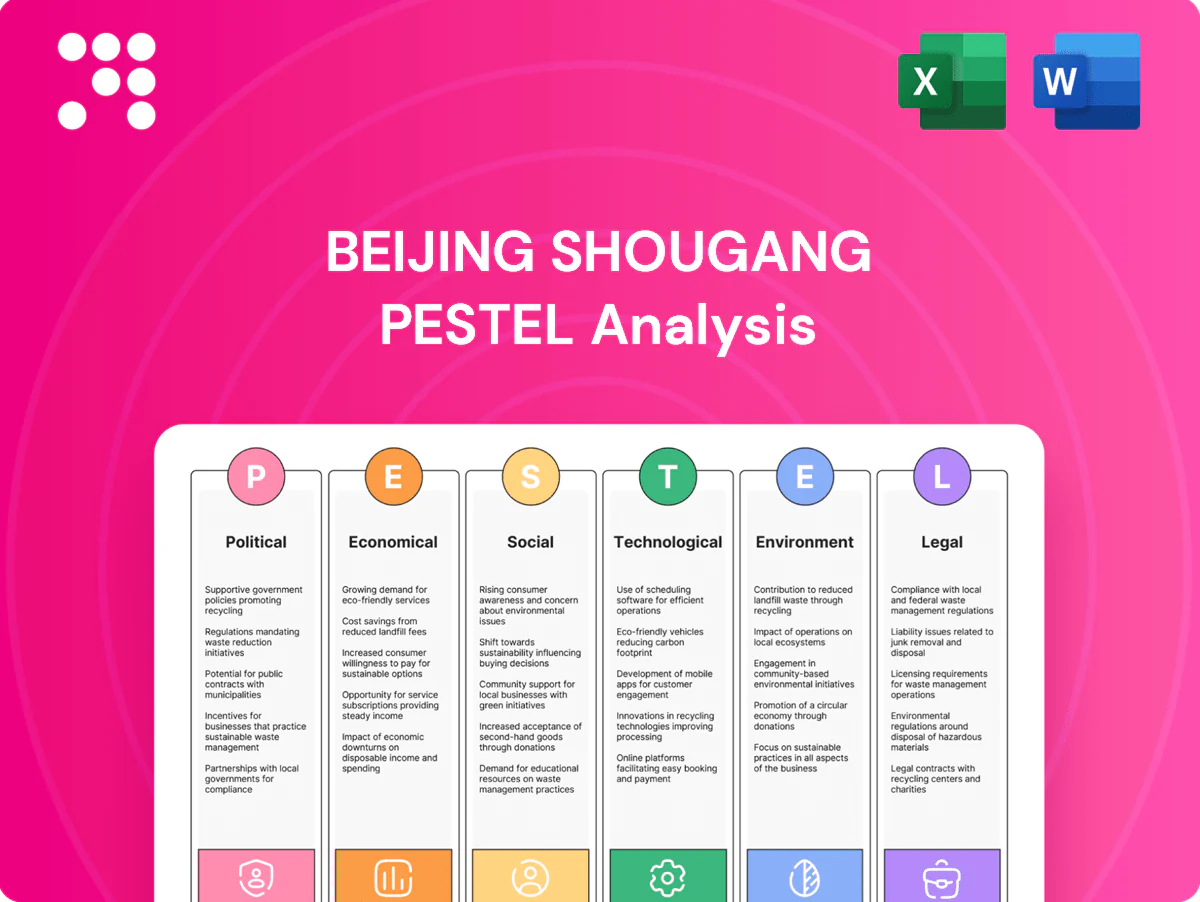
Beijing Shougang PESTLE Analysis

Your Shortcut to Market Insight Starts Here
Our targeted PESTLE analysis for Beijing Shougang highlights key political, economic, social, technological, legal and environmental forces reshaping its operations and competitive stance. Gain concise, actionable insights to inform investment or strategic decisions. Purchase the full report for a deep-dive, editable breakdown you can use immediately.
Political factors

SOE guidance and oversight
As a state-owned enterprise Shougang formally aligns with central and Beijing municipal industrial and the 14th Five-Year Plan (2021–25), with Beijing GDP about CNY 4 trillion (2023) shaping local priorities. Government oversight determines capex, output discipline and diversification into mining and urban renewal; political backing can unlock financing and fast approvals while imposing social and employment obligations. Rapid policy shifts—carbon targets and urban redevelopment—can quickly redirect strategy across steel, mining and real estate.
Industrial policy and capacity control
China’s ongoing supply-side reforms and capacity-control programs force production quotas and plant upgrades for steelmakers, with national crude steel output near 1.05 billion tonnes in 2024 per the World Steel Association, so compliance can help stabilize prices but limits volume growth. Policy-driven consolidation creates M&A opportunities for groups like Beijing Shougang seeking scale or cleaner assets. Failure to meet targets can trigger fines, permit suspension or closure under NDRC/MEE enforcement.

Infrastructure and urban renewal mandates
Beijing’s urban transformation policy favors repurposing legacy industrial sites, and Shougang’s relocation of steel production to Caofeidian in 2006 positioned its former complex for redevelopment. Shougang Park’s reuse—highlighted by hosting the Big Air events during the 2022 Winter Olympics—aligns with city branding and land-use optimization. Strong political endorsement has smoothed land-conversion and mixed-use approvals, with project milestones monitored by municipal authorities against public-interest outcomes.

Geopolitical trade dynamics
Export policies, tariffs and rising anti-dumping cases have reshaped steel flows—China exported roughly 59.6 million tonnes of steel products in 2023 while producing about 1,032 million tonnes of crude steel (~53% of global output), making policy shifts materially impactful for Beijing Shougang. Diplomatic tensions constrain high-end technology imports and overseas project approvals, pushing the group toward services and real estate to buffer commodity volatility. Strategic partnerships, especially with foreign investors, increasingly require political vetting and compliance screening under tighter PLA and foreign investment rules.
- Export volume 2023: 59.6 Mt
- China crude steel 2023: 1,032 Mt (~53% global)
- Diversification: services/real estate reduce exposure to export swings
- Partnerships: heightened political vetting and compliance
Regional development and BRI links
Belt and Road links open overseas resource and construction contracts across 150+ countries, with policy-bank and state financing exceeding roughly US$1 trillion since launch, expanding Beijing Shougang’s project pipeline. Political risk varies sharply by host country and financing terms; government-backed lenders and Sinosure insurance can materially de-risk deals. Execution requires strict compliance with bilateral agreements, local standards and export-credit conditions.
- BRI reach: 150+ countries
- Financing scale: ~US$1 trillion
- De-risking: Sinosure, policy banks
- Must comply: bilateral agreements, local standards
State-backed steel: political support secures financing; production caps and BRI raise risk
As a state-owned firm Shougang aligns with central/Beijing plans (Beijing GDP ~CNY4.0trn in 2023) — political backing secures financing but imposes social/employment obligations. National steel controls (China crude steel ~1.05bn t in 2024; exports 59.6Mt in 2023) limit volume growth and drive consolidation. BRI and policy banks (>$1tn financing) expand projects but raise geopolitical and compliance risk.
| Indicator | Value | Implication |
|---|---|---|
| Beijing GDP | CNY4.0tn (2023) | Local priorities, land-use |
| China crude steel | ~1.05bn t (2024) | Production caps, consolidation |
| Exports | 59.6Mt (2023) | Trade risk, tariffs |
| BRI finance | >US$1tn | Project pipeline, political risk |
What is included in the product
 Detailed Word Document
Explores how macro-environmental forces uniquely impact Beijing Shougang across Political, Economic, Social, Technological, Environmental and Legal dimensions, with data-backed trends and sector-specific examples to identify risks and opportunities for executives and investors. Designed for direct use in strategy, planning and investor materials, and includes forward-looking insights for scenario planning.

 Customizable Excel Spreadsheet
Condensed Beijing Shougang PESTLE that’s visually segmented for quick reference, editable for local context or business lines, and formatted for easy sharing in presentations, planning sessions, or client reports to streamline risk discussions and decision-making.
Economic factors

Steel demand cyclicality
Steel demand cyclicality ties Shougang earnings to domestic construction and manufacturing cycles, with China accounting for roughly half of global steel output, so housing and infrastructure slowdowns directly compress margins through price declines and higher inventory costs. Diversified revenue streams across real estate and services smooth cash flows, while flexible production planning and idling capacity reduce downside exposure during downturns.
Commodity price volatility
Iron ore (62% CFR China averaged about $105/t in 2024), premium coking coal (≈$230/t in 2024) and rising energy costs are key drivers of Shougang’s unit economics, directly compressing margins when spikes occur. Hedging programs and long‑term offtakes have reduced short‑term input price shocks for the group. Vertical integration into mining and logistics improves cost control and supply security. Price swings materially influence capex timing and shifts toward higher‑margin product mixes.

Interest rates and credit access
As an SOE, Beijing Shougang typically secures preferential bank credit—often 10–50 basis points below market—helping lower funding costs versus private peers while China’s 1-year LPR around 3.65% (mid‑2024/2025 range) raises absolute borrowing expense; higher rates increase capex costs for plant upgrades and redevelopment, making capital intensity demand strict leverage targets and sequencing projects to match available funding windows.

Real estate and services diversification
Real estate and services diversification via urban renewal, property and financial services gives Beijing Shougang countercyclical income streams. Macro property policies strongly affect sales velocity and valuation, altering cash flow timing. Fee-based, asset-light services can scale margins and offset industrial cyclicality. Property-related sectors constituted roughly a quarter of China’s economy in 2024.
- Countercyclical income from urban renewal, property, financial services
- Macro policy drives sales velocity & valuations
- Fee-based, asset-light services boost scalable margins
- Portfolio balance reduces exposure to industrial downturns
Export markets and FX
Global steel spreads and USD/CNY moves materially affect Beijing Shougang export competitiveness: China accounted for about 55% of world crude steel output in 2023, so small spread shifts change export volumes and margins. Currency swings alter costs of imported alloying inputs and translate overseas revenues, while diversified sales channels (domestic, ASEAN, EU) reduce single‑market exposure. Tighter trade finance terms raise working capital needs and can compress cash conversion cycles.
- 55% — China share of global crude steel output (2023, Worldsteel)
- USD/CNY range ~6.7–7.3 (2023–24) — impacts export pricing and import costs
- Diversified channels — lowers single‑market risk
- Tighter trade finance — increases working capital strain
State-backed steel: political support secures financing; production caps and BRI raise risk
Steel demand cyclicality ties Shougang earnings to housing/infrastructure cycles; input price spikes and energy costs compress margins. SOE status lowers funding spreads while 1y LPR ≈3.65% raises absolute borrowing costs. Diversification into real estate/services (~25% of GDP‑linked activity in 2024) smooths cash flow. FX and global spreads (USD/CNY ≈6.9) reshape export competitiveness.
| Metric | 2024/25 |
|---|---|
| Iron ore (62% CFR China) | $105/t (2024) |
| Premium coking coal | $230/t (2024) |
| China crude steel share | ≈55% (2023) |
| 1y LPR | ≈3.65% (mid‑2024/25) |
| USD/CNY | ≈6.9 (2023–24) |
Preview Before You Purchase
Beijing Shougang PESTLE Analysis
The preview shown here is the exact Beijing Shougang PESTLE Analysis you’ll receive after purchase—fully formatted and ready to use. It contains the complete political, economic, social, technological, legal and environmental assessment as displayed. No placeholders or teasers—this is the real, final file you’ll download instantly after payment.

Your Shortcut to Market Insight Starts Here
Our targeted PESTLE analysis for Beijing Shougang highlights key political, economic, social, technological, legal and environmental forces reshaping its operations and competitive stance. Gain concise, actionable insights to inform investment or strategic decisions. Purchase the full report for a deep-dive, editable breakdown you can use immediately.
Political factors
SOE guidance and oversight
As a state-owned enterprise Shougang formally aligns with central and Beijing municipal industrial and the 14th Five-Year Plan (2021–25), with Beijing GDP about CNY 4 trillion (2023) shaping local priorities. Government oversight determines capex, output discipline and diversification into mining and urban renewal; political backing can unlock financing and fast approvals while imposing social and employment obligations. Rapid policy shifts—carbon targets and urban redevelopment—can quickly redirect strategy across steel, mining and real estate.
Industrial policy and capacity control
China’s ongoing supply-side reforms and capacity-control programs force production quotas and plant upgrades for steelmakers, with national crude steel output near 1.05 billion tonnes in 2024 per the World Steel Association, so compliance can help stabilize prices but limits volume growth. Policy-driven consolidation creates M&A opportunities for groups like Beijing Shougang seeking scale or cleaner assets. Failure to meet targets can trigger fines, permit suspension or closure under NDRC/MEE enforcement.
Infrastructure and urban renewal mandates
Beijing’s urban transformation policy favors repurposing legacy industrial sites, and Shougang’s relocation of steel production to Caofeidian in 2006 positioned its former complex for redevelopment. Shougang Park’s reuse—highlighted by hosting the Big Air events during the 2022 Winter Olympics—aligns with city branding and land-use optimization. Strong political endorsement has smoothed land-conversion and mixed-use approvals, with project milestones monitored by municipal authorities against public-interest outcomes.
Geopolitical trade dynamics
Export policies, tariffs and rising anti-dumping cases have reshaped steel flows—China exported roughly 59.6 million tonnes of steel products in 2023 while producing about 1,032 million tonnes of crude steel (~53% of global output), making policy shifts materially impactful for Beijing Shougang. Diplomatic tensions constrain high-end technology imports and overseas project approvals, pushing the group toward services and real estate to buffer commodity volatility. Strategic partnerships, especially with foreign investors, increasingly require political vetting and compliance screening under tighter PLA and foreign investment rules.
- Export volume 2023: 59.6 Mt
- China crude steel 2023: 1,032 Mt (~53% global)
- Diversification: services/real estate reduce exposure to export swings
- Partnerships: heightened political vetting and compliance
Regional development and BRI links
Belt and Road links open overseas resource and construction contracts across 150+ countries, with policy-bank and state financing exceeding roughly US$1 trillion since launch, expanding Beijing Shougang’s project pipeline. Political risk varies sharply by host country and financing terms; government-backed lenders and Sinosure insurance can materially de-risk deals. Execution requires strict compliance with bilateral agreements, local standards and export-credit conditions.
- BRI reach: 150+ countries
- Financing scale: ~US$1 trillion
- De-risking: Sinosure, policy banks
- Must comply: bilateral agreements, local standards
State-backed steel: political support secures financing; production caps and BRI raise risk
As a state-owned firm Shougang aligns with central/Beijing plans (Beijing GDP ~CNY4.0trn in 2023) — political backing secures financing but imposes social/employment obligations. National steel controls (China crude steel ~1.05bn t in 2024; exports 59.6Mt in 2023) limit volume growth and drive consolidation. BRI and policy banks (>$1tn financing) expand projects but raise geopolitical and compliance risk.
| Indicator | Value | Implication |
|---|---|---|
| Beijing GDP | CNY4.0tn (2023) | Local priorities, land-use |
| China crude steel | ~1.05bn t (2024) | Production caps, consolidation |
| Exports | 59.6Mt (2023) | Trade risk, tariffs |
| BRI finance | >US$1tn | Project pipeline, political risk |
What is included in the product
Detailed Word Document
Explores how macro-environmental forces uniquely impact Beijing Shougang across Political, Economic, Social, Technological, Environmental and Legal dimensions, with data-backed trends and sector-specific examples to identify risks and opportunities for executives and investors. Designed for direct use in strategy, planning and investor materials, and includes forward-looking insights for scenario planning.
Customizable Excel Spreadsheet
Condensed Beijing Shougang PESTLE that’s visually segmented for quick reference, editable for local context or business lines, and formatted for easy sharing in presentations, planning sessions, or client reports to streamline risk discussions and decision-making.
Economic factors
Steel demand cyclicality
Steel demand cyclicality ties Shougang earnings to domestic construction and manufacturing cycles, with China accounting for roughly half of global steel output, so housing and infrastructure slowdowns directly compress margins through price declines and higher inventory costs. Diversified revenue streams across real estate and services smooth cash flows, while flexible production planning and idling capacity reduce downside exposure during downturns.
Commodity price volatility
Iron ore (62% CFR China averaged about $105/t in 2024), premium coking coal (≈$230/t in 2024) and rising energy costs are key drivers of Shougang’s unit economics, directly compressing margins when spikes occur. Hedging programs and long‑term offtakes have reduced short‑term input price shocks for the group. Vertical integration into mining and logistics improves cost control and supply security. Price swings materially influence capex timing and shifts toward higher‑margin product mixes.
Interest rates and credit access
As an SOE, Beijing Shougang typically secures preferential bank credit—often 10–50 basis points below market—helping lower funding costs versus private peers while China’s 1-year LPR around 3.65% (mid‑2024/2025 range) raises absolute borrowing expense; higher rates increase capex costs for plant upgrades and redevelopment, making capital intensity demand strict leverage targets and sequencing projects to match available funding windows.
Real estate and services diversification
Real estate and services diversification via urban renewal, property and financial services gives Beijing Shougang countercyclical income streams. Macro property policies strongly affect sales velocity and valuation, altering cash flow timing. Fee-based, asset-light services can scale margins and offset industrial cyclicality. Property-related sectors constituted roughly a quarter of China’s economy in 2024.
- Countercyclical income from urban renewal, property, financial services
- Macro policy drives sales velocity & valuations
- Fee-based, asset-light services boost scalable margins
- Portfolio balance reduces exposure to industrial downturns
Export markets and FX
Global steel spreads and USD/CNY moves materially affect Beijing Shougang export competitiveness: China accounted for about 55% of world crude steel output in 2023, so small spread shifts change export volumes and margins. Currency swings alter costs of imported alloying inputs and translate overseas revenues, while diversified sales channels (domestic, ASEAN, EU) reduce single‑market exposure. Tighter trade finance terms raise working capital needs and can compress cash conversion cycles.
- 55% — China share of global crude steel output (2023, Worldsteel)
- USD/CNY range ~6.7–7.3 (2023–24) — impacts export pricing and import costs
- Diversified channels — lowers single‑market risk
- Tighter trade finance — increases working capital strain
State-backed steel: political support secures financing; production caps and BRI raise risk
Steel demand cyclicality ties Shougang earnings to housing/infrastructure cycles; input price spikes and energy costs compress margins. SOE status lowers funding spreads while 1y LPR ≈3.65% raises absolute borrowing costs. Diversification into real estate/services (~25% of GDP‑linked activity in 2024) smooths cash flow. FX and global spreads (USD/CNY ≈6.9) reshape export competitiveness.
| Metric | 2024/25 |
|---|---|
| Iron ore (62% CFR China) | $105/t (2024) |
| Premium coking coal | $230/t (2024) |
| China crude steel share | ≈55% (2023) |
| 1y LPR | ≈3.65% (mid‑2024/25) |
| USD/CNY | ≈6.9 (2023–24) |
Preview Before You Purchase
Beijing Shougang PESTLE Analysis
The preview shown here is the exact Beijing Shougang PESTLE Analysis you’ll receive after purchase—fully formatted and ready to use. It contains the complete political, economic, social, technological, legal and environmental assessment as displayed. No placeholders or teasers—this is the real, final file you’ll download instantly after payment.
Original: $10.00
-65%$10.00
$3.50Description
Your Shortcut to Market Insight Starts Here
Our targeted PESTLE analysis for Beijing Shougang highlights key political, economic, social, technological, legal and environmental forces reshaping its operations and competitive stance. Gain concise, actionable insights to inform investment or strategic decisions. Purchase the full report for a deep-dive, editable breakdown you can use immediately.
Political factors
SOE guidance and oversight
As a state-owned enterprise Shougang formally aligns with central and Beijing municipal industrial and the 14th Five-Year Plan (2021–25), with Beijing GDP about CNY 4 trillion (2023) shaping local priorities. Government oversight determines capex, output discipline and diversification into mining and urban renewal; political backing can unlock financing and fast approvals while imposing social and employment obligations. Rapid policy shifts—carbon targets and urban redevelopment—can quickly redirect strategy across steel, mining and real estate.
Industrial policy and capacity control
China’s ongoing supply-side reforms and capacity-control programs force production quotas and plant upgrades for steelmakers, with national crude steel output near 1.05 billion tonnes in 2024 per the World Steel Association, so compliance can help stabilize prices but limits volume growth. Policy-driven consolidation creates M&A opportunities for groups like Beijing Shougang seeking scale or cleaner assets. Failure to meet targets can trigger fines, permit suspension or closure under NDRC/MEE enforcement.
Infrastructure and urban renewal mandates
Beijing’s urban transformation policy favors repurposing legacy industrial sites, and Shougang’s relocation of steel production to Caofeidian in 2006 positioned its former complex for redevelopment. Shougang Park’s reuse—highlighted by hosting the Big Air events during the 2022 Winter Olympics—aligns with city branding and land-use optimization. Strong political endorsement has smoothed land-conversion and mixed-use approvals, with project milestones monitored by municipal authorities against public-interest outcomes.
Geopolitical trade dynamics
Export policies, tariffs and rising anti-dumping cases have reshaped steel flows—China exported roughly 59.6 million tonnes of steel products in 2023 while producing about 1,032 million tonnes of crude steel (~53% of global output), making policy shifts materially impactful for Beijing Shougang. Diplomatic tensions constrain high-end technology imports and overseas project approvals, pushing the group toward services and real estate to buffer commodity volatility. Strategic partnerships, especially with foreign investors, increasingly require political vetting and compliance screening under tighter PLA and foreign investment rules.
- Export volume 2023: 59.6 Mt
- China crude steel 2023: 1,032 Mt (~53% global)
- Diversification: services/real estate reduce exposure to export swings
- Partnerships: heightened political vetting and compliance
Regional development and BRI links
Belt and Road links open overseas resource and construction contracts across 150+ countries, with policy-bank and state financing exceeding roughly US$1 trillion since launch, expanding Beijing Shougang’s project pipeline. Political risk varies sharply by host country and financing terms; government-backed lenders and Sinosure insurance can materially de-risk deals. Execution requires strict compliance with bilateral agreements, local standards and export-credit conditions.
- BRI reach: 150+ countries
- Financing scale: ~US$1 trillion
- De-risking: Sinosure, policy banks
- Must comply: bilateral agreements, local standards
State-backed steel: political support secures financing; production caps and BRI raise risk
As a state-owned firm Shougang aligns with central/Beijing plans (Beijing GDP ~CNY4.0trn in 2023) — political backing secures financing but imposes social/employment obligations. National steel controls (China crude steel ~1.05bn t in 2024; exports 59.6Mt in 2023) limit volume growth and drive consolidation. BRI and policy banks (>$1tn financing) expand projects but raise geopolitical and compliance risk.
| Indicator | Value | Implication |
|---|---|---|
| Beijing GDP | CNY4.0tn (2023) | Local priorities, land-use |
| China crude steel | ~1.05bn t (2024) | Production caps, consolidation |
| Exports | 59.6Mt (2023) | Trade risk, tariffs |
| BRI finance | >US$1tn | Project pipeline, political risk |
What is included in the product
Detailed Word Document
Explores how macro-environmental forces uniquely impact Beijing Shougang across Political, Economic, Social, Technological, Environmental and Legal dimensions, with data-backed trends and sector-specific examples to identify risks and opportunities for executives and investors. Designed for direct use in strategy, planning and investor materials, and includes forward-looking insights for scenario planning.
Customizable Excel Spreadsheet
Condensed Beijing Shougang PESTLE that’s visually segmented for quick reference, editable for local context or business lines, and formatted for easy sharing in presentations, planning sessions, or client reports to streamline risk discussions and decision-making.
Economic factors
Steel demand cyclicality
Steel demand cyclicality ties Shougang earnings to domestic construction and manufacturing cycles, with China accounting for roughly half of global steel output, so housing and infrastructure slowdowns directly compress margins through price declines and higher inventory costs. Diversified revenue streams across real estate and services smooth cash flows, while flexible production planning and idling capacity reduce downside exposure during downturns.
Commodity price volatility
Iron ore (62% CFR China averaged about $105/t in 2024), premium coking coal (≈$230/t in 2024) and rising energy costs are key drivers of Shougang’s unit economics, directly compressing margins when spikes occur. Hedging programs and long‑term offtakes have reduced short‑term input price shocks for the group. Vertical integration into mining and logistics improves cost control and supply security. Price swings materially influence capex timing and shifts toward higher‑margin product mixes.
Interest rates and credit access
As an SOE, Beijing Shougang typically secures preferential bank credit—often 10–50 basis points below market—helping lower funding costs versus private peers while China’s 1-year LPR around 3.65% (mid‑2024/2025 range) raises absolute borrowing expense; higher rates increase capex costs for plant upgrades and redevelopment, making capital intensity demand strict leverage targets and sequencing projects to match available funding windows.
Real estate and services diversification
Real estate and services diversification via urban renewal, property and financial services gives Beijing Shougang countercyclical income streams. Macro property policies strongly affect sales velocity and valuation, altering cash flow timing. Fee-based, asset-light services can scale margins and offset industrial cyclicality. Property-related sectors constituted roughly a quarter of China’s economy in 2024.
- Countercyclical income from urban renewal, property, financial services
- Macro policy drives sales velocity & valuations
- Fee-based, asset-light services boost scalable margins
- Portfolio balance reduces exposure to industrial downturns
Export markets and FX
Global steel spreads and USD/CNY moves materially affect Beijing Shougang export competitiveness: China accounted for about 55% of world crude steel output in 2023, so small spread shifts change export volumes and margins. Currency swings alter costs of imported alloying inputs and translate overseas revenues, while diversified sales channels (domestic, ASEAN, EU) reduce single‑market exposure. Tighter trade finance terms raise working capital needs and can compress cash conversion cycles.
- 55% — China share of global crude steel output (2023, Worldsteel)
- USD/CNY range ~6.7–7.3 (2023–24) — impacts export pricing and import costs
- Diversified channels — lowers single‑market risk
- Tighter trade finance — increases working capital strain
State-backed steel: political support secures financing; production caps and BRI raise risk
Steel demand cyclicality ties Shougang earnings to housing/infrastructure cycles; input price spikes and energy costs compress margins. SOE status lowers funding spreads while 1y LPR ≈3.65% raises absolute borrowing costs. Diversification into real estate/services (~25% of GDP‑linked activity in 2024) smooths cash flow. FX and global spreads (USD/CNY ≈6.9) reshape export competitiveness.
| Metric | 2024/25 |
|---|---|
| Iron ore (62% CFR China) | $105/t (2024) |
| Premium coking coal | $230/t (2024) |
| China crude steel share | ≈55% (2023) |
| 1y LPR | ≈3.65% (mid‑2024/25) |
| USD/CNY | ≈6.9 (2023–24) |
Preview Before You Purchase
Beijing Shougang PESTLE Analysis
The preview shown here is the exact Beijing Shougang PESTLE Analysis you’ll receive after purchase—fully formatted and ready to use. It contains the complete political, economic, social, technological, legal and environmental assessment as displayed. No placeholders or teasers—this is the real, final file you’ll download instantly after payment.











