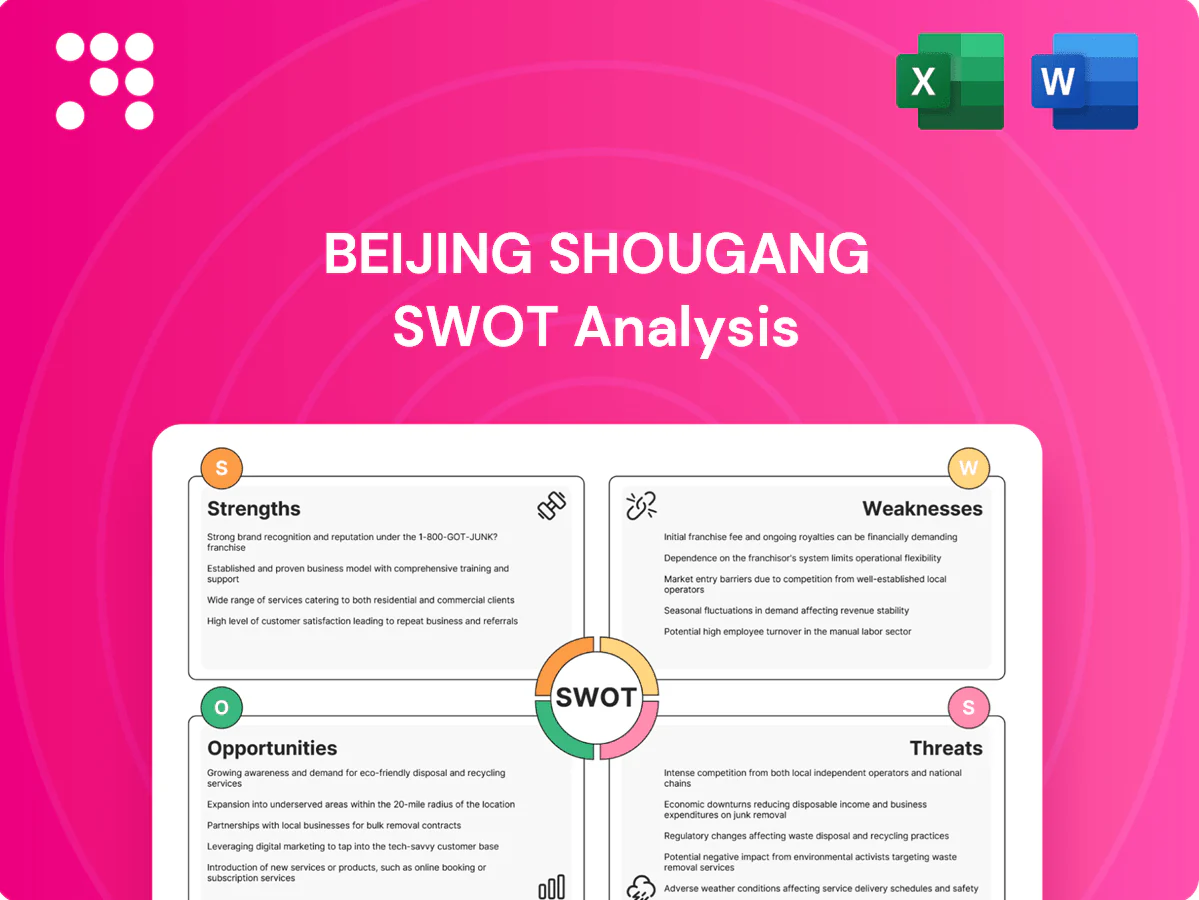
Beijing Shougang SWOT Analysis

Elevate Your Analysis with the Complete SWOT Report
Discover a concise Beijing Shougang SWOT snapshot highlighting its industrial strengths, environmental transition risks, competitive pressures, and untapped growth drivers. Our full SWOT dives deeper into operational metrics, regulatory impacts, and strategic options. Purchase the complete report for an editable, investor-ready Word and Excel package. Gain the analysis you need to plan, pitch, or invest with confidence.
Strengths

State-backed scale and resilience
As a major state-owned enterprise, Shougang benefits from policy support, preferential financing and strategic alignment with Beijing and national industrial priorities, underpinning stability across cycles and enabling large, long-horizon projects. Government linkage accelerates permits and partnerships with local authorities and SOEs, while state backing enhances credibility with domestic stakeholders and lenders, lowering execution and refinancing risk.
Core steel expertise with vertical integration
Shougangs deep upstream-to-downstream integration, spanning mining, steelmaking, machinery and construction, tightens cost control and secures feedstock amid a market where China produced over half of global crude steel in 2023. Internal demand capture from affiliated construction and equipment units enables coordinated planning and higher plant utilization. Process know-how underpins consistent product quality and gives Shougang leverage to shift into higher-margin, value-added steel segments.

Diverse portfolio beyond steel
Operations in electronics, real estate and financial services dilute single-industry risk, with Shougang ranked among China’s top-10 steelmakers while maintaining visible non-steel business lines across Beijing urban redevelopment projects.
Cross-segment synergies enable bundled infrastructure and urban services for industrial and municipal customers, leveraging real-estate projects built for post-2008 Olympic redevelopment.
Diversification creates multiple profit pools and optionality, cushioning group earnings when steel margins compress and stabilizing cash flow across cycles.

Leadership in green and sustainable development
Active decarbonization and circular practices strengthen Shougang’s license to operate by aligning with China’s 2030 carbon peak and 2060 neutrality goals; the steel sector accounts for roughly 15% of global CO2, so green steel can meet tightening standards and win premium customers. Sustainability positioning attracts ESG-focused partners and capital—global sustainable assets exceeded an estimated 40 trillion USD by 2024—differentiating the brand in a high-emission sector.
- Green premium: wins regulated customers
- Compliance: aligns with 2030/2060 targets
- Capital: taps >40T USD ESG flows (2024)
- Brand: differentiation in high-emission industry
Urban renewal and asset revitalization capability
- Repurposed Olympic venue
- Converts liabilities to income
- Replicable urban model
- Enhances stakeholder ties, recurring revenue
State-owned steel group: integrated assets, decarbonization unlocks >40T USD ESG
State ownership gives Shougang policy, financing and permit advantages and lowers execution risk. Deep upstream-to-downstream integration plus diversification (real estate, finance, electronics) and Shougang Park (millions visitors/year) stabilize cash flow. Decarbonization aligns with 2030/2060 and accesses >40T USD ESG capital (2024).
| Metric | Value |
|---|---|
| China share of crude steel (2023) | ~56% |
| ESG assets (2024) | >40T USD |
| Shougang Park visitors | Millions/year |
What is included in the product
 Detailed Word Document
Provides a clear SWOT framework that maps Beijing Shougang’s internal strengths and weaknesses alongside external opportunities and threats, highlighting key growth drivers, operational gaps, and market risks shaping its strategic position.

 Customizable Excel Spreadsheet
Provides a concise SWOT matrix for Beijing Shougang to quickly align strategy, relieve analysis bottlenecks, and support fast stakeholder decisions.
Weaknesses

High exposure to steel cyclicality
Beijing Shougang faces high exposure to steel cyclicality: Chinese crude steel output remained around 1.02 billion tonnes in 2024, and hot-rolled coil prices swung roughly 20% in 2024, tying earnings closely to construction and infrastructure cycles. Earnings can therefore swing sharply with macro conditions, complicating planning and capital allocation, while hedging tools only partially mitigate this volatility.
Legacy assets and potential overcapacity
Older plants at Beijing Shougang can lag peers on energy intensity and emissions, raising compliance and unit-cost risks; China still produced 1,018.9 million tonnes of crude steel in 2023, highlighting intense domestic competition. Overcapacity can depress utilization and margins in downturns; retrofit projects demand substantial CAPEX and months of downtime, and heavy, site-specific assets limit rapid strategic shifts.

SOE bureaucracy and slower decision-making
Layered SOE governance at Beijing Shougang can delay market-responsive moves, with multi-tier approvals slowing project starts and capital reallocation. Incentive structures often prioritize stability and social objectives over rapid innovation, hindering swift product pivots or portfolio pruning. Competitors with leaner, private-sector structures can outpace Shougang in execution and time-to-market.

Capital-intensive operations and leverage needs
Capital-intensive steel, mining and urban-redevelopment activities tie up large capex and working capital, and benefit-sensitive payback horizons are exposed to cycle timing; China produced 1.09 billion tonnes of crude steel in 2023, highlighting sector scale and capital intensity. High fixed costs lift break-even points and heavy external financing raises interest-rate and refinancing risks for Beijing Shougang.
- Large capex and WC needs
- Long, cycle-sensitive paybacks
- High fixed-cost break-even
- Dependence on external financing — interest/refinancing risk
Environmental legacy and compliance burden
Historic industrial sites impose ongoing remediation obligations for Beijing Shougang, raising both opex and capex as compliance with China's tightening environmental standards becomes stricter; any pollution incident can trigger regulatory penalties and significant reputational damage.
Steel cyclicity: China ~1.02bn t, HRC ~20% swings
Beijing Shougang is highly exposed to steel cyclicality: China crude steel output ~1.02 billion tonnes in 2024 and hot-rolled coil prices swung ~20% in 2024, creating earnings volatility. Older plants increase energy/emissions intensity and retrofit CAPEX. Layered SOE governance slows decisions while large, cycle-sensitive capex and remediation liabilities raise financing and compliance risks.
| Metric | Value |
|---|---|
| China crude steel (2024) | ~1.02 bn t |
| HRC price swing (2024) | ~20% |
| Primary risks | Capex, emissions, governance |
Preview Before You Purchase
Beijing Shougang SWOT Analysis
This is a real excerpt from the complete Beijing Shougang SWOT analysis document you'll receive after purchase—professional, structured, and ready to use. The preview below is taken directly from the full report; buying unlocks the editable, comprehensive version. No samples, just the exact file you'll download post-checkout.

Elevate Your Analysis with the Complete SWOT Report
Discover a concise Beijing Shougang SWOT snapshot highlighting its industrial strengths, environmental transition risks, competitive pressures, and untapped growth drivers. Our full SWOT dives deeper into operational metrics, regulatory impacts, and strategic options. Purchase the complete report for an editable, investor-ready Word and Excel package. Gain the analysis you need to plan, pitch, or invest with confidence.
Strengths
State-backed scale and resilience
As a major state-owned enterprise, Shougang benefits from policy support, preferential financing and strategic alignment with Beijing and national industrial priorities, underpinning stability across cycles and enabling large, long-horizon projects. Government linkage accelerates permits and partnerships with local authorities and SOEs, while state backing enhances credibility with domestic stakeholders and lenders, lowering execution and refinancing risk.
Core steel expertise with vertical integration
Shougangs deep upstream-to-downstream integration, spanning mining, steelmaking, machinery and construction, tightens cost control and secures feedstock amid a market where China produced over half of global crude steel in 2023. Internal demand capture from affiliated construction and equipment units enables coordinated planning and higher plant utilization. Process know-how underpins consistent product quality and gives Shougang leverage to shift into higher-margin, value-added steel segments.
Diverse portfolio beyond steel
Operations in electronics, real estate and financial services dilute single-industry risk, with Shougang ranked among China’s top-10 steelmakers while maintaining visible non-steel business lines across Beijing urban redevelopment projects.
Cross-segment synergies enable bundled infrastructure and urban services for industrial and municipal customers, leveraging real-estate projects built for post-2008 Olympic redevelopment.
Diversification creates multiple profit pools and optionality, cushioning group earnings when steel margins compress and stabilizing cash flow across cycles.
Leadership in green and sustainable development
Active decarbonization and circular practices strengthen Shougang’s license to operate by aligning with China’s 2030 carbon peak and 2060 neutrality goals; the steel sector accounts for roughly 15% of global CO2, so green steel can meet tightening standards and win premium customers. Sustainability positioning attracts ESG-focused partners and capital—global sustainable assets exceeded an estimated 40 trillion USD by 2024—differentiating the brand in a high-emission sector.
- Green premium: wins regulated customers
- Compliance: aligns with 2030/2060 targets
- Capital: taps >40T USD ESG flows (2024)
- Brand: differentiation in high-emission industry
Urban renewal and asset revitalization capability
- Repurposed Olympic venue
- Converts liabilities to income
- Replicable urban model
- Enhances stakeholder ties, recurring revenue
State-owned steel group: integrated assets, decarbonization unlocks >40T USD ESG
State ownership gives Shougang policy, financing and permit advantages and lowers execution risk. Deep upstream-to-downstream integration plus diversification (real estate, finance, electronics) and Shougang Park (millions visitors/year) stabilize cash flow. Decarbonization aligns with 2030/2060 and accesses >40T USD ESG capital (2024).
| Metric | Value |
|---|---|
| China share of crude steel (2023) | ~56% |
| ESG assets (2024) | >40T USD |
| Shougang Park visitors | Millions/year |
What is included in the product
Detailed Word Document
Provides a clear SWOT framework that maps Beijing Shougang’s internal strengths and weaknesses alongside external opportunities and threats, highlighting key growth drivers, operational gaps, and market risks shaping its strategic position.
Customizable Excel Spreadsheet
Provides a concise SWOT matrix for Beijing Shougang to quickly align strategy, relieve analysis bottlenecks, and support fast stakeholder decisions.
Weaknesses
High exposure to steel cyclicality
Beijing Shougang faces high exposure to steel cyclicality: Chinese crude steel output remained around 1.02 billion tonnes in 2024, and hot-rolled coil prices swung roughly 20% in 2024, tying earnings closely to construction and infrastructure cycles. Earnings can therefore swing sharply with macro conditions, complicating planning and capital allocation, while hedging tools only partially mitigate this volatility.
Legacy assets and potential overcapacity
Older plants at Beijing Shougang can lag peers on energy intensity and emissions, raising compliance and unit-cost risks; China still produced 1,018.9 million tonnes of crude steel in 2023, highlighting intense domestic competition. Overcapacity can depress utilization and margins in downturns; retrofit projects demand substantial CAPEX and months of downtime, and heavy, site-specific assets limit rapid strategic shifts.
SOE bureaucracy and slower decision-making
Layered SOE governance at Beijing Shougang can delay market-responsive moves, with multi-tier approvals slowing project starts and capital reallocation. Incentive structures often prioritize stability and social objectives over rapid innovation, hindering swift product pivots or portfolio pruning. Competitors with leaner, private-sector structures can outpace Shougang in execution and time-to-market.
Capital-intensive operations and leverage needs
Capital-intensive steel, mining and urban-redevelopment activities tie up large capex and working capital, and benefit-sensitive payback horizons are exposed to cycle timing; China produced 1.09 billion tonnes of crude steel in 2023, highlighting sector scale and capital intensity. High fixed costs lift break-even points and heavy external financing raises interest-rate and refinancing risks for Beijing Shougang.
- Large capex and WC needs
- Long, cycle-sensitive paybacks
- High fixed-cost break-even
- Dependence on external financing — interest/refinancing risk
Environmental legacy and compliance burden
Historic industrial sites impose ongoing remediation obligations for Beijing Shougang, raising both opex and capex as compliance with China's tightening environmental standards becomes stricter; any pollution incident can trigger regulatory penalties and significant reputational damage.
Steel cyclicity: China ~1.02bn t, HRC ~20% swings
Beijing Shougang is highly exposed to steel cyclicality: China crude steel output ~1.02 billion tonnes in 2024 and hot-rolled coil prices swung ~20% in 2024, creating earnings volatility. Older plants increase energy/emissions intensity and retrofit CAPEX. Layered SOE governance slows decisions while large, cycle-sensitive capex and remediation liabilities raise financing and compliance risks.
| Metric | Value |
|---|---|
| China crude steel (2024) | ~1.02 bn t |
| HRC price swing (2024) | ~20% |
| Primary risks | Capex, emissions, governance |
Preview Before You Purchase
Beijing Shougang SWOT Analysis
This is a real excerpt from the complete Beijing Shougang SWOT analysis document you'll receive after purchase—professional, structured, and ready to use. The preview below is taken directly from the full report; buying unlocks the editable, comprehensive version. No samples, just the exact file you'll download post-checkout.
Original: $10.00
-65%$10.00
$3.50Description
Elevate Your Analysis with the Complete SWOT Report
Discover a concise Beijing Shougang SWOT snapshot highlighting its industrial strengths, environmental transition risks, competitive pressures, and untapped growth drivers. Our full SWOT dives deeper into operational metrics, regulatory impacts, and strategic options. Purchase the complete report for an editable, investor-ready Word and Excel package. Gain the analysis you need to plan, pitch, or invest with confidence.
Strengths
State-backed scale and resilience
As a major state-owned enterprise, Shougang benefits from policy support, preferential financing and strategic alignment with Beijing and national industrial priorities, underpinning stability across cycles and enabling large, long-horizon projects. Government linkage accelerates permits and partnerships with local authorities and SOEs, while state backing enhances credibility with domestic stakeholders and lenders, lowering execution and refinancing risk.
Core steel expertise with vertical integration
Shougangs deep upstream-to-downstream integration, spanning mining, steelmaking, machinery and construction, tightens cost control and secures feedstock amid a market where China produced over half of global crude steel in 2023. Internal demand capture from affiliated construction and equipment units enables coordinated planning and higher plant utilization. Process know-how underpins consistent product quality and gives Shougang leverage to shift into higher-margin, value-added steel segments.
Diverse portfolio beyond steel
Operations in electronics, real estate and financial services dilute single-industry risk, with Shougang ranked among China’s top-10 steelmakers while maintaining visible non-steel business lines across Beijing urban redevelopment projects.
Cross-segment synergies enable bundled infrastructure and urban services for industrial and municipal customers, leveraging real-estate projects built for post-2008 Olympic redevelopment.
Diversification creates multiple profit pools and optionality, cushioning group earnings when steel margins compress and stabilizing cash flow across cycles.
Leadership in green and sustainable development
Active decarbonization and circular practices strengthen Shougang’s license to operate by aligning with China’s 2030 carbon peak and 2060 neutrality goals; the steel sector accounts for roughly 15% of global CO2, so green steel can meet tightening standards and win premium customers. Sustainability positioning attracts ESG-focused partners and capital—global sustainable assets exceeded an estimated 40 trillion USD by 2024—differentiating the brand in a high-emission sector.
- Green premium: wins regulated customers
- Compliance: aligns with 2030/2060 targets
- Capital: taps >40T USD ESG flows (2024)
- Brand: differentiation in high-emission industry
Urban renewal and asset revitalization capability
- Repurposed Olympic venue
- Converts liabilities to income
- Replicable urban model
- Enhances stakeholder ties, recurring revenue
State-owned steel group: integrated assets, decarbonization unlocks >40T USD ESG
State ownership gives Shougang policy, financing and permit advantages and lowers execution risk. Deep upstream-to-downstream integration plus diversification (real estate, finance, electronics) and Shougang Park (millions visitors/year) stabilize cash flow. Decarbonization aligns with 2030/2060 and accesses >40T USD ESG capital (2024).
| Metric | Value |
|---|---|
| China share of crude steel (2023) | ~56% |
| ESG assets (2024) | >40T USD |
| Shougang Park visitors | Millions/year |
What is included in the product
Detailed Word Document
Provides a clear SWOT framework that maps Beijing Shougang’s internal strengths and weaknesses alongside external opportunities and threats, highlighting key growth drivers, operational gaps, and market risks shaping its strategic position.
Customizable Excel Spreadsheet
Provides a concise SWOT matrix for Beijing Shougang to quickly align strategy, relieve analysis bottlenecks, and support fast stakeholder decisions.
Weaknesses
High exposure to steel cyclicality
Beijing Shougang faces high exposure to steel cyclicality: Chinese crude steel output remained around 1.02 billion tonnes in 2024, and hot-rolled coil prices swung roughly 20% in 2024, tying earnings closely to construction and infrastructure cycles. Earnings can therefore swing sharply with macro conditions, complicating planning and capital allocation, while hedging tools only partially mitigate this volatility.
Legacy assets and potential overcapacity
Older plants at Beijing Shougang can lag peers on energy intensity and emissions, raising compliance and unit-cost risks; China still produced 1,018.9 million tonnes of crude steel in 2023, highlighting intense domestic competition. Overcapacity can depress utilization and margins in downturns; retrofit projects demand substantial CAPEX and months of downtime, and heavy, site-specific assets limit rapid strategic shifts.
SOE bureaucracy and slower decision-making
Layered SOE governance at Beijing Shougang can delay market-responsive moves, with multi-tier approvals slowing project starts and capital reallocation. Incentive structures often prioritize stability and social objectives over rapid innovation, hindering swift product pivots or portfolio pruning. Competitors with leaner, private-sector structures can outpace Shougang in execution and time-to-market.
Capital-intensive operations and leverage needs
Capital-intensive steel, mining and urban-redevelopment activities tie up large capex and working capital, and benefit-sensitive payback horizons are exposed to cycle timing; China produced 1.09 billion tonnes of crude steel in 2023, highlighting sector scale and capital intensity. High fixed costs lift break-even points and heavy external financing raises interest-rate and refinancing risks for Beijing Shougang.
- Large capex and WC needs
- Long, cycle-sensitive paybacks
- High fixed-cost break-even
- Dependence on external financing — interest/refinancing risk
Environmental legacy and compliance burden
Historic industrial sites impose ongoing remediation obligations for Beijing Shougang, raising both opex and capex as compliance with China's tightening environmental standards becomes stricter; any pollution incident can trigger regulatory penalties and significant reputational damage.
Steel cyclicity: China ~1.02bn t, HRC ~20% swings
Beijing Shougang is highly exposed to steel cyclicality: China crude steel output ~1.02 billion tonnes in 2024 and hot-rolled coil prices swung ~20% in 2024, creating earnings volatility. Older plants increase energy/emissions intensity and retrofit CAPEX. Layered SOE governance slows decisions while large, cycle-sensitive capex and remediation liabilities raise financing and compliance risks.
| Metric | Value |
|---|---|
| China crude steel (2024) | ~1.02 bn t |
| HRC price swing (2024) | ~20% |
| Primary risks | Capex, emissions, governance |
Preview Before You Purchase
Beijing Shougang SWOT Analysis
This is a real excerpt from the complete Beijing Shougang SWOT analysis document you'll receive after purchase—professional, structured, and ready to use. The preview below is taken directly from the full report; buying unlocks the editable, comprehensive version. No samples, just the exact file you'll download post-checkout.











