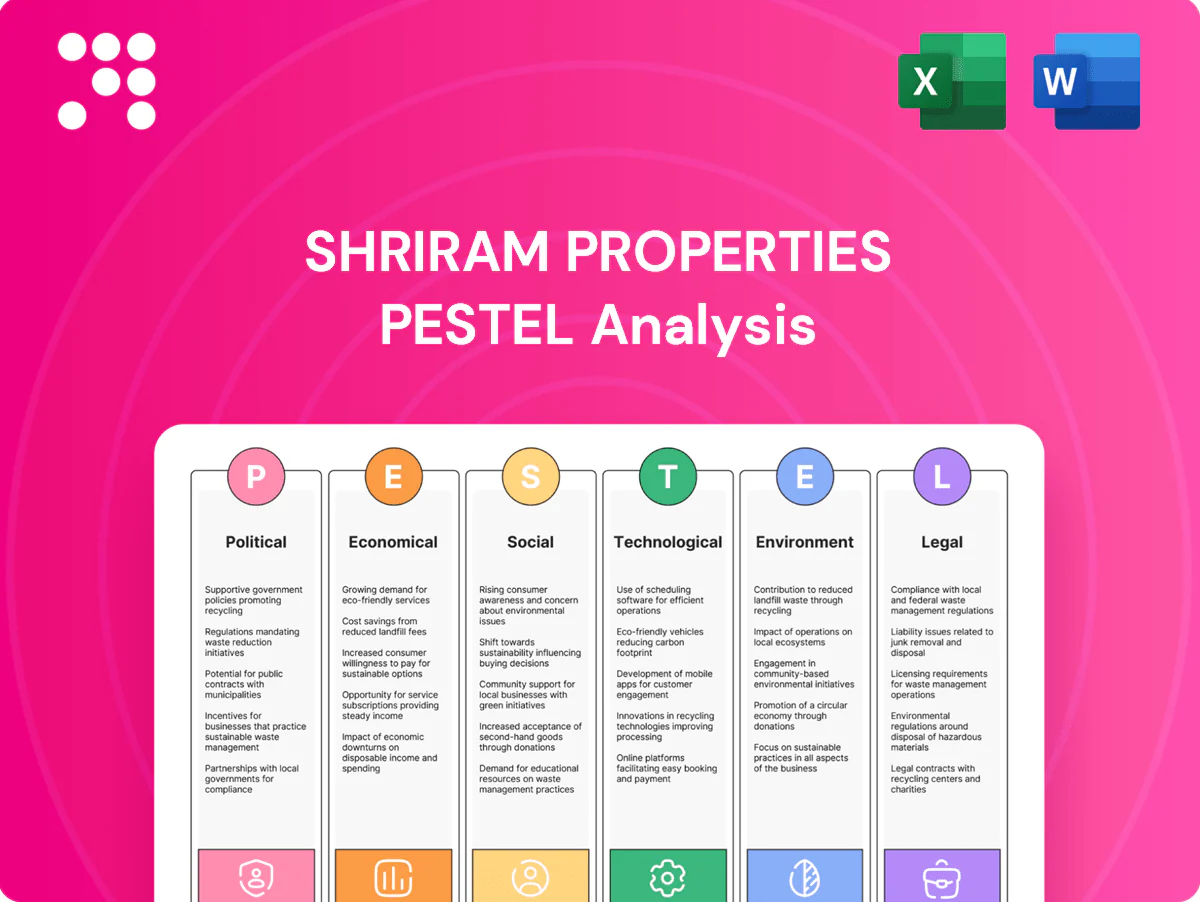
Shriram Properties PESTLE Analysis

Skip the Research. Get the Strategy.
Shriram Properties faces regulatory shifts, interest-rate sensitivity, and rising sustainability expectations that will reshape project economics and customer demand. Our PESTLE distills these external forces into strategic implications and risk signals you can act on. Purchase the full analysis to get the detailed, ready-to-use insights that inform smarter investment and planning.
Political factors

Housing policies and subsidies
Central and state programs such as PMAY and state housing missions shape mid‑market and affordable demand; PMAY has sanctioned over 1.2 crore houses since launch. Incentives, subsidy eligibility and beneficiary‑led construction norms directly influence product mix and pricing. Shriram Properties can time launches to capture interest‑subvention and CLSS benefits (CLSS offers up to Rs 2.67 lakh for EWS/LIG). Policy continuity and budget allocations affect sales velocity in targeted micro‑markets.
State-level governance and approvals
Real estate approvals in Karnataka, Tamil Nadu, Telangana and West Bengal are largely state/municipal responsibilities; land-use conversion often ranges 30–180 days while layout sanctions and occupancy certificates can add 3–12 months, extending cycle times. Cities with effective single-window digital clearances cut execution risk and approval times materially, whereas manual systems increase delays. Stable local administrations can shorten permits, lowering carrying cost drag—typically 1–2% of project cost annually.

Infrastructure push and urban planning
Central infrastructure programmes such as the National Infrastructure Pipeline (approved ~₹111 lakh crore for 2020–25) and PM Gati Shakti (₹100 lakh crore coordination plan) are redirecting capex into metros, suburban rail, ring roads and industrial corridors, shifting residential catchment appeal. Projects adjacent to new stations or highways show faster absorption and higher pricing in Bengaluru, Chennai, Hyderabad and Kolkata. Development control revisions and transit-oriented development policies alter feasible densities and project economics. Proactive engagement with city planning authorities can unlock significant land-value uplift.

Land acquisition and regional politics
Land aggregation for Shriram Properties is tightly linked to local politics, land-ceiling rules and cooperative panchayat ties; clarity of land records and digitization levels vary by state, complicating negotiation and legal diligence. Politically driven circle rate and guideline-value changes in 2024 across several states tightened affordability and registration costs, so strong local stakeholder networks and on-ground teams reduce disruption risk.
- Local politics governs land access and panchayat approvals
- Uneven digitization increases due-diligence time and legal exposure
- 2024 circle-rate revisions raised transaction costs in multiple markets
- Robust local networks lower expropriation, protest and delay risk
Election cycles and policy continuity
Election periods, such as the India general election April–May 2024, often slow government approvals and defer buyer decisions, compressing quarterly bookings for developers like Shriram Properties. Post-election policy resets at state level can change stamp duty or incentive schemes, requiring firms to revise pricing and margins. Companies need pipeline buffers and active sales communication to mitigate administrative pauses and buyer uncertainty.
- Election pause: April–May 2024
- State-level stamp duty risk
- Maintain 1–2 quarter pipeline buffer
- Proactive customer communication
PMAY >1.2 crore and CLSS Rs 2.67 lakh boost affordable housing demand
Central/state schemes (PMAY: >1.2 crore houses sanctioned) and CLSS (up to Rs 2.67 lakh) shape affordable demand and pricing; policy continuity and budget allocations drive sales velocity. State/municipal approvals (30–180 days for land conversion; 3–12 months for OC) and 2024 circle‑rate revisions raised transaction costs. National infrastructure (NIP ~₹111 lakh crore) and Apr–May 2024 elections shifted approvals and demand timing.
| Factor | Metric/2024–25 |
|---|---|
| PMAY houses sanctioned | >1.2 crore |
| CLSS max subsidy | Rs 2.67 lakh |
| NIP capex | ~₹111 lakh crore (2020–25) |
| Election pause | Apr–May 2024 |
What is included in the product
 Detailed Word Document
Explores how Political, Economic, Social, Technological, Environmental and Legal forces uniquely shape Shriram Properties, combining data-driven trends and regulatory context to identify risks and opportunities; designed for executives and investors, it offers clean, region-specific, forward-looking insights ready for reports and strategy planning.

 Customizable Excel Spreadsheet
A clean, summarized PESTLE of Shriram Properties that’s visually segmented for quick interpretation, easily dropped into presentations or shared across teams to streamline risk discussions and speed alignment during planning sessions.
Economic factors

Interest rates and mortgage affordability
Home loan rates (avg retail home loan ~8.2% in 2024) directly affect EMI affordability for mid-income buyers buying ₹30–60 lakh homes; a 100bp rise can raise EMIs ~8–10%, compressing conversion rates and ticket sizes. RBI repo at 6.5% (mid-2025) sets the cycle that drives buyer behavior; rate stability sustains bookings, hikes lengthen decision timelines. Shriram Properties' flexible payment plans and banker tie-ups mitigate short-term demand dips.
Income growth and urbanization
Rising employment in IT/ITES, manufacturing and services is driving housing demand for Shriram Properties: NASSCOM 2024 cites IT‑BPM employment at about 5.4 million nationwide with Bengaluru, Chennai and Hyderabad accounting for roughly 2.2 million of that, expanding demand corridors. Migration to Tier‑1 cities and growth corridors increases catchment for affordable and mid‑market projects, while income dispersion shifts unit mix toward compact 1/2 BHKs and value 3 BHKs. Monitoring job markets in Bengaluru, Chennai and Hyderabad—key hiring hubs—helps calibrate launch timing and inventory mix.

Construction input costs volatility
Steel, cement and sand price swings—steel rebar moved about 10% and cement near 5% in 2023–24—compress Shriram Properties margins and pricing power, raising project IRR risk. Long-term procurement contracts, design optimization and alternative materials (e.g., AAC blocks, FRP) hedge input volatility. Transparent escalation clauses align contractor cashflows and reduce disputes. Aggressive value engineering preserves affordability without diluting quality.

Inventory cycles and price elasticity
Unsold inventory and absorption rates at Shriram Properties vary sharply by micro-market, keeping mid-market buyers highly price-sensitive and constraining aggressive price hikes; phased launches and dynamic pricing are used to balance sales velocity with price realization, while data-led micro-market selection reduces holding costs and improves ROCE.
- Unsold inventory: micro-market dependent
- Price elasticity: limits > aggressive hikes
- Phased launches + dynamic pricing: balance velocity/realization
- Data-led locational choice: lower holding costs, higher ROCE
Funding environment and liquidity
Access to construction finance from banks, NBFCs and AIFs determines Shriram Properties project cadence; asset-light JD/JV or development-management models reduce capital intensity and speed delivery. Strong sales collections and presales provide execution certainty, while macro liquidity shocks can tighten credit access and raise funding costs. Robust compliance and governance help lower borrowing spreads and attract institutional capital.
- Funding mix: banks, NBFCs, AIFs
- Capital strategy: JD/JV, asset-light
- Cash importance: sales collections
- Risk: macro liquidity shocks
- Mitigation: strong governance, compliance
PMAY >1.2 crore and CLSS Rs 2.67 lakh boost affordable housing demand
Home loans avg ~8.2% (2024); RBI repo 6.5% (mid‑2025) — rate moves shift EMIs and booking timelines. IT‑BPM employment ~5.4M (2024) expands mid‑market demand in Bengaluru/Chennai/Hyderabad. Steel rebar ~+10% and cement ~+5% (2023–24) squeeze margins. Funding mix: banks, NBFCs, AIFs; JD/JV reduces capital intensity.
| Metric | Value | Impact |
|---|---|---|
| Home loan rate | 8.2% | EMI affordability |
| RBI repo | 6.5% | buyer sentiment |
| IT jobs | 5.4M | demand |
Same Document Delivered
Shriram Properties PESTLE Analysis
This preview of the Shriram Properties PESTLE Analysis is the exact, fully formatted document you’ll receive after purchase. It contains the same structure, insights, and visuals as the downloadable file. No placeholders or teasers—what you see is the final ready-to-use report.

Skip the Research. Get the Strategy.
Shriram Properties faces regulatory shifts, interest-rate sensitivity, and rising sustainability expectations that will reshape project economics and customer demand. Our PESTLE distills these external forces into strategic implications and risk signals you can act on. Purchase the full analysis to get the detailed, ready-to-use insights that inform smarter investment and planning.
Political factors
Housing policies and subsidies
Central and state programs such as PMAY and state housing missions shape mid‑market and affordable demand; PMAY has sanctioned over 1.2 crore houses since launch. Incentives, subsidy eligibility and beneficiary‑led construction norms directly influence product mix and pricing. Shriram Properties can time launches to capture interest‑subvention and CLSS benefits (CLSS offers up to Rs 2.67 lakh for EWS/LIG). Policy continuity and budget allocations affect sales velocity in targeted micro‑markets.
State-level governance and approvals
Real estate approvals in Karnataka, Tamil Nadu, Telangana and West Bengal are largely state/municipal responsibilities; land-use conversion often ranges 30–180 days while layout sanctions and occupancy certificates can add 3–12 months, extending cycle times. Cities with effective single-window digital clearances cut execution risk and approval times materially, whereas manual systems increase delays. Stable local administrations can shorten permits, lowering carrying cost drag—typically 1–2% of project cost annually.
Infrastructure push and urban planning
Central infrastructure programmes such as the National Infrastructure Pipeline (approved ~₹111 lakh crore for 2020–25) and PM Gati Shakti (₹100 lakh crore coordination plan) are redirecting capex into metros, suburban rail, ring roads and industrial corridors, shifting residential catchment appeal. Projects adjacent to new stations or highways show faster absorption and higher pricing in Bengaluru, Chennai, Hyderabad and Kolkata. Development control revisions and transit-oriented development policies alter feasible densities and project economics. Proactive engagement with city planning authorities can unlock significant land-value uplift.
Land acquisition and regional politics
Land aggregation for Shriram Properties is tightly linked to local politics, land-ceiling rules and cooperative panchayat ties; clarity of land records and digitization levels vary by state, complicating negotiation and legal diligence. Politically driven circle rate and guideline-value changes in 2024 across several states tightened affordability and registration costs, so strong local stakeholder networks and on-ground teams reduce disruption risk.
- Local politics governs land access and panchayat approvals
- Uneven digitization increases due-diligence time and legal exposure
- 2024 circle-rate revisions raised transaction costs in multiple markets
- Robust local networks lower expropriation, protest and delay risk
Election cycles and policy continuity
Election periods, such as the India general election April–May 2024, often slow government approvals and defer buyer decisions, compressing quarterly bookings for developers like Shriram Properties. Post-election policy resets at state level can change stamp duty or incentive schemes, requiring firms to revise pricing and margins. Companies need pipeline buffers and active sales communication to mitigate administrative pauses and buyer uncertainty.
- Election pause: April–May 2024
- State-level stamp duty risk
- Maintain 1–2 quarter pipeline buffer
- Proactive customer communication
PMAY >1.2 crore and CLSS Rs 2.67 lakh boost affordable housing demand
Central/state schemes (PMAY: >1.2 crore houses sanctioned) and CLSS (up to Rs 2.67 lakh) shape affordable demand and pricing; policy continuity and budget allocations drive sales velocity. State/municipal approvals (30–180 days for land conversion; 3–12 months for OC) and 2024 circle‑rate revisions raised transaction costs. National infrastructure (NIP ~₹111 lakh crore) and Apr–May 2024 elections shifted approvals and demand timing.
| Factor | Metric/2024–25 |
|---|---|
| PMAY houses sanctioned | >1.2 crore |
| CLSS max subsidy | Rs 2.67 lakh |
| NIP capex | ~₹111 lakh crore (2020–25) |
| Election pause | Apr–May 2024 |
What is included in the product
Detailed Word Document
Explores how Political, Economic, Social, Technological, Environmental and Legal forces uniquely shape Shriram Properties, combining data-driven trends and regulatory context to identify risks and opportunities; designed for executives and investors, it offers clean, region-specific, forward-looking insights ready for reports and strategy planning.
Customizable Excel Spreadsheet
A clean, summarized PESTLE of Shriram Properties that’s visually segmented for quick interpretation, easily dropped into presentations or shared across teams to streamline risk discussions and speed alignment during planning sessions.
Economic factors
Interest rates and mortgage affordability
Home loan rates (avg retail home loan ~8.2% in 2024) directly affect EMI affordability for mid-income buyers buying ₹30–60 lakh homes; a 100bp rise can raise EMIs ~8–10%, compressing conversion rates and ticket sizes. RBI repo at 6.5% (mid-2025) sets the cycle that drives buyer behavior; rate stability sustains bookings, hikes lengthen decision timelines. Shriram Properties' flexible payment plans and banker tie-ups mitigate short-term demand dips.
Income growth and urbanization
Rising employment in IT/ITES, manufacturing and services is driving housing demand for Shriram Properties: NASSCOM 2024 cites IT‑BPM employment at about 5.4 million nationwide with Bengaluru, Chennai and Hyderabad accounting for roughly 2.2 million of that, expanding demand corridors. Migration to Tier‑1 cities and growth corridors increases catchment for affordable and mid‑market projects, while income dispersion shifts unit mix toward compact 1/2 BHKs and value 3 BHKs. Monitoring job markets in Bengaluru, Chennai and Hyderabad—key hiring hubs—helps calibrate launch timing and inventory mix.
Construction input costs volatility
Steel, cement and sand price swings—steel rebar moved about 10% and cement near 5% in 2023–24—compress Shriram Properties margins and pricing power, raising project IRR risk. Long-term procurement contracts, design optimization and alternative materials (e.g., AAC blocks, FRP) hedge input volatility. Transparent escalation clauses align contractor cashflows and reduce disputes. Aggressive value engineering preserves affordability without diluting quality.
Inventory cycles and price elasticity
Unsold inventory and absorption rates at Shriram Properties vary sharply by micro-market, keeping mid-market buyers highly price-sensitive and constraining aggressive price hikes; phased launches and dynamic pricing are used to balance sales velocity with price realization, while data-led micro-market selection reduces holding costs and improves ROCE.
- Unsold inventory: micro-market dependent
- Price elasticity: limits > aggressive hikes
- Phased launches + dynamic pricing: balance velocity/realization
- Data-led locational choice: lower holding costs, higher ROCE
Funding environment and liquidity
Access to construction finance from banks, NBFCs and AIFs determines Shriram Properties project cadence; asset-light JD/JV or development-management models reduce capital intensity and speed delivery. Strong sales collections and presales provide execution certainty, while macro liquidity shocks can tighten credit access and raise funding costs. Robust compliance and governance help lower borrowing spreads and attract institutional capital.
- Funding mix: banks, NBFCs, AIFs
- Capital strategy: JD/JV, asset-light
- Cash importance: sales collections
- Risk: macro liquidity shocks
- Mitigation: strong governance, compliance
PMAY >1.2 crore and CLSS Rs 2.67 lakh boost affordable housing demand
Home loans avg ~8.2% (2024); RBI repo 6.5% (mid‑2025) — rate moves shift EMIs and booking timelines. IT‑BPM employment ~5.4M (2024) expands mid‑market demand in Bengaluru/Chennai/Hyderabad. Steel rebar ~+10% and cement ~+5% (2023–24) squeeze margins. Funding mix: banks, NBFCs, AIFs; JD/JV reduces capital intensity.
| Metric | Value | Impact |
|---|---|---|
| Home loan rate | 8.2% | EMI affordability |
| RBI repo | 6.5% | buyer sentiment |
| IT jobs | 5.4M | demand |
Same Document Delivered
Shriram Properties PESTLE Analysis
This preview of the Shriram Properties PESTLE Analysis is the exact, fully formatted document you’ll receive after purchase. It contains the same structure, insights, and visuals as the downloadable file. No placeholders or teasers—what you see is the final ready-to-use report.
Original: $10.00
-65%$10.00
$3.50Description
Skip the Research. Get the Strategy.
Shriram Properties faces regulatory shifts, interest-rate sensitivity, and rising sustainability expectations that will reshape project economics and customer demand. Our PESTLE distills these external forces into strategic implications and risk signals you can act on. Purchase the full analysis to get the detailed, ready-to-use insights that inform smarter investment and planning.
Political factors
Housing policies and subsidies
Central and state programs such as PMAY and state housing missions shape mid‑market and affordable demand; PMAY has sanctioned over 1.2 crore houses since launch. Incentives, subsidy eligibility and beneficiary‑led construction norms directly influence product mix and pricing. Shriram Properties can time launches to capture interest‑subvention and CLSS benefits (CLSS offers up to Rs 2.67 lakh for EWS/LIG). Policy continuity and budget allocations affect sales velocity in targeted micro‑markets.
State-level governance and approvals
Real estate approvals in Karnataka, Tamil Nadu, Telangana and West Bengal are largely state/municipal responsibilities; land-use conversion often ranges 30–180 days while layout sanctions and occupancy certificates can add 3–12 months, extending cycle times. Cities with effective single-window digital clearances cut execution risk and approval times materially, whereas manual systems increase delays. Stable local administrations can shorten permits, lowering carrying cost drag—typically 1–2% of project cost annually.
Infrastructure push and urban planning
Central infrastructure programmes such as the National Infrastructure Pipeline (approved ~₹111 lakh crore for 2020–25) and PM Gati Shakti (₹100 lakh crore coordination plan) are redirecting capex into metros, suburban rail, ring roads and industrial corridors, shifting residential catchment appeal. Projects adjacent to new stations or highways show faster absorption and higher pricing in Bengaluru, Chennai, Hyderabad and Kolkata. Development control revisions and transit-oriented development policies alter feasible densities and project economics. Proactive engagement with city planning authorities can unlock significant land-value uplift.
Land acquisition and regional politics
Land aggregation for Shriram Properties is tightly linked to local politics, land-ceiling rules and cooperative panchayat ties; clarity of land records and digitization levels vary by state, complicating negotiation and legal diligence. Politically driven circle rate and guideline-value changes in 2024 across several states tightened affordability and registration costs, so strong local stakeholder networks and on-ground teams reduce disruption risk.
- Local politics governs land access and panchayat approvals
- Uneven digitization increases due-diligence time and legal exposure
- 2024 circle-rate revisions raised transaction costs in multiple markets
- Robust local networks lower expropriation, protest and delay risk
Election cycles and policy continuity
Election periods, such as the India general election April–May 2024, often slow government approvals and defer buyer decisions, compressing quarterly bookings for developers like Shriram Properties. Post-election policy resets at state level can change stamp duty or incentive schemes, requiring firms to revise pricing and margins. Companies need pipeline buffers and active sales communication to mitigate administrative pauses and buyer uncertainty.
- Election pause: April–May 2024
- State-level stamp duty risk
- Maintain 1–2 quarter pipeline buffer
- Proactive customer communication
PMAY >1.2 crore and CLSS Rs 2.67 lakh boost affordable housing demand
Central/state schemes (PMAY: >1.2 crore houses sanctioned) and CLSS (up to Rs 2.67 lakh) shape affordable demand and pricing; policy continuity and budget allocations drive sales velocity. State/municipal approvals (30–180 days for land conversion; 3–12 months for OC) and 2024 circle‑rate revisions raised transaction costs. National infrastructure (NIP ~₹111 lakh crore) and Apr–May 2024 elections shifted approvals and demand timing.
| Factor | Metric/2024–25 |
|---|---|
| PMAY houses sanctioned | >1.2 crore |
| CLSS max subsidy | Rs 2.67 lakh |
| NIP capex | ~₹111 lakh crore (2020–25) |
| Election pause | Apr–May 2024 |
What is included in the product
Detailed Word Document
Explores how Political, Economic, Social, Technological, Environmental and Legal forces uniquely shape Shriram Properties, combining data-driven trends and regulatory context to identify risks and opportunities; designed for executives and investors, it offers clean, region-specific, forward-looking insights ready for reports and strategy planning.
Customizable Excel Spreadsheet
A clean, summarized PESTLE of Shriram Properties that’s visually segmented for quick interpretation, easily dropped into presentations or shared across teams to streamline risk discussions and speed alignment during planning sessions.
Economic factors
Interest rates and mortgage affordability
Home loan rates (avg retail home loan ~8.2% in 2024) directly affect EMI affordability for mid-income buyers buying ₹30–60 lakh homes; a 100bp rise can raise EMIs ~8–10%, compressing conversion rates and ticket sizes. RBI repo at 6.5% (mid-2025) sets the cycle that drives buyer behavior; rate stability sustains bookings, hikes lengthen decision timelines. Shriram Properties' flexible payment plans and banker tie-ups mitigate short-term demand dips.
Income growth and urbanization
Rising employment in IT/ITES, manufacturing and services is driving housing demand for Shriram Properties: NASSCOM 2024 cites IT‑BPM employment at about 5.4 million nationwide with Bengaluru, Chennai and Hyderabad accounting for roughly 2.2 million of that, expanding demand corridors. Migration to Tier‑1 cities and growth corridors increases catchment for affordable and mid‑market projects, while income dispersion shifts unit mix toward compact 1/2 BHKs and value 3 BHKs. Monitoring job markets in Bengaluru, Chennai and Hyderabad—key hiring hubs—helps calibrate launch timing and inventory mix.
Construction input costs volatility
Steel, cement and sand price swings—steel rebar moved about 10% and cement near 5% in 2023–24—compress Shriram Properties margins and pricing power, raising project IRR risk. Long-term procurement contracts, design optimization and alternative materials (e.g., AAC blocks, FRP) hedge input volatility. Transparent escalation clauses align contractor cashflows and reduce disputes. Aggressive value engineering preserves affordability without diluting quality.
Inventory cycles and price elasticity
Unsold inventory and absorption rates at Shriram Properties vary sharply by micro-market, keeping mid-market buyers highly price-sensitive and constraining aggressive price hikes; phased launches and dynamic pricing are used to balance sales velocity with price realization, while data-led micro-market selection reduces holding costs and improves ROCE.
- Unsold inventory: micro-market dependent
- Price elasticity: limits > aggressive hikes
- Phased launches + dynamic pricing: balance velocity/realization
- Data-led locational choice: lower holding costs, higher ROCE
Funding environment and liquidity
Access to construction finance from banks, NBFCs and AIFs determines Shriram Properties project cadence; asset-light JD/JV or development-management models reduce capital intensity and speed delivery. Strong sales collections and presales provide execution certainty, while macro liquidity shocks can tighten credit access and raise funding costs. Robust compliance and governance help lower borrowing spreads and attract institutional capital.
- Funding mix: banks, NBFCs, AIFs
- Capital strategy: JD/JV, asset-light
- Cash importance: sales collections
- Risk: macro liquidity shocks
- Mitigation: strong governance, compliance
PMAY >1.2 crore and CLSS Rs 2.67 lakh boost affordable housing demand
Home loans avg ~8.2% (2024); RBI repo 6.5% (mid‑2025) — rate moves shift EMIs and booking timelines. IT‑BPM employment ~5.4M (2024) expands mid‑market demand in Bengaluru/Chennai/Hyderabad. Steel rebar ~+10% and cement ~+5% (2023–24) squeeze margins. Funding mix: banks, NBFCs, AIFs; JD/JV reduces capital intensity.
| Metric | Value | Impact |
|---|---|---|
| Home loan rate | 8.2% | EMI affordability |
| RBI repo | 6.5% | buyer sentiment |
| IT jobs | 5.4M | demand |
Same Document Delivered
Shriram Properties PESTLE Analysis
This preview of the Shriram Properties PESTLE Analysis is the exact, fully formatted document you’ll receive after purchase. It contains the same structure, insights, and visuals as the downloadable file. No placeholders or teasers—what you see is the final ready-to-use report.











