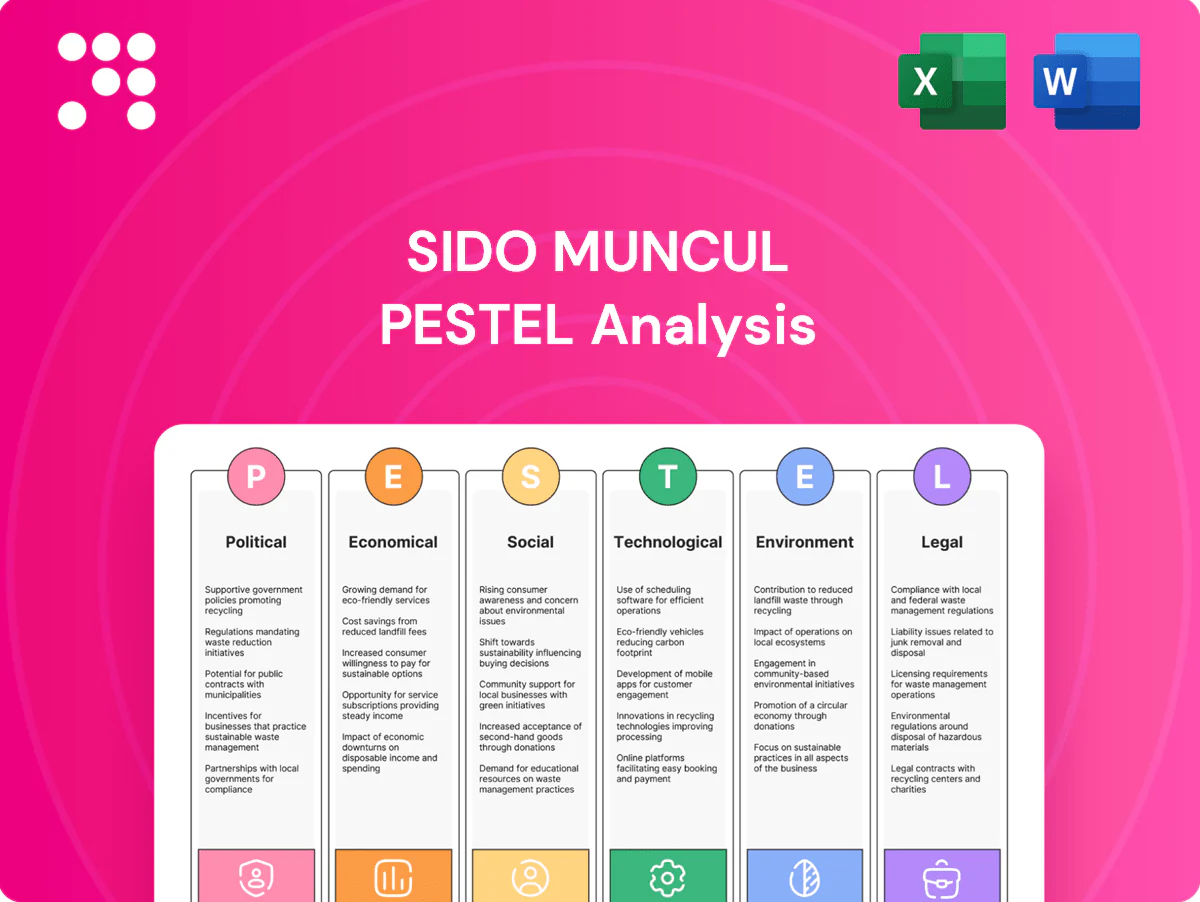
Sido Muncul PESTLE Analysis

Your Shortcut to Market Insight Starts Here
Our PESTLE analysis for Sido Muncul reveals how political regulations, economic trends, social health consciousness, technological adoption, legal compliance, and environmental pressures shape its competitive edge. These insights help forecast risks and identify growth levers for investors and strategists. Download the full report now for the complete, actionable breakdown.
Political factors

Health policy priorities and public spending
Indonesia's push for preventive care and formal integration of traditional medicine (jamu) boosts demand for herbal products; BPJS Kesehatan covered about 244 million participants by 2024, expanding institutional channels. 2024 public health spending rose to roughly 2.8% of GDP, with increased budgets for community programs that can amplify Sido Muncul distribution through clinics and pharmacies. Policy moves toward universal coverage and wellness campaigns favor procurement, while sudden reallocations or austerity could quickly reduce institutional orders.
Regulatory oversight by BPOM and harmonization
BPOM, established in 2000, sets binding standards for traditional medicines, supplements and claims, driving approvals and reformulations for Sido Muncul. ASEAN harmonization across 10 member states can ease regional market access but increases documentary and quality requirements. Strong political will to curb misleading claims is raising enforcement intensity. Predictable oversight supports brand trust and market stability.

Trade policy, tariffs, and export incentives
Export incentives for value-added natural products can help Sido Muncul enter ASEAN’s ~670 million consumers and the Middle East’s ~280 million market (2024), especially for herbal and nutraceutical lines.
Tariff shifts on botanicals, packaging or machinery directly affect COGS and margins, while bilateral trade pacts can lower barriers for halal-certified goods and speed market access.
However, rising protectionism and non-tariff measures—sanitary rules, labeling or origin checks—could materially slow cross-border growth.

Rural development and agricultural support
Government rural programs shape herb supply and price stability for Sido Muncul: extension services and subsidies in 2024 expanded smallholder support, improving ginger and turmeric yields and reducing raw material volatility; emphasis on agribusiness traceability (2024 regulations) favors compliant firms, while policy inconsistency risks disrupting contract farming arrangements.
- Traceability rules: compliance advantage
- Subsidies/extension: yield uplift for smallholders
- Supply risk: policy shifts threaten contracts
Macropolitical stability and election cycles
Indonesia’s relative macropolitical stability and 5.1% GDP growth in 2024 support Sido Muncul’s investment, branding and distribution expansion, but the 2024 election cycle caused documented administrative slowdowns that delayed permits and public tenders. Populist fiscal moves, including the VAT rise to 12% in April 2025, can affect pricing of consumer health products, while shifts in cross-ministry coordination have slowed policy execution.
- Stability: 5.1% GDP (2024)
- Election impact: permit/tender delays (2024)
- Tax risk: VAT 12% since Apr 2025
- Policy execution: cross-ministry shifts slow rollout
Policy tailwinds boost jamu demand; 12% VAT and compliance raise costs
Favorable policies for jamu integration and BPJS expansion (244m participants by 2024) boost institutional demand, while BPOM enforcement and ASEAN harmonization raise quality/compliance costs. Export incentives aid ASEAN (670m) and Middle East (280m) access, but VAT hike to 12% (Apr 2025), protectionism and election-related permit delays constrain margins and rollout.
| Indicator | Value |
|---|---|
| BPJS participants (2024) | 244,000,000 |
| Public health spend (%GDP, 2024) | 2.8% |
| Indonesia GDP growth (2024) | 5.1% |
| VAT rate | 12% (since Apr 2025) |
| ASEAN market | 670,000,000 |
| Middle East market | 280,000,000 |
What is included in the product
 Detailed Word Document
Provides a focused PESTLE analysis of Sido Muncul, examining Political, Economic, Social, Technological, Environmental and Legal drivers with data-backed trends and region- and industry-specific examples. Designed for executives and investors, it highlights threats, opportunities and forward-looking scenarios ready for business plans or investor materials.

 Customizable Excel Spreadsheet
A concise, visually segmented PESTLE summary of Sido Muncul that streamlines stakeholder alignment and presentations, editable for regional context or product lines and drop‑in ready for slides or meeting packs.
Economic factors

Consumer purchasing power and inflation
Real wages in Indonesia lagged 2024 inflation of about 3.0% (BPS), pressuring discretionary spending but boosting demand for affordable wellness lines; herbal remedies like jamu remain resilient as cost-effective alternatives to pharmaceuticals, with herbal OTC growing ~6% YoY in 2024. High food inflation (~4.2%) and energy inflation (~5.8%) squeezed budgets, making price-pack architecture critical to retain volume.
Rupiah volatility and import reliance
Currency swings (USD/IDR ~14,800–16,200 in 2024–H1 2025) directly raise costs for imported excipients, capsules and equipment, squeezing gross margins; Sido Muncul increasingly uses forward hedges and local sourcing to blunt impact. FX moves also alter export competitiveness to ASEAN and Middle East markets, while persistent volatility and Indonesia reserves (~USD132bn mid‑2025) complicate pricing and inventory planning.

Channel growth: modern trade and e-commerce
Modern retail expansion and e-commerce in Indonesia—with roughly 210 million internet users and e‑commerce GMV near US$70–80bn in recent reports—widen Sido Muncul’s reach and real‑time data visibility. Digital attribution and targeted bundles boost promotional efficiency, raising conversion rates and lowering CPMs. Economic slowdowns shift consumers toward value channels and private labels (private‑label share in modern trade ~5–7%), pressuring pricing. Omnichannel execution becomes a key differentiator to win market share.

Tourism and OTC demand
Tourism recovery lifts demand for Sido Muncul’s herbal remedies as souvenirs and travel health aids; UNWTO reported international arrivals reached roughly 85% of 2019 levels by 2023, supporting airport and hospitality channels regaining relevance. Currency shifts that make rupiah weaker versus major currencies can boost foreign visitor purchases, while travel shocks quickly dampen this tailwind.
- Tourism rebound: +~85% of 2019 (UNWTO)
- Channels: airports, hotels revive sales
- Risk: travel shocks can reverse gains fast
Capital costs and investment cycle
Capital costs and investment cycles for Sido Muncul are sensitive to interest rates: Bank Indonesia's policy rate at 5.75% (mid-2024) improves affordability for factory automation and R&D, while tighter lending curbs delay GMP upgrades and new-product rollouts; weaker public-market sentiment compresses valuation and limits M&A avenues for a company with ~IDR 25 trillion market cap.
- BI rate 5.75% (mid-2024)
- IDR 25T market cap (approx.)
- Lower rates = easier CAPEX & R&D
- Tight credit delays product pipelines
Policy tailwinds boost jamu demand; 12% VAT and compliance raise costs
Inflation ~3.0% (2024) cut real wages, but herbal OTC grew ~6% YoY as consumers shift to affordable jamu; price-pack architecture is vital. USD/IDR ~14,800–16,200 (2024–H1 2025) and FX volatility + reserves ~USD132bn (mid‑2025) affect input costs and export pricing. Digital reach (210m internet users; e‑commerce GMV ~US$70–80bn) and BI rate 5.75% (mid‑2024) shape distribution and CAPEX choices.
| Metric | Value |
|---|---|
| Inflation (2024) | ~3.0% |
| Herbal OTC growth (2024) | ~6% YoY |
| USD/IDR | 14,800–16,200 |
| FX reserves (mid‑2025) | ~USD132bn |
| Internet users | ~210M |
| E‑commerce GMV | US$70–80bn |
| BI rate (mid‑2024) | 5.75% |
| Market cap (approx.) | IDR 25T |
Preview the Actual Deliverable
Sido Muncul PESTLE Analysis
The Sido Muncul PESTLE Analysis preview shown here is the exact document you’ll receive after purchase—fully formatted and ready to use. It covers Political, Economic, Social, Technological, Legal and Environmental factors with concise findings and actionable insights for strategy and investment decisions. No placeholders—this is the final file.

Your Shortcut to Market Insight Starts Here
Our PESTLE analysis for Sido Muncul reveals how political regulations, economic trends, social health consciousness, technological adoption, legal compliance, and environmental pressures shape its competitive edge. These insights help forecast risks and identify growth levers for investors and strategists. Download the full report now for the complete, actionable breakdown.
Political factors
Health policy priorities and public spending
Indonesia's push for preventive care and formal integration of traditional medicine (jamu) boosts demand for herbal products; BPJS Kesehatan covered about 244 million participants by 2024, expanding institutional channels. 2024 public health spending rose to roughly 2.8% of GDP, with increased budgets for community programs that can amplify Sido Muncul distribution through clinics and pharmacies. Policy moves toward universal coverage and wellness campaigns favor procurement, while sudden reallocations or austerity could quickly reduce institutional orders.
Regulatory oversight by BPOM and harmonization
BPOM, established in 2000, sets binding standards for traditional medicines, supplements and claims, driving approvals and reformulations for Sido Muncul. ASEAN harmonization across 10 member states can ease regional market access but increases documentary and quality requirements. Strong political will to curb misleading claims is raising enforcement intensity. Predictable oversight supports brand trust and market stability.
Trade policy, tariffs, and export incentives
Export incentives for value-added natural products can help Sido Muncul enter ASEAN’s ~670 million consumers and the Middle East’s ~280 million market (2024), especially for herbal and nutraceutical lines.
Tariff shifts on botanicals, packaging or machinery directly affect COGS and margins, while bilateral trade pacts can lower barriers for halal-certified goods and speed market access.
However, rising protectionism and non-tariff measures—sanitary rules, labeling or origin checks—could materially slow cross-border growth.
Rural development and agricultural support
Government rural programs shape herb supply and price stability for Sido Muncul: extension services and subsidies in 2024 expanded smallholder support, improving ginger and turmeric yields and reducing raw material volatility; emphasis on agribusiness traceability (2024 regulations) favors compliant firms, while policy inconsistency risks disrupting contract farming arrangements.
- Traceability rules: compliance advantage
- Subsidies/extension: yield uplift for smallholders
- Supply risk: policy shifts threaten contracts
Macropolitical stability and election cycles
Indonesia’s relative macropolitical stability and 5.1% GDP growth in 2024 support Sido Muncul’s investment, branding and distribution expansion, but the 2024 election cycle caused documented administrative slowdowns that delayed permits and public tenders. Populist fiscal moves, including the VAT rise to 12% in April 2025, can affect pricing of consumer health products, while shifts in cross-ministry coordination have slowed policy execution.
- Stability: 5.1% GDP (2024)
- Election impact: permit/tender delays (2024)
- Tax risk: VAT 12% since Apr 2025
- Policy execution: cross-ministry shifts slow rollout
Policy tailwinds boost jamu demand; 12% VAT and compliance raise costs
Favorable policies for jamu integration and BPJS expansion (244m participants by 2024) boost institutional demand, while BPOM enforcement and ASEAN harmonization raise quality/compliance costs. Export incentives aid ASEAN (670m) and Middle East (280m) access, but VAT hike to 12% (Apr 2025), protectionism and election-related permit delays constrain margins and rollout.
| Indicator | Value |
|---|---|
| BPJS participants (2024) | 244,000,000 |
| Public health spend (%GDP, 2024) | 2.8% |
| Indonesia GDP growth (2024) | 5.1% |
| VAT rate | 12% (since Apr 2025) |
| ASEAN market | 670,000,000 |
| Middle East market | 280,000,000 |
What is included in the product
Detailed Word Document
Provides a focused PESTLE analysis of Sido Muncul, examining Political, Economic, Social, Technological, Environmental and Legal drivers with data-backed trends and region- and industry-specific examples. Designed for executives and investors, it highlights threats, opportunities and forward-looking scenarios ready for business plans or investor materials.
Customizable Excel Spreadsheet
A concise, visually segmented PESTLE summary of Sido Muncul that streamlines stakeholder alignment and presentations, editable for regional context or product lines and drop‑in ready for slides or meeting packs.
Economic factors
Consumer purchasing power and inflation
Real wages in Indonesia lagged 2024 inflation of about 3.0% (BPS), pressuring discretionary spending but boosting demand for affordable wellness lines; herbal remedies like jamu remain resilient as cost-effective alternatives to pharmaceuticals, with herbal OTC growing ~6% YoY in 2024. High food inflation (~4.2%) and energy inflation (~5.8%) squeezed budgets, making price-pack architecture critical to retain volume.
Rupiah volatility and import reliance
Currency swings (USD/IDR ~14,800–16,200 in 2024–H1 2025) directly raise costs for imported excipients, capsules and equipment, squeezing gross margins; Sido Muncul increasingly uses forward hedges and local sourcing to blunt impact. FX moves also alter export competitiveness to ASEAN and Middle East markets, while persistent volatility and Indonesia reserves (~USD132bn mid‑2025) complicate pricing and inventory planning.
Channel growth: modern trade and e-commerce
Modern retail expansion and e-commerce in Indonesia—with roughly 210 million internet users and e‑commerce GMV near US$70–80bn in recent reports—widen Sido Muncul’s reach and real‑time data visibility. Digital attribution and targeted bundles boost promotional efficiency, raising conversion rates and lowering CPMs. Economic slowdowns shift consumers toward value channels and private labels (private‑label share in modern trade ~5–7%), pressuring pricing. Omnichannel execution becomes a key differentiator to win market share.
Tourism and OTC demand
Tourism recovery lifts demand for Sido Muncul’s herbal remedies as souvenirs and travel health aids; UNWTO reported international arrivals reached roughly 85% of 2019 levels by 2023, supporting airport and hospitality channels regaining relevance. Currency shifts that make rupiah weaker versus major currencies can boost foreign visitor purchases, while travel shocks quickly dampen this tailwind.
- Tourism rebound: +~85% of 2019 (UNWTO)
- Channels: airports, hotels revive sales
- Risk: travel shocks can reverse gains fast
Capital costs and investment cycle
Capital costs and investment cycles for Sido Muncul are sensitive to interest rates: Bank Indonesia's policy rate at 5.75% (mid-2024) improves affordability for factory automation and R&D, while tighter lending curbs delay GMP upgrades and new-product rollouts; weaker public-market sentiment compresses valuation and limits M&A avenues for a company with ~IDR 25 trillion market cap.
- BI rate 5.75% (mid-2024)
- IDR 25T market cap (approx.)
- Lower rates = easier CAPEX & R&D
- Tight credit delays product pipelines
Policy tailwinds boost jamu demand; 12% VAT and compliance raise costs
Inflation ~3.0% (2024) cut real wages, but herbal OTC grew ~6% YoY as consumers shift to affordable jamu; price-pack architecture is vital. USD/IDR ~14,800–16,200 (2024–H1 2025) and FX volatility + reserves ~USD132bn (mid‑2025) affect input costs and export pricing. Digital reach (210m internet users; e‑commerce GMV ~US$70–80bn) and BI rate 5.75% (mid‑2024) shape distribution and CAPEX choices.
| Metric | Value |
|---|---|
| Inflation (2024) | ~3.0% |
| Herbal OTC growth (2024) | ~6% YoY |
| USD/IDR | 14,800–16,200 |
| FX reserves (mid‑2025) | ~USD132bn |
| Internet users | ~210M |
| E‑commerce GMV | US$70–80bn |
| BI rate (mid‑2024) | 5.75% |
| Market cap (approx.) | IDR 25T |
Preview the Actual Deliverable
Sido Muncul PESTLE Analysis
The Sido Muncul PESTLE Analysis preview shown here is the exact document you’ll receive after purchase—fully formatted and ready to use. It covers Political, Economic, Social, Technological, Legal and Environmental factors with concise findings and actionable insights for strategy and investment decisions. No placeholders—this is the final file.
Original: $10.00
-65%$10.00
$3.50Description
Your Shortcut to Market Insight Starts Here
Our PESTLE analysis for Sido Muncul reveals how political regulations, economic trends, social health consciousness, technological adoption, legal compliance, and environmental pressures shape its competitive edge. These insights help forecast risks and identify growth levers for investors and strategists. Download the full report now for the complete, actionable breakdown.
Political factors
Health policy priorities and public spending
Indonesia's push for preventive care and formal integration of traditional medicine (jamu) boosts demand for herbal products; BPJS Kesehatan covered about 244 million participants by 2024, expanding institutional channels. 2024 public health spending rose to roughly 2.8% of GDP, with increased budgets for community programs that can amplify Sido Muncul distribution through clinics and pharmacies. Policy moves toward universal coverage and wellness campaigns favor procurement, while sudden reallocations or austerity could quickly reduce institutional orders.
Regulatory oversight by BPOM and harmonization
BPOM, established in 2000, sets binding standards for traditional medicines, supplements and claims, driving approvals and reformulations for Sido Muncul. ASEAN harmonization across 10 member states can ease regional market access but increases documentary and quality requirements. Strong political will to curb misleading claims is raising enforcement intensity. Predictable oversight supports brand trust and market stability.
Trade policy, tariffs, and export incentives
Export incentives for value-added natural products can help Sido Muncul enter ASEAN’s ~670 million consumers and the Middle East’s ~280 million market (2024), especially for herbal and nutraceutical lines.
Tariff shifts on botanicals, packaging or machinery directly affect COGS and margins, while bilateral trade pacts can lower barriers for halal-certified goods and speed market access.
However, rising protectionism and non-tariff measures—sanitary rules, labeling or origin checks—could materially slow cross-border growth.
Rural development and agricultural support
Government rural programs shape herb supply and price stability for Sido Muncul: extension services and subsidies in 2024 expanded smallholder support, improving ginger and turmeric yields and reducing raw material volatility; emphasis on agribusiness traceability (2024 regulations) favors compliant firms, while policy inconsistency risks disrupting contract farming arrangements.
- Traceability rules: compliance advantage
- Subsidies/extension: yield uplift for smallholders
- Supply risk: policy shifts threaten contracts
Macropolitical stability and election cycles
Indonesia’s relative macropolitical stability and 5.1% GDP growth in 2024 support Sido Muncul’s investment, branding and distribution expansion, but the 2024 election cycle caused documented administrative slowdowns that delayed permits and public tenders. Populist fiscal moves, including the VAT rise to 12% in April 2025, can affect pricing of consumer health products, while shifts in cross-ministry coordination have slowed policy execution.
- Stability: 5.1% GDP (2024)
- Election impact: permit/tender delays (2024)
- Tax risk: VAT 12% since Apr 2025
- Policy execution: cross-ministry shifts slow rollout
Policy tailwinds boost jamu demand; 12% VAT and compliance raise costs
Favorable policies for jamu integration and BPJS expansion (244m participants by 2024) boost institutional demand, while BPOM enforcement and ASEAN harmonization raise quality/compliance costs. Export incentives aid ASEAN (670m) and Middle East (280m) access, but VAT hike to 12% (Apr 2025), protectionism and election-related permit delays constrain margins and rollout.
| Indicator | Value |
|---|---|
| BPJS participants (2024) | 244,000,000 |
| Public health spend (%GDP, 2024) | 2.8% |
| Indonesia GDP growth (2024) | 5.1% |
| VAT rate | 12% (since Apr 2025) |
| ASEAN market | 670,000,000 |
| Middle East market | 280,000,000 |
What is included in the product
Detailed Word Document
Provides a focused PESTLE analysis of Sido Muncul, examining Political, Economic, Social, Technological, Environmental and Legal drivers with data-backed trends and region- and industry-specific examples. Designed for executives and investors, it highlights threats, opportunities and forward-looking scenarios ready for business plans or investor materials.
Customizable Excel Spreadsheet
A concise, visually segmented PESTLE summary of Sido Muncul that streamlines stakeholder alignment and presentations, editable for regional context or product lines and drop‑in ready for slides or meeting packs.
Economic factors
Consumer purchasing power and inflation
Real wages in Indonesia lagged 2024 inflation of about 3.0% (BPS), pressuring discretionary spending but boosting demand for affordable wellness lines; herbal remedies like jamu remain resilient as cost-effective alternatives to pharmaceuticals, with herbal OTC growing ~6% YoY in 2024. High food inflation (~4.2%) and energy inflation (~5.8%) squeezed budgets, making price-pack architecture critical to retain volume.
Rupiah volatility and import reliance
Currency swings (USD/IDR ~14,800–16,200 in 2024–H1 2025) directly raise costs for imported excipients, capsules and equipment, squeezing gross margins; Sido Muncul increasingly uses forward hedges and local sourcing to blunt impact. FX moves also alter export competitiveness to ASEAN and Middle East markets, while persistent volatility and Indonesia reserves (~USD132bn mid‑2025) complicate pricing and inventory planning.
Channel growth: modern trade and e-commerce
Modern retail expansion and e-commerce in Indonesia—with roughly 210 million internet users and e‑commerce GMV near US$70–80bn in recent reports—widen Sido Muncul’s reach and real‑time data visibility. Digital attribution and targeted bundles boost promotional efficiency, raising conversion rates and lowering CPMs. Economic slowdowns shift consumers toward value channels and private labels (private‑label share in modern trade ~5–7%), pressuring pricing. Omnichannel execution becomes a key differentiator to win market share.
Tourism and OTC demand
Tourism recovery lifts demand for Sido Muncul’s herbal remedies as souvenirs and travel health aids; UNWTO reported international arrivals reached roughly 85% of 2019 levels by 2023, supporting airport and hospitality channels regaining relevance. Currency shifts that make rupiah weaker versus major currencies can boost foreign visitor purchases, while travel shocks quickly dampen this tailwind.
- Tourism rebound: +~85% of 2019 (UNWTO)
- Channels: airports, hotels revive sales
- Risk: travel shocks can reverse gains fast
Capital costs and investment cycle
Capital costs and investment cycles for Sido Muncul are sensitive to interest rates: Bank Indonesia's policy rate at 5.75% (mid-2024) improves affordability for factory automation and R&D, while tighter lending curbs delay GMP upgrades and new-product rollouts; weaker public-market sentiment compresses valuation and limits M&A avenues for a company with ~IDR 25 trillion market cap.
- BI rate 5.75% (mid-2024)
- IDR 25T market cap (approx.)
- Lower rates = easier CAPEX & R&D
- Tight credit delays product pipelines
Policy tailwinds boost jamu demand; 12% VAT and compliance raise costs
Inflation ~3.0% (2024) cut real wages, but herbal OTC grew ~6% YoY as consumers shift to affordable jamu; price-pack architecture is vital. USD/IDR ~14,800–16,200 (2024–H1 2025) and FX volatility + reserves ~USD132bn (mid‑2025) affect input costs and export pricing. Digital reach (210m internet users; e‑commerce GMV ~US$70–80bn) and BI rate 5.75% (mid‑2024) shape distribution and CAPEX choices.
| Metric | Value |
|---|---|
| Inflation (2024) | ~3.0% |
| Herbal OTC growth (2024) | ~6% YoY |
| USD/IDR | 14,800–16,200 |
| FX reserves (mid‑2025) | ~USD132bn |
| Internet users | ~210M |
| E‑commerce GMV | US$70–80bn |
| BI rate (mid‑2024) | 5.75% |
| Market cap (approx.) | IDR 25T |
Preview the Actual Deliverable
Sido Muncul PESTLE Analysis
The Sido Muncul PESTLE Analysis preview shown here is the exact document you’ll receive after purchase—fully formatted and ready to use. It covers Political, Economic, Social, Technological, Legal and Environmental factors with concise findings and actionable insights for strategy and investment decisions. No placeholders—this is the final file.











