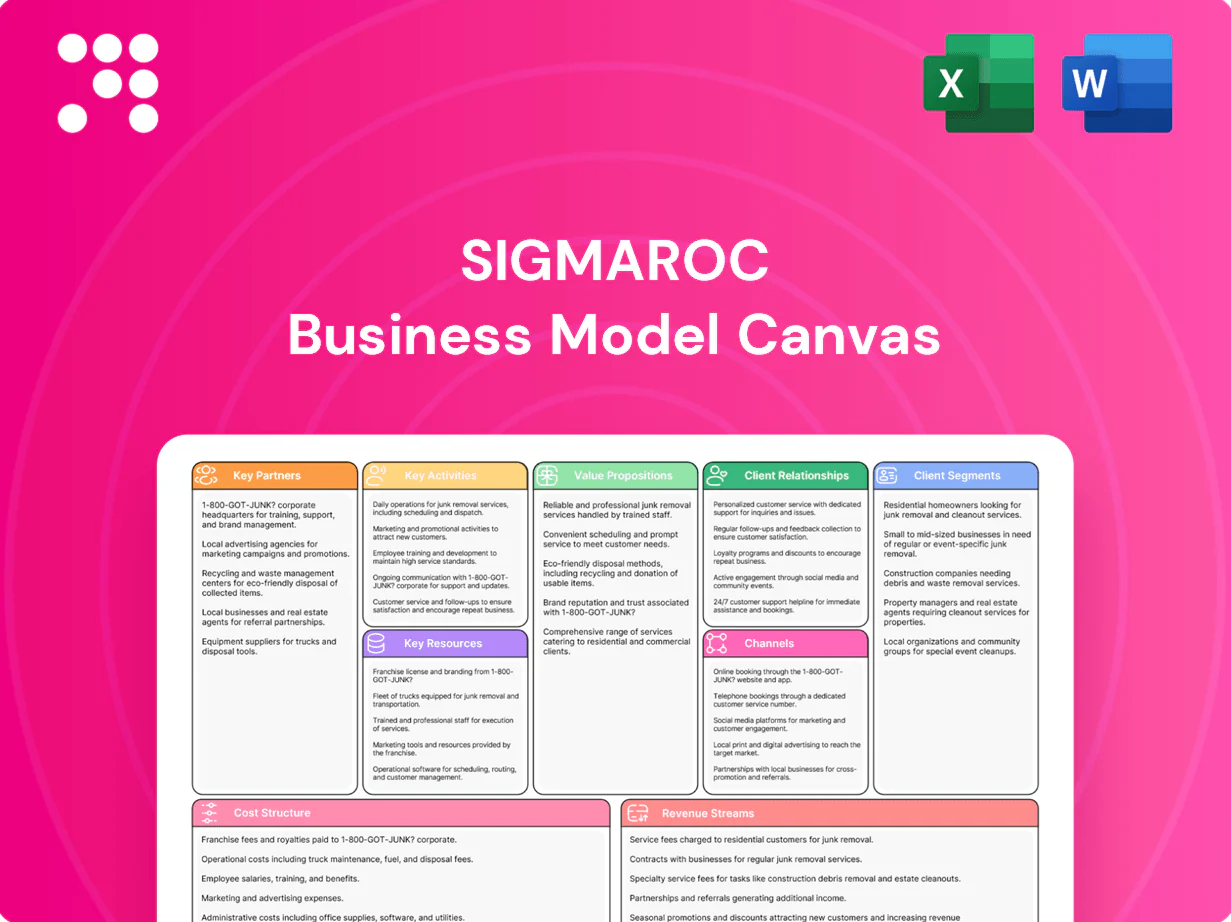
SigmaRoc Business Model Canvas

Unlock the Business Model Canvas for scaling operations and protecting margins
Unlock the full strategic blueprint behind SigmaRoc's business model. This concise Business Model Canvas reveals key value propositions, revenue streams, partnerships and cost structure to show how SigmaRoc scales and protects margins. Download the full Word/Excel canvas to benchmark and apply proven insights.
Partnerships

Quarry owners and mineral rights holders
Long-term agreements with quarry owners and mineral rights holders secure access to high-quality reserves, enabling multi-year extraction planning and continuity of supply essential for SigmaRoc’s integrated materials operations.
Equipment, kiln, and maintenance OEMs
Heavy plant, crushing lines, kilns and automation vendors (eg OEM service from Metso/FLSmidth partners) are critical to uptime and efficiency; digital automation can raise OEE by roughly 10–20%. Strategic service agreements cut unplanned downtime and optimize lifecycle costs, often improving availability materially. Co-development with OEMs targets energy and emissions cuts in a sector that drives about 7% of global CO2. Preferred pricing supports capex discipline and ROI.

Logistics and haulage providers
In 2024 SigmaRoc leverages road, rail and marine partners to ensure dependable distribution across regional markets. Integrated logistics reduce delivery times and lower on-site costs, while backhaul and multimodal solutions boost asset utilization and fleet efficiency. Dedicated capacity agreements secure volumes during peak-season demand for plants and civil projects.

Energy suppliers and carbon solutions partners
Cement and lime are highly energy-intensive; global cement production accounts for about 7% of CO2 emissions, so SigmaRoc’s partnerships for electricity, gas and alternative fuels are critical. Long-term PPAs and biomass/waste-derived fuel suppliers lower energy cost volatility and carbon intensity; EU carbon price averaged around €85/t in 2024, increasing compliance pressure. Carbon capture and verified offsets support regulatory alignment and decarbonization roadmaps.
- Long-term PPAs: price stability, supply security
- Biomass/waste fuels: significant fossil fuel displacement
- Carbon capture/offsets: regulatory compliance, emissions abatement
M&A advisors, financiers, and local regulators
Acquisition-led growth depends on M&A advisors, banks and equity investors for sourcing and funding; global M&A deal value recovered to about $2.1tn in the first nine months of 2024, underscoring active capital markets. Constructive planning authority relationships speed permits and integrations, while stakeholder engagement eases post-deal restructuring and governance partners ensure cross-jurisdictional compliance.
- Advisors: deal sourcing, valuation
- Financiers: debt/equity funding
- Regulators: permit streamlining
- Governance: multi-jurisdiction compliance
Partnerships secure reserves, lift OEE +10-20%, lower carbon risk
Long-term quarry agreements secure multi-year reserves and continuity for integrated materials operations.
OEM and automation partners (eg Metso/FLSmidth) boost OEE ~10–20% and lower lifecycle capex.
Logistics partners (road/rail/marine) cut delivery times and secure peak-season capacity.
Energy partners/PPAs, biomass and CCUS lower carbon intensity as EU carbon price averaged €85/t in 2024.
| Partnership | Role | 2024 metric |
|---|---|---|
| Quarry owners | Reserve security | Multi-year contracts |
| OEMs/Automation | Efficiency | OEE +10–20% |
| Energy suppliers | Decarbonisation | EU carbon €85/t |
What is included in the product
 Detailed Word Document
A comprehensive Business Model Canvas tailored to SigmaRoc’s strategy, organized into the nine classic BMC blocks with full narratives on customer segments, value propositions, channels, revenue streams and key resources. Ideal for presentations and investor or bank discussions, it includes block-level competitive advantages, SWOT-linked insights and real-company data to validate plans and guide decisions.

 Customizable Excel Spreadsheet
SigmaRoc Business Model Canvas condenses complex strategy into an editable one-page snapshot, relieving the pain of scattered documents and lengthy formatting while enabling fast decision-making, team collaboration, and side-by-side comparisons.
Activities

Quarrying, processing, and blending
Core quarrying activities cover extraction, crushing, screening and grading to deliver construction aggregates; cement and lime processing uses calcination, grinding and blending to meet performance specs, aligned with global cement output of about 4.1 billion tonnes in 2024. Continuous optimization (industry gains typically 2–5% in yield) improves throughput and uniformity, while rigorous process control and QA safeguard product quality and compliance.
Distribution and on-time delivery
Coordinating fleets, rail links and depots secures reliable, site-ready supplies across SigmaRoc’s quarry and asphalt networks and reduces downtime. Route optimization—industry studies in 2024 report up to 15% fuel savings—trims transport costs and CO2 emissions. Just-in-time scheduling aligns deliveries with project timelines to avoid delays and site congestion. Inventory management balances service levels against working capital to minimize stock holding.

M&A sourcing, diligence, and integration
M&A sourcing, diligence and execution target bolt-on aggregates and asphalt businesses to drive scale and synergies, with roll-up strategies central to SigmaRoc’s growth. Valuations focus on asset quality and cash returns, while integration standardizes systems, procurement and safety practices to capture procurement savings of 5–15% in typical roll-ups. Operational excellence programs lift performance and EBITDA margins, and cultural alignment underpins retention and productivity.

Quality assurance and technical support
Labs perform gradation (EN 933), compressive strength and chemical composition tests (EN 196, EN 206) to verify materials against standards; technical teams then optimize mix designs and predict application performance. ISO 9001 and CE/EN 206 certifications in 2024 remain prerequisites for regulated infrastructure contracts; systematic root-cause analysis reduces process variability and rejects.
- Labs: EN 933, EN 196, EN 206 testing
- Tech advise: mix design & performance
- Certs: ISO 9001, CE enable regulated bids
- RCA: lowers variability & rejects
ESG and decarbonization initiatives
ESG and decarbonization focus reduces operational footprint via energy efficiency, alternative fuels and recycled inputs — HVO can cut lifecycle GHG by up to 90% and recycled aggregates can lower embodied CO2 by ~50%; biodiversity and rehabilitation protect quarry ecosystems through targeted restoration plans; safety and community engagement sustain license to operate; CSRD reporting obligations began for large EU entities in 2024, tightening disclosure standards.
- HVO: up to 90% lifecycle GHG reduction
- Recycled inputs: ~50% lower embodied CO2
- EU target: -55% GHG by 2030
- CSRD: reporting from 2024 for large EU entities
Cement sector: 2–5% yield gains, ~15% fuel savings, HVO up to 90% GHG cut
Core extraction, crushing and cement/lime processing (global cement 4.1bn t in 2024) with 2–5% yield gains; logistics and JIT deliveries reduce fuel/CO2 (route opt ~15% savings); M&A roll-ups target 5–15% procurement synergies and EBITDA uplift; ESG: HVO up to 90% lifecycle GHG cut, recycled inputs ~50% lower embodied CO2; CSRD reporting from 2024.
| Metric | 2024 |
|---|---|
| Global cement | 4.1bn t |
| Route opt | ~15% fuel saved |
| Procurement synergies | 5–15% |
| HVO GHG cut | up to 90% |
| Recycled CO2 | ~50% |
Full Version Awaits
Business Model Canvas
The document you're previewing is the exact SigmaRoc Business Model Canvas you will receive—no mockups or samples. Upon purchase you'll immediately get this full, editable file formatted and structured exactly as shown, ready for presentation and editing in Word and Excel. We guarantee transparency: what you see is the deliverable.

Unlock the Business Model Canvas for scaling operations and protecting margins
Unlock the full strategic blueprint behind SigmaRoc's business model. This concise Business Model Canvas reveals key value propositions, revenue streams, partnerships and cost structure to show how SigmaRoc scales and protects margins. Download the full Word/Excel canvas to benchmark and apply proven insights.
Partnerships
Quarry owners and mineral rights holders
Long-term agreements with quarry owners and mineral rights holders secure access to high-quality reserves, enabling multi-year extraction planning and continuity of supply essential for SigmaRoc’s integrated materials operations.
Equipment, kiln, and maintenance OEMs
Heavy plant, crushing lines, kilns and automation vendors (eg OEM service from Metso/FLSmidth partners) are critical to uptime and efficiency; digital automation can raise OEE by roughly 10–20%. Strategic service agreements cut unplanned downtime and optimize lifecycle costs, often improving availability materially. Co-development with OEMs targets energy and emissions cuts in a sector that drives about 7% of global CO2. Preferred pricing supports capex discipline and ROI.
Logistics and haulage providers
In 2024 SigmaRoc leverages road, rail and marine partners to ensure dependable distribution across regional markets. Integrated logistics reduce delivery times and lower on-site costs, while backhaul and multimodal solutions boost asset utilization and fleet efficiency. Dedicated capacity agreements secure volumes during peak-season demand for plants and civil projects.
Energy suppliers and carbon solutions partners
Cement and lime are highly energy-intensive; global cement production accounts for about 7% of CO2 emissions, so SigmaRoc’s partnerships for electricity, gas and alternative fuels are critical. Long-term PPAs and biomass/waste-derived fuel suppliers lower energy cost volatility and carbon intensity; EU carbon price averaged around €85/t in 2024, increasing compliance pressure. Carbon capture and verified offsets support regulatory alignment and decarbonization roadmaps.
- Long-term PPAs: price stability, supply security
- Biomass/waste fuels: significant fossil fuel displacement
- Carbon capture/offsets: regulatory compliance, emissions abatement
M&A advisors, financiers, and local regulators
Acquisition-led growth depends on M&A advisors, banks and equity investors for sourcing and funding; global M&A deal value recovered to about $2.1tn in the first nine months of 2024, underscoring active capital markets. Constructive planning authority relationships speed permits and integrations, while stakeholder engagement eases post-deal restructuring and governance partners ensure cross-jurisdictional compliance.
- Advisors: deal sourcing, valuation
- Financiers: debt/equity funding
- Regulators: permit streamlining
- Governance: multi-jurisdiction compliance
Partnerships secure reserves, lift OEE +10-20%, lower carbon risk
Long-term quarry agreements secure multi-year reserves and continuity for integrated materials operations.
OEM and automation partners (eg Metso/FLSmidth) boost OEE ~10–20% and lower lifecycle capex.
Logistics partners (road/rail/marine) cut delivery times and secure peak-season capacity.
Energy partners/PPAs, biomass and CCUS lower carbon intensity as EU carbon price averaged €85/t in 2024.
| Partnership | Role | 2024 metric |
|---|---|---|
| Quarry owners | Reserve security | Multi-year contracts |
| OEMs/Automation | Efficiency | OEE +10–20% |
| Energy suppliers | Decarbonisation | EU carbon €85/t |
What is included in the product
Detailed Word Document
A comprehensive Business Model Canvas tailored to SigmaRoc’s strategy, organized into the nine classic BMC blocks with full narratives on customer segments, value propositions, channels, revenue streams and key resources. Ideal for presentations and investor or bank discussions, it includes block-level competitive advantages, SWOT-linked insights and real-company data to validate plans and guide decisions.
Customizable Excel Spreadsheet
SigmaRoc Business Model Canvas condenses complex strategy into an editable one-page snapshot, relieving the pain of scattered documents and lengthy formatting while enabling fast decision-making, team collaboration, and side-by-side comparisons.
Activities
Quarrying, processing, and blending
Core quarrying activities cover extraction, crushing, screening and grading to deliver construction aggregates; cement and lime processing uses calcination, grinding and blending to meet performance specs, aligned with global cement output of about 4.1 billion tonnes in 2024. Continuous optimization (industry gains typically 2–5% in yield) improves throughput and uniformity, while rigorous process control and QA safeguard product quality and compliance.
Distribution and on-time delivery
Coordinating fleets, rail links and depots secures reliable, site-ready supplies across SigmaRoc’s quarry and asphalt networks and reduces downtime. Route optimization—industry studies in 2024 report up to 15% fuel savings—trims transport costs and CO2 emissions. Just-in-time scheduling aligns deliveries with project timelines to avoid delays and site congestion. Inventory management balances service levels against working capital to minimize stock holding.
M&A sourcing, diligence, and integration
M&A sourcing, diligence and execution target bolt-on aggregates and asphalt businesses to drive scale and synergies, with roll-up strategies central to SigmaRoc’s growth. Valuations focus on asset quality and cash returns, while integration standardizes systems, procurement and safety practices to capture procurement savings of 5–15% in typical roll-ups. Operational excellence programs lift performance and EBITDA margins, and cultural alignment underpins retention and productivity.
Quality assurance and technical support
Labs perform gradation (EN 933), compressive strength and chemical composition tests (EN 196, EN 206) to verify materials against standards; technical teams then optimize mix designs and predict application performance. ISO 9001 and CE/EN 206 certifications in 2024 remain prerequisites for regulated infrastructure contracts; systematic root-cause analysis reduces process variability and rejects.
- Labs: EN 933, EN 196, EN 206 testing
- Tech advise: mix design & performance
- Certs: ISO 9001, CE enable regulated bids
- RCA: lowers variability & rejects
ESG and decarbonization initiatives
ESG and decarbonization focus reduces operational footprint via energy efficiency, alternative fuels and recycled inputs — HVO can cut lifecycle GHG by up to 90% and recycled aggregates can lower embodied CO2 by ~50%; biodiversity and rehabilitation protect quarry ecosystems through targeted restoration plans; safety and community engagement sustain license to operate; CSRD reporting obligations began for large EU entities in 2024, tightening disclosure standards.
- HVO: up to 90% lifecycle GHG reduction
- Recycled inputs: ~50% lower embodied CO2
- EU target: -55% GHG by 2030
- CSRD: reporting from 2024 for large EU entities
Cement sector: 2–5% yield gains, ~15% fuel savings, HVO up to 90% GHG cut
Core extraction, crushing and cement/lime processing (global cement 4.1bn t in 2024) with 2–5% yield gains; logistics and JIT deliveries reduce fuel/CO2 (route opt ~15% savings); M&A roll-ups target 5–15% procurement synergies and EBITDA uplift; ESG: HVO up to 90% lifecycle GHG cut, recycled inputs ~50% lower embodied CO2; CSRD reporting from 2024.
| Metric | 2024 |
|---|---|
| Global cement | 4.1bn t |
| Route opt | ~15% fuel saved |
| Procurement synergies | 5–15% |
| HVO GHG cut | up to 90% |
| Recycled CO2 | ~50% |
Full Version Awaits
Business Model Canvas
The document you're previewing is the exact SigmaRoc Business Model Canvas you will receive—no mockups or samples. Upon purchase you'll immediately get this full, editable file formatted and structured exactly as shown, ready for presentation and editing in Word and Excel. We guarantee transparency: what you see is the deliverable.
Original: $10.00
-65%$10.00
$3.50Description
Unlock the Business Model Canvas for scaling operations and protecting margins
Unlock the full strategic blueprint behind SigmaRoc's business model. This concise Business Model Canvas reveals key value propositions, revenue streams, partnerships and cost structure to show how SigmaRoc scales and protects margins. Download the full Word/Excel canvas to benchmark and apply proven insights.
Partnerships
Quarry owners and mineral rights holders
Long-term agreements with quarry owners and mineral rights holders secure access to high-quality reserves, enabling multi-year extraction planning and continuity of supply essential for SigmaRoc’s integrated materials operations.
Equipment, kiln, and maintenance OEMs
Heavy plant, crushing lines, kilns and automation vendors (eg OEM service from Metso/FLSmidth partners) are critical to uptime and efficiency; digital automation can raise OEE by roughly 10–20%. Strategic service agreements cut unplanned downtime and optimize lifecycle costs, often improving availability materially. Co-development with OEMs targets energy and emissions cuts in a sector that drives about 7% of global CO2. Preferred pricing supports capex discipline and ROI.
Logistics and haulage providers
In 2024 SigmaRoc leverages road, rail and marine partners to ensure dependable distribution across regional markets. Integrated logistics reduce delivery times and lower on-site costs, while backhaul and multimodal solutions boost asset utilization and fleet efficiency. Dedicated capacity agreements secure volumes during peak-season demand for plants and civil projects.
Energy suppliers and carbon solutions partners
Cement and lime are highly energy-intensive; global cement production accounts for about 7% of CO2 emissions, so SigmaRoc’s partnerships for electricity, gas and alternative fuels are critical. Long-term PPAs and biomass/waste-derived fuel suppliers lower energy cost volatility and carbon intensity; EU carbon price averaged around €85/t in 2024, increasing compliance pressure. Carbon capture and verified offsets support regulatory alignment and decarbonization roadmaps.
- Long-term PPAs: price stability, supply security
- Biomass/waste fuels: significant fossil fuel displacement
- Carbon capture/offsets: regulatory compliance, emissions abatement
M&A advisors, financiers, and local regulators
Acquisition-led growth depends on M&A advisors, banks and equity investors for sourcing and funding; global M&A deal value recovered to about $2.1tn in the first nine months of 2024, underscoring active capital markets. Constructive planning authority relationships speed permits and integrations, while stakeholder engagement eases post-deal restructuring and governance partners ensure cross-jurisdictional compliance.
- Advisors: deal sourcing, valuation
- Financiers: debt/equity funding
- Regulators: permit streamlining
- Governance: multi-jurisdiction compliance
Partnerships secure reserves, lift OEE +10-20%, lower carbon risk
Long-term quarry agreements secure multi-year reserves and continuity for integrated materials operations.
OEM and automation partners (eg Metso/FLSmidth) boost OEE ~10–20% and lower lifecycle capex.
Logistics partners (road/rail/marine) cut delivery times and secure peak-season capacity.
Energy partners/PPAs, biomass and CCUS lower carbon intensity as EU carbon price averaged €85/t in 2024.
| Partnership | Role | 2024 metric |
|---|---|---|
| Quarry owners | Reserve security | Multi-year contracts |
| OEMs/Automation | Efficiency | OEE +10–20% |
| Energy suppliers | Decarbonisation | EU carbon €85/t |
What is included in the product
Detailed Word Document
A comprehensive Business Model Canvas tailored to SigmaRoc’s strategy, organized into the nine classic BMC blocks with full narratives on customer segments, value propositions, channels, revenue streams and key resources. Ideal for presentations and investor or bank discussions, it includes block-level competitive advantages, SWOT-linked insights and real-company data to validate plans and guide decisions.
Customizable Excel Spreadsheet
SigmaRoc Business Model Canvas condenses complex strategy into an editable one-page snapshot, relieving the pain of scattered documents and lengthy formatting while enabling fast decision-making, team collaboration, and side-by-side comparisons.
Activities
Quarrying, processing, and blending
Core quarrying activities cover extraction, crushing, screening and grading to deliver construction aggregates; cement and lime processing uses calcination, grinding and blending to meet performance specs, aligned with global cement output of about 4.1 billion tonnes in 2024. Continuous optimization (industry gains typically 2–5% in yield) improves throughput and uniformity, while rigorous process control and QA safeguard product quality and compliance.
Distribution and on-time delivery
Coordinating fleets, rail links and depots secures reliable, site-ready supplies across SigmaRoc’s quarry and asphalt networks and reduces downtime. Route optimization—industry studies in 2024 report up to 15% fuel savings—trims transport costs and CO2 emissions. Just-in-time scheduling aligns deliveries with project timelines to avoid delays and site congestion. Inventory management balances service levels against working capital to minimize stock holding.
M&A sourcing, diligence, and integration
M&A sourcing, diligence and execution target bolt-on aggregates and asphalt businesses to drive scale and synergies, with roll-up strategies central to SigmaRoc’s growth. Valuations focus on asset quality and cash returns, while integration standardizes systems, procurement and safety practices to capture procurement savings of 5–15% in typical roll-ups. Operational excellence programs lift performance and EBITDA margins, and cultural alignment underpins retention and productivity.
Quality assurance and technical support
Labs perform gradation (EN 933), compressive strength and chemical composition tests (EN 196, EN 206) to verify materials against standards; technical teams then optimize mix designs and predict application performance. ISO 9001 and CE/EN 206 certifications in 2024 remain prerequisites for regulated infrastructure contracts; systematic root-cause analysis reduces process variability and rejects.
- Labs: EN 933, EN 196, EN 206 testing
- Tech advise: mix design & performance
- Certs: ISO 9001, CE enable regulated bids
- RCA: lowers variability & rejects
ESG and decarbonization initiatives
ESG and decarbonization focus reduces operational footprint via energy efficiency, alternative fuels and recycled inputs — HVO can cut lifecycle GHG by up to 90% and recycled aggregates can lower embodied CO2 by ~50%; biodiversity and rehabilitation protect quarry ecosystems through targeted restoration plans; safety and community engagement sustain license to operate; CSRD reporting obligations began for large EU entities in 2024, tightening disclosure standards.
- HVO: up to 90% lifecycle GHG reduction
- Recycled inputs: ~50% lower embodied CO2
- EU target: -55% GHG by 2030
- CSRD: reporting from 2024 for large EU entities
Cement sector: 2–5% yield gains, ~15% fuel savings, HVO up to 90% GHG cut
Core extraction, crushing and cement/lime processing (global cement 4.1bn t in 2024) with 2–5% yield gains; logistics and JIT deliveries reduce fuel/CO2 (route opt ~15% savings); M&A roll-ups target 5–15% procurement synergies and EBITDA uplift; ESG: HVO up to 90% lifecycle GHG cut, recycled inputs ~50% lower embodied CO2; CSRD reporting from 2024.
| Metric | 2024 |
|---|---|
| Global cement | 4.1bn t |
| Route opt | ~15% fuel saved |
| Procurement synergies | 5–15% |
| HVO GHG cut | up to 90% |
| Recycled CO2 | ~50% |
Full Version Awaits
Business Model Canvas
The document you're previewing is the exact SigmaRoc Business Model Canvas you will receive—no mockups or samples. Upon purchase you'll immediately get this full, editable file formatted and structured exactly as shown, ready for presentation and editing in Word and Excel. We guarantee transparency: what you see is the deliverable.











