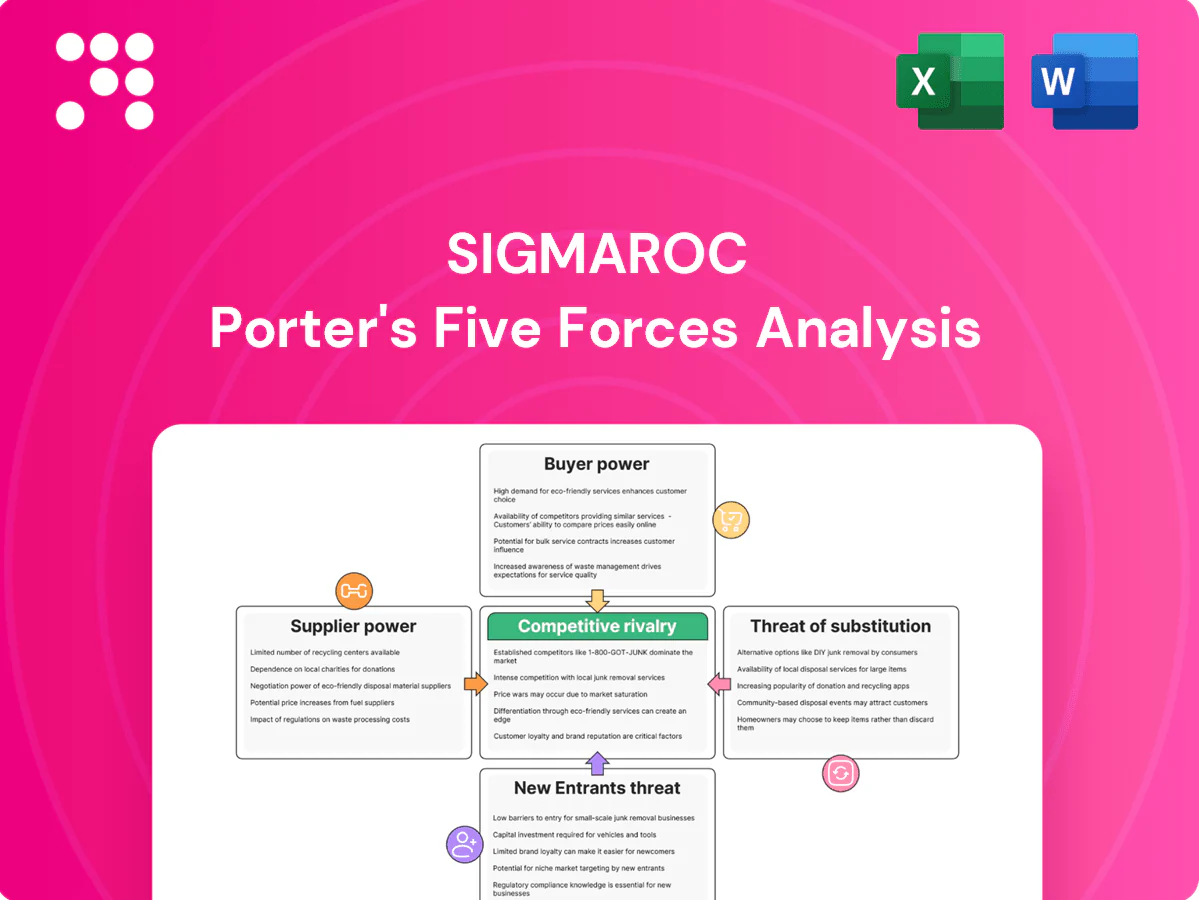
SigmaRoc Porter's Five Forces Analysis

From Overview to Strategy Blueprint
SigmaRoc’s Porter’s Five Forces snapshot highlights competitive intensity, supplier and buyer leverage, threat of new entrants, and substitute pressures shaping margins and strategy. Early signals point to concentrated supplier power and moderate entry barriers, with consolidation altering competitive dynamics. This preview only scratches the surface—unlock the full Porter’s Five Forces Analysis for force-by-force ratings, visuals, and actionable strategy insights.
Suppliers Bargaining Power

Energy and fuel concentration
Energy and fuel markets are relatively concentrated, giving suppliers leverage over pricing and contract terms. Volatile gas, electricity and diesel costs directly affect kiln and quarry ops; pass-through lags can compress margins despite SigmaRoc’s hedging and multi-source contracts. Regional policy and carbon pricing amplify supplier power — EU ETS averaged near €100/t CO2 in 2024, raising input cost exposure.
Equipment and spare parts dependence
Heavy plant OEMs and critical spare-part makers offer highly differentiated products and service networks, with 2024 industry reports showing typical lead times of 8–12+ weeks that raise outage switching costs. Limited alternatives and specialty components mean emergency procurement can cost 10–30% premium versus planned buy. Long-term service agreements cut downtime but lock pricing; SigmaRoc’s ~200-site scale improves bargaining yet does not remove supplier dependency.

Raw inputs and quarry rights
Access to quality limestone and aggregates depends on mineral rights, local quarries and permitting; where SigmaRoc owns quarries supplier power is low, while reliance on third-party pits increases supplier leverage. As of 2024 long-duration supply contracts and JV structures commonly span 5–10 years, helping stabilise terms. Geographic dispersion across markets diversifies sourcing risk and limits local permitting bottlenecks.

Logistics and hauling capacity
Transporters and maritime bulk carriers heavily influence delivered cost for heavy, low-value aggregates; in 2024 periodic port constraints and tight trucking capacity continued to push spot hinterland rates higher and limit scheduling flexibility. Backhaul optimization and captive fleets reduce exposure and unit cost volatility, while cross-border routing options provide alternative lanes that temper supplier power.
Environmental services and reagents
Specialized suppliers of additives, refractories and environmental reagents (eg lime kiln reagents) often command pricing premiums and face limited substitution due to certification and regulatory standards in 2024; this sustains supplier leverage while increasing compliance costs for SigmaRoc. Multi-vendor qualification programs materially reduce single-source risk. SigmaRoc’s technical standards and approvals can expand the approved supplier base over time, lowering supplier bargaining power.
- Certification limits substitution
- Premiums persist for specialty reagents
- Multi-vendor cuts single-source risk
- Technical standards broaden supplier pool
EU ETS ≈ €100/t and 8-12+ week OEM lead times raise input costs and supply risk
Energy/fuel market concentration and EU ETS ≈ €100/t CO2 in 2024 increase input cost exposure. OEMs and spare-part vendors show 8–12+ week lead times and 10–30% emergency premiums, keeping supplier leverage despite SigmaRoc’s scale. Transport bottlenecks and port constraints in 2024 elevate spot cost volatility; captive fleets and backhaul lower carrier dependence.
| Metric | 2024 value | Impact |
|---|---|---|
| EU ETS | ≈ €100/t CO2 | Raises fuel/input costs |
| OEM lead time | 8–12+ weeks | High outage switching cost |
| Emergency premium | 10–30% | Higher unplanned procurement cost |
What is included in the product
 Detailed Word Document
Uncovers key drivers of competition, customer influence, and market entry risks tailored exclusively for SigmaRoc, evaluating supplier and buyer power, substitutes, and competitive rivalry. Identifies disruptive threats, barriers protecting incumbents, and strategic opportunities to preserve pricing and profitability.

 Customizable Excel Spreadsheet
A single-sheet Porter’s Five Forces for SigmaRoc that removes strategic guesswork by highlighting key competitive pressures and bottlenecks; easily update inputs and instantly visualize impact with a radar chart, ready to drop into decks or broader Excel dashboards.
Customers Bargaining Power

Large contractors and distributors
Tier-1 contractors and major builders' merchants buy in high volumes and in 2024 continued to drive aggressive price negotiation through framework agreements and tender processes that compress margins. SigmaRoc counters with multi-product bundles and reliability premiums to protect mix and margin. Rigorous performance KPIs and just-in-time delivery contracts support justified price differentials by linking payment to service and uptime.
Price sensitivity in projects
Materials are the largest cost in civil projects, making buyers highly price elastic in competitive bids; industry studies show materials often account for a plurality of project costs. Commodity price transparency and indices enable rapid benchmarking across suppliers. Providing technical specification input and tailored support shifts negotiations from lowest price to life‑cycle value. Long‑term indexed supply agreements (price index or CPI linkage) align incentives and reduce bid volatility.

Switching costs and local availability
Short-haul radii, typically under 25–30 km in the aggregates sector, make local availability crucial and can limit buyer options in certain catchments, strengthening buyer dependence on nearby SigmaRoc quarries. Where multiple quarries exist within these radii, buyers can switch rapidly, keeping bargaining power high. Service reliability and consistent gradation drive stickiness, while multi-site regional contracts materially raise switching costs across regions.

Quality and compliance demands
Infrastructure and industrial customers demand tight specifications and certifications, giving buyers leverage on warranties and quality controls because failures often trigger contractual penalties and remediation obligations. SigmaRoc’s established track record and documented compliance history can reduce frequency of audits and transactional friction. Co-development of mixes and lime solutions creates technical lock-in and raises switching costs for customers.
- Specs & certifications: leverage on QC
- Penalties & warranties: increase buyer power
- Track record: fewer audits, lower friction
- Co-development: embedded, higher switching costs
Cyclical demand and backlog
In downturns volumes shrink and buyers gain leverage from excess market capacity; in peaks tight supply and backlog return pricing power to producers. Public infrastructure programmes such as NextGenerationEU (€800bn) help stabilise demand. SigmaRoc’s diversified European footprint smooths local cycles and moderates buyer power.
- Downturn leverage: excess capacity
- Peak leverage: tight supply, higher prices
- Stabiliser: NextGenerationEU €800bn
- Defensive: diversified European footprint
Tenders squeeze prices; bundles, KPIs and JIT defend margins within 25–30 km markets
Buyers (tier‑1 contractors, merchants) exert strong price pressure via 2024 framework tenders; SigmaRoc defends margins with multi‑product bundles, KPIs and JIT contracts. Local short‑haul (25–30 km) limits options in many catchments, but where multiple quarries exist switching remains easy. Infrastructure specs and co‑development raise switching costs; demand cycles (NextGenerationEU €800bn) modulate buyer leverage.
| Metric | Value |
|---|---|
| Short‑haul radius | 25–30 km |
| NG‑EU (stabiliser) | €800bn |
Same Document Delivered
SigmaRoc Porter's Five Forces Analysis
This preview shows the exact SigmaRoc Porter’s Five Forces analysis you will receive—no placeholders or mockups. The document is fully formatted, professionally written, and ready for immediate download and use upon purchase. You’re viewing the final deliverable; complete your purchase to get this same file instantly.

From Overview to Strategy Blueprint
SigmaRoc’s Porter’s Five Forces snapshot highlights competitive intensity, supplier and buyer leverage, threat of new entrants, and substitute pressures shaping margins and strategy. Early signals point to concentrated supplier power and moderate entry barriers, with consolidation altering competitive dynamics. This preview only scratches the surface—unlock the full Porter’s Five Forces Analysis for force-by-force ratings, visuals, and actionable strategy insights.
Suppliers Bargaining Power
Energy and fuel concentration
Energy and fuel markets are relatively concentrated, giving suppliers leverage over pricing and contract terms. Volatile gas, electricity and diesel costs directly affect kiln and quarry ops; pass-through lags can compress margins despite SigmaRoc’s hedging and multi-source contracts. Regional policy and carbon pricing amplify supplier power — EU ETS averaged near €100/t CO2 in 2024, raising input cost exposure.
Equipment and spare parts dependence
Heavy plant OEMs and critical spare-part makers offer highly differentiated products and service networks, with 2024 industry reports showing typical lead times of 8–12+ weeks that raise outage switching costs. Limited alternatives and specialty components mean emergency procurement can cost 10–30% premium versus planned buy. Long-term service agreements cut downtime but lock pricing; SigmaRoc’s ~200-site scale improves bargaining yet does not remove supplier dependency.
Raw inputs and quarry rights
Access to quality limestone and aggregates depends on mineral rights, local quarries and permitting; where SigmaRoc owns quarries supplier power is low, while reliance on third-party pits increases supplier leverage. As of 2024 long-duration supply contracts and JV structures commonly span 5–10 years, helping stabilise terms. Geographic dispersion across markets diversifies sourcing risk and limits local permitting bottlenecks.
Logistics and hauling capacity
Transporters and maritime bulk carriers heavily influence delivered cost for heavy, low-value aggregates; in 2024 periodic port constraints and tight trucking capacity continued to push spot hinterland rates higher and limit scheduling flexibility. Backhaul optimization and captive fleets reduce exposure and unit cost volatility, while cross-border routing options provide alternative lanes that temper supplier power.
Environmental services and reagents
Specialized suppliers of additives, refractories and environmental reagents (eg lime kiln reagents) often command pricing premiums and face limited substitution due to certification and regulatory standards in 2024; this sustains supplier leverage while increasing compliance costs for SigmaRoc. Multi-vendor qualification programs materially reduce single-source risk. SigmaRoc’s technical standards and approvals can expand the approved supplier base over time, lowering supplier bargaining power.
- Certification limits substitution
- Premiums persist for specialty reagents
- Multi-vendor cuts single-source risk
- Technical standards broaden supplier pool
EU ETS ≈ €100/t and 8-12+ week OEM lead times raise input costs and supply risk
Energy/fuel market concentration and EU ETS ≈ €100/t CO2 in 2024 increase input cost exposure. OEMs and spare-part vendors show 8–12+ week lead times and 10–30% emergency premiums, keeping supplier leverage despite SigmaRoc’s scale. Transport bottlenecks and port constraints in 2024 elevate spot cost volatility; captive fleets and backhaul lower carrier dependence.
| Metric | 2024 value | Impact |
|---|---|---|
| EU ETS | ≈ €100/t CO2 | Raises fuel/input costs |
| OEM lead time | 8–12+ weeks | High outage switching cost |
| Emergency premium | 10–30% | Higher unplanned procurement cost |
What is included in the product
Detailed Word Document
Uncovers key drivers of competition, customer influence, and market entry risks tailored exclusively for SigmaRoc, evaluating supplier and buyer power, substitutes, and competitive rivalry. Identifies disruptive threats, barriers protecting incumbents, and strategic opportunities to preserve pricing and profitability.
Customizable Excel Spreadsheet
A single-sheet Porter’s Five Forces for SigmaRoc that removes strategic guesswork by highlighting key competitive pressures and bottlenecks; easily update inputs and instantly visualize impact with a radar chart, ready to drop into decks or broader Excel dashboards.
Customers Bargaining Power
Large contractors and distributors
Tier-1 contractors and major builders' merchants buy in high volumes and in 2024 continued to drive aggressive price negotiation through framework agreements and tender processes that compress margins. SigmaRoc counters with multi-product bundles and reliability premiums to protect mix and margin. Rigorous performance KPIs and just-in-time delivery contracts support justified price differentials by linking payment to service and uptime.
Price sensitivity in projects
Materials are the largest cost in civil projects, making buyers highly price elastic in competitive bids; industry studies show materials often account for a plurality of project costs. Commodity price transparency and indices enable rapid benchmarking across suppliers. Providing technical specification input and tailored support shifts negotiations from lowest price to life‑cycle value. Long‑term indexed supply agreements (price index or CPI linkage) align incentives and reduce bid volatility.
Switching costs and local availability
Short-haul radii, typically under 25–30 km in the aggregates sector, make local availability crucial and can limit buyer options in certain catchments, strengthening buyer dependence on nearby SigmaRoc quarries. Where multiple quarries exist within these radii, buyers can switch rapidly, keeping bargaining power high. Service reliability and consistent gradation drive stickiness, while multi-site regional contracts materially raise switching costs across regions.
Quality and compliance demands
Infrastructure and industrial customers demand tight specifications and certifications, giving buyers leverage on warranties and quality controls because failures often trigger contractual penalties and remediation obligations. SigmaRoc’s established track record and documented compliance history can reduce frequency of audits and transactional friction. Co-development of mixes and lime solutions creates technical lock-in and raises switching costs for customers.
- Specs & certifications: leverage on QC
- Penalties & warranties: increase buyer power
- Track record: fewer audits, lower friction
- Co-development: embedded, higher switching costs
Cyclical demand and backlog
In downturns volumes shrink and buyers gain leverage from excess market capacity; in peaks tight supply and backlog return pricing power to producers. Public infrastructure programmes such as NextGenerationEU (€800bn) help stabilise demand. SigmaRoc’s diversified European footprint smooths local cycles and moderates buyer power.
- Downturn leverage: excess capacity
- Peak leverage: tight supply, higher prices
- Stabiliser: NextGenerationEU €800bn
- Defensive: diversified European footprint
Tenders squeeze prices; bundles, KPIs and JIT defend margins within 25–30 km markets
Buyers (tier‑1 contractors, merchants) exert strong price pressure via 2024 framework tenders; SigmaRoc defends margins with multi‑product bundles, KPIs and JIT contracts. Local short‑haul (25–30 km) limits options in many catchments, but where multiple quarries exist switching remains easy. Infrastructure specs and co‑development raise switching costs; demand cycles (NextGenerationEU €800bn) modulate buyer leverage.
| Metric | Value |
|---|---|
| Short‑haul radius | 25–30 km |
| NG‑EU (stabiliser) | €800bn |
Same Document Delivered
SigmaRoc Porter's Five Forces Analysis
This preview shows the exact SigmaRoc Porter’s Five Forces analysis you will receive—no placeholders or mockups. The document is fully formatted, professionally written, and ready for immediate download and use upon purchase. You’re viewing the final deliverable; complete your purchase to get this same file instantly.
Original: $10.00
-65%$10.00
$3.50Description
From Overview to Strategy Blueprint
SigmaRoc’s Porter’s Five Forces snapshot highlights competitive intensity, supplier and buyer leverage, threat of new entrants, and substitute pressures shaping margins and strategy. Early signals point to concentrated supplier power and moderate entry barriers, with consolidation altering competitive dynamics. This preview only scratches the surface—unlock the full Porter’s Five Forces Analysis for force-by-force ratings, visuals, and actionable strategy insights.
Suppliers Bargaining Power
Energy and fuel concentration
Energy and fuel markets are relatively concentrated, giving suppliers leverage over pricing and contract terms. Volatile gas, electricity and diesel costs directly affect kiln and quarry ops; pass-through lags can compress margins despite SigmaRoc’s hedging and multi-source contracts. Regional policy and carbon pricing amplify supplier power — EU ETS averaged near €100/t CO2 in 2024, raising input cost exposure.
Equipment and spare parts dependence
Heavy plant OEMs and critical spare-part makers offer highly differentiated products and service networks, with 2024 industry reports showing typical lead times of 8–12+ weeks that raise outage switching costs. Limited alternatives and specialty components mean emergency procurement can cost 10–30% premium versus planned buy. Long-term service agreements cut downtime but lock pricing; SigmaRoc’s ~200-site scale improves bargaining yet does not remove supplier dependency.
Raw inputs and quarry rights
Access to quality limestone and aggregates depends on mineral rights, local quarries and permitting; where SigmaRoc owns quarries supplier power is low, while reliance on third-party pits increases supplier leverage. As of 2024 long-duration supply contracts and JV structures commonly span 5–10 years, helping stabilise terms. Geographic dispersion across markets diversifies sourcing risk and limits local permitting bottlenecks.
Logistics and hauling capacity
Transporters and maritime bulk carriers heavily influence delivered cost for heavy, low-value aggregates; in 2024 periodic port constraints and tight trucking capacity continued to push spot hinterland rates higher and limit scheduling flexibility. Backhaul optimization and captive fleets reduce exposure and unit cost volatility, while cross-border routing options provide alternative lanes that temper supplier power.
Environmental services and reagents
Specialized suppliers of additives, refractories and environmental reagents (eg lime kiln reagents) often command pricing premiums and face limited substitution due to certification and regulatory standards in 2024; this sustains supplier leverage while increasing compliance costs for SigmaRoc. Multi-vendor qualification programs materially reduce single-source risk. SigmaRoc’s technical standards and approvals can expand the approved supplier base over time, lowering supplier bargaining power.
- Certification limits substitution
- Premiums persist for specialty reagents
- Multi-vendor cuts single-source risk
- Technical standards broaden supplier pool
EU ETS ≈ €100/t and 8-12+ week OEM lead times raise input costs and supply risk
Energy/fuel market concentration and EU ETS ≈ €100/t CO2 in 2024 increase input cost exposure. OEMs and spare-part vendors show 8–12+ week lead times and 10–30% emergency premiums, keeping supplier leverage despite SigmaRoc’s scale. Transport bottlenecks and port constraints in 2024 elevate spot cost volatility; captive fleets and backhaul lower carrier dependence.
| Metric | 2024 value | Impact |
|---|---|---|
| EU ETS | ≈ €100/t CO2 | Raises fuel/input costs |
| OEM lead time | 8–12+ weeks | High outage switching cost |
| Emergency premium | 10–30% | Higher unplanned procurement cost |
What is included in the product
Detailed Word Document
Uncovers key drivers of competition, customer influence, and market entry risks tailored exclusively for SigmaRoc, evaluating supplier and buyer power, substitutes, and competitive rivalry. Identifies disruptive threats, barriers protecting incumbents, and strategic opportunities to preserve pricing and profitability.
Customizable Excel Spreadsheet
A single-sheet Porter’s Five Forces for SigmaRoc that removes strategic guesswork by highlighting key competitive pressures and bottlenecks; easily update inputs and instantly visualize impact with a radar chart, ready to drop into decks or broader Excel dashboards.
Customers Bargaining Power
Large contractors and distributors
Tier-1 contractors and major builders' merchants buy in high volumes and in 2024 continued to drive aggressive price negotiation through framework agreements and tender processes that compress margins. SigmaRoc counters with multi-product bundles and reliability premiums to protect mix and margin. Rigorous performance KPIs and just-in-time delivery contracts support justified price differentials by linking payment to service and uptime.
Price sensitivity in projects
Materials are the largest cost in civil projects, making buyers highly price elastic in competitive bids; industry studies show materials often account for a plurality of project costs. Commodity price transparency and indices enable rapid benchmarking across suppliers. Providing technical specification input and tailored support shifts negotiations from lowest price to life‑cycle value. Long‑term indexed supply agreements (price index or CPI linkage) align incentives and reduce bid volatility.
Switching costs and local availability
Short-haul radii, typically under 25–30 km in the aggregates sector, make local availability crucial and can limit buyer options in certain catchments, strengthening buyer dependence on nearby SigmaRoc quarries. Where multiple quarries exist within these radii, buyers can switch rapidly, keeping bargaining power high. Service reliability and consistent gradation drive stickiness, while multi-site regional contracts materially raise switching costs across regions.
Quality and compliance demands
Infrastructure and industrial customers demand tight specifications and certifications, giving buyers leverage on warranties and quality controls because failures often trigger contractual penalties and remediation obligations. SigmaRoc’s established track record and documented compliance history can reduce frequency of audits and transactional friction. Co-development of mixes and lime solutions creates technical lock-in and raises switching costs for customers.
- Specs & certifications: leverage on QC
- Penalties & warranties: increase buyer power
- Track record: fewer audits, lower friction
- Co-development: embedded, higher switching costs
Cyclical demand and backlog
In downturns volumes shrink and buyers gain leverage from excess market capacity; in peaks tight supply and backlog return pricing power to producers. Public infrastructure programmes such as NextGenerationEU (€800bn) help stabilise demand. SigmaRoc’s diversified European footprint smooths local cycles and moderates buyer power.
- Downturn leverage: excess capacity
- Peak leverage: tight supply, higher prices
- Stabiliser: NextGenerationEU €800bn
- Defensive: diversified European footprint
Tenders squeeze prices; bundles, KPIs and JIT defend margins within 25–30 km markets
Buyers (tier‑1 contractors, merchants) exert strong price pressure via 2024 framework tenders; SigmaRoc defends margins with multi‑product bundles, KPIs and JIT contracts. Local short‑haul (25–30 km) limits options in many catchments, but where multiple quarries exist switching remains easy. Infrastructure specs and co‑development raise switching costs; demand cycles (NextGenerationEU €800bn) modulate buyer leverage.
| Metric | Value |
|---|---|
| Short‑haul radius | 25–30 km |
| NG‑EU (stabiliser) | €800bn |
Same Document Delivered
SigmaRoc Porter's Five Forces Analysis
This preview shows the exact SigmaRoc Porter’s Five Forces analysis you will receive—no placeholders or mockups. The document is fully formatted, professionally written, and ready for immediate download and use upon purchase. You’re viewing the final deliverable; complete your purchase to get this same file instantly.











