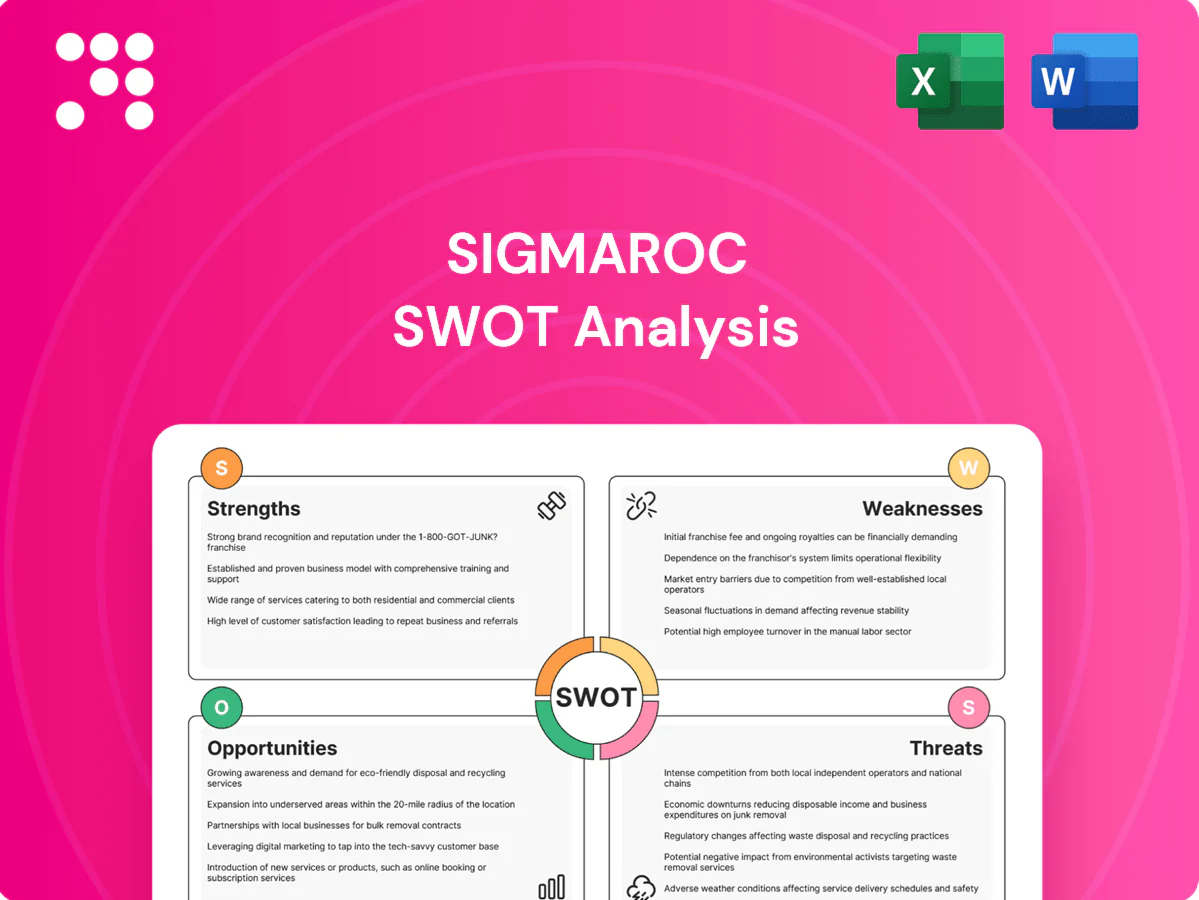
SigmaRoc SWOT Analysis

Dive Deeper Into the Company’s Strategic Blueprint
SigmaRoc shows resilient regional market reach and diversified aggregates operations, but faces integration, cyclicality, and regulatory risks that could pressure margins. Strategic acquisitions and infrastructure demand are clear growth drivers. Want deeper, actionable insights and financial context? Purchase the full SWOT analysis—complete Word and Excel deliverables to plan and present with confidence.
Strengths

Diversified product portfolio
Diversified product portfolio spanning aggregates, cement, lime and related materials serves infrastructure, residential and commercial end-markets, smoothing revenue across cycles and customer segments. This breadth enables cross-selling and bundled solutions—supplying multiple materials for single projects—boosting average order value and customer stickiness. Exposure to both public infrastructure and private construction enhances resilience against sector-specific downturns.
Pan-European footprint
SigmaRoc’s pan‑European footprint spans multiple national markets, placing quarries and ready‑mix plants close to major demand centers to cut haulage on heavy, low‑value aggregates and improve margins. Local regulatory familiarity and operational presence enable quick arbitrage of regional supply/demand imbalances and smoother permitting. Geographic spread also disperses project and country risk.

Buy-and-build discipline
Buy-and-build discipline: SigmaRoc operates a repeatable M&A playbook focused on acquiring under-optimized aggregates and concrete businesses and lifting performance through standardised operational upgrades. Value levers include targeted operational improvements, procurement synergies and integration of regional sales networks to drive cross-sell and margin expansion. The group has a track record of bolt-on deals delivering scale economies and margin uplift. Fragmented sector dynamics provide visible pipeline of further consolidatable assets.

Vertical integration benefits
Vertical integration gives SigmaRoc direct control of upstream quarries and downstream processing, reducing input volatility and enabling consistent quality for customers. Capturing margins from mine-to-market operations improves profitability and pricing flexibility. Integrated logistics, blending and quality control lower unit costs and support long-term contract fulfilment by securing supply.
- Upstream control: reduced input volatility
- Mine-to-market: margin capture
- Logistics/blending: cost & quality advantage
- Secures long-term contracts
Operational excellence focus
SigmaRoc leverages lean practices, centralized energy management and improved asset utilization to standardize KPIs and transfer best practices across sites, while automation and rigorous predictive maintenance raise uptime and lower unit costs, enhancing operating margins and cash conversion for reinvestment.
- Lean processes
- Energy optimization
- Standard KPIs
- Automation & maintenance
- Higher cash conversion
Aggregates-to-concrete platform: pan-EU quarries, vertical integration and repeatable M&A margins
SigmaRoc benefits from a diversified aggregates-to-concrete portfolio serving infrastructure and construction, enabling cross-sell and revenue smoothing. A pan‑European quarry and plant network reduces haulage, improves margins and spreads country risk. Repeatable buy‑and‑build M&A plus vertical integration and standardized operations drive margin capture, uptime and cash conversion.
| Metric | Relevance |
|---|---|
| Product breadth | Cross-sell, resilience |
| Geographic spread | Logistics & risk diversification |
| M&A playbook | Scale & margin uplift |
What is included in the product
 Detailed Word Document
Delivers a strategic overview of SigmaRoc’s internal and external business factors, outlining core strengths, weaknesses, opportunities, and threats to assess its competitive position and growth prospects.

 Customizable Excel Spreadsheet
Provides a concise, SigmaRoc-specific SWOT matrix for rapid strategy alignment and executive decision-making, streamlining communication across business units.
Weaknesses

High capital intensity
High capital intensity forces ongoing capex for quarries, kilns and environmental compliance, with regular investment in dust, water and emissions controls. Cash flows are sensitive to maintenance cycles and timing of major overhauls, which can create multi‑million pound cash outflows in outage years. Expansion or upgrades compress free cash flow and can limit the pace of deleveraging, increasing reliance on external funding.
Exposure to cyclical construction demand
SigmaRoc is heavily dependent on housing, commercial builds and public infrastructure spend, making volumes sensitive to construction cycles; during slowdowns volumes can swing materially, amplifying operating leverage and compressing EBITDA margins as fixed quarry and plant costs remain. Pricing pressure intensifies in weak markets, forcing margin erosion and tighter cash flow.

M&A integration risks
M&A integration risks include harmonizing ERP, safety and HR systems and aligning cultures and safety standards across businesses; SigmaRoc’s roll-up model, with over 30 bolt-on acquisitions since 2019, can push synergy realization beyond deal models and delay expected margin uplift. Concurrent integrations strain execution bandwidth when multiple deals overlap, and there is ongoing exposure to unforeseen liabilities in acquired assets (environmental, pension, legacy contracts).

Energy and fuel cost sensitivity
Regulatory and permitting complexity
Permitting for quarries typically takes 12–36 months and major kiln upgrades 18–48 months, with compliance driven by the EU Industrial Emissions Directive (2010/75/EU) and Natura 2000/site-specific rules; this multiplies approval layers across member states, restricts capacity expansions and often limits blasting to 1–3 events/week, while environmental monitoring and reporting can cost €100k–€1.5M/year for large sites.
- Permitting: 12–36m (quarries), 18–48m (kilns)
- Legal: IED 2010/75/EU, Natura 2000, national rules
- Operational: 1–3 blasts/week cap, constrained expansions
- Monitoring cost: €100k–€1.5M/yr
High capex, long permits and roll-up exposure squeeze FCF and increase funding needs
High capex intensity and multi‑million outage years strain cash flow and slow deleveraging; expansion capex compresses FCF and raises external funding needs.
Revenue and volumes are highly cyclical, tied to housing/infrastructure spend, magnifying operating leverage and margin pressure in downturns.
Roll‑up risks (30+ bolt‑ons since 2019) and lengthy permitting (12–36m quarries, 18–48m kilns) plus €100k–€1.5M/yr monitoring and 2024–25 energy volatility increase execution and margin risk.
| Metric | Value |
|---|---|
| Bolt‑ons since 2019 | 30+ |
| Permitting | 12–36m (quarries), 18–48m (kilns) |
| Environmental monitoring | €100k–€1.5M/yr |
Preview Before You Purchase
SigmaRoc SWOT Analysis
This is the actual SWOT analysis document you’ll receive upon purchase—no surprises, just professional quality. The preview below is taken directly from the full SWOT report you'll get, so what you see is what you'll download. Buy now to unlock the complete, editable version with full detail and formatting.

Dive Deeper Into the Company’s Strategic Blueprint
SigmaRoc shows resilient regional market reach and diversified aggregates operations, but faces integration, cyclicality, and regulatory risks that could pressure margins. Strategic acquisitions and infrastructure demand are clear growth drivers. Want deeper, actionable insights and financial context? Purchase the full SWOT analysis—complete Word and Excel deliverables to plan and present with confidence.
Strengths
Diversified product portfolio
Diversified product portfolio spanning aggregates, cement, lime and related materials serves infrastructure, residential and commercial end-markets, smoothing revenue across cycles and customer segments. This breadth enables cross-selling and bundled solutions—supplying multiple materials for single projects—boosting average order value and customer stickiness. Exposure to both public infrastructure and private construction enhances resilience against sector-specific downturns.
Pan-European footprint
SigmaRoc’s pan‑European footprint spans multiple national markets, placing quarries and ready‑mix plants close to major demand centers to cut haulage on heavy, low‑value aggregates and improve margins. Local regulatory familiarity and operational presence enable quick arbitrage of regional supply/demand imbalances and smoother permitting. Geographic spread also disperses project and country risk.
Buy-and-build discipline
Buy-and-build discipline: SigmaRoc operates a repeatable M&A playbook focused on acquiring under-optimized aggregates and concrete businesses and lifting performance through standardised operational upgrades. Value levers include targeted operational improvements, procurement synergies and integration of regional sales networks to drive cross-sell and margin expansion. The group has a track record of bolt-on deals delivering scale economies and margin uplift. Fragmented sector dynamics provide visible pipeline of further consolidatable assets.
Vertical integration benefits
Vertical integration gives SigmaRoc direct control of upstream quarries and downstream processing, reducing input volatility and enabling consistent quality for customers. Capturing margins from mine-to-market operations improves profitability and pricing flexibility. Integrated logistics, blending and quality control lower unit costs and support long-term contract fulfilment by securing supply.
- Upstream control: reduced input volatility
- Mine-to-market: margin capture
- Logistics/blending: cost & quality advantage
- Secures long-term contracts
Operational excellence focus
SigmaRoc leverages lean practices, centralized energy management and improved asset utilization to standardize KPIs and transfer best practices across sites, while automation and rigorous predictive maintenance raise uptime and lower unit costs, enhancing operating margins and cash conversion for reinvestment.
- Lean processes
- Energy optimization
- Standard KPIs
- Automation & maintenance
- Higher cash conversion
Aggregates-to-concrete platform: pan-EU quarries, vertical integration and repeatable M&A margins
SigmaRoc benefits from a diversified aggregates-to-concrete portfolio serving infrastructure and construction, enabling cross-sell and revenue smoothing. A pan‑European quarry and plant network reduces haulage, improves margins and spreads country risk. Repeatable buy‑and‑build M&A plus vertical integration and standardized operations drive margin capture, uptime and cash conversion.
| Metric | Relevance |
|---|---|
| Product breadth | Cross-sell, resilience |
| Geographic spread | Logistics & risk diversification |
| M&A playbook | Scale & margin uplift |
What is included in the product
Detailed Word Document
Delivers a strategic overview of SigmaRoc’s internal and external business factors, outlining core strengths, weaknesses, opportunities, and threats to assess its competitive position and growth prospects.
Customizable Excel Spreadsheet
Provides a concise, SigmaRoc-specific SWOT matrix for rapid strategy alignment and executive decision-making, streamlining communication across business units.
Weaknesses
High capital intensity
High capital intensity forces ongoing capex for quarries, kilns and environmental compliance, with regular investment in dust, water and emissions controls. Cash flows are sensitive to maintenance cycles and timing of major overhauls, which can create multi‑million pound cash outflows in outage years. Expansion or upgrades compress free cash flow and can limit the pace of deleveraging, increasing reliance on external funding.
Exposure to cyclical construction demand
SigmaRoc is heavily dependent on housing, commercial builds and public infrastructure spend, making volumes sensitive to construction cycles; during slowdowns volumes can swing materially, amplifying operating leverage and compressing EBITDA margins as fixed quarry and plant costs remain. Pricing pressure intensifies in weak markets, forcing margin erosion and tighter cash flow.
M&A integration risks
M&A integration risks include harmonizing ERP, safety and HR systems and aligning cultures and safety standards across businesses; SigmaRoc’s roll-up model, with over 30 bolt-on acquisitions since 2019, can push synergy realization beyond deal models and delay expected margin uplift. Concurrent integrations strain execution bandwidth when multiple deals overlap, and there is ongoing exposure to unforeseen liabilities in acquired assets (environmental, pension, legacy contracts).
Energy and fuel cost sensitivity
Regulatory and permitting complexity
Permitting for quarries typically takes 12–36 months and major kiln upgrades 18–48 months, with compliance driven by the EU Industrial Emissions Directive (2010/75/EU) and Natura 2000/site-specific rules; this multiplies approval layers across member states, restricts capacity expansions and often limits blasting to 1–3 events/week, while environmental monitoring and reporting can cost €100k–€1.5M/year for large sites.
- Permitting: 12–36m (quarries), 18–48m (kilns)
- Legal: IED 2010/75/EU, Natura 2000, national rules
- Operational: 1–3 blasts/week cap, constrained expansions
- Monitoring cost: €100k–€1.5M/yr
High capex, long permits and roll-up exposure squeeze FCF and increase funding needs
High capex intensity and multi‑million outage years strain cash flow and slow deleveraging; expansion capex compresses FCF and raises external funding needs.
Revenue and volumes are highly cyclical, tied to housing/infrastructure spend, magnifying operating leverage and margin pressure in downturns.
Roll‑up risks (30+ bolt‑ons since 2019) and lengthy permitting (12–36m quarries, 18–48m kilns) plus €100k–€1.5M/yr monitoring and 2024–25 energy volatility increase execution and margin risk.
| Metric | Value |
|---|---|
| Bolt‑ons since 2019 | 30+ |
| Permitting | 12–36m (quarries), 18–48m (kilns) |
| Environmental monitoring | €100k–€1.5M/yr |
Preview Before You Purchase
SigmaRoc SWOT Analysis
This is the actual SWOT analysis document you’ll receive upon purchase—no surprises, just professional quality. The preview below is taken directly from the full SWOT report you'll get, so what you see is what you'll download. Buy now to unlock the complete, editable version with full detail and formatting.
Description
Dive Deeper Into the Company’s Strategic Blueprint
SigmaRoc shows resilient regional market reach and diversified aggregates operations, but faces integration, cyclicality, and regulatory risks that could pressure margins. Strategic acquisitions and infrastructure demand are clear growth drivers. Want deeper, actionable insights and financial context? Purchase the full SWOT analysis—complete Word and Excel deliverables to plan and present with confidence.
Strengths
Diversified product portfolio
Diversified product portfolio spanning aggregates, cement, lime and related materials serves infrastructure, residential and commercial end-markets, smoothing revenue across cycles and customer segments. This breadth enables cross-selling and bundled solutions—supplying multiple materials for single projects—boosting average order value and customer stickiness. Exposure to both public infrastructure and private construction enhances resilience against sector-specific downturns.
Pan-European footprint
SigmaRoc’s pan‑European footprint spans multiple national markets, placing quarries and ready‑mix plants close to major demand centers to cut haulage on heavy, low‑value aggregates and improve margins. Local regulatory familiarity and operational presence enable quick arbitrage of regional supply/demand imbalances and smoother permitting. Geographic spread also disperses project and country risk.
Buy-and-build discipline
Buy-and-build discipline: SigmaRoc operates a repeatable M&A playbook focused on acquiring under-optimized aggregates and concrete businesses and lifting performance through standardised operational upgrades. Value levers include targeted operational improvements, procurement synergies and integration of regional sales networks to drive cross-sell and margin expansion. The group has a track record of bolt-on deals delivering scale economies and margin uplift. Fragmented sector dynamics provide visible pipeline of further consolidatable assets.
Vertical integration benefits
Vertical integration gives SigmaRoc direct control of upstream quarries and downstream processing, reducing input volatility and enabling consistent quality for customers. Capturing margins from mine-to-market operations improves profitability and pricing flexibility. Integrated logistics, blending and quality control lower unit costs and support long-term contract fulfilment by securing supply.
- Upstream control: reduced input volatility
- Mine-to-market: margin capture
- Logistics/blending: cost & quality advantage
- Secures long-term contracts
Operational excellence focus
SigmaRoc leverages lean practices, centralized energy management and improved asset utilization to standardize KPIs and transfer best practices across sites, while automation and rigorous predictive maintenance raise uptime and lower unit costs, enhancing operating margins and cash conversion for reinvestment.
- Lean processes
- Energy optimization
- Standard KPIs
- Automation & maintenance
- Higher cash conversion
Aggregates-to-concrete platform: pan-EU quarries, vertical integration and repeatable M&A margins
SigmaRoc benefits from a diversified aggregates-to-concrete portfolio serving infrastructure and construction, enabling cross-sell and revenue smoothing. A pan‑European quarry and plant network reduces haulage, improves margins and spreads country risk. Repeatable buy‑and‑build M&A plus vertical integration and standardized operations drive margin capture, uptime and cash conversion.
| Metric | Relevance |
|---|---|
| Product breadth | Cross-sell, resilience |
| Geographic spread | Logistics & risk diversification |
| M&A playbook | Scale & margin uplift |
What is included in the product
Detailed Word Document
Delivers a strategic overview of SigmaRoc’s internal and external business factors, outlining core strengths, weaknesses, opportunities, and threats to assess its competitive position and growth prospects.
Customizable Excel Spreadsheet
Provides a concise, SigmaRoc-specific SWOT matrix for rapid strategy alignment and executive decision-making, streamlining communication across business units.
Weaknesses
High capital intensity
High capital intensity forces ongoing capex for quarries, kilns and environmental compliance, with regular investment in dust, water and emissions controls. Cash flows are sensitive to maintenance cycles and timing of major overhauls, which can create multi‑million pound cash outflows in outage years. Expansion or upgrades compress free cash flow and can limit the pace of deleveraging, increasing reliance on external funding.
Exposure to cyclical construction demand
SigmaRoc is heavily dependent on housing, commercial builds and public infrastructure spend, making volumes sensitive to construction cycles; during slowdowns volumes can swing materially, amplifying operating leverage and compressing EBITDA margins as fixed quarry and plant costs remain. Pricing pressure intensifies in weak markets, forcing margin erosion and tighter cash flow.
M&A integration risks
M&A integration risks include harmonizing ERP, safety and HR systems and aligning cultures and safety standards across businesses; SigmaRoc’s roll-up model, with over 30 bolt-on acquisitions since 2019, can push synergy realization beyond deal models and delay expected margin uplift. Concurrent integrations strain execution bandwidth when multiple deals overlap, and there is ongoing exposure to unforeseen liabilities in acquired assets (environmental, pension, legacy contracts).
Energy and fuel cost sensitivity
Regulatory and permitting complexity
Permitting for quarries typically takes 12–36 months and major kiln upgrades 18–48 months, with compliance driven by the EU Industrial Emissions Directive (2010/75/EU) and Natura 2000/site-specific rules; this multiplies approval layers across member states, restricts capacity expansions and often limits blasting to 1–3 events/week, while environmental monitoring and reporting can cost €100k–€1.5M/year for large sites.
- Permitting: 12–36m (quarries), 18–48m (kilns)
- Legal: IED 2010/75/EU, Natura 2000, national rules
- Operational: 1–3 blasts/week cap, constrained expansions
- Monitoring cost: €100k–€1.5M/yr
High capex, long permits and roll-up exposure squeeze FCF and increase funding needs
High capex intensity and multi‑million outage years strain cash flow and slow deleveraging; expansion capex compresses FCF and raises external funding needs.
Revenue and volumes are highly cyclical, tied to housing/infrastructure spend, magnifying operating leverage and margin pressure in downturns.
Roll‑up risks (30+ bolt‑ons since 2019) and lengthy permitting (12–36m quarries, 18–48m kilns) plus €100k–€1.5M/yr monitoring and 2024–25 energy volatility increase execution and margin risk.
| Metric | Value |
|---|---|
| Bolt‑ons since 2019 | 30+ |
| Permitting | 12–36m (quarries), 18–48m (kilns) |
| Environmental monitoring | €100k–€1.5M/yr |
Preview Before You Purchase
SigmaRoc SWOT Analysis
This is the actual SWOT analysis document you’ll receive upon purchase—no surprises, just professional quality. The preview below is taken directly from the full SWOT report you'll get, so what you see is what you'll download. Buy now to unlock the complete, editable version with full detail and formatting.











