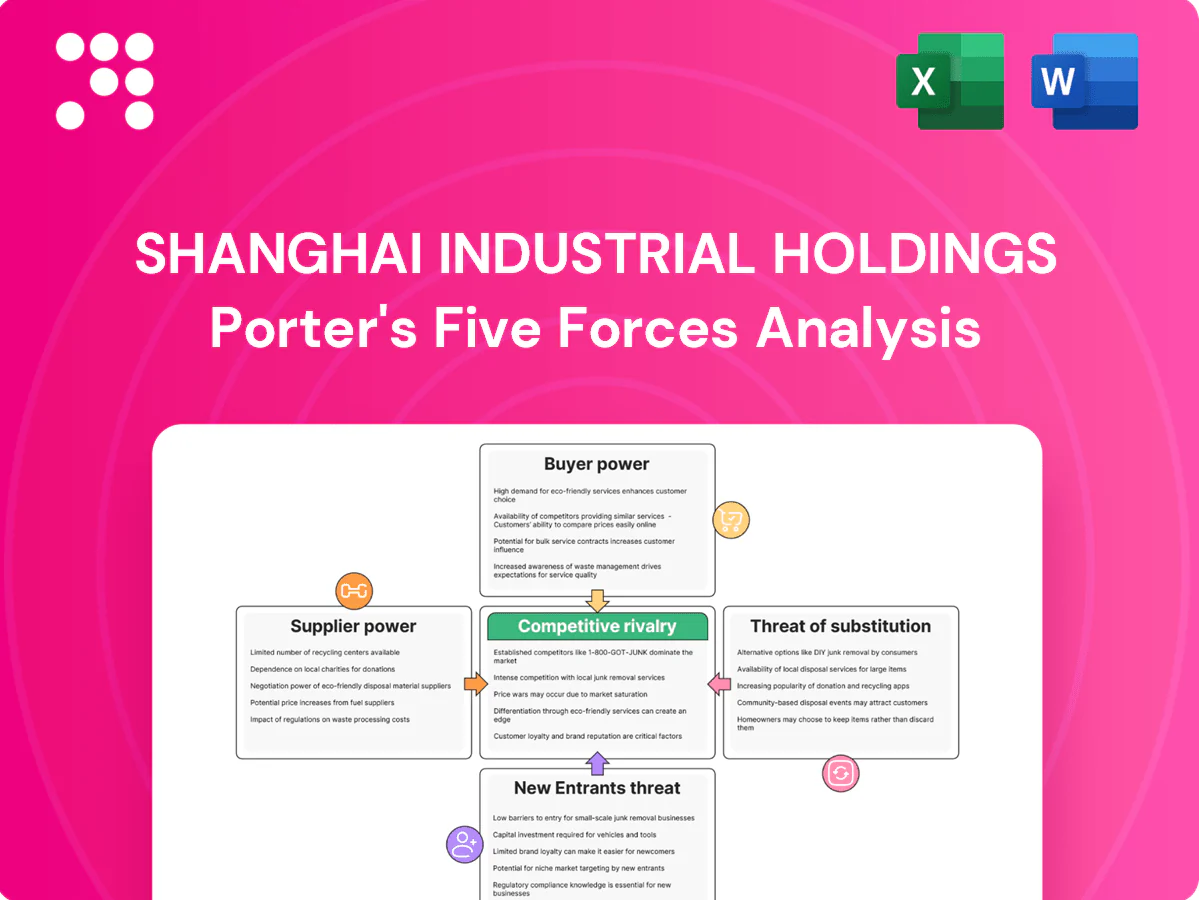
Shanghai Industrial Holdings Porter's Five Forces Analysis

Don't Miss the Bigger Picture
Shanghai Industrial Holdings faces concentrated buyer power, moderate supplier influence, intense rivalry among port operators, limited threat from new entrants given high capital barriers, and rising substitute pressures from logistics tech. This brief snapshot only scratches the surface. Unlock the full Porter's Five Forces Analysis to explore Shanghai Industrial Holdings’s competitive dynamics, market pressures, and strategic advantages in detail.
Suppliers Bargaining Power

Government as land/concession supplier
Land in China is state-owned and local/provincial governments centrally control land-use right auctions and public-utility concessions, concentrating supplier power over ports and real-estate projects. Pricing, duration and performance clauses are largely set by policy, leaving limited negotiation latitude for Shanghai Industrial Holdings. Relationship capital and track record reduce but do not eliminate exposure, since policy shifts can reprice project risk. This amplifies dependence in real estate and infrastructure.
Construction/EPC and key materials
Steel, cement, asphalt and EPC services are scale-sensitive and cyclical, with Chinese rebar and cement markets showing price swings up to about 20% in 2024, creating supplier leverage in up-cycles; SIHL’s multi-project pipeline and batch procurement enable standardization and dilution of that leverage, long-term framework contracts (common in EPC) stabilize input costs but cut flexibility, while volatility still risks margin erosion on large builds.

Specialized water-tech vendors
Membranes, pumps, SCADA and specialty chemicals for water services come from specialized vendors, creating technical lock-in and certification hurdles that raise switching costs; the global membrane market was about $10.5B in 2024, underscoring supplier concentration. SIHL mitigates price pressure by dual-sourcing and piloting new tech, and shifting to performance-linked contracts transfers uptime and quality risk onto suppliers.

Financing providers
Banks, bond markets and policy lenders are primary capital suppliers for Shanghai Industrial Holdings' port projects; 2024 PBOC LPRs (1Y 3.45%, 5Y 4.20%) set baseline financing costs and shape project IRRs and bid competitiveness. SOE ties and collateralizable cash flows often secure tighter spreads, while narrow credit windows and weak bank appetite amplify lender leverage.
- Banks: dominant debt source, rate-sensitive
- Bond markets: alternative term funding
- Policy lenders/SOEs: lower-cost, credit-enhancing
Skilled labor and subcontractors
Local labor markets for project management and O&M in Shanghai can tighten regionally, raising recruitment lead times and pushback on hourly rates; safety, compliance, and uptime requirements limit rapid substitution of skilled staff.
Vendor pre-qualification and in-house training programs reduce dependency on spot hires, though persistent wage inflation (around 4–6% nationally in 2024) can still erode project returns and margins.
- Labor tightness: regional shortages raise hiring costs
- Replacement barriers: safety/compliance/uptime limit swap
- Mitigation: vendor pre-qual and training lower risk
- Pressure: 2024 wage inflation ~4–6% hits returns
High supplier power, inputs ±20% and wage inflation 4–6%
Supplier power for Shanghai Industrial Holdings is high due to state-controlled land auctions, cyclical inputs (rebar/cement ±20% in 2024) and specialized water-tech suppliers; financing set by 2024 LPRs (1Y 3.45%, 5Y 4.20%) further constrains margins. SIHL mitigates via scale, framework contracts, dual-sourcing and performance-linked deals, but policy shifts and wage inflation (4–6% in 2024) remain risks.
| Factor | 2024 Metric |
|---|---|
| Rebar/cement volatility | ~±20% |
| Wage inflation | 4–6% |
| LPR | 1Y 3.45%, 5Y 4.20% |
What is included in the product
 Detailed Word Document
Concise Porter's Five Forces analysis tailored for Shanghai Industrial Holdings, assessing competitive rivalry, supplier/buyer power, entry barriers, substitutes, and strategic threats to its port and infrastructure operations.

 Customizable Excel Spreadsheet
One-sheet Porter's Five Forces for Shanghai Industrial Holdings—instantly highlights port, property and regulatory pressures, lets you customize threat levels and scenarios for quick deck-ready insights and strategic decision-making.
Customers Bargaining Power

Municipal/industrial water offtakers
Municipal and industrial water offtakers are typically single municipal governments or few state-owned entities, concentrating bargaining power in tenders and renewals. Tariff pass-through is often constrained while KPI penalty regimes materially affect project cashflows. Long concession tenors of 20–30 years and take-or-pay or availability payments reduce renegotiation risk. Demonstrable operational performance remains critical to sustain premium pricing.
Toll road users and regulators
End-users are highly fragmented with low individual bargaining power, while regulators dictate toll frameworks and can mandate policy-driven discounts and ETC preferential rates; ETC penetration in China reached about 90% by 2024, materially affecting realized yields. Route alternatives make price elasticity corridor-specific, with suburban corridors showing higher diversion risk. Traffic-management and ANPR/ETC data enable granular tariff reviews and yield optimization.

Property buyers and tenants
Homebuyers and corporates are highly price-sensitive amid the 2023–24 market correction, with pre-sales and inventory pressure giving buyers strong leverage; developers often rely on pre-sales for funding, historically contributing over 50% of project cashflow. Tighter mortgage policy and high unsold stock amplify bargaining. Differentiation by location, amenities and delivery certainty limits required discounts, while a balanced leasing mix can stabilize recurrent cash flow.

Consumer goods distributors/retailers
Modern trade chains and e-commerce now command the majority of shelf space and traffic in China, with online retail penetration at about 36% in 2024, compressing distributor margins; private-label penetration in modern trade is roughly 10%, raising switching risk. A coordinated multi-channel strategy and strong brand equity help Shanghai Industrial Holdings secure better terms and mitigate price pressure. Data-sharing partnerships have been shown to lift promotional ROI by around 12% in 2024 industry studies.
- Modern trade + e‑commerce ~ majority share (online 36% in 2024)
- Private-label ~10% in modern trade, increases switching threat
- Multi-channel + brand equity = better negotiating leverage
- Data-sharing deals ≈ +12% promo ROI (2024)
Institutional counterparties
Institutional counterparties in SIHL port deals push on fees, governance and target yields, often negotiating management fees in the 100–300 basis points range and hurdle IRRs around 8–12% in 2024. Comparable deal flow across Greater China ports narrows SIHL’s bargaining range, while stronger pipeline visibility in 2024 (projects >RMB10bn) improved SIHL’s leverage. Co-invest structures used in recent JVs align incentives and have reduced immediate fee pressure.
- Fees: 100–300bps
- Target IRR: 8–12%
- 2024 visible pipeline: >RMB10bn
Municipal risk high; ETC ~90%, online retail 36%, tariffs tight, investors seek 8–12% IRR
Municipal offtakers are concentrated (single city or few SOEs), tariffs often constrained and KPI penalties materially affect cashflows despite long 20–30y concessions. End-users are fragmented; ETC penetration ~90% in 2024 and online retail 36% (2024) shift bargaining toward platform-driven pricing. Institutional counterparties push fees 100–300bps and target IRR 8–12% with visible pipeline >RMB10bn in 2024.
| Metric | 2024 value |
|---|---|
| ETC penetration | ~90% |
| Online retail share | 36% |
| Management fees | 100–300bps |
| Target IRR | 8–12% |
| Visible pipeline | >RMB10bn |
Same Document Delivered
Shanghai Industrial Holdings Porter's Five Forces Analysis
This Porter's Five Forces analysis of Shanghai Industrial Holdings assesses competitive rivalry, supplier and buyer power, and the threats of new entrants and substitutes, with clear conclusions and actionable implications. This preview shows the exact document you'll receive immediately after purchase—fully formatted, no placeholders. Use it instantly for research or strategic decision-making.

Don't Miss the Bigger Picture
Shanghai Industrial Holdings faces concentrated buyer power, moderate supplier influence, intense rivalry among port operators, limited threat from new entrants given high capital barriers, and rising substitute pressures from logistics tech. This brief snapshot only scratches the surface. Unlock the full Porter's Five Forces Analysis to explore Shanghai Industrial Holdings’s competitive dynamics, market pressures, and strategic advantages in detail.
Suppliers Bargaining Power
Government as land/concession supplier
Land in China is state-owned and local/provincial governments centrally control land-use right auctions and public-utility concessions, concentrating supplier power over ports and real-estate projects. Pricing, duration and performance clauses are largely set by policy, leaving limited negotiation latitude for Shanghai Industrial Holdings. Relationship capital and track record reduce but do not eliminate exposure, since policy shifts can reprice project risk. This amplifies dependence in real estate and infrastructure.
Construction/EPC and key materials
Steel, cement, asphalt and EPC services are scale-sensitive and cyclical, with Chinese rebar and cement markets showing price swings up to about 20% in 2024, creating supplier leverage in up-cycles; SIHL’s multi-project pipeline and batch procurement enable standardization and dilution of that leverage, long-term framework contracts (common in EPC) stabilize input costs but cut flexibility, while volatility still risks margin erosion on large builds.
Specialized water-tech vendors
Membranes, pumps, SCADA and specialty chemicals for water services come from specialized vendors, creating technical lock-in and certification hurdles that raise switching costs; the global membrane market was about $10.5B in 2024, underscoring supplier concentration. SIHL mitigates price pressure by dual-sourcing and piloting new tech, and shifting to performance-linked contracts transfers uptime and quality risk onto suppliers.
Financing providers
Banks, bond markets and policy lenders are primary capital suppliers for Shanghai Industrial Holdings' port projects; 2024 PBOC LPRs (1Y 3.45%, 5Y 4.20%) set baseline financing costs and shape project IRRs and bid competitiveness. SOE ties and collateralizable cash flows often secure tighter spreads, while narrow credit windows and weak bank appetite amplify lender leverage.
- Banks: dominant debt source, rate-sensitive
- Bond markets: alternative term funding
- Policy lenders/SOEs: lower-cost, credit-enhancing
Skilled labor and subcontractors
Local labor markets for project management and O&M in Shanghai can tighten regionally, raising recruitment lead times and pushback on hourly rates; safety, compliance, and uptime requirements limit rapid substitution of skilled staff.
Vendor pre-qualification and in-house training programs reduce dependency on spot hires, though persistent wage inflation (around 4–6% nationally in 2024) can still erode project returns and margins.
- Labor tightness: regional shortages raise hiring costs
- Replacement barriers: safety/compliance/uptime limit swap
- Mitigation: vendor pre-qual and training lower risk
- Pressure: 2024 wage inflation ~4–6% hits returns
High supplier power, inputs ±20% and wage inflation 4–6%
Supplier power for Shanghai Industrial Holdings is high due to state-controlled land auctions, cyclical inputs (rebar/cement ±20% in 2024) and specialized water-tech suppliers; financing set by 2024 LPRs (1Y 3.45%, 5Y 4.20%) further constrains margins. SIHL mitigates via scale, framework contracts, dual-sourcing and performance-linked deals, but policy shifts and wage inflation (4–6% in 2024) remain risks.
| Factor | 2024 Metric |
|---|---|
| Rebar/cement volatility | ~±20% |
| Wage inflation | 4–6% |
| LPR | 1Y 3.45%, 5Y 4.20% |
What is included in the product
Detailed Word Document
Concise Porter's Five Forces analysis tailored for Shanghai Industrial Holdings, assessing competitive rivalry, supplier/buyer power, entry barriers, substitutes, and strategic threats to its port and infrastructure operations.
Customizable Excel Spreadsheet
One-sheet Porter's Five Forces for Shanghai Industrial Holdings—instantly highlights port, property and regulatory pressures, lets you customize threat levels and scenarios for quick deck-ready insights and strategic decision-making.
Customers Bargaining Power
Municipal/industrial water offtakers
Municipal and industrial water offtakers are typically single municipal governments or few state-owned entities, concentrating bargaining power in tenders and renewals. Tariff pass-through is often constrained while KPI penalty regimes materially affect project cashflows. Long concession tenors of 20–30 years and take-or-pay or availability payments reduce renegotiation risk. Demonstrable operational performance remains critical to sustain premium pricing.
Toll road users and regulators
End-users are highly fragmented with low individual bargaining power, while regulators dictate toll frameworks and can mandate policy-driven discounts and ETC preferential rates; ETC penetration in China reached about 90% by 2024, materially affecting realized yields. Route alternatives make price elasticity corridor-specific, with suburban corridors showing higher diversion risk. Traffic-management and ANPR/ETC data enable granular tariff reviews and yield optimization.
Property buyers and tenants
Homebuyers and corporates are highly price-sensitive amid the 2023–24 market correction, with pre-sales and inventory pressure giving buyers strong leverage; developers often rely on pre-sales for funding, historically contributing over 50% of project cashflow. Tighter mortgage policy and high unsold stock amplify bargaining. Differentiation by location, amenities and delivery certainty limits required discounts, while a balanced leasing mix can stabilize recurrent cash flow.
Consumer goods distributors/retailers
Modern trade chains and e-commerce now command the majority of shelf space and traffic in China, with online retail penetration at about 36% in 2024, compressing distributor margins; private-label penetration in modern trade is roughly 10%, raising switching risk. A coordinated multi-channel strategy and strong brand equity help Shanghai Industrial Holdings secure better terms and mitigate price pressure. Data-sharing partnerships have been shown to lift promotional ROI by around 12% in 2024 industry studies.
- Modern trade + e‑commerce ~ majority share (online 36% in 2024)
- Private-label ~10% in modern trade, increases switching threat
- Multi-channel + brand equity = better negotiating leverage
- Data-sharing deals ≈ +12% promo ROI (2024)
Institutional counterparties
Institutional counterparties in SIHL port deals push on fees, governance and target yields, often negotiating management fees in the 100–300 basis points range and hurdle IRRs around 8–12% in 2024. Comparable deal flow across Greater China ports narrows SIHL’s bargaining range, while stronger pipeline visibility in 2024 (projects >RMB10bn) improved SIHL’s leverage. Co-invest structures used in recent JVs align incentives and have reduced immediate fee pressure.
- Fees: 100–300bps
- Target IRR: 8–12%
- 2024 visible pipeline: >RMB10bn
Municipal risk high; ETC ~90%, online retail 36%, tariffs tight, investors seek 8–12% IRR
Municipal offtakers are concentrated (single city or few SOEs), tariffs often constrained and KPI penalties materially affect cashflows despite long 20–30y concessions. End-users are fragmented; ETC penetration ~90% in 2024 and online retail 36% (2024) shift bargaining toward platform-driven pricing. Institutional counterparties push fees 100–300bps and target IRR 8–12% with visible pipeline >RMB10bn in 2024.
| Metric | 2024 value |
|---|---|
| ETC penetration | ~90% |
| Online retail share | 36% |
| Management fees | 100–300bps |
| Target IRR | 8–12% |
| Visible pipeline | >RMB10bn |
Same Document Delivered
Shanghai Industrial Holdings Porter's Five Forces Analysis
This Porter's Five Forces analysis of Shanghai Industrial Holdings assesses competitive rivalry, supplier and buyer power, and the threats of new entrants and substitutes, with clear conclusions and actionable implications. This preview shows the exact document you'll receive immediately after purchase—fully formatted, no placeholders. Use it instantly for research or strategic decision-making.
Original: $10.00
-65%$10.00
$3.50Description
Don't Miss the Bigger Picture
Shanghai Industrial Holdings faces concentrated buyer power, moderate supplier influence, intense rivalry among port operators, limited threat from new entrants given high capital barriers, and rising substitute pressures from logistics tech. This brief snapshot only scratches the surface. Unlock the full Porter's Five Forces Analysis to explore Shanghai Industrial Holdings’s competitive dynamics, market pressures, and strategic advantages in detail.
Suppliers Bargaining Power
Government as land/concession supplier
Land in China is state-owned and local/provincial governments centrally control land-use right auctions and public-utility concessions, concentrating supplier power over ports and real-estate projects. Pricing, duration and performance clauses are largely set by policy, leaving limited negotiation latitude for Shanghai Industrial Holdings. Relationship capital and track record reduce but do not eliminate exposure, since policy shifts can reprice project risk. This amplifies dependence in real estate and infrastructure.
Construction/EPC and key materials
Steel, cement, asphalt and EPC services are scale-sensitive and cyclical, with Chinese rebar and cement markets showing price swings up to about 20% in 2024, creating supplier leverage in up-cycles; SIHL’s multi-project pipeline and batch procurement enable standardization and dilution of that leverage, long-term framework contracts (common in EPC) stabilize input costs but cut flexibility, while volatility still risks margin erosion on large builds.
Specialized water-tech vendors
Membranes, pumps, SCADA and specialty chemicals for water services come from specialized vendors, creating technical lock-in and certification hurdles that raise switching costs; the global membrane market was about $10.5B in 2024, underscoring supplier concentration. SIHL mitigates price pressure by dual-sourcing and piloting new tech, and shifting to performance-linked contracts transfers uptime and quality risk onto suppliers.
Financing providers
Banks, bond markets and policy lenders are primary capital suppliers for Shanghai Industrial Holdings' port projects; 2024 PBOC LPRs (1Y 3.45%, 5Y 4.20%) set baseline financing costs and shape project IRRs and bid competitiveness. SOE ties and collateralizable cash flows often secure tighter spreads, while narrow credit windows and weak bank appetite amplify lender leverage.
- Banks: dominant debt source, rate-sensitive
- Bond markets: alternative term funding
- Policy lenders/SOEs: lower-cost, credit-enhancing
Skilled labor and subcontractors
Local labor markets for project management and O&M in Shanghai can tighten regionally, raising recruitment lead times and pushback on hourly rates; safety, compliance, and uptime requirements limit rapid substitution of skilled staff.
Vendor pre-qualification and in-house training programs reduce dependency on spot hires, though persistent wage inflation (around 4–6% nationally in 2024) can still erode project returns and margins.
- Labor tightness: regional shortages raise hiring costs
- Replacement barriers: safety/compliance/uptime limit swap
- Mitigation: vendor pre-qual and training lower risk
- Pressure: 2024 wage inflation ~4–6% hits returns
High supplier power, inputs ±20% and wage inflation 4–6%
Supplier power for Shanghai Industrial Holdings is high due to state-controlled land auctions, cyclical inputs (rebar/cement ±20% in 2024) and specialized water-tech suppliers; financing set by 2024 LPRs (1Y 3.45%, 5Y 4.20%) further constrains margins. SIHL mitigates via scale, framework contracts, dual-sourcing and performance-linked deals, but policy shifts and wage inflation (4–6% in 2024) remain risks.
| Factor | 2024 Metric |
|---|---|
| Rebar/cement volatility | ~±20% |
| Wage inflation | 4–6% |
| LPR | 1Y 3.45%, 5Y 4.20% |
What is included in the product
Detailed Word Document
Concise Porter's Five Forces analysis tailored for Shanghai Industrial Holdings, assessing competitive rivalry, supplier/buyer power, entry barriers, substitutes, and strategic threats to its port and infrastructure operations.
Customizable Excel Spreadsheet
One-sheet Porter's Five Forces for Shanghai Industrial Holdings—instantly highlights port, property and regulatory pressures, lets you customize threat levels and scenarios for quick deck-ready insights and strategic decision-making.
Customers Bargaining Power
Municipal/industrial water offtakers
Municipal and industrial water offtakers are typically single municipal governments or few state-owned entities, concentrating bargaining power in tenders and renewals. Tariff pass-through is often constrained while KPI penalty regimes materially affect project cashflows. Long concession tenors of 20–30 years and take-or-pay or availability payments reduce renegotiation risk. Demonstrable operational performance remains critical to sustain premium pricing.
Toll road users and regulators
End-users are highly fragmented with low individual bargaining power, while regulators dictate toll frameworks and can mandate policy-driven discounts and ETC preferential rates; ETC penetration in China reached about 90% by 2024, materially affecting realized yields. Route alternatives make price elasticity corridor-specific, with suburban corridors showing higher diversion risk. Traffic-management and ANPR/ETC data enable granular tariff reviews and yield optimization.
Property buyers and tenants
Homebuyers and corporates are highly price-sensitive amid the 2023–24 market correction, with pre-sales and inventory pressure giving buyers strong leverage; developers often rely on pre-sales for funding, historically contributing over 50% of project cashflow. Tighter mortgage policy and high unsold stock amplify bargaining. Differentiation by location, amenities and delivery certainty limits required discounts, while a balanced leasing mix can stabilize recurrent cash flow.
Consumer goods distributors/retailers
Modern trade chains and e-commerce now command the majority of shelf space and traffic in China, with online retail penetration at about 36% in 2024, compressing distributor margins; private-label penetration in modern trade is roughly 10%, raising switching risk. A coordinated multi-channel strategy and strong brand equity help Shanghai Industrial Holdings secure better terms and mitigate price pressure. Data-sharing partnerships have been shown to lift promotional ROI by around 12% in 2024 industry studies.
- Modern trade + e‑commerce ~ majority share (online 36% in 2024)
- Private-label ~10% in modern trade, increases switching threat
- Multi-channel + brand equity = better negotiating leverage
- Data-sharing deals ≈ +12% promo ROI (2024)
Institutional counterparties
Institutional counterparties in SIHL port deals push on fees, governance and target yields, often negotiating management fees in the 100–300 basis points range and hurdle IRRs around 8–12% in 2024. Comparable deal flow across Greater China ports narrows SIHL’s bargaining range, while stronger pipeline visibility in 2024 (projects >RMB10bn) improved SIHL’s leverage. Co-invest structures used in recent JVs align incentives and have reduced immediate fee pressure.
- Fees: 100–300bps
- Target IRR: 8–12%
- 2024 visible pipeline: >RMB10bn
Municipal risk high; ETC ~90%, online retail 36%, tariffs tight, investors seek 8–12% IRR
Municipal offtakers are concentrated (single city or few SOEs), tariffs often constrained and KPI penalties materially affect cashflows despite long 20–30y concessions. End-users are fragmented; ETC penetration ~90% in 2024 and online retail 36% (2024) shift bargaining toward platform-driven pricing. Institutional counterparties push fees 100–300bps and target IRR 8–12% with visible pipeline >RMB10bn in 2024.
| Metric | 2024 value |
|---|---|
| ETC penetration | ~90% |
| Online retail share | 36% |
| Management fees | 100–300bps |
| Target IRR | 8–12% |
| Visible pipeline | >RMB10bn |
Same Document Delivered
Shanghai Industrial Holdings Porter's Five Forces Analysis
This Porter's Five Forces analysis of Shanghai Industrial Holdings assesses competitive rivalry, supplier and buyer power, and the threats of new entrants and substitutes, with clear conclusions and actionable implications. This preview shows the exact document you'll receive immediately after purchase—fully formatted, no placeholders. Use it instantly for research or strategic decision-making.











