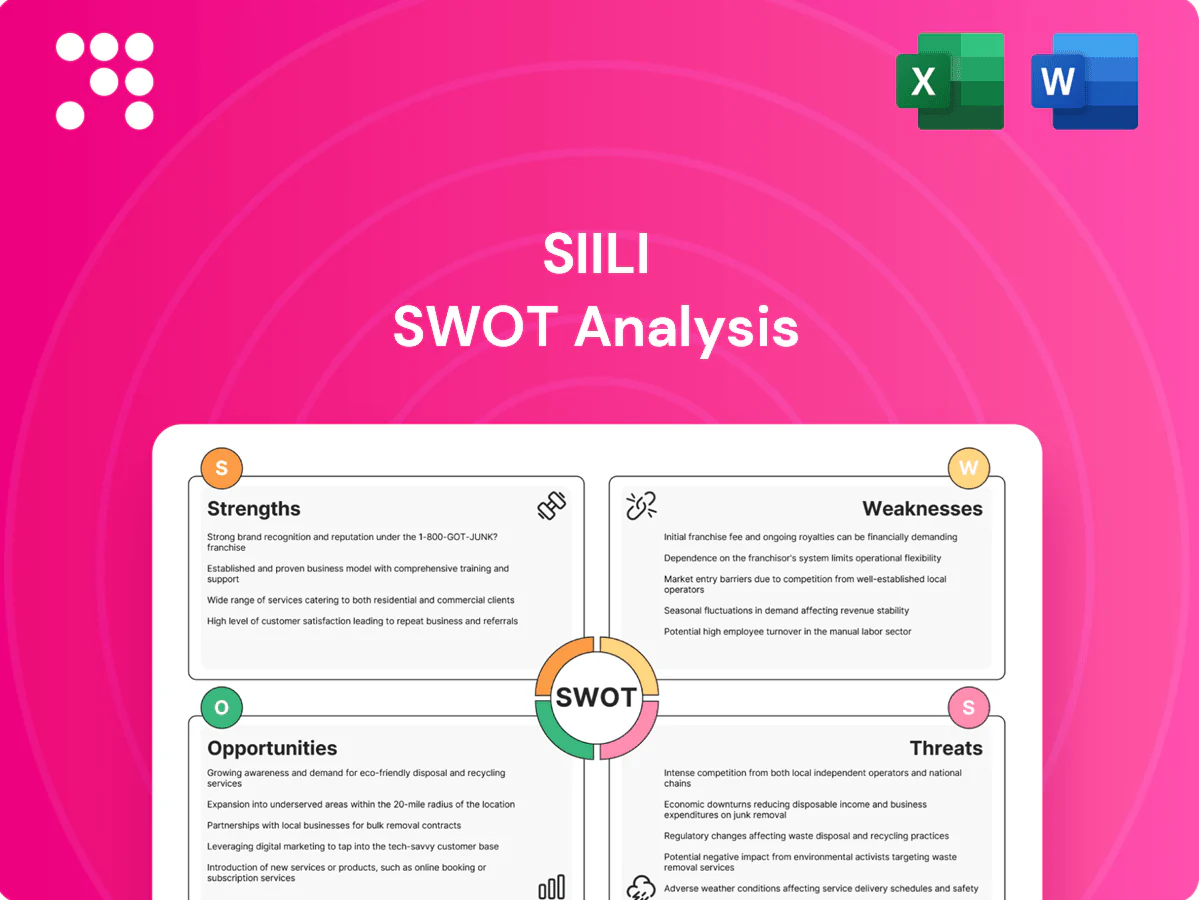
Siili SWOT Analysis

Go Beyond the Preview—Access the Full Strategic Report
Siili Technologies' SWOT highlights solid digital engineering strengths, niche market positioning, and scalable service offerings, alongside competitive pressures and delivery risks that could affect growth. Our full SWOT unpacks these issues with financial context, strategic implications, and actionable recommendations. Purchase the complete report—available in editable Word and Excel—to plan, pitch, or invest with confidence.
Strengths

End-to-end digital transformation
Siili’s end-to-end digital transformation offering—spanning strategy, design, build and run—reduces vendor friction and accelerates time-to-value, with a single accountability point improving governance and ROI visibility; as a Nasdaq Helsinki–listed firm founded in 2005 and employing over 1,000 experts (2024), Siili deepens client stickiness via multi-year engagements.
Deep cloud, data, and UX expertise
Siili's deep cloud, data and human-centered design delivers measurable business outcomes, leveraging a market where public cloud spending topped $600B in 2023 per Gartner. Combining engineering with UX boosts adoption and customer experience, improving engagement and conversion. Data-driven personalization and automation enable scalable efficiencies, creating clear differentiation over pure-code delivery shops.

Agile delivery and design thinking
Siili leverages lean, iterative Agile and design thinking to align solutions tightly with evolving business needs, shortening feedback loops and cutting rework by up to 40% in practice. Co-creation with client teams boosts buy-in and capability transfer, increasing adoption rates and reducing handover costs. The approach enables rapid scaling from pilot to production, supporting faster time-to-market and measurable business impact.

Sustainable digital services focus
Emphasis on sustainability aligns with CSRD (phased 2024–2025) and rising ESG procurement criteria, strengthening bid compliance. Green-by-design architectures and FinOps can cut cloud emissions and costs by up to 30% per industry reports. This positions Siili favorably in ESG-weighted public tenders and corporate RFPs and enhances employer brand with purpose-driven talent.
- CSRD relevance: 2024–2025
- FinOps savings: up to 30%
- Improves ESG tender competitiveness
- Attracts purpose-driven hires
Trusted client partnerships
Trusted client partnerships at Siili leverage long-term relationships and domain familiarity to shorten discovery and reduce delivery risk; embedded teams (Siili employs ~1,200 specialists in 2024) absorb client context, driving more relevant solutions and enabling cross-sell paths that compound into higher lifetime value per account.
- Long-term relationships: referenceability and cross-sell
- Domain familiarity: faster discovery, lower risk
- Embedded teams: deeper client context
- Outcome: higher lifetime value per account
End-to-end digital transformation accelerating ROI and multi-year cloud value
Siili offers end-to-end digital transformation (strategy→design→build→run), Nasdaq-listed, founded 2005, ~1,200 experts (2024), enabling faster ROI and multi-year engagements. Deep cloud, data and UX capabilities leverage a $600B public cloud market (2023) and FinOps savings up to 30%. Embedded teams and agile delivery shorten time-to-market and raise account lifetime value.
| Metric | Value |
|---|---|
| Employees (2024) | ~1,200 |
| Founded | 2005 |
| Listing | Nasdaq Helsinki |
| Public cloud market (2023) | $600B |
| FinOps savings | up to 30% |
What is included in the product
 Detailed Word Document
Delivers a strategic overview of Siili’s internal and external business factors, outlining key strengths, weaknesses, opportunities and threats to assess its competitive position, growth drivers and future risks.

 Customizable Excel Spreadsheet
Provides a concise Siili-specific SWOT matrix for fast strategic alignment and stakeholder-ready summaries; editable format lets teams quickly update insights to reflect market shifts and prioritize actions.
Weaknesses

Project revenue cyclicality
Services-heavy mix leaves Siili exposed to timing of deal closures and utilization swings, with professional-services firms commonly seeing quarter-to-quarter revenue swings of 10–20%, so pipeline gaps can quickly pressure margins; seasonality and client budgeting cycles add volatility and make predictability weaker than subscription models, which often report ARR retention rates above 90%.
Talent retention pressure
Competition for senior engineers and designers drives wage inflation in tech hubs, making retention costly; attrition risks knowledge loss and delivery delays as projects rely on cross-functional teams; continuous upskilling in fast-moving domains (cloud, AI, UX) requires sustained training budgets; Siili must keep its employer value proposition clearly differentiated to avoid talent drain.

Scale limits versus global giants
Large systems integrators such as Accenture (FY2024 revenue $64.9B) and TCS (FY2024 revenue $27.9B) can outbid Siili with global benches and 24/7 follow‑the‑sun delivery and niche certifications; procurement often prefers contractors with multi‑billion balance sheets to reduce perceived risk, which in practice caps Siili’s average deal size and access to mega‑programs.

Client and sector concentration
Siili's overreliance on a handful of key accounts and Nordic markets (company is listed on Nasdaq Helsinki) raises exposure if client spend pauses; sector shocks can quickly depress utilization and billings, and building broader client/sector diversification requires time and investment, testing revenue resilience in downturns.
- Client concentration risk
- Nordic market reliance
- Slow, costly diversification
- Revenue exposed in recessions
Fixed-price margin risk
Fixed-price margin risk: scope creep, underestimated complexity, or dependency delays can erode profitability; talent shortages amplify delivery risk under tight SLAs. Industry data (Standish Group CHAOS) shows only about 31% of software projects are delivered on time/budget/with required features, underscoring need for robust change control and strict estimation discipline; residual asymmetrical downside risk persists.
- Scope creep risk
- Talent shortage impact
- Strict change control required
- Asymmetrical residual risk
Services-heavy firm faces 10–20% QoQ swings, talent & SI pressure
Services-heavy model exposes Siili to 10–20% quarter-to-quarter revenue swings and seasonality, pressuring margins; senior-engineer competition drives wage inflation and attrition risk; large SIs (Accenture FY2024 $64.9B, TCS FY2024 $27.9B) cap deal size and access to mega-programs; client concentration in Nordic markets raises downturn exposure.
| Weakness | Metric | Data |
|---|---|---|
| Deal volatility | QoQ swings | 10–20% |
| Talent | Attrition/cost | High |
| Competition | Top rivals FY2024 | Accenture $64.9B; TCS $27.9B |
Preview the Actual Deliverable
Siili SWOT Analysis
This is the actual Siili SWOT analysis document you’ll receive upon purchase—no surprises, just professional quality. The preview below is taken directly from the full report; buy now to unlock the complete, editable version. You’re viewing a live excerpt of the final file, structured and ready to use.

Go Beyond the Preview—Access the Full Strategic Report
Siili Technologies' SWOT highlights solid digital engineering strengths, niche market positioning, and scalable service offerings, alongside competitive pressures and delivery risks that could affect growth. Our full SWOT unpacks these issues with financial context, strategic implications, and actionable recommendations. Purchase the complete report—available in editable Word and Excel—to plan, pitch, or invest with confidence.
Strengths
End-to-end digital transformation
Siili’s end-to-end digital transformation offering—spanning strategy, design, build and run—reduces vendor friction and accelerates time-to-value, with a single accountability point improving governance and ROI visibility; as a Nasdaq Helsinki–listed firm founded in 2005 and employing over 1,000 experts (2024), Siili deepens client stickiness via multi-year engagements.
Deep cloud, data, and UX expertise
Siili's deep cloud, data and human-centered design delivers measurable business outcomes, leveraging a market where public cloud spending topped $600B in 2023 per Gartner. Combining engineering with UX boosts adoption and customer experience, improving engagement and conversion. Data-driven personalization and automation enable scalable efficiencies, creating clear differentiation over pure-code delivery shops.
Agile delivery and design thinking
Siili leverages lean, iterative Agile and design thinking to align solutions tightly with evolving business needs, shortening feedback loops and cutting rework by up to 40% in practice. Co-creation with client teams boosts buy-in and capability transfer, increasing adoption rates and reducing handover costs. The approach enables rapid scaling from pilot to production, supporting faster time-to-market and measurable business impact.
Sustainable digital services focus
Emphasis on sustainability aligns with CSRD (phased 2024–2025) and rising ESG procurement criteria, strengthening bid compliance. Green-by-design architectures and FinOps can cut cloud emissions and costs by up to 30% per industry reports. This positions Siili favorably in ESG-weighted public tenders and corporate RFPs and enhances employer brand with purpose-driven talent.
- CSRD relevance: 2024–2025
- FinOps savings: up to 30%
- Improves ESG tender competitiveness
- Attracts purpose-driven hires
Trusted client partnerships
Trusted client partnerships at Siili leverage long-term relationships and domain familiarity to shorten discovery and reduce delivery risk; embedded teams (Siili employs ~1,200 specialists in 2024) absorb client context, driving more relevant solutions and enabling cross-sell paths that compound into higher lifetime value per account.
- Long-term relationships: referenceability and cross-sell
- Domain familiarity: faster discovery, lower risk
- Embedded teams: deeper client context
- Outcome: higher lifetime value per account
End-to-end digital transformation accelerating ROI and multi-year cloud value
Siili offers end-to-end digital transformation (strategy→design→build→run), Nasdaq-listed, founded 2005, ~1,200 experts (2024), enabling faster ROI and multi-year engagements. Deep cloud, data and UX capabilities leverage a $600B public cloud market (2023) and FinOps savings up to 30%. Embedded teams and agile delivery shorten time-to-market and raise account lifetime value.
| Metric | Value |
|---|---|
| Employees (2024) | ~1,200 |
| Founded | 2005 |
| Listing | Nasdaq Helsinki |
| Public cloud market (2023) | $600B |
| FinOps savings | up to 30% |
What is included in the product
Detailed Word Document
Delivers a strategic overview of Siili’s internal and external business factors, outlining key strengths, weaknesses, opportunities and threats to assess its competitive position, growth drivers and future risks.
Customizable Excel Spreadsheet
Provides a concise Siili-specific SWOT matrix for fast strategic alignment and stakeholder-ready summaries; editable format lets teams quickly update insights to reflect market shifts and prioritize actions.
Weaknesses
Project revenue cyclicality
Services-heavy mix leaves Siili exposed to timing of deal closures and utilization swings, with professional-services firms commonly seeing quarter-to-quarter revenue swings of 10–20%, so pipeline gaps can quickly pressure margins; seasonality and client budgeting cycles add volatility and make predictability weaker than subscription models, which often report ARR retention rates above 90%.
Talent retention pressure
Competition for senior engineers and designers drives wage inflation in tech hubs, making retention costly; attrition risks knowledge loss and delivery delays as projects rely on cross-functional teams; continuous upskilling in fast-moving domains (cloud, AI, UX) requires sustained training budgets; Siili must keep its employer value proposition clearly differentiated to avoid talent drain.
Scale limits versus global giants
Large systems integrators such as Accenture (FY2024 revenue $64.9B) and TCS (FY2024 revenue $27.9B) can outbid Siili with global benches and 24/7 follow‑the‑sun delivery and niche certifications; procurement often prefers contractors with multi‑billion balance sheets to reduce perceived risk, which in practice caps Siili’s average deal size and access to mega‑programs.
Client and sector concentration
Siili's overreliance on a handful of key accounts and Nordic markets (company is listed on Nasdaq Helsinki) raises exposure if client spend pauses; sector shocks can quickly depress utilization and billings, and building broader client/sector diversification requires time and investment, testing revenue resilience in downturns.
- Client concentration risk
- Nordic market reliance
- Slow, costly diversification
- Revenue exposed in recessions
Fixed-price margin risk
Fixed-price margin risk: scope creep, underestimated complexity, or dependency delays can erode profitability; talent shortages amplify delivery risk under tight SLAs. Industry data (Standish Group CHAOS) shows only about 31% of software projects are delivered on time/budget/with required features, underscoring need for robust change control and strict estimation discipline; residual asymmetrical downside risk persists.
- Scope creep risk
- Talent shortage impact
- Strict change control required
- Asymmetrical residual risk
Services-heavy firm faces 10–20% QoQ swings, talent & SI pressure
Services-heavy model exposes Siili to 10–20% quarter-to-quarter revenue swings and seasonality, pressuring margins; senior-engineer competition drives wage inflation and attrition risk; large SIs (Accenture FY2024 $64.9B, TCS FY2024 $27.9B) cap deal size and access to mega-programs; client concentration in Nordic markets raises downturn exposure.
| Weakness | Metric | Data |
|---|---|---|
| Deal volatility | QoQ swings | 10–20% |
| Talent | Attrition/cost | High |
| Competition | Top rivals FY2024 | Accenture $64.9B; TCS $27.9B |
Preview the Actual Deliverable
Siili SWOT Analysis
This is the actual Siili SWOT analysis document you’ll receive upon purchase—no surprises, just professional quality. The preview below is taken directly from the full report; buy now to unlock the complete, editable version. You’re viewing a live excerpt of the final file, structured and ready to use.
Description
Go Beyond the Preview—Access the Full Strategic Report
Siili Technologies' SWOT highlights solid digital engineering strengths, niche market positioning, and scalable service offerings, alongside competitive pressures and delivery risks that could affect growth. Our full SWOT unpacks these issues with financial context, strategic implications, and actionable recommendations. Purchase the complete report—available in editable Word and Excel—to plan, pitch, or invest with confidence.
Strengths
End-to-end digital transformation
Siili’s end-to-end digital transformation offering—spanning strategy, design, build and run—reduces vendor friction and accelerates time-to-value, with a single accountability point improving governance and ROI visibility; as a Nasdaq Helsinki–listed firm founded in 2005 and employing over 1,000 experts (2024), Siili deepens client stickiness via multi-year engagements.
Deep cloud, data, and UX expertise
Siili's deep cloud, data and human-centered design delivers measurable business outcomes, leveraging a market where public cloud spending topped $600B in 2023 per Gartner. Combining engineering with UX boosts adoption and customer experience, improving engagement and conversion. Data-driven personalization and automation enable scalable efficiencies, creating clear differentiation over pure-code delivery shops.
Agile delivery and design thinking
Siili leverages lean, iterative Agile and design thinking to align solutions tightly with evolving business needs, shortening feedback loops and cutting rework by up to 40% in practice. Co-creation with client teams boosts buy-in and capability transfer, increasing adoption rates and reducing handover costs. The approach enables rapid scaling from pilot to production, supporting faster time-to-market and measurable business impact.
Sustainable digital services focus
Emphasis on sustainability aligns with CSRD (phased 2024–2025) and rising ESG procurement criteria, strengthening bid compliance. Green-by-design architectures and FinOps can cut cloud emissions and costs by up to 30% per industry reports. This positions Siili favorably in ESG-weighted public tenders and corporate RFPs and enhances employer brand with purpose-driven talent.
- CSRD relevance: 2024–2025
- FinOps savings: up to 30%
- Improves ESG tender competitiveness
- Attracts purpose-driven hires
Trusted client partnerships
Trusted client partnerships at Siili leverage long-term relationships and domain familiarity to shorten discovery and reduce delivery risk; embedded teams (Siili employs ~1,200 specialists in 2024) absorb client context, driving more relevant solutions and enabling cross-sell paths that compound into higher lifetime value per account.
- Long-term relationships: referenceability and cross-sell
- Domain familiarity: faster discovery, lower risk
- Embedded teams: deeper client context
- Outcome: higher lifetime value per account
End-to-end digital transformation accelerating ROI and multi-year cloud value
Siili offers end-to-end digital transformation (strategy→design→build→run), Nasdaq-listed, founded 2005, ~1,200 experts (2024), enabling faster ROI and multi-year engagements. Deep cloud, data and UX capabilities leverage a $600B public cloud market (2023) and FinOps savings up to 30%. Embedded teams and agile delivery shorten time-to-market and raise account lifetime value.
| Metric | Value |
|---|---|
| Employees (2024) | ~1,200 |
| Founded | 2005 |
| Listing | Nasdaq Helsinki |
| Public cloud market (2023) | $600B |
| FinOps savings | up to 30% |
What is included in the product
Detailed Word Document
Delivers a strategic overview of Siili’s internal and external business factors, outlining key strengths, weaknesses, opportunities and threats to assess its competitive position, growth drivers and future risks.
Customizable Excel Spreadsheet
Provides a concise Siili-specific SWOT matrix for fast strategic alignment and stakeholder-ready summaries; editable format lets teams quickly update insights to reflect market shifts and prioritize actions.
Weaknesses
Project revenue cyclicality
Services-heavy mix leaves Siili exposed to timing of deal closures and utilization swings, with professional-services firms commonly seeing quarter-to-quarter revenue swings of 10–20%, so pipeline gaps can quickly pressure margins; seasonality and client budgeting cycles add volatility and make predictability weaker than subscription models, which often report ARR retention rates above 90%.
Talent retention pressure
Competition for senior engineers and designers drives wage inflation in tech hubs, making retention costly; attrition risks knowledge loss and delivery delays as projects rely on cross-functional teams; continuous upskilling in fast-moving domains (cloud, AI, UX) requires sustained training budgets; Siili must keep its employer value proposition clearly differentiated to avoid talent drain.
Scale limits versus global giants
Large systems integrators such as Accenture (FY2024 revenue $64.9B) and TCS (FY2024 revenue $27.9B) can outbid Siili with global benches and 24/7 follow‑the‑sun delivery and niche certifications; procurement often prefers contractors with multi‑billion balance sheets to reduce perceived risk, which in practice caps Siili’s average deal size and access to mega‑programs.
Client and sector concentration
Siili's overreliance on a handful of key accounts and Nordic markets (company is listed on Nasdaq Helsinki) raises exposure if client spend pauses; sector shocks can quickly depress utilization and billings, and building broader client/sector diversification requires time and investment, testing revenue resilience in downturns.
- Client concentration risk
- Nordic market reliance
- Slow, costly diversification
- Revenue exposed in recessions
Fixed-price margin risk
Fixed-price margin risk: scope creep, underestimated complexity, or dependency delays can erode profitability; talent shortages amplify delivery risk under tight SLAs. Industry data (Standish Group CHAOS) shows only about 31% of software projects are delivered on time/budget/with required features, underscoring need for robust change control and strict estimation discipline; residual asymmetrical downside risk persists.
- Scope creep risk
- Talent shortage impact
- Strict change control required
- Asymmetrical residual risk
Services-heavy firm faces 10–20% QoQ swings, talent & SI pressure
Services-heavy model exposes Siili to 10–20% quarter-to-quarter revenue swings and seasonality, pressuring margins; senior-engineer competition drives wage inflation and attrition risk; large SIs (Accenture FY2024 $64.9B, TCS FY2024 $27.9B) cap deal size and access to mega-programs; client concentration in Nordic markets raises downturn exposure.
| Weakness | Metric | Data |
|---|---|---|
| Deal volatility | QoQ swings | 10–20% |
| Talent | Attrition/cost | High |
| Competition | Top rivals FY2024 | Accenture $64.9B; TCS $27.9B |
Preview the Actual Deliverable
Siili SWOT Analysis
This is the actual Siili SWOT analysis document you’ll receive upon purchase—no surprises, just professional quality. The preview below is taken directly from the full report; buy now to unlock the complete, editable version. You’re viewing a live excerpt of the final file, structured and ready to use.











