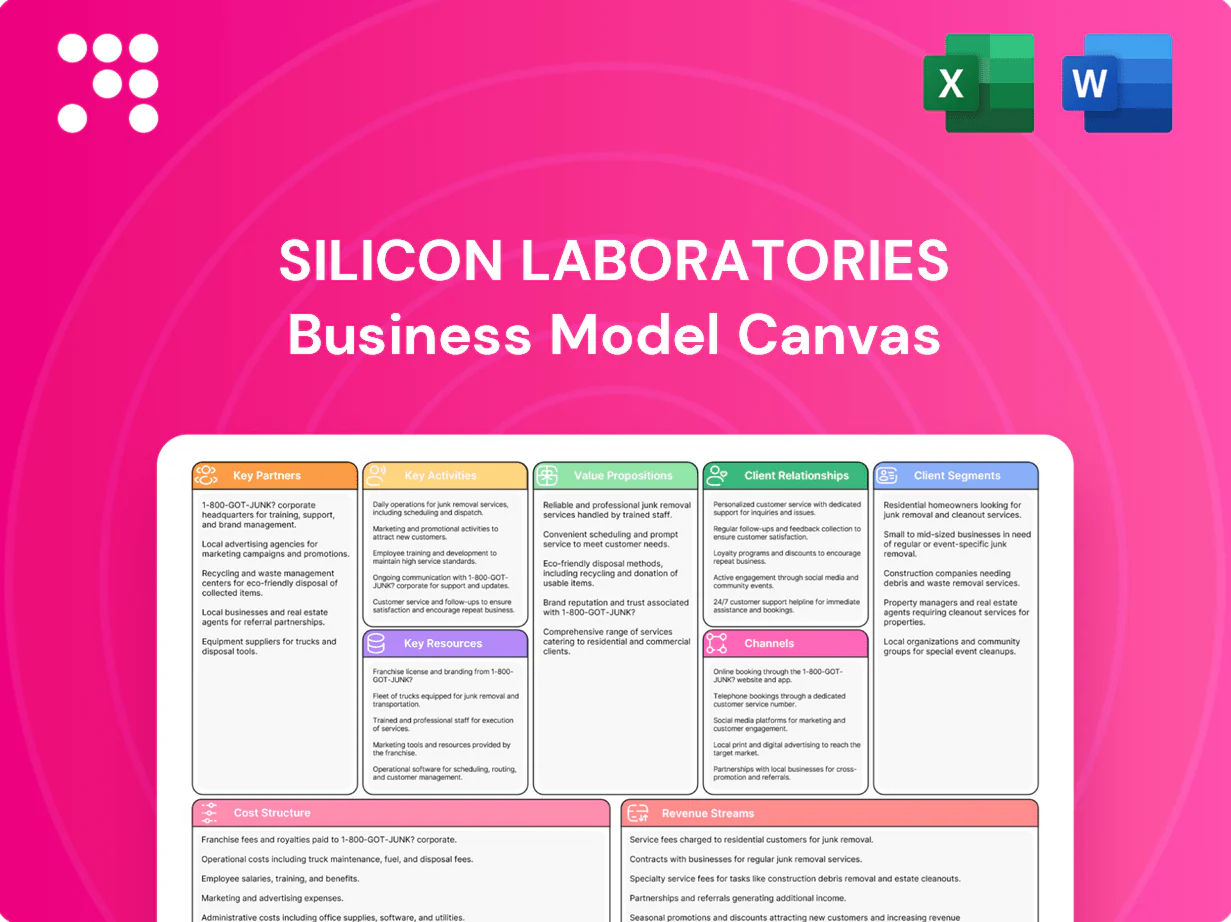
Silicon Laboratories Business Model Canvas

IoT and wireless growth playbook: Business Model Canvas for scalable IP-led firms
Unlock Silicon Laboratories' strategic playbook with our Business Model Canvas: concise mapping of customer segments, value propositions, channels, and revenue streams. See how SLAB scales IoT and wireless solutions through partnerships and IP-driven margins. Ideal for investors, strategists, and founders seeking actionable insights. Purchase the full, editable Canvas in Word/Excel to benchmark and implement proven tactics.
Partnerships

Foundry and packaging alliances
Silabs partners with leading fabs and OSATs using nodes from 65nm down to 28nm and mature nodes for RF/analog to secure wafer fabrication, advanced-node features, and high-volume assembly supporting multi-million unit production runs. These alliances deliver volume scalability, cost efficiency and quality, with close co-development enabling process tweaks for RF, analog and ultra-low-power performance. Multi-sourcing across fabs and OSATs reduces supply risk and lead-time volatility.
IP, standards, and ecosystem partners
Collaboration with Bluetooth, Zigbee, Thread, Matter, Wi‑Fi and proprietary IP providers accelerates protocol compliance; Silicon Labs supports all these stacks and leverages Matter’s 1,000+ certified devices (2024) to speed ecosystem adoption. Participation in standards bodies gives early visibility and influence, improving interoperability with hubs and cloud platforms. Ecosystem alignment strengthens developer trust and shortens time-to-certification.

Software, cloud, and toolchain partners
Alliances with IDE, RTOS (FreeRTOS, Zephyr, Micrium) and cloud vendors (AWS, Azure, Google Cloud) enhance the Silicon Labs SDK experience and ecosystem viability, supporting product lines that contributed to Silicon Labs reporting roughly $1.13B revenue in FY2024. Turnkey stacks and reference designs cut integration time; cloud connectors and device management speed deployment; joint roadmaps sustain feature parity and regular updates.

Module, ODM, and EMS partners
Manufacturing and design partners move customers from silicon to product by combining Silicon Labs IP with ODM design-for-manufacture, while pre-certified modules shorten regulatory cycles and speed time-to-market; ODMs optimize BOM cost and yield, and EMS partners deliver global production and logistics at scale in 2024.
- Modules: faster certification, lower integration cost
- ODM: DFM, BOM optimization
- EMS: global sites, scalable fulfillment
Distributors and design houses
Global distributors extend Silicon Labs reach to SMEs and long-tail customers, leveraging a distribution channel in an industry where 2024 global semiconductor distribution sales exceeded $70 billion, broadening addressable markets and order velocity.
Field application engineers provide localized technical support and demand creation, accelerating integration and reducing design cycle time for customers across regions.
Design houses enable customizations and rapid prototyping, driving design wins and lowering onboarding friction through turnkey solutions and co-engineering.
- Distributors: expand SME/long-tail access
- FAEs: localized support + demand creation
- Design houses: rapid prototyping & customization
- Outcome: faster design wins, reduced onboarding friction
IoT scale: 1,000+ Matter devices, $1.13B FY2024
Silabs partners with fabs/OSATs (65–28nm + mature RF nodes) and ODM/EMS to secure multi‑million unit scale, yield and cost efficiency. Alliances with protocol/IP, RTOS and cloud vendors and standards (Matter 1,000+ certified devices in 2024) accelerate certification and ecosystem adoption. Distributors, FAEs and design houses expand SME reach and supported FY2024 revenue ~$1.13B.
| Metric | Value |
|---|---|
| Matter certified devices (2024) | 1,000+ |
| FY2024 revenue | $1.13B |
| Global semiconductor distribution (2024) | >$70B |
| Manufacturing nodes | 65–28nm + mature RF |
What is included in the product
 Detailed Word Document
A tailored Business Model Canvas for Silicon Laboratories detailing its nine BMC blocks—customer segments, value propositions, channels, customer relationships, revenue streams, key resources, key activities, key partners, and cost structure—aligned with its IoT and mixed-signal semiconductor strategy. Includes competitive advantage analysis, linked SWOT insights, and polished narrative for investor presentations and strategic planning.

 Customizable Excel Spreadsheet
High-level, editable Business Model Canvas for Silicon Laboratories that condenses device-to-cloud strategy into a one-page snapshot to quickly identify core components and relieve strategic alignment pain points. Saves hours of formatting while enabling fast team collaboration, board-ready summaries, and easy comparison with competitors.
Activities

Mixed-signal and RF IC design
Core mixed-signal and RF IC design centers on low-power MCUs, wireless SoCs and analog front-ends optimized for integration, coexistence and robust RF performance. Continuous node migration balances power, cost and yield while the silicon roadmap maps to Bluetooth LE, Zigbee, Thread and Matter certifications. Silicon Labs reported FY2024 revenue of $1.84 billion, reflecting IoT-driven demand.
Firmware, SDKs, and security stacks
Delivering production-grade wireless stacks and HALs—covering BLE, Zigbee, Thread and proprietary protocols—is critical as the global installed base of IoT devices surpassed ~14 billion in 2024, driving demand for robust firmware. Secure boot, key management, and OTA are maintained, audited, and versioned; tooling supports debug, energy profiling, and code optimization. Regular updates address vulnerabilities and add features to meet enterprise SLAs.

Reference designs and certification
Silicon Labs supplies hardware reference boards and open design files to accelerate adoption and shorten development cycles; the company reported $1.07 billion revenue in 2024, reflecting strong product-led growth. Pre-certification for radio standards lowers customer regulatory risk, while compliance testing covers EMC, safety and regional RF requirements. Detailed application notes document best practices and tradeoffs to reduce integration issues and speed time-to-market.

Developer enablement and support
Developer enablement and support at Silicon Laboratories centers on community forums, comprehensive documentation, and sample projects to drive self-serve adoption; FAEs and applications engineers handle complex integrations and custom proofs of concept; regular trainings and webinars shorten learning curves; hackathons and partner demos accelerate design wins with customers.
- Community forums and samples: self-serve growth
- FAEs/apps engineers: complex integration support
- Trainings/webinars: reduced onboarding time
- Hackathons/partner demos: catalytic design wins
Supply chain and quality management
Silicon Laboratories plans wafers, test and packaging to absorb demand variability, drives yield improvements and reliability screening using HTOL (commonly 1,000+ hour runs) and AEC-Q100 automotive qualification, and maintains secure supply through alternate fabs and buffer inventory. Continuous improvement is enforced under ISO 9001 and IATF 16949 processes to support automotive-grade quality and traceability.
- HTOL: 1,000+ hours
- Standards: AEC-Q100, ISO 9001, IATF 16949
- Supply tactics: multi-sourcing, alternates, buffer inventory
- Focus: yield, reliability, automotive traceability
Low-power RF SoCs: FY2024 revenue $1.84B, serving ~14B IoT devices
Core mixed-signal/RF IC design targets low-power MCUs, wireless SoCs and analog front-ends for BLE, Zigbee, Thread and Matter, supporting FY2024 revenue $1.84B.
Firmware stacks, secure boot/OTA and tooling scale to a global IoT base ~14B devices (2024), with continuous security updates and enterprise SLAs.
Manufacturing emphasizes HTOL 1,000+ hrs, AEC-Q100/IATF 16949, multi-sourcing and buffer inventory to ensure automotive-grade yield and supply continuity.
| Metric | 2024 |
|---|---|
| Revenue | $1.84B |
| IoT installed base | ~14B |
| HTOL | 1,000+ hrs |
Full Version Awaits
Business Model Canvas
The Silicon Laboratories Business Model Canvas you’re previewing is the exact deliverable, not a mockup. When you purchase, you’ll receive this same complete document—structured and formatted as shown. Files are provided ready-to-edit in Word and Excel so you can present, customize, or share without further work.

IoT and wireless growth playbook: Business Model Canvas for scalable IP-led firms
Unlock Silicon Laboratories' strategic playbook with our Business Model Canvas: concise mapping of customer segments, value propositions, channels, and revenue streams. See how SLAB scales IoT and wireless solutions through partnerships and IP-driven margins. Ideal for investors, strategists, and founders seeking actionable insights. Purchase the full, editable Canvas in Word/Excel to benchmark and implement proven tactics.
Partnerships
Foundry and packaging alliances
Silabs partners with leading fabs and OSATs using nodes from 65nm down to 28nm and mature nodes for RF/analog to secure wafer fabrication, advanced-node features, and high-volume assembly supporting multi-million unit production runs. These alliances deliver volume scalability, cost efficiency and quality, with close co-development enabling process tweaks for RF, analog and ultra-low-power performance. Multi-sourcing across fabs and OSATs reduces supply risk and lead-time volatility.
IP, standards, and ecosystem partners
Collaboration with Bluetooth, Zigbee, Thread, Matter, Wi‑Fi and proprietary IP providers accelerates protocol compliance; Silicon Labs supports all these stacks and leverages Matter’s 1,000+ certified devices (2024) to speed ecosystem adoption. Participation in standards bodies gives early visibility and influence, improving interoperability with hubs and cloud platforms. Ecosystem alignment strengthens developer trust and shortens time-to-certification.
Software, cloud, and toolchain partners
Alliances with IDE, RTOS (FreeRTOS, Zephyr, Micrium) and cloud vendors (AWS, Azure, Google Cloud) enhance the Silicon Labs SDK experience and ecosystem viability, supporting product lines that contributed to Silicon Labs reporting roughly $1.13B revenue in FY2024. Turnkey stacks and reference designs cut integration time; cloud connectors and device management speed deployment; joint roadmaps sustain feature parity and regular updates.
Module, ODM, and EMS partners
Manufacturing and design partners move customers from silicon to product by combining Silicon Labs IP with ODM design-for-manufacture, while pre-certified modules shorten regulatory cycles and speed time-to-market; ODMs optimize BOM cost and yield, and EMS partners deliver global production and logistics at scale in 2024.
- Modules: faster certification, lower integration cost
- ODM: DFM, BOM optimization
- EMS: global sites, scalable fulfillment
Distributors and design houses
Global distributors extend Silicon Labs reach to SMEs and long-tail customers, leveraging a distribution channel in an industry where 2024 global semiconductor distribution sales exceeded $70 billion, broadening addressable markets and order velocity.
Field application engineers provide localized technical support and demand creation, accelerating integration and reducing design cycle time for customers across regions.
Design houses enable customizations and rapid prototyping, driving design wins and lowering onboarding friction through turnkey solutions and co-engineering.
- Distributors: expand SME/long-tail access
- FAEs: localized support + demand creation
- Design houses: rapid prototyping & customization
- Outcome: faster design wins, reduced onboarding friction
IoT scale: 1,000+ Matter devices, $1.13B FY2024
Silabs partners with fabs/OSATs (65–28nm + mature RF nodes) and ODM/EMS to secure multi‑million unit scale, yield and cost efficiency. Alliances with protocol/IP, RTOS and cloud vendors and standards (Matter 1,000+ certified devices in 2024) accelerate certification and ecosystem adoption. Distributors, FAEs and design houses expand SME reach and supported FY2024 revenue ~$1.13B.
| Metric | Value |
|---|---|
| Matter certified devices (2024) | 1,000+ |
| FY2024 revenue | $1.13B |
| Global semiconductor distribution (2024) | >$70B |
| Manufacturing nodes | 65–28nm + mature RF |
What is included in the product
Detailed Word Document
A tailored Business Model Canvas for Silicon Laboratories detailing its nine BMC blocks—customer segments, value propositions, channels, customer relationships, revenue streams, key resources, key activities, key partners, and cost structure—aligned with its IoT and mixed-signal semiconductor strategy. Includes competitive advantage analysis, linked SWOT insights, and polished narrative for investor presentations and strategic planning.
Customizable Excel Spreadsheet
High-level, editable Business Model Canvas for Silicon Laboratories that condenses device-to-cloud strategy into a one-page snapshot to quickly identify core components and relieve strategic alignment pain points. Saves hours of formatting while enabling fast team collaboration, board-ready summaries, and easy comparison with competitors.
Activities
Mixed-signal and RF IC design
Core mixed-signal and RF IC design centers on low-power MCUs, wireless SoCs and analog front-ends optimized for integration, coexistence and robust RF performance. Continuous node migration balances power, cost and yield while the silicon roadmap maps to Bluetooth LE, Zigbee, Thread and Matter certifications. Silicon Labs reported FY2024 revenue of $1.84 billion, reflecting IoT-driven demand.
Firmware, SDKs, and security stacks
Delivering production-grade wireless stacks and HALs—covering BLE, Zigbee, Thread and proprietary protocols—is critical as the global installed base of IoT devices surpassed ~14 billion in 2024, driving demand for robust firmware. Secure boot, key management, and OTA are maintained, audited, and versioned; tooling supports debug, energy profiling, and code optimization. Regular updates address vulnerabilities and add features to meet enterprise SLAs.
Reference designs and certification
Silicon Labs supplies hardware reference boards and open design files to accelerate adoption and shorten development cycles; the company reported $1.07 billion revenue in 2024, reflecting strong product-led growth. Pre-certification for radio standards lowers customer regulatory risk, while compliance testing covers EMC, safety and regional RF requirements. Detailed application notes document best practices and tradeoffs to reduce integration issues and speed time-to-market.
Developer enablement and support
Developer enablement and support at Silicon Laboratories centers on community forums, comprehensive documentation, and sample projects to drive self-serve adoption; FAEs and applications engineers handle complex integrations and custom proofs of concept; regular trainings and webinars shorten learning curves; hackathons and partner demos accelerate design wins with customers.
- Community forums and samples: self-serve growth
- FAEs/apps engineers: complex integration support
- Trainings/webinars: reduced onboarding time
- Hackathons/partner demos: catalytic design wins
Supply chain and quality management
Silicon Laboratories plans wafers, test and packaging to absorb demand variability, drives yield improvements and reliability screening using HTOL (commonly 1,000+ hour runs) and AEC-Q100 automotive qualification, and maintains secure supply through alternate fabs and buffer inventory. Continuous improvement is enforced under ISO 9001 and IATF 16949 processes to support automotive-grade quality and traceability.
- HTOL: 1,000+ hours
- Standards: AEC-Q100, ISO 9001, IATF 16949
- Supply tactics: multi-sourcing, alternates, buffer inventory
- Focus: yield, reliability, automotive traceability
Low-power RF SoCs: FY2024 revenue $1.84B, serving ~14B IoT devices
Core mixed-signal/RF IC design targets low-power MCUs, wireless SoCs and analog front-ends for BLE, Zigbee, Thread and Matter, supporting FY2024 revenue $1.84B.
Firmware stacks, secure boot/OTA and tooling scale to a global IoT base ~14B devices (2024), with continuous security updates and enterprise SLAs.
Manufacturing emphasizes HTOL 1,000+ hrs, AEC-Q100/IATF 16949, multi-sourcing and buffer inventory to ensure automotive-grade yield and supply continuity.
| Metric | 2024 |
|---|---|
| Revenue | $1.84B |
| IoT installed base | ~14B |
| HTOL | 1,000+ hrs |
Full Version Awaits
Business Model Canvas
The Silicon Laboratories Business Model Canvas you’re previewing is the exact deliverable, not a mockup. When you purchase, you’ll receive this same complete document—structured and formatted as shown. Files are provided ready-to-edit in Word and Excel so you can present, customize, or share without further work.
Original: $10.00
-65%$10.00
$3.50Description
IoT and wireless growth playbook: Business Model Canvas for scalable IP-led firms
Unlock Silicon Laboratories' strategic playbook with our Business Model Canvas: concise mapping of customer segments, value propositions, channels, and revenue streams. See how SLAB scales IoT and wireless solutions through partnerships and IP-driven margins. Ideal for investors, strategists, and founders seeking actionable insights. Purchase the full, editable Canvas in Word/Excel to benchmark and implement proven tactics.
Partnerships
Foundry and packaging alliances
Silabs partners with leading fabs and OSATs using nodes from 65nm down to 28nm and mature nodes for RF/analog to secure wafer fabrication, advanced-node features, and high-volume assembly supporting multi-million unit production runs. These alliances deliver volume scalability, cost efficiency and quality, with close co-development enabling process tweaks for RF, analog and ultra-low-power performance. Multi-sourcing across fabs and OSATs reduces supply risk and lead-time volatility.
IP, standards, and ecosystem partners
Collaboration with Bluetooth, Zigbee, Thread, Matter, Wi‑Fi and proprietary IP providers accelerates protocol compliance; Silicon Labs supports all these stacks and leverages Matter’s 1,000+ certified devices (2024) to speed ecosystem adoption. Participation in standards bodies gives early visibility and influence, improving interoperability with hubs and cloud platforms. Ecosystem alignment strengthens developer trust and shortens time-to-certification.
Software, cloud, and toolchain partners
Alliances with IDE, RTOS (FreeRTOS, Zephyr, Micrium) and cloud vendors (AWS, Azure, Google Cloud) enhance the Silicon Labs SDK experience and ecosystem viability, supporting product lines that contributed to Silicon Labs reporting roughly $1.13B revenue in FY2024. Turnkey stacks and reference designs cut integration time; cloud connectors and device management speed deployment; joint roadmaps sustain feature parity and regular updates.
Module, ODM, and EMS partners
Manufacturing and design partners move customers from silicon to product by combining Silicon Labs IP with ODM design-for-manufacture, while pre-certified modules shorten regulatory cycles and speed time-to-market; ODMs optimize BOM cost and yield, and EMS partners deliver global production and logistics at scale in 2024.
- Modules: faster certification, lower integration cost
- ODM: DFM, BOM optimization
- EMS: global sites, scalable fulfillment
Distributors and design houses
Global distributors extend Silicon Labs reach to SMEs and long-tail customers, leveraging a distribution channel in an industry where 2024 global semiconductor distribution sales exceeded $70 billion, broadening addressable markets and order velocity.
Field application engineers provide localized technical support and demand creation, accelerating integration and reducing design cycle time for customers across regions.
Design houses enable customizations and rapid prototyping, driving design wins and lowering onboarding friction through turnkey solutions and co-engineering.
- Distributors: expand SME/long-tail access
- FAEs: localized support + demand creation
- Design houses: rapid prototyping & customization
- Outcome: faster design wins, reduced onboarding friction
IoT scale: 1,000+ Matter devices, $1.13B FY2024
Silabs partners with fabs/OSATs (65–28nm + mature RF nodes) and ODM/EMS to secure multi‑million unit scale, yield and cost efficiency. Alliances with protocol/IP, RTOS and cloud vendors and standards (Matter 1,000+ certified devices in 2024) accelerate certification and ecosystem adoption. Distributors, FAEs and design houses expand SME reach and supported FY2024 revenue ~$1.13B.
| Metric | Value |
|---|---|
| Matter certified devices (2024) | 1,000+ |
| FY2024 revenue | $1.13B |
| Global semiconductor distribution (2024) | >$70B |
| Manufacturing nodes | 65–28nm + mature RF |
What is included in the product
Detailed Word Document
A tailored Business Model Canvas for Silicon Laboratories detailing its nine BMC blocks—customer segments, value propositions, channels, customer relationships, revenue streams, key resources, key activities, key partners, and cost structure—aligned with its IoT and mixed-signal semiconductor strategy. Includes competitive advantage analysis, linked SWOT insights, and polished narrative for investor presentations and strategic planning.
Customizable Excel Spreadsheet
High-level, editable Business Model Canvas for Silicon Laboratories that condenses device-to-cloud strategy into a one-page snapshot to quickly identify core components and relieve strategic alignment pain points. Saves hours of formatting while enabling fast team collaboration, board-ready summaries, and easy comparison with competitors.
Activities
Mixed-signal and RF IC design
Core mixed-signal and RF IC design centers on low-power MCUs, wireless SoCs and analog front-ends optimized for integration, coexistence and robust RF performance. Continuous node migration balances power, cost and yield while the silicon roadmap maps to Bluetooth LE, Zigbee, Thread and Matter certifications. Silicon Labs reported FY2024 revenue of $1.84 billion, reflecting IoT-driven demand.
Firmware, SDKs, and security stacks
Delivering production-grade wireless stacks and HALs—covering BLE, Zigbee, Thread and proprietary protocols—is critical as the global installed base of IoT devices surpassed ~14 billion in 2024, driving demand for robust firmware. Secure boot, key management, and OTA are maintained, audited, and versioned; tooling supports debug, energy profiling, and code optimization. Regular updates address vulnerabilities and add features to meet enterprise SLAs.
Reference designs and certification
Silicon Labs supplies hardware reference boards and open design files to accelerate adoption and shorten development cycles; the company reported $1.07 billion revenue in 2024, reflecting strong product-led growth. Pre-certification for radio standards lowers customer regulatory risk, while compliance testing covers EMC, safety and regional RF requirements. Detailed application notes document best practices and tradeoffs to reduce integration issues and speed time-to-market.
Developer enablement and support
Developer enablement and support at Silicon Laboratories centers on community forums, comprehensive documentation, and sample projects to drive self-serve adoption; FAEs and applications engineers handle complex integrations and custom proofs of concept; regular trainings and webinars shorten learning curves; hackathons and partner demos accelerate design wins with customers.
- Community forums and samples: self-serve growth
- FAEs/apps engineers: complex integration support
- Trainings/webinars: reduced onboarding time
- Hackathons/partner demos: catalytic design wins
Supply chain and quality management
Silicon Laboratories plans wafers, test and packaging to absorb demand variability, drives yield improvements and reliability screening using HTOL (commonly 1,000+ hour runs) and AEC-Q100 automotive qualification, and maintains secure supply through alternate fabs and buffer inventory. Continuous improvement is enforced under ISO 9001 and IATF 16949 processes to support automotive-grade quality and traceability.
- HTOL: 1,000+ hours
- Standards: AEC-Q100, ISO 9001, IATF 16949
- Supply tactics: multi-sourcing, alternates, buffer inventory
- Focus: yield, reliability, automotive traceability
Low-power RF SoCs: FY2024 revenue $1.84B, serving ~14B IoT devices
Core mixed-signal/RF IC design targets low-power MCUs, wireless SoCs and analog front-ends for BLE, Zigbee, Thread and Matter, supporting FY2024 revenue $1.84B.
Firmware stacks, secure boot/OTA and tooling scale to a global IoT base ~14B devices (2024), with continuous security updates and enterprise SLAs.
Manufacturing emphasizes HTOL 1,000+ hrs, AEC-Q100/IATF 16949, multi-sourcing and buffer inventory to ensure automotive-grade yield and supply continuity.
| Metric | 2024 |
|---|---|
| Revenue | $1.84B |
| IoT installed base | ~14B |
| HTOL | 1,000+ hrs |
Full Version Awaits
Business Model Canvas
The Silicon Laboratories Business Model Canvas you’re previewing is the exact deliverable, not a mockup. When you purchase, you’ll receive this same complete document—structured and formatted as shown. Files are provided ready-to-edit in Word and Excel so you can present, customize, or share without further work.











