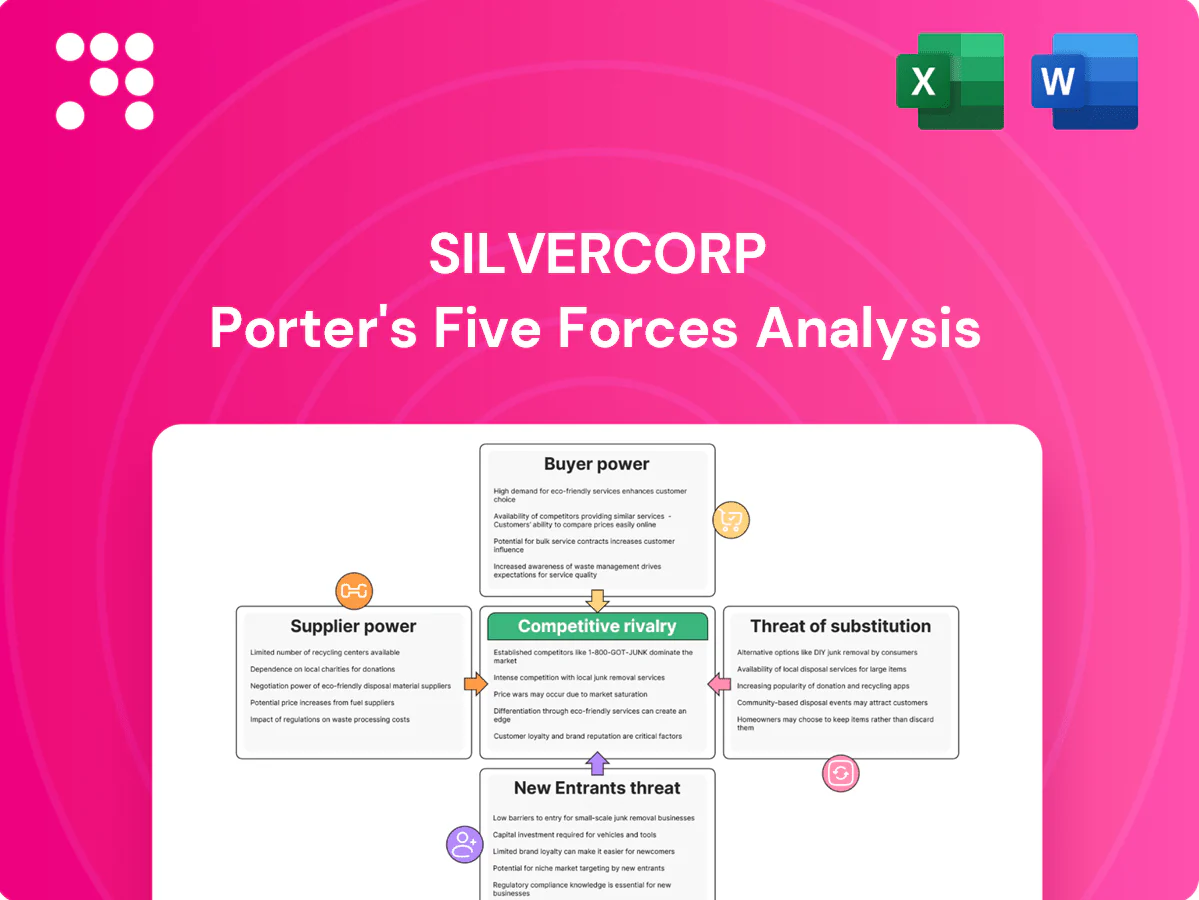
Silvercorp Porter's Five Forces Analysis

From Overview to Strategy Blueprint
Silvercorp's Porter’s Five Forces snapshot highlights moderate supplier leverage, fragmented buyer power, high rivalry among junior miners, manageable threat of new entrants, and limited substitutes given silver’s industrial uses. This brief snapshot only scratches the surface. Unlock the full Porter's Five Forces Analysis to explore Silvercorp’s competitive dynamics, market pressures, and strategic advantages in detail.
Suppliers Bargaining Power

Concentrated critical input vendors
Mining relies on a narrow set of suppliers for explosives, reagents and specialized equipment, allowing major providers such as Orica and MAXAM to exert pricing leverage. OEM parts and proprietary chemical specs limit switching without downtime risk, with specialized part lead times commonly exceeding 12 weeks. Silvercorp can multi-source many consumables, but long lead times and supplier concentration sustain bargaining power despite China proximity.
Energy and power dependencies
Electricity (~0.10 USD/kWh in China, 2024) and diesel (~1.20 USD/L, 2024) materially affect Silvercorp’s cash cost per tonne, with energy often driving double‑digit percent swings in unit costs; local utilities and fuel distributors can pass through price changes, tightening margins. Long‑term tariffs and fuel hedges provide partial relief but typically cover only a portion of exposure. Outages or rationing confer non‑price leverage to suppliers, forcing costly production interruptions.

Skilled labor and contractors
Underground mining for Silvercorp depends on experienced geologists, miners and maintenance crews, and tight local labor markets in 2024 pushed mining wages up roughly 8% year‑over‑year, increasing supplier power of labor. Retention bonuses and signing premiums rose, elevating operating cost pressure and bargaining leverage. Training pipelines (apprenticeships, local colleges) reduce but do not remove scarcity, and contractor substitution raises safety and productivity risks.

Regulatory and land-use permissions
Government agencies function as quasi-suppliers for Silvercorp by controlling permits, licenses and land access; timing and compliance requirements create direct cost burdens and schedule risk that affect project NPV and cash flow. Authorities exert indirect pricing and non-price power through conditional approvals, environmental offsets and operational constraints. A strong compliance record eases renewals but does not eliminate exposure to permit changes or political shifts.
- Regulatory control: permits/licences drive schedule risk
- Cost impact: compliance and mitigation increase CAPEX/OPEX
- Leverage: authorities impose non-price constraints
- Mitigation: strong compliance reduces but cannot remove permit exposure
Technology and aftermarket services
- Vendor lock-in: proprietary parts and software
- SLAs: 98–99% uptime common
- Switching cost: high for retrofit projects
- Multi-year deals: mitigate but not remove leverage
Supplier leverage high: long lead times, diesel 1.20 USD/L, labor +8%
Supplier power for Silvercorp is moderate‑high: concentrated explosives/OEMs, long lead times (>12 weeks) and vendor lock‑in raise switching costs; energy (0.10 USD/kWh, diesel 1.20 USD/L in 2024) and labor (+8% YoY in 2024) drive cash‑cost volatility; regulators add non‑price leverage via permits; multi‑year contracts mitigate but do not eliminate leverage.
| Metric | 2024 Value |
|---|---|
| Electricity | 0.10 USD/kWh |
| Diesel | 1.20 USD/L |
| Lead times | >12 weeks |
| Labor inflation | +8% YoY |
What is included in the product
 Detailed Word Document
Concise Porter's Five Forces assessment of Silvercorp that evaluates competitive rivalry, supplier and buyer power, threat of substitutes and new entrants, and highlights disruptive risks, pricing pressures, and strategic levers to protect margins and market position.

 Customizable Excel Spreadsheet
Clear, one-sheet Porter's Five Forces for Silvercorp—instantly visualizes competitive pressure with a spider chart and customizable intensity levels so teams can quickly assess threats and opportunities without complex tools.
Customers Bargaining Power

Limited pool of domestic smelters
Silvercorp sells silver, lead and zinc concentrates into a concentrated pool of Chinese smelters, giving buyers leverage to demand tighter TC/RCs and tougher commercial terms. Volume commitments mitigate but do not eliminate risk because alternative smelting capacity is often distant or capacity-constrained. Quality differentials in concentrates further strengthen buyer negotiating power, especially for higher-grade material.
Price transparency to global benchmarks
Silvercorp’s realized prices are constrained by global benchmark linkage—silver averaged about $26.5/oz in 2024—so the company has limited pricing discretion versus spot moves.
Smelters routinely index contracts to LME/Shanghai benchmarks and dynamically adjust tolling charges (TC/RC), passing volatility to miners.
That mechanism compresses margins in weak cycles and caps upside through preset formulaic settlements.

Stringent quality and penalty regimes
Impurity penalties and moisture adjustments are standardized and strictly enforced, often reducing payable metal value by more than 5%, and buyers exploit assay disputes and sampling protocols to press charges and adjustments. Achieving premium specs cuts this leverage but typically requires process-control capex of several million USD and tighter QA; freight and FOB versus delivered terms (shifting cost/risk) provide additional negotiating levers for purchasers.

Alternatives and blending options
Smelters can blend concentrates from multiple mines to optimize feed, giving buyers flexibility that lowers their reliance on any single supplier. This optionality forces Silvercorp to maintain reliable delivery and consistent grades to stay preferred; even short-term disruptions or grade variability can prompt rapid reallocation of smelter capacity. Loss of preferred status reduces pricing leverage and contract stability.
- Blending reduces supplier dependence
- Consistent grades and on-time delivery are critical
- Disruptions can quickly shift allocations
Contract tenor and working capital
Shorter contract tenors let buyers reprice metal deliveries frequently, increasing Silvercorp’s working capital strain as provisional pricing and extended payment terms can delay cash realization; with silver spot around $30/oz in mid-2024, price moves materially affect cash flow. Prepayments or floor-price clauses materially reduce buyer leverage but are difficult to secure; consistent production performance improves bargaining leverage over time.
- Shorter tenors = higher repricing frequency
- Provisional pricing/payment terms affect cash conversion
- Prepayments/floor clauses lower buyer power but rare
- Track record strengthens terms over time
Chinese smelter concentration tightens TC/RCs; $26.5 avg silver
Buyers hold strong leverage due to concentration of Chinese smelters, driving tighter TC/RCs and strict assay/penalty enforcement. Silver averaged $26.5/oz in 2024, limiting Silvercorp’s pricing discretion versus spot volatility (~$30/oz mid‑2024). Impurity penalties commonly exceed 5% and shorter contract tenors raise provisional pricing and working capital strain.
| Metric | 2024/ mid‑2024 |
|---|---|
| Silver price (avg) | $26.5/oz |
| Silver spot (mid‑2024) | $30/oz |
| Typical impurity penalties | >5% |
Full Version Awaits
Silvercorp Porter's Five Forces Analysis
This preview shows the exact Silvercorp Porter’s Five Forces Analysis you’ll receive after purchase—fully written, formatted, and ready to use. No placeholders or samples; the file available for instant download is precisely this document, complete and professional for immediate application.

From Overview to Strategy Blueprint
Silvercorp's Porter’s Five Forces snapshot highlights moderate supplier leverage, fragmented buyer power, high rivalry among junior miners, manageable threat of new entrants, and limited substitutes given silver’s industrial uses. This brief snapshot only scratches the surface. Unlock the full Porter's Five Forces Analysis to explore Silvercorp’s competitive dynamics, market pressures, and strategic advantages in detail.
Suppliers Bargaining Power
Concentrated critical input vendors
Mining relies on a narrow set of suppliers for explosives, reagents and specialized equipment, allowing major providers such as Orica and MAXAM to exert pricing leverage. OEM parts and proprietary chemical specs limit switching without downtime risk, with specialized part lead times commonly exceeding 12 weeks. Silvercorp can multi-source many consumables, but long lead times and supplier concentration sustain bargaining power despite China proximity.
Energy and power dependencies
Electricity (~0.10 USD/kWh in China, 2024) and diesel (~1.20 USD/L, 2024) materially affect Silvercorp’s cash cost per tonne, with energy often driving double‑digit percent swings in unit costs; local utilities and fuel distributors can pass through price changes, tightening margins. Long‑term tariffs and fuel hedges provide partial relief but typically cover only a portion of exposure. Outages or rationing confer non‑price leverage to suppliers, forcing costly production interruptions.
Skilled labor and contractors
Underground mining for Silvercorp depends on experienced geologists, miners and maintenance crews, and tight local labor markets in 2024 pushed mining wages up roughly 8% year‑over‑year, increasing supplier power of labor. Retention bonuses and signing premiums rose, elevating operating cost pressure and bargaining leverage. Training pipelines (apprenticeships, local colleges) reduce but do not remove scarcity, and contractor substitution raises safety and productivity risks.
Regulatory and land-use permissions
Government agencies function as quasi-suppliers for Silvercorp by controlling permits, licenses and land access; timing and compliance requirements create direct cost burdens and schedule risk that affect project NPV and cash flow. Authorities exert indirect pricing and non-price power through conditional approvals, environmental offsets and operational constraints. A strong compliance record eases renewals but does not eliminate exposure to permit changes or political shifts.
- Regulatory control: permits/licences drive schedule risk
- Cost impact: compliance and mitigation increase CAPEX/OPEX
- Leverage: authorities impose non-price constraints
- Mitigation: strong compliance reduces but cannot remove permit exposure
Technology and aftermarket services
- Vendor lock-in: proprietary parts and software
- SLAs: 98–99% uptime common
- Switching cost: high for retrofit projects
- Multi-year deals: mitigate but not remove leverage
Supplier leverage high: long lead times, diesel 1.20 USD/L, labor +8%
Supplier power for Silvercorp is moderate‑high: concentrated explosives/OEMs, long lead times (>12 weeks) and vendor lock‑in raise switching costs; energy (0.10 USD/kWh, diesel 1.20 USD/L in 2024) and labor (+8% YoY in 2024) drive cash‑cost volatility; regulators add non‑price leverage via permits; multi‑year contracts mitigate but do not eliminate leverage.
| Metric | 2024 Value |
|---|---|
| Electricity | 0.10 USD/kWh |
| Diesel | 1.20 USD/L |
| Lead times | >12 weeks |
| Labor inflation | +8% YoY |
What is included in the product
Detailed Word Document
Concise Porter's Five Forces assessment of Silvercorp that evaluates competitive rivalry, supplier and buyer power, threat of substitutes and new entrants, and highlights disruptive risks, pricing pressures, and strategic levers to protect margins and market position.
Customizable Excel Spreadsheet
Clear, one-sheet Porter's Five Forces for Silvercorp—instantly visualizes competitive pressure with a spider chart and customizable intensity levels so teams can quickly assess threats and opportunities without complex tools.
Customers Bargaining Power
Limited pool of domestic smelters
Silvercorp sells silver, lead and zinc concentrates into a concentrated pool of Chinese smelters, giving buyers leverage to demand tighter TC/RCs and tougher commercial terms. Volume commitments mitigate but do not eliminate risk because alternative smelting capacity is often distant or capacity-constrained. Quality differentials in concentrates further strengthen buyer negotiating power, especially for higher-grade material.
Price transparency to global benchmarks
Silvercorp’s realized prices are constrained by global benchmark linkage—silver averaged about $26.5/oz in 2024—so the company has limited pricing discretion versus spot moves.
Smelters routinely index contracts to LME/Shanghai benchmarks and dynamically adjust tolling charges (TC/RC), passing volatility to miners.
That mechanism compresses margins in weak cycles and caps upside through preset formulaic settlements.
Stringent quality and penalty regimes
Impurity penalties and moisture adjustments are standardized and strictly enforced, often reducing payable metal value by more than 5%, and buyers exploit assay disputes and sampling protocols to press charges and adjustments. Achieving premium specs cuts this leverage but typically requires process-control capex of several million USD and tighter QA; freight and FOB versus delivered terms (shifting cost/risk) provide additional negotiating levers for purchasers.
Alternatives and blending options
Smelters can blend concentrates from multiple mines to optimize feed, giving buyers flexibility that lowers their reliance on any single supplier. This optionality forces Silvercorp to maintain reliable delivery and consistent grades to stay preferred; even short-term disruptions or grade variability can prompt rapid reallocation of smelter capacity. Loss of preferred status reduces pricing leverage and contract stability.
- Blending reduces supplier dependence
- Consistent grades and on-time delivery are critical
- Disruptions can quickly shift allocations
Contract tenor and working capital
Shorter contract tenors let buyers reprice metal deliveries frequently, increasing Silvercorp’s working capital strain as provisional pricing and extended payment terms can delay cash realization; with silver spot around $30/oz in mid-2024, price moves materially affect cash flow. Prepayments or floor-price clauses materially reduce buyer leverage but are difficult to secure; consistent production performance improves bargaining leverage over time.
- Shorter tenors = higher repricing frequency
- Provisional pricing/payment terms affect cash conversion
- Prepayments/floor clauses lower buyer power but rare
- Track record strengthens terms over time
Chinese smelter concentration tightens TC/RCs; $26.5 avg silver
Buyers hold strong leverage due to concentration of Chinese smelters, driving tighter TC/RCs and strict assay/penalty enforcement. Silver averaged $26.5/oz in 2024, limiting Silvercorp’s pricing discretion versus spot volatility (~$30/oz mid‑2024). Impurity penalties commonly exceed 5% and shorter contract tenors raise provisional pricing and working capital strain.
| Metric | 2024/ mid‑2024 |
|---|---|
| Silver price (avg) | $26.5/oz |
| Silver spot (mid‑2024) | $30/oz |
| Typical impurity penalties | >5% |
Full Version Awaits
Silvercorp Porter's Five Forces Analysis
This preview shows the exact Silvercorp Porter’s Five Forces Analysis you’ll receive after purchase—fully written, formatted, and ready to use. No placeholders or samples; the file available for instant download is precisely this document, complete and professional for immediate application.
Original: $10.00
-65%$10.00
$3.50Description
From Overview to Strategy Blueprint
Silvercorp's Porter’s Five Forces snapshot highlights moderate supplier leverage, fragmented buyer power, high rivalry among junior miners, manageable threat of new entrants, and limited substitutes given silver’s industrial uses. This brief snapshot only scratches the surface. Unlock the full Porter's Five Forces Analysis to explore Silvercorp’s competitive dynamics, market pressures, and strategic advantages in detail.
Suppliers Bargaining Power
Concentrated critical input vendors
Mining relies on a narrow set of suppliers for explosives, reagents and specialized equipment, allowing major providers such as Orica and MAXAM to exert pricing leverage. OEM parts and proprietary chemical specs limit switching without downtime risk, with specialized part lead times commonly exceeding 12 weeks. Silvercorp can multi-source many consumables, but long lead times and supplier concentration sustain bargaining power despite China proximity.
Energy and power dependencies
Electricity (~0.10 USD/kWh in China, 2024) and diesel (~1.20 USD/L, 2024) materially affect Silvercorp’s cash cost per tonne, with energy often driving double‑digit percent swings in unit costs; local utilities and fuel distributors can pass through price changes, tightening margins. Long‑term tariffs and fuel hedges provide partial relief but typically cover only a portion of exposure. Outages or rationing confer non‑price leverage to suppliers, forcing costly production interruptions.
Skilled labor and contractors
Underground mining for Silvercorp depends on experienced geologists, miners and maintenance crews, and tight local labor markets in 2024 pushed mining wages up roughly 8% year‑over‑year, increasing supplier power of labor. Retention bonuses and signing premiums rose, elevating operating cost pressure and bargaining leverage. Training pipelines (apprenticeships, local colleges) reduce but do not remove scarcity, and contractor substitution raises safety and productivity risks.
Regulatory and land-use permissions
Government agencies function as quasi-suppliers for Silvercorp by controlling permits, licenses and land access; timing and compliance requirements create direct cost burdens and schedule risk that affect project NPV and cash flow. Authorities exert indirect pricing and non-price power through conditional approvals, environmental offsets and operational constraints. A strong compliance record eases renewals but does not eliminate exposure to permit changes or political shifts.
- Regulatory control: permits/licences drive schedule risk
- Cost impact: compliance and mitigation increase CAPEX/OPEX
- Leverage: authorities impose non-price constraints
- Mitigation: strong compliance reduces but cannot remove permit exposure
Technology and aftermarket services
- Vendor lock-in: proprietary parts and software
- SLAs: 98–99% uptime common
- Switching cost: high for retrofit projects
- Multi-year deals: mitigate but not remove leverage
Supplier leverage high: long lead times, diesel 1.20 USD/L, labor +8%
Supplier power for Silvercorp is moderate‑high: concentrated explosives/OEMs, long lead times (>12 weeks) and vendor lock‑in raise switching costs; energy (0.10 USD/kWh, diesel 1.20 USD/L in 2024) and labor (+8% YoY in 2024) drive cash‑cost volatility; regulators add non‑price leverage via permits; multi‑year contracts mitigate but do not eliminate leverage.
| Metric | 2024 Value |
|---|---|
| Electricity | 0.10 USD/kWh |
| Diesel | 1.20 USD/L |
| Lead times | >12 weeks |
| Labor inflation | +8% YoY |
What is included in the product
Detailed Word Document
Concise Porter's Five Forces assessment of Silvercorp that evaluates competitive rivalry, supplier and buyer power, threat of substitutes and new entrants, and highlights disruptive risks, pricing pressures, and strategic levers to protect margins and market position.
Customizable Excel Spreadsheet
Clear, one-sheet Porter's Five Forces for Silvercorp—instantly visualizes competitive pressure with a spider chart and customizable intensity levels so teams can quickly assess threats and opportunities without complex tools.
Customers Bargaining Power
Limited pool of domestic smelters
Silvercorp sells silver, lead and zinc concentrates into a concentrated pool of Chinese smelters, giving buyers leverage to demand tighter TC/RCs and tougher commercial terms. Volume commitments mitigate but do not eliminate risk because alternative smelting capacity is often distant or capacity-constrained. Quality differentials in concentrates further strengthen buyer negotiating power, especially for higher-grade material.
Price transparency to global benchmarks
Silvercorp’s realized prices are constrained by global benchmark linkage—silver averaged about $26.5/oz in 2024—so the company has limited pricing discretion versus spot moves.
Smelters routinely index contracts to LME/Shanghai benchmarks and dynamically adjust tolling charges (TC/RC), passing volatility to miners.
That mechanism compresses margins in weak cycles and caps upside through preset formulaic settlements.
Stringent quality and penalty regimes
Impurity penalties and moisture adjustments are standardized and strictly enforced, often reducing payable metal value by more than 5%, and buyers exploit assay disputes and sampling protocols to press charges and adjustments. Achieving premium specs cuts this leverage but typically requires process-control capex of several million USD and tighter QA; freight and FOB versus delivered terms (shifting cost/risk) provide additional negotiating levers for purchasers.
Alternatives and blending options
Smelters can blend concentrates from multiple mines to optimize feed, giving buyers flexibility that lowers their reliance on any single supplier. This optionality forces Silvercorp to maintain reliable delivery and consistent grades to stay preferred; even short-term disruptions or grade variability can prompt rapid reallocation of smelter capacity. Loss of preferred status reduces pricing leverage and contract stability.
- Blending reduces supplier dependence
- Consistent grades and on-time delivery are critical
- Disruptions can quickly shift allocations
Contract tenor and working capital
Shorter contract tenors let buyers reprice metal deliveries frequently, increasing Silvercorp’s working capital strain as provisional pricing and extended payment terms can delay cash realization; with silver spot around $30/oz in mid-2024, price moves materially affect cash flow. Prepayments or floor-price clauses materially reduce buyer leverage but are difficult to secure; consistent production performance improves bargaining leverage over time.
- Shorter tenors = higher repricing frequency
- Provisional pricing/payment terms affect cash conversion
- Prepayments/floor clauses lower buyer power but rare
- Track record strengthens terms over time
Chinese smelter concentration tightens TC/RCs; $26.5 avg silver
Buyers hold strong leverage due to concentration of Chinese smelters, driving tighter TC/RCs and strict assay/penalty enforcement. Silver averaged $26.5/oz in 2024, limiting Silvercorp’s pricing discretion versus spot volatility (~$30/oz mid‑2024). Impurity penalties commonly exceed 5% and shorter contract tenors raise provisional pricing and working capital strain.
| Metric | 2024/ mid‑2024 |
|---|---|
| Silver price (avg) | $26.5/oz |
| Silver spot (mid‑2024) | $30/oz |
| Typical impurity penalties | >5% |
Full Version Awaits
Silvercorp Porter's Five Forces Analysis
This preview shows the exact Silvercorp Porter’s Five Forces Analysis you’ll receive after purchase—fully written, formatted, and ready to use. No placeholders or samples; the file available for instant download is precisely this document, complete and professional for immediate application.











