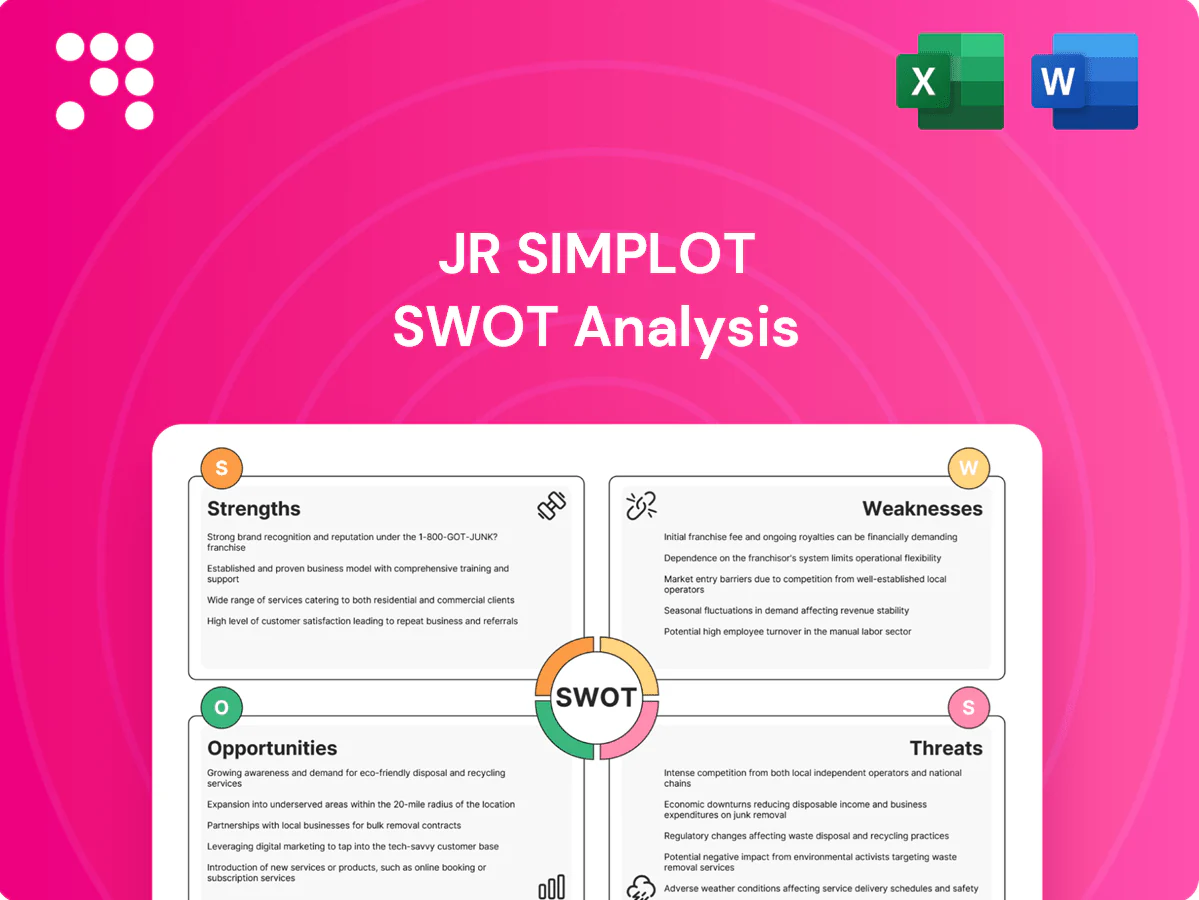
JR Simplot SWOT Analysis

Your Strategic Toolkit Starts Here
JR Simplot’s SWOT analysis highlights its strong agricultural legacy, diversified fertilizer and food ingredient portfolio, and integrated supply chain, while noting exposure to commodity cycles, regulatory pressures, and climate risks. Want the full strategic picture with data-driven recommendations? Purchase the complete SWOT for a professionally formatted Word report and editable Excel tools to plan, pitch, or invest with confidence.
Strengths

Integrated agribusiness value chain
JR Simplot’s integrated agribusiness spans seed development, farming support, processing and distribution, creating end-to-end control that underpins operational consistency; the privately held company reported roughly $6.5 billion in revenue in 2023. Vertical integration reduces transaction costs and stabilizes quality, improving responsiveness to supply shocks and demand shifts. This structure captures margins across multiple stages of the value chain, strengthening margin resilience.
Global leader in frozen potato products
JR Simplot is a top global supplier of fries and frozen potato products, supplying major QSRs including McDonald’s (a supplier since 1955), with scale that drives cost advantages, high plant utilization and strong buyer stickiness; long-term contracts underpin predictable volumes, while brand-equivalent quality and food-safety standards protect market share.

Diversified portfolio across inputs and proteins
Exposure to phosphate mining, fertilizers and cattle feeding balances Simplot’s revenue, supporting an estimated $6.4 billion in annual sales (Forbes 2024). Cross-business synergies—fertilizer margins offset cyclical ag swings—help stabilize earnings. Fertilizer and feed operations supply core grower customers, enhancing retention. Turf and horticulture serve niche, higher‑margin channels.

Operational excellence and agronomic R&D
With 90+ years since its 1929 founding, JR Simplot leverages deep agronomy expertise and processing know-how to drive higher yields and plant throughput. Proprietary potato varieties and processing innovations improve product performance and operational efficiency. Data-driven agronomic support strengthens grower loyalty, and a culture of continuous improvement steadily compresses unit costs.
- 90+ years of agronomy and processing experience
- Proprietary varieties and process IP boosting efficiency
- Data-driven grower support enhancing loyalty
- Continuous improvement lowering unit costs
Private ownership and long-term orientation
As a privately held firm, JR Simplot prioritizes multi-year investments without quarterly earnings pressure, enabling capacity expansions and long-term sustainability projects that align with its integrated agribusiness model. Strategic patience strengthens partnerships with growers and major customers by supporting multi-season contracts and technology adoption. Private capital flexibility also permits countercyclical deployment to acquire assets or expand processing during downturns.
- Private ownership: long-term capital planning
- Supports multi-year capacity & sustainability projects
- Deep grower/customer partnerships via strategic patience
- Countercyclical capital deployment capability
Vertically integrated agribusiness: $6.5B, 96 yrs
JR Simplot’s vertically integrated agribusiness drives end-to-end margin capture and supply resilience, reporting roughly $6.5B revenue in 2023 (Forbes est. $6.4B 2024); scale secures long-term contracts with major QSRs including McDonald’s (supplier since 1955). Diversified fertilizers, feed and turf operations stabilize earnings; 96 years of agronomy IP and private ownership enable multiyear capital planning.
| Metric | Value |
|---|---|
| 2023 Revenue | $6.5B |
| Forbes 2024 | $6.4B |
| Founded | 1929 (96 yrs) |
| McDonald’s supplier | Since 1955 |
What is included in the product
 Detailed Word Document
Provides a strategic overview of JR Simplot’s internal capabilities and external market forces. Identifies core strengths and weaknesses while mapping opportunities and threats that will shape the company’s competitive position and growth prospects.

 Customizable Excel Spreadsheet
Delivers a compact SWOT matrix tailored to JR Simplot for quick strategic clarity and operational focus. Easy-to-update format enables rapid alignment across supply chain and leadership teams.
Weaknesses

Commodity price and margin volatility
Potato, phosphate, energy and beef price swings compress margins for J.R. Simplot; hedging reduces but cannot eliminate exposure. Cost pass-through to QSR customers and growers often lags, widening short-term margin pressure. Earnings remain sensitive to fertilizer/ammonia and natural gas spikes—U.S. Henry Hub averaged about $2.82/MMBtu in 2024 (EIA), illustrating the energy-price linkage to input costs.
Customer concentration risk with large QSRs
J.R. Simplot derives a large portion of its potato and frozen-product volumes from a handful of global QSRs, including long-term supply relationships with McDonald’s and other major chains. Contract renewals, menu changes or vendor rationalization at these buyers can materially reduce throughput and margin. Pricing leverage is constrained when negotiating with large QSR customers. Further diversification into retail and broader foodservice channels is necessary to rebalance risk and stabilize revenue mix.

High capital intensity and environmental liabilities
Mining, fertilizer plants and processing facilities demand heavy capex often in the hundreds of millions to >$1 billion per major site, pressuring cash flow. Environmental remediation, water-use management and emissions controls add tens–hundreds of millions in compliance costs. Permitting delays can stall growth projects for years, while decommissioning obligations create long-term liabilities recorded as multi‑year provisions.

Supply chain and weather sensitivity
JR Simplot's yields are highly weather- and water-dependent; Idaho supplies roughly 30% of U.S. potatoes, so cold snaps, heat waves or droughts materially affect volumes and quality and raise crop-disease pressure. Logistics bottlenecks increase storage and freight costs, while inventory imbalances have forced industry write-downs in recent seasons.
- Weather/water sensitivity: Idaho ≈30% of U.S. potato supply
- Quality volatility: cold snaps, heat waves, droughts
- Higher logistics/storage costs: capacity constraints
- Inventory risk: seasonal write-downs
Limited transparency as a private company
As a privately held company, J.R. Simplot provides far fewer public financial disclosures, which complicates benchmarking against listed peers and can constrain access to investor-grade credit facilities; Simplot reported roughly 11,000 employees worldwide as of 2024, underscoring scale but not public transparency. Counterparties may demand higher due diligence and wider pricing spreads, and limited visibility can hinder recruiting external executive talent.
Commodity swings, QSR concentration and heavy capex compress margins
Commodity price swings (potato, phosphate, natural gas) and QSR concentration compress margins and limit pricing leverage, while heavy capex, environmental compliance and water/weather exposure (Idaho ≈30% of U.S. potato supply) create cash‑flow and operational risks. Limited public disclosures (≈11,000 employees in 2024) constrain benchmarking and capital access.
| Metric | Value |
|---|---|
| Idaho share | ≈30% |
| Employees (2024) | ≈11,000 |
| Henry Hub (2024) | $2.82/MMBtu |
| Major site capex | >$1bn |
What You See Is What You Get
JR Simplot SWOT Analysis
This is the actual JR Simplot SWOT analysis document you’ll receive upon purchase—no surprises, just professional quality. The preview below is taken directly from the full report you'll get, with the same structured, editable content. Buy now to unlock the complete, detailed version immediately after checkout.

Your Strategic Toolkit Starts Here
JR Simplot’s SWOT analysis highlights its strong agricultural legacy, diversified fertilizer and food ingredient portfolio, and integrated supply chain, while noting exposure to commodity cycles, regulatory pressures, and climate risks. Want the full strategic picture with data-driven recommendations? Purchase the complete SWOT for a professionally formatted Word report and editable Excel tools to plan, pitch, or invest with confidence.
Strengths
Integrated agribusiness value chain
JR Simplot’s integrated agribusiness spans seed development, farming support, processing and distribution, creating end-to-end control that underpins operational consistency; the privately held company reported roughly $6.5 billion in revenue in 2023. Vertical integration reduces transaction costs and stabilizes quality, improving responsiveness to supply shocks and demand shifts. This structure captures margins across multiple stages of the value chain, strengthening margin resilience.
Global leader in frozen potato products
JR Simplot is a top global supplier of fries and frozen potato products, supplying major QSRs including McDonald’s (a supplier since 1955), with scale that drives cost advantages, high plant utilization and strong buyer stickiness; long-term contracts underpin predictable volumes, while brand-equivalent quality and food-safety standards protect market share.
Diversified portfolio across inputs and proteins
Exposure to phosphate mining, fertilizers and cattle feeding balances Simplot’s revenue, supporting an estimated $6.4 billion in annual sales (Forbes 2024). Cross-business synergies—fertilizer margins offset cyclical ag swings—help stabilize earnings. Fertilizer and feed operations supply core grower customers, enhancing retention. Turf and horticulture serve niche, higher‑margin channels.
Operational excellence and agronomic R&D
With 90+ years since its 1929 founding, JR Simplot leverages deep agronomy expertise and processing know-how to drive higher yields and plant throughput. Proprietary potato varieties and processing innovations improve product performance and operational efficiency. Data-driven agronomic support strengthens grower loyalty, and a culture of continuous improvement steadily compresses unit costs.
- 90+ years of agronomy and processing experience
- Proprietary varieties and process IP boosting efficiency
- Data-driven grower support enhancing loyalty
- Continuous improvement lowering unit costs
Private ownership and long-term orientation
As a privately held firm, JR Simplot prioritizes multi-year investments without quarterly earnings pressure, enabling capacity expansions and long-term sustainability projects that align with its integrated agribusiness model. Strategic patience strengthens partnerships with growers and major customers by supporting multi-season contracts and technology adoption. Private capital flexibility also permits countercyclical deployment to acquire assets or expand processing during downturns.
- Private ownership: long-term capital planning
- Supports multi-year capacity & sustainability projects
- Deep grower/customer partnerships via strategic patience
- Countercyclical capital deployment capability
Vertically integrated agribusiness: $6.5B, 96 yrs
JR Simplot’s vertically integrated agribusiness drives end-to-end margin capture and supply resilience, reporting roughly $6.5B revenue in 2023 (Forbes est. $6.4B 2024); scale secures long-term contracts with major QSRs including McDonald’s (supplier since 1955). Diversified fertilizers, feed and turf operations stabilize earnings; 96 years of agronomy IP and private ownership enable multiyear capital planning.
| Metric | Value |
|---|---|
| 2023 Revenue | $6.5B |
| Forbes 2024 | $6.4B |
| Founded | 1929 (96 yrs) |
| McDonald’s supplier | Since 1955 |
What is included in the product
Detailed Word Document
Provides a strategic overview of JR Simplot’s internal capabilities and external market forces. Identifies core strengths and weaknesses while mapping opportunities and threats that will shape the company’s competitive position and growth prospects.
Customizable Excel Spreadsheet
Delivers a compact SWOT matrix tailored to JR Simplot for quick strategic clarity and operational focus. Easy-to-update format enables rapid alignment across supply chain and leadership teams.
Weaknesses
Commodity price and margin volatility
Potato, phosphate, energy and beef price swings compress margins for J.R. Simplot; hedging reduces but cannot eliminate exposure. Cost pass-through to QSR customers and growers often lags, widening short-term margin pressure. Earnings remain sensitive to fertilizer/ammonia and natural gas spikes—U.S. Henry Hub averaged about $2.82/MMBtu in 2024 (EIA), illustrating the energy-price linkage to input costs.
Customer concentration risk with large QSRs
J.R. Simplot derives a large portion of its potato and frozen-product volumes from a handful of global QSRs, including long-term supply relationships with McDonald’s and other major chains. Contract renewals, menu changes or vendor rationalization at these buyers can materially reduce throughput and margin. Pricing leverage is constrained when negotiating with large QSR customers. Further diversification into retail and broader foodservice channels is necessary to rebalance risk and stabilize revenue mix.
High capital intensity and environmental liabilities
Mining, fertilizer plants and processing facilities demand heavy capex often in the hundreds of millions to >$1 billion per major site, pressuring cash flow. Environmental remediation, water-use management and emissions controls add tens–hundreds of millions in compliance costs. Permitting delays can stall growth projects for years, while decommissioning obligations create long-term liabilities recorded as multi‑year provisions.
Supply chain and weather sensitivity
JR Simplot's yields are highly weather- and water-dependent; Idaho supplies roughly 30% of U.S. potatoes, so cold snaps, heat waves or droughts materially affect volumes and quality and raise crop-disease pressure. Logistics bottlenecks increase storage and freight costs, while inventory imbalances have forced industry write-downs in recent seasons.
- Weather/water sensitivity: Idaho ≈30% of U.S. potato supply
- Quality volatility: cold snaps, heat waves, droughts
- Higher logistics/storage costs: capacity constraints
- Inventory risk: seasonal write-downs
Limited transparency as a private company
As a privately held company, J.R. Simplot provides far fewer public financial disclosures, which complicates benchmarking against listed peers and can constrain access to investor-grade credit facilities; Simplot reported roughly 11,000 employees worldwide as of 2024, underscoring scale but not public transparency. Counterparties may demand higher due diligence and wider pricing spreads, and limited visibility can hinder recruiting external executive talent.
Commodity swings, QSR concentration and heavy capex compress margins
Commodity price swings (potato, phosphate, natural gas) and QSR concentration compress margins and limit pricing leverage, while heavy capex, environmental compliance and water/weather exposure (Idaho ≈30% of U.S. potato supply) create cash‑flow and operational risks. Limited public disclosures (≈11,000 employees in 2024) constrain benchmarking and capital access.
| Metric | Value |
|---|---|
| Idaho share | ≈30% |
| Employees (2024) | ≈11,000 |
| Henry Hub (2024) | $2.82/MMBtu |
| Major site capex | >$1bn |
What You See Is What You Get
JR Simplot SWOT Analysis
This is the actual JR Simplot SWOT analysis document you’ll receive upon purchase—no surprises, just professional quality. The preview below is taken directly from the full report you'll get, with the same structured, editable content. Buy now to unlock the complete, detailed version immediately after checkout.
Original: $10.00
-65%$10.00
$3.50Description
Your Strategic Toolkit Starts Here
JR Simplot’s SWOT analysis highlights its strong agricultural legacy, diversified fertilizer and food ingredient portfolio, and integrated supply chain, while noting exposure to commodity cycles, regulatory pressures, and climate risks. Want the full strategic picture with data-driven recommendations? Purchase the complete SWOT for a professionally formatted Word report and editable Excel tools to plan, pitch, or invest with confidence.
Strengths
Integrated agribusiness value chain
JR Simplot’s integrated agribusiness spans seed development, farming support, processing and distribution, creating end-to-end control that underpins operational consistency; the privately held company reported roughly $6.5 billion in revenue in 2023. Vertical integration reduces transaction costs and stabilizes quality, improving responsiveness to supply shocks and demand shifts. This structure captures margins across multiple stages of the value chain, strengthening margin resilience.
Global leader in frozen potato products
JR Simplot is a top global supplier of fries and frozen potato products, supplying major QSRs including McDonald’s (a supplier since 1955), with scale that drives cost advantages, high plant utilization and strong buyer stickiness; long-term contracts underpin predictable volumes, while brand-equivalent quality and food-safety standards protect market share.
Diversified portfolio across inputs and proteins
Exposure to phosphate mining, fertilizers and cattle feeding balances Simplot’s revenue, supporting an estimated $6.4 billion in annual sales (Forbes 2024). Cross-business synergies—fertilizer margins offset cyclical ag swings—help stabilize earnings. Fertilizer and feed operations supply core grower customers, enhancing retention. Turf and horticulture serve niche, higher‑margin channels.
Operational excellence and agronomic R&D
With 90+ years since its 1929 founding, JR Simplot leverages deep agronomy expertise and processing know-how to drive higher yields and plant throughput. Proprietary potato varieties and processing innovations improve product performance and operational efficiency. Data-driven agronomic support strengthens grower loyalty, and a culture of continuous improvement steadily compresses unit costs.
- 90+ years of agronomy and processing experience
- Proprietary varieties and process IP boosting efficiency
- Data-driven grower support enhancing loyalty
- Continuous improvement lowering unit costs
Private ownership and long-term orientation
As a privately held firm, JR Simplot prioritizes multi-year investments without quarterly earnings pressure, enabling capacity expansions and long-term sustainability projects that align with its integrated agribusiness model. Strategic patience strengthens partnerships with growers and major customers by supporting multi-season contracts and technology adoption. Private capital flexibility also permits countercyclical deployment to acquire assets or expand processing during downturns.
- Private ownership: long-term capital planning
- Supports multi-year capacity & sustainability projects
- Deep grower/customer partnerships via strategic patience
- Countercyclical capital deployment capability
Vertically integrated agribusiness: $6.5B, 96 yrs
JR Simplot’s vertically integrated agribusiness drives end-to-end margin capture and supply resilience, reporting roughly $6.5B revenue in 2023 (Forbes est. $6.4B 2024); scale secures long-term contracts with major QSRs including McDonald’s (supplier since 1955). Diversified fertilizers, feed and turf operations stabilize earnings; 96 years of agronomy IP and private ownership enable multiyear capital planning.
| Metric | Value |
|---|---|
| 2023 Revenue | $6.5B |
| Forbes 2024 | $6.4B |
| Founded | 1929 (96 yrs) |
| McDonald’s supplier | Since 1955 |
What is included in the product
Detailed Word Document
Provides a strategic overview of JR Simplot’s internal capabilities and external market forces. Identifies core strengths and weaknesses while mapping opportunities and threats that will shape the company’s competitive position and growth prospects.
Customizable Excel Spreadsheet
Delivers a compact SWOT matrix tailored to JR Simplot for quick strategic clarity and operational focus. Easy-to-update format enables rapid alignment across supply chain and leadership teams.
Weaknesses
Commodity price and margin volatility
Potato, phosphate, energy and beef price swings compress margins for J.R. Simplot; hedging reduces but cannot eliminate exposure. Cost pass-through to QSR customers and growers often lags, widening short-term margin pressure. Earnings remain sensitive to fertilizer/ammonia and natural gas spikes—U.S. Henry Hub averaged about $2.82/MMBtu in 2024 (EIA), illustrating the energy-price linkage to input costs.
Customer concentration risk with large QSRs
J.R. Simplot derives a large portion of its potato and frozen-product volumes from a handful of global QSRs, including long-term supply relationships with McDonald’s and other major chains. Contract renewals, menu changes or vendor rationalization at these buyers can materially reduce throughput and margin. Pricing leverage is constrained when negotiating with large QSR customers. Further diversification into retail and broader foodservice channels is necessary to rebalance risk and stabilize revenue mix.
High capital intensity and environmental liabilities
Mining, fertilizer plants and processing facilities demand heavy capex often in the hundreds of millions to >$1 billion per major site, pressuring cash flow. Environmental remediation, water-use management and emissions controls add tens–hundreds of millions in compliance costs. Permitting delays can stall growth projects for years, while decommissioning obligations create long-term liabilities recorded as multi‑year provisions.
Supply chain and weather sensitivity
JR Simplot's yields are highly weather- and water-dependent; Idaho supplies roughly 30% of U.S. potatoes, so cold snaps, heat waves or droughts materially affect volumes and quality and raise crop-disease pressure. Logistics bottlenecks increase storage and freight costs, while inventory imbalances have forced industry write-downs in recent seasons.
- Weather/water sensitivity: Idaho ≈30% of U.S. potato supply
- Quality volatility: cold snaps, heat waves, droughts
- Higher logistics/storage costs: capacity constraints
- Inventory risk: seasonal write-downs
Limited transparency as a private company
As a privately held company, J.R. Simplot provides far fewer public financial disclosures, which complicates benchmarking against listed peers and can constrain access to investor-grade credit facilities; Simplot reported roughly 11,000 employees worldwide as of 2024, underscoring scale but not public transparency. Counterparties may demand higher due diligence and wider pricing spreads, and limited visibility can hinder recruiting external executive talent.
Commodity swings, QSR concentration and heavy capex compress margins
Commodity price swings (potato, phosphate, natural gas) and QSR concentration compress margins and limit pricing leverage, while heavy capex, environmental compliance and water/weather exposure (Idaho ≈30% of U.S. potato supply) create cash‑flow and operational risks. Limited public disclosures (≈11,000 employees in 2024) constrain benchmarking and capital access.
| Metric | Value |
|---|---|
| Idaho share | ≈30% |
| Employees (2024) | ≈11,000 |
| Henry Hub (2024) | $2.82/MMBtu |
| Major site capex | >$1bn |
What You See Is What You Get
JR Simplot SWOT Analysis
This is the actual JR Simplot SWOT analysis document you’ll receive upon purchase—no surprises, just professional quality. The preview below is taken directly from the full report you'll get, with the same structured, editable content. Buy now to unlock the complete, detailed version immediately after checkout.











