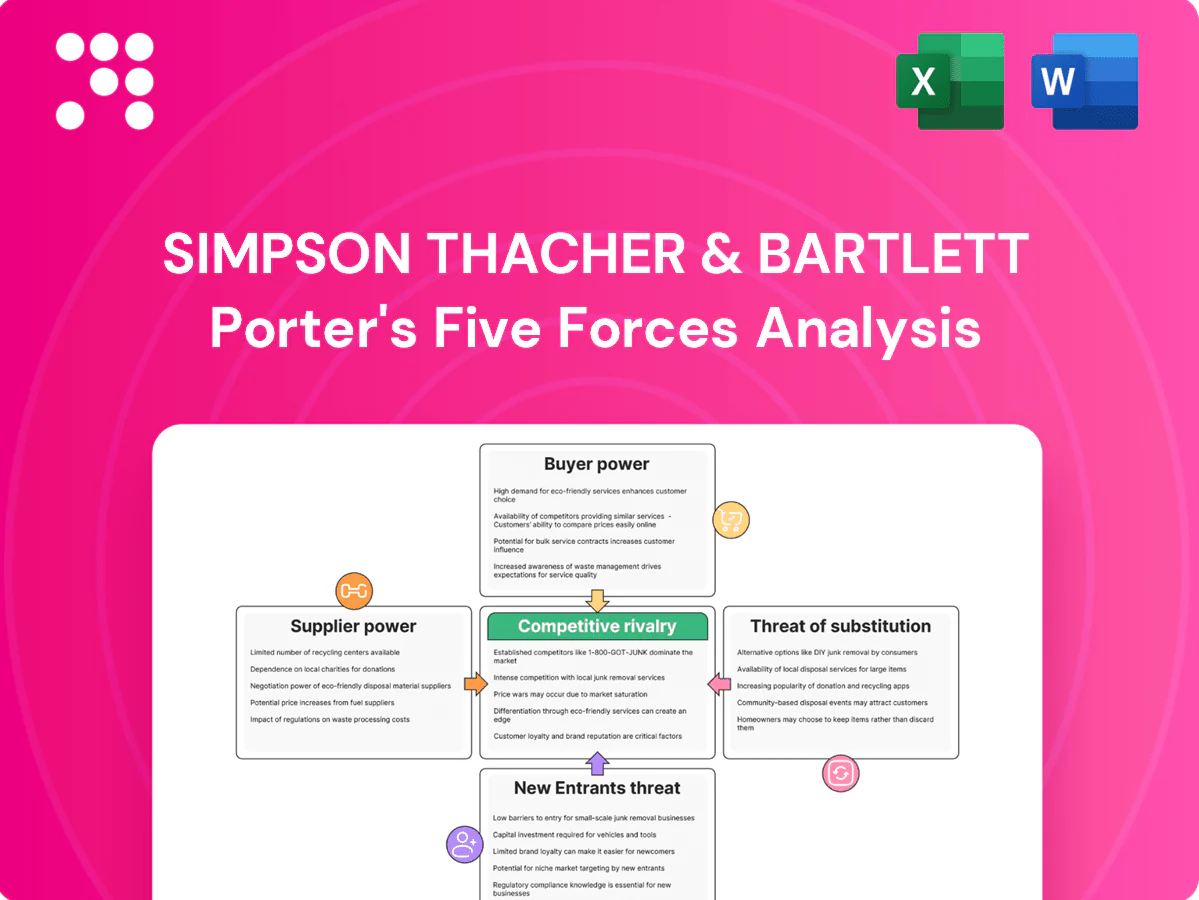
Simpson Thacher & Bartlett Porter's Five Forces Analysis

Don't Miss the Bigger Picture
Simpson Thacher & Bartlett's Porter's Five Forces Analysis highlights intense buyer bargaining, high barriers to entry, moderate supplier influence, limited substitute threats, and fierce rivalry driven by elite deal flow. This snapshot surfaces strategic pressure points and potential growth levers. Unlock the full Porter's Five Forces Analysis to explore detailed force ratings, visuals, and actionable implications.
Suppliers Bargaining Power

Elite lawyer talent scarcity
Top-tier associates and partners are critical inputs whose supply is constrained by elite training pipelines and prestige filters; 2024 Am Law data show top firms paying total associate compensation packages exceeding $400,000, underscoring scarce premium talent. Lateral markets let those lawyers demand premium pay and favorable terms, raising Simpson Thacher’s cost base and limiting staffing flexibility. Heavy retention investments and culture programs are strategic levers to moderate this supplier power and protect margins.
Legal research and data platforms
Dependence on Westlaw, LexisNexis and specialized datasets gives suppliers leverage through price escalators and bundling, while meaningful switching costs from workflow integration and attorney training lock-in spending. Competition among providers and negotiation via enterprise contracts can temper price increases. Firmwide volume purchasing across Simpson Thacher offices provides additional, though limited, negotiating power.

Technology and AI tooling vendors
E-discovery, contract-analysis and gen-AI platforms are integral to Simpson Thacher’s delivery; a 2024 ILTA survey found 62% of law firms deploying gen-AI or automation, giving well-credentialed vendors pricing power. Interoperability and data-governance gaps raise switching frictions and compliance costs, while multi-vendor strategies and rising in-house tooling adoption (estimated +20% firm investment in 2024) partly rebalance supplier leverage.

Referral and expert networks
Specialist experts, economists, and local counsel function as niche suppliers for Simpson Thacher on complex matters, with 2024 reports noting continued scarcity of high-reputation advisors who command premium fees and scheduling priority. Conflicts of interest and calendar constraints raise dependence in high-stakes litigation and transactions. Building deep benches and preferred panels reduces exposure and procurement friction.
- Specialists: niche supply, premium fees
- Availability: conflicts increase dependence
- Mitigation: preferred panels, deep benches
Prime real estate and support services
Prime office locations and premium support services remain critical for client perception and talent retention; top trophy assets command a measurable premium, and major landlords in NYC, London and Hong Kong exert strong lease terms. Hybrid work has trimmed overall space needs but client-facing spaces retain high leverage for landlords. Portfolio optimization and long-term leases mitigate rent volatility, with law firms benchmarking real-estate costs around 30,000–40,000 USD per lawyer annually in 2024.
- Prestige locations = higher landlord leverage
- Trophy assets command premium rents
- Hybrid work lowers but does not eliminate demand for client-facing spaces
- Long leases and portfolio mix contain cost volatility
Supplier power: top-firm pay >400,000 USD, tech 62%, leases 30–40k USD
Top-tier lawyers, premium tech vendors and expert consultants exert significant supplier power: Am Law 2024 shows top-firm associate comp >400,000 USD, ILTA 2024 reports 62% gen-AI/automation adoption, and firms increased tooling spend ~20% in 2024. Lease costs remain material at 30,000–40,000 USD per lawyer annually, constraining margin flexibility; preferred panels and enterprise contracts mitigate but do not eliminate leverage.
| Supplier | 2024 Metric | Impact |
|---|---|---|
| Top lawyers | >400,000 USD comp | High wage pressure |
| Legal tech | 62% adoption; +20% spend | Pricing power, switching costs |
| Real estate | 30–40k USD/lawyer | Lease leverage |
What is included in the product
 Detailed Word Document
Tailored Porter's Five Forces analysis for Simpson Thacher & Bartlett that uncovers competitive intensity, client bargaining power, supplier influence, and threats from new entrants and substitutes, highlighting disruptive forces and protective barriers to inform strategic positioning and profitability.

 Customizable Excel Spreadsheet
A concise one-sheet Five Forces summary tailored to Simpson Thacher & Bartlett—instantly highlights competitive pressures and lets you adjust force levels for evolving legal market dynamics, no macros required and ready to drop into pitch decks or board reports.
Customers Bargaining Power

Concentrated blue-chip clients
Global corporates, PE sponsors, and banks—Simpson Thacher's concentrated blue-chip clients—are sophisticated buyers producing dozens to hundreds of matters annually, running competitive RFPs and panel reviews to pressure fees and terms. Their scale enables rate benchmarking across firms and annual procurement reviews; however, mission-critical matters such as billion-dollar deals reduce willingness to trade down on quality.
Alternative fee arrangements
Clients increasingly push for AFAs, caps and success fees to improve predictability; a 2024 BTI survey found roughly 48% of corporate clients demanded alternative pricing, shifting risk to firms and compressing margins on routine work. To preserve profitability firms must deploy data-driven scoping and matter management, including fixed-fee analytics and staffing models. Premium, bespoke matters continue to command resilient billable rates.

Switching and multi-firm strategies
In 2024 large buyers maintain diversified rosters, enabling substitution across firms and limiting individual bargaining leverage over Simpson Thacher. Panel rotations and conflict-driven reallocations periodically shift mandates away from incumbents, especially on commodity work. Relationship capital and specialized track records raise switching costs for bet-the-company matters, while consistent outcomes and service levels drive client stickiness.

In-house legal sophistication
Expanded GC teams in 2024 increasingly insource standardized tasks and unbundle matters, demanding transparency, knowledge transfer, and self-serve tools that have driven down external spend on commoditized work while preserving Simpson Thacher’s premium role on high-complexity, cross-border deals.
- Insourcing trend: 2024 corporate legal departments prioritizing in-house resourcing
- Demand: transparency, playbooks, self-serve tools
- Spend shift: reduced external fees for commoditized work
- Enduring demand: complex cross-border matters favor Simpson Thacher
Regulatory and reputational sensitivity
Clients demand flawless compliance, confidentiality, and conflict management; any perceived lapse magnifies buyer leverage to renegotiate fees or switch firms, especially in high-stakes M&A and private equity work. Robust risk controls and conflicts hygiene at Simpson Thacher serve as clear differentiators, while a trusted advisory status helps offset pure price pressure by emphasizing value over hourly rates.
- Compliance-first client demands
- Perceived lapses increase switching risk
- Risk controls as competitive moat
- Trusted advice mitigates price focus
Elite law firm sees buyer sophistication squeeze routine margins while complex deals hold premium
Simpson Thacher faces high buyer sophistication: global corporates, PE sponsors and banks run competitive RFPs and benchmark rates, yet bet-the-company deals sustain premium pricing. In 2024 roughly 48% of corporate clients demanded alternative fees, compressing margins on routine work while preserving rates on complex cross-border matters. Insourcing and panel rotations limit but do not eliminate firm leverage.
| Metric | 2024 Data |
|---|---|
| Clients demanding AFAs | 48% (BTI 2024) |
| Commodity work margin pressure | High |
Preview the Actual Deliverable
Simpson Thacher & Bartlett Porter's Five Forces Analysis
This preview shows the exact Porter’s Five Forces analysis of Simpson Thacher & Bartlett you'll receive instantly after purchase—no placeholders. The document is fully formatted, professionally written, and ready for download and use. What you see is what you get.

Don't Miss the Bigger Picture
Simpson Thacher & Bartlett's Porter's Five Forces Analysis highlights intense buyer bargaining, high barriers to entry, moderate supplier influence, limited substitute threats, and fierce rivalry driven by elite deal flow. This snapshot surfaces strategic pressure points and potential growth levers. Unlock the full Porter's Five Forces Analysis to explore detailed force ratings, visuals, and actionable implications.
Suppliers Bargaining Power
Elite lawyer talent scarcity
Top-tier associates and partners are critical inputs whose supply is constrained by elite training pipelines and prestige filters; 2024 Am Law data show top firms paying total associate compensation packages exceeding $400,000, underscoring scarce premium talent. Lateral markets let those lawyers demand premium pay and favorable terms, raising Simpson Thacher’s cost base and limiting staffing flexibility. Heavy retention investments and culture programs are strategic levers to moderate this supplier power and protect margins.
Legal research and data platforms
Dependence on Westlaw, LexisNexis and specialized datasets gives suppliers leverage through price escalators and bundling, while meaningful switching costs from workflow integration and attorney training lock-in spending. Competition among providers and negotiation via enterprise contracts can temper price increases. Firmwide volume purchasing across Simpson Thacher offices provides additional, though limited, negotiating power.
Technology and AI tooling vendors
E-discovery, contract-analysis and gen-AI platforms are integral to Simpson Thacher’s delivery; a 2024 ILTA survey found 62% of law firms deploying gen-AI or automation, giving well-credentialed vendors pricing power. Interoperability and data-governance gaps raise switching frictions and compliance costs, while multi-vendor strategies and rising in-house tooling adoption (estimated +20% firm investment in 2024) partly rebalance supplier leverage.
Referral and expert networks
Specialist experts, economists, and local counsel function as niche suppliers for Simpson Thacher on complex matters, with 2024 reports noting continued scarcity of high-reputation advisors who command premium fees and scheduling priority. Conflicts of interest and calendar constraints raise dependence in high-stakes litigation and transactions. Building deep benches and preferred panels reduces exposure and procurement friction.
- Specialists: niche supply, premium fees
- Availability: conflicts increase dependence
- Mitigation: preferred panels, deep benches
Prime real estate and support services
Prime office locations and premium support services remain critical for client perception and talent retention; top trophy assets command a measurable premium, and major landlords in NYC, London and Hong Kong exert strong lease terms. Hybrid work has trimmed overall space needs but client-facing spaces retain high leverage for landlords. Portfolio optimization and long-term leases mitigate rent volatility, with law firms benchmarking real-estate costs around 30,000–40,000 USD per lawyer annually in 2024.
- Prestige locations = higher landlord leverage
- Trophy assets command premium rents
- Hybrid work lowers but does not eliminate demand for client-facing spaces
- Long leases and portfolio mix contain cost volatility
Supplier power: top-firm pay >400,000 USD, tech 62%, leases 30–40k USD
Top-tier lawyers, premium tech vendors and expert consultants exert significant supplier power: Am Law 2024 shows top-firm associate comp >400,000 USD, ILTA 2024 reports 62% gen-AI/automation adoption, and firms increased tooling spend ~20% in 2024. Lease costs remain material at 30,000–40,000 USD per lawyer annually, constraining margin flexibility; preferred panels and enterprise contracts mitigate but do not eliminate leverage.
| Supplier | 2024 Metric | Impact |
|---|---|---|
| Top lawyers | >400,000 USD comp | High wage pressure |
| Legal tech | 62% adoption; +20% spend | Pricing power, switching costs |
| Real estate | 30–40k USD/lawyer | Lease leverage |
What is included in the product
Detailed Word Document
Tailored Porter's Five Forces analysis for Simpson Thacher & Bartlett that uncovers competitive intensity, client bargaining power, supplier influence, and threats from new entrants and substitutes, highlighting disruptive forces and protective barriers to inform strategic positioning and profitability.
Customizable Excel Spreadsheet
A concise one-sheet Five Forces summary tailored to Simpson Thacher & Bartlett—instantly highlights competitive pressures and lets you adjust force levels for evolving legal market dynamics, no macros required and ready to drop into pitch decks or board reports.
Customers Bargaining Power
Concentrated blue-chip clients
Global corporates, PE sponsors, and banks—Simpson Thacher's concentrated blue-chip clients—are sophisticated buyers producing dozens to hundreds of matters annually, running competitive RFPs and panel reviews to pressure fees and terms. Their scale enables rate benchmarking across firms and annual procurement reviews; however, mission-critical matters such as billion-dollar deals reduce willingness to trade down on quality.
Alternative fee arrangements
Clients increasingly push for AFAs, caps and success fees to improve predictability; a 2024 BTI survey found roughly 48% of corporate clients demanded alternative pricing, shifting risk to firms and compressing margins on routine work. To preserve profitability firms must deploy data-driven scoping and matter management, including fixed-fee analytics and staffing models. Premium, bespoke matters continue to command resilient billable rates.
Switching and multi-firm strategies
In 2024 large buyers maintain diversified rosters, enabling substitution across firms and limiting individual bargaining leverage over Simpson Thacher. Panel rotations and conflict-driven reallocations periodically shift mandates away from incumbents, especially on commodity work. Relationship capital and specialized track records raise switching costs for bet-the-company matters, while consistent outcomes and service levels drive client stickiness.
In-house legal sophistication
Expanded GC teams in 2024 increasingly insource standardized tasks and unbundle matters, demanding transparency, knowledge transfer, and self-serve tools that have driven down external spend on commoditized work while preserving Simpson Thacher’s premium role on high-complexity, cross-border deals.
- Insourcing trend: 2024 corporate legal departments prioritizing in-house resourcing
- Demand: transparency, playbooks, self-serve tools
- Spend shift: reduced external fees for commoditized work
- Enduring demand: complex cross-border matters favor Simpson Thacher
Regulatory and reputational sensitivity
Clients demand flawless compliance, confidentiality, and conflict management; any perceived lapse magnifies buyer leverage to renegotiate fees or switch firms, especially in high-stakes M&A and private equity work. Robust risk controls and conflicts hygiene at Simpson Thacher serve as clear differentiators, while a trusted advisory status helps offset pure price pressure by emphasizing value over hourly rates.
- Compliance-first client demands
- Perceived lapses increase switching risk
- Risk controls as competitive moat
- Trusted advice mitigates price focus
Elite law firm sees buyer sophistication squeeze routine margins while complex deals hold premium
Simpson Thacher faces high buyer sophistication: global corporates, PE sponsors and banks run competitive RFPs and benchmark rates, yet bet-the-company deals sustain premium pricing. In 2024 roughly 48% of corporate clients demanded alternative fees, compressing margins on routine work while preserving rates on complex cross-border matters. Insourcing and panel rotations limit but do not eliminate firm leverage.
| Metric | 2024 Data |
|---|---|
| Clients demanding AFAs | 48% (BTI 2024) |
| Commodity work margin pressure | High |
Preview the Actual Deliverable
Simpson Thacher & Bartlett Porter's Five Forces Analysis
This preview shows the exact Porter’s Five Forces analysis of Simpson Thacher & Bartlett you'll receive instantly after purchase—no placeholders. The document is fully formatted, professionally written, and ready for download and use. What you see is what you get.
Original: $10.00
-65%$10.00
$3.50Description
Don't Miss the Bigger Picture
Simpson Thacher & Bartlett's Porter's Five Forces Analysis highlights intense buyer bargaining, high barriers to entry, moderate supplier influence, limited substitute threats, and fierce rivalry driven by elite deal flow. This snapshot surfaces strategic pressure points and potential growth levers. Unlock the full Porter's Five Forces Analysis to explore detailed force ratings, visuals, and actionable implications.
Suppliers Bargaining Power
Elite lawyer talent scarcity
Top-tier associates and partners are critical inputs whose supply is constrained by elite training pipelines and prestige filters; 2024 Am Law data show top firms paying total associate compensation packages exceeding $400,000, underscoring scarce premium talent. Lateral markets let those lawyers demand premium pay and favorable terms, raising Simpson Thacher’s cost base and limiting staffing flexibility. Heavy retention investments and culture programs are strategic levers to moderate this supplier power and protect margins.
Legal research and data platforms
Dependence on Westlaw, LexisNexis and specialized datasets gives suppliers leverage through price escalators and bundling, while meaningful switching costs from workflow integration and attorney training lock-in spending. Competition among providers and negotiation via enterprise contracts can temper price increases. Firmwide volume purchasing across Simpson Thacher offices provides additional, though limited, negotiating power.
Technology and AI tooling vendors
E-discovery, contract-analysis and gen-AI platforms are integral to Simpson Thacher’s delivery; a 2024 ILTA survey found 62% of law firms deploying gen-AI or automation, giving well-credentialed vendors pricing power. Interoperability and data-governance gaps raise switching frictions and compliance costs, while multi-vendor strategies and rising in-house tooling adoption (estimated +20% firm investment in 2024) partly rebalance supplier leverage.
Referral and expert networks
Specialist experts, economists, and local counsel function as niche suppliers for Simpson Thacher on complex matters, with 2024 reports noting continued scarcity of high-reputation advisors who command premium fees and scheduling priority. Conflicts of interest and calendar constraints raise dependence in high-stakes litigation and transactions. Building deep benches and preferred panels reduces exposure and procurement friction.
- Specialists: niche supply, premium fees
- Availability: conflicts increase dependence
- Mitigation: preferred panels, deep benches
Prime real estate and support services
Prime office locations and premium support services remain critical for client perception and talent retention; top trophy assets command a measurable premium, and major landlords in NYC, London and Hong Kong exert strong lease terms. Hybrid work has trimmed overall space needs but client-facing spaces retain high leverage for landlords. Portfolio optimization and long-term leases mitigate rent volatility, with law firms benchmarking real-estate costs around 30,000–40,000 USD per lawyer annually in 2024.
- Prestige locations = higher landlord leverage
- Trophy assets command premium rents
- Hybrid work lowers but does not eliminate demand for client-facing spaces
- Long leases and portfolio mix contain cost volatility
Supplier power: top-firm pay >400,000 USD, tech 62%, leases 30–40k USD
Top-tier lawyers, premium tech vendors and expert consultants exert significant supplier power: Am Law 2024 shows top-firm associate comp >400,000 USD, ILTA 2024 reports 62% gen-AI/automation adoption, and firms increased tooling spend ~20% in 2024. Lease costs remain material at 30,000–40,000 USD per lawyer annually, constraining margin flexibility; preferred panels and enterprise contracts mitigate but do not eliminate leverage.
| Supplier | 2024 Metric | Impact |
|---|---|---|
| Top lawyers | >400,000 USD comp | High wage pressure |
| Legal tech | 62% adoption; +20% spend | Pricing power, switching costs |
| Real estate | 30–40k USD/lawyer | Lease leverage |
What is included in the product
Detailed Word Document
Tailored Porter's Five Forces analysis for Simpson Thacher & Bartlett that uncovers competitive intensity, client bargaining power, supplier influence, and threats from new entrants and substitutes, highlighting disruptive forces and protective barriers to inform strategic positioning and profitability.
Customizable Excel Spreadsheet
A concise one-sheet Five Forces summary tailored to Simpson Thacher & Bartlett—instantly highlights competitive pressures and lets you adjust force levels for evolving legal market dynamics, no macros required and ready to drop into pitch decks or board reports.
Customers Bargaining Power
Concentrated blue-chip clients
Global corporates, PE sponsors, and banks—Simpson Thacher's concentrated blue-chip clients—are sophisticated buyers producing dozens to hundreds of matters annually, running competitive RFPs and panel reviews to pressure fees and terms. Their scale enables rate benchmarking across firms and annual procurement reviews; however, mission-critical matters such as billion-dollar deals reduce willingness to trade down on quality.
Alternative fee arrangements
Clients increasingly push for AFAs, caps and success fees to improve predictability; a 2024 BTI survey found roughly 48% of corporate clients demanded alternative pricing, shifting risk to firms and compressing margins on routine work. To preserve profitability firms must deploy data-driven scoping and matter management, including fixed-fee analytics and staffing models. Premium, bespoke matters continue to command resilient billable rates.
Switching and multi-firm strategies
In 2024 large buyers maintain diversified rosters, enabling substitution across firms and limiting individual bargaining leverage over Simpson Thacher. Panel rotations and conflict-driven reallocations periodically shift mandates away from incumbents, especially on commodity work. Relationship capital and specialized track records raise switching costs for bet-the-company matters, while consistent outcomes and service levels drive client stickiness.
In-house legal sophistication
Expanded GC teams in 2024 increasingly insource standardized tasks and unbundle matters, demanding transparency, knowledge transfer, and self-serve tools that have driven down external spend on commoditized work while preserving Simpson Thacher’s premium role on high-complexity, cross-border deals.
- Insourcing trend: 2024 corporate legal departments prioritizing in-house resourcing
- Demand: transparency, playbooks, self-serve tools
- Spend shift: reduced external fees for commoditized work
- Enduring demand: complex cross-border matters favor Simpson Thacher
Regulatory and reputational sensitivity
Clients demand flawless compliance, confidentiality, and conflict management; any perceived lapse magnifies buyer leverage to renegotiate fees or switch firms, especially in high-stakes M&A and private equity work. Robust risk controls and conflicts hygiene at Simpson Thacher serve as clear differentiators, while a trusted advisory status helps offset pure price pressure by emphasizing value over hourly rates.
- Compliance-first client demands
- Perceived lapses increase switching risk
- Risk controls as competitive moat
- Trusted advice mitigates price focus
Elite law firm sees buyer sophistication squeeze routine margins while complex deals hold premium
Simpson Thacher faces high buyer sophistication: global corporates, PE sponsors and banks run competitive RFPs and benchmark rates, yet bet-the-company deals sustain premium pricing. In 2024 roughly 48% of corporate clients demanded alternative fees, compressing margins on routine work while preserving rates on complex cross-border matters. Insourcing and panel rotations limit but do not eliminate firm leverage.
| Metric | 2024 Data |
|---|---|
| Clients demanding AFAs | 48% (BTI 2024) |
| Commodity work margin pressure | High |
Preview the Actual Deliverable
Simpson Thacher & Bartlett Porter's Five Forces Analysis
This preview shows the exact Porter’s Five Forces analysis of Simpson Thacher & Bartlett you'll receive instantly after purchase—no placeholders. The document is fully formatted, professionally written, and ready for download and use. What you see is what you get.











