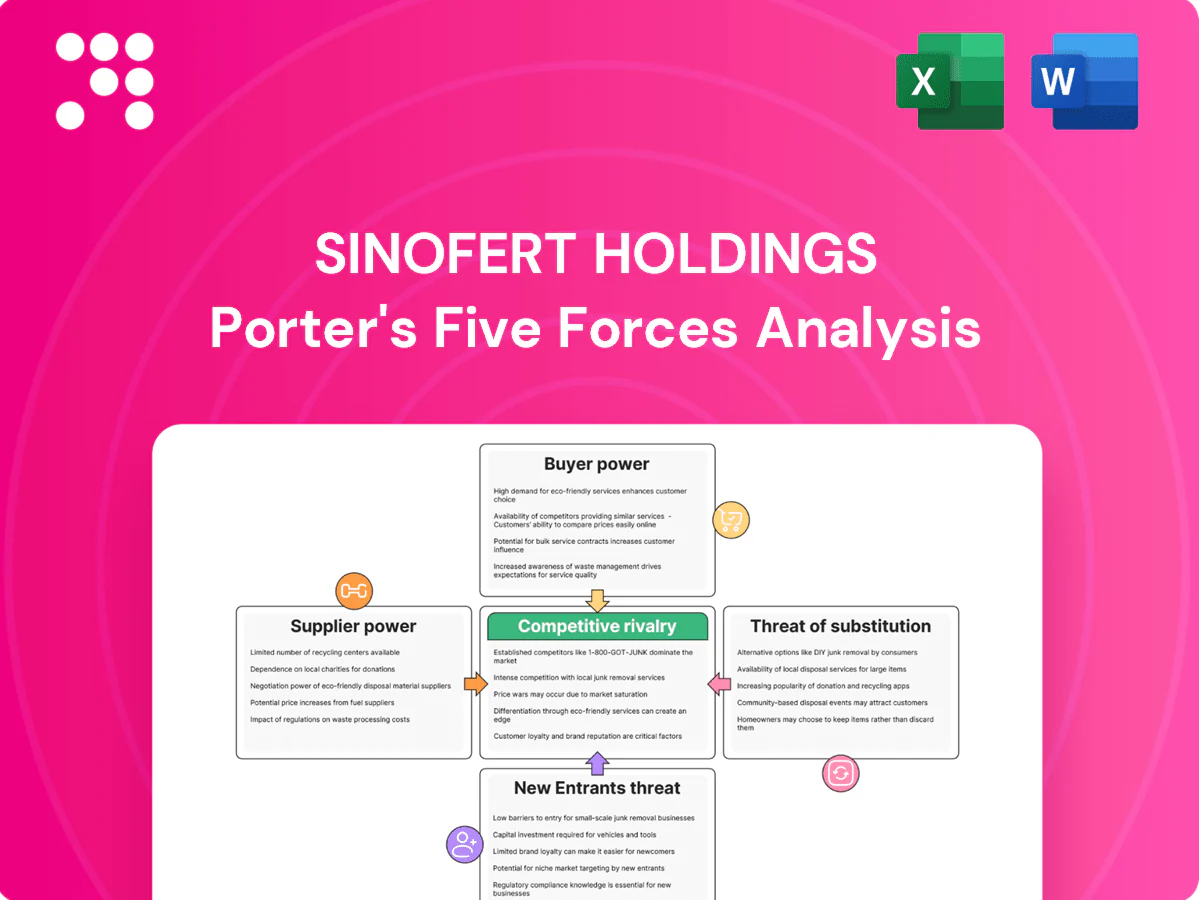
Sinofert Holdings Porter's Five Forces Analysis

Go Beyond the Preview—Access the Full Strategic Report
Sinofert Holdings faces nuanced industry pressures—from concentrated supplier influence on fertilizer inputs to moderate buyer power and regulatory risks in China’s agri-chemical sector. This snapshot hints at strategic vulnerabilities and growth levers. Unlock the full Porter's Five Forces Analysis to view force-by-force ratings, visuals, and actionable recommendations for informed investment or strategy decisions.
Suppliers Bargaining Power

Concentrated potash and phosphate sources
Global potash supply is concentrated—Canada supplies around 30% of production while Russia and Belarus add significant shares—and Morocco holds roughly 70% of known phosphate rock reserves, giving upstream firms leverage over price and volumes. China imports roughly 10 million tonnes of potash annually, exposing Sinofert to international price and freight swings. Export curbs, sanctions or logistics shocks (e.g., Black Sea, Belarus) can tighten feedstock availability. Diversified sourcing and strategic stockpiles partially mitigate but do not eliminate this concentration risk.
Energy and ammonia input volatility
Nitrogen fertilizer production is feedstock‑intensive, with energy and ammonia input often accounting for around 70% of production cost, so natural gas/coal price swings strongly affect margins. Suppliers of gas, coal and ammonia can pass through price spikes, compressing distributor margins. Contract hedges and tolling mitigate but cannot fully offset sudden shocks; operational flexibility and diversified product mix provide buffering.

State influence and long-term contracts
Policy guidance and state-related upstream counterparts anchor supply flows for Sinofert but can impose non-market constraints such as allocation mandates and prioritized pricing, limiting commercial flexibility.
Long-term offtake and framework agreements enhance supply security and planning by smoothing procurement, while take-or-pay clauses and formula pricing can lock in unfavorable margins during downcycles.
Negotiation leverage therefore depends critically on Sinofert’s scale, distribution reach and ability to diversify supplier channels.

Logistics and port capacity bottlenecks
Imported feedstock for Sinofert depends on port slots, rail and trucking; 2024 Chinese coastal ports handled about 280 million TEU, leaving peak windows tight and logistics providers with pricing power. Seasonal peaks in Q3–Q4 push spot freight and demurrage sharply higher, while dedicated terminals and integrated warehousing cut exposure but require ongoing capex. Disruptions transmit quickly to product availability and margins.
- Logistics concentration: >85% utilization at peak
- Cost shock: spot freight/demurrage spikes up to ~30% in peak months
- Mitigation: dedicated terminals reduce delay risk but increase fixed costs
Quality specs and specialty additives
Specialty nutrients, coatings and micronutrient additives have far fewer qualified suppliers, and in 2024 the top 5 global specialty-additive producers controlled roughly 60–70% of capacity, increasing supplier leverage. Stringent certification, batch-consistency and agronomic-performance specs raise switching costs and allow compliant suppliers to command price premiums. Dual-sourcing and Sinofert in‑house R&D are reducing dependence over time.
- Concentration: top-5 ~60–70%
- Switching costs: high due to certification/consistency
- Pricing power: suppliers meeting specs achieve premiums
- Mitigants: dual-sourcing, in-house R&D
Supplier power: concentrated potash, Moroccan phosphate, energy & logistics set prices
Supplier power is high: potash concentrated (Canada ~30%); Morocco holds ~70% phosphate reserves; China imports ~10 Mt potash/yr, exposing Sinofert to price/ freight swings. Energy/ammonia ≈70% of nitrogen costs, making gas/coal suppliers price setters. Logistics and specialty-additive concentration (top-5 ~60–70%) further strengthen suppliers despite Sinofert’s hedges and dual-sourcing.
| Metric | 2024 value |
|---|---|
| Canada potash share | ~30% |
| China potash imports | ~10 Mt |
| Energy share in N costs | ~70% |
| Chinese port throughput | ~280 M TEU |
| Top-5 specialty suppliers | 60–70% |
What is included in the product
 Detailed Word Document
Tailored Porter's Five Forces analysis for Sinofert Holdings, uncovering competitive intensity, supplier and buyer power, entry barriers, substitutes and disruptive threats shaping pricing, margins and strategic positioning.

 Customizable Excel Spreadsheet
A concise one-sheet Porter's Five Forces for Sinofert Holdings—quickly highlight supplier/buyer leverage, competitive rivalry, substitute risk, and entry threats to ease strategic decisions. Clean layout ready for pitch decks or Excel dashboards and simple to customize as market conditions change.
Customers Bargaining Power

Fragmented farmers but high price sensitivity
China's farming base remains highly fragmented, with around 200 million smallholder farmers as of 2024, which limits individual bargaining power versus distributors like Sinofert. Yet fertilizer is a major cash input—China consumed roughly 58 million tonnes of fertilizer nutrients in 2023—so buyers are highly price sensitive. In weak crop-price cycles discounting and promotions become common and volume elasticity pressures margins when commodity prices fall.
Aggregators and cooperatives consolidate demand
Large distributors, co-ops and digital ag platforms consolidated buyer demand in 2024, using tenders and framework contracts that compressed per-ton margins by an estimated 5–15% and pushed Sinofert to offer longer credit—commonly up to 60–90 days—and bundled logistics and technical services. Winning these accounts lifts plant utilization by roughly 10–20% but forces deeper concessions on price and payment terms, shifting bargaining power toward customers.

Low switching costs across commodity SKUs
Standard N, P, K products are largely interchangeable by grade, so farmers and dealers switch brands quickly based on price and availability. Low switching costs mean procurement shifts toward suppliers offering better spot pricing or faster delivery. Differentiation for Sinofert depends on logistics reliability and technical support to secure repeat business. Loyalty builds when field results and service quality are consistently demonstrated.

Advisory and digital services reduce churn
Providing soil testing, agronomy advice and digital tools increases perceived value for Sinofert clients, with outcome-based recommendations typically enabling pricing premiums of about 5–10% and reported churn reductions near 20% in comparable agri-service rollouts (2024 industry data).
- Value: soil testing + agronomy + apps raise perceived value
- Switching costs: bundled solutions > pure product sellers
- Pricing: outcome-based premiums ~5–10%
- Stickiness: data-driven engagements cut churn ~20% season-to-season
Credit terms and working-capital leverage
Dealers often press Sinofert for longer credit, shifting financing upstream and increasing buyer leverage; extended receivables (industry median ~60 days in 2024) raise default and liquidity risk for the company. Credit scoring, trade credit insurance and selective tightening of terms have been used to protect cash flow while early-pay discounts (1–2% for 30 days) help align incentives and shorten working-capital cycles.
- Receivables pressure: industry median ~60 days (2024)
- Risk mitigants: credit scoring, insurance, selective tightening
- Incentive tool: 1–2% early-pay discounts for 30 days
~200m smallholders, 5–15% margin squeeze; agronomy yields 5–10%
Buyers are fragmented (≈200m smallholders in 2024) but price-sensitive after China used ~58mt fertilizer nutrients in 2023; large distributors and digital platforms pushed margins down 5–15% in 2024. Switching costs are low for NPK; Sinofert earns ~5–10% premium via agronomy services and cuts churn ~20%. Dealers demand longer credit (industry median ~60 days), prompting early-pay discounts (1–2%/30 days).
| Metric | Value |
|---|---|
| Smallholders (2024) | ~200m |
| Fertilizer use (2023) | ~58 mt |
| Margin squeeze (2024) | 5–15% |
| Premium from services | 5–10% |
| Churn reduction | ~20% |
| Receivables median (2024) | ~60 days |
| Early-pay discount | 1–2%/30d |
Same Document Delivered
Sinofert Holdings Porter's Five Forces Analysis
This preview shows the exact Sinofert Holdings Porter's Five Forces Analysis you'll receive—no placeholders, no samples. The file is fully formatted, professionally written, and ready for immediate download upon purchase. What you see is precisely the deliverable available after payment.

Go Beyond the Preview—Access the Full Strategic Report
Sinofert Holdings faces nuanced industry pressures—from concentrated supplier influence on fertilizer inputs to moderate buyer power and regulatory risks in China’s agri-chemical sector. This snapshot hints at strategic vulnerabilities and growth levers. Unlock the full Porter's Five Forces Analysis to view force-by-force ratings, visuals, and actionable recommendations for informed investment or strategy decisions.
Suppliers Bargaining Power
Concentrated potash and phosphate sources
Global potash supply is concentrated—Canada supplies around 30% of production while Russia and Belarus add significant shares—and Morocco holds roughly 70% of known phosphate rock reserves, giving upstream firms leverage over price and volumes. China imports roughly 10 million tonnes of potash annually, exposing Sinofert to international price and freight swings. Export curbs, sanctions or logistics shocks (e.g., Black Sea, Belarus) can tighten feedstock availability. Diversified sourcing and strategic stockpiles partially mitigate but do not eliminate this concentration risk.
Energy and ammonia input volatility
Nitrogen fertilizer production is feedstock‑intensive, with energy and ammonia input often accounting for around 70% of production cost, so natural gas/coal price swings strongly affect margins. Suppliers of gas, coal and ammonia can pass through price spikes, compressing distributor margins. Contract hedges and tolling mitigate but cannot fully offset sudden shocks; operational flexibility and diversified product mix provide buffering.
State influence and long-term contracts
Policy guidance and state-related upstream counterparts anchor supply flows for Sinofert but can impose non-market constraints such as allocation mandates and prioritized pricing, limiting commercial flexibility.
Long-term offtake and framework agreements enhance supply security and planning by smoothing procurement, while take-or-pay clauses and formula pricing can lock in unfavorable margins during downcycles.
Negotiation leverage therefore depends critically on Sinofert’s scale, distribution reach and ability to diversify supplier channels.
Logistics and port capacity bottlenecks
Imported feedstock for Sinofert depends on port slots, rail and trucking; 2024 Chinese coastal ports handled about 280 million TEU, leaving peak windows tight and logistics providers with pricing power. Seasonal peaks in Q3–Q4 push spot freight and demurrage sharply higher, while dedicated terminals and integrated warehousing cut exposure but require ongoing capex. Disruptions transmit quickly to product availability and margins.
- Logistics concentration: >85% utilization at peak
- Cost shock: spot freight/demurrage spikes up to ~30% in peak months
- Mitigation: dedicated terminals reduce delay risk but increase fixed costs
Quality specs and specialty additives
Specialty nutrients, coatings and micronutrient additives have far fewer qualified suppliers, and in 2024 the top 5 global specialty-additive producers controlled roughly 60–70% of capacity, increasing supplier leverage. Stringent certification, batch-consistency and agronomic-performance specs raise switching costs and allow compliant suppliers to command price premiums. Dual-sourcing and Sinofert in‑house R&D are reducing dependence over time.
- Concentration: top-5 ~60–70%
- Switching costs: high due to certification/consistency
- Pricing power: suppliers meeting specs achieve premiums
- Mitigants: dual-sourcing, in-house R&D
Supplier power: concentrated potash, Moroccan phosphate, energy & logistics set prices
Supplier power is high: potash concentrated (Canada ~30%); Morocco holds ~70% phosphate reserves; China imports ~10 Mt potash/yr, exposing Sinofert to price/ freight swings. Energy/ammonia ≈70% of nitrogen costs, making gas/coal suppliers price setters. Logistics and specialty-additive concentration (top-5 ~60–70%) further strengthen suppliers despite Sinofert’s hedges and dual-sourcing.
| Metric | 2024 value |
|---|---|
| Canada potash share | ~30% |
| China potash imports | ~10 Mt |
| Energy share in N costs | ~70% |
| Chinese port throughput | ~280 M TEU |
| Top-5 specialty suppliers | 60–70% |
What is included in the product
Detailed Word Document
Tailored Porter's Five Forces analysis for Sinofert Holdings, uncovering competitive intensity, supplier and buyer power, entry barriers, substitutes and disruptive threats shaping pricing, margins and strategic positioning.
Customizable Excel Spreadsheet
A concise one-sheet Porter's Five Forces for Sinofert Holdings—quickly highlight supplier/buyer leverage, competitive rivalry, substitute risk, and entry threats to ease strategic decisions. Clean layout ready for pitch decks or Excel dashboards and simple to customize as market conditions change.
Customers Bargaining Power
Fragmented farmers but high price sensitivity
China's farming base remains highly fragmented, with around 200 million smallholder farmers as of 2024, which limits individual bargaining power versus distributors like Sinofert. Yet fertilizer is a major cash input—China consumed roughly 58 million tonnes of fertilizer nutrients in 2023—so buyers are highly price sensitive. In weak crop-price cycles discounting and promotions become common and volume elasticity pressures margins when commodity prices fall.
Aggregators and cooperatives consolidate demand
Large distributors, co-ops and digital ag platforms consolidated buyer demand in 2024, using tenders and framework contracts that compressed per-ton margins by an estimated 5–15% and pushed Sinofert to offer longer credit—commonly up to 60–90 days—and bundled logistics and technical services. Winning these accounts lifts plant utilization by roughly 10–20% but forces deeper concessions on price and payment terms, shifting bargaining power toward customers.
Low switching costs across commodity SKUs
Standard N, P, K products are largely interchangeable by grade, so farmers and dealers switch brands quickly based on price and availability. Low switching costs mean procurement shifts toward suppliers offering better spot pricing or faster delivery. Differentiation for Sinofert depends on logistics reliability and technical support to secure repeat business. Loyalty builds when field results and service quality are consistently demonstrated.
Advisory and digital services reduce churn
Providing soil testing, agronomy advice and digital tools increases perceived value for Sinofert clients, with outcome-based recommendations typically enabling pricing premiums of about 5–10% and reported churn reductions near 20% in comparable agri-service rollouts (2024 industry data).
- Value: soil testing + agronomy + apps raise perceived value
- Switching costs: bundled solutions > pure product sellers
- Pricing: outcome-based premiums ~5–10%
- Stickiness: data-driven engagements cut churn ~20% season-to-season
Credit terms and working-capital leverage
Dealers often press Sinofert for longer credit, shifting financing upstream and increasing buyer leverage; extended receivables (industry median ~60 days in 2024) raise default and liquidity risk for the company. Credit scoring, trade credit insurance and selective tightening of terms have been used to protect cash flow while early-pay discounts (1–2% for 30 days) help align incentives and shorten working-capital cycles.
- Receivables pressure: industry median ~60 days (2024)
- Risk mitigants: credit scoring, insurance, selective tightening
- Incentive tool: 1–2% early-pay discounts for 30 days
~200m smallholders, 5–15% margin squeeze; agronomy yields 5–10%
Buyers are fragmented (≈200m smallholders in 2024) but price-sensitive after China used ~58mt fertilizer nutrients in 2023; large distributors and digital platforms pushed margins down 5–15% in 2024. Switching costs are low for NPK; Sinofert earns ~5–10% premium via agronomy services and cuts churn ~20%. Dealers demand longer credit (industry median ~60 days), prompting early-pay discounts (1–2%/30 days).
| Metric | Value |
|---|---|
| Smallholders (2024) | ~200m |
| Fertilizer use (2023) | ~58 mt |
| Margin squeeze (2024) | 5–15% |
| Premium from services | 5–10% |
| Churn reduction | ~20% |
| Receivables median (2024) | ~60 days |
| Early-pay discount | 1–2%/30d |
Same Document Delivered
Sinofert Holdings Porter's Five Forces Analysis
This preview shows the exact Sinofert Holdings Porter's Five Forces Analysis you'll receive—no placeholders, no samples. The file is fully formatted, professionally written, and ready for immediate download upon purchase. What you see is precisely the deliverable available after payment.
Description
Go Beyond the Preview—Access the Full Strategic Report
Sinofert Holdings faces nuanced industry pressures—from concentrated supplier influence on fertilizer inputs to moderate buyer power and regulatory risks in China’s agri-chemical sector. This snapshot hints at strategic vulnerabilities and growth levers. Unlock the full Porter's Five Forces Analysis to view force-by-force ratings, visuals, and actionable recommendations for informed investment or strategy decisions.
Suppliers Bargaining Power
Concentrated potash and phosphate sources
Global potash supply is concentrated—Canada supplies around 30% of production while Russia and Belarus add significant shares—and Morocco holds roughly 70% of known phosphate rock reserves, giving upstream firms leverage over price and volumes. China imports roughly 10 million tonnes of potash annually, exposing Sinofert to international price and freight swings. Export curbs, sanctions or logistics shocks (e.g., Black Sea, Belarus) can tighten feedstock availability. Diversified sourcing and strategic stockpiles partially mitigate but do not eliminate this concentration risk.
Energy and ammonia input volatility
Nitrogen fertilizer production is feedstock‑intensive, with energy and ammonia input often accounting for around 70% of production cost, so natural gas/coal price swings strongly affect margins. Suppliers of gas, coal and ammonia can pass through price spikes, compressing distributor margins. Contract hedges and tolling mitigate but cannot fully offset sudden shocks; operational flexibility and diversified product mix provide buffering.
State influence and long-term contracts
Policy guidance and state-related upstream counterparts anchor supply flows for Sinofert but can impose non-market constraints such as allocation mandates and prioritized pricing, limiting commercial flexibility.
Long-term offtake and framework agreements enhance supply security and planning by smoothing procurement, while take-or-pay clauses and formula pricing can lock in unfavorable margins during downcycles.
Negotiation leverage therefore depends critically on Sinofert’s scale, distribution reach and ability to diversify supplier channels.
Logistics and port capacity bottlenecks
Imported feedstock for Sinofert depends on port slots, rail and trucking; 2024 Chinese coastal ports handled about 280 million TEU, leaving peak windows tight and logistics providers with pricing power. Seasonal peaks in Q3–Q4 push spot freight and demurrage sharply higher, while dedicated terminals and integrated warehousing cut exposure but require ongoing capex. Disruptions transmit quickly to product availability and margins.
- Logistics concentration: >85% utilization at peak
- Cost shock: spot freight/demurrage spikes up to ~30% in peak months
- Mitigation: dedicated terminals reduce delay risk but increase fixed costs
Quality specs and specialty additives
Specialty nutrients, coatings and micronutrient additives have far fewer qualified suppliers, and in 2024 the top 5 global specialty-additive producers controlled roughly 60–70% of capacity, increasing supplier leverage. Stringent certification, batch-consistency and agronomic-performance specs raise switching costs and allow compliant suppliers to command price premiums. Dual-sourcing and Sinofert in‑house R&D are reducing dependence over time.
- Concentration: top-5 ~60–70%
- Switching costs: high due to certification/consistency
- Pricing power: suppliers meeting specs achieve premiums
- Mitigants: dual-sourcing, in-house R&D
Supplier power: concentrated potash, Moroccan phosphate, energy & logistics set prices
Supplier power is high: potash concentrated (Canada ~30%); Morocco holds ~70% phosphate reserves; China imports ~10 Mt potash/yr, exposing Sinofert to price/ freight swings. Energy/ammonia ≈70% of nitrogen costs, making gas/coal suppliers price setters. Logistics and specialty-additive concentration (top-5 ~60–70%) further strengthen suppliers despite Sinofert’s hedges and dual-sourcing.
| Metric | 2024 value |
|---|---|
| Canada potash share | ~30% |
| China potash imports | ~10 Mt |
| Energy share in N costs | ~70% |
| Chinese port throughput | ~280 M TEU |
| Top-5 specialty suppliers | 60–70% |
What is included in the product
Detailed Word Document
Tailored Porter's Five Forces analysis for Sinofert Holdings, uncovering competitive intensity, supplier and buyer power, entry barriers, substitutes and disruptive threats shaping pricing, margins and strategic positioning.
Customizable Excel Spreadsheet
A concise one-sheet Porter's Five Forces for Sinofert Holdings—quickly highlight supplier/buyer leverage, competitive rivalry, substitute risk, and entry threats to ease strategic decisions. Clean layout ready for pitch decks or Excel dashboards and simple to customize as market conditions change.
Customers Bargaining Power
Fragmented farmers but high price sensitivity
China's farming base remains highly fragmented, with around 200 million smallholder farmers as of 2024, which limits individual bargaining power versus distributors like Sinofert. Yet fertilizer is a major cash input—China consumed roughly 58 million tonnes of fertilizer nutrients in 2023—so buyers are highly price sensitive. In weak crop-price cycles discounting and promotions become common and volume elasticity pressures margins when commodity prices fall.
Aggregators and cooperatives consolidate demand
Large distributors, co-ops and digital ag platforms consolidated buyer demand in 2024, using tenders and framework contracts that compressed per-ton margins by an estimated 5–15% and pushed Sinofert to offer longer credit—commonly up to 60–90 days—and bundled logistics and technical services. Winning these accounts lifts plant utilization by roughly 10–20% but forces deeper concessions on price and payment terms, shifting bargaining power toward customers.
Low switching costs across commodity SKUs
Standard N, P, K products are largely interchangeable by grade, so farmers and dealers switch brands quickly based on price and availability. Low switching costs mean procurement shifts toward suppliers offering better spot pricing or faster delivery. Differentiation for Sinofert depends on logistics reliability and technical support to secure repeat business. Loyalty builds when field results and service quality are consistently demonstrated.
Advisory and digital services reduce churn
Providing soil testing, agronomy advice and digital tools increases perceived value for Sinofert clients, with outcome-based recommendations typically enabling pricing premiums of about 5–10% and reported churn reductions near 20% in comparable agri-service rollouts (2024 industry data).
- Value: soil testing + agronomy + apps raise perceived value
- Switching costs: bundled solutions > pure product sellers
- Pricing: outcome-based premiums ~5–10%
- Stickiness: data-driven engagements cut churn ~20% season-to-season
Credit terms and working-capital leverage
Dealers often press Sinofert for longer credit, shifting financing upstream and increasing buyer leverage; extended receivables (industry median ~60 days in 2024) raise default and liquidity risk for the company. Credit scoring, trade credit insurance and selective tightening of terms have been used to protect cash flow while early-pay discounts (1–2% for 30 days) help align incentives and shorten working-capital cycles.
- Receivables pressure: industry median ~60 days (2024)
- Risk mitigants: credit scoring, insurance, selective tightening
- Incentive tool: 1–2% early-pay discounts for 30 days
~200m smallholders, 5–15% margin squeeze; agronomy yields 5–10%
Buyers are fragmented (≈200m smallholders in 2024) but price-sensitive after China used ~58mt fertilizer nutrients in 2023; large distributors and digital platforms pushed margins down 5–15% in 2024. Switching costs are low for NPK; Sinofert earns ~5–10% premium via agronomy services and cuts churn ~20%. Dealers demand longer credit (industry median ~60 days), prompting early-pay discounts (1–2%/30 days).
| Metric | Value |
|---|---|
| Smallholders (2024) | ~200m |
| Fertilizer use (2023) | ~58 mt |
| Margin squeeze (2024) | 5–15% |
| Premium from services | 5–10% |
| Churn reduction | ~20% |
| Receivables median (2024) | ~60 days |
| Early-pay discount | 1–2%/30d |
Same Document Delivered
Sinofert Holdings Porter's Five Forces Analysis
This preview shows the exact Sinofert Holdings Porter's Five Forces Analysis you'll receive—no placeholders, no samples. The file is fully formatted, professionally written, and ready for immediate download upon purchase. What you see is precisely the deliverable available after payment.











