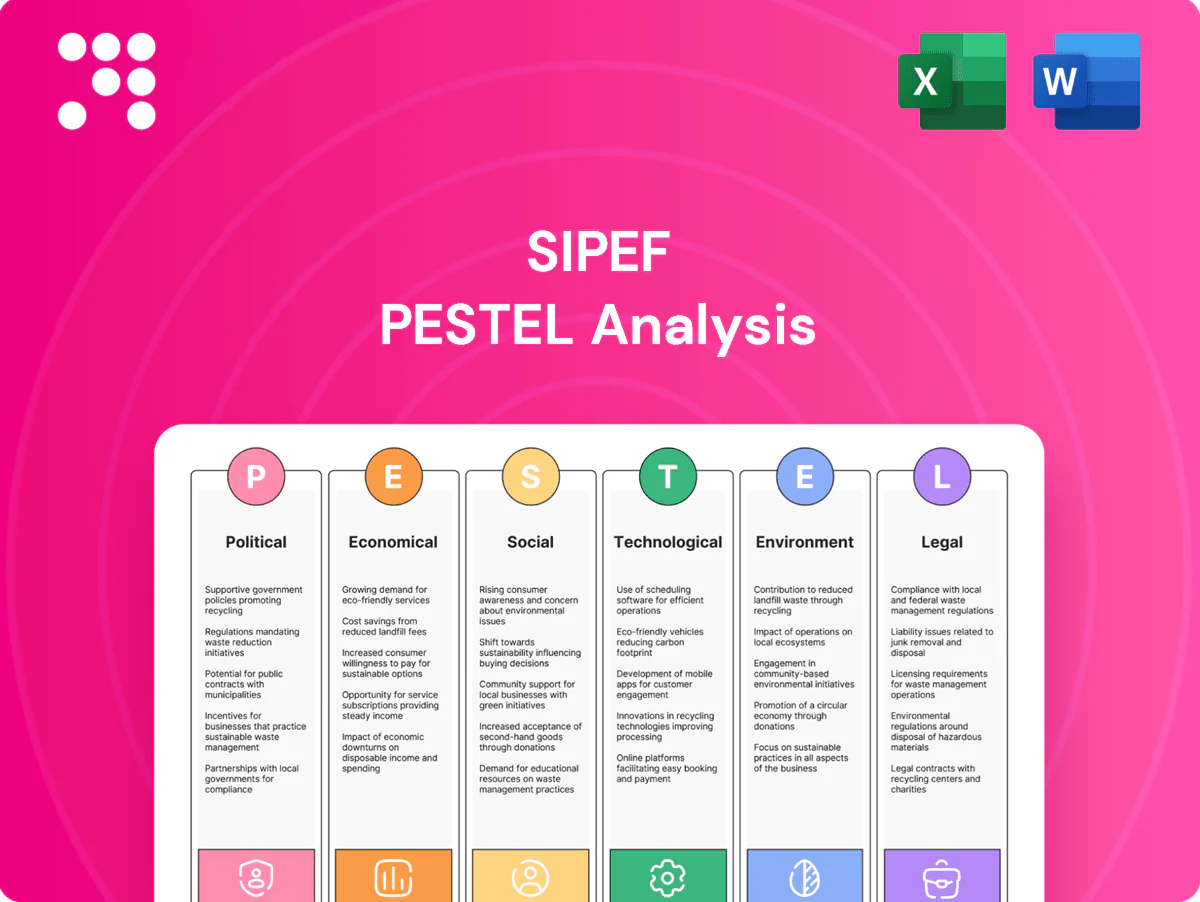
Sipef PESTLE Analysis

Your Competitive Advantage Starts with This Report
Our PESTLE analysis of Sipef unpacks the political, economic, social, technological, legal and environmental forces shaping its palm oil and rubber operations. It highlights regulatory risks, commodity cycles, sustainability pressures and tech opportunities. Ideal for investors and strategists, the full report delivers actionable insights and ready-to-use slides. Purchase the complete analysis to make confident, informed decisions.
Political factors

Host-country stability and governance
Sipef operates in 3 countries—Indonesia, Papua New Guinea and Ivory Coast—each presenting distinct political risk profiles that affect land rights and community relations. Policy continuity in host governments directly influences permits, taxation and nearby infrastructure investment for plantations. Local election cycles can quickly shift provincial priorities and stakeholder engagement. Scenario planning and diversified country exposure help buffer regulatory and political shocks for the Euronext-listed group.
Land tenure and concession policy
Secure land titles and timely concession renewals are essential for plantation longevity and investment returns; in Indonesia HGU and spatial planning procedures frequently affect expansion timelines. Customary land rights in PNG and Côte d’Ivoire necessitate sustained, documented stakeholder engagement to prevent conflicts. Clear FPIC-based documentation and grievance mechanisms materially reduce disputes and operational downtime.

Trade and export policies
Indonesia's use of export levies and Domestic Market Obligations on crude palm oil continues to squeeze CPO netbacks, while shifting tariff regimes for rubber and bananas directly alter market access and price realization.
The EU Deforestation Regulation, enforced from December 2024 and covering seven commodities including palm oil and rubber, tightens sustainability compliance for Sipef's exports to EU markets.
Close monitoring of policy pipelines lets Sipef adjust contracts, pricing clauses and logistics proactively to protect margins.

Rural development and subsidy agendas
Governments link agribusiness to rural jobs, roads and social programs, making Sipef a focal point for local development; Indonesia and other producers use palm biodiesel mandates (B30 introduced 2020) to promote downstream use, shifting product mix toward fuel and processed oils. Removal of subsidies has raised fertilizer and fuel costs in recent years, so aligning operations with public development goals builds political goodwill and mitigates intervention risk.
- Rural employment linkage
- Biodiesel mandate: B30 (since 2020)
- Subsidy withdrawals → higher fertilizer/fuel costs
- Alignment = stronger political goodwill
Security and local conflict dynamics
Localized land disputes and artisanal activity can halt field work and logistics, complicating harvests and transport; PNG population ~9.6 million (UN 2024) and regional West African operations fall under ECOWAS 15-member dynamics, while police capacity and judicial efficiency vary widely, prolonging resolution timelines.
- Disruptions: land disputes, artisanal mining
- Law enforcement: variable capacity and slow courts
- Cross-border: PNG mobility, West Africa regional tensions
- Mitigation: risk mapping and community security protocols
Political risks in Indonesia, PNG and Ivory Coast raise compliance and margin pressure
Sipef faces varying political risks across Indonesia, PNG and Ivory Coast that affect land rights, permits, taxes and community relations; policy shifts (local elections, export rules) quickly alter margins. EU Deforestation Regulation (effective Dec 2024) and Indonesia biodiesel mandate B30 (since 2020) raise compliance and product-mix pressures; PNG population ~9.6M, Indonesia ~276M, Ivory Coast ~28.7M.
| Country | Key political risks | Relevant stats |
|---|---|---|
| Indonesia | permits, export levies, B30 mandate | Pop ~276M; B30 since 2020 |
| PNG | customary land rights, weak courts | Pop ~9.6M (UN 2024) |
| Ivory Coast | customary rights, ECOWAS dynamics | Pop ~28.7M (UN 2024) |
What is included in the product
 Detailed Word Document
Provides a concise PESTLE assessment of Sipef across Political, Economic, Social, Technological, Environmental, and Legal factors, with data-backed insights, region- and industry-specific examples, forward-looking scenarios, and practical implications to help executives, consultants, and investors identify risks and strategic opportunities.

 Customizable Excel Spreadsheet
A concise, visually segmented PESTLE summary of Sipef that fits into presentations and planning sessions, is easily editable for regional or business-line notes, and quickly shareable to align teams during external risk and market-position discussions.
Economic factors

Commodity price volatility
Palm oil, rubber and banana prices are cyclical and highly elastic to global demand; global palm oil production/consumption is about 75–80 Mt/year, natural rubber ~13–14 Mt and banana exports ~20 Mt, so shifts in China/India buying can swing margins. Biofuel policies (eg Indonesia B35) and synthetic rubber substitutes exert further pressure on prices and margins. Hedging and sales‑mix optimization help stabilize cash flows. Rigorous cost discipline in downcycles protects returns.
Foreign exchange exposure
Revenues are largely in USD and EUR while operating costs and royalties occur in IDR, PGK and XOF, creating exposure where FX moves materially affect unit margins and capex affordability. The CFA franc is pegged to the euro at 655.957 XOF per EUR, while IDR and PGK have shown occasional double-digit moves versus USD, amplifying margin risk. Natural operational hedges and treasury instruments can dampen volatility, so budgeting should stress-test multi-currency scenarios.

Inflation and wage dynamics
Rural wage inflation (about 5–7% in key SE Asian growing regions in 2024) and higher energy costs raised harvesting and milling expenses, squeezing margins per tonne. Fertilizer and agrochemical prices continued to track global commodity cycles, with fertilizer indices remaining above pre‑2020 levels. Mechanization can lower unit labor cost where terrain allows, while productivity programs are essential to protect EBITDA per hectare.

Logistics and infrastructure costs
Port access, road quality and inland transport set delivered cost for Sipef, with maritime routes from Indonesia and PNG directly affecting export timing; weather-driven disruptions drive demurrage and spoilage risk for perishables—bananas have a typical post-harvest shelf life of 7–14 days—making on-time transport critical. Diversified routes and added cold storage reduce bottlenecks, while long-term logistics partnerships improve schedule reliability and tariff predictability.
- Port access impacts lead times
- Road quality affects inland haul costs
- Banana shelf life 7–14 days raises spoilage risk
- Diversified routes/storage cut bottlenecks
- Long-term logistics contracts boost reliability
Capital intensity and interest rates
New plantings and mill upgrades require multi-year capex and patient payback; global rate cycles influence borrowing costs — US federal funds rate 5.25–5.50% (mid‑2025) and higher EM spreads raise local financing costs; phased investments aligned to cash generation reduce balance-sheet risk; disciplined hurdle rates preserve capital efficiency across crops.
- Multi-year capex: phased to cashflow
- Borrowing: Fed funds 5.25–5.50% (mid‑2025)
- Risk: EM spread volatility
- Governance: strict hurdle rates
Political risks in Indonesia, PNG and Ivory Coast raise compliance and margin pressure
Palm oil ~76–78 Mt/yr, rubber ~13–14 Mt, banana exports ~20 Mt, so China/India demand swings margins. Revenues in USD/EUR vs costs in IDR/PGK/XOF create FX risk (XOF peg 655.957/EUR). Rural wages ~5–7% (2024) and Fed funds 5.25–5.50% (mid‑2025) raise operating and financing costs.
| Metric | Value |
|---|---|
| Palm oil | 76–78 Mt |
| Rubber | 13–14 Mt |
| Banana exports | ~20 Mt |
| Fed funds | 5.25–5.50% |
Preview the Actual Deliverable
Sipef PESTLE Analysis
The Sipef PESTLE Analysis preview shown here is the exact document you’ll receive after purchase—fully formatted, professionally structured, and ready to use. This screenshot reflects the real file delivered exactly as shown, with no placeholders or teasers. After payment you’ll instantly download this same finished report, including layout, content, and structure.

Your Competitive Advantage Starts with This Report
Our PESTLE analysis of Sipef unpacks the political, economic, social, technological, legal and environmental forces shaping its palm oil and rubber operations. It highlights regulatory risks, commodity cycles, sustainability pressures and tech opportunities. Ideal for investors and strategists, the full report delivers actionable insights and ready-to-use slides. Purchase the complete analysis to make confident, informed decisions.
Political factors
Host-country stability and governance
Sipef operates in 3 countries—Indonesia, Papua New Guinea and Ivory Coast—each presenting distinct political risk profiles that affect land rights and community relations. Policy continuity in host governments directly influences permits, taxation and nearby infrastructure investment for plantations. Local election cycles can quickly shift provincial priorities and stakeholder engagement. Scenario planning and diversified country exposure help buffer regulatory and political shocks for the Euronext-listed group.
Land tenure and concession policy
Secure land titles and timely concession renewals are essential for plantation longevity and investment returns; in Indonesia HGU and spatial planning procedures frequently affect expansion timelines. Customary land rights in PNG and Côte d’Ivoire necessitate sustained, documented stakeholder engagement to prevent conflicts. Clear FPIC-based documentation and grievance mechanisms materially reduce disputes and operational downtime.
Trade and export policies
Indonesia's use of export levies and Domestic Market Obligations on crude palm oil continues to squeeze CPO netbacks, while shifting tariff regimes for rubber and bananas directly alter market access and price realization.
The EU Deforestation Regulation, enforced from December 2024 and covering seven commodities including palm oil and rubber, tightens sustainability compliance for Sipef's exports to EU markets.
Close monitoring of policy pipelines lets Sipef adjust contracts, pricing clauses and logistics proactively to protect margins.
Rural development and subsidy agendas
Governments link agribusiness to rural jobs, roads and social programs, making Sipef a focal point for local development; Indonesia and other producers use palm biodiesel mandates (B30 introduced 2020) to promote downstream use, shifting product mix toward fuel and processed oils. Removal of subsidies has raised fertilizer and fuel costs in recent years, so aligning operations with public development goals builds political goodwill and mitigates intervention risk.
- Rural employment linkage
- Biodiesel mandate: B30 (since 2020)
- Subsidy withdrawals → higher fertilizer/fuel costs
- Alignment = stronger political goodwill
Security and local conflict dynamics
Localized land disputes and artisanal activity can halt field work and logistics, complicating harvests and transport; PNG population ~9.6 million (UN 2024) and regional West African operations fall under ECOWAS 15-member dynamics, while police capacity and judicial efficiency vary widely, prolonging resolution timelines.
- Disruptions: land disputes, artisanal mining
- Law enforcement: variable capacity and slow courts
- Cross-border: PNG mobility, West Africa regional tensions
- Mitigation: risk mapping and community security protocols
Political risks in Indonesia, PNG and Ivory Coast raise compliance and margin pressure
Sipef faces varying political risks across Indonesia, PNG and Ivory Coast that affect land rights, permits, taxes and community relations; policy shifts (local elections, export rules) quickly alter margins. EU Deforestation Regulation (effective Dec 2024) and Indonesia biodiesel mandate B30 (since 2020) raise compliance and product-mix pressures; PNG population ~9.6M, Indonesia ~276M, Ivory Coast ~28.7M.
| Country | Key political risks | Relevant stats |
|---|---|---|
| Indonesia | permits, export levies, B30 mandate | Pop ~276M; B30 since 2020 |
| PNG | customary land rights, weak courts | Pop ~9.6M (UN 2024) |
| Ivory Coast | customary rights, ECOWAS dynamics | Pop ~28.7M (UN 2024) |
What is included in the product
Detailed Word Document
Provides a concise PESTLE assessment of Sipef across Political, Economic, Social, Technological, Environmental, and Legal factors, with data-backed insights, region- and industry-specific examples, forward-looking scenarios, and practical implications to help executives, consultants, and investors identify risks and strategic opportunities.
Customizable Excel Spreadsheet
A concise, visually segmented PESTLE summary of Sipef that fits into presentations and planning sessions, is easily editable for regional or business-line notes, and quickly shareable to align teams during external risk and market-position discussions.
Economic factors
Commodity price volatility
Palm oil, rubber and banana prices are cyclical and highly elastic to global demand; global palm oil production/consumption is about 75–80 Mt/year, natural rubber ~13–14 Mt and banana exports ~20 Mt, so shifts in China/India buying can swing margins. Biofuel policies (eg Indonesia B35) and synthetic rubber substitutes exert further pressure on prices and margins. Hedging and sales‑mix optimization help stabilize cash flows. Rigorous cost discipline in downcycles protects returns.
Foreign exchange exposure
Revenues are largely in USD and EUR while operating costs and royalties occur in IDR, PGK and XOF, creating exposure where FX moves materially affect unit margins and capex affordability. The CFA franc is pegged to the euro at 655.957 XOF per EUR, while IDR and PGK have shown occasional double-digit moves versus USD, amplifying margin risk. Natural operational hedges and treasury instruments can dampen volatility, so budgeting should stress-test multi-currency scenarios.
Inflation and wage dynamics
Rural wage inflation (about 5–7% in key SE Asian growing regions in 2024) and higher energy costs raised harvesting and milling expenses, squeezing margins per tonne. Fertilizer and agrochemical prices continued to track global commodity cycles, with fertilizer indices remaining above pre‑2020 levels. Mechanization can lower unit labor cost where terrain allows, while productivity programs are essential to protect EBITDA per hectare.
Logistics and infrastructure costs
Port access, road quality and inland transport set delivered cost for Sipef, with maritime routes from Indonesia and PNG directly affecting export timing; weather-driven disruptions drive demurrage and spoilage risk for perishables—bananas have a typical post-harvest shelf life of 7–14 days—making on-time transport critical. Diversified routes and added cold storage reduce bottlenecks, while long-term logistics partnerships improve schedule reliability and tariff predictability.
- Port access impacts lead times
- Road quality affects inland haul costs
- Banana shelf life 7–14 days raises spoilage risk
- Diversified routes/storage cut bottlenecks
- Long-term logistics contracts boost reliability
Capital intensity and interest rates
New plantings and mill upgrades require multi-year capex and patient payback; global rate cycles influence borrowing costs — US federal funds rate 5.25–5.50% (mid‑2025) and higher EM spreads raise local financing costs; phased investments aligned to cash generation reduce balance-sheet risk; disciplined hurdle rates preserve capital efficiency across crops.
- Multi-year capex: phased to cashflow
- Borrowing: Fed funds 5.25–5.50% (mid‑2025)
- Risk: EM spread volatility
- Governance: strict hurdle rates
Political risks in Indonesia, PNG and Ivory Coast raise compliance and margin pressure
Palm oil ~76–78 Mt/yr, rubber ~13–14 Mt, banana exports ~20 Mt, so China/India demand swings margins. Revenues in USD/EUR vs costs in IDR/PGK/XOF create FX risk (XOF peg 655.957/EUR). Rural wages ~5–7% (2024) and Fed funds 5.25–5.50% (mid‑2025) raise operating and financing costs.
| Metric | Value |
|---|---|
| Palm oil | 76–78 Mt |
| Rubber | 13–14 Mt |
| Banana exports | ~20 Mt |
| Fed funds | 5.25–5.50% |
Preview the Actual Deliverable
Sipef PESTLE Analysis
The Sipef PESTLE Analysis preview shown here is the exact document you’ll receive after purchase—fully formatted, professionally structured, and ready to use. This screenshot reflects the real file delivered exactly as shown, with no placeholders or teasers. After payment you’ll instantly download this same finished report, including layout, content, and structure.
Original: $10.00
-65%$10.00
$3.50Description
Your Competitive Advantage Starts with This Report
Our PESTLE analysis of Sipef unpacks the political, economic, social, technological, legal and environmental forces shaping its palm oil and rubber operations. It highlights regulatory risks, commodity cycles, sustainability pressures and tech opportunities. Ideal for investors and strategists, the full report delivers actionable insights and ready-to-use slides. Purchase the complete analysis to make confident, informed decisions.
Political factors
Host-country stability and governance
Sipef operates in 3 countries—Indonesia, Papua New Guinea and Ivory Coast—each presenting distinct political risk profiles that affect land rights and community relations. Policy continuity in host governments directly influences permits, taxation and nearby infrastructure investment for plantations. Local election cycles can quickly shift provincial priorities and stakeholder engagement. Scenario planning and diversified country exposure help buffer regulatory and political shocks for the Euronext-listed group.
Land tenure and concession policy
Secure land titles and timely concession renewals are essential for plantation longevity and investment returns; in Indonesia HGU and spatial planning procedures frequently affect expansion timelines. Customary land rights in PNG and Côte d’Ivoire necessitate sustained, documented stakeholder engagement to prevent conflicts. Clear FPIC-based documentation and grievance mechanisms materially reduce disputes and operational downtime.
Trade and export policies
Indonesia's use of export levies and Domestic Market Obligations on crude palm oil continues to squeeze CPO netbacks, while shifting tariff regimes for rubber and bananas directly alter market access and price realization.
The EU Deforestation Regulation, enforced from December 2024 and covering seven commodities including palm oil and rubber, tightens sustainability compliance for Sipef's exports to EU markets.
Close monitoring of policy pipelines lets Sipef adjust contracts, pricing clauses and logistics proactively to protect margins.
Rural development and subsidy agendas
Governments link agribusiness to rural jobs, roads and social programs, making Sipef a focal point for local development; Indonesia and other producers use palm biodiesel mandates (B30 introduced 2020) to promote downstream use, shifting product mix toward fuel and processed oils. Removal of subsidies has raised fertilizer and fuel costs in recent years, so aligning operations with public development goals builds political goodwill and mitigates intervention risk.
- Rural employment linkage
- Biodiesel mandate: B30 (since 2020)
- Subsidy withdrawals → higher fertilizer/fuel costs
- Alignment = stronger political goodwill
Security and local conflict dynamics
Localized land disputes and artisanal activity can halt field work and logistics, complicating harvests and transport; PNG population ~9.6 million (UN 2024) and regional West African operations fall under ECOWAS 15-member dynamics, while police capacity and judicial efficiency vary widely, prolonging resolution timelines.
- Disruptions: land disputes, artisanal mining
- Law enforcement: variable capacity and slow courts
- Cross-border: PNG mobility, West Africa regional tensions
- Mitigation: risk mapping and community security protocols
Political risks in Indonesia, PNG and Ivory Coast raise compliance and margin pressure
Sipef faces varying political risks across Indonesia, PNG and Ivory Coast that affect land rights, permits, taxes and community relations; policy shifts (local elections, export rules) quickly alter margins. EU Deforestation Regulation (effective Dec 2024) and Indonesia biodiesel mandate B30 (since 2020) raise compliance and product-mix pressures; PNG population ~9.6M, Indonesia ~276M, Ivory Coast ~28.7M.
| Country | Key political risks | Relevant stats |
|---|---|---|
| Indonesia | permits, export levies, B30 mandate | Pop ~276M; B30 since 2020 |
| PNG | customary land rights, weak courts | Pop ~9.6M (UN 2024) |
| Ivory Coast | customary rights, ECOWAS dynamics | Pop ~28.7M (UN 2024) |
What is included in the product
Detailed Word Document
Provides a concise PESTLE assessment of Sipef across Political, Economic, Social, Technological, Environmental, and Legal factors, with data-backed insights, region- and industry-specific examples, forward-looking scenarios, and practical implications to help executives, consultants, and investors identify risks and strategic opportunities.
Customizable Excel Spreadsheet
A concise, visually segmented PESTLE summary of Sipef that fits into presentations and planning sessions, is easily editable for regional or business-line notes, and quickly shareable to align teams during external risk and market-position discussions.
Economic factors
Commodity price volatility
Palm oil, rubber and banana prices are cyclical and highly elastic to global demand; global palm oil production/consumption is about 75–80 Mt/year, natural rubber ~13–14 Mt and banana exports ~20 Mt, so shifts in China/India buying can swing margins. Biofuel policies (eg Indonesia B35) and synthetic rubber substitutes exert further pressure on prices and margins. Hedging and sales‑mix optimization help stabilize cash flows. Rigorous cost discipline in downcycles protects returns.
Foreign exchange exposure
Revenues are largely in USD and EUR while operating costs and royalties occur in IDR, PGK and XOF, creating exposure where FX moves materially affect unit margins and capex affordability. The CFA franc is pegged to the euro at 655.957 XOF per EUR, while IDR and PGK have shown occasional double-digit moves versus USD, amplifying margin risk. Natural operational hedges and treasury instruments can dampen volatility, so budgeting should stress-test multi-currency scenarios.
Inflation and wage dynamics
Rural wage inflation (about 5–7% in key SE Asian growing regions in 2024) and higher energy costs raised harvesting and milling expenses, squeezing margins per tonne. Fertilizer and agrochemical prices continued to track global commodity cycles, with fertilizer indices remaining above pre‑2020 levels. Mechanization can lower unit labor cost where terrain allows, while productivity programs are essential to protect EBITDA per hectare.
Logistics and infrastructure costs
Port access, road quality and inland transport set delivered cost for Sipef, with maritime routes from Indonesia and PNG directly affecting export timing; weather-driven disruptions drive demurrage and spoilage risk for perishables—bananas have a typical post-harvest shelf life of 7–14 days—making on-time transport critical. Diversified routes and added cold storage reduce bottlenecks, while long-term logistics partnerships improve schedule reliability and tariff predictability.
- Port access impacts lead times
- Road quality affects inland haul costs
- Banana shelf life 7–14 days raises spoilage risk
- Diversified routes/storage cut bottlenecks
- Long-term logistics contracts boost reliability
Capital intensity and interest rates
New plantings and mill upgrades require multi-year capex and patient payback; global rate cycles influence borrowing costs — US federal funds rate 5.25–5.50% (mid‑2025) and higher EM spreads raise local financing costs; phased investments aligned to cash generation reduce balance-sheet risk; disciplined hurdle rates preserve capital efficiency across crops.
- Multi-year capex: phased to cashflow
- Borrowing: Fed funds 5.25–5.50% (mid‑2025)
- Risk: EM spread volatility
- Governance: strict hurdle rates
Political risks in Indonesia, PNG and Ivory Coast raise compliance and margin pressure
Palm oil ~76–78 Mt/yr, rubber ~13–14 Mt, banana exports ~20 Mt, so China/India demand swings margins. Revenues in USD/EUR vs costs in IDR/PGK/XOF create FX risk (XOF peg 655.957/EUR). Rural wages ~5–7% (2024) and Fed funds 5.25–5.50% (mid‑2025) raise operating and financing costs.
| Metric | Value |
|---|---|
| Palm oil | 76–78 Mt |
| Rubber | 13–14 Mt |
| Banana exports | ~20 Mt |
| Fed funds | 5.25–5.50% |
Preview the Actual Deliverable
Sipef PESTLE Analysis
The Sipef PESTLE Analysis preview shown here is the exact document you’ll receive after purchase—fully formatted, professionally structured, and ready to use. This screenshot reflects the real file delivered exactly as shown, with no placeholders or teasers. After payment you’ll instantly download this same finished report, including layout, content, and structure.











