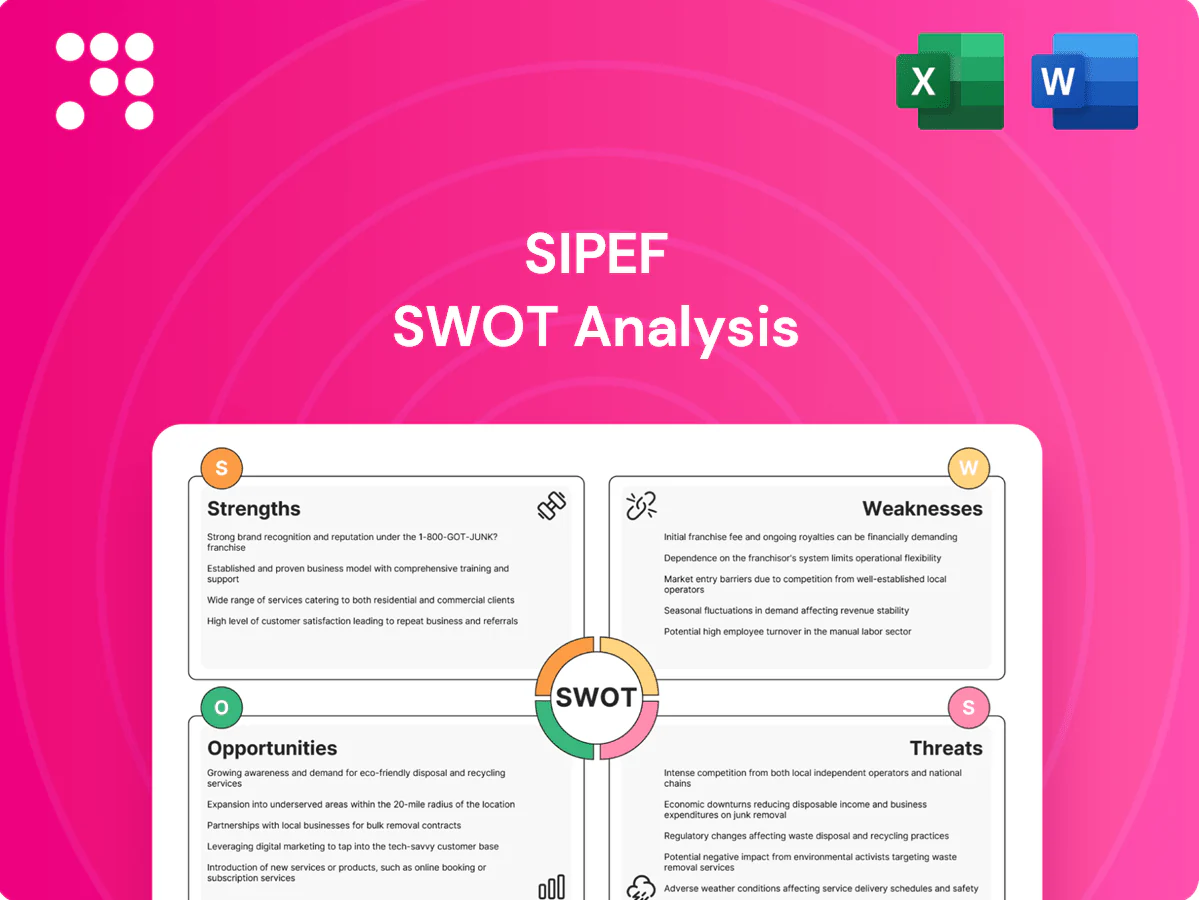
Sipef SWOT Analysis

Your Strategic Toolkit Starts Here
Explore Sipef’s competitive edge in agribusiness with our concise SWOT preview—highlighting strengths like diversified plantations, exposure to commodity swings, and sustainability initiatives. Want the complete strategic picture? Purchase the full SWOT analysis for a research-backed, editable Word and Excel package to support investing, planning, and presentations.
Strengths

Sustainable plantation expertise
Decades of agronomic know-how across oil palm, rubber and bananas underpin high-yield operations in Indonesia, Papua New Guinea and Ivory Coast; integrated cultivation-to-processing enables traceability and quality control. RSPO-aligned practices bolster environmental and social credibility, reinforcing relationships with global buyers and financiers; Sipef is listed on Euronext Brussels (SIPB).
Diversified crop portfolio
Exposure to oil palm, rubber and bananas across c.95,000 ha (2024) reduces reliance on a single commodity cycle, with crop mix smoothing seasonal revenue swings. Cross-crop cash flow balancing helps stabilize group cash generation during volatile price periods. Agronomic synergies boost fertilizer, labor and logistics efficiency across estates, while diversification enhances resilience to crop-specific diseases and price shocks.

Strategic geographic footprint
SIPEF’s operations across 3 countries—Indonesia, Papua New Guinea and Ivory Coast—spread climatic and political risks, reducing exposure to single-country shocks. Multiple jurisdictions give access to varied labor pools and export routes, enabling logistics flexibility into Asia, Europe and Africa. Regional diversification helps mitigate localized weather and regulatory disruptions and supports year‑round supply continuity.

End-to-end processing capabilities
Owning mills lets Sipef capture processing margins beyond fresh fruit bunches, while in-house quality/spec control raises bargaining power with buyers and supports higher realised FOBs. Faster harvest-to-mill logistics cut losses and can boost oil extraction rates by about 1–2 percentage points versus delayed processing. Vertical integration underpins premium positioning and certification uptake (RSPO/ISCC).
- mills capture downstream margin
- quality control = stronger buyer terms
- faster logistics → +1–2 ppt OER
- vertical integration enables premiums & certifications
Strong ESG and community engagement
Strong ESG and community engagement positions Sipef to meet tightening buyer standards and retain market access, while inclusive smallholder programs strengthen local license to operate and reduce supply-chain disruption risk.
- Aligns with buyer ESG requirements
- Smallholder inclusion improves social license
- Transparent reporting attracts impact capital
- Reduces reputational and regulatory risk
Integrated palm, rubber and banana platform across 3 countries - ~95,000 ha
Decades of agronomic expertise across oil palm, rubber and bananas support high yields and integrated cultivation-to-processing (RSPO-aligned). c.95,000 ha (2024) across Indonesia, PNG and Ivory Coast diversifies crop and country risk, stabilising cash flow. Own mills + faster logistics boost OER ~+1–2 ppt and capture downstream margins; Euronext Brussels (SIPB) listing aids capital access.
| Metric | Value |
|---|---|
| Planted area (2024) | c.95,000 ha |
| Countries | 3 |
| OER benefit | +1–2 ppt |
| Listing | Euronext Brussels (SIPB) |
What is included in the product
 Detailed Word Document
Provides a concise SWOT analysis of Sipef, highlighting internal capabilities and operational weaknesses while mapping market opportunities and external threats that shape its competitive position in the agribusiness sector.

 Customizable Excel Spreadsheet
Provides a focused Sipef SWOT matrix for fast alignment on plantation and agribusiness risks and opportunities, enabling quick, informed strategic decisions.
Weaknesses

High commodity price dependence
Earnings remain highly sensitive to CPO, rubber and banana price swings, a weakness highlighted by margin compression during the volatile 2024 commodity cycle. Limited downstream branded products constrain pricing power and leave Sipef exposed to spot raw-material moves. Hedging options are imperfect due to basis and liquidity constraints in regional futures markets. Resulting cash flow volatility can pressure 2024–2025 investment plans and dividends.
Geopolitical and jurisdictional complexity
Operating across three emerging-market jurisdictions (Indonesia, Papua New Guinea, Ivory Coast) raises regulatory and legal risks that increase compliance costs and delay projects. Land tenure disputes, permitting hurdles and environmental compliance drive capex overruns and uncertainty for plantations and mills. Sudden changes in export levies or taxes can compress margins materially, while management bandwidth is stretched across distant geographies, complicating oversight and execution.

Capital-intensive operations
Plantation cycles (oil palm ~25 years) demand heavy upfront capex with long paybacks, forcing large early cash outflows for companies like Sipef. Replanting and sustainability upgrades (RSPO/ISCC) tie capital and create periodic investment waves every ~25 years. In weak commodity cycles balance sheet flexibility tightens and higher policy rates (Fed ~5.25%, ECB ~4% in 2024) raise financing costs.

Climate and agronomic vulnerability
Yields are highly exposed to El Niño/La Niña cycles, which recur roughly every 2–7 years, increasing volatility from droughts, floods and pest pressure; banana and rubber disease outbreaks can sharply raise input and replanting costs. Climate adaptation raises operational complexity and CAPEX, while comprehensive insurance is often limited or expensive for tropical perennial crops.
- El Niño/La Niña recurrence: 2–7 years
- Higher OPEX/CAPEX from adaptation
- Disease outbreaks drive cost spikes
- Insurance coverage limited/costly
Limited downstream market presence
Sipef's focus on upstream plantation operations limits capture of downstream consumer margins, leaving value realization dependent on CPO and rubber commodity prices rather than branded or refined spreads.
Bargaining power often rests with large refiners and global traders who set off-take terms and spreads, compressing Sipef's pricing flexibility and margin capture.
Compared with vertically integrated peers offering refined, branded or consumer products, Sipef's product mix is less differentiated, which can cap valuation multiples in public markets.
- Upstream-centric model
- Exposure to refiner/trader bargaining power
- Less differentiated product mix
- Potential ceiling on valuation multiples
Crop-price, weather and jurisdiction risks drive volatile cash flows and higher financing costs
Sipef remains highly exposed to CPO, rubber and banana price swings with limited downstream branding, creating cash-flow and margin volatility. Operating in Indonesia, Papua New Guinea and Ivory Coast raises regulatory, land-tenure and compliance risks that drive capex uncertainty. Long palm cycles (~25 years) plus El Niño/La Niña (2–7y) amplify yield and cost volatility while higher 2024 policy rates (Fed ~5.25%) increase financing costs.
| Metric | Value |
|---|---|
| Jurisdictions | 3 |
| Palm cycle | ~25 years |
| El Niño/La Niña | 2–7 years |
| Fed policy rate (2024) | ~5.25% |
Same Document Delivered
Sipef SWOT Analysis
This is the actual Sipef SWOT analysis document you’ll receive upon purchase—no surprises, just professional quality. The preview below is taken directly from the full report; buy to unlock the complete, editable version. The file shown is the real, downloadable analysis.

Your Strategic Toolkit Starts Here
Explore Sipef’s competitive edge in agribusiness with our concise SWOT preview—highlighting strengths like diversified plantations, exposure to commodity swings, and sustainability initiatives. Want the complete strategic picture? Purchase the full SWOT analysis for a research-backed, editable Word and Excel package to support investing, planning, and presentations.
Strengths
Sustainable plantation expertise
Decades of agronomic know-how across oil palm, rubber and bananas underpin high-yield operations in Indonesia, Papua New Guinea and Ivory Coast; integrated cultivation-to-processing enables traceability and quality control. RSPO-aligned practices bolster environmental and social credibility, reinforcing relationships with global buyers and financiers; Sipef is listed on Euronext Brussels (SIPB).
Diversified crop portfolio
Exposure to oil palm, rubber and bananas across c.95,000 ha (2024) reduces reliance on a single commodity cycle, with crop mix smoothing seasonal revenue swings. Cross-crop cash flow balancing helps stabilize group cash generation during volatile price periods. Agronomic synergies boost fertilizer, labor and logistics efficiency across estates, while diversification enhances resilience to crop-specific diseases and price shocks.
Strategic geographic footprint
SIPEF’s operations across 3 countries—Indonesia, Papua New Guinea and Ivory Coast—spread climatic and political risks, reducing exposure to single-country shocks. Multiple jurisdictions give access to varied labor pools and export routes, enabling logistics flexibility into Asia, Europe and Africa. Regional diversification helps mitigate localized weather and regulatory disruptions and supports year‑round supply continuity.
End-to-end processing capabilities
Owning mills lets Sipef capture processing margins beyond fresh fruit bunches, while in-house quality/spec control raises bargaining power with buyers and supports higher realised FOBs. Faster harvest-to-mill logistics cut losses and can boost oil extraction rates by about 1–2 percentage points versus delayed processing. Vertical integration underpins premium positioning and certification uptake (RSPO/ISCC).
- mills capture downstream margin
- quality control = stronger buyer terms
- faster logistics → +1–2 ppt OER
- vertical integration enables premiums & certifications
Strong ESG and community engagement
Strong ESG and community engagement positions Sipef to meet tightening buyer standards and retain market access, while inclusive smallholder programs strengthen local license to operate and reduce supply-chain disruption risk.
- Aligns with buyer ESG requirements
- Smallholder inclusion improves social license
- Transparent reporting attracts impact capital
- Reduces reputational and regulatory risk
Integrated palm, rubber and banana platform across 3 countries - ~95,000 ha
Decades of agronomic expertise across oil palm, rubber and bananas support high yields and integrated cultivation-to-processing (RSPO-aligned). c.95,000 ha (2024) across Indonesia, PNG and Ivory Coast diversifies crop and country risk, stabilising cash flow. Own mills + faster logistics boost OER ~+1–2 ppt and capture downstream margins; Euronext Brussels (SIPB) listing aids capital access.
| Metric | Value |
|---|---|
| Planted area (2024) | c.95,000 ha |
| Countries | 3 |
| OER benefit | +1–2 ppt |
| Listing | Euronext Brussels (SIPB) |
What is included in the product
Detailed Word Document
Provides a concise SWOT analysis of Sipef, highlighting internal capabilities and operational weaknesses while mapping market opportunities and external threats that shape its competitive position in the agribusiness sector.
Customizable Excel Spreadsheet
Provides a focused Sipef SWOT matrix for fast alignment on plantation and agribusiness risks and opportunities, enabling quick, informed strategic decisions.
Weaknesses
High commodity price dependence
Earnings remain highly sensitive to CPO, rubber and banana price swings, a weakness highlighted by margin compression during the volatile 2024 commodity cycle. Limited downstream branded products constrain pricing power and leave Sipef exposed to spot raw-material moves. Hedging options are imperfect due to basis and liquidity constraints in regional futures markets. Resulting cash flow volatility can pressure 2024–2025 investment plans and dividends.
Geopolitical and jurisdictional complexity
Operating across three emerging-market jurisdictions (Indonesia, Papua New Guinea, Ivory Coast) raises regulatory and legal risks that increase compliance costs and delay projects. Land tenure disputes, permitting hurdles and environmental compliance drive capex overruns and uncertainty for plantations and mills. Sudden changes in export levies or taxes can compress margins materially, while management bandwidth is stretched across distant geographies, complicating oversight and execution.
Capital-intensive operations
Plantation cycles (oil palm ~25 years) demand heavy upfront capex with long paybacks, forcing large early cash outflows for companies like Sipef. Replanting and sustainability upgrades (RSPO/ISCC) tie capital and create periodic investment waves every ~25 years. In weak commodity cycles balance sheet flexibility tightens and higher policy rates (Fed ~5.25%, ECB ~4% in 2024) raise financing costs.
Climate and agronomic vulnerability
Yields are highly exposed to El Niño/La Niña cycles, which recur roughly every 2–7 years, increasing volatility from droughts, floods and pest pressure; banana and rubber disease outbreaks can sharply raise input and replanting costs. Climate adaptation raises operational complexity and CAPEX, while comprehensive insurance is often limited or expensive for tropical perennial crops.
- El Niño/La Niña recurrence: 2–7 years
- Higher OPEX/CAPEX from adaptation
- Disease outbreaks drive cost spikes
- Insurance coverage limited/costly
Limited downstream market presence
Sipef's focus on upstream plantation operations limits capture of downstream consumer margins, leaving value realization dependent on CPO and rubber commodity prices rather than branded or refined spreads.
Bargaining power often rests with large refiners and global traders who set off-take terms and spreads, compressing Sipef's pricing flexibility and margin capture.
Compared with vertically integrated peers offering refined, branded or consumer products, Sipef's product mix is less differentiated, which can cap valuation multiples in public markets.
- Upstream-centric model
- Exposure to refiner/trader bargaining power
- Less differentiated product mix
- Potential ceiling on valuation multiples
Crop-price, weather and jurisdiction risks drive volatile cash flows and higher financing costs
Sipef remains highly exposed to CPO, rubber and banana price swings with limited downstream branding, creating cash-flow and margin volatility. Operating in Indonesia, Papua New Guinea and Ivory Coast raises regulatory, land-tenure and compliance risks that drive capex uncertainty. Long palm cycles (~25 years) plus El Niño/La Niña (2–7y) amplify yield and cost volatility while higher 2024 policy rates (Fed ~5.25%) increase financing costs.
| Metric | Value |
|---|---|
| Jurisdictions | 3 |
| Palm cycle | ~25 years |
| El Niño/La Niña | 2–7 years |
| Fed policy rate (2024) | ~5.25% |
Same Document Delivered
Sipef SWOT Analysis
This is the actual Sipef SWOT analysis document you’ll receive upon purchase—no surprises, just professional quality. The preview below is taken directly from the full report; buy to unlock the complete, editable version. The file shown is the real, downloadable analysis.
Original: $10.00
-65%$10.00
$3.50Description
Your Strategic Toolkit Starts Here
Explore Sipef’s competitive edge in agribusiness with our concise SWOT preview—highlighting strengths like diversified plantations, exposure to commodity swings, and sustainability initiatives. Want the complete strategic picture? Purchase the full SWOT analysis for a research-backed, editable Word and Excel package to support investing, planning, and presentations.
Strengths
Sustainable plantation expertise
Decades of agronomic know-how across oil palm, rubber and bananas underpin high-yield operations in Indonesia, Papua New Guinea and Ivory Coast; integrated cultivation-to-processing enables traceability and quality control. RSPO-aligned practices bolster environmental and social credibility, reinforcing relationships with global buyers and financiers; Sipef is listed on Euronext Brussels (SIPB).
Diversified crop portfolio
Exposure to oil palm, rubber and bananas across c.95,000 ha (2024) reduces reliance on a single commodity cycle, with crop mix smoothing seasonal revenue swings. Cross-crop cash flow balancing helps stabilize group cash generation during volatile price periods. Agronomic synergies boost fertilizer, labor and logistics efficiency across estates, while diversification enhances resilience to crop-specific diseases and price shocks.
Strategic geographic footprint
SIPEF’s operations across 3 countries—Indonesia, Papua New Guinea and Ivory Coast—spread climatic and political risks, reducing exposure to single-country shocks. Multiple jurisdictions give access to varied labor pools and export routes, enabling logistics flexibility into Asia, Europe and Africa. Regional diversification helps mitigate localized weather and regulatory disruptions and supports year‑round supply continuity.
End-to-end processing capabilities
Owning mills lets Sipef capture processing margins beyond fresh fruit bunches, while in-house quality/spec control raises bargaining power with buyers and supports higher realised FOBs. Faster harvest-to-mill logistics cut losses and can boost oil extraction rates by about 1–2 percentage points versus delayed processing. Vertical integration underpins premium positioning and certification uptake (RSPO/ISCC).
- mills capture downstream margin
- quality control = stronger buyer terms
- faster logistics → +1–2 ppt OER
- vertical integration enables premiums & certifications
Strong ESG and community engagement
Strong ESG and community engagement positions Sipef to meet tightening buyer standards and retain market access, while inclusive smallholder programs strengthen local license to operate and reduce supply-chain disruption risk.
- Aligns with buyer ESG requirements
- Smallholder inclusion improves social license
- Transparent reporting attracts impact capital
- Reduces reputational and regulatory risk
Integrated palm, rubber and banana platform across 3 countries - ~95,000 ha
Decades of agronomic expertise across oil palm, rubber and bananas support high yields and integrated cultivation-to-processing (RSPO-aligned). c.95,000 ha (2024) across Indonesia, PNG and Ivory Coast diversifies crop and country risk, stabilising cash flow. Own mills + faster logistics boost OER ~+1–2 ppt and capture downstream margins; Euronext Brussels (SIPB) listing aids capital access.
| Metric | Value |
|---|---|
| Planted area (2024) | c.95,000 ha |
| Countries | 3 |
| OER benefit | +1–2 ppt |
| Listing | Euronext Brussels (SIPB) |
What is included in the product
Detailed Word Document
Provides a concise SWOT analysis of Sipef, highlighting internal capabilities and operational weaknesses while mapping market opportunities and external threats that shape its competitive position in the agribusiness sector.
Customizable Excel Spreadsheet
Provides a focused Sipef SWOT matrix for fast alignment on plantation and agribusiness risks and opportunities, enabling quick, informed strategic decisions.
Weaknesses
High commodity price dependence
Earnings remain highly sensitive to CPO, rubber and banana price swings, a weakness highlighted by margin compression during the volatile 2024 commodity cycle. Limited downstream branded products constrain pricing power and leave Sipef exposed to spot raw-material moves. Hedging options are imperfect due to basis and liquidity constraints in regional futures markets. Resulting cash flow volatility can pressure 2024–2025 investment plans and dividends.
Geopolitical and jurisdictional complexity
Operating across three emerging-market jurisdictions (Indonesia, Papua New Guinea, Ivory Coast) raises regulatory and legal risks that increase compliance costs and delay projects. Land tenure disputes, permitting hurdles and environmental compliance drive capex overruns and uncertainty for plantations and mills. Sudden changes in export levies or taxes can compress margins materially, while management bandwidth is stretched across distant geographies, complicating oversight and execution.
Capital-intensive operations
Plantation cycles (oil palm ~25 years) demand heavy upfront capex with long paybacks, forcing large early cash outflows for companies like Sipef. Replanting and sustainability upgrades (RSPO/ISCC) tie capital and create periodic investment waves every ~25 years. In weak commodity cycles balance sheet flexibility tightens and higher policy rates (Fed ~5.25%, ECB ~4% in 2024) raise financing costs.
Climate and agronomic vulnerability
Yields are highly exposed to El Niño/La Niña cycles, which recur roughly every 2–7 years, increasing volatility from droughts, floods and pest pressure; banana and rubber disease outbreaks can sharply raise input and replanting costs. Climate adaptation raises operational complexity and CAPEX, while comprehensive insurance is often limited or expensive for tropical perennial crops.
- El Niño/La Niña recurrence: 2–7 years
- Higher OPEX/CAPEX from adaptation
- Disease outbreaks drive cost spikes
- Insurance coverage limited/costly
Limited downstream market presence
Sipef's focus on upstream plantation operations limits capture of downstream consumer margins, leaving value realization dependent on CPO and rubber commodity prices rather than branded or refined spreads.
Bargaining power often rests with large refiners and global traders who set off-take terms and spreads, compressing Sipef's pricing flexibility and margin capture.
Compared with vertically integrated peers offering refined, branded or consumer products, Sipef's product mix is less differentiated, which can cap valuation multiples in public markets.
- Upstream-centric model
- Exposure to refiner/trader bargaining power
- Less differentiated product mix
- Potential ceiling on valuation multiples
Crop-price, weather and jurisdiction risks drive volatile cash flows and higher financing costs
Sipef remains highly exposed to CPO, rubber and banana price swings with limited downstream branding, creating cash-flow and margin volatility. Operating in Indonesia, Papua New Guinea and Ivory Coast raises regulatory, land-tenure and compliance risks that drive capex uncertainty. Long palm cycles (~25 years) plus El Niño/La Niña (2–7y) amplify yield and cost volatility while higher 2024 policy rates (Fed ~5.25%) increase financing costs.
| Metric | Value |
|---|---|
| Jurisdictions | 3 |
| Palm cycle | ~25 years |
| El Niño/La Niña | 2–7 years |
| Fed policy rate (2024) | ~5.25% |
Same Document Delivered
Sipef SWOT Analysis
This is the actual Sipef SWOT analysis document you’ll receive upon purchase—no surprises, just professional quality. The preview below is taken directly from the full report; buy to unlock the complete, editable version. The file shown is the real, downloadable analysis.











