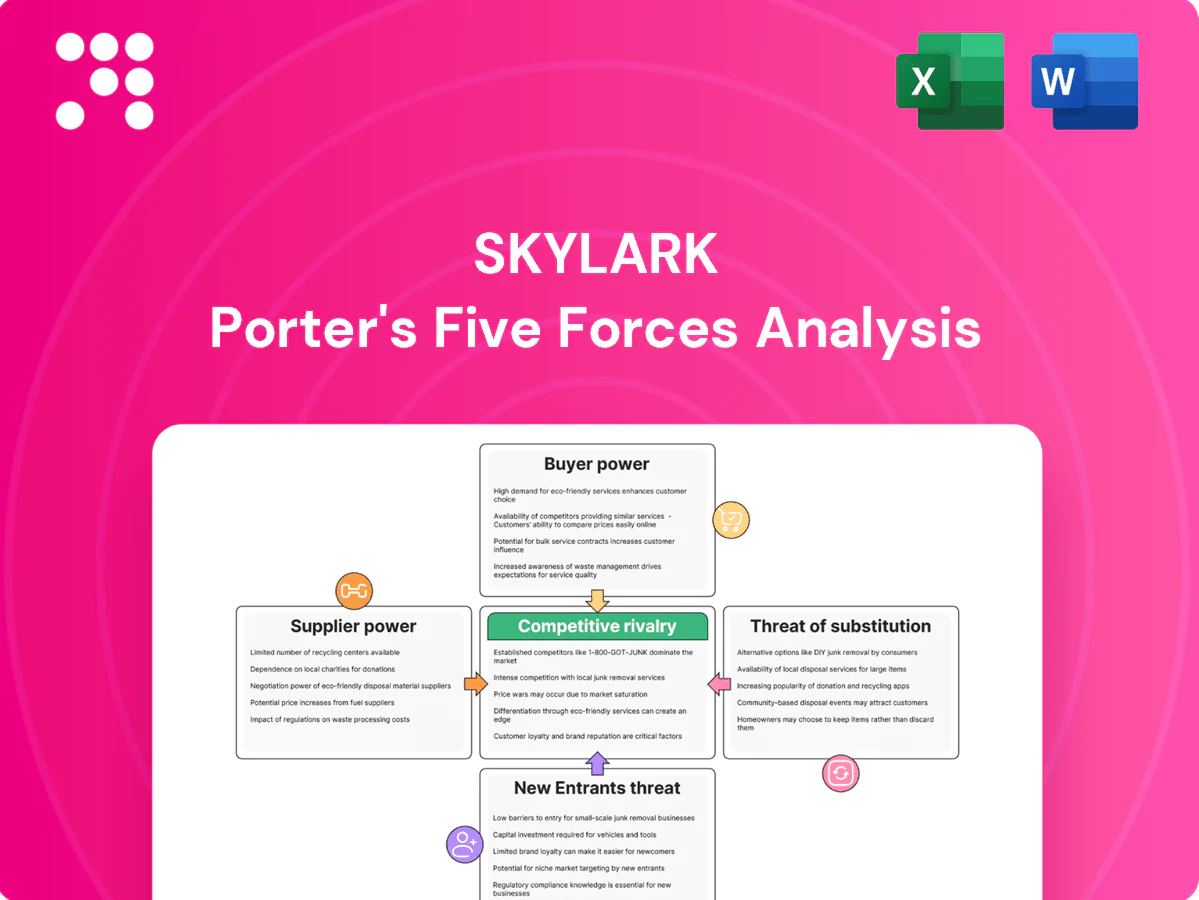
Skylark Porter's Five Forces Analysis

Don't Miss the Bigger Picture
Skylark’s Porter's Five Forces snapshot highlights competitive rivalry, supplier and buyer pressures, and substitute threats shaping its market position. This brief overview surfaces key strategic tensions and potential risks for investors and managers. Unlock the full Porter's Five Forces Analysis to explore Skylark’s competitive dynamics, market pressures, and strategic advantages in detail.
Suppliers Bargaining Power

Scale-driven sourcing
Skylark’s scale—about 2,800 restaurants and reported consolidated net sales of roughly 429 billion yen in FY2023—enables bulk purchasing and multi-year supply contracts that cut per-unit costs and strengthen price negotiation leverage. Suppliers face the risk of losing substantial volumes if delisted, reducing their bargaining power. Multi-brand demand lets Skylark reallocate ingredients across menus to optimize supply and costs.
Multi-sourcing and switching
Skylark multi-sources key inputs such as proteins, produce, and dry goods, which diversifies supplier risk and lowers switching costs for commodity items.
Specialized SKUs and proprietary sauces create localized dependence, increasing bargaining power for those specific suppliers.
Contractual terms and QA standards—including tiered service levels and approved supplier lists—moderate the impact of abrupt supplier changes.

Commodity and FX exposure
Food inputs for Skylark are exposed to global commodity cycles—FAO Food Price Index averaged about 118 in 2024—and to JPY moves (USD/JPY traded near 150 in 2024), so raw-cost inflation can compress margins despite scale purchasing. Hedging and menu repricing typically lag by 1–3 months and only partially offset price shocks, leaving volatility-linked margin risk. Seasonality and weather (El Niño-linked yield variability) further tighten supplier leverage.

Logistics and cold chain
Reliable nationwide distribution and cold chain are critical for quality and safety; the global cold chain market was valued at about USD 238 billion in 2024, underscoring its scale. Concentration among logistics providers, with top carriers controlling a majority of refrigerated lanes, raises switching costs and supplier leverage. Any disruption—weather, strike or port delay—increases supplier power temporarily. Skylark’s SOPs and multi-node redundancy mitigate outage impact and preserve safety.
- 2024 market size: USD 238B
- High carrier concentration → elevated switching costs
- Disruptions temporarily boost supplier leverage
- Skylark: SOPs + redundancy to reduce risk
Regulatory and safety compliance
Japanese food safety and traceability rules significantly narrow Skylarks qualified supplier pool, raising entry barriers and reducing supplier price-cutting power; compliance typically increases supplier operating costs by roughly 5–15% in 2024 estimates, limiting margin-led discounts.
- Approved vendor lists create moderate stickiness, raising switching costs.
- Supplier audits and co-development improve consistency but entrench relationships.
- Traceability requirements concentrate supply among certified vendors.
Scale reduces supplier power; cold-chain concentration, traceability and FX swings squeeze margins
Skylark’s scale (≈2,800 restaurants; ¥429bn net sales FY2023) + multi-sourcing limits supplier power for commodities, but specialized SKUs, concentrated cold-chain logistics (global market ≈USD 238bn in 2024) and traceability rules (compliance +5–15% cost) raise supplier leverage; FX/commodity swings (FAO index ~118, USD/JPY ~150 in 2024) keep margin risk.
| Metric | Value | Impact |
|---|---|---|
| Restaurants | ~2,800 | Scale buying |
| Net sales FY2023 | ¥429bn | Leverage |
| Cold chain 2024 | USD 238bn | Concentration |
| FAO index 2024 | ~118 | Cost pressure |
| USD/JPY 2024 | ~150 | Imported cost |
| Compliance cost | +5–15% | Supplier pricing |
What is included in the product
 Detailed Word Document
Uncovers key drivers of competition for Skylark by evaluating supplier and buyer power, rivalry, threat of new entrants and substitutes, and identifying disruptive forces and protective barriers, with strategic commentary and editable Word format for reports, investor decks, or academic use.

 Customizable Excel Spreadsheet
A one-sheet Skylark Porter's Five Forces summary that instantly maps competitive pressure with a clean spider chart—customizable inputs, no macros, and ready to drop into pitch decks or Excel dashboards to speed strategic decisions and relieve analysis bottlenecks.
Customers Bargaining Power

Price-sensitive families
Core Skylark customers are value-conscious, routinely comparing set menus and promotions across chains, with industry surveys in 2024 showing roughly 6 in 10 diners seek deals. Low switching costs—no loyalty lock-in—intensify price pressure, so small price cuts can shift off-peak traffic by double digits. Price elasticity rises noticeably during macro slowdowns as household disposable income tightens.
Abundant alternatives
Consumers can pick convenience stores, QSR, fast-casual and independents, and delivery apps — with the global online food delivery market exceeding $200 billion in 2024 — amplify visibility of thousands of alternatives. This breadth empowers customers to demand better value and variety, pressuring margins. Clear operational and brand differentiation is required to sustain traffic and loyalty.

Quality and consistency expectations
Repeat diners expect standardized taste, speed, and cleanliness; any variance often drives churn to substitutes, with 2024 industry reports showing over 65% of patrons willing to switch after a single bad experience. Online ratings amplify misses rapidly, as platforms convert one incident into widespread visibility. Skylark’s SOPs and intensive training programs are therefore essential to dampen buyer power and protect repeat revenue.

Digital discovery and reviews
Platforms and social media concentrate buyer influence via ratings and trends; 2024 studies show reviews affect purchase decisions for over 80% of consumers. Rapid negative sentiment can cut local unit sales quickly, so promotions must be data-driven. Loyalty programs and app engagement retain price-sensitive users.
Loyalty and delivery channels
Own apps, coupons and memberships reduce churn and blunt price sensitivity by boosting repeat spend, while third-party delivery platforms—charging roughly 15–30% commissions in 2024—aggregate demand but increase buyer leverage. Cross-channel consistency in pricing, fulfillment and messaging is required to maintain trust. Menu engineering steers customers toward higher-margin items to offset delivery fees.
- Third-party commissions: 15–30% (2024)
- Loyalty uplift: ~+12% spend
- Cross-channel consistency: critical for retention
- Menu engineering: increases margin capture
Value-driven diners: ~60% seek deals; >80% influenced by reviews; loyalty lifts spend ~12%
Skylark customers are highly value-sensitive—about 60% seek deals in 2024—and low switching costs make small price moves shift off-peak traffic. Online delivery (> $200B global, 2024) and third-party commissions (15–30%) amplify buyer leverage. Ratings influence purchase decisions for >80% of diners and a single bad experience drives churn in >65% of cases; loyalty programs lift spend ~+12%.
| Metric | 2024 |
|---|---|
| Deal-seeking diners | ~60% |
| Online delivery market | >$200B |
| 3P commissions | 15–30% |
| Ratings influence | >80% |
| Churn after bad CX | >65% |
| Loyalty uplift | ~+12% |
Same Document Delivered
Skylark Porter's Five Forces Analysis
This preview shows the exact Skylark Porter's Five Forces Analysis you'll receive immediately after purchase—no surprises or placeholders. It is the complete, professionally formatted file ready for download and use. The analysis covers supplier and buyer power, competitive rivalry, and entry/substitute threats in actionable detail.

Don't Miss the Bigger Picture
Skylark’s Porter's Five Forces snapshot highlights competitive rivalry, supplier and buyer pressures, and substitute threats shaping its market position. This brief overview surfaces key strategic tensions and potential risks for investors and managers. Unlock the full Porter's Five Forces Analysis to explore Skylark’s competitive dynamics, market pressures, and strategic advantages in detail.
Suppliers Bargaining Power
Scale-driven sourcing
Skylark’s scale—about 2,800 restaurants and reported consolidated net sales of roughly 429 billion yen in FY2023—enables bulk purchasing and multi-year supply contracts that cut per-unit costs and strengthen price negotiation leverage. Suppliers face the risk of losing substantial volumes if delisted, reducing their bargaining power. Multi-brand demand lets Skylark reallocate ingredients across menus to optimize supply and costs.
Multi-sourcing and switching
Skylark multi-sources key inputs such as proteins, produce, and dry goods, which diversifies supplier risk and lowers switching costs for commodity items.
Specialized SKUs and proprietary sauces create localized dependence, increasing bargaining power for those specific suppliers.
Contractual terms and QA standards—including tiered service levels and approved supplier lists—moderate the impact of abrupt supplier changes.
Commodity and FX exposure
Food inputs for Skylark are exposed to global commodity cycles—FAO Food Price Index averaged about 118 in 2024—and to JPY moves (USD/JPY traded near 150 in 2024), so raw-cost inflation can compress margins despite scale purchasing. Hedging and menu repricing typically lag by 1–3 months and only partially offset price shocks, leaving volatility-linked margin risk. Seasonality and weather (El Niño-linked yield variability) further tighten supplier leverage.
Logistics and cold chain
Reliable nationwide distribution and cold chain are critical for quality and safety; the global cold chain market was valued at about USD 238 billion in 2024, underscoring its scale. Concentration among logistics providers, with top carriers controlling a majority of refrigerated lanes, raises switching costs and supplier leverage. Any disruption—weather, strike or port delay—increases supplier power temporarily. Skylark’s SOPs and multi-node redundancy mitigate outage impact and preserve safety.
- 2024 market size: USD 238B
- High carrier concentration → elevated switching costs
- Disruptions temporarily boost supplier leverage
- Skylark: SOPs + redundancy to reduce risk
Regulatory and safety compliance
Japanese food safety and traceability rules significantly narrow Skylarks qualified supplier pool, raising entry barriers and reducing supplier price-cutting power; compliance typically increases supplier operating costs by roughly 5–15% in 2024 estimates, limiting margin-led discounts.
- Approved vendor lists create moderate stickiness, raising switching costs.
- Supplier audits and co-development improve consistency but entrench relationships.
- Traceability requirements concentrate supply among certified vendors.
Scale reduces supplier power; cold-chain concentration, traceability and FX swings squeeze margins
Skylark’s scale (≈2,800 restaurants; ¥429bn net sales FY2023) + multi-sourcing limits supplier power for commodities, but specialized SKUs, concentrated cold-chain logistics (global market ≈USD 238bn in 2024) and traceability rules (compliance +5–15% cost) raise supplier leverage; FX/commodity swings (FAO index ~118, USD/JPY ~150 in 2024) keep margin risk.
| Metric | Value | Impact |
|---|---|---|
| Restaurants | ~2,800 | Scale buying |
| Net sales FY2023 | ¥429bn | Leverage |
| Cold chain 2024 | USD 238bn | Concentration |
| FAO index 2024 | ~118 | Cost pressure |
| USD/JPY 2024 | ~150 | Imported cost |
| Compliance cost | +5–15% | Supplier pricing |
What is included in the product
Detailed Word Document
Uncovers key drivers of competition for Skylark by evaluating supplier and buyer power, rivalry, threat of new entrants and substitutes, and identifying disruptive forces and protective barriers, with strategic commentary and editable Word format for reports, investor decks, or academic use.
Customizable Excel Spreadsheet
A one-sheet Skylark Porter's Five Forces summary that instantly maps competitive pressure with a clean spider chart—customizable inputs, no macros, and ready to drop into pitch decks or Excel dashboards to speed strategic decisions and relieve analysis bottlenecks.
Customers Bargaining Power
Price-sensitive families
Core Skylark customers are value-conscious, routinely comparing set menus and promotions across chains, with industry surveys in 2024 showing roughly 6 in 10 diners seek deals. Low switching costs—no loyalty lock-in—intensify price pressure, so small price cuts can shift off-peak traffic by double digits. Price elasticity rises noticeably during macro slowdowns as household disposable income tightens.
Abundant alternatives
Consumers can pick convenience stores, QSR, fast-casual and independents, and delivery apps — with the global online food delivery market exceeding $200 billion in 2024 — amplify visibility of thousands of alternatives. This breadth empowers customers to demand better value and variety, pressuring margins. Clear operational and brand differentiation is required to sustain traffic and loyalty.
Quality and consistency expectations
Repeat diners expect standardized taste, speed, and cleanliness; any variance often drives churn to substitutes, with 2024 industry reports showing over 65% of patrons willing to switch after a single bad experience. Online ratings amplify misses rapidly, as platforms convert one incident into widespread visibility. Skylark’s SOPs and intensive training programs are therefore essential to dampen buyer power and protect repeat revenue.
Digital discovery and reviews
Platforms and social media concentrate buyer influence via ratings and trends; 2024 studies show reviews affect purchase decisions for over 80% of consumers. Rapid negative sentiment can cut local unit sales quickly, so promotions must be data-driven. Loyalty programs and app engagement retain price-sensitive users.
Loyalty and delivery channels
Own apps, coupons and memberships reduce churn and blunt price sensitivity by boosting repeat spend, while third-party delivery platforms—charging roughly 15–30% commissions in 2024—aggregate demand but increase buyer leverage. Cross-channel consistency in pricing, fulfillment and messaging is required to maintain trust. Menu engineering steers customers toward higher-margin items to offset delivery fees.
- Third-party commissions: 15–30% (2024)
- Loyalty uplift: ~+12% spend
- Cross-channel consistency: critical for retention
- Menu engineering: increases margin capture
Value-driven diners: ~60% seek deals; >80% influenced by reviews; loyalty lifts spend ~12%
Skylark customers are highly value-sensitive—about 60% seek deals in 2024—and low switching costs make small price moves shift off-peak traffic. Online delivery (> $200B global, 2024) and third-party commissions (15–30%) amplify buyer leverage. Ratings influence purchase decisions for >80% of diners and a single bad experience drives churn in >65% of cases; loyalty programs lift spend ~+12%.
| Metric | 2024 |
|---|---|
| Deal-seeking diners | ~60% |
| Online delivery market | >$200B |
| 3P commissions | 15–30% |
| Ratings influence | >80% |
| Churn after bad CX | >65% |
| Loyalty uplift | ~+12% |
Same Document Delivered
Skylark Porter's Five Forces Analysis
This preview shows the exact Skylark Porter's Five Forces Analysis you'll receive immediately after purchase—no surprises or placeholders. It is the complete, professionally formatted file ready for download and use. The analysis covers supplier and buyer power, competitive rivalry, and entry/substitute threats in actionable detail.
Original: $10.00
-65%$10.00
$3.50Description
Don't Miss the Bigger Picture
Skylark’s Porter's Five Forces snapshot highlights competitive rivalry, supplier and buyer pressures, and substitute threats shaping its market position. This brief overview surfaces key strategic tensions and potential risks for investors and managers. Unlock the full Porter's Five Forces Analysis to explore Skylark’s competitive dynamics, market pressures, and strategic advantages in detail.
Suppliers Bargaining Power
Scale-driven sourcing
Skylark’s scale—about 2,800 restaurants and reported consolidated net sales of roughly 429 billion yen in FY2023—enables bulk purchasing and multi-year supply contracts that cut per-unit costs and strengthen price negotiation leverage. Suppliers face the risk of losing substantial volumes if delisted, reducing their bargaining power. Multi-brand demand lets Skylark reallocate ingredients across menus to optimize supply and costs.
Multi-sourcing and switching
Skylark multi-sources key inputs such as proteins, produce, and dry goods, which diversifies supplier risk and lowers switching costs for commodity items.
Specialized SKUs and proprietary sauces create localized dependence, increasing bargaining power for those specific suppliers.
Contractual terms and QA standards—including tiered service levels and approved supplier lists—moderate the impact of abrupt supplier changes.
Commodity and FX exposure
Food inputs for Skylark are exposed to global commodity cycles—FAO Food Price Index averaged about 118 in 2024—and to JPY moves (USD/JPY traded near 150 in 2024), so raw-cost inflation can compress margins despite scale purchasing. Hedging and menu repricing typically lag by 1–3 months and only partially offset price shocks, leaving volatility-linked margin risk. Seasonality and weather (El Niño-linked yield variability) further tighten supplier leverage.
Logistics and cold chain
Reliable nationwide distribution and cold chain are critical for quality and safety; the global cold chain market was valued at about USD 238 billion in 2024, underscoring its scale. Concentration among logistics providers, with top carriers controlling a majority of refrigerated lanes, raises switching costs and supplier leverage. Any disruption—weather, strike or port delay—increases supplier power temporarily. Skylark’s SOPs and multi-node redundancy mitigate outage impact and preserve safety.
- 2024 market size: USD 238B
- High carrier concentration → elevated switching costs
- Disruptions temporarily boost supplier leverage
- Skylark: SOPs + redundancy to reduce risk
Regulatory and safety compliance
Japanese food safety and traceability rules significantly narrow Skylarks qualified supplier pool, raising entry barriers and reducing supplier price-cutting power; compliance typically increases supplier operating costs by roughly 5–15% in 2024 estimates, limiting margin-led discounts.
- Approved vendor lists create moderate stickiness, raising switching costs.
- Supplier audits and co-development improve consistency but entrench relationships.
- Traceability requirements concentrate supply among certified vendors.
Scale reduces supplier power; cold-chain concentration, traceability and FX swings squeeze margins
Skylark’s scale (≈2,800 restaurants; ¥429bn net sales FY2023) + multi-sourcing limits supplier power for commodities, but specialized SKUs, concentrated cold-chain logistics (global market ≈USD 238bn in 2024) and traceability rules (compliance +5–15% cost) raise supplier leverage; FX/commodity swings (FAO index ~118, USD/JPY ~150 in 2024) keep margin risk.
| Metric | Value | Impact |
|---|---|---|
| Restaurants | ~2,800 | Scale buying |
| Net sales FY2023 | ¥429bn | Leverage |
| Cold chain 2024 | USD 238bn | Concentration |
| FAO index 2024 | ~118 | Cost pressure |
| USD/JPY 2024 | ~150 | Imported cost |
| Compliance cost | +5–15% | Supplier pricing |
What is included in the product
Detailed Word Document
Uncovers key drivers of competition for Skylark by evaluating supplier and buyer power, rivalry, threat of new entrants and substitutes, and identifying disruptive forces and protective barriers, with strategic commentary and editable Word format for reports, investor decks, or academic use.
Customizable Excel Spreadsheet
A one-sheet Skylark Porter's Five Forces summary that instantly maps competitive pressure with a clean spider chart—customizable inputs, no macros, and ready to drop into pitch decks or Excel dashboards to speed strategic decisions and relieve analysis bottlenecks.
Customers Bargaining Power
Price-sensitive families
Core Skylark customers are value-conscious, routinely comparing set menus and promotions across chains, with industry surveys in 2024 showing roughly 6 in 10 diners seek deals. Low switching costs—no loyalty lock-in—intensify price pressure, so small price cuts can shift off-peak traffic by double digits. Price elasticity rises noticeably during macro slowdowns as household disposable income tightens.
Abundant alternatives
Consumers can pick convenience stores, QSR, fast-casual and independents, and delivery apps — with the global online food delivery market exceeding $200 billion in 2024 — amplify visibility of thousands of alternatives. This breadth empowers customers to demand better value and variety, pressuring margins. Clear operational and brand differentiation is required to sustain traffic and loyalty.
Quality and consistency expectations
Repeat diners expect standardized taste, speed, and cleanliness; any variance often drives churn to substitutes, with 2024 industry reports showing over 65% of patrons willing to switch after a single bad experience. Online ratings amplify misses rapidly, as platforms convert one incident into widespread visibility. Skylark’s SOPs and intensive training programs are therefore essential to dampen buyer power and protect repeat revenue.
Digital discovery and reviews
Platforms and social media concentrate buyer influence via ratings and trends; 2024 studies show reviews affect purchase decisions for over 80% of consumers. Rapid negative sentiment can cut local unit sales quickly, so promotions must be data-driven. Loyalty programs and app engagement retain price-sensitive users.
Loyalty and delivery channels
Own apps, coupons and memberships reduce churn and blunt price sensitivity by boosting repeat spend, while third-party delivery platforms—charging roughly 15–30% commissions in 2024—aggregate demand but increase buyer leverage. Cross-channel consistency in pricing, fulfillment and messaging is required to maintain trust. Menu engineering steers customers toward higher-margin items to offset delivery fees.
- Third-party commissions: 15–30% (2024)
- Loyalty uplift: ~+12% spend
- Cross-channel consistency: critical for retention
- Menu engineering: increases margin capture
Value-driven diners: ~60% seek deals; >80% influenced by reviews; loyalty lifts spend ~12%
Skylark customers are highly value-sensitive—about 60% seek deals in 2024—and low switching costs make small price moves shift off-peak traffic. Online delivery (> $200B global, 2024) and third-party commissions (15–30%) amplify buyer leverage. Ratings influence purchase decisions for >80% of diners and a single bad experience drives churn in >65% of cases; loyalty programs lift spend ~+12%.
| Metric | 2024 |
|---|---|
| Deal-seeking diners | ~60% |
| Online delivery market | >$200B |
| 3P commissions | 15–30% |
| Ratings influence | >80% |
| Churn after bad CX | >65% |
| Loyalty uplift | ~+12% |
Same Document Delivered
Skylark Porter's Five Forces Analysis
This preview shows the exact Skylark Porter's Five Forces Analysis you'll receive immediately after purchase—no surprises or placeholders. It is the complete, professionally formatted file ready for download and use. The analysis covers supplier and buyer power, competitive rivalry, and entry/substitute threats in actionable detail.











