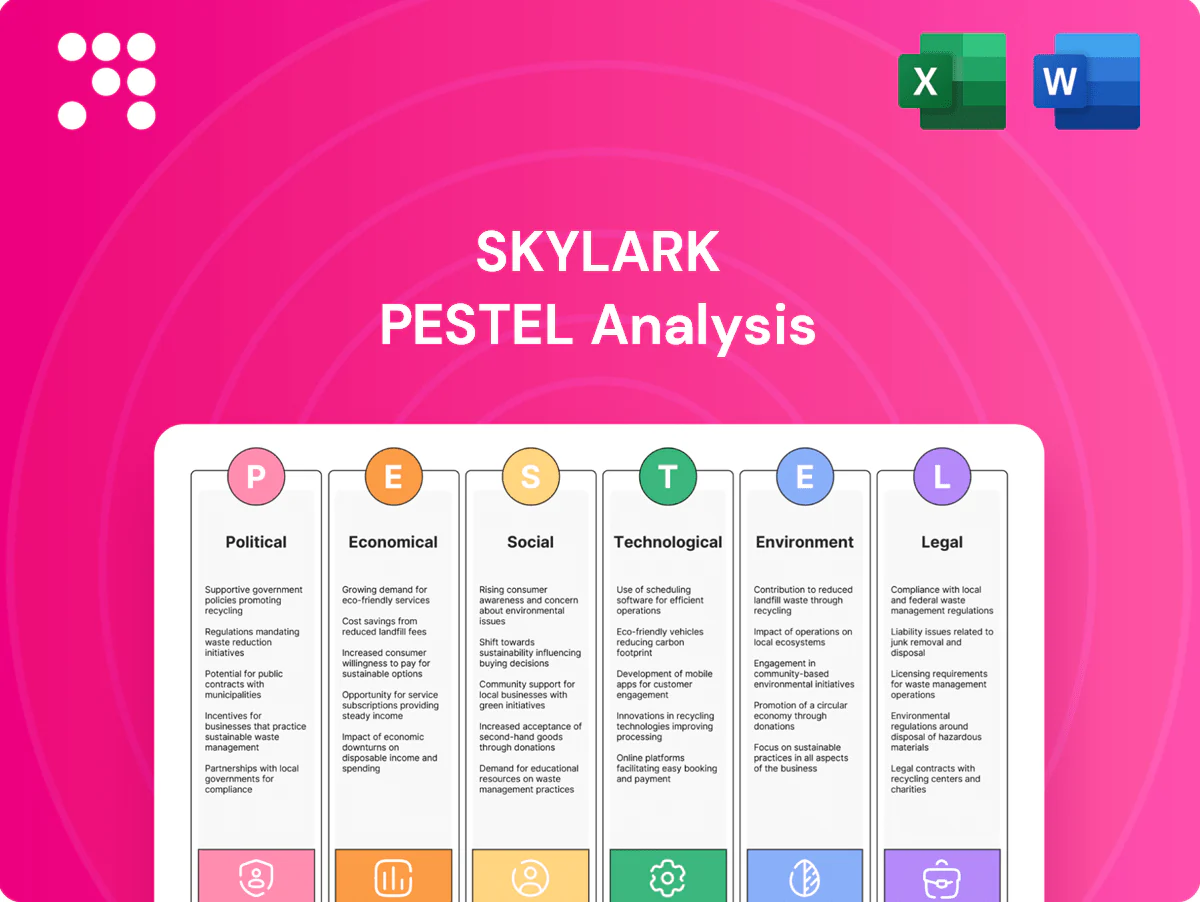
Skylark PESTLE Analysis

Skip the Research. Get the Strategy.
Discover how macro-forces shape Skylark’s strategy and risk profile in our concise PESTLE overview. Investors and strategists will find actionable signals on regulation, tech shifts, and environmental pressures. Buy the full PESTLE for the complete, editable report and instant insights.
Political factors

Food security and import dependencies
Japan's food self-sufficiency was 38% (calorie basis, MAFF 2022), with wheat largely imported and most beef and edible oils sourced abroad, exposing Skylark to exporter policy shifts. Government stockpiling and price-stabilization measures exist but are uneven by commodity, buffering some shocks. Monitoring MAFF policy moves and bilateral food agreements helps forecast cost pass-through windows. Diversifying supplier origins reduces political concentration risk.
Trade agreements and tariffs
Japan’s EPAs and CPTPP have eliminated or lowered tariffs on roughly 95% of tariff lines, easing input costs for ingredients and supporting menu cost control. Renegotiations or safeguard clauses can reintroduce volatility in meat and dairy prices. Skylark can lock benefits via long-term supply contracts aligned to tariff phase-out schedules. Cross-border expansion should map menu cuisine mix to favorable tariff lines to preserve margins.

Geopolitical tensions and logistics
Regional tensions have forced many carriers to reroute around Africa, adding roughly 8–10 days to transit and pushing some freight rates up to 20% during 2023–24, while insurance premiums for high-risk corridors rose materially. Port congestion and rerouting inflate lead times for imported staples, so Skylark’s menu engineering must enable rapid substitution to domestic or alternative sources. Multi-port procurement and prudent safety stocks reduce exposure to political-logistics shocks.

Tourism and regional revitalization policy
Inbound tourism recovery—international arrivals reached about 85% of 2019 levels by mid-2024 (UNWTO)—raises casual-dining demand near transit hubs and attractions, benefiting operators like Skylark (≈2,100 outlets FY2023) seeking placement gains. Local revitalization grants and government tourism corridors enable new outlet formats in underserved regions, while multilingual menus and tax-free alignment lift tourist conversion.
- Inbound arrivals ~85% of 2019 (mid-2024)
- Skylark ≈2,100 outlets (FY2023)
- Grants enable low-capex formats in underserved areas
- Multilingual menus + tax-free increase tourist spend/conversion
Public health preparedness policy
Post-COVID legal frameworks, including Japan’s revisions to infectious-disease legislation in 2020–21, allow authorities to reimpose capacity or operating-hour limits during outbreaks; governments continue offering targeted grants and tax incentives for infection control and digital ordering to lower compliance costs. Skylark must keep agile shift scheduling and expand off-premise channels; scenario planning tied to alert levels preserves revenue resilience.
- Maintain agile shifts
- Expand off-premise/delivery
- Link scenarios to alert levels
- Leverage infection-control subsidies
Import risk, +8-10 day freight delays and tourism rebound reshape Japan restaurant outlook
Japan’s 38% food self-sufficiency (calorie, MAFF 2022) and heavy import reliance expose Skylark to exporter policy and tariff risk, though EPAs/CPTPP cover ~95% of tariff lines. Regional tensions and rerouting added ~8–10 days and raised freight up to 20% in 2023–24, pressuring lead times and costs. Inbound tourism (~85% of 2019 mid-2024) and ≈2,100 outlets (FY2023) support demand recovery.
| Indicator | Value |
|---|---|
| Food self-sufficiency | 38% (MAFF 2022) |
| EPA/CPTPP tariff coverage | ~95% lines |
| Freight impact | +8–10 days; up to +20% rates (2023–24) |
| Inbound tourism | ~85% of 2019 (mid-2024, UNWTO) |
| Skylark outlets | ≈2,100 (FY2023) |
What is included in the product
 Detailed Word Document
Explores how Political, Economic, Social, Technological, Environmental and Legal factors uniquely impact the Skylark, with data-backed trends, region- and industry-specific examples, and multiple sub-points; designed by strategy professionals to inform executives, support scenario planning, funding pitches, and reveal external threats and opportunities.

 Customizable Excel Spreadsheet
Skylark PESTLE delivers a clean, visually segmented summary of external factors, letting teams quickly reference risks and opportunities during meetings or drop concise slides into presentations for fast alignment.
Economic factors

Inflation and input cost volatility
Global food inflation remained elevated through 2024, with the FAO Food Price Index averaging about 118, while global oil prices averaged near USD 80–90/barrel in 2024, squeezing family-dining margins. Frequent menu price revisions risk demand elasticity among Skylark’s value-seeking customers, jeopardizing traffic. Skylark must deploy granular cost-tracking and protect KVI items to sustain visits. Hedging and supplier co-innovation can stabilize costs for key SKUs.
Yen weakness and FX exposure
Yen weakness (JPY ~155 per USD in mid‑2025) raises import bills for grains, meats and oils used by Skylark, squeezing margins as menu repricing lags during rapid FX moves. Natural hedges are limited given Skylark's overwhelmingly domestic sales, while FX pass‑through is partial; the company mitigates exposure via FX clauses, staggered procurement cycles and forward hedging.

Wage growth and labor scarcity
Tight labor markets in Japan (unemployment ~2.5% and jobs-to-applicants ~1.39 in 2024) have pushed hourly wages higher, raising hiring and turnover costs for Skylark. Defending unit economics will require productivity investments and multi-skilling to offset wage inflation (nominal cash earnings rose about 3.3% YoY in 2024). Dynamic scheduling tied to demand curves reduces costly overtime. Value menus should be reweighted to reflect labor content across items.

Consumer confidence and discretionary spend
Macroeconomic slowdowns reduce dining-out frequency—families cut visits first; Japan headline CPI was roughly 3% in 2024, weighing on real discretionary spend. Promotions and set menus can trade customers down without losing visits; Skylark must monitor traffic mix across dayparts to protect peak profitability and use loyalty offers to stabilize repeat behavior.
- Monitor daypart mix
- Use promotions to retain traffic
- Deploy loyalty to boost repeat rate
Inbound tourism recovery
Inbound arrivals recovered to roughly 80% of 2019 levels by 2024, lifting sales in urban hubs and travel nodes such as Tokyo, Osaka and major airports. Yen weakness through 2023–24 improved price competitiveness, making Japan dining attractive and favoring reliable chains. Seasonal staffing plus multilingual digital ordering can capture incremental demand, while menu localization typically raises tourist check sizes by ~5–10%.
- Recovery: ~80% of 2019 arrivals (2024)
- Currency: weaker yen boosts tourist spend
- Ops: seasonal hires + multilingual apps
- Revenue: menu localization ↑ check size ~5–10%
Import risk, +8-10 day freight delays and tourism rebound reshape Japan restaurant outlook
Elevated input costs (FAO FPI ~118; oil USD80–90/bbl in 2024) and JPY weakness (~¥155/USD mid‑2025) squeeze Skylark margins, forcing selective price moves to protect traffic. Tight labor (unemp ~2.5%; jobs/applicants ~1.39) and wages +3.3% raise operating costs; demand softness and 80% recovery in inbound arrivals (2024) require targeted promotions and localized menus to defend check and visits.
| Metric | Value (year) |
|---|---|
| FAO Food Price Index | ~118 (2024) |
| Oil | USD80–90/bbl (2024) |
| JPY | ~155/USD (mid‑2025) |
| Unemployment | 2.5% (2024) |
| Jobs/applicants | 1.39 (2024) |
| Nominal earnings | +3.3% YoY (2024) |
| Inbound arrivals | ~80% of 2019 (2024) |
Preview Before You Purchase
Skylark PESTLE Analysis
The preview shown here is the exact Skylark PESTLE Analysis document you’ll receive after purchase—fully formatted and ready to use. It includes complete political, economic, social, technological, legal and environmental insights, charts and clear, actionable recommendations. After payment you’ll instantly download this identical, professional file with no placeholders or surprises.

Skip the Research. Get the Strategy.
Discover how macro-forces shape Skylark’s strategy and risk profile in our concise PESTLE overview. Investors and strategists will find actionable signals on regulation, tech shifts, and environmental pressures. Buy the full PESTLE for the complete, editable report and instant insights.
Political factors
Food security and import dependencies
Japan's food self-sufficiency was 38% (calorie basis, MAFF 2022), with wheat largely imported and most beef and edible oils sourced abroad, exposing Skylark to exporter policy shifts. Government stockpiling and price-stabilization measures exist but are uneven by commodity, buffering some shocks. Monitoring MAFF policy moves and bilateral food agreements helps forecast cost pass-through windows. Diversifying supplier origins reduces political concentration risk.
Trade agreements and tariffs
Japan’s EPAs and CPTPP have eliminated or lowered tariffs on roughly 95% of tariff lines, easing input costs for ingredients and supporting menu cost control. Renegotiations or safeguard clauses can reintroduce volatility in meat and dairy prices. Skylark can lock benefits via long-term supply contracts aligned to tariff phase-out schedules. Cross-border expansion should map menu cuisine mix to favorable tariff lines to preserve margins.
Geopolitical tensions and logistics
Regional tensions have forced many carriers to reroute around Africa, adding roughly 8–10 days to transit and pushing some freight rates up to 20% during 2023–24, while insurance premiums for high-risk corridors rose materially. Port congestion and rerouting inflate lead times for imported staples, so Skylark’s menu engineering must enable rapid substitution to domestic or alternative sources. Multi-port procurement and prudent safety stocks reduce exposure to political-logistics shocks.
Tourism and regional revitalization policy
Inbound tourism recovery—international arrivals reached about 85% of 2019 levels by mid-2024 (UNWTO)—raises casual-dining demand near transit hubs and attractions, benefiting operators like Skylark (≈2,100 outlets FY2023) seeking placement gains. Local revitalization grants and government tourism corridors enable new outlet formats in underserved regions, while multilingual menus and tax-free alignment lift tourist conversion.
- Inbound arrivals ~85% of 2019 (mid-2024)
- Skylark ≈2,100 outlets (FY2023)
- Grants enable low-capex formats in underserved areas
- Multilingual menus + tax-free increase tourist spend/conversion
Public health preparedness policy
Post-COVID legal frameworks, including Japan’s revisions to infectious-disease legislation in 2020–21, allow authorities to reimpose capacity or operating-hour limits during outbreaks; governments continue offering targeted grants and tax incentives for infection control and digital ordering to lower compliance costs. Skylark must keep agile shift scheduling and expand off-premise channels; scenario planning tied to alert levels preserves revenue resilience.
- Maintain agile shifts
- Expand off-premise/delivery
- Link scenarios to alert levels
- Leverage infection-control subsidies
Import risk, +8-10 day freight delays and tourism rebound reshape Japan restaurant outlook
Japan’s 38% food self-sufficiency (calorie, MAFF 2022) and heavy import reliance expose Skylark to exporter policy and tariff risk, though EPAs/CPTPP cover ~95% of tariff lines. Regional tensions and rerouting added ~8–10 days and raised freight up to 20% in 2023–24, pressuring lead times and costs. Inbound tourism (~85% of 2019 mid-2024) and ≈2,100 outlets (FY2023) support demand recovery.
| Indicator | Value |
|---|---|
| Food self-sufficiency | 38% (MAFF 2022) |
| EPA/CPTPP tariff coverage | ~95% lines |
| Freight impact | +8–10 days; up to +20% rates (2023–24) |
| Inbound tourism | ~85% of 2019 (mid-2024, UNWTO) |
| Skylark outlets | ≈2,100 (FY2023) |
What is included in the product
Detailed Word Document
Explores how Political, Economic, Social, Technological, Environmental and Legal factors uniquely impact the Skylark, with data-backed trends, region- and industry-specific examples, and multiple sub-points; designed by strategy professionals to inform executives, support scenario planning, funding pitches, and reveal external threats and opportunities.
Customizable Excel Spreadsheet
Skylark PESTLE delivers a clean, visually segmented summary of external factors, letting teams quickly reference risks and opportunities during meetings or drop concise slides into presentations for fast alignment.
Economic factors
Inflation and input cost volatility
Global food inflation remained elevated through 2024, with the FAO Food Price Index averaging about 118, while global oil prices averaged near USD 80–90/barrel in 2024, squeezing family-dining margins. Frequent menu price revisions risk demand elasticity among Skylark’s value-seeking customers, jeopardizing traffic. Skylark must deploy granular cost-tracking and protect KVI items to sustain visits. Hedging and supplier co-innovation can stabilize costs for key SKUs.
Yen weakness and FX exposure
Yen weakness (JPY ~155 per USD in mid‑2025) raises import bills for grains, meats and oils used by Skylark, squeezing margins as menu repricing lags during rapid FX moves. Natural hedges are limited given Skylark's overwhelmingly domestic sales, while FX pass‑through is partial; the company mitigates exposure via FX clauses, staggered procurement cycles and forward hedging.
Wage growth and labor scarcity
Tight labor markets in Japan (unemployment ~2.5% and jobs-to-applicants ~1.39 in 2024) have pushed hourly wages higher, raising hiring and turnover costs for Skylark. Defending unit economics will require productivity investments and multi-skilling to offset wage inflation (nominal cash earnings rose about 3.3% YoY in 2024). Dynamic scheduling tied to demand curves reduces costly overtime. Value menus should be reweighted to reflect labor content across items.
Consumer confidence and discretionary spend
Macroeconomic slowdowns reduce dining-out frequency—families cut visits first; Japan headline CPI was roughly 3% in 2024, weighing on real discretionary spend. Promotions and set menus can trade customers down without losing visits; Skylark must monitor traffic mix across dayparts to protect peak profitability and use loyalty offers to stabilize repeat behavior.
- Monitor daypart mix
- Use promotions to retain traffic
- Deploy loyalty to boost repeat rate
Inbound tourism recovery
Inbound arrivals recovered to roughly 80% of 2019 levels by 2024, lifting sales in urban hubs and travel nodes such as Tokyo, Osaka and major airports. Yen weakness through 2023–24 improved price competitiveness, making Japan dining attractive and favoring reliable chains. Seasonal staffing plus multilingual digital ordering can capture incremental demand, while menu localization typically raises tourist check sizes by ~5–10%.
- Recovery: ~80% of 2019 arrivals (2024)
- Currency: weaker yen boosts tourist spend
- Ops: seasonal hires + multilingual apps
- Revenue: menu localization ↑ check size ~5–10%
Import risk, +8-10 day freight delays and tourism rebound reshape Japan restaurant outlook
Elevated input costs (FAO FPI ~118; oil USD80–90/bbl in 2024) and JPY weakness (~¥155/USD mid‑2025) squeeze Skylark margins, forcing selective price moves to protect traffic. Tight labor (unemp ~2.5%; jobs/applicants ~1.39) and wages +3.3% raise operating costs; demand softness and 80% recovery in inbound arrivals (2024) require targeted promotions and localized menus to defend check and visits.
| Metric | Value (year) |
|---|---|
| FAO Food Price Index | ~118 (2024) |
| Oil | USD80–90/bbl (2024) |
| JPY | ~155/USD (mid‑2025) |
| Unemployment | 2.5% (2024) |
| Jobs/applicants | 1.39 (2024) |
| Nominal earnings | +3.3% YoY (2024) |
| Inbound arrivals | ~80% of 2019 (2024) |
Preview Before You Purchase
Skylark PESTLE Analysis
The preview shown here is the exact Skylark PESTLE Analysis document you’ll receive after purchase—fully formatted and ready to use. It includes complete political, economic, social, technological, legal and environmental insights, charts and clear, actionable recommendations. After payment you’ll instantly download this identical, professional file with no placeholders or surprises.
Original: $10.00
-65%$10.00
$3.50Description
Skip the Research. Get the Strategy.
Discover how macro-forces shape Skylark’s strategy and risk profile in our concise PESTLE overview. Investors and strategists will find actionable signals on regulation, tech shifts, and environmental pressures. Buy the full PESTLE for the complete, editable report and instant insights.
Political factors
Food security and import dependencies
Japan's food self-sufficiency was 38% (calorie basis, MAFF 2022), with wheat largely imported and most beef and edible oils sourced abroad, exposing Skylark to exporter policy shifts. Government stockpiling and price-stabilization measures exist but are uneven by commodity, buffering some shocks. Monitoring MAFF policy moves and bilateral food agreements helps forecast cost pass-through windows. Diversifying supplier origins reduces political concentration risk.
Trade agreements and tariffs
Japan’s EPAs and CPTPP have eliminated or lowered tariffs on roughly 95% of tariff lines, easing input costs for ingredients and supporting menu cost control. Renegotiations or safeguard clauses can reintroduce volatility in meat and dairy prices. Skylark can lock benefits via long-term supply contracts aligned to tariff phase-out schedules. Cross-border expansion should map menu cuisine mix to favorable tariff lines to preserve margins.
Geopolitical tensions and logistics
Regional tensions have forced many carriers to reroute around Africa, adding roughly 8–10 days to transit and pushing some freight rates up to 20% during 2023–24, while insurance premiums for high-risk corridors rose materially. Port congestion and rerouting inflate lead times for imported staples, so Skylark’s menu engineering must enable rapid substitution to domestic or alternative sources. Multi-port procurement and prudent safety stocks reduce exposure to political-logistics shocks.
Tourism and regional revitalization policy
Inbound tourism recovery—international arrivals reached about 85% of 2019 levels by mid-2024 (UNWTO)—raises casual-dining demand near transit hubs and attractions, benefiting operators like Skylark (≈2,100 outlets FY2023) seeking placement gains. Local revitalization grants and government tourism corridors enable new outlet formats in underserved regions, while multilingual menus and tax-free alignment lift tourist conversion.
- Inbound arrivals ~85% of 2019 (mid-2024)
- Skylark ≈2,100 outlets (FY2023)
- Grants enable low-capex formats in underserved areas
- Multilingual menus + tax-free increase tourist spend/conversion
Public health preparedness policy
Post-COVID legal frameworks, including Japan’s revisions to infectious-disease legislation in 2020–21, allow authorities to reimpose capacity or operating-hour limits during outbreaks; governments continue offering targeted grants and tax incentives for infection control and digital ordering to lower compliance costs. Skylark must keep agile shift scheduling and expand off-premise channels; scenario planning tied to alert levels preserves revenue resilience.
- Maintain agile shifts
- Expand off-premise/delivery
- Link scenarios to alert levels
- Leverage infection-control subsidies
Import risk, +8-10 day freight delays and tourism rebound reshape Japan restaurant outlook
Japan’s 38% food self-sufficiency (calorie, MAFF 2022) and heavy import reliance expose Skylark to exporter policy and tariff risk, though EPAs/CPTPP cover ~95% of tariff lines. Regional tensions and rerouting added ~8–10 days and raised freight up to 20% in 2023–24, pressuring lead times and costs. Inbound tourism (~85% of 2019 mid-2024) and ≈2,100 outlets (FY2023) support demand recovery.
| Indicator | Value |
|---|---|
| Food self-sufficiency | 38% (MAFF 2022) |
| EPA/CPTPP tariff coverage | ~95% lines |
| Freight impact | +8–10 days; up to +20% rates (2023–24) |
| Inbound tourism | ~85% of 2019 (mid-2024, UNWTO) |
| Skylark outlets | ≈2,100 (FY2023) |
What is included in the product
Detailed Word Document
Explores how Political, Economic, Social, Technological, Environmental and Legal factors uniquely impact the Skylark, with data-backed trends, region- and industry-specific examples, and multiple sub-points; designed by strategy professionals to inform executives, support scenario planning, funding pitches, and reveal external threats and opportunities.
Customizable Excel Spreadsheet
Skylark PESTLE delivers a clean, visually segmented summary of external factors, letting teams quickly reference risks and opportunities during meetings or drop concise slides into presentations for fast alignment.
Economic factors
Inflation and input cost volatility
Global food inflation remained elevated through 2024, with the FAO Food Price Index averaging about 118, while global oil prices averaged near USD 80–90/barrel in 2024, squeezing family-dining margins. Frequent menu price revisions risk demand elasticity among Skylark’s value-seeking customers, jeopardizing traffic. Skylark must deploy granular cost-tracking and protect KVI items to sustain visits. Hedging and supplier co-innovation can stabilize costs for key SKUs.
Yen weakness and FX exposure
Yen weakness (JPY ~155 per USD in mid‑2025) raises import bills for grains, meats and oils used by Skylark, squeezing margins as menu repricing lags during rapid FX moves. Natural hedges are limited given Skylark's overwhelmingly domestic sales, while FX pass‑through is partial; the company mitigates exposure via FX clauses, staggered procurement cycles and forward hedging.
Wage growth and labor scarcity
Tight labor markets in Japan (unemployment ~2.5% and jobs-to-applicants ~1.39 in 2024) have pushed hourly wages higher, raising hiring and turnover costs for Skylark. Defending unit economics will require productivity investments and multi-skilling to offset wage inflation (nominal cash earnings rose about 3.3% YoY in 2024). Dynamic scheduling tied to demand curves reduces costly overtime. Value menus should be reweighted to reflect labor content across items.
Consumer confidence and discretionary spend
Macroeconomic slowdowns reduce dining-out frequency—families cut visits first; Japan headline CPI was roughly 3% in 2024, weighing on real discretionary spend. Promotions and set menus can trade customers down without losing visits; Skylark must monitor traffic mix across dayparts to protect peak profitability and use loyalty offers to stabilize repeat behavior.
- Monitor daypart mix
- Use promotions to retain traffic
- Deploy loyalty to boost repeat rate
Inbound tourism recovery
Inbound arrivals recovered to roughly 80% of 2019 levels by 2024, lifting sales in urban hubs and travel nodes such as Tokyo, Osaka and major airports. Yen weakness through 2023–24 improved price competitiveness, making Japan dining attractive and favoring reliable chains. Seasonal staffing plus multilingual digital ordering can capture incremental demand, while menu localization typically raises tourist check sizes by ~5–10%.
- Recovery: ~80% of 2019 arrivals (2024)
- Currency: weaker yen boosts tourist spend
- Ops: seasonal hires + multilingual apps
- Revenue: menu localization ↑ check size ~5–10%
Import risk, +8-10 day freight delays and tourism rebound reshape Japan restaurant outlook
Elevated input costs (FAO FPI ~118; oil USD80–90/bbl in 2024) and JPY weakness (~¥155/USD mid‑2025) squeeze Skylark margins, forcing selective price moves to protect traffic. Tight labor (unemp ~2.5%; jobs/applicants ~1.39) and wages +3.3% raise operating costs; demand softness and 80% recovery in inbound arrivals (2024) require targeted promotions and localized menus to defend check and visits.
| Metric | Value (year) |
|---|---|
| FAO Food Price Index | ~118 (2024) |
| Oil | USD80–90/bbl (2024) |
| JPY | ~155/USD (mid‑2025) |
| Unemployment | 2.5% (2024) |
| Jobs/applicants | 1.39 (2024) |
| Nominal earnings | +3.3% YoY (2024) |
| Inbound arrivals | ~80% of 2019 (2024) |
Preview Before You Purchase
Skylark PESTLE Analysis
The preview shown here is the exact Skylark PESTLE Analysis document you’ll receive after purchase—fully formatted and ready to use. It includes complete political, economic, social, technological, legal and environmental insights, charts and clear, actionable recommendations. After payment you’ll instantly download this identical, professional file with no placeholders or surprises.











