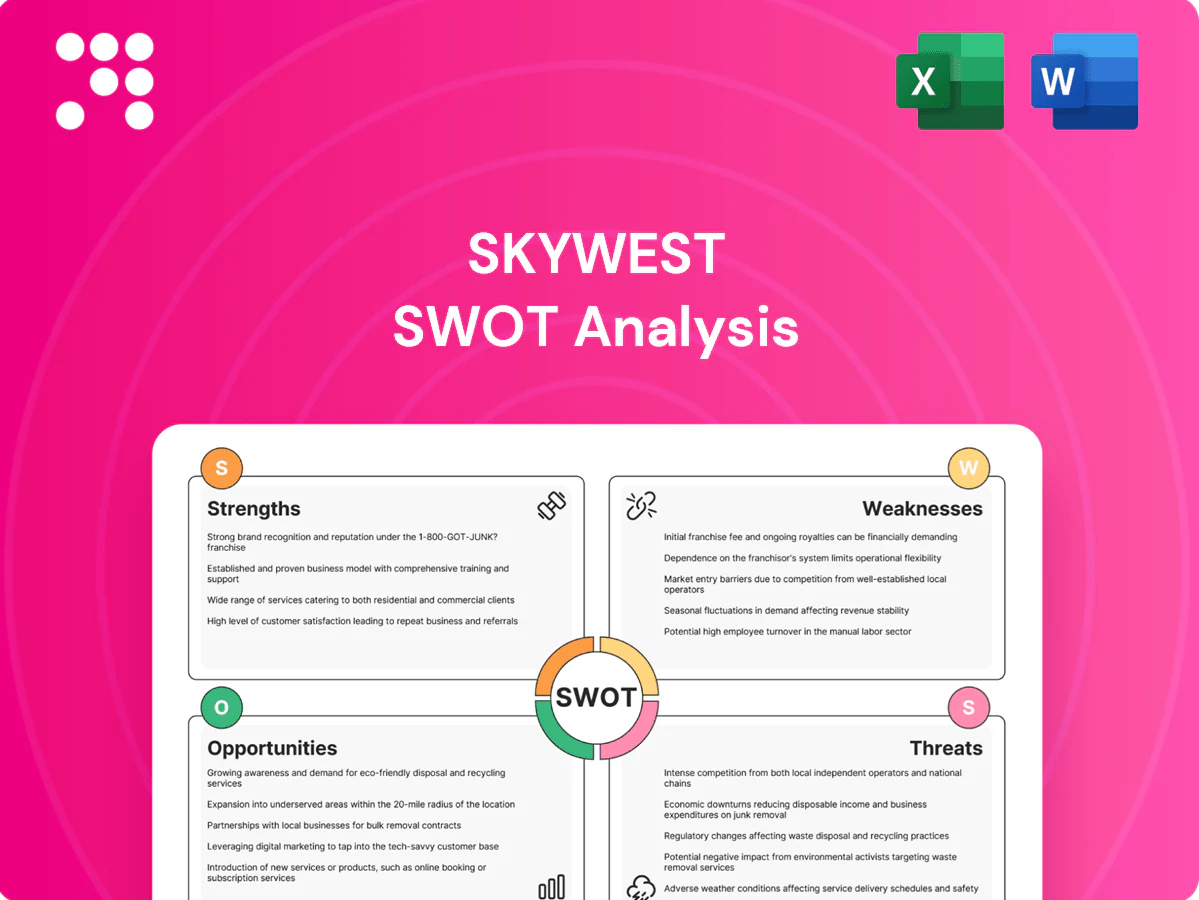
SkyWest SWOT Analysis

Make Insightful Decisions Backed by Expert Research
SkyWest’s reliability in regional networks, strong carrier partnerships, and efficient fleet mix contrast with exposure to cycle-sensitive demand, fuel volatility, and labor constraints. Our full SWOT unpacks strategic levers, financial context, and competitive risks in actionable detail. Purchase the complete report—Word and Excel deliverables—to plan, pitch, or invest with confidence.
Strengths

Largest regional scale
As North America’s largest regional contract carrier, SkyWest serves major partners including United, Delta, American and Alaska, leveraging network breadth and fleet depth smaller rivals lack. Its scale drives lower unit costs and supports industry-leading completion factors above 99% for partners. Scale also enhances bargaining power with OEMs, lessors and vendors, making SkyWest a preferred counterparty for reliable feed.
Diversified major partners
SkyWest operates regional flying for United, Delta, American, and Alaska, limiting single-customer risk and spreading exposure across four majors. That multi-partner mix smooths demand cycles and route shifts, enabling reallocation of capacity across networks as partner needs change. With a fleet of roughly 460 aircraft and 2024 operating revenues centered on regional flying, this diversification stabilizes revenue and aircraft utilization.

Contracted revenue model
SkyWest's capacity purchase agreements (CPAs) with United, Delta, American and Alaska provide cost pass-throughs and fixed margins that largely insulate the carrier from fuel and demand volatility. As of 2024, the CPA model delivers predictable cash flows that support financing and fleet-planning decisions. The structure prioritizes operational reliability over fare risk and enables management to focus on execution rather than retail demand swings.

Operational reliability
SkyWest is recognized for exceptional operational reliability, with completion factors above 99.5% and industry-leading on-time performance that mainline partners value for schedule integrity. That consistency supports CPA renewals and incremental block-hour awards from partners, reduces penalty exposure under performance clauses, and strengthens SkyWest’s competitive moat in RFPs.
- Completion factor: >99.5%
- Reduces contract penalties
- Drives CPA renewals & block-hour gains
Fleet and crew flexibility
SkyWest’s largely standardized regional-jet fleet (Embraer E175 and Bombardier/CRJ families) and broad domicile network enable efficient scheduling and quick gauge adjustments across markets, helping right-size capacity during peak and off-peak periods. Flexibility eases management of seasonality and IRROPS, while developed crew training pipelines support rapid redeployment across partners and bases.
- Standardized fleet: E175/CRJ
- Broad domiciles enable schedule efficiency
- Quick right-sizing by gauge and market
- Crew training supports rapid redeployment
North America's largest regional carrier (≈460 aircraft) delivers low unit costs, reliable CPAs
SkyWest’s scale as North America’s largest regional contract carrier (≈460 aircraft) yields lower unit costs, strong bargaining power with OEMs/lessors, and diversified exposure across United, Delta, American and Alaska. Long-term CPAs deliver predictable cash flows and margins, while operational reliability (completion factor >99.5%) secures CPA renewals and block-hour awards.
| Metric | Value |
|---|---|
| Fleet size | ≈460 aircraft |
| Partners | United, Delta, American, Alaska |
| Completion factor | >99.5% |
| Business model | Capacity Purchase Agreements |
What is included in the product
 Detailed Word Document
Provides a concise strategic assessment of SkyWest Airlines’ strengths, weaknesses, opportunities, and threats, highlighting operational scale and regional partnerships, fleet and contractual constraints, growth potential from capacity agreements, and market, regulatory, and competitive risks shaping its outlook.

 Customizable Excel Spreadsheet
Delivers a concise, visual SWOT matrix of SkyWest to rapidly align strategy and ease stakeholder briefings, with an editable structure for quick updates as operational or market conditions change.
Weaknesses

Partner concentration risk
Despite network diversification, SkyWest remains heavily reliant on its major partners—United, Delta, American and Alaska—which together account for over 80% of its capacity and block hours; any CPA non‑renewal, consolidation, or strategic shift could materially cut block hours and revenue. Renewal negotiations favor the majors, constraining SkyWest’s pricing power and limiting margin expansion—even small rate concessions can swing regional margins significantly.
Limited brand control
As a contract carrier, SkyWest has minimal influence over pricing, schedules or the passenger experience, leaving over 90% of revenue tied to CPA terms and partner decisions. It cannot build a consumer-facing brand or capture ancillary revenue streams, and reliance on partner-led network changes creates operational complexity. Brand invisibility limits strategic optionality beyond CPAs despite a fleet of roughly 450 aircraft.

Pilot supply constraints
Industry-wide pilot shortages strain SkyWest's staffing, training throughput and utilization, with Boeing's 2024 Pilot Outlook calling for 602,000 new civil aviation pilots globally over 2024–2043. Competition from mainline carriers elevates regional wage pressure and increases training and attrition-driven non-productive time and cost. These dynamics compress margins and can disrupt operational performance.

Aging 50-seat aircraft
Legacy 50-seat CRJ-200s incur rising maintenance and fuel inefficiencies as they age, pressuring unit economics; U.S. pilot scope clauses (limiting regional equipment and 50-seat equivalents) and constrained OEM availability complicate direct replacements, making phased retirements and precise backfill essential to avoid capacity gaps while managing near-term capex and operational complexity.
- 50-seat CRJ-200 aging fleet
- Scope clauses limit replacement options
- OEM production/backlog constrains buys
- Retirements need careful backfill
- Transition adds near-term capex & complexity
Scope clause dependency
SkyWest is constrained by partner airlines' pilot scope clauses that typically cap regional jets at 76 seats, restricting fleet gauge and the types of aircraft it can deploy. With a network of over 400 regional aircraft, this prevents scaling into larger, more fuel-efficient RJs and compresses unit-cost improvement opportunities. Growth and fleet strategy remain tied to union negotiations at major carriers, outside SkyWest's control.
- 76-seat scope cap limits aircraft types
- Network of over 400 regional aircraft affected
- Fleet growth contingent on partner union agreements
Regional airline exposed: >80% capacity tied to 4 majors, pilot shortage, aging 50-seat fleet
SkyWest depends on four majors for >80% of capacity and >90% of revenue via CPAs, exposing it to renewal and consolidation risk. Pilot shortages (Boeing 2024: 602,000 pilots needed globally 2024–2043) and mainline wage pressure raise staffing costs and attrition. Aging 50-seat CRJ-200s within a ~450-aircraft network increase maintenance and fuel unit costs amid scope-clause constraints.
| Metric | Value |
|---|---|
| Capacity concentration | >80% with 4 majors |
| Revenue tied to CPAs | >90% |
| Fleet size | ~450 aircraft |
What You See Is What You Get
SkyWest SWOT Analysis
This is the actual SkyWest SWOT analysis document you’ll receive upon purchase—professional, structured, and ready to use. The preview below is taken directly from the full report, so there are no surprises. Purchase unlocks the entire editable file with in-depth strengths, weaknesses, opportunities and threats.

Make Insightful Decisions Backed by Expert Research
SkyWest’s reliability in regional networks, strong carrier partnerships, and efficient fleet mix contrast with exposure to cycle-sensitive demand, fuel volatility, and labor constraints. Our full SWOT unpacks strategic levers, financial context, and competitive risks in actionable detail. Purchase the complete report—Word and Excel deliverables—to plan, pitch, or invest with confidence.
Strengths
Largest regional scale
As North America’s largest regional contract carrier, SkyWest serves major partners including United, Delta, American and Alaska, leveraging network breadth and fleet depth smaller rivals lack. Its scale drives lower unit costs and supports industry-leading completion factors above 99% for partners. Scale also enhances bargaining power with OEMs, lessors and vendors, making SkyWest a preferred counterparty for reliable feed.
Diversified major partners
SkyWest operates regional flying for United, Delta, American, and Alaska, limiting single-customer risk and spreading exposure across four majors. That multi-partner mix smooths demand cycles and route shifts, enabling reallocation of capacity across networks as partner needs change. With a fleet of roughly 460 aircraft and 2024 operating revenues centered on regional flying, this diversification stabilizes revenue and aircraft utilization.
Contracted revenue model
SkyWest's capacity purchase agreements (CPAs) with United, Delta, American and Alaska provide cost pass-throughs and fixed margins that largely insulate the carrier from fuel and demand volatility. As of 2024, the CPA model delivers predictable cash flows that support financing and fleet-planning decisions. The structure prioritizes operational reliability over fare risk and enables management to focus on execution rather than retail demand swings.
Operational reliability
SkyWest is recognized for exceptional operational reliability, with completion factors above 99.5% and industry-leading on-time performance that mainline partners value for schedule integrity. That consistency supports CPA renewals and incremental block-hour awards from partners, reduces penalty exposure under performance clauses, and strengthens SkyWest’s competitive moat in RFPs.
- Completion factor: >99.5%
- Reduces contract penalties
- Drives CPA renewals & block-hour gains
Fleet and crew flexibility
SkyWest’s largely standardized regional-jet fleet (Embraer E175 and Bombardier/CRJ families) and broad domicile network enable efficient scheduling and quick gauge adjustments across markets, helping right-size capacity during peak and off-peak periods. Flexibility eases management of seasonality and IRROPS, while developed crew training pipelines support rapid redeployment across partners and bases.
- Standardized fleet: E175/CRJ
- Broad domiciles enable schedule efficiency
- Quick right-sizing by gauge and market
- Crew training supports rapid redeployment
North America's largest regional carrier (≈460 aircraft) delivers low unit costs, reliable CPAs
SkyWest’s scale as North America’s largest regional contract carrier (≈460 aircraft) yields lower unit costs, strong bargaining power with OEMs/lessors, and diversified exposure across United, Delta, American and Alaska. Long-term CPAs deliver predictable cash flows and margins, while operational reliability (completion factor >99.5%) secures CPA renewals and block-hour awards.
| Metric | Value |
|---|---|
| Fleet size | ≈460 aircraft |
| Partners | United, Delta, American, Alaska |
| Completion factor | >99.5% |
| Business model | Capacity Purchase Agreements |
What is included in the product
Detailed Word Document
Provides a concise strategic assessment of SkyWest Airlines’ strengths, weaknesses, opportunities, and threats, highlighting operational scale and regional partnerships, fleet and contractual constraints, growth potential from capacity agreements, and market, regulatory, and competitive risks shaping its outlook.
Customizable Excel Spreadsheet
Delivers a concise, visual SWOT matrix of SkyWest to rapidly align strategy and ease stakeholder briefings, with an editable structure for quick updates as operational or market conditions change.
Weaknesses
Partner concentration risk
Despite network diversification, SkyWest remains heavily reliant on its major partners—United, Delta, American and Alaska—which together account for over 80% of its capacity and block hours; any CPA non‑renewal, consolidation, or strategic shift could materially cut block hours and revenue. Renewal negotiations favor the majors, constraining SkyWest’s pricing power and limiting margin expansion—even small rate concessions can swing regional margins significantly.
Limited brand control
As a contract carrier, SkyWest has minimal influence over pricing, schedules or the passenger experience, leaving over 90% of revenue tied to CPA terms and partner decisions. It cannot build a consumer-facing brand or capture ancillary revenue streams, and reliance on partner-led network changes creates operational complexity. Brand invisibility limits strategic optionality beyond CPAs despite a fleet of roughly 450 aircraft.
Pilot supply constraints
Industry-wide pilot shortages strain SkyWest's staffing, training throughput and utilization, with Boeing's 2024 Pilot Outlook calling for 602,000 new civil aviation pilots globally over 2024–2043. Competition from mainline carriers elevates regional wage pressure and increases training and attrition-driven non-productive time and cost. These dynamics compress margins and can disrupt operational performance.
Aging 50-seat aircraft
Legacy 50-seat CRJ-200s incur rising maintenance and fuel inefficiencies as they age, pressuring unit economics; U.S. pilot scope clauses (limiting regional equipment and 50-seat equivalents) and constrained OEM availability complicate direct replacements, making phased retirements and precise backfill essential to avoid capacity gaps while managing near-term capex and operational complexity.
- 50-seat CRJ-200 aging fleet
- Scope clauses limit replacement options
- OEM production/backlog constrains buys
- Retirements need careful backfill
- Transition adds near-term capex & complexity
Scope clause dependency
SkyWest is constrained by partner airlines' pilot scope clauses that typically cap regional jets at 76 seats, restricting fleet gauge and the types of aircraft it can deploy. With a network of over 400 regional aircraft, this prevents scaling into larger, more fuel-efficient RJs and compresses unit-cost improvement opportunities. Growth and fleet strategy remain tied to union negotiations at major carriers, outside SkyWest's control.
- 76-seat scope cap limits aircraft types
- Network of over 400 regional aircraft affected
- Fleet growth contingent on partner union agreements
Regional airline exposed: >80% capacity tied to 4 majors, pilot shortage, aging 50-seat fleet
SkyWest depends on four majors for >80% of capacity and >90% of revenue via CPAs, exposing it to renewal and consolidation risk. Pilot shortages (Boeing 2024: 602,000 pilots needed globally 2024–2043) and mainline wage pressure raise staffing costs and attrition. Aging 50-seat CRJ-200s within a ~450-aircraft network increase maintenance and fuel unit costs amid scope-clause constraints.
| Metric | Value |
|---|---|
| Capacity concentration | >80% with 4 majors |
| Revenue tied to CPAs | >90% |
| Fleet size | ~450 aircraft |
What You See Is What You Get
SkyWest SWOT Analysis
This is the actual SkyWest SWOT analysis document you’ll receive upon purchase—professional, structured, and ready to use. The preview below is taken directly from the full report, so there are no surprises. Purchase unlocks the entire editable file with in-depth strengths, weaknesses, opportunities and threats.
Description
Make Insightful Decisions Backed by Expert Research
SkyWest’s reliability in regional networks, strong carrier partnerships, and efficient fleet mix contrast with exposure to cycle-sensitive demand, fuel volatility, and labor constraints. Our full SWOT unpacks strategic levers, financial context, and competitive risks in actionable detail. Purchase the complete report—Word and Excel deliverables—to plan, pitch, or invest with confidence.
Strengths
Largest regional scale
As North America’s largest regional contract carrier, SkyWest serves major partners including United, Delta, American and Alaska, leveraging network breadth and fleet depth smaller rivals lack. Its scale drives lower unit costs and supports industry-leading completion factors above 99% for partners. Scale also enhances bargaining power with OEMs, lessors and vendors, making SkyWest a preferred counterparty for reliable feed.
Diversified major partners
SkyWest operates regional flying for United, Delta, American, and Alaska, limiting single-customer risk and spreading exposure across four majors. That multi-partner mix smooths demand cycles and route shifts, enabling reallocation of capacity across networks as partner needs change. With a fleet of roughly 460 aircraft and 2024 operating revenues centered on regional flying, this diversification stabilizes revenue and aircraft utilization.
Contracted revenue model
SkyWest's capacity purchase agreements (CPAs) with United, Delta, American and Alaska provide cost pass-throughs and fixed margins that largely insulate the carrier from fuel and demand volatility. As of 2024, the CPA model delivers predictable cash flows that support financing and fleet-planning decisions. The structure prioritizes operational reliability over fare risk and enables management to focus on execution rather than retail demand swings.
Operational reliability
SkyWest is recognized for exceptional operational reliability, with completion factors above 99.5% and industry-leading on-time performance that mainline partners value for schedule integrity. That consistency supports CPA renewals and incremental block-hour awards from partners, reduces penalty exposure under performance clauses, and strengthens SkyWest’s competitive moat in RFPs.
- Completion factor: >99.5%
- Reduces contract penalties
- Drives CPA renewals & block-hour gains
Fleet and crew flexibility
SkyWest’s largely standardized regional-jet fleet (Embraer E175 and Bombardier/CRJ families) and broad domicile network enable efficient scheduling and quick gauge adjustments across markets, helping right-size capacity during peak and off-peak periods. Flexibility eases management of seasonality and IRROPS, while developed crew training pipelines support rapid redeployment across partners and bases.
- Standardized fleet: E175/CRJ
- Broad domiciles enable schedule efficiency
- Quick right-sizing by gauge and market
- Crew training supports rapid redeployment
North America's largest regional carrier (≈460 aircraft) delivers low unit costs, reliable CPAs
SkyWest’s scale as North America’s largest regional contract carrier (≈460 aircraft) yields lower unit costs, strong bargaining power with OEMs/lessors, and diversified exposure across United, Delta, American and Alaska. Long-term CPAs deliver predictable cash flows and margins, while operational reliability (completion factor >99.5%) secures CPA renewals and block-hour awards.
| Metric | Value |
|---|---|
| Fleet size | ≈460 aircraft |
| Partners | United, Delta, American, Alaska |
| Completion factor | >99.5% |
| Business model | Capacity Purchase Agreements |
What is included in the product
Detailed Word Document
Provides a concise strategic assessment of SkyWest Airlines’ strengths, weaknesses, opportunities, and threats, highlighting operational scale and regional partnerships, fleet and contractual constraints, growth potential from capacity agreements, and market, regulatory, and competitive risks shaping its outlook.
Customizable Excel Spreadsheet
Delivers a concise, visual SWOT matrix of SkyWest to rapidly align strategy and ease stakeholder briefings, with an editable structure for quick updates as operational or market conditions change.
Weaknesses
Partner concentration risk
Despite network diversification, SkyWest remains heavily reliant on its major partners—United, Delta, American and Alaska—which together account for over 80% of its capacity and block hours; any CPA non‑renewal, consolidation, or strategic shift could materially cut block hours and revenue. Renewal negotiations favor the majors, constraining SkyWest’s pricing power and limiting margin expansion—even small rate concessions can swing regional margins significantly.
Limited brand control
As a contract carrier, SkyWest has minimal influence over pricing, schedules or the passenger experience, leaving over 90% of revenue tied to CPA terms and partner decisions. It cannot build a consumer-facing brand or capture ancillary revenue streams, and reliance on partner-led network changes creates operational complexity. Brand invisibility limits strategic optionality beyond CPAs despite a fleet of roughly 450 aircraft.
Pilot supply constraints
Industry-wide pilot shortages strain SkyWest's staffing, training throughput and utilization, with Boeing's 2024 Pilot Outlook calling for 602,000 new civil aviation pilots globally over 2024–2043. Competition from mainline carriers elevates regional wage pressure and increases training and attrition-driven non-productive time and cost. These dynamics compress margins and can disrupt operational performance.
Aging 50-seat aircraft
Legacy 50-seat CRJ-200s incur rising maintenance and fuel inefficiencies as they age, pressuring unit economics; U.S. pilot scope clauses (limiting regional equipment and 50-seat equivalents) and constrained OEM availability complicate direct replacements, making phased retirements and precise backfill essential to avoid capacity gaps while managing near-term capex and operational complexity.
- 50-seat CRJ-200 aging fleet
- Scope clauses limit replacement options
- OEM production/backlog constrains buys
- Retirements need careful backfill
- Transition adds near-term capex & complexity
Scope clause dependency
SkyWest is constrained by partner airlines' pilot scope clauses that typically cap regional jets at 76 seats, restricting fleet gauge and the types of aircraft it can deploy. With a network of over 400 regional aircraft, this prevents scaling into larger, more fuel-efficient RJs and compresses unit-cost improvement opportunities. Growth and fleet strategy remain tied to union negotiations at major carriers, outside SkyWest's control.
- 76-seat scope cap limits aircraft types
- Network of over 400 regional aircraft affected
- Fleet growth contingent on partner union agreements
Regional airline exposed: >80% capacity tied to 4 majors, pilot shortage, aging 50-seat fleet
SkyWest depends on four majors for >80% of capacity and >90% of revenue via CPAs, exposing it to renewal and consolidation risk. Pilot shortages (Boeing 2024: 602,000 pilots needed globally 2024–2043) and mainline wage pressure raise staffing costs and attrition. Aging 50-seat CRJ-200s within a ~450-aircraft network increase maintenance and fuel unit costs amid scope-clause constraints.
| Metric | Value |
|---|---|
| Capacity concentration | >80% with 4 majors |
| Revenue tied to CPAs | >90% |
| Fleet size | ~450 aircraft |
What You See Is What You Get
SkyWest SWOT Analysis
This is the actual SkyWest SWOT analysis document you’ll receive upon purchase—professional, structured, and ready to use. The preview below is taken directly from the full report, so there are no surprises. Purchase unlocks the entire editable file with in-depth strengths, weaknesses, opportunities and threats.











