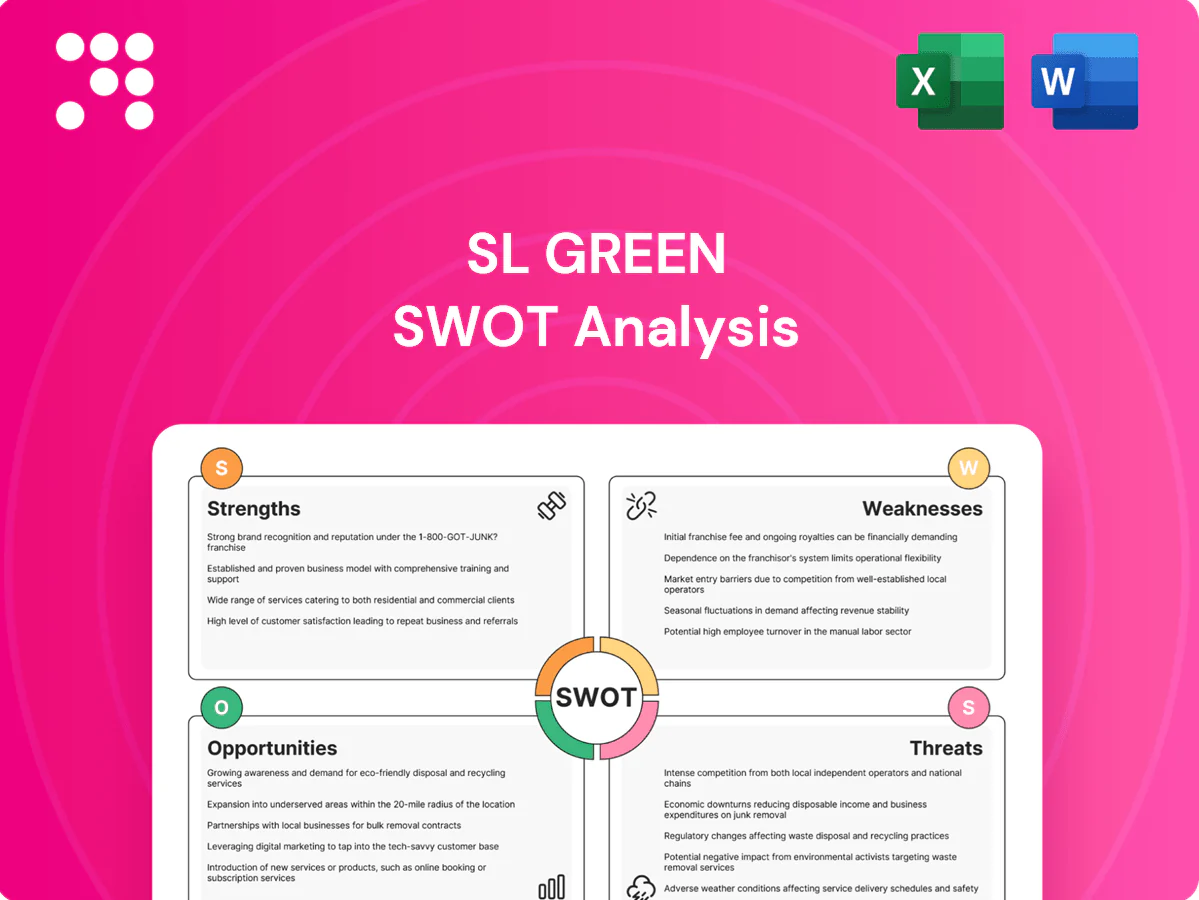
SL Green SWOT Analysis

Dive Deeper Into the Company’s Strategic Blueprint
SL Green leverages a premier Manhattan office portfolio and strong leasing expertise, but concentration in NYC and rising capex needs expose it to market cyclicality. Opportunities include asset repositioning and mixed-use conversions, while remote work trends and interest-rate sensitivity remain material threats. Want the full strategic picture and actionable recommendations? Purchase the complete SWOT analysis for a ready-to-use Word and Excel package.
Strengths

Premier Manhattan office footprint
SL Green is Manhattan's largest office landlord, owning flagship assets such as One Vanderbilt that anchor its premium portfolio. Its prime Manhattan locations in a roughly 400 million square‑foot office market support pricing power, liquidity and resilient tenant demand across cycles. Scarcity of developable Manhattan sites underpins long-term asset values, while strong brand recognition attracts blue‑chip tenants and capital partners.
Leasing and asset management expertise
SL Green, the largest Manhattan office landlord with roughly 24.6 million rentable square feet, has demonstrated repeated ability to lease-up and re-tenant complex assets. Active asset management has driven higher occupancy and rent spreads across its core portfolio. Amenity upgrades and curated tenant mixes increase tenant stickiness. A data-driven leasing approach supports faster absorption versus many peers.

Value-add redevelopment track record
SL Green leverages repositionings, expansions and modernization to create value across its ~25 million rentable sq ft NYC portfolio, converting underperforming assets into trophy-caliber properties. Redevelopments lift achievable rents, cut operating costs and extend asset life, helping sustain a portfolio-wide occupancy near 91% (2024) and mitigating obsolescence risk.

Deep capital markets and JV relationships
SL Green, New York Citys largest office landlord, leverages joint ventures, preferred equity and structured debt to underwrite assets and developments; by 2024 the platform increasingly used JV capital to fund growth while sharing downside. Diversified capital sources lower funding costs and institutional lender relationships enhance deal flow and access to off‑balance sheet opportunities. Financial structuring boosts return-on-equity while allocating risk across partners.
- JV + preferred equity + structured debt: diversified funding
- 2024: increased JV deployment to scale development pipeline
- Institutional lender ties: improved deal flow
- Structured finance: enhanced returns, shared risk
Experienced management and local intelligence
Leadership has cycle-tested experience in NYC real estate, guiding SL Green through multiple office cycles and marquee projects such as One Vanderbilt (1,401 ft). Local market insight enables nimble pricing, targeted acquisitions and timely dispositions. On-the-ground operations and execution discipline preserve NAV and enable rapid tenant response.
- cycle-tested leadership
- local market intelligence
- rapid tenant response
- NAV preservation
NYC office leader: 24.6M sq ft, One Vanderbilt, ~91% occ
SL Green is Manhattan's largest office landlord with ~24.6 million rentable sq ft and flagship One Vanderbilt (1,401 ft), supporting pricing power and blue‑chip demand. Active asset management and redevelopments drove portfolio occupancy near 91% in 2024 and sustained rent spreads. By 2024 the platform scaled JV and structured-capital use to fund growth while sharing downside.
| Metric | Value |
|---|---|
| Rentable area | ~24.6M sq ft |
| Occupancy (2024) | ~91% |
| Flagship | One Vanderbilt (1,401 ft) |
| Capital strategy (2024) | Increased JV & structured financing |
What is included in the product
 Detailed Word Document
Provides a concise SWOT analysis of SL Green, highlighting internal strengths and weaknesses and external opportunities and threats that shape its competitive position and future growth.

 Customizable Excel Spreadsheet
Provides a concise, high-level SWOT of SL Green for fast stakeholder briefings and investment decisions; editable layout lets analysts quickly update risks and opportunities as market conditions shift.
Weaknesses

High geographic concentration in NYC
SL Green's revenue and asset base remain concentrated in Manhattan—roughly 90%+ of its portfolio exposure—so local shocks can disproportionately hit cash flows and valuations. Manhattan office vacancy hovered near 17% in early 2025, amplifying rent pressure and re-leasing risk. Limited geographic diversification reduces downside buffering, making recovery dependent on NYC-specific demand drivers such as finance, tech rehiring, and tourism flows.
Interest rate and leverage sensitivity
REIT cash flows are highly sensitive to rising debt costs and tougher refinancing terms; with the federal funds rate near 5.25–5.50% and the 10‑yr Treasury ~4.3% (mid‑2025), higher borrowing costs compress FFO and transaction spreads. Leverage amplifies upside and downside in valuations, increasing volatility in NAV and share price. Concentrated near‑term debt maturities create acute timing risk in volatile credit markets.

Tenant concentration and large-block exposure
As Manhattan's largest office landlord, SL Green's reliance on a handful of major tenants concentrates rollover risk and heightens exposure when large-block leases expire. Large-block vacancies can take 12–24 months to backfill and require tenant incentives, amplifying carrying costs in a market with Manhattan office vacancy near 20% in 2024. Renewal negotiations often tilt toward anchor tenants, and cash flow can be lumpy around significant expirations.

Capex-intensive portfolio requirements
Capex-intensive portfolio requirements force SL Green to continuously invest in amenities and ESG upgrades to remain competitive, with major redevelopment projects typically requiring hundreds of millions in upfront capital and carrying execution risk. Cost overruns or schedule delays can compress IRRs and pressure near-term returns, while capital allocation trade-offs may limit growth or acquisition activity.
- Competitive upgrades: ongoing heavy spend
- Redevelopments: hundreds of millions, execution risk
- Delays/overruns: pressure on returns
- Allocation trade-offs: constrain growth
Office demand cyclicality
Office fundamentals are pro-cyclical and sentiment-driven; leasing velocity slows in downturns and vacancies can persist. Manhattan office vacancy remained above 15% through 2024, amplifying rent pressure and forcing larger TI and concession packages as markets soften. SL Green's earnings visibility tightens in weak cycles as leasing timing and renewal spreads become more uncertain.
- Manhattan vacancy >15% (2024)
- Leasing velocity slows → prolonged vacancies
- Higher TI/concessions in soft markets
- Narrower earnings visibility in downturns
Manhattan-concentrated offices: ~17% vacancy, rate pressure and large redevelopment risk
SL Green is highly concentrated in Manhattan (≈90%+ of assets), so local shocks (Manhattan office vacancy ~17% in early 2025) materially pressure cash flows and valuations. Rising rates (federal funds 5.25–5.50%, 10‑yr ≈4.3% mid‑2025) increase refinancing costs and compress FFO; heavy capex/redevelopments (hundreds of millions) add execution and timing risk.
| Metric | Value |
|---|---|
| Manhattan exposure | ≈90%+ |
| Vacancy (early 2025) | ≈17% |
| Fed funds (mid‑2025) | 5.25–5.50% |
| 10‑yr Treasury | ≈4.3% |
| Redev. capex | Hundreds of $MM |
Same Document Delivered
SL Green SWOT Analysis
This is the actual SL Green SWOT analysis document you’ll receive upon purchase—no surprises, just professional quality. The preview below is taken directly from the full report you'll get; purchase unlocks the entire in-depth, editable version. You’re viewing a live preview of the real file; the complete document is available after checkout.

Dive Deeper Into the Company’s Strategic Blueprint
SL Green leverages a premier Manhattan office portfolio and strong leasing expertise, but concentration in NYC and rising capex needs expose it to market cyclicality. Opportunities include asset repositioning and mixed-use conversions, while remote work trends and interest-rate sensitivity remain material threats. Want the full strategic picture and actionable recommendations? Purchase the complete SWOT analysis for a ready-to-use Word and Excel package.
Strengths
Premier Manhattan office footprint
SL Green is Manhattan's largest office landlord, owning flagship assets such as One Vanderbilt that anchor its premium portfolio. Its prime Manhattan locations in a roughly 400 million square‑foot office market support pricing power, liquidity and resilient tenant demand across cycles. Scarcity of developable Manhattan sites underpins long-term asset values, while strong brand recognition attracts blue‑chip tenants and capital partners.
Leasing and asset management expertise
SL Green, the largest Manhattan office landlord with roughly 24.6 million rentable square feet, has demonstrated repeated ability to lease-up and re-tenant complex assets. Active asset management has driven higher occupancy and rent spreads across its core portfolio. Amenity upgrades and curated tenant mixes increase tenant stickiness. A data-driven leasing approach supports faster absorption versus many peers.
Value-add redevelopment track record
SL Green leverages repositionings, expansions and modernization to create value across its ~25 million rentable sq ft NYC portfolio, converting underperforming assets into trophy-caliber properties. Redevelopments lift achievable rents, cut operating costs and extend asset life, helping sustain a portfolio-wide occupancy near 91% (2024) and mitigating obsolescence risk.
Deep capital markets and JV relationships
SL Green, New York Citys largest office landlord, leverages joint ventures, preferred equity and structured debt to underwrite assets and developments; by 2024 the platform increasingly used JV capital to fund growth while sharing downside. Diversified capital sources lower funding costs and institutional lender relationships enhance deal flow and access to off‑balance sheet opportunities. Financial structuring boosts return-on-equity while allocating risk across partners.
- JV + preferred equity + structured debt: diversified funding
- 2024: increased JV deployment to scale development pipeline
- Institutional lender ties: improved deal flow
- Structured finance: enhanced returns, shared risk
Experienced management and local intelligence
Leadership has cycle-tested experience in NYC real estate, guiding SL Green through multiple office cycles and marquee projects such as One Vanderbilt (1,401 ft). Local market insight enables nimble pricing, targeted acquisitions and timely dispositions. On-the-ground operations and execution discipline preserve NAV and enable rapid tenant response.
- cycle-tested leadership
- local market intelligence
- rapid tenant response
- NAV preservation
NYC office leader: 24.6M sq ft, One Vanderbilt, ~91% occ
SL Green is Manhattan's largest office landlord with ~24.6 million rentable sq ft and flagship One Vanderbilt (1,401 ft), supporting pricing power and blue‑chip demand. Active asset management and redevelopments drove portfolio occupancy near 91% in 2024 and sustained rent spreads. By 2024 the platform scaled JV and structured-capital use to fund growth while sharing downside.
| Metric | Value |
|---|---|
| Rentable area | ~24.6M sq ft |
| Occupancy (2024) | ~91% |
| Flagship | One Vanderbilt (1,401 ft) |
| Capital strategy (2024) | Increased JV & structured financing |
What is included in the product
Detailed Word Document
Provides a concise SWOT analysis of SL Green, highlighting internal strengths and weaknesses and external opportunities and threats that shape its competitive position and future growth.
Customizable Excel Spreadsheet
Provides a concise, high-level SWOT of SL Green for fast stakeholder briefings and investment decisions; editable layout lets analysts quickly update risks and opportunities as market conditions shift.
Weaknesses
High geographic concentration in NYC
SL Green's revenue and asset base remain concentrated in Manhattan—roughly 90%+ of its portfolio exposure—so local shocks can disproportionately hit cash flows and valuations. Manhattan office vacancy hovered near 17% in early 2025, amplifying rent pressure and re-leasing risk. Limited geographic diversification reduces downside buffering, making recovery dependent on NYC-specific demand drivers such as finance, tech rehiring, and tourism flows.
Interest rate and leverage sensitivity
REIT cash flows are highly sensitive to rising debt costs and tougher refinancing terms; with the federal funds rate near 5.25–5.50% and the 10‑yr Treasury ~4.3% (mid‑2025), higher borrowing costs compress FFO and transaction spreads. Leverage amplifies upside and downside in valuations, increasing volatility in NAV and share price. Concentrated near‑term debt maturities create acute timing risk in volatile credit markets.
Tenant concentration and large-block exposure
As Manhattan's largest office landlord, SL Green's reliance on a handful of major tenants concentrates rollover risk and heightens exposure when large-block leases expire. Large-block vacancies can take 12–24 months to backfill and require tenant incentives, amplifying carrying costs in a market with Manhattan office vacancy near 20% in 2024. Renewal negotiations often tilt toward anchor tenants, and cash flow can be lumpy around significant expirations.
Capex-intensive portfolio requirements
Capex-intensive portfolio requirements force SL Green to continuously invest in amenities and ESG upgrades to remain competitive, with major redevelopment projects typically requiring hundreds of millions in upfront capital and carrying execution risk. Cost overruns or schedule delays can compress IRRs and pressure near-term returns, while capital allocation trade-offs may limit growth or acquisition activity.
- Competitive upgrades: ongoing heavy spend
- Redevelopments: hundreds of millions, execution risk
- Delays/overruns: pressure on returns
- Allocation trade-offs: constrain growth
Office demand cyclicality
Office fundamentals are pro-cyclical and sentiment-driven; leasing velocity slows in downturns and vacancies can persist. Manhattan office vacancy remained above 15% through 2024, amplifying rent pressure and forcing larger TI and concession packages as markets soften. SL Green's earnings visibility tightens in weak cycles as leasing timing and renewal spreads become more uncertain.
- Manhattan vacancy >15% (2024)
- Leasing velocity slows → prolonged vacancies
- Higher TI/concessions in soft markets
- Narrower earnings visibility in downturns
Manhattan-concentrated offices: ~17% vacancy, rate pressure and large redevelopment risk
SL Green is highly concentrated in Manhattan (≈90%+ of assets), so local shocks (Manhattan office vacancy ~17% in early 2025) materially pressure cash flows and valuations. Rising rates (federal funds 5.25–5.50%, 10‑yr ≈4.3% mid‑2025) increase refinancing costs and compress FFO; heavy capex/redevelopments (hundreds of millions) add execution and timing risk.
| Metric | Value |
|---|---|
| Manhattan exposure | ≈90%+ |
| Vacancy (early 2025) | ≈17% |
| Fed funds (mid‑2025) | 5.25–5.50% |
| 10‑yr Treasury | ≈4.3% |
| Redev. capex | Hundreds of $MM |
Same Document Delivered
SL Green SWOT Analysis
This is the actual SL Green SWOT analysis document you’ll receive upon purchase—no surprises, just professional quality. The preview below is taken directly from the full report you'll get; purchase unlocks the entire in-depth, editable version. You’re viewing a live preview of the real file; the complete document is available after checkout.
Description
Dive Deeper Into the Company’s Strategic Blueprint
SL Green leverages a premier Manhattan office portfolio and strong leasing expertise, but concentration in NYC and rising capex needs expose it to market cyclicality. Opportunities include asset repositioning and mixed-use conversions, while remote work trends and interest-rate sensitivity remain material threats. Want the full strategic picture and actionable recommendations? Purchase the complete SWOT analysis for a ready-to-use Word and Excel package.
Strengths
Premier Manhattan office footprint
SL Green is Manhattan's largest office landlord, owning flagship assets such as One Vanderbilt that anchor its premium portfolio. Its prime Manhattan locations in a roughly 400 million square‑foot office market support pricing power, liquidity and resilient tenant demand across cycles. Scarcity of developable Manhattan sites underpins long-term asset values, while strong brand recognition attracts blue‑chip tenants and capital partners.
Leasing and asset management expertise
SL Green, the largest Manhattan office landlord with roughly 24.6 million rentable square feet, has demonstrated repeated ability to lease-up and re-tenant complex assets. Active asset management has driven higher occupancy and rent spreads across its core portfolio. Amenity upgrades and curated tenant mixes increase tenant stickiness. A data-driven leasing approach supports faster absorption versus many peers.
Value-add redevelopment track record
SL Green leverages repositionings, expansions and modernization to create value across its ~25 million rentable sq ft NYC portfolio, converting underperforming assets into trophy-caliber properties. Redevelopments lift achievable rents, cut operating costs and extend asset life, helping sustain a portfolio-wide occupancy near 91% (2024) and mitigating obsolescence risk.
Deep capital markets and JV relationships
SL Green, New York Citys largest office landlord, leverages joint ventures, preferred equity and structured debt to underwrite assets and developments; by 2024 the platform increasingly used JV capital to fund growth while sharing downside. Diversified capital sources lower funding costs and institutional lender relationships enhance deal flow and access to off‑balance sheet opportunities. Financial structuring boosts return-on-equity while allocating risk across partners.
- JV + preferred equity + structured debt: diversified funding
- 2024: increased JV deployment to scale development pipeline
- Institutional lender ties: improved deal flow
- Structured finance: enhanced returns, shared risk
Experienced management and local intelligence
Leadership has cycle-tested experience in NYC real estate, guiding SL Green through multiple office cycles and marquee projects such as One Vanderbilt (1,401 ft). Local market insight enables nimble pricing, targeted acquisitions and timely dispositions. On-the-ground operations and execution discipline preserve NAV and enable rapid tenant response.
- cycle-tested leadership
- local market intelligence
- rapid tenant response
- NAV preservation
NYC office leader: 24.6M sq ft, One Vanderbilt, ~91% occ
SL Green is Manhattan's largest office landlord with ~24.6 million rentable sq ft and flagship One Vanderbilt (1,401 ft), supporting pricing power and blue‑chip demand. Active asset management and redevelopments drove portfolio occupancy near 91% in 2024 and sustained rent spreads. By 2024 the platform scaled JV and structured-capital use to fund growth while sharing downside.
| Metric | Value |
|---|---|
| Rentable area | ~24.6M sq ft |
| Occupancy (2024) | ~91% |
| Flagship | One Vanderbilt (1,401 ft) |
| Capital strategy (2024) | Increased JV & structured financing |
What is included in the product
Detailed Word Document
Provides a concise SWOT analysis of SL Green, highlighting internal strengths and weaknesses and external opportunities and threats that shape its competitive position and future growth.
Customizable Excel Spreadsheet
Provides a concise, high-level SWOT of SL Green for fast stakeholder briefings and investment decisions; editable layout lets analysts quickly update risks and opportunities as market conditions shift.
Weaknesses
High geographic concentration in NYC
SL Green's revenue and asset base remain concentrated in Manhattan—roughly 90%+ of its portfolio exposure—so local shocks can disproportionately hit cash flows and valuations. Manhattan office vacancy hovered near 17% in early 2025, amplifying rent pressure and re-leasing risk. Limited geographic diversification reduces downside buffering, making recovery dependent on NYC-specific demand drivers such as finance, tech rehiring, and tourism flows.
Interest rate and leverage sensitivity
REIT cash flows are highly sensitive to rising debt costs and tougher refinancing terms; with the federal funds rate near 5.25–5.50% and the 10‑yr Treasury ~4.3% (mid‑2025), higher borrowing costs compress FFO and transaction spreads. Leverage amplifies upside and downside in valuations, increasing volatility in NAV and share price. Concentrated near‑term debt maturities create acute timing risk in volatile credit markets.
Tenant concentration and large-block exposure
As Manhattan's largest office landlord, SL Green's reliance on a handful of major tenants concentrates rollover risk and heightens exposure when large-block leases expire. Large-block vacancies can take 12–24 months to backfill and require tenant incentives, amplifying carrying costs in a market with Manhattan office vacancy near 20% in 2024. Renewal negotiations often tilt toward anchor tenants, and cash flow can be lumpy around significant expirations.
Capex-intensive portfolio requirements
Capex-intensive portfolio requirements force SL Green to continuously invest in amenities and ESG upgrades to remain competitive, with major redevelopment projects typically requiring hundreds of millions in upfront capital and carrying execution risk. Cost overruns or schedule delays can compress IRRs and pressure near-term returns, while capital allocation trade-offs may limit growth or acquisition activity.
- Competitive upgrades: ongoing heavy spend
- Redevelopments: hundreds of millions, execution risk
- Delays/overruns: pressure on returns
- Allocation trade-offs: constrain growth
Office demand cyclicality
Office fundamentals are pro-cyclical and sentiment-driven; leasing velocity slows in downturns and vacancies can persist. Manhattan office vacancy remained above 15% through 2024, amplifying rent pressure and forcing larger TI and concession packages as markets soften. SL Green's earnings visibility tightens in weak cycles as leasing timing and renewal spreads become more uncertain.
- Manhattan vacancy >15% (2024)
- Leasing velocity slows → prolonged vacancies
- Higher TI/concessions in soft markets
- Narrower earnings visibility in downturns
Manhattan-concentrated offices: ~17% vacancy, rate pressure and large redevelopment risk
SL Green is highly concentrated in Manhattan (≈90%+ of assets), so local shocks (Manhattan office vacancy ~17% in early 2025) materially pressure cash flows and valuations. Rising rates (federal funds 5.25–5.50%, 10‑yr ≈4.3% mid‑2025) increase refinancing costs and compress FFO; heavy capex/redevelopments (hundreds of millions) add execution and timing risk.
| Metric | Value |
|---|---|
| Manhattan exposure | ≈90%+ |
| Vacancy (early 2025) | ≈17% |
| Fed funds (mid‑2025) | 5.25–5.50% |
| 10‑yr Treasury | ≈4.3% |
| Redev. capex | Hundreds of $MM |
Same Document Delivered
SL Green SWOT Analysis
This is the actual SL Green SWOT analysis document you’ll receive upon purchase—no surprises, just professional quality. The preview below is taken directly from the full report you'll get; purchase unlocks the entire in-depth, editable version. You’re viewing a live preview of the real file; the complete document is available after checkout.











