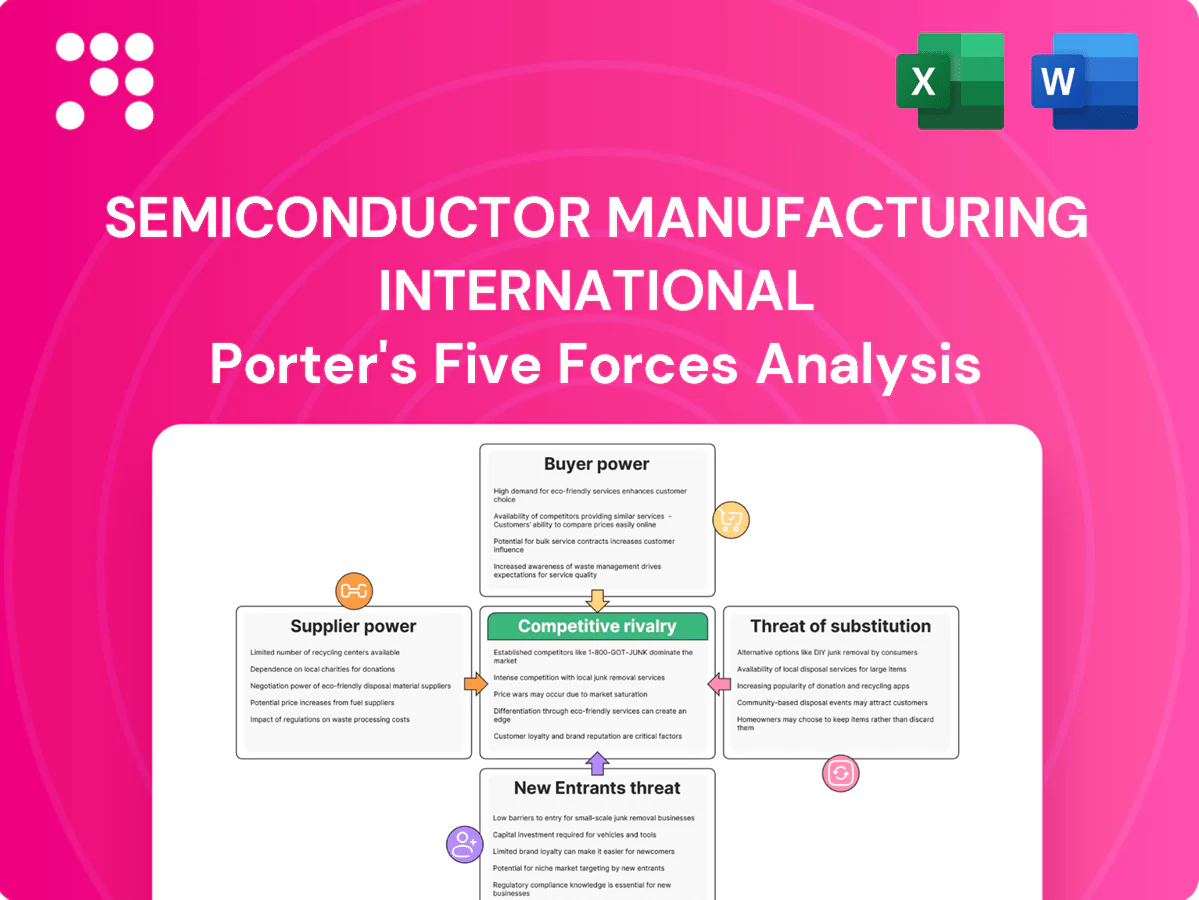
Semiconductor Manufacturing International Porter's Five Forces Analysis

Elevate Your Analysis with the Complete Porter's Five Forces Analysis
Semiconductor Manufacturing International operates in a capital‑intensive, technology‑driven market where supplier concentration, customer bargaining power, and rapid innovation critically shape margins. Our concise force‑by‑force snapshot highlights threats from new entrants, substitutes, and geopolitical supply risks. This brief snapshot only scratches the surface. Unlock the full Porter's Five Forces Analysis to explore Semiconductor Manufacturing International’s competitive dynamics, market pressures, and strategic advantages in detail.
Suppliers Bargaining Power

Concentrated tool vendors
Leading lithography, etch and metrology tools are supplied by a handful of firms—ASML (virtually all EUV), Applied Materials, Tokyo Electron and KLA—concentrating market power and giving suppliers pricing leverage. 2023–24 export controls restrict EUV and certain DUV shipments to China, tightening SMIC’s access and extending lead times to 12–36 months. Limited substitutes raise switching costs and amplify supplier control over price and delivery for critical equipment.
Specialty materials dependence
300mm wafers, high-purity gases, photoresists and CMP slurries are sourced from few qualified vendors, with 300mm fabs accounting for over 70% of leading-edge capacity in 2024; material specs are tightly coupled to processes so dual-qualification typically takes 6–18 months. Any quality or logistics disruption can cut yields and output materially, and with top suppliers holding concentrated share (>60% in key materials), suppliers gain bargaining power via qualification lock-in.

EDA/IP ecosystem lock-in
Design enablement for SMIC is tightly tied to EDA/IP incumbents: the global EDA market was about $12B in 2024 with Synopsys/Cadence/Siemens holding >70% share, and Arm/Rambus dominant in IP, creating strong lock-in. License limits and US export controls since the 2020s have already constrained tool/support access for some Chinese fabs. Porting PDKs and flows often takes months and costs multiple millions, amplifying upstream negotiating leverage.

Long lead times and obsolescence risk
- Lead times: 6–18+ months
- Backlog: ASML €34.6bn (end‑2023)
- Risk: stranded capex, schedule & financing exposure for SMIC
Localization mitigations
China’s push for domestic tools and materials—backed by state-backed chip funds exceeding US$100 billion—adds alternative sources that reduce SMIC’s supplier leverage; early-stage local suppliers improve supply diversity but frequently lag on specs and yield, keeping near-term impact partial. Co-development partnerships with local vendors can rebalance power over time, making long-term effects meaningful.
- China chip imports ~US$300B (2022–23)
- State funds >US$100B
- Short-term: partial mitigation
- Long-term: potential meaningful shift
High supplier power: long lead times, >70% capacity, backlog €34.6bn, >$100B state funds
Supplier power is high: few vendors (ASML, Applied, TEL, KLA) dominate critical tools and materials, with lead times 6–36 months and ASML backlog €34.6bn (end‑2023). 300mm/leading‑edge >70% capacity (2024); EDA market ~$12B (2024) with Synopsys/Cadence/Siemens >70% share, raising lock‑in and switching costs. State support (>US$100B) and local suppliers reduce but do not eliminate leverage short‑term.
| Metric | Value |
|---|---|
| ASML backlog | €34.6bn (end‑2023) |
| Lead times | 6–36 months |
| EDA market | $12B (2024) |
| 300mm share | >70% leading‑edge (2024) |
| China state funds | >US$100B |
What is included in the product
 Detailed Word Document
Provides a focused Porter's Five Forces assessment of Semiconductor Manufacturing International, revealing competitive rivalry, supplier and buyer power, threat of new entrants and substitutes, and regulatory/geopolitical pressures shaping pricing, margins, and strategic positioning.

 Customizable Excel Spreadsheet
A clear one-sheet Porter's Five Forces for Semiconductor Manufacturing International (SMIC)—customizable pressures with a spider chart, no macros, and slide-ready layout to instantly pinpoint regulatory, supply-chain and competitive pain points.
Customers Bargaining Power

Fabless giants negotiate hard
Fabless giants aggregate volumes across nodes and geographies—SMIC, which posted RMB 47.8 billion (≈US$6.6 billion) revenue in 2023, faces concentrated demand that pushes price and priority-wafer negotiations. Customers insist on pricing concessions, priority scheduling and tailored PDK features to meet product roadmaps. Their dual-sourcing ability raises leverage, forcing SMIC to trade price for utilization and customer stickiness.
Switching costs vs qualification
Process qualification and IP porting create switching frictions, often requiring 6–18 months and multi-million-dollar engineering spend. For mature nodes such as 28nm/40nm, multiple foundries (TSMC, UMC, SMIC) offer alternatives, tempering stickiness. Specialty RF, eNVM and BCD need bespoke process tweaks, raising switching costs and lowering buyer power; longer qualification timelines expand pricing headroom.

Capacity cycles shift leverage
In tight cycles allocation favors foundries and ASPs hold up, but in downcycles buyers force ASP cuts and rebates; SMIC’s exposure to mature nodes—over 70% of its capacity—makes it especially vulnerable to mature-node gluts. Utilization swings (often swinging 10–20 percentage points industry-wide) translate directly into buyer bargaining strength and margin pressure for SMIC.

Domestic policy-driven demand
China-based customers prioritize supply security and regulatory compliance, shifting negotiations from price toward guaranteed capacity and certified domestic sourcing.
Policy alignment with national goals and government-backed programs, including the National Integrated Circuit Industry Investment Fund (Big Fund) initial size of RMB139.7 billion, anchor long-term agreements and reduce spot-price leverage.
This state support and procurement orientation moderates buyer power for SMIC relative to global peers by locking demand and favoring compliance over pure cost savings.
- Supply security over price
- Policy alignment reduces price bargaining
- Big Fund (RMB139.7bn) anchors long-term deals
- Moderated buyer power vs global peers
Technology roadmap constraints
Limited access to leading-edge nodes (sub-14nm) constrains SMIC, pushing customers seeking cutting-edge chips toward rivals; TSMC held about 54% global foundry share in 2024, drawing high-performance demand. Customers focused on mature and specialty nodes face fewer outside substitutes, preserving SMIC pricing power in those segments. This segment split produces uneven buyer leverage across SMIC's portfolio.
- Leading-edge demand: high switching risk to TSMC (54% share 2024)
- Mature/specialty: fewer substitutes, stronger SMIC leverage
- Net effect: mixed buyer power by segment
Buyers aggregate volume; state fund cushions pricing as leading-edge shifts to external foundries
Buyers aggregate volume and demand pricing, with SMIC (RMB47.8bn revenue in 2023) trading price for utilization and priority; dual-sourcing raises leverage. Qualification takes 6–18 months and multi-million-dollar spend, especially for mature/specialty nodes. State support (Big Fund RMB139.7bn) and supply-security needs blunt pure price pressure; leading-edge demand shifts to TSMC (≈54% share 2024).
| Metric | Value |
|---|---|
| SMIC revenue 2023 | RMB47.8bn |
| Big Fund | RMB139.7bn |
| TSMC share 2024 | 54% |
| Qualification time | 6–18 months |
Preview Before You Purchase
Semiconductor Manufacturing International Porter's Five Forces Analysis
This preview displays the exact Semiconductor Manufacturing Porter's Five Forces Analysis you'll receive after purchase—fully written, professionally formatted, and ready to download. No samples or placeholders: the file shown is the final deliverable and will be available instantly once you complete payment.

Elevate Your Analysis with the Complete Porter's Five Forces Analysis
Semiconductor Manufacturing International operates in a capital‑intensive, technology‑driven market where supplier concentration, customer bargaining power, and rapid innovation critically shape margins. Our concise force‑by‑force snapshot highlights threats from new entrants, substitutes, and geopolitical supply risks. This brief snapshot only scratches the surface. Unlock the full Porter's Five Forces Analysis to explore Semiconductor Manufacturing International’s competitive dynamics, market pressures, and strategic advantages in detail.
Suppliers Bargaining Power
Concentrated tool vendors
Leading lithography, etch and metrology tools are supplied by a handful of firms—ASML (virtually all EUV), Applied Materials, Tokyo Electron and KLA—concentrating market power and giving suppliers pricing leverage. 2023–24 export controls restrict EUV and certain DUV shipments to China, tightening SMIC’s access and extending lead times to 12–36 months. Limited substitutes raise switching costs and amplify supplier control over price and delivery for critical equipment.
Specialty materials dependence
300mm wafers, high-purity gases, photoresists and CMP slurries are sourced from few qualified vendors, with 300mm fabs accounting for over 70% of leading-edge capacity in 2024; material specs are tightly coupled to processes so dual-qualification typically takes 6–18 months. Any quality or logistics disruption can cut yields and output materially, and with top suppliers holding concentrated share (>60% in key materials), suppliers gain bargaining power via qualification lock-in.
EDA/IP ecosystem lock-in
Design enablement for SMIC is tightly tied to EDA/IP incumbents: the global EDA market was about $12B in 2024 with Synopsys/Cadence/Siemens holding >70% share, and Arm/Rambus dominant in IP, creating strong lock-in. License limits and US export controls since the 2020s have already constrained tool/support access for some Chinese fabs. Porting PDKs and flows often takes months and costs multiple millions, amplifying upstream negotiating leverage.
Long lead times and obsolescence risk
- Lead times: 6–18+ months
- Backlog: ASML €34.6bn (end‑2023)
- Risk: stranded capex, schedule & financing exposure for SMIC
Localization mitigations
China’s push for domestic tools and materials—backed by state-backed chip funds exceeding US$100 billion—adds alternative sources that reduce SMIC’s supplier leverage; early-stage local suppliers improve supply diversity but frequently lag on specs and yield, keeping near-term impact partial. Co-development partnerships with local vendors can rebalance power over time, making long-term effects meaningful.
- China chip imports ~US$300B (2022–23)
- State funds >US$100B
- Short-term: partial mitigation
- Long-term: potential meaningful shift
High supplier power: long lead times, >70% capacity, backlog €34.6bn, >$100B state funds
Supplier power is high: few vendors (ASML, Applied, TEL, KLA) dominate critical tools and materials, with lead times 6–36 months and ASML backlog €34.6bn (end‑2023). 300mm/leading‑edge >70% capacity (2024); EDA market ~$12B (2024) with Synopsys/Cadence/Siemens >70% share, raising lock‑in and switching costs. State support (>US$100B) and local suppliers reduce but do not eliminate leverage short‑term.
| Metric | Value |
|---|---|
| ASML backlog | €34.6bn (end‑2023) |
| Lead times | 6–36 months |
| EDA market | $12B (2024) |
| 300mm share | >70% leading‑edge (2024) |
| China state funds | >US$100B |
What is included in the product
Detailed Word Document
Provides a focused Porter's Five Forces assessment of Semiconductor Manufacturing International, revealing competitive rivalry, supplier and buyer power, threat of new entrants and substitutes, and regulatory/geopolitical pressures shaping pricing, margins, and strategic positioning.
Customizable Excel Spreadsheet
A clear one-sheet Porter's Five Forces for Semiconductor Manufacturing International (SMIC)—customizable pressures with a spider chart, no macros, and slide-ready layout to instantly pinpoint regulatory, supply-chain and competitive pain points.
Customers Bargaining Power
Fabless giants negotiate hard
Fabless giants aggregate volumes across nodes and geographies—SMIC, which posted RMB 47.8 billion (≈US$6.6 billion) revenue in 2023, faces concentrated demand that pushes price and priority-wafer negotiations. Customers insist on pricing concessions, priority scheduling and tailored PDK features to meet product roadmaps. Their dual-sourcing ability raises leverage, forcing SMIC to trade price for utilization and customer stickiness.
Switching costs vs qualification
Process qualification and IP porting create switching frictions, often requiring 6–18 months and multi-million-dollar engineering spend. For mature nodes such as 28nm/40nm, multiple foundries (TSMC, UMC, SMIC) offer alternatives, tempering stickiness. Specialty RF, eNVM and BCD need bespoke process tweaks, raising switching costs and lowering buyer power; longer qualification timelines expand pricing headroom.
Capacity cycles shift leverage
In tight cycles allocation favors foundries and ASPs hold up, but in downcycles buyers force ASP cuts and rebates; SMIC’s exposure to mature nodes—over 70% of its capacity—makes it especially vulnerable to mature-node gluts. Utilization swings (often swinging 10–20 percentage points industry-wide) translate directly into buyer bargaining strength and margin pressure for SMIC.
Domestic policy-driven demand
China-based customers prioritize supply security and regulatory compliance, shifting negotiations from price toward guaranteed capacity and certified domestic sourcing.
Policy alignment with national goals and government-backed programs, including the National Integrated Circuit Industry Investment Fund (Big Fund) initial size of RMB139.7 billion, anchor long-term agreements and reduce spot-price leverage.
This state support and procurement orientation moderates buyer power for SMIC relative to global peers by locking demand and favoring compliance over pure cost savings.
- Supply security over price
- Policy alignment reduces price bargaining
- Big Fund (RMB139.7bn) anchors long-term deals
- Moderated buyer power vs global peers
Technology roadmap constraints
Limited access to leading-edge nodes (sub-14nm) constrains SMIC, pushing customers seeking cutting-edge chips toward rivals; TSMC held about 54% global foundry share in 2024, drawing high-performance demand. Customers focused on mature and specialty nodes face fewer outside substitutes, preserving SMIC pricing power in those segments. This segment split produces uneven buyer leverage across SMIC's portfolio.
- Leading-edge demand: high switching risk to TSMC (54% share 2024)
- Mature/specialty: fewer substitutes, stronger SMIC leverage
- Net effect: mixed buyer power by segment
Buyers aggregate volume; state fund cushions pricing as leading-edge shifts to external foundries
Buyers aggregate volume and demand pricing, with SMIC (RMB47.8bn revenue in 2023) trading price for utilization and priority; dual-sourcing raises leverage. Qualification takes 6–18 months and multi-million-dollar spend, especially for mature/specialty nodes. State support (Big Fund RMB139.7bn) and supply-security needs blunt pure price pressure; leading-edge demand shifts to TSMC (≈54% share 2024).
| Metric | Value |
|---|---|
| SMIC revenue 2023 | RMB47.8bn |
| Big Fund | RMB139.7bn |
| TSMC share 2024 | 54% |
| Qualification time | 6–18 months |
Preview Before You Purchase
Semiconductor Manufacturing International Porter's Five Forces Analysis
This preview displays the exact Semiconductor Manufacturing Porter's Five Forces Analysis you'll receive after purchase—fully written, professionally formatted, and ready to download. No samples or placeholders: the file shown is the final deliverable and will be available instantly once you complete payment.
Original: $10.00
-65%$10.00
$3.50Description
Elevate Your Analysis with the Complete Porter's Five Forces Analysis
Semiconductor Manufacturing International operates in a capital‑intensive, technology‑driven market where supplier concentration, customer bargaining power, and rapid innovation critically shape margins. Our concise force‑by‑force snapshot highlights threats from new entrants, substitutes, and geopolitical supply risks. This brief snapshot only scratches the surface. Unlock the full Porter's Five Forces Analysis to explore Semiconductor Manufacturing International’s competitive dynamics, market pressures, and strategic advantages in detail.
Suppliers Bargaining Power
Concentrated tool vendors
Leading lithography, etch and metrology tools are supplied by a handful of firms—ASML (virtually all EUV), Applied Materials, Tokyo Electron and KLA—concentrating market power and giving suppliers pricing leverage. 2023–24 export controls restrict EUV and certain DUV shipments to China, tightening SMIC’s access and extending lead times to 12–36 months. Limited substitutes raise switching costs and amplify supplier control over price and delivery for critical equipment.
Specialty materials dependence
300mm wafers, high-purity gases, photoresists and CMP slurries are sourced from few qualified vendors, with 300mm fabs accounting for over 70% of leading-edge capacity in 2024; material specs are tightly coupled to processes so dual-qualification typically takes 6–18 months. Any quality or logistics disruption can cut yields and output materially, and with top suppliers holding concentrated share (>60% in key materials), suppliers gain bargaining power via qualification lock-in.
EDA/IP ecosystem lock-in
Design enablement for SMIC is tightly tied to EDA/IP incumbents: the global EDA market was about $12B in 2024 with Synopsys/Cadence/Siemens holding >70% share, and Arm/Rambus dominant in IP, creating strong lock-in. License limits and US export controls since the 2020s have already constrained tool/support access for some Chinese fabs. Porting PDKs and flows often takes months and costs multiple millions, amplifying upstream negotiating leverage.
Long lead times and obsolescence risk
- Lead times: 6–18+ months
- Backlog: ASML €34.6bn (end‑2023)
- Risk: stranded capex, schedule & financing exposure for SMIC
Localization mitigations
China’s push for domestic tools and materials—backed by state-backed chip funds exceeding US$100 billion—adds alternative sources that reduce SMIC’s supplier leverage; early-stage local suppliers improve supply diversity but frequently lag on specs and yield, keeping near-term impact partial. Co-development partnerships with local vendors can rebalance power over time, making long-term effects meaningful.
- China chip imports ~US$300B (2022–23)
- State funds >US$100B
- Short-term: partial mitigation
- Long-term: potential meaningful shift
High supplier power: long lead times, >70% capacity, backlog €34.6bn, >$100B state funds
Supplier power is high: few vendors (ASML, Applied, TEL, KLA) dominate critical tools and materials, with lead times 6–36 months and ASML backlog €34.6bn (end‑2023). 300mm/leading‑edge >70% capacity (2024); EDA market ~$12B (2024) with Synopsys/Cadence/Siemens >70% share, raising lock‑in and switching costs. State support (>US$100B) and local suppliers reduce but do not eliminate leverage short‑term.
| Metric | Value |
|---|---|
| ASML backlog | €34.6bn (end‑2023) |
| Lead times | 6–36 months |
| EDA market | $12B (2024) |
| 300mm share | >70% leading‑edge (2024) |
| China state funds | >US$100B |
What is included in the product
Detailed Word Document
Provides a focused Porter's Five Forces assessment of Semiconductor Manufacturing International, revealing competitive rivalry, supplier and buyer power, threat of new entrants and substitutes, and regulatory/geopolitical pressures shaping pricing, margins, and strategic positioning.
Customizable Excel Spreadsheet
A clear one-sheet Porter's Five Forces for Semiconductor Manufacturing International (SMIC)—customizable pressures with a spider chart, no macros, and slide-ready layout to instantly pinpoint regulatory, supply-chain and competitive pain points.
Customers Bargaining Power
Fabless giants negotiate hard
Fabless giants aggregate volumes across nodes and geographies—SMIC, which posted RMB 47.8 billion (≈US$6.6 billion) revenue in 2023, faces concentrated demand that pushes price and priority-wafer negotiations. Customers insist on pricing concessions, priority scheduling and tailored PDK features to meet product roadmaps. Their dual-sourcing ability raises leverage, forcing SMIC to trade price for utilization and customer stickiness.
Switching costs vs qualification
Process qualification and IP porting create switching frictions, often requiring 6–18 months and multi-million-dollar engineering spend. For mature nodes such as 28nm/40nm, multiple foundries (TSMC, UMC, SMIC) offer alternatives, tempering stickiness. Specialty RF, eNVM and BCD need bespoke process tweaks, raising switching costs and lowering buyer power; longer qualification timelines expand pricing headroom.
Capacity cycles shift leverage
In tight cycles allocation favors foundries and ASPs hold up, but in downcycles buyers force ASP cuts and rebates; SMIC’s exposure to mature nodes—over 70% of its capacity—makes it especially vulnerable to mature-node gluts. Utilization swings (often swinging 10–20 percentage points industry-wide) translate directly into buyer bargaining strength and margin pressure for SMIC.
Domestic policy-driven demand
China-based customers prioritize supply security and regulatory compliance, shifting negotiations from price toward guaranteed capacity and certified domestic sourcing.
Policy alignment with national goals and government-backed programs, including the National Integrated Circuit Industry Investment Fund (Big Fund) initial size of RMB139.7 billion, anchor long-term agreements and reduce spot-price leverage.
This state support and procurement orientation moderates buyer power for SMIC relative to global peers by locking demand and favoring compliance over pure cost savings.
- Supply security over price
- Policy alignment reduces price bargaining
- Big Fund (RMB139.7bn) anchors long-term deals
- Moderated buyer power vs global peers
Technology roadmap constraints
Limited access to leading-edge nodes (sub-14nm) constrains SMIC, pushing customers seeking cutting-edge chips toward rivals; TSMC held about 54% global foundry share in 2024, drawing high-performance demand. Customers focused on mature and specialty nodes face fewer outside substitutes, preserving SMIC pricing power in those segments. This segment split produces uneven buyer leverage across SMIC's portfolio.
- Leading-edge demand: high switching risk to TSMC (54% share 2024)
- Mature/specialty: fewer substitutes, stronger SMIC leverage
- Net effect: mixed buyer power by segment
Buyers aggregate volume; state fund cushions pricing as leading-edge shifts to external foundries
Buyers aggregate volume and demand pricing, with SMIC (RMB47.8bn revenue in 2023) trading price for utilization and priority; dual-sourcing raises leverage. Qualification takes 6–18 months and multi-million-dollar spend, especially for mature/specialty nodes. State support (Big Fund RMB139.7bn) and supply-security needs blunt pure price pressure; leading-edge demand shifts to TSMC (≈54% share 2024).
| Metric | Value |
|---|---|
| SMIC revenue 2023 | RMB47.8bn |
| Big Fund | RMB139.7bn |
| TSMC share 2024 | 54% |
| Qualification time | 6–18 months |
Preview Before You Purchase
Semiconductor Manufacturing International Porter's Five Forces Analysis
This preview displays the exact Semiconductor Manufacturing Porter's Five Forces Analysis you'll receive after purchase—fully written, professionally formatted, and ready to download. No samples or placeholders: the file shown is the final deliverable and will be available instantly once you complete payment.











