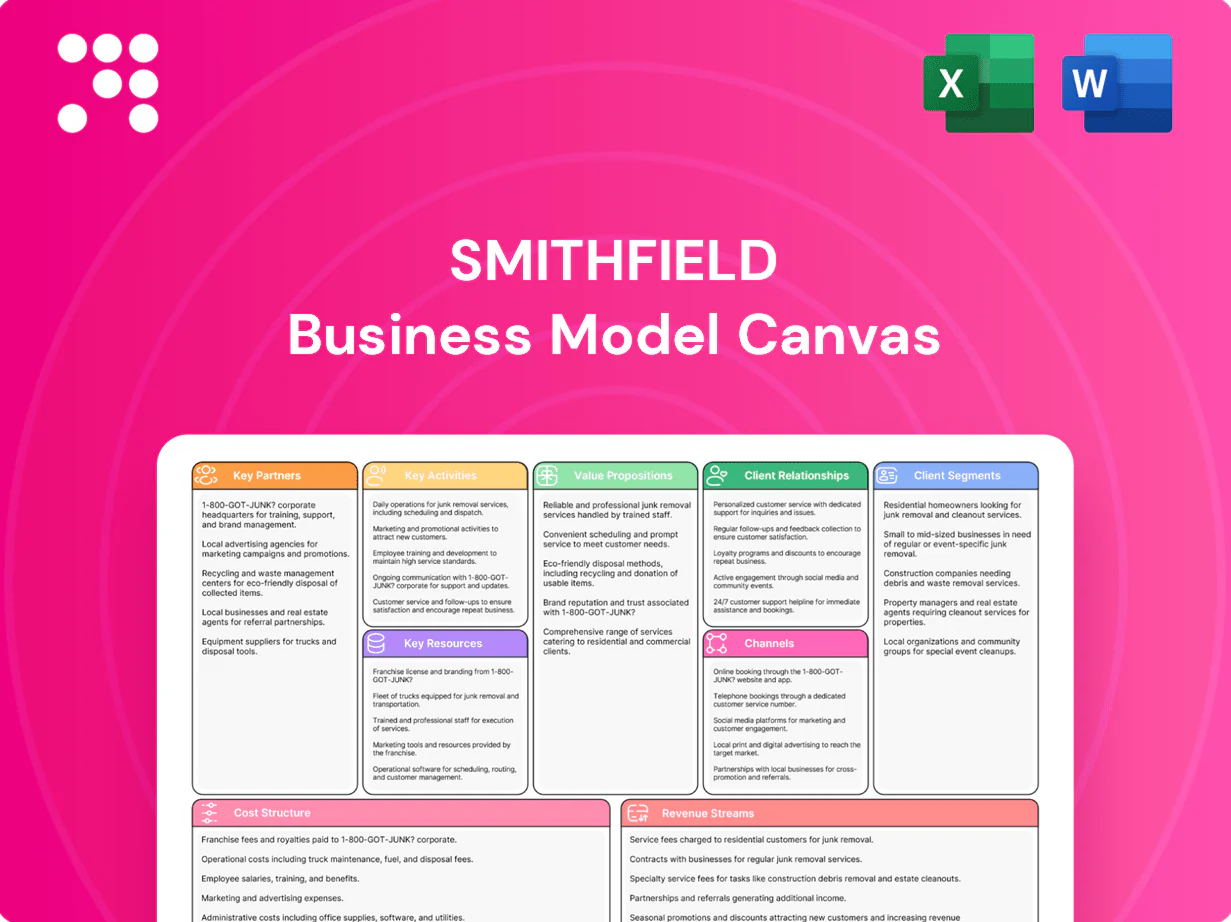
Smithfield Business Model Canvas

Pork & Prepared Foods Business Model Canvas: Strategic Snapshot for Investors and Operators
Discover Smithfield’s strategic core in a concise Business Model Canvas that maps its value propositions, key partnerships, revenue streams and cost structure across the pork and prepared foods ecosystem. This snapshot highlights competitive advantages and growth levers for investors, operators and analysts. Purchase the full, editable Canvas (Word & Excel) to benchmark, plan or present evidence-based strategies.
Partnerships

Hog farm suppliers
Smithfield leverages a network of about 2,000 contract growers and independent farmers to expand herd capacity and geographic diversity, supplying a majority of its live hogs in 2024. Long-term supply contracts (typically 3–10 year terms) stabilize input volumes and pricing for both parties. Partnerships with animal health and genetics firms have improved yield consistency, while collaboration enforces biosecurity standards across all contract farms.
Feed & grain providers
Strategic relationships with corn and soybean meal suppliers secure feed quality and cost for Smithfield, where feed typically represents roughly 60% of live‑production costs. Hedging support and coordinated logistics help reduce price and supply volatility. Nutritional consultants tailor rations to growth and animal‑welfare targets. Regional mills provide just‑in‑time availability to sustain operations.

Retail & foodservice chains
As the world’s largest pork processor, Smithfield leverages national grocers, club stores, and QSR/restaurant groups to anchor sustained channel demand and scale. Joint planning with these partners synchronizes promotions, assortment, and private label programs to drive velocity. Shared POS and supply-chain data improves forecasting and reduces shrink, while co-marketing initiatives expand category sales and brand visibility.

Distributors & exporters
Cold-chain distributors extend Smithfield’s reach into independent retail and foodservice, supporting the company that processes roughly 25% of U.S. pork and exports to 40+ countries. Export brokers navigate customs, quotas, and documentation to move high-value cuts efficiently. Overseas partners localize cuts and packaging to match market preferences. Tight coordination reduces freight costs, shortens lead times, and ensures compliance.
- Coverage: 40+ export markets
- Processing share: ~25% of U.S. pork
- Benefits: lower freight, faster lead times
- Risk control: broker-led customs compliance
Regulatory & certification bodies
USDA, FDA and state agencies oversee Smithfield’s food-safety and animal-welfare compliance, with Smithfield being the largest US pork processor and reporting roughly $14.5 billion in 2024 revenue, making regulatory alignment critical.
Third-party auditors certify sustainability and humane-handling claims and industry groups supply best practices and policy advocacy, lowering regulatory risk and strengthening customer trust.
- Regulatory oversight: USDA, FDA, state agencies
- Third-party audits: sustainability & humane certifications
- Industry groups: best practices & advocacy
- Impact: reduced regulatory risk, enhanced market trust
Pork producer: ~2,000 contract growers; feed ≈60% of live-production costs; 2024 rev $14.5B
Smithfield leverages ~2,000 contract growers supplying the majority of live hogs in 2024. Feed partners secure corn/soymeal where feed ≈60% of live‑production costs. Retail/QSR and cold‑chain/export partners support scale (≈25% U.S. processing; 40+ export markets). Regulatory bodies and third‑party auditors underpin compliance; 2024 revenue ≈$14.5B.
| Metric | Value |
|---|---|
| Contract growers | ~2,000 |
| Feed cost share | ~60% |
| U.S. processing share | ~25% |
| Export markets | 40+ |
| 2024 revenue | $14.5B |
What is included in the product
 Detailed Word Document
A comprehensive, pre-written Business Model Canvas for Smithfield that maps customer segments, channels, value propositions, and revenue streams across the nine BMC blocks, reflects real-world operations and competitive advantages, includes SWOT-linked insights, and is polished for investor presentations and strategic validation.

 Customizable Excel Spreadsheet
High-level one-page snapshot of Smithfield’s business model with editable cells, condensing strategy into a digestible format to quickly identify core components, reduce analysis time, and align teams for faster decision-making.
Activities

Hog production & care
Breeding, farrowing and finishing operations coordinate to manage herd health and growth, supporting Smithfield’s integrated supply chain that processed roughly 25 million hogs in 2024 and contributed to about $16 billion in annual net sales.
Strict biosecurity protocols across farms and plants minimize disease outbreaks and protect supply continuity.
Veterinary oversight and welfare programs optimize productivity, while data tracking enhances traceability and genetics decisions across the herd.
Processing & packaging
Slaughter, fabrication and case-ready operations convert hogs into primal cuts and branded products at Smithfield, supported by automated lines that boost yield and throughput and reduce labor intensity. Packaging extends shelf life and meets retailer specs for case-ready merchandising, while rigorous quality checks—aligned with USDA/FSIS standards—ensure food safety and product consistency. Smithfield employs over 50,000 and reported roughly $17 billion revenue in 2023.

Brand & product development
R&D drives value-added meats, new flavors and packaging formats to expand shelf-ready and meal-kit penetration. Consumer insights inform innovation toward convenience and health-forward attributes like reduced sodium and clean-label formulations. Private-label customization supports major retail and foodservice accounts, while labeling and substantiated claims are aligned with USDA/FDA requirements and evolving market expectations.

Supply chain & cold chain
Integrated logistics synchronize live haul, plant scheduling and outbound distribution to sustain throughput and traceability; demand planning targets roughly 88% capacity utilization to balance service levels; cold storage preserves product integrity (cutting spoilage ~25% and enabling frozen shelf life to ~120 days) for domestic and export markets; freight optimization reduces cost-to-serve by ~8%.
- Integrated logistics: live haul → plants → outbound
- Demand planning: ~88% utilization
- Cold chain: ~25% spoilage reduction, ~120-day frozen shelf life
- Freight optimization: ~8% lower cost-to-serve
Risk management & compliance
Smithfield, the world’s largest pork processor and a WH Group subsidiary, uses commodity hedging to reduce feed—about 60% of live hog production cost— and hog price volatility; HACCP-based food safety systems and third-party audits sustain quality control. ESG, welfare and traceability reporting align with investor/stakeholder standards, while contingency and biosecurity plans address animal-health events.
- hedging: reduces feed-cost exposure (~60% of production cost)
- HACCP & audits: quality risk control
- ESG & traceability: stakeholder reporting
- contingency: animal-health/biosecurity plans
Integrated pork chain: $16B sales, 25M hogs, 88% utilization
Breeding-to-retail integration processed ~25 million hogs in 2024 and drove ~ $16B net sales, coordinating herd health, vet oversight and genetics for yield. Strict biosecurity, HACCP and audits protect continuity; hedging limits feed-cost volatility (feed ≈60% of live hog cost). Integrated logistics target ~88% utilization with cold chain cutting spoilage ~25% and freight optimization lowering cost-to-serve ~8%.
| Metric | 2024 |
|---|---|
| Hogs processed | 25M |
| Net sales | $16B |
| Employees | 50,000 |
| Utilization | 88% |
| Spoilage reduction | 25% |
| Frozen life | 120 days |
| Freight saving | 8% |
| Feed share | 60% |
Full Version Awaits
Business Model Canvas
The Smithfield Business Model Canvas shown here is the actual document you’ll receive—not a mockup or sample. When you purchase, you’ll get this same professional, ready-to-edit file with all content and pages included. No surprises, just the full deliverable formatted for immediate use.

Pork & Prepared Foods Business Model Canvas: Strategic Snapshot for Investors and Operators
Discover Smithfield’s strategic core in a concise Business Model Canvas that maps its value propositions, key partnerships, revenue streams and cost structure across the pork and prepared foods ecosystem. This snapshot highlights competitive advantages and growth levers for investors, operators and analysts. Purchase the full, editable Canvas (Word & Excel) to benchmark, plan or present evidence-based strategies.
Partnerships
Hog farm suppliers
Smithfield leverages a network of about 2,000 contract growers and independent farmers to expand herd capacity and geographic diversity, supplying a majority of its live hogs in 2024. Long-term supply contracts (typically 3–10 year terms) stabilize input volumes and pricing for both parties. Partnerships with animal health and genetics firms have improved yield consistency, while collaboration enforces biosecurity standards across all contract farms.
Feed & grain providers
Strategic relationships with corn and soybean meal suppliers secure feed quality and cost for Smithfield, where feed typically represents roughly 60% of live‑production costs. Hedging support and coordinated logistics help reduce price and supply volatility. Nutritional consultants tailor rations to growth and animal‑welfare targets. Regional mills provide just‑in‑time availability to sustain operations.
Retail & foodservice chains
As the world’s largest pork processor, Smithfield leverages national grocers, club stores, and QSR/restaurant groups to anchor sustained channel demand and scale. Joint planning with these partners synchronizes promotions, assortment, and private label programs to drive velocity. Shared POS and supply-chain data improves forecasting and reduces shrink, while co-marketing initiatives expand category sales and brand visibility.
Distributors & exporters
Cold-chain distributors extend Smithfield’s reach into independent retail and foodservice, supporting the company that processes roughly 25% of U.S. pork and exports to 40+ countries. Export brokers navigate customs, quotas, and documentation to move high-value cuts efficiently. Overseas partners localize cuts and packaging to match market preferences. Tight coordination reduces freight costs, shortens lead times, and ensures compliance.
- Coverage: 40+ export markets
- Processing share: ~25% of U.S. pork
- Benefits: lower freight, faster lead times
- Risk control: broker-led customs compliance
Regulatory & certification bodies
USDA, FDA and state agencies oversee Smithfield’s food-safety and animal-welfare compliance, with Smithfield being the largest US pork processor and reporting roughly $14.5 billion in 2024 revenue, making regulatory alignment critical.
Third-party auditors certify sustainability and humane-handling claims and industry groups supply best practices and policy advocacy, lowering regulatory risk and strengthening customer trust.
- Regulatory oversight: USDA, FDA, state agencies
- Third-party audits: sustainability & humane certifications
- Industry groups: best practices & advocacy
- Impact: reduced regulatory risk, enhanced market trust
Pork producer: ~2,000 contract growers; feed ≈60% of live-production costs; 2024 rev $14.5B
Smithfield leverages ~2,000 contract growers supplying the majority of live hogs in 2024. Feed partners secure corn/soymeal where feed ≈60% of live‑production costs. Retail/QSR and cold‑chain/export partners support scale (≈25% U.S. processing; 40+ export markets). Regulatory bodies and third‑party auditors underpin compliance; 2024 revenue ≈$14.5B.
| Metric | Value |
|---|---|
| Contract growers | ~2,000 |
| Feed cost share | ~60% |
| U.S. processing share | ~25% |
| Export markets | 40+ |
| 2024 revenue | $14.5B |
What is included in the product
Detailed Word Document
A comprehensive, pre-written Business Model Canvas for Smithfield that maps customer segments, channels, value propositions, and revenue streams across the nine BMC blocks, reflects real-world operations and competitive advantages, includes SWOT-linked insights, and is polished for investor presentations and strategic validation.
Customizable Excel Spreadsheet
High-level one-page snapshot of Smithfield’s business model with editable cells, condensing strategy into a digestible format to quickly identify core components, reduce analysis time, and align teams for faster decision-making.
Activities
Hog production & care
Breeding, farrowing and finishing operations coordinate to manage herd health and growth, supporting Smithfield’s integrated supply chain that processed roughly 25 million hogs in 2024 and contributed to about $16 billion in annual net sales.
Strict biosecurity protocols across farms and plants minimize disease outbreaks and protect supply continuity.
Veterinary oversight and welfare programs optimize productivity, while data tracking enhances traceability and genetics decisions across the herd.
Processing & packaging
Slaughter, fabrication and case-ready operations convert hogs into primal cuts and branded products at Smithfield, supported by automated lines that boost yield and throughput and reduce labor intensity. Packaging extends shelf life and meets retailer specs for case-ready merchandising, while rigorous quality checks—aligned with USDA/FSIS standards—ensure food safety and product consistency. Smithfield employs over 50,000 and reported roughly $17 billion revenue in 2023.
Brand & product development
R&D drives value-added meats, new flavors and packaging formats to expand shelf-ready and meal-kit penetration. Consumer insights inform innovation toward convenience and health-forward attributes like reduced sodium and clean-label formulations. Private-label customization supports major retail and foodservice accounts, while labeling and substantiated claims are aligned with USDA/FDA requirements and evolving market expectations.
Supply chain & cold chain
Integrated logistics synchronize live haul, plant scheduling and outbound distribution to sustain throughput and traceability; demand planning targets roughly 88% capacity utilization to balance service levels; cold storage preserves product integrity (cutting spoilage ~25% and enabling frozen shelf life to ~120 days) for domestic and export markets; freight optimization reduces cost-to-serve by ~8%.
- Integrated logistics: live haul → plants → outbound
- Demand planning: ~88% utilization
- Cold chain: ~25% spoilage reduction, ~120-day frozen shelf life
- Freight optimization: ~8% lower cost-to-serve
Risk management & compliance
Smithfield, the world’s largest pork processor and a WH Group subsidiary, uses commodity hedging to reduce feed—about 60% of live hog production cost— and hog price volatility; HACCP-based food safety systems and third-party audits sustain quality control. ESG, welfare and traceability reporting align with investor/stakeholder standards, while contingency and biosecurity plans address animal-health events.
- hedging: reduces feed-cost exposure (~60% of production cost)
- HACCP & audits: quality risk control
- ESG & traceability: stakeholder reporting
- contingency: animal-health/biosecurity plans
Integrated pork chain: $16B sales, 25M hogs, 88% utilization
Breeding-to-retail integration processed ~25 million hogs in 2024 and drove ~ $16B net sales, coordinating herd health, vet oversight and genetics for yield. Strict biosecurity, HACCP and audits protect continuity; hedging limits feed-cost volatility (feed ≈60% of live hog cost). Integrated logistics target ~88% utilization with cold chain cutting spoilage ~25% and freight optimization lowering cost-to-serve ~8%.
| Metric | 2024 |
|---|---|
| Hogs processed | 25M |
| Net sales | $16B |
| Employees | 50,000 |
| Utilization | 88% |
| Spoilage reduction | 25% |
| Frozen life | 120 days |
| Freight saving | 8% |
| Feed share | 60% |
Full Version Awaits
Business Model Canvas
The Smithfield Business Model Canvas shown here is the actual document you’ll receive—not a mockup or sample. When you purchase, you’ll get this same professional, ready-to-edit file with all content and pages included. No surprises, just the full deliverable formatted for immediate use.
Original: $10.00
-65%$10.00
$3.50Description
Pork & Prepared Foods Business Model Canvas: Strategic Snapshot for Investors and Operators
Discover Smithfield’s strategic core in a concise Business Model Canvas that maps its value propositions, key partnerships, revenue streams and cost structure across the pork and prepared foods ecosystem. This snapshot highlights competitive advantages and growth levers for investors, operators and analysts. Purchase the full, editable Canvas (Word & Excel) to benchmark, plan or present evidence-based strategies.
Partnerships
Hog farm suppliers
Smithfield leverages a network of about 2,000 contract growers and independent farmers to expand herd capacity and geographic diversity, supplying a majority of its live hogs in 2024. Long-term supply contracts (typically 3–10 year terms) stabilize input volumes and pricing for both parties. Partnerships with animal health and genetics firms have improved yield consistency, while collaboration enforces biosecurity standards across all contract farms.
Feed & grain providers
Strategic relationships with corn and soybean meal suppliers secure feed quality and cost for Smithfield, where feed typically represents roughly 60% of live‑production costs. Hedging support and coordinated logistics help reduce price and supply volatility. Nutritional consultants tailor rations to growth and animal‑welfare targets. Regional mills provide just‑in‑time availability to sustain operations.
Retail & foodservice chains
As the world’s largest pork processor, Smithfield leverages national grocers, club stores, and QSR/restaurant groups to anchor sustained channel demand and scale. Joint planning with these partners synchronizes promotions, assortment, and private label programs to drive velocity. Shared POS and supply-chain data improves forecasting and reduces shrink, while co-marketing initiatives expand category sales and brand visibility.
Distributors & exporters
Cold-chain distributors extend Smithfield’s reach into independent retail and foodservice, supporting the company that processes roughly 25% of U.S. pork and exports to 40+ countries. Export brokers navigate customs, quotas, and documentation to move high-value cuts efficiently. Overseas partners localize cuts and packaging to match market preferences. Tight coordination reduces freight costs, shortens lead times, and ensures compliance.
- Coverage: 40+ export markets
- Processing share: ~25% of U.S. pork
- Benefits: lower freight, faster lead times
- Risk control: broker-led customs compliance
Regulatory & certification bodies
USDA, FDA and state agencies oversee Smithfield’s food-safety and animal-welfare compliance, with Smithfield being the largest US pork processor and reporting roughly $14.5 billion in 2024 revenue, making regulatory alignment critical.
Third-party auditors certify sustainability and humane-handling claims and industry groups supply best practices and policy advocacy, lowering regulatory risk and strengthening customer trust.
- Regulatory oversight: USDA, FDA, state agencies
- Third-party audits: sustainability & humane certifications
- Industry groups: best practices & advocacy
- Impact: reduced regulatory risk, enhanced market trust
Pork producer: ~2,000 contract growers; feed ≈60% of live-production costs; 2024 rev $14.5B
Smithfield leverages ~2,000 contract growers supplying the majority of live hogs in 2024. Feed partners secure corn/soymeal where feed ≈60% of live‑production costs. Retail/QSR and cold‑chain/export partners support scale (≈25% U.S. processing; 40+ export markets). Regulatory bodies and third‑party auditors underpin compliance; 2024 revenue ≈$14.5B.
| Metric | Value |
|---|---|
| Contract growers | ~2,000 |
| Feed cost share | ~60% |
| U.S. processing share | ~25% |
| Export markets | 40+ |
| 2024 revenue | $14.5B |
What is included in the product
Detailed Word Document
A comprehensive, pre-written Business Model Canvas for Smithfield that maps customer segments, channels, value propositions, and revenue streams across the nine BMC blocks, reflects real-world operations and competitive advantages, includes SWOT-linked insights, and is polished for investor presentations and strategic validation.
Customizable Excel Spreadsheet
High-level one-page snapshot of Smithfield’s business model with editable cells, condensing strategy into a digestible format to quickly identify core components, reduce analysis time, and align teams for faster decision-making.
Activities
Hog production & care
Breeding, farrowing and finishing operations coordinate to manage herd health and growth, supporting Smithfield’s integrated supply chain that processed roughly 25 million hogs in 2024 and contributed to about $16 billion in annual net sales.
Strict biosecurity protocols across farms and plants minimize disease outbreaks and protect supply continuity.
Veterinary oversight and welfare programs optimize productivity, while data tracking enhances traceability and genetics decisions across the herd.
Processing & packaging
Slaughter, fabrication and case-ready operations convert hogs into primal cuts and branded products at Smithfield, supported by automated lines that boost yield and throughput and reduce labor intensity. Packaging extends shelf life and meets retailer specs for case-ready merchandising, while rigorous quality checks—aligned with USDA/FSIS standards—ensure food safety and product consistency. Smithfield employs over 50,000 and reported roughly $17 billion revenue in 2023.
Brand & product development
R&D drives value-added meats, new flavors and packaging formats to expand shelf-ready and meal-kit penetration. Consumer insights inform innovation toward convenience and health-forward attributes like reduced sodium and clean-label formulations. Private-label customization supports major retail and foodservice accounts, while labeling and substantiated claims are aligned with USDA/FDA requirements and evolving market expectations.
Supply chain & cold chain
Integrated logistics synchronize live haul, plant scheduling and outbound distribution to sustain throughput and traceability; demand planning targets roughly 88% capacity utilization to balance service levels; cold storage preserves product integrity (cutting spoilage ~25% and enabling frozen shelf life to ~120 days) for domestic and export markets; freight optimization reduces cost-to-serve by ~8%.
- Integrated logistics: live haul → plants → outbound
- Demand planning: ~88% utilization
- Cold chain: ~25% spoilage reduction, ~120-day frozen shelf life
- Freight optimization: ~8% lower cost-to-serve
Risk management & compliance
Smithfield, the world’s largest pork processor and a WH Group subsidiary, uses commodity hedging to reduce feed—about 60% of live hog production cost— and hog price volatility; HACCP-based food safety systems and third-party audits sustain quality control. ESG, welfare and traceability reporting align with investor/stakeholder standards, while contingency and biosecurity plans address animal-health events.
- hedging: reduces feed-cost exposure (~60% of production cost)
- HACCP & audits: quality risk control
- ESG & traceability: stakeholder reporting
- contingency: animal-health/biosecurity plans
Integrated pork chain: $16B sales, 25M hogs, 88% utilization
Breeding-to-retail integration processed ~25 million hogs in 2024 and drove ~ $16B net sales, coordinating herd health, vet oversight and genetics for yield. Strict biosecurity, HACCP and audits protect continuity; hedging limits feed-cost volatility (feed ≈60% of live hog cost). Integrated logistics target ~88% utilization with cold chain cutting spoilage ~25% and freight optimization lowering cost-to-serve ~8%.
| Metric | 2024 |
|---|---|
| Hogs processed | 25M |
| Net sales | $16B |
| Employees | 50,000 |
| Utilization | 88% |
| Spoilage reduction | 25% |
| Frozen life | 120 days |
| Freight saving | 8% |
| Feed share | 60% |
Full Version Awaits
Business Model Canvas
The Smithfield Business Model Canvas shown here is the actual document you’ll receive—not a mockup or sample. When you purchase, you’ll get this same professional, ready-to-edit file with all content and pages included. No surprises, just the full deliverable formatted for immediate use.











