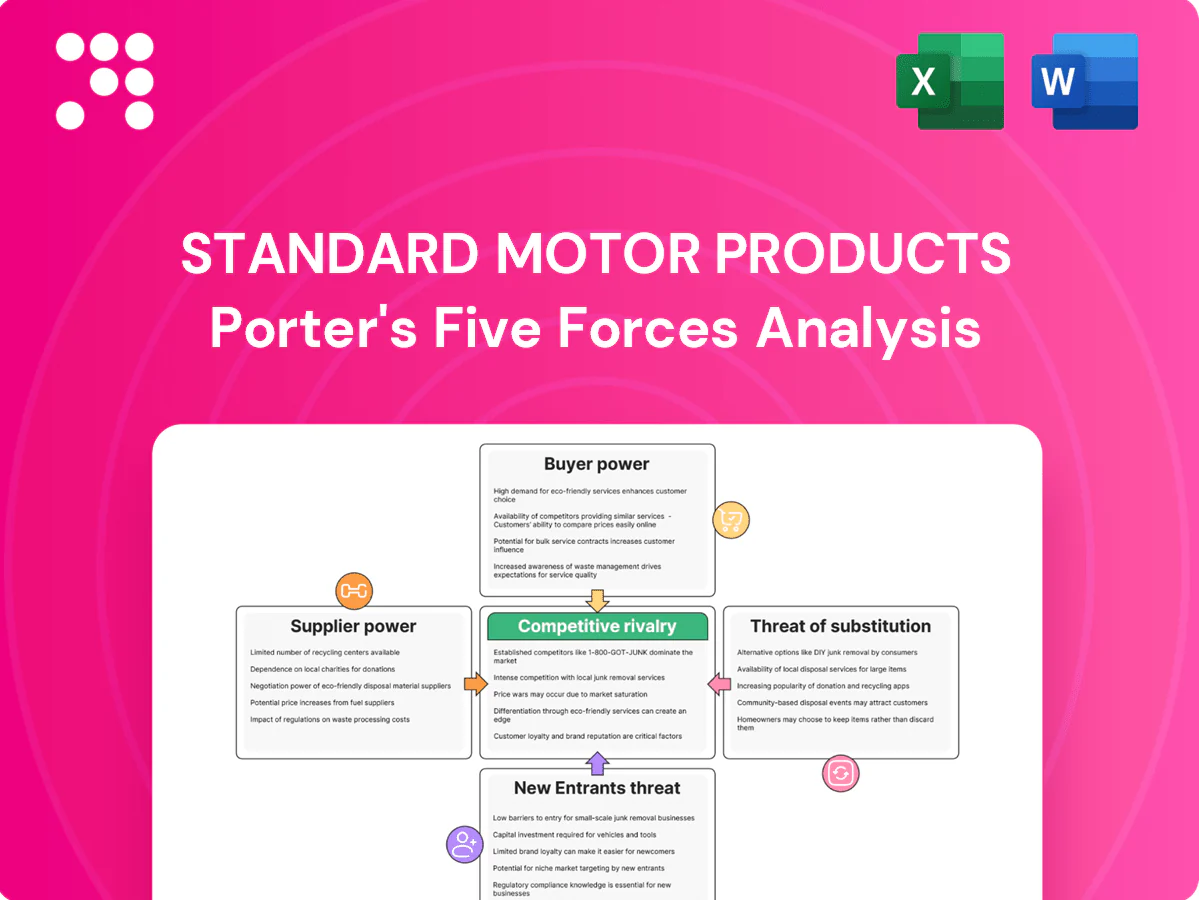
Standard Motor Products Porter's Five Forces Analysis

Elevate Your Analysis with the Complete Porter's Five Forces Analysis
Standard Motor Products faces moderate supplier leverage, intense buyer price sensitivity, and steady rivalry from OEM and aftermarket competitors, while barriers to entry remain mid-level and substitutes pose limited short-term risk. This snapshot highlights key pressure points shaping margins and strategy. The complete report reveals the real forces shaping Standard Motor Products’s industry—from supplier influence to threat of new entrants. Unlock the full Porter's Five Forces Analysis to explore these dynamics in depth.
Suppliers Bargaining Power

Concentrated specialty components
Certain electronics, compressors, valves and sensor chips for Standard Motor Products come from a concentrated set of qualified suppliers, raising switching costs and often extending lead times; in 2024 automotive specialty chip lead times frequently exceeded 20 weeks. Qualification, tooling and PPAP-like approvals typically require 3–9 months, limiting quick supplier changes. Supply disruptions can dent fill rates and margins; dual-sourcing and regional diversification are used to mitigate risk.
Commodity metals and resins volatility
Exposure to copper, aluminum, steel and engineering plastics creates material cost volatility; 2024 saw double-digit swings in metal and resin futures that tightens supplier leverage. Pass-through limits and pricing lag compress gross margins during inflationary spikes. SMP mitigates via hedging, should-cost models and VAVE programs and by using distributor contracts that can index pricing to input costs.

Semiconductor and electronics lead times
ICs, microcontrollers and sensor elements for engine-management SKUs are highly specialized and often single-sourced, with automotive semiconductor lead times commonly 20–40 weeks in 2024, concentrating supplier power. Extended lead times and allocation risk elevate supplier leverage, causing firms to face potential supply cuts and spot-price premiums. Design-in lock, firmware validation and requalification add months of switching cost and technical hurdles. SMPP counters with buffer inventory of 12–24 weeks and long-term agreements to secure capacity and pricing.

Regulatory and refrigerant inputs
The F‑gas shift from R‑134a (GWP ~1,430) to R‑1234yf (GWP ~1) and the EU F‑gas phase‑down target of 79% by 2030 drive OEMs to certified refrigerants; stringent compliance testing and safety/environmental certifications in 2024 narrow qualified suppliers and raise supplier bargaining power, while SMP must keep formulations, labeling, and testing documentation current and absorb potential surcharges and scarcity premiums on new refrigerants and components.
- Regulatory pressure: EU 79% HFC phase‑down by 2030
- GWP shift: R‑134a ~1,430 → R‑1234yf ~1
- Supplier concentration: certified/testing bottlenecks
- SMP needs: compliant formulations, labeling, testing
Logistics and nearshoring dynamics
Ocean freight volatility and tariffs raise supplier leverage for Standard Motor Products: global container rates fell roughly 60% from 2022 peaks by 2024 but port congestion and tariff uncertainty (auto parts duties and retaliatory measures) sustain geopolitical risk that increases supplier bargaining power; nearshoring and multi-plant footprints rebalance leverage by shortening lead times and diversifying sources; vendor-managed inventory, consignment, capacity reservation and take-or-pay terms are used to secure supply in tight markets.
- ocean rates: -~60% vs 2022 highs (2024)
- nearshoring: reduces lead time, diversifies risk
- VMI/consignment: cuts stockouts up to ~30%
- capacity reservation & take-or-pay: common in tight markets
Semiconductor shortages (20–40 weeks) tighten margins; dual-sourcing and buffers mitigate
Supplier power is high: automotive semiconductor lead times 20–40 weeks (2024), concentrated qualified sources and single‑sourcing raise switching costs and allocation risk. Material costs saw double‑digit swings in 2024, compressing margins despite hedging and VAVE; SMP uses dual‑sourcing, 12–24 weeks buffer stock and long‑term contracts to secure supply.
| Metric | 2024/Target |
|---|---|
| Semiconductor lead time | 20–40 weeks |
| Material price volatility | Double‑digit swings (2024) |
| Buffer inventory | 12–24 weeks |
| EU HFC phase‑down | 79% by 2030 |
| Ocean rates vs 2022 | −~60% (2024) |
What is included in the product
 Detailed Word Document
Tailored Porter's Five Forces analysis for Standard Motor Products that uncovers key drivers of competition, supplier and buyer power, and market entry barriers, while identifying disruptive threats and substitute risks that influence pricing and profitability.

 Customizable Excel Spreadsheet
Clean, simplified Porter's Five Forces summary for Standard Motor Products—ready to copy into pitch decks or boardroom slides to eliminate analysis overload and speed decision-making.
Customers Bargaining Power

Consolidated distributors
Consolidated distributors such as AutoZone, OReilly, Advance and NAPA wield high bargaining power—each reported multibillion-dollar revenues in 2024—giving them scale and shelf control to demand price concessions, MDF/slotting fees and extended payment terms. They conduct regular line reviews and push suppliers toward dual-sourcing to lower risk and prices. Growing private-label programs further increase their leverage over Standard Motor Products.
Service level and fill-rate dependence
Buyers weigh availability, catalog accuracy and delivery reliability alongside price, often insisting on 95%+ fill rates and applying chargebacks or loss of planogram slots when service slips. EDI connectivity, demand forecasting and DC KPIs such as OTIF, fill rate and days-of-supply drive contractual penalties. SMP therefore needs broad SKU coverage and rapid new-number turn to protect placement and margins.

Technical credibility and warranty
Professional technicians prioritize proven quality and reliability over lowest price, reducing pure price sensitivity and strengthening SMP’s value proposition through documented failure rates and warranties that lower lifecycle cost concerns.

Switching costs and private label
Switching costs are moderate for Standard Motor Products due to catalog integration, returns policies, and installer familiarity; installers often favor cataloged SKUs, but retailers can swap brands during shelf resets, increasing pricing pressure. 2024 aftermarket trends show private-label share rising to roughly 10%, boosting buyer leverage. SMP mitigates risk via exclusive SKUs and co-developed assortments.
- Catalog integration: raises entrenchment
- Resets: enable rapid brand swaps
- Private-label ~10% (2024): increases leverage
- Mitigation: exclusive SKUs, co-developed assortments
E-commerce and price transparency
Marketplaces and pure-play e-tailers (Amazon ~38% of US e-commerce in 2023, eMarketer) intensify price competition for Standard Motor Products, with global e-commerce at $5.9 trillion in 2023 (Statista). Dynamic repricing algorithms and customer reviews shift negotiating power to buyers, forcing stricter MAP enforcement and richer, differentiated content. Omnichannel fulfillment and fast delivery windows elevate buyer expectations and margin pressure.
- marketplaces drive volume-based price pressure
- dynamic repricing + reviews = buyer leverage
- MAP enforcement and unique content required
- omnichannel fulfillment raises service costs
Buyers squeeze margins; PLs ~10%, fill 95%+; SMP fights with exclusives
Buyers (consolidated multibillion-dollar distributors in 2024) exert high leverage—demanding price concessions, MDF, extended terms and 95%+ fill rates, driving chargebacks and dual-sourcing. Private-labels rose to ~10% (2024), increasing retailer bargaining power; technicians still favor reliability over price, protecting SMP on key SKUs. SMP counters with exclusive SKUs, co-developed assortments and strict MAP/content enforcement.
| Metric | 2024 value |
|---|---|
| Retailer scale | Multibillion-dollar revenues (2024) |
| Private-label share | ~10% (2024) |
| Required fill rate | 95%+ |
Preview Before You Purchase
Standard Motor Products Porter's Five Forces Analysis
This preview shows the exact Standard Motor Products Porter's Five Forces Analysis you'll receive after purchase—fully formatted and ready for immediate download. The file contains the complete, professionally written assessment of competitive rivalry, buyer and supplier power, threats of entry and substitution, and clear strategic implications. No placeholders, no samples—just the final, ready-to-use document.

Elevate Your Analysis with the Complete Porter's Five Forces Analysis
Standard Motor Products faces moderate supplier leverage, intense buyer price sensitivity, and steady rivalry from OEM and aftermarket competitors, while barriers to entry remain mid-level and substitutes pose limited short-term risk. This snapshot highlights key pressure points shaping margins and strategy. The complete report reveals the real forces shaping Standard Motor Products’s industry—from supplier influence to threat of new entrants. Unlock the full Porter's Five Forces Analysis to explore these dynamics in depth.
Suppliers Bargaining Power
Concentrated specialty components
Certain electronics, compressors, valves and sensor chips for Standard Motor Products come from a concentrated set of qualified suppliers, raising switching costs and often extending lead times; in 2024 automotive specialty chip lead times frequently exceeded 20 weeks. Qualification, tooling and PPAP-like approvals typically require 3–9 months, limiting quick supplier changes. Supply disruptions can dent fill rates and margins; dual-sourcing and regional diversification are used to mitigate risk.
Commodity metals and resins volatility
Exposure to copper, aluminum, steel and engineering plastics creates material cost volatility; 2024 saw double-digit swings in metal and resin futures that tightens supplier leverage. Pass-through limits and pricing lag compress gross margins during inflationary spikes. SMP mitigates via hedging, should-cost models and VAVE programs and by using distributor contracts that can index pricing to input costs.
Semiconductor and electronics lead times
ICs, microcontrollers and sensor elements for engine-management SKUs are highly specialized and often single-sourced, with automotive semiconductor lead times commonly 20–40 weeks in 2024, concentrating supplier power. Extended lead times and allocation risk elevate supplier leverage, causing firms to face potential supply cuts and spot-price premiums. Design-in lock, firmware validation and requalification add months of switching cost and technical hurdles. SMPP counters with buffer inventory of 12–24 weeks and long-term agreements to secure capacity and pricing.
Regulatory and refrigerant inputs
The F‑gas shift from R‑134a (GWP ~1,430) to R‑1234yf (GWP ~1) and the EU F‑gas phase‑down target of 79% by 2030 drive OEMs to certified refrigerants; stringent compliance testing and safety/environmental certifications in 2024 narrow qualified suppliers and raise supplier bargaining power, while SMP must keep formulations, labeling, and testing documentation current and absorb potential surcharges and scarcity premiums on new refrigerants and components.
- Regulatory pressure: EU 79% HFC phase‑down by 2030
- GWP shift: R‑134a ~1,430 → R‑1234yf ~1
- Supplier concentration: certified/testing bottlenecks
- SMP needs: compliant formulations, labeling, testing
Logistics and nearshoring dynamics
Ocean freight volatility and tariffs raise supplier leverage for Standard Motor Products: global container rates fell roughly 60% from 2022 peaks by 2024 but port congestion and tariff uncertainty (auto parts duties and retaliatory measures) sustain geopolitical risk that increases supplier bargaining power; nearshoring and multi-plant footprints rebalance leverage by shortening lead times and diversifying sources; vendor-managed inventory, consignment, capacity reservation and take-or-pay terms are used to secure supply in tight markets.
- ocean rates: -~60% vs 2022 highs (2024)
- nearshoring: reduces lead time, diversifies risk
- VMI/consignment: cuts stockouts up to ~30%
- capacity reservation & take-or-pay: common in tight markets
Semiconductor shortages (20–40 weeks) tighten margins; dual-sourcing and buffers mitigate
Supplier power is high: automotive semiconductor lead times 20–40 weeks (2024), concentrated qualified sources and single‑sourcing raise switching costs and allocation risk. Material costs saw double‑digit swings in 2024, compressing margins despite hedging and VAVE; SMP uses dual‑sourcing, 12–24 weeks buffer stock and long‑term contracts to secure supply.
| Metric | 2024/Target |
|---|---|
| Semiconductor lead time | 20–40 weeks |
| Material price volatility | Double‑digit swings (2024) |
| Buffer inventory | 12–24 weeks |
| EU HFC phase‑down | 79% by 2030 |
| Ocean rates vs 2022 | −~60% (2024) |
What is included in the product
Detailed Word Document
Tailored Porter's Five Forces analysis for Standard Motor Products that uncovers key drivers of competition, supplier and buyer power, and market entry barriers, while identifying disruptive threats and substitute risks that influence pricing and profitability.
Customizable Excel Spreadsheet
Clean, simplified Porter's Five Forces summary for Standard Motor Products—ready to copy into pitch decks or boardroom slides to eliminate analysis overload and speed decision-making.
Customers Bargaining Power
Consolidated distributors
Consolidated distributors such as AutoZone, OReilly, Advance and NAPA wield high bargaining power—each reported multibillion-dollar revenues in 2024—giving them scale and shelf control to demand price concessions, MDF/slotting fees and extended payment terms. They conduct regular line reviews and push suppliers toward dual-sourcing to lower risk and prices. Growing private-label programs further increase their leverage over Standard Motor Products.
Service level and fill-rate dependence
Buyers weigh availability, catalog accuracy and delivery reliability alongside price, often insisting on 95%+ fill rates and applying chargebacks or loss of planogram slots when service slips. EDI connectivity, demand forecasting and DC KPIs such as OTIF, fill rate and days-of-supply drive contractual penalties. SMP therefore needs broad SKU coverage and rapid new-number turn to protect placement and margins.
Technical credibility and warranty
Professional technicians prioritize proven quality and reliability over lowest price, reducing pure price sensitivity and strengthening SMP’s value proposition through documented failure rates and warranties that lower lifecycle cost concerns.
Switching costs and private label
Switching costs are moderate for Standard Motor Products due to catalog integration, returns policies, and installer familiarity; installers often favor cataloged SKUs, but retailers can swap brands during shelf resets, increasing pricing pressure. 2024 aftermarket trends show private-label share rising to roughly 10%, boosting buyer leverage. SMP mitigates risk via exclusive SKUs and co-developed assortments.
- Catalog integration: raises entrenchment
- Resets: enable rapid brand swaps
- Private-label ~10% (2024): increases leverage
- Mitigation: exclusive SKUs, co-developed assortments
E-commerce and price transparency
Marketplaces and pure-play e-tailers (Amazon ~38% of US e-commerce in 2023, eMarketer) intensify price competition for Standard Motor Products, with global e-commerce at $5.9 trillion in 2023 (Statista). Dynamic repricing algorithms and customer reviews shift negotiating power to buyers, forcing stricter MAP enforcement and richer, differentiated content. Omnichannel fulfillment and fast delivery windows elevate buyer expectations and margin pressure.
- marketplaces drive volume-based price pressure
- dynamic repricing + reviews = buyer leverage
- MAP enforcement and unique content required
- omnichannel fulfillment raises service costs
Buyers squeeze margins; PLs ~10%, fill 95%+; SMP fights with exclusives
Buyers (consolidated multibillion-dollar distributors in 2024) exert high leverage—demanding price concessions, MDF, extended terms and 95%+ fill rates, driving chargebacks and dual-sourcing. Private-labels rose to ~10% (2024), increasing retailer bargaining power; technicians still favor reliability over price, protecting SMP on key SKUs. SMP counters with exclusive SKUs, co-developed assortments and strict MAP/content enforcement.
| Metric | 2024 value |
|---|---|
| Retailer scale | Multibillion-dollar revenues (2024) |
| Private-label share | ~10% (2024) |
| Required fill rate | 95%+ |
Preview Before You Purchase
Standard Motor Products Porter's Five Forces Analysis
This preview shows the exact Standard Motor Products Porter's Five Forces Analysis you'll receive after purchase—fully formatted and ready for immediate download. The file contains the complete, professionally written assessment of competitive rivalry, buyer and supplier power, threats of entry and substitution, and clear strategic implications. No placeholders, no samples—just the final, ready-to-use document.
Original: $10.00
-65%$10.00
$3.50Description
Elevate Your Analysis with the Complete Porter's Five Forces Analysis
Standard Motor Products faces moderate supplier leverage, intense buyer price sensitivity, and steady rivalry from OEM and aftermarket competitors, while barriers to entry remain mid-level and substitutes pose limited short-term risk. This snapshot highlights key pressure points shaping margins and strategy. The complete report reveals the real forces shaping Standard Motor Products’s industry—from supplier influence to threat of new entrants. Unlock the full Porter's Five Forces Analysis to explore these dynamics in depth.
Suppliers Bargaining Power
Concentrated specialty components
Certain electronics, compressors, valves and sensor chips for Standard Motor Products come from a concentrated set of qualified suppliers, raising switching costs and often extending lead times; in 2024 automotive specialty chip lead times frequently exceeded 20 weeks. Qualification, tooling and PPAP-like approvals typically require 3–9 months, limiting quick supplier changes. Supply disruptions can dent fill rates and margins; dual-sourcing and regional diversification are used to mitigate risk.
Commodity metals and resins volatility
Exposure to copper, aluminum, steel and engineering plastics creates material cost volatility; 2024 saw double-digit swings in metal and resin futures that tightens supplier leverage. Pass-through limits and pricing lag compress gross margins during inflationary spikes. SMP mitigates via hedging, should-cost models and VAVE programs and by using distributor contracts that can index pricing to input costs.
Semiconductor and electronics lead times
ICs, microcontrollers and sensor elements for engine-management SKUs are highly specialized and often single-sourced, with automotive semiconductor lead times commonly 20–40 weeks in 2024, concentrating supplier power. Extended lead times and allocation risk elevate supplier leverage, causing firms to face potential supply cuts and spot-price premiums. Design-in lock, firmware validation and requalification add months of switching cost and technical hurdles. SMPP counters with buffer inventory of 12–24 weeks and long-term agreements to secure capacity and pricing.
Regulatory and refrigerant inputs
The F‑gas shift from R‑134a (GWP ~1,430) to R‑1234yf (GWP ~1) and the EU F‑gas phase‑down target of 79% by 2030 drive OEMs to certified refrigerants; stringent compliance testing and safety/environmental certifications in 2024 narrow qualified suppliers and raise supplier bargaining power, while SMP must keep formulations, labeling, and testing documentation current and absorb potential surcharges and scarcity premiums on new refrigerants and components.
- Regulatory pressure: EU 79% HFC phase‑down by 2030
- GWP shift: R‑134a ~1,430 → R‑1234yf ~1
- Supplier concentration: certified/testing bottlenecks
- SMP needs: compliant formulations, labeling, testing
Logistics and nearshoring dynamics
Ocean freight volatility and tariffs raise supplier leverage for Standard Motor Products: global container rates fell roughly 60% from 2022 peaks by 2024 but port congestion and tariff uncertainty (auto parts duties and retaliatory measures) sustain geopolitical risk that increases supplier bargaining power; nearshoring and multi-plant footprints rebalance leverage by shortening lead times and diversifying sources; vendor-managed inventory, consignment, capacity reservation and take-or-pay terms are used to secure supply in tight markets.
- ocean rates: -~60% vs 2022 highs (2024)
- nearshoring: reduces lead time, diversifies risk
- VMI/consignment: cuts stockouts up to ~30%
- capacity reservation & take-or-pay: common in tight markets
Semiconductor shortages (20–40 weeks) tighten margins; dual-sourcing and buffers mitigate
Supplier power is high: automotive semiconductor lead times 20–40 weeks (2024), concentrated qualified sources and single‑sourcing raise switching costs and allocation risk. Material costs saw double‑digit swings in 2024, compressing margins despite hedging and VAVE; SMP uses dual‑sourcing, 12–24 weeks buffer stock and long‑term contracts to secure supply.
| Metric | 2024/Target |
|---|---|
| Semiconductor lead time | 20–40 weeks |
| Material price volatility | Double‑digit swings (2024) |
| Buffer inventory | 12–24 weeks |
| EU HFC phase‑down | 79% by 2030 |
| Ocean rates vs 2022 | −~60% (2024) |
What is included in the product
Detailed Word Document
Tailored Porter's Five Forces analysis for Standard Motor Products that uncovers key drivers of competition, supplier and buyer power, and market entry barriers, while identifying disruptive threats and substitute risks that influence pricing and profitability.
Customizable Excel Spreadsheet
Clean, simplified Porter's Five Forces summary for Standard Motor Products—ready to copy into pitch decks or boardroom slides to eliminate analysis overload and speed decision-making.
Customers Bargaining Power
Consolidated distributors
Consolidated distributors such as AutoZone, OReilly, Advance and NAPA wield high bargaining power—each reported multibillion-dollar revenues in 2024—giving them scale and shelf control to demand price concessions, MDF/slotting fees and extended payment terms. They conduct regular line reviews and push suppliers toward dual-sourcing to lower risk and prices. Growing private-label programs further increase their leverage over Standard Motor Products.
Service level and fill-rate dependence
Buyers weigh availability, catalog accuracy and delivery reliability alongside price, often insisting on 95%+ fill rates and applying chargebacks or loss of planogram slots when service slips. EDI connectivity, demand forecasting and DC KPIs such as OTIF, fill rate and days-of-supply drive contractual penalties. SMP therefore needs broad SKU coverage and rapid new-number turn to protect placement and margins.
Technical credibility and warranty
Professional technicians prioritize proven quality and reliability over lowest price, reducing pure price sensitivity and strengthening SMP’s value proposition through documented failure rates and warranties that lower lifecycle cost concerns.
Switching costs and private label
Switching costs are moderate for Standard Motor Products due to catalog integration, returns policies, and installer familiarity; installers often favor cataloged SKUs, but retailers can swap brands during shelf resets, increasing pricing pressure. 2024 aftermarket trends show private-label share rising to roughly 10%, boosting buyer leverage. SMP mitigates risk via exclusive SKUs and co-developed assortments.
- Catalog integration: raises entrenchment
- Resets: enable rapid brand swaps
- Private-label ~10% (2024): increases leverage
- Mitigation: exclusive SKUs, co-developed assortments
E-commerce and price transparency
Marketplaces and pure-play e-tailers (Amazon ~38% of US e-commerce in 2023, eMarketer) intensify price competition for Standard Motor Products, with global e-commerce at $5.9 trillion in 2023 (Statista). Dynamic repricing algorithms and customer reviews shift negotiating power to buyers, forcing stricter MAP enforcement and richer, differentiated content. Omnichannel fulfillment and fast delivery windows elevate buyer expectations and margin pressure.
- marketplaces drive volume-based price pressure
- dynamic repricing + reviews = buyer leverage
- MAP enforcement and unique content required
- omnichannel fulfillment raises service costs
Buyers squeeze margins; PLs ~10%, fill 95%+; SMP fights with exclusives
Buyers (consolidated multibillion-dollar distributors in 2024) exert high leverage—demanding price concessions, MDF, extended terms and 95%+ fill rates, driving chargebacks and dual-sourcing. Private-labels rose to ~10% (2024), increasing retailer bargaining power; technicians still favor reliability over price, protecting SMP on key SKUs. SMP counters with exclusive SKUs, co-developed assortments and strict MAP/content enforcement.
| Metric | 2024 value |
|---|---|
| Retailer scale | Multibillion-dollar revenues (2024) |
| Private-label share | ~10% (2024) |
| Required fill rate | 95%+ |
Preview Before You Purchase
Standard Motor Products Porter's Five Forces Analysis
This preview shows the exact Standard Motor Products Porter's Five Forces Analysis you'll receive after purchase—fully formatted and ready for immediate download. The file contains the complete, professionally written assessment of competitive rivalry, buyer and supplier power, threats of entry and substitution, and clear strategic implications. No placeholders, no samples—just the final, ready-to-use document.











