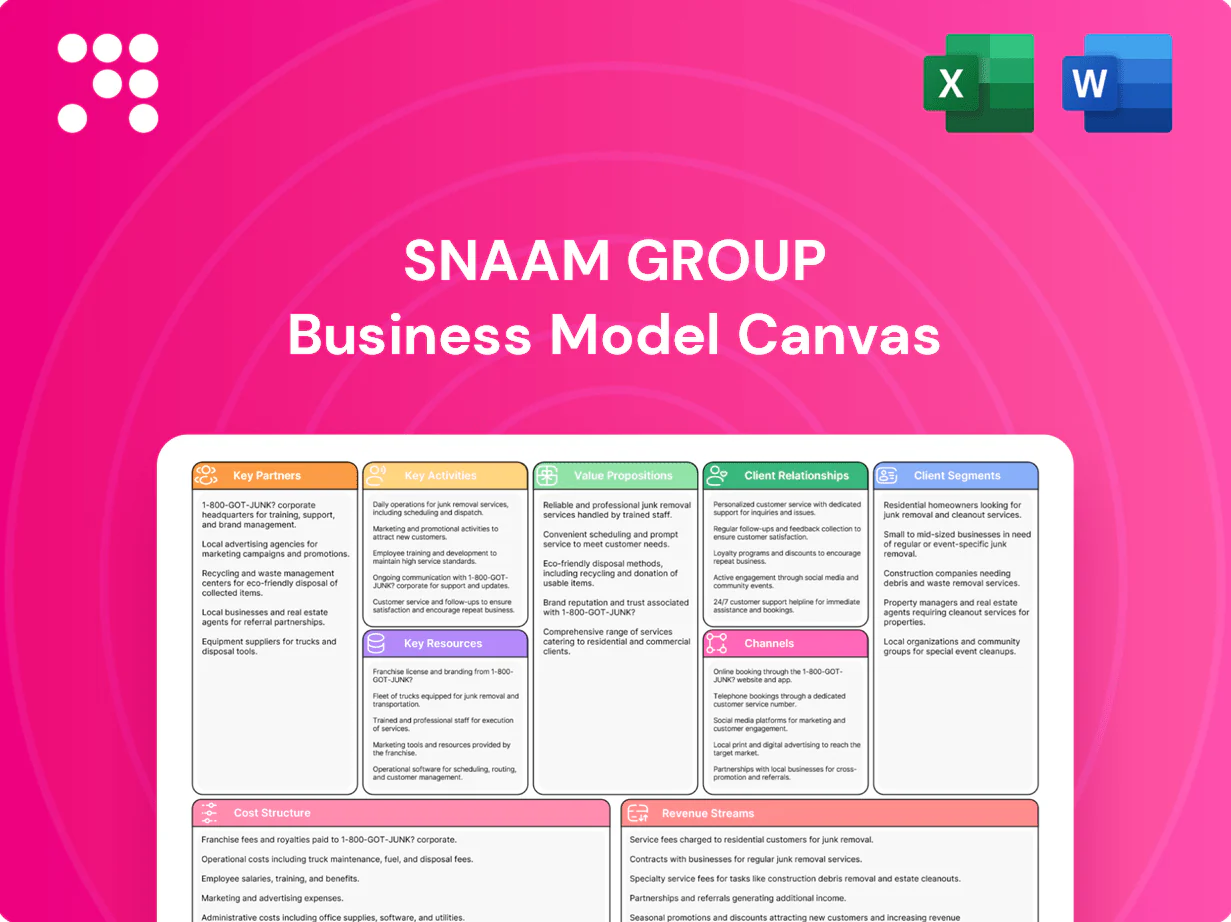
SNAAM Group Business Model Canvas

Unlock a company-specific Business Model Canvas: value proposition, partners, revenue
Unlock the full strategic blueprint behind SNAAM Group’s business model with our detailed Business Model Canvas. This concise, company-specific analysis reveals value propositions, key partners, revenue streams and cost structure. Ideal for investors, consultants and founders seeking actionable insights. Purchase the full Canvas to download editable Word and Excel files for immediate use.
Partnerships

Industrial component suppliers
Partner with manufacturers of fans, motors, filters, ducts, sensors and control panels to ensure component quality and availability; the global HVAC components market was estimated at USD 52.3 billion in 2024, supporting scale purchasing. Strategic sourcing reduced procurement costs and improved lead-time reliability by targeting bulk contracts and JIT agreements. Multi-vendor relationships cut supply disruption risk, while co-development with key suppliers drove measurable gains in performance and energy efficiency.
EPC and mechanical contractors
Collaborate with EPC and HVAC/mechanical contractors on large turnkey installations to leverage combined engineering, procurement and construction expertise and handle projects often exceeding $5m in scope. Partnerships expand project capacity and geographic reach, tapping into the global HVAC market (≈$150bn in 2024) and regional EPC networks. Joint bidding and integrated proposals improve win rates on complex sites through shared risk and resources. Clear scopes, KPIs and technical standards ensure seamless on-site integration and handovers.

Regulatory and certification bodies
Engage proactively with OSHA, ISO, CE, ATEX and local authorities to secure compliance pathways; ISO 9001 counted about 1.3 million certified organizations worldwide in 2024, underscoring certification prevalence. Early alignment with these bodies reduces rework and approval delays during product development. Independent certification partners validate safety and performance claims, and continuous updates keep SNAAM Group solutions audit-ready across industries.

IoT and automation technology partners
IoT and automation partners integrate sensors, PLCs, VFDs and cloud monitoring to enable real-time control; 2024 pilots delivered typical energy savings of 14% and downtime reductions of 28% on HVAC assets.
- Interoperability with BMS/SCADA increases retro‑fit adoption
- Data-driven control improves air quality and cuts OPEX
- Co-innovation accelerates predictive maintenance GTM
Distributors and regional agents
Distributors and regional agents give SNAAM Group direct access to mid-market clients, supplying localized market intelligence and scalable after-sales reach; in 2024 channel-led models influenced an estimated 65% of regional mid-market purchases. Incentive structures tied to pipeline and deal velocity drive partner performance, while standardized enablement ensures a consistent customer experience across territories.
- Local access: faster entry to mid-market
- Intelligence & support: continuous after-sales reach
- Incentives + enablement: pipeline growth and CX consistency
Partners secure HVAC supply, ISO compliance and 14% IoT energy savings
Key partnerships secure component supply (HVAC components market USD 52.3B in 2024), expand EPC and contractor capacity for >$5m projects, ensure compliance via ISO/CE approvals (ISO 9001 ≈1.3M certs in 2024) and enable IoT-driven savings (~14% energy reduction in 2024 pilots), while distributors drive 65% of mid-market channel influence.
| Partner | Metric (2024) |
|---|---|
| Components | USD 52.3B |
| Global HVAC market | USD 150B |
| ISO 9001 | ≈1.3M orgs |
| IoT pilots | 14% energy |
| Channel influence | 65% |
What is included in the product
 Detailed Word Document
A comprehensive, pre-written business model tailored to SNAAM Group’s strategy, organized into 9 BMC blocks with detailed customer segments, value propositions, channels, revenue streams, resources, partners, activities and cost structure; includes SWOT-linked insights, competitive advantages and a polished format for investor presentations and strategic decisions.

 Customizable Excel Spreadsheet
High-level view of SNAAM Group’s business model with editable cells, quickly identifying core components to relieve strategic ambiguity and save hours of formatting and structuring your own model for team collaboration.
Activities

Custom design and engineering
Assess site risks and process emissions to tailor solutions using detailed hazard mapping and measured emission loads. Size dust collectors, hoods, and airflow to meet capture targets and HEPA requirements (EN 1822 H13 99.95% / H14 99.995%). Produce CAD, CFD, and P&IDs for constructability and performance validation. Engineer compliance with GMP (EU Annex 1 2022), ISO 14644 cleanroom standards and ISO 45001 safety norms.
Manufacturing and assembly
Fabricate housings, ducts and frames to tight tolerances while assembling filtration media, fans and controls to technical specifications; current shop-floor QA yield exceeds 98% with factory acceptance tests (FAT) per ISO 9001/ISO 17025. Prototype lead time targets are 48–72 hours and production runs pursue a 15% unit-cost reduction through line balancing and lean cells. Continuous SPC and Kaizen drive throughput and on-time delivery.

Installation and commissioning
Coordinate on-site works to minimize downtime (target <4 hours for critical systems), execute integrated mechanical, electrical and PLC/SCADA controls integration, perform commissioning, balancing and performance tests per ASHRAE/ISO protocols, then hand over with complete documentation (typically 50+ page O&M pack) and operator training (standard 8-hour session) for SNAAM Group projects.

Maintenance and lifecycle services
SNAAM Group delivers preventive and corrective maintenance programs that industry benchmarks in 2024 show can cut unplanned downtime by up to 70% and maintenance costs by ~25%, while managing spare parts, filter replacements and calibrations with parts-fill targets near 98% and inventory turnover ~4x.
- Preventive maintenance: downtime -70%, cost -25%
- Spare parts: fill rate 98%, turnover 4x
- Remote monitoring: energy savings up to 15%, 24/7 alerts
- KPI tracking: SLA adherence >95%, IAQ and energy targets monitored
R&D and compliance testing
Develop higher-efficiency filtration targeting HEPA-class 99.97% at 0.3 µm and low-noise envelopes (aiming under 50 dB for residential use); validate designs against ISO 29463 and EN 1822 plus applicable IEC/EN safety standards; iterate prototypes with lab particle-count and field performance data; pursue patent protection where feasible.
- HEPA 99.97% at 0.3 µm
- ISO 29463 / EN 1822 testing
- Field + lab iteration using particle counters
- IP filings when viable
EN 1822 H13/H14 & EU Annex 1 systems — ISO QA >98%, prototypes 48–72h, -15% cost
Assess site risks, size capture systems and validate with CAD/CFD to meet EN 1822 H13/H14 and EU Annex 1 2022. Fabricate to ISO 9001/ISO 17025 QA yield >98%, prototype 48–72h, target -15% unit cost. Commission with <4h critical downtime, 50+ page O&M and 8h operator training. Maintenance programs (2024) cut unplanned downtime up to 70%, costs ~25%; spare fill 98%, turnover 4x; remote monitoring saves up to 15% energy.
| Metric | Value |
|---|---|
| QA yield | 98%+ |
| Prototype LT | 48–72h |
| Unit-cost target | -15% |
| Unplanned downtime | -70% |
| Maintenance cost | -25% |
| Spare fill | 98% |
| Inventory turnover | 4x |
| Energy savings (remote) | up to 15% |
Preview Before You Purchase
Business Model Canvas
The document you're previewing is the actual SNAAM Group Business Model Canvas—not a mockup or teaser—and it reflects the exact content and structure you’ll receive after purchase. Upon completing your order you’ll get this same professional, editable file in its full form, ready for presentation, editing, and sharing. No surprises, just the real deliverable.

Unlock a company-specific Business Model Canvas: value proposition, partners, revenue
Unlock the full strategic blueprint behind SNAAM Group’s business model with our detailed Business Model Canvas. This concise, company-specific analysis reveals value propositions, key partners, revenue streams and cost structure. Ideal for investors, consultants and founders seeking actionable insights. Purchase the full Canvas to download editable Word and Excel files for immediate use.
Partnerships
Industrial component suppliers
Partner with manufacturers of fans, motors, filters, ducts, sensors and control panels to ensure component quality and availability; the global HVAC components market was estimated at USD 52.3 billion in 2024, supporting scale purchasing. Strategic sourcing reduced procurement costs and improved lead-time reliability by targeting bulk contracts and JIT agreements. Multi-vendor relationships cut supply disruption risk, while co-development with key suppliers drove measurable gains in performance and energy efficiency.
EPC and mechanical contractors
Collaborate with EPC and HVAC/mechanical contractors on large turnkey installations to leverage combined engineering, procurement and construction expertise and handle projects often exceeding $5m in scope. Partnerships expand project capacity and geographic reach, tapping into the global HVAC market (≈$150bn in 2024) and regional EPC networks. Joint bidding and integrated proposals improve win rates on complex sites through shared risk and resources. Clear scopes, KPIs and technical standards ensure seamless on-site integration and handovers.
Regulatory and certification bodies
Engage proactively with OSHA, ISO, CE, ATEX and local authorities to secure compliance pathways; ISO 9001 counted about 1.3 million certified organizations worldwide in 2024, underscoring certification prevalence. Early alignment with these bodies reduces rework and approval delays during product development. Independent certification partners validate safety and performance claims, and continuous updates keep SNAAM Group solutions audit-ready across industries.
IoT and automation technology partners
IoT and automation partners integrate sensors, PLCs, VFDs and cloud monitoring to enable real-time control; 2024 pilots delivered typical energy savings of 14% and downtime reductions of 28% on HVAC assets.
- Interoperability with BMS/SCADA increases retro‑fit adoption
- Data-driven control improves air quality and cuts OPEX
- Co-innovation accelerates predictive maintenance GTM
Distributors and regional agents
Distributors and regional agents give SNAAM Group direct access to mid-market clients, supplying localized market intelligence and scalable after-sales reach; in 2024 channel-led models influenced an estimated 65% of regional mid-market purchases. Incentive structures tied to pipeline and deal velocity drive partner performance, while standardized enablement ensures a consistent customer experience across territories.
- Local access: faster entry to mid-market
- Intelligence & support: continuous after-sales reach
- Incentives + enablement: pipeline growth and CX consistency
Partners secure HVAC supply, ISO compliance and 14% IoT energy savings
Key partnerships secure component supply (HVAC components market USD 52.3B in 2024), expand EPC and contractor capacity for >$5m projects, ensure compliance via ISO/CE approvals (ISO 9001 ≈1.3M certs in 2024) and enable IoT-driven savings (~14% energy reduction in 2024 pilots), while distributors drive 65% of mid-market channel influence.
| Partner | Metric (2024) |
|---|---|
| Components | USD 52.3B |
| Global HVAC market | USD 150B |
| ISO 9001 | ≈1.3M orgs |
| IoT pilots | 14% energy |
| Channel influence | 65% |
What is included in the product
Detailed Word Document
A comprehensive, pre-written business model tailored to SNAAM Group’s strategy, organized into 9 BMC blocks with detailed customer segments, value propositions, channels, revenue streams, resources, partners, activities and cost structure; includes SWOT-linked insights, competitive advantages and a polished format for investor presentations and strategic decisions.
Customizable Excel Spreadsheet
High-level view of SNAAM Group’s business model with editable cells, quickly identifying core components to relieve strategic ambiguity and save hours of formatting and structuring your own model for team collaboration.
Activities
Custom design and engineering
Assess site risks and process emissions to tailor solutions using detailed hazard mapping and measured emission loads. Size dust collectors, hoods, and airflow to meet capture targets and HEPA requirements (EN 1822 H13 99.95% / H14 99.995%). Produce CAD, CFD, and P&IDs for constructability and performance validation. Engineer compliance with GMP (EU Annex 1 2022), ISO 14644 cleanroom standards and ISO 45001 safety norms.
Manufacturing and assembly
Fabricate housings, ducts and frames to tight tolerances while assembling filtration media, fans and controls to technical specifications; current shop-floor QA yield exceeds 98% with factory acceptance tests (FAT) per ISO 9001/ISO 17025. Prototype lead time targets are 48–72 hours and production runs pursue a 15% unit-cost reduction through line balancing and lean cells. Continuous SPC and Kaizen drive throughput and on-time delivery.
Installation and commissioning
Coordinate on-site works to minimize downtime (target <4 hours for critical systems), execute integrated mechanical, electrical and PLC/SCADA controls integration, perform commissioning, balancing and performance tests per ASHRAE/ISO protocols, then hand over with complete documentation (typically 50+ page O&M pack) and operator training (standard 8-hour session) for SNAAM Group projects.
Maintenance and lifecycle services
SNAAM Group delivers preventive and corrective maintenance programs that industry benchmarks in 2024 show can cut unplanned downtime by up to 70% and maintenance costs by ~25%, while managing spare parts, filter replacements and calibrations with parts-fill targets near 98% and inventory turnover ~4x.
- Preventive maintenance: downtime -70%, cost -25%
- Spare parts: fill rate 98%, turnover 4x
- Remote monitoring: energy savings up to 15%, 24/7 alerts
- KPI tracking: SLA adherence >95%, IAQ and energy targets monitored
R&D and compliance testing
Develop higher-efficiency filtration targeting HEPA-class 99.97% at 0.3 µm and low-noise envelopes (aiming under 50 dB for residential use); validate designs against ISO 29463 and EN 1822 plus applicable IEC/EN safety standards; iterate prototypes with lab particle-count and field performance data; pursue patent protection where feasible.
- HEPA 99.97% at 0.3 µm
- ISO 29463 / EN 1822 testing
- Field + lab iteration using particle counters
- IP filings when viable
EN 1822 H13/H14 & EU Annex 1 systems — ISO QA >98%, prototypes 48–72h, -15% cost
Assess site risks, size capture systems and validate with CAD/CFD to meet EN 1822 H13/H14 and EU Annex 1 2022. Fabricate to ISO 9001/ISO 17025 QA yield >98%, prototype 48–72h, target -15% unit cost. Commission with <4h critical downtime, 50+ page O&M and 8h operator training. Maintenance programs (2024) cut unplanned downtime up to 70%, costs ~25%; spare fill 98%, turnover 4x; remote monitoring saves up to 15% energy.
| Metric | Value |
|---|---|
| QA yield | 98%+ |
| Prototype LT | 48–72h |
| Unit-cost target | -15% |
| Unplanned downtime | -70% |
| Maintenance cost | -25% |
| Spare fill | 98% |
| Inventory turnover | 4x |
| Energy savings (remote) | up to 15% |
Preview Before You Purchase
Business Model Canvas
The document you're previewing is the actual SNAAM Group Business Model Canvas—not a mockup or teaser—and it reflects the exact content and structure you’ll receive after purchase. Upon completing your order you’ll get this same professional, editable file in its full form, ready for presentation, editing, and sharing. No surprises, just the real deliverable.
Description
Unlock a company-specific Business Model Canvas: value proposition, partners, revenue
Unlock the full strategic blueprint behind SNAAM Group’s business model with our detailed Business Model Canvas. This concise, company-specific analysis reveals value propositions, key partners, revenue streams and cost structure. Ideal for investors, consultants and founders seeking actionable insights. Purchase the full Canvas to download editable Word and Excel files for immediate use.
Partnerships
Industrial component suppliers
Partner with manufacturers of fans, motors, filters, ducts, sensors and control panels to ensure component quality and availability; the global HVAC components market was estimated at USD 52.3 billion in 2024, supporting scale purchasing. Strategic sourcing reduced procurement costs and improved lead-time reliability by targeting bulk contracts and JIT agreements. Multi-vendor relationships cut supply disruption risk, while co-development with key suppliers drove measurable gains in performance and energy efficiency.
EPC and mechanical contractors
Collaborate with EPC and HVAC/mechanical contractors on large turnkey installations to leverage combined engineering, procurement and construction expertise and handle projects often exceeding $5m in scope. Partnerships expand project capacity and geographic reach, tapping into the global HVAC market (≈$150bn in 2024) and regional EPC networks. Joint bidding and integrated proposals improve win rates on complex sites through shared risk and resources. Clear scopes, KPIs and technical standards ensure seamless on-site integration and handovers.
Regulatory and certification bodies
Engage proactively with OSHA, ISO, CE, ATEX and local authorities to secure compliance pathways; ISO 9001 counted about 1.3 million certified organizations worldwide in 2024, underscoring certification prevalence. Early alignment with these bodies reduces rework and approval delays during product development. Independent certification partners validate safety and performance claims, and continuous updates keep SNAAM Group solutions audit-ready across industries.
IoT and automation technology partners
IoT and automation partners integrate sensors, PLCs, VFDs and cloud monitoring to enable real-time control; 2024 pilots delivered typical energy savings of 14% and downtime reductions of 28% on HVAC assets.
- Interoperability with BMS/SCADA increases retro‑fit adoption
- Data-driven control improves air quality and cuts OPEX
- Co-innovation accelerates predictive maintenance GTM
Distributors and regional agents
Distributors and regional agents give SNAAM Group direct access to mid-market clients, supplying localized market intelligence and scalable after-sales reach; in 2024 channel-led models influenced an estimated 65% of regional mid-market purchases. Incentive structures tied to pipeline and deal velocity drive partner performance, while standardized enablement ensures a consistent customer experience across territories.
- Local access: faster entry to mid-market
- Intelligence & support: continuous after-sales reach
- Incentives + enablement: pipeline growth and CX consistency
Partners secure HVAC supply, ISO compliance and 14% IoT energy savings
Key partnerships secure component supply (HVAC components market USD 52.3B in 2024), expand EPC and contractor capacity for >$5m projects, ensure compliance via ISO/CE approvals (ISO 9001 ≈1.3M certs in 2024) and enable IoT-driven savings (~14% energy reduction in 2024 pilots), while distributors drive 65% of mid-market channel influence.
| Partner | Metric (2024) |
|---|---|
| Components | USD 52.3B |
| Global HVAC market | USD 150B |
| ISO 9001 | ≈1.3M orgs |
| IoT pilots | 14% energy |
| Channel influence | 65% |
What is included in the product
Detailed Word Document
A comprehensive, pre-written business model tailored to SNAAM Group’s strategy, organized into 9 BMC blocks with detailed customer segments, value propositions, channels, revenue streams, resources, partners, activities and cost structure; includes SWOT-linked insights, competitive advantages and a polished format for investor presentations and strategic decisions.
Customizable Excel Spreadsheet
High-level view of SNAAM Group’s business model with editable cells, quickly identifying core components to relieve strategic ambiguity and save hours of formatting and structuring your own model for team collaboration.
Activities
Custom design and engineering
Assess site risks and process emissions to tailor solutions using detailed hazard mapping and measured emission loads. Size dust collectors, hoods, and airflow to meet capture targets and HEPA requirements (EN 1822 H13 99.95% / H14 99.995%). Produce CAD, CFD, and P&IDs for constructability and performance validation. Engineer compliance with GMP (EU Annex 1 2022), ISO 14644 cleanroom standards and ISO 45001 safety norms.
Manufacturing and assembly
Fabricate housings, ducts and frames to tight tolerances while assembling filtration media, fans and controls to technical specifications; current shop-floor QA yield exceeds 98% with factory acceptance tests (FAT) per ISO 9001/ISO 17025. Prototype lead time targets are 48–72 hours and production runs pursue a 15% unit-cost reduction through line balancing and lean cells. Continuous SPC and Kaizen drive throughput and on-time delivery.
Installation and commissioning
Coordinate on-site works to minimize downtime (target <4 hours for critical systems), execute integrated mechanical, electrical and PLC/SCADA controls integration, perform commissioning, balancing and performance tests per ASHRAE/ISO protocols, then hand over with complete documentation (typically 50+ page O&M pack) and operator training (standard 8-hour session) for SNAAM Group projects.
Maintenance and lifecycle services
SNAAM Group delivers preventive and corrective maintenance programs that industry benchmarks in 2024 show can cut unplanned downtime by up to 70% and maintenance costs by ~25%, while managing spare parts, filter replacements and calibrations with parts-fill targets near 98% and inventory turnover ~4x.
- Preventive maintenance: downtime -70%, cost -25%
- Spare parts: fill rate 98%, turnover 4x
- Remote monitoring: energy savings up to 15%, 24/7 alerts
- KPI tracking: SLA adherence >95%, IAQ and energy targets monitored
R&D and compliance testing
Develop higher-efficiency filtration targeting HEPA-class 99.97% at 0.3 µm and low-noise envelopes (aiming under 50 dB for residential use); validate designs against ISO 29463 and EN 1822 plus applicable IEC/EN safety standards; iterate prototypes with lab particle-count and field performance data; pursue patent protection where feasible.
- HEPA 99.97% at 0.3 µm
- ISO 29463 / EN 1822 testing
- Field + lab iteration using particle counters
- IP filings when viable
EN 1822 H13/H14 & EU Annex 1 systems — ISO QA >98%, prototypes 48–72h, -15% cost
Assess site risks, size capture systems and validate with CAD/CFD to meet EN 1822 H13/H14 and EU Annex 1 2022. Fabricate to ISO 9001/ISO 17025 QA yield >98%, prototype 48–72h, target -15% unit cost. Commission with <4h critical downtime, 50+ page O&M and 8h operator training. Maintenance programs (2024) cut unplanned downtime up to 70%, costs ~25%; spare fill 98%, turnover 4x; remote monitoring saves up to 15% energy.
| Metric | Value |
|---|---|
| QA yield | 98%+ |
| Prototype LT | 48–72h |
| Unit-cost target | -15% |
| Unplanned downtime | -70% |
| Maintenance cost | -25% |
| Spare fill | 98% |
| Inventory turnover | 4x |
| Energy savings (remote) | up to 15% |
Preview Before You Purchase
Business Model Canvas
The document you're previewing is the actual SNAAM Group Business Model Canvas—not a mockup or teaser—and it reflects the exact content and structure you’ll receive after purchase. Upon completing your order you’ll get this same professional, editable file in its full form, ready for presentation, editing, and sharing. No surprises, just the real deliverable.











