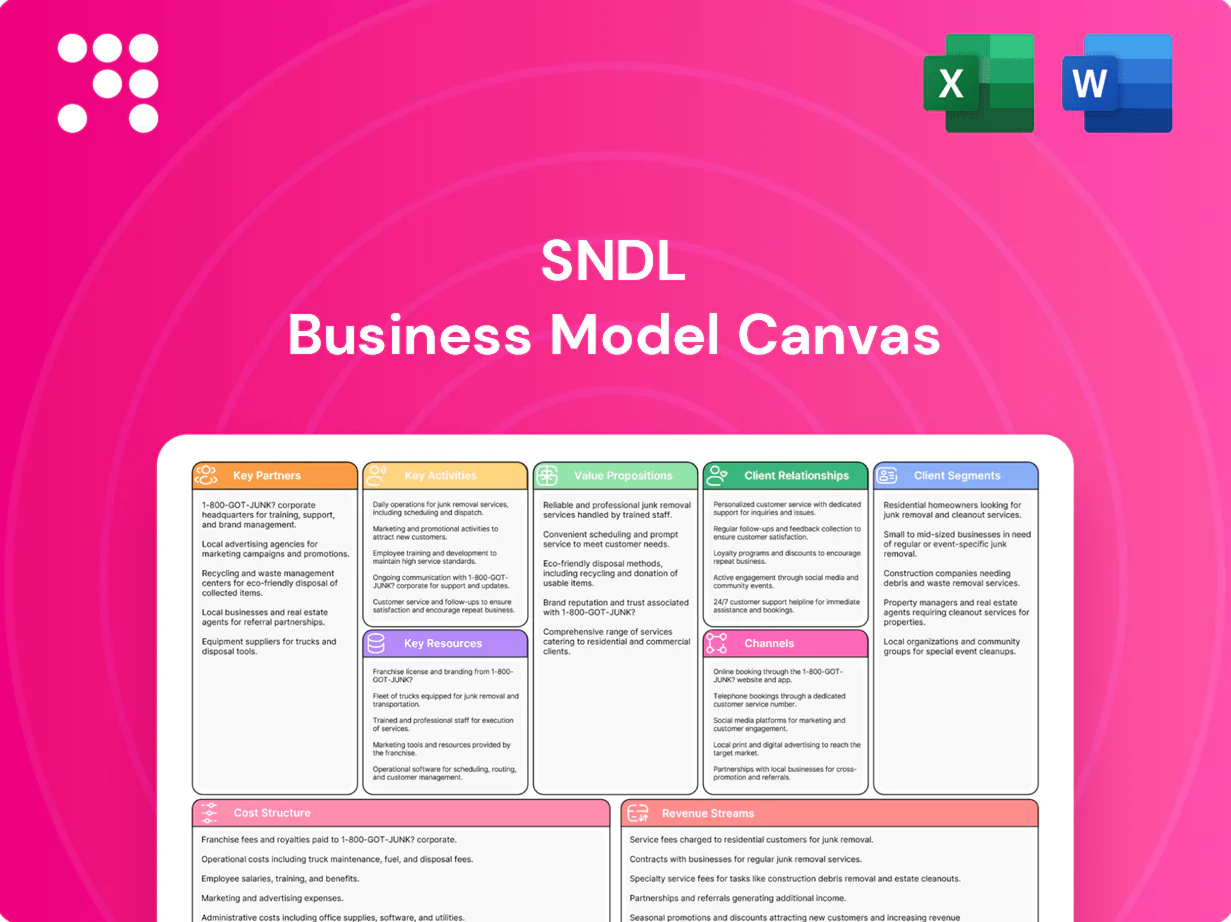
SNDL Business Model Canvas

Business Model Canvas: Retail, Wholesale, Partnerships, Revenue Drivers & Growth Levers
Dive into SNDL’s Business Model Canvas to see how it creates value across retail, wholesale and brand channels, secures partnerships, and monetizes product mix. This concise snapshot highlights risks, revenue drivers and growth levers. Download the full Word/Excel canvas to benchmark, implement insights, and unlock the complete strategic blueprint.
Partnerships

Licensed retail alliances
Licensed retail alliances expand SNDL’s shelf space and regional reach by placing products across multiple cannabis and liquor banners, enabling coordinated promotions, shared POS data and co-developed assortments. These partnerships stabilize demand and improve forecasting through aggregated sales signals, while joint marketing and in-store programs lower customer acquisition costs and increase repeat purchase frequency.
Supply, genetics, and co-manufacturers
Agreements with seed genetics providers, extraction specialists, and white-label co-manufacturers broaden SKUs and supported SNDL’s faster go-to-market, tapping formats that align with Canada’s CAD 4.2B legal cannabis retail market (2023). They accelerate innovation in vapes, edibles, and pre-rolls, while flexible co-manufacturing capacity reduces capex intensity and mitigates crop risk. Quality-focused partners uphold product consistency and regulatory compliance.

Logistics, warehousing, and last-mile
Third-party logistics firms handle provincial shipments, bonded storage and temperature control, supporting perishable cannabis supply chains across Canada; last-mile delivery typically represents ~53% of total fulfillment cost. Integrated track-and-trace systems enable timely replenishment and can cut stockouts by up to 30%, improving on-shelf availability. Cost-efficient routing preserves margins across dispersed stores and reduces delivery spend per stop.

Regulatory, compliance, and testing bodies
Close coordination with federal, provincial, and municipal regulators sustains SNDLs licensing and market access, while accredited labs validate potency, purity, and safety to meet Health Canada and provincial standards.
Compliance advisors streamline SOPs and audits, lowering operational friction and reducing recall risk, which safeguards brand trust and shelf placement with retail partners.
- Regulatory coordination: licensing continuity
- Accredited labs: potency, purity, safety validation
- Compliance advisors: SOPs and audit readiness
- Outcome: reduced recalls and preserved brand trust
Research, brand, and retail media collaborators
Academic and clinical collaborators validate product claims within Canada and U.S. regulations, supporting trials (typical cohorts 100–500) that underpin compliant labeling. Brand partnerships open new segments and co-branded launches, often lifting trial rates by mid-teens. Retail media networks — a US$60–70B channel in 2024 — amplify in-store and digital visibility. Data-sharing partners refine pricing and assortment, improving margins and SKU turn.
- research: clinical cohorts 100–500
- brand: +15% trial lift
- retail media: US$60–70B (2024)
- data: better pricing, higher SKU turns
Retail alliances, co-manufacturing and 3PLs boost SKU speed, cut capex, trials +15%, stockouts -30%
SNDL leverages retail alliances, co-manufacturers, 3PLs and regulatory labs to expand shelf presence, accelerate SKUs and secure compliant supply across Canada’s CAD 4.2B legal market (2023). Partners cut capex via white-labeling, lower CAC through joint promos (brand trial +15%) and reduce stockouts ~30%; last-mile ~53% of fulfillment cost. Clinical cohorts 100–500 support claims; retail media reach US$60–70B (2024).
| Partner | Role | Key metric |
|---|---|---|
| Retail banners | Distribution, promos | +15% trial |
| Co-manufacturers | SKU speed, capex | Reduce capex |
| 3PL/labs | Logistics/compliance | Stockouts -30%/53% cost |
What is included in the product
 Detailed Word Document
A comprehensive Business Model Canvas for SNDL outlining its nine BMC blocks—customer segments, value propositions, channels, customer relationships, revenue streams, key resources, key activities, key partners, and cost structure—tailored to its cannabis cultivation, wholesale and retail distribution strategy, with competitive advantages, linked SWOT insights, and investor-ready narrative for strategic decisions and funding discussions.

 Customizable Excel Spreadsheet
High-level, editable Business Model Canvas for SNDL that condenses complex cannabis retail and production strategy into a one-page snapshot, saving hours of formatting and enabling fast comparisons, board-ready presentations, and collaborative adaptation.
Activities

Cultivation and processing
Grow, harvest, and cure cannabis to consistently meet potency and yield targets, converting biomass into dried flower, pre-rolls, extracts, and derivatives while standardizing QA to reduce batch variability. Continuous improvement programs focus on optimizing cost per gram through operational efficiencies, process automation, and supplier negotiations. Rigorous QA protocols and traceability shorten time-to-shelf and stabilize product metrics.
Retail operations management
Retail operations management focuses on efficient labor scheduling, targeted merchandising and inventory controls to maximize turns and margin in SNDL’s stores. In 2024 stores maintain compliant age-verification per provincial laws (18 or 19+) and strict responsible service protocols. Teams execute promotions and loyalty programs to increase visit frequency and basket size. Continuous assortment and pricing optimization drive same-store sales growth.

Brand portfolio and innovation
SNDL manages a multi-tier portfolio—from value to premium and medical—aligning assortments to regulatory categories and consumer demand; in 2024 the company leveraged its 150+ retail doors to deploy tiered shelving and targeted promos. It launches formats compliant with provincial limits and consumer trends, running rapid test-and-learn limited releases to validate ~100 SKUs in-market. Packaging and messaging are refreshed regularly for clarity and compliance, reducing regulatory non-conformity risks and improving shelf conversion.

Omnichannel distribution and sales
Compliance, risk, and quality assurance
Maintain licences and GMP-aligned processes with lot-level track-and-trace and batch COAs as required by Health Canada (2024); perform regular internal and third-party audits and vendor requalifications; operate recall and incident-reporting protocols with documented root-cause analysis; deliver ongoing staff training on evolving regulations and best practices.
- licenses & GMP
- lot-level COAs
- audits & vendor qual
- recalls & incident reporting
- staff regulatory training
Integrated cannabis cultivation-to-retail: 150+ stores, ~100 SKUs tested, optimized cost/gram
Grow, harvest and process cannabis to meet potency and yield targets, converting biomass into dried flower, pre-rolls and extracts while optimizing cost per gram and QA. Operate 150+ retail doors (2024), compliant with provincial age limits (18/19) and responsible service, running loyalty and promotions to lift basket size. Manage omnichannel wholesale, retail and click-and-collect, testing ~100 SKUs in-market.
| Metric | 2024 |
|---|---|
| Retail doors | 150+ |
| SKUs tested | ~100 |
Preview Before You Purchase
Business Model Canvas
The SNDL Business Model Canvas you see here is the actual document, not a mockup or sample—this preview is a direct snapshot of the final file. When you purchase, you’ll receive the same complete, ready-to-edit document in Word and Excel. No hidden pages or surprises—formatted for presenting, editing, and immediate use.

Business Model Canvas: Retail, Wholesale, Partnerships, Revenue Drivers & Growth Levers
Dive into SNDL’s Business Model Canvas to see how it creates value across retail, wholesale and brand channels, secures partnerships, and monetizes product mix. This concise snapshot highlights risks, revenue drivers and growth levers. Download the full Word/Excel canvas to benchmark, implement insights, and unlock the complete strategic blueprint.
Partnerships
Licensed retail alliances
Licensed retail alliances expand SNDL’s shelf space and regional reach by placing products across multiple cannabis and liquor banners, enabling coordinated promotions, shared POS data and co-developed assortments. These partnerships stabilize demand and improve forecasting through aggregated sales signals, while joint marketing and in-store programs lower customer acquisition costs and increase repeat purchase frequency.
Supply, genetics, and co-manufacturers
Agreements with seed genetics providers, extraction specialists, and white-label co-manufacturers broaden SKUs and supported SNDL’s faster go-to-market, tapping formats that align with Canada’s CAD 4.2B legal cannabis retail market (2023). They accelerate innovation in vapes, edibles, and pre-rolls, while flexible co-manufacturing capacity reduces capex intensity and mitigates crop risk. Quality-focused partners uphold product consistency and regulatory compliance.
Logistics, warehousing, and last-mile
Third-party logistics firms handle provincial shipments, bonded storage and temperature control, supporting perishable cannabis supply chains across Canada; last-mile delivery typically represents ~53% of total fulfillment cost. Integrated track-and-trace systems enable timely replenishment and can cut stockouts by up to 30%, improving on-shelf availability. Cost-efficient routing preserves margins across dispersed stores and reduces delivery spend per stop.
Regulatory, compliance, and testing bodies
Close coordination with federal, provincial, and municipal regulators sustains SNDLs licensing and market access, while accredited labs validate potency, purity, and safety to meet Health Canada and provincial standards.
Compliance advisors streamline SOPs and audits, lowering operational friction and reducing recall risk, which safeguards brand trust and shelf placement with retail partners.
- Regulatory coordination: licensing continuity
- Accredited labs: potency, purity, safety validation
- Compliance advisors: SOPs and audit readiness
- Outcome: reduced recalls and preserved brand trust
Research, brand, and retail media collaborators
Academic and clinical collaborators validate product claims within Canada and U.S. regulations, supporting trials (typical cohorts 100–500) that underpin compliant labeling. Brand partnerships open new segments and co-branded launches, often lifting trial rates by mid-teens. Retail media networks — a US$60–70B channel in 2024 — amplify in-store and digital visibility. Data-sharing partners refine pricing and assortment, improving margins and SKU turn.
- research: clinical cohorts 100–500
- brand: +15% trial lift
- retail media: US$60–70B (2024)
- data: better pricing, higher SKU turns
Retail alliances, co-manufacturing and 3PLs boost SKU speed, cut capex, trials +15%, stockouts -30%
SNDL leverages retail alliances, co-manufacturers, 3PLs and regulatory labs to expand shelf presence, accelerate SKUs and secure compliant supply across Canada’s CAD 4.2B legal market (2023). Partners cut capex via white-labeling, lower CAC through joint promos (brand trial +15%) and reduce stockouts ~30%; last-mile ~53% of fulfillment cost. Clinical cohorts 100–500 support claims; retail media reach US$60–70B (2024).
| Partner | Role | Key metric |
|---|---|---|
| Retail banners | Distribution, promos | +15% trial |
| Co-manufacturers | SKU speed, capex | Reduce capex |
| 3PL/labs | Logistics/compliance | Stockouts -30%/53% cost |
What is included in the product
Detailed Word Document
A comprehensive Business Model Canvas for SNDL outlining its nine BMC blocks—customer segments, value propositions, channels, customer relationships, revenue streams, key resources, key activities, key partners, and cost structure—tailored to its cannabis cultivation, wholesale and retail distribution strategy, with competitive advantages, linked SWOT insights, and investor-ready narrative for strategic decisions and funding discussions.
Customizable Excel Spreadsheet
High-level, editable Business Model Canvas for SNDL that condenses complex cannabis retail and production strategy into a one-page snapshot, saving hours of formatting and enabling fast comparisons, board-ready presentations, and collaborative adaptation.
Activities
Cultivation and processing
Grow, harvest, and cure cannabis to consistently meet potency and yield targets, converting biomass into dried flower, pre-rolls, extracts, and derivatives while standardizing QA to reduce batch variability. Continuous improvement programs focus on optimizing cost per gram through operational efficiencies, process automation, and supplier negotiations. Rigorous QA protocols and traceability shorten time-to-shelf and stabilize product metrics.
Retail operations management
Retail operations management focuses on efficient labor scheduling, targeted merchandising and inventory controls to maximize turns and margin in SNDL’s stores. In 2024 stores maintain compliant age-verification per provincial laws (18 or 19+) and strict responsible service protocols. Teams execute promotions and loyalty programs to increase visit frequency and basket size. Continuous assortment and pricing optimization drive same-store sales growth.
Brand portfolio and innovation
SNDL manages a multi-tier portfolio—from value to premium and medical—aligning assortments to regulatory categories and consumer demand; in 2024 the company leveraged its 150+ retail doors to deploy tiered shelving and targeted promos. It launches formats compliant with provincial limits and consumer trends, running rapid test-and-learn limited releases to validate ~100 SKUs in-market. Packaging and messaging are refreshed regularly for clarity and compliance, reducing regulatory non-conformity risks and improving shelf conversion.
Omnichannel distribution and sales
Compliance, risk, and quality assurance
Maintain licences and GMP-aligned processes with lot-level track-and-trace and batch COAs as required by Health Canada (2024); perform regular internal and third-party audits and vendor requalifications; operate recall and incident-reporting protocols with documented root-cause analysis; deliver ongoing staff training on evolving regulations and best practices.
- licenses & GMP
- lot-level COAs
- audits & vendor qual
- recalls & incident reporting
- staff regulatory training
Integrated cannabis cultivation-to-retail: 150+ stores, ~100 SKUs tested, optimized cost/gram
Grow, harvest and process cannabis to meet potency and yield targets, converting biomass into dried flower, pre-rolls and extracts while optimizing cost per gram and QA. Operate 150+ retail doors (2024), compliant with provincial age limits (18/19) and responsible service, running loyalty and promotions to lift basket size. Manage omnichannel wholesale, retail and click-and-collect, testing ~100 SKUs in-market.
| Metric | 2024 |
|---|---|
| Retail doors | 150+ |
| SKUs tested | ~100 |
Preview Before You Purchase
Business Model Canvas
The SNDL Business Model Canvas you see here is the actual document, not a mockup or sample—this preview is a direct snapshot of the final file. When you purchase, you’ll receive the same complete, ready-to-edit document in Word and Excel. No hidden pages or surprises—formatted for presenting, editing, and immediate use.
Description
Business Model Canvas: Retail, Wholesale, Partnerships, Revenue Drivers & Growth Levers
Dive into SNDL’s Business Model Canvas to see how it creates value across retail, wholesale and brand channels, secures partnerships, and monetizes product mix. This concise snapshot highlights risks, revenue drivers and growth levers. Download the full Word/Excel canvas to benchmark, implement insights, and unlock the complete strategic blueprint.
Partnerships
Licensed retail alliances
Licensed retail alliances expand SNDL’s shelf space and regional reach by placing products across multiple cannabis and liquor banners, enabling coordinated promotions, shared POS data and co-developed assortments. These partnerships stabilize demand and improve forecasting through aggregated sales signals, while joint marketing and in-store programs lower customer acquisition costs and increase repeat purchase frequency.
Supply, genetics, and co-manufacturers
Agreements with seed genetics providers, extraction specialists, and white-label co-manufacturers broaden SKUs and supported SNDL’s faster go-to-market, tapping formats that align with Canada’s CAD 4.2B legal cannabis retail market (2023). They accelerate innovation in vapes, edibles, and pre-rolls, while flexible co-manufacturing capacity reduces capex intensity and mitigates crop risk. Quality-focused partners uphold product consistency and regulatory compliance.
Logistics, warehousing, and last-mile
Third-party logistics firms handle provincial shipments, bonded storage and temperature control, supporting perishable cannabis supply chains across Canada; last-mile delivery typically represents ~53% of total fulfillment cost. Integrated track-and-trace systems enable timely replenishment and can cut stockouts by up to 30%, improving on-shelf availability. Cost-efficient routing preserves margins across dispersed stores and reduces delivery spend per stop.
Regulatory, compliance, and testing bodies
Close coordination with federal, provincial, and municipal regulators sustains SNDLs licensing and market access, while accredited labs validate potency, purity, and safety to meet Health Canada and provincial standards.
Compliance advisors streamline SOPs and audits, lowering operational friction and reducing recall risk, which safeguards brand trust and shelf placement with retail partners.
- Regulatory coordination: licensing continuity
- Accredited labs: potency, purity, safety validation
- Compliance advisors: SOPs and audit readiness
- Outcome: reduced recalls and preserved brand trust
Research, brand, and retail media collaborators
Academic and clinical collaborators validate product claims within Canada and U.S. regulations, supporting trials (typical cohorts 100–500) that underpin compliant labeling. Brand partnerships open new segments and co-branded launches, often lifting trial rates by mid-teens. Retail media networks — a US$60–70B channel in 2024 — amplify in-store and digital visibility. Data-sharing partners refine pricing and assortment, improving margins and SKU turn.
- research: clinical cohorts 100–500
- brand: +15% trial lift
- retail media: US$60–70B (2024)
- data: better pricing, higher SKU turns
Retail alliances, co-manufacturing and 3PLs boost SKU speed, cut capex, trials +15%, stockouts -30%
SNDL leverages retail alliances, co-manufacturers, 3PLs and regulatory labs to expand shelf presence, accelerate SKUs and secure compliant supply across Canada’s CAD 4.2B legal market (2023). Partners cut capex via white-labeling, lower CAC through joint promos (brand trial +15%) and reduce stockouts ~30%; last-mile ~53% of fulfillment cost. Clinical cohorts 100–500 support claims; retail media reach US$60–70B (2024).
| Partner | Role | Key metric |
|---|---|---|
| Retail banners | Distribution, promos | +15% trial |
| Co-manufacturers | SKU speed, capex | Reduce capex |
| 3PL/labs | Logistics/compliance | Stockouts -30%/53% cost |
What is included in the product
Detailed Word Document
A comprehensive Business Model Canvas for SNDL outlining its nine BMC blocks—customer segments, value propositions, channels, customer relationships, revenue streams, key resources, key activities, key partners, and cost structure—tailored to its cannabis cultivation, wholesale and retail distribution strategy, with competitive advantages, linked SWOT insights, and investor-ready narrative for strategic decisions and funding discussions.
Customizable Excel Spreadsheet
High-level, editable Business Model Canvas for SNDL that condenses complex cannabis retail and production strategy into a one-page snapshot, saving hours of formatting and enabling fast comparisons, board-ready presentations, and collaborative adaptation.
Activities
Cultivation and processing
Grow, harvest, and cure cannabis to consistently meet potency and yield targets, converting biomass into dried flower, pre-rolls, extracts, and derivatives while standardizing QA to reduce batch variability. Continuous improvement programs focus on optimizing cost per gram through operational efficiencies, process automation, and supplier negotiations. Rigorous QA protocols and traceability shorten time-to-shelf and stabilize product metrics.
Retail operations management
Retail operations management focuses on efficient labor scheduling, targeted merchandising and inventory controls to maximize turns and margin in SNDL’s stores. In 2024 stores maintain compliant age-verification per provincial laws (18 or 19+) and strict responsible service protocols. Teams execute promotions and loyalty programs to increase visit frequency and basket size. Continuous assortment and pricing optimization drive same-store sales growth.
Brand portfolio and innovation
SNDL manages a multi-tier portfolio—from value to premium and medical—aligning assortments to regulatory categories and consumer demand; in 2024 the company leveraged its 150+ retail doors to deploy tiered shelving and targeted promos. It launches formats compliant with provincial limits and consumer trends, running rapid test-and-learn limited releases to validate ~100 SKUs in-market. Packaging and messaging are refreshed regularly for clarity and compliance, reducing regulatory non-conformity risks and improving shelf conversion.
Omnichannel distribution and sales
Compliance, risk, and quality assurance
Maintain licences and GMP-aligned processes with lot-level track-and-trace and batch COAs as required by Health Canada (2024); perform regular internal and third-party audits and vendor requalifications; operate recall and incident-reporting protocols with documented root-cause analysis; deliver ongoing staff training on evolving regulations and best practices.
- licenses & GMP
- lot-level COAs
- audits & vendor qual
- recalls & incident reporting
- staff regulatory training
Integrated cannabis cultivation-to-retail: 150+ stores, ~100 SKUs tested, optimized cost/gram
Grow, harvest and process cannabis to meet potency and yield targets, converting biomass into dried flower, pre-rolls and extracts while optimizing cost per gram and QA. Operate 150+ retail doors (2024), compliant with provincial age limits (18/19) and responsible service, running loyalty and promotions to lift basket size. Manage omnichannel wholesale, retail and click-and-collect, testing ~100 SKUs in-market.
| Metric | 2024 |
|---|---|
| Retail doors | 150+ |
| SKUs tested | ~100 |
Preview Before You Purchase
Business Model Canvas
The SNDL Business Model Canvas you see here is the actual document, not a mockup or sample—this preview is a direct snapshot of the final file. When you purchase, you’ll receive the same complete, ready-to-edit document in Word and Excel. No hidden pages or surprises—formatted for presenting, editing, and immediate use.











