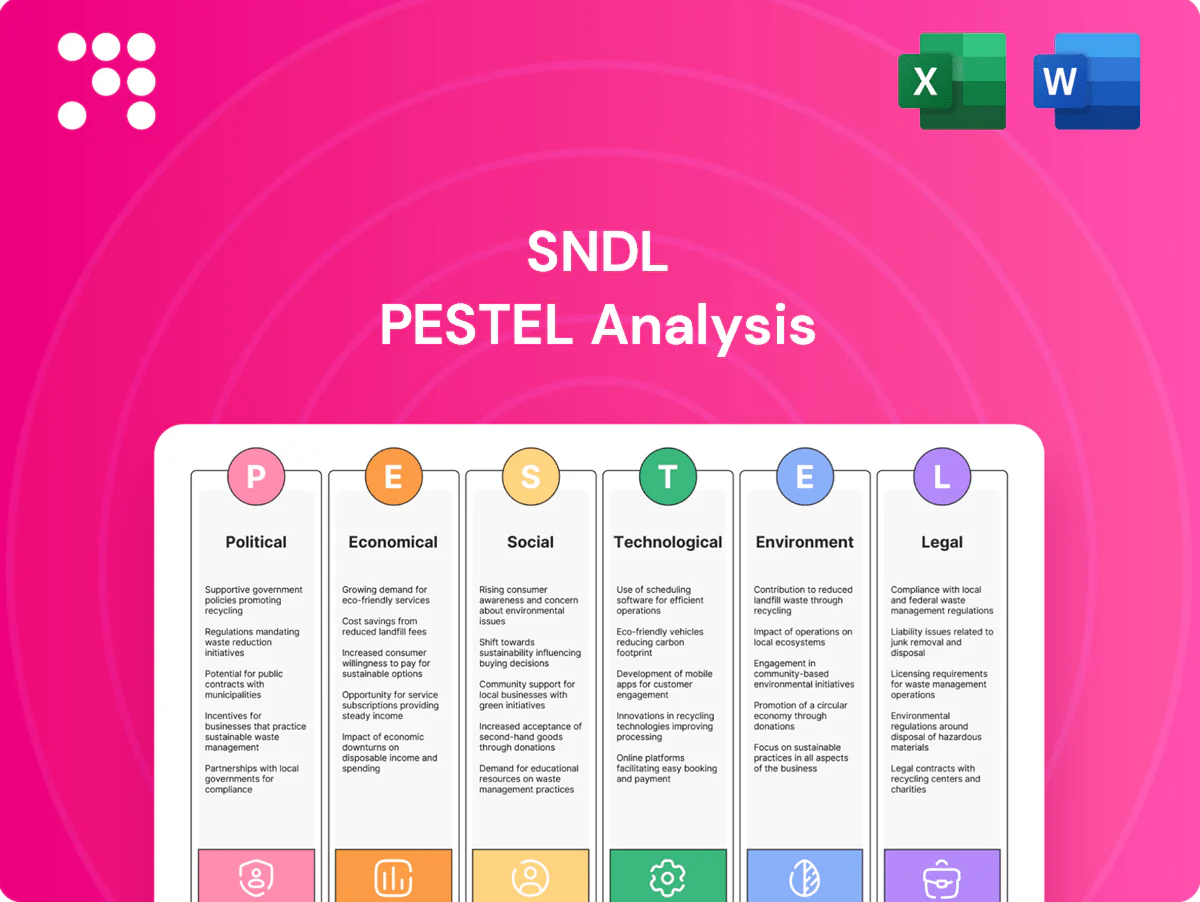
SNDL PESTLE Analysis

Your Shortcut to Market Insight Starts Here
Gain a strategic edge with our SNDL PESTLE analysis: three to five sentence snapshot revealing how political regulation, shifting consumer economics, tech adoption, social trends, and environmental policy shape SNDL’s outlook. Ideal for investors and strategists—buy the full report to access detailed, actionable insights and ready-to-use charts.
Political factors

Federal cannabis stance
Canada’s federal legalization on October 17, 2018 enables cultivation, processing and retail under Health Canada oversight, creating a nationally regulated market. Changes to product limits or medical frameworks could materially expand or contract addressable demand. U.S. federal illegality under the Controlled Substances Act still blocks cross-border expansion and banking. Any U.S. federal reform would materially increase strategic optionality for SNDL.
Provincial control
Provincial boards in Canada (10 provinces, 3 territories) dictate wholesale channels, pricing frameworks, product listings and retail licensing, directly shaping SNDL’s go-to-market execution. Changes in provincial distribution models can compress margins and limit shelf access for SNDL’s brands. Liquor retail is similarly provincially regulated, layering policy complexity for combined cannabis-liquor strategies. SNDL must optimize operations and compliance across varied provincial rules to protect revenue and market share.

Excise and sin taxes
High excise burdens in Canada—federal duty set as the greater of $1 per gram or 10% of producer price for dried cannabis—compress producer and retailer margins, squeezing SNDL’s wholesale and retail profits. Potential reforms toward minimum duty or ad valorem changes would shift profitability across the value chain. Governments may tweak taxes to curb illicit trade or raise revenue; SNDL’s diversified retail, wholesale and branded platform helps absorb tax volatility.

Illicit market enforcement
Enforcement intensity directly shapes legal market share: Deloitte 2024 estimates the illicit Canadian cannabis market at about 40%, so strong crackdowns restore price and access parity and favor licensed operators. Weak enforcement preserves illicit price gaps, eroding returns on brand and retail investment. SNDL’s scale, including Fire & Flower’s ~170 stores (2024), positions it to gain when enforcement tightens.
- Enforcement intensity: key determinant of legal share
- Strong crackdowns: price/access parity → licensed gains
- Weak enforcement: sustains illicit gaps, hurts brand ROI
- SNDL scale (Fire & Flower ~170 stores, 2024): ready to capitalize
Trade and investment policy
- Foreign ownership: Investment Canada Act reviews
- Trade limits: Health Canada export permits; no US cross-border sales
- Currency: CAD ~0.74 USD (2024)
- Policy clarity: critical for capex
National cannabis market; US illegality blocks banking, ~40% illicit
Federal legalization (Oct 17, 2018) creates a national regulated market while US federal illegality blocks cross-border expansion and banking; Investment Canada Act limits large foreign takeovers. Provincial regimes drive distribution, pricing and retail licensing, raising compliance complexity. High excise (greater of $1/gram or 10% producer price) and a ~40% illicit market (Deloitte 2024) compress margins; Fire & Flower ~170 stores (2024) scale aids resilience.
| Metric | 2024/2025 |
|---|---|
| Illicit market | ~40% (Deloitte 2024) |
| Fire & Flower stores | ~170 (2024) |
| Excise | ≥$1/g or 10% producer price |
| CAD/USD | ~0.74 USD (2024) |
What is included in the product
 Detailed Word Document
Explores how macro-environmental factors uniquely affect SNDL across Political, Economic, Social, Technological, Environmental and Legal dimensions, with data-driven examples tied to Canadian and export markets. Designed for executives and investors, the analysis highlights risks, opportunities, and forward-looking scenarios to inform strategy and funding decisions.

 Customizable Excel Spreadsheet
A concise, visually segmented SNDL PESTLE summary that distills regulatory, economic, social and technological risks for quick reference in meetings, easily dropped into presentations or shared across teams to align planning and support external risk discussions.
Economic factors

Consumer spending cycles
Cannabis and liquor sales track disposable income and inflation — Canada’s CPI eased from a 2022 peak to about 3.4% in 2023 while legal cannabis retail sales were roughly CAD 4.5B in 2023, illustrating sensitivity to macro trends. Downturns shift consumers to value tiers; recoveries drive premium trade-up. SNDL’s multi-brand portfolio and Alcanna’s 200+ store footprint let the company flex across price segments and use point-of-sale data to optimize assortments.
Interest rates and capital
Higher interest rates (Bank of Canada policy rate ~5.00% in 2024) raise SNDL’s borrowing costs, depress valuations and complicate M&A by shrinking deal financing and cap structures. Lower rates would revive financing, support expansion and store refurbishments across a C$5.8B Canadian legal cannabis market (2023 sales). SNDL’s reported cash buffer (~C$97M per latest filings) shapes resilience and deal capacity, making capital discipline critical amid sector consolidation.

Illicit price competition
Untaxed illicit supply continues to pressure legal pricing and gross margins, with industry estimates putting the illicit share at roughly 30–40% of Canadian cannabis sales (~C$2.5–3.5B in 2023–24); efficiency and scale are required to compete without eroding product quality. Strategic retail curation and loyalty programs can defend share, while regulatory tax reform (lower excise/provincial burdens) would materially improve legal-sector economics.

Input and labor costs
Energy, packaging and labour inflation have compressed SNDL unit economics, with Canada annual CPI ~2.9% in 2024 and Ontario minimum wage at 16.55 CAD/hour (Jan 2024). Automation and procurement scale can stabilize COGS volatility, while provincial wage policy changes directly affect retail operating leverage and SKU rationalization raises throughput and margins.
- Provincial wage: Ontario 16.55 CAD/hr (Jan 2024)
- Canada CPI 2024 ~2.9%
- Automation reduces per‑unit labour % of COGS
- SKU rationalization boosts throughput & GM%
FX and supply chain
CAD/USD traded roughly 0.73–0.79 in 2024, affecting costs for imported equipment and select inputs for SNDL; weaker CAD raises capex and input costs in USD terms. Global logistics disruptions kept component and packaging lead times near 8–12 weeks in 2024, risking production timing. SNDL’s post-Alcanna dual exposure to cannabis and liquor spreads supplier risk, while strategic inventory buffers and multi-sourcing improve continuity.
- FX exposure: CAD 0.73–0.79 (2024)
- Lead times: 8–12 weeks (2024)
- Risk diversification: cannabis + liquor (post-Alcanna)
- Mitigation: inventory buffers, supplier diversification
National cannabis market; US illegality blocks banking, ~40% illicit
SNDL sales remain CPI- and income-sensitive: Canadian CPI ~2.9% (2024) and legal cannabis retail ~C$4.5B (2023), driving value trade-down in downturns and premium return in recoveries. BoC policy ~5.00% (2024) raises borrowing costs; SNDL cash ~C$97M cushions liquidity. Illicit market ~30–40% of sales pressures margins; SKU rationalization, automation and Alcanna retail scale are key mitigants.
| Metric | Value |
|---|---|
| Canada CPI (2024) | ~2.9% |
| BoC policy (2024) | ~5.00% |
| Legal cannabis sales (2023) | C$4.5B |
| SNDL cash | ~C$97M |
| Illicit share | 30–40% |
Same Document Delivered
SNDL PESTLE Analysis
This SNDL PESTLE Analysis is the exact, finished file you’ll receive after purchase—fully formatted and ready to use. It includes comprehensive Political, Economic, Social, Technological, Legal, and Environmental insights tailored to SNDL. The layout, content, and structure visible here are exactly what you’ll download immediately after buying.

Your Shortcut to Market Insight Starts Here
Gain a strategic edge with our SNDL PESTLE analysis: three to five sentence snapshot revealing how political regulation, shifting consumer economics, tech adoption, social trends, and environmental policy shape SNDL’s outlook. Ideal for investors and strategists—buy the full report to access detailed, actionable insights and ready-to-use charts.
Political factors
Federal cannabis stance
Canada’s federal legalization on October 17, 2018 enables cultivation, processing and retail under Health Canada oversight, creating a nationally regulated market. Changes to product limits or medical frameworks could materially expand or contract addressable demand. U.S. federal illegality under the Controlled Substances Act still blocks cross-border expansion and banking. Any U.S. federal reform would materially increase strategic optionality for SNDL.
Provincial control
Provincial boards in Canada (10 provinces, 3 territories) dictate wholesale channels, pricing frameworks, product listings and retail licensing, directly shaping SNDL’s go-to-market execution. Changes in provincial distribution models can compress margins and limit shelf access for SNDL’s brands. Liquor retail is similarly provincially regulated, layering policy complexity for combined cannabis-liquor strategies. SNDL must optimize operations and compliance across varied provincial rules to protect revenue and market share.
Excise and sin taxes
High excise burdens in Canada—federal duty set as the greater of $1 per gram or 10% of producer price for dried cannabis—compress producer and retailer margins, squeezing SNDL’s wholesale and retail profits. Potential reforms toward minimum duty or ad valorem changes would shift profitability across the value chain. Governments may tweak taxes to curb illicit trade or raise revenue; SNDL’s diversified retail, wholesale and branded platform helps absorb tax volatility.
Illicit market enforcement
Enforcement intensity directly shapes legal market share: Deloitte 2024 estimates the illicit Canadian cannabis market at about 40%, so strong crackdowns restore price and access parity and favor licensed operators. Weak enforcement preserves illicit price gaps, eroding returns on brand and retail investment. SNDL’s scale, including Fire & Flower’s ~170 stores (2024), positions it to gain when enforcement tightens.
- Enforcement intensity: key determinant of legal share
- Strong crackdowns: price/access parity → licensed gains
- Weak enforcement: sustains illicit gaps, hurts brand ROI
- SNDL scale (Fire & Flower ~170 stores, 2024): ready to capitalize
Trade and investment policy
- Foreign ownership: Investment Canada Act reviews
- Trade limits: Health Canada export permits; no US cross-border sales
- Currency: CAD ~0.74 USD (2024)
- Policy clarity: critical for capex
National cannabis market; US illegality blocks banking, ~40% illicit
Federal legalization (Oct 17, 2018) creates a national regulated market while US federal illegality blocks cross-border expansion and banking; Investment Canada Act limits large foreign takeovers. Provincial regimes drive distribution, pricing and retail licensing, raising compliance complexity. High excise (greater of $1/gram or 10% producer price) and a ~40% illicit market (Deloitte 2024) compress margins; Fire & Flower ~170 stores (2024) scale aids resilience.
| Metric | 2024/2025 |
|---|---|
| Illicit market | ~40% (Deloitte 2024) |
| Fire & Flower stores | ~170 (2024) |
| Excise | ≥$1/g or 10% producer price |
| CAD/USD | ~0.74 USD (2024) |
What is included in the product
Detailed Word Document
Explores how macro-environmental factors uniquely affect SNDL across Political, Economic, Social, Technological, Environmental and Legal dimensions, with data-driven examples tied to Canadian and export markets. Designed for executives and investors, the analysis highlights risks, opportunities, and forward-looking scenarios to inform strategy and funding decisions.
Customizable Excel Spreadsheet
A concise, visually segmented SNDL PESTLE summary that distills regulatory, economic, social and technological risks for quick reference in meetings, easily dropped into presentations or shared across teams to align planning and support external risk discussions.
Economic factors
Consumer spending cycles
Cannabis and liquor sales track disposable income and inflation — Canada’s CPI eased from a 2022 peak to about 3.4% in 2023 while legal cannabis retail sales were roughly CAD 4.5B in 2023, illustrating sensitivity to macro trends. Downturns shift consumers to value tiers; recoveries drive premium trade-up. SNDL’s multi-brand portfolio and Alcanna’s 200+ store footprint let the company flex across price segments and use point-of-sale data to optimize assortments.
Interest rates and capital
Higher interest rates (Bank of Canada policy rate ~5.00% in 2024) raise SNDL’s borrowing costs, depress valuations and complicate M&A by shrinking deal financing and cap structures. Lower rates would revive financing, support expansion and store refurbishments across a C$5.8B Canadian legal cannabis market (2023 sales). SNDL’s reported cash buffer (~C$97M per latest filings) shapes resilience and deal capacity, making capital discipline critical amid sector consolidation.
Illicit price competition
Untaxed illicit supply continues to pressure legal pricing and gross margins, with industry estimates putting the illicit share at roughly 30–40% of Canadian cannabis sales (~C$2.5–3.5B in 2023–24); efficiency and scale are required to compete without eroding product quality. Strategic retail curation and loyalty programs can defend share, while regulatory tax reform (lower excise/provincial burdens) would materially improve legal-sector economics.
Input and labor costs
Energy, packaging and labour inflation have compressed SNDL unit economics, with Canada annual CPI ~2.9% in 2024 and Ontario minimum wage at 16.55 CAD/hour (Jan 2024). Automation and procurement scale can stabilize COGS volatility, while provincial wage policy changes directly affect retail operating leverage and SKU rationalization raises throughput and margins.
- Provincial wage: Ontario 16.55 CAD/hr (Jan 2024)
- Canada CPI 2024 ~2.9%
- Automation reduces per‑unit labour % of COGS
- SKU rationalization boosts throughput & GM%
FX and supply chain
CAD/USD traded roughly 0.73–0.79 in 2024, affecting costs for imported equipment and select inputs for SNDL; weaker CAD raises capex and input costs in USD terms. Global logistics disruptions kept component and packaging lead times near 8–12 weeks in 2024, risking production timing. SNDL’s post-Alcanna dual exposure to cannabis and liquor spreads supplier risk, while strategic inventory buffers and multi-sourcing improve continuity.
- FX exposure: CAD 0.73–0.79 (2024)
- Lead times: 8–12 weeks (2024)
- Risk diversification: cannabis + liquor (post-Alcanna)
- Mitigation: inventory buffers, supplier diversification
National cannabis market; US illegality blocks banking, ~40% illicit
SNDL sales remain CPI- and income-sensitive: Canadian CPI ~2.9% (2024) and legal cannabis retail ~C$4.5B (2023), driving value trade-down in downturns and premium return in recoveries. BoC policy ~5.00% (2024) raises borrowing costs; SNDL cash ~C$97M cushions liquidity. Illicit market ~30–40% of sales pressures margins; SKU rationalization, automation and Alcanna retail scale are key mitigants.
| Metric | Value |
|---|---|
| Canada CPI (2024) | ~2.9% |
| BoC policy (2024) | ~5.00% |
| Legal cannabis sales (2023) | C$4.5B |
| SNDL cash | ~C$97M |
| Illicit share | 30–40% |
Same Document Delivered
SNDL PESTLE Analysis
This SNDL PESTLE Analysis is the exact, finished file you’ll receive after purchase—fully formatted and ready to use. It includes comprehensive Political, Economic, Social, Technological, Legal, and Environmental insights tailored to SNDL. The layout, content, and structure visible here are exactly what you’ll download immediately after buying.
Original: $10.00
-65%$10.00
$3.50Description
Your Shortcut to Market Insight Starts Here
Gain a strategic edge with our SNDL PESTLE analysis: three to five sentence snapshot revealing how political regulation, shifting consumer economics, tech adoption, social trends, and environmental policy shape SNDL’s outlook. Ideal for investors and strategists—buy the full report to access detailed, actionable insights and ready-to-use charts.
Political factors
Federal cannabis stance
Canada’s federal legalization on October 17, 2018 enables cultivation, processing and retail under Health Canada oversight, creating a nationally regulated market. Changes to product limits or medical frameworks could materially expand or contract addressable demand. U.S. federal illegality under the Controlled Substances Act still blocks cross-border expansion and banking. Any U.S. federal reform would materially increase strategic optionality for SNDL.
Provincial control
Provincial boards in Canada (10 provinces, 3 territories) dictate wholesale channels, pricing frameworks, product listings and retail licensing, directly shaping SNDL’s go-to-market execution. Changes in provincial distribution models can compress margins and limit shelf access for SNDL’s brands. Liquor retail is similarly provincially regulated, layering policy complexity for combined cannabis-liquor strategies. SNDL must optimize operations and compliance across varied provincial rules to protect revenue and market share.
Excise and sin taxes
High excise burdens in Canada—federal duty set as the greater of $1 per gram or 10% of producer price for dried cannabis—compress producer and retailer margins, squeezing SNDL’s wholesale and retail profits. Potential reforms toward minimum duty or ad valorem changes would shift profitability across the value chain. Governments may tweak taxes to curb illicit trade or raise revenue; SNDL’s diversified retail, wholesale and branded platform helps absorb tax volatility.
Illicit market enforcement
Enforcement intensity directly shapes legal market share: Deloitte 2024 estimates the illicit Canadian cannabis market at about 40%, so strong crackdowns restore price and access parity and favor licensed operators. Weak enforcement preserves illicit price gaps, eroding returns on brand and retail investment. SNDL’s scale, including Fire & Flower’s ~170 stores (2024), positions it to gain when enforcement tightens.
- Enforcement intensity: key determinant of legal share
- Strong crackdowns: price/access parity → licensed gains
- Weak enforcement: sustains illicit gaps, hurts brand ROI
- SNDL scale (Fire & Flower ~170 stores, 2024): ready to capitalize
Trade and investment policy
- Foreign ownership: Investment Canada Act reviews
- Trade limits: Health Canada export permits; no US cross-border sales
- Currency: CAD ~0.74 USD (2024)
- Policy clarity: critical for capex
National cannabis market; US illegality blocks banking, ~40% illicit
Federal legalization (Oct 17, 2018) creates a national regulated market while US federal illegality blocks cross-border expansion and banking; Investment Canada Act limits large foreign takeovers. Provincial regimes drive distribution, pricing and retail licensing, raising compliance complexity. High excise (greater of $1/gram or 10% producer price) and a ~40% illicit market (Deloitte 2024) compress margins; Fire & Flower ~170 stores (2024) scale aids resilience.
| Metric | 2024/2025 |
|---|---|
| Illicit market | ~40% (Deloitte 2024) |
| Fire & Flower stores | ~170 (2024) |
| Excise | ≥$1/g or 10% producer price |
| CAD/USD | ~0.74 USD (2024) |
What is included in the product
Detailed Word Document
Explores how macro-environmental factors uniquely affect SNDL across Political, Economic, Social, Technological, Environmental and Legal dimensions, with data-driven examples tied to Canadian and export markets. Designed for executives and investors, the analysis highlights risks, opportunities, and forward-looking scenarios to inform strategy and funding decisions.
Customizable Excel Spreadsheet
A concise, visually segmented SNDL PESTLE summary that distills regulatory, economic, social and technological risks for quick reference in meetings, easily dropped into presentations or shared across teams to align planning and support external risk discussions.
Economic factors
Consumer spending cycles
Cannabis and liquor sales track disposable income and inflation — Canada’s CPI eased from a 2022 peak to about 3.4% in 2023 while legal cannabis retail sales were roughly CAD 4.5B in 2023, illustrating sensitivity to macro trends. Downturns shift consumers to value tiers; recoveries drive premium trade-up. SNDL’s multi-brand portfolio and Alcanna’s 200+ store footprint let the company flex across price segments and use point-of-sale data to optimize assortments.
Interest rates and capital
Higher interest rates (Bank of Canada policy rate ~5.00% in 2024) raise SNDL’s borrowing costs, depress valuations and complicate M&A by shrinking deal financing and cap structures. Lower rates would revive financing, support expansion and store refurbishments across a C$5.8B Canadian legal cannabis market (2023 sales). SNDL’s reported cash buffer (~C$97M per latest filings) shapes resilience and deal capacity, making capital discipline critical amid sector consolidation.
Illicit price competition
Untaxed illicit supply continues to pressure legal pricing and gross margins, with industry estimates putting the illicit share at roughly 30–40% of Canadian cannabis sales (~C$2.5–3.5B in 2023–24); efficiency and scale are required to compete without eroding product quality. Strategic retail curation and loyalty programs can defend share, while regulatory tax reform (lower excise/provincial burdens) would materially improve legal-sector economics.
Input and labor costs
Energy, packaging and labour inflation have compressed SNDL unit economics, with Canada annual CPI ~2.9% in 2024 and Ontario minimum wage at 16.55 CAD/hour (Jan 2024). Automation and procurement scale can stabilize COGS volatility, while provincial wage policy changes directly affect retail operating leverage and SKU rationalization raises throughput and margins.
- Provincial wage: Ontario 16.55 CAD/hr (Jan 2024)
- Canada CPI 2024 ~2.9%
- Automation reduces per‑unit labour % of COGS
- SKU rationalization boosts throughput & GM%
FX and supply chain
CAD/USD traded roughly 0.73–0.79 in 2024, affecting costs for imported equipment and select inputs for SNDL; weaker CAD raises capex and input costs in USD terms. Global logistics disruptions kept component and packaging lead times near 8–12 weeks in 2024, risking production timing. SNDL’s post-Alcanna dual exposure to cannabis and liquor spreads supplier risk, while strategic inventory buffers and multi-sourcing improve continuity.
- FX exposure: CAD 0.73–0.79 (2024)
- Lead times: 8–12 weeks (2024)
- Risk diversification: cannabis + liquor (post-Alcanna)
- Mitigation: inventory buffers, supplier diversification
National cannabis market; US illegality blocks banking, ~40% illicit
SNDL sales remain CPI- and income-sensitive: Canadian CPI ~2.9% (2024) and legal cannabis retail ~C$4.5B (2023), driving value trade-down in downturns and premium return in recoveries. BoC policy ~5.00% (2024) raises borrowing costs; SNDL cash ~C$97M cushions liquidity. Illicit market ~30–40% of sales pressures margins; SKU rationalization, automation and Alcanna retail scale are key mitigants.
| Metric | Value |
|---|---|
| Canada CPI (2024) | ~2.9% |
| BoC policy (2024) | ~5.00% |
| Legal cannabis sales (2023) | C$4.5B |
| SNDL cash | ~C$97M |
| Illicit share | 30–40% |
Same Document Delivered
SNDL PESTLE Analysis
This SNDL PESTLE Analysis is the exact, finished file you’ll receive after purchase—fully formatted and ready to use. It includes comprehensive Political, Economic, Social, Technological, Legal, and Environmental insights tailored to SNDL. The layout, content, and structure visible here are exactly what you’ll download immediately after buying.











