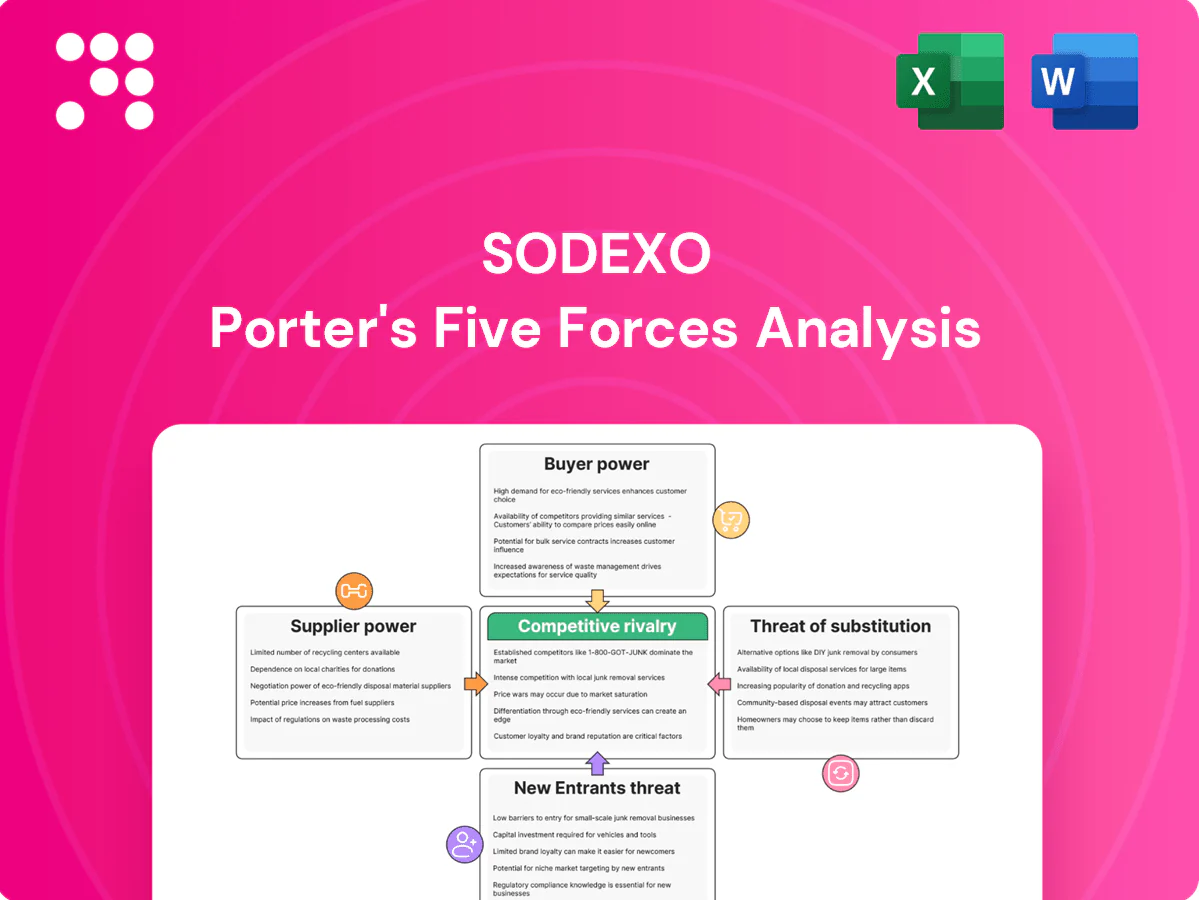
Sodexo Porter's Five Forces Analysis

Don't Miss the Bigger Picture
Sodexo’s Porter's Five Forces snapshot highlights moderate buyer power, fragmented supplier influence, and industry rivalry driven by contract scale and service differentiation. New entrants face high barriers while substitutes pose niche threats. This brief teaser outlines strategic pressures—unlock the full Porter's Five Forces Analysis to access force-by-force ratings, visuals, and actionable recommendations for investment or strategy.
Suppliers Bargaining Power

Global food commodity exposure
Sodexo purchases large volumes of proteins, grains and produce, leaving food costs exposed to commodity volatility; serving about 100 million consumers daily across 55 countries gives scale and a hedging/contracting advantage that dampened recent price spikes but supply shocks (eg. meat or grain disruptions) can still squeeze margins. Diversified sourcing and menu engineering reduce supplier leverage and input-risk concentration.
Specialized FM and equipment vendors
Critical suppliers for HVAC, cleaning chemicals and kitchen equipment hold niche leverage, raising switching frictions due to technical standards and compliance; Sodexo operates in 56 countries and employs c.412,000 people, so long-term framework agreements and multi-sourcing (used across its global contracts) are deployed to reduce supplier dependence while enabling structured, competitive bids.

Branded products and technology
Dependence on branded food, payment systems and IoT/FM platforms raises procurement and integration costs for Sodexo, especially across its 56-country network and over 400,000 employees (2024). Co-branding and preferred partnerships trade margin for consumer pull and reliability, boosting adoption but compressing gross margins. Embracing open architectures and vendor-neutral platforms limits supplier lock-in and lowers long-term TCO across multi-service contracts.

Labor agencies and training providers
- staff_size: ~400,000
- agency_dependence: reduced by in-house training
- tech_effect: lowers third-party staffing needs
ESG and local sourcing constraints
Sodexo’s ESG and local-sourcing commitments narrow supplier pools, raising input costs but improving supply-chain resilience and brand credibility amid growing client demand for sustainable services.
Supplier development programs, including training and procurement partnerships, help mitigate higher prices by improving supplier capacity and diversifying compliant vendors, softening suppliers’ bargaining leverage.
- Narrower pools increase price pressure
- Stronger resilience and brand value
- Supplier development balances cost and leverage
Global foodservice: moderate supplier power - scale limits input risk; partners compress margins
Sodexo faces moderate supplier power: commodity exposure (serves ~100m consumers/day across 55 countries) raises input risk, but scale and multi-sourcing limit leverage. Technical suppliers and branded partners exert niche bargaining power, compressing margins. In 2024, ~400,000 workforce and global framework agreements reduce agency and supplier dependence.
| Metric | 2024 |
|---|---|
| Consumers/day | ~100m |
| Countries | 55 |
| Employees | ~400,000 |
What is included in the product
 Detailed Word Document
Tailored Porter's Five Forces assessment for Sodexo that uncovers competitive rivalry, buyer and supplier power, threat of substitutes, and entry barriers affecting its pricing and profitability. Highlights disruptive trends, emerging substitutes, and strategic levers to protect market share and inform investor or internal strategy materials.

 Customizable Excel Spreadsheet
A clear one-sheet summary of Sodexo's five forces—ready to drop into decks for quick strategic decisions; customize pressure levels and swap in your own data to model labor costs, contract risk, supplier leverage and new-entrant threats.
Customers Bargaining Power

Large enterprise and public tenders
Corporate, healthcare, education and government clients run competitive RFPs for large, multi-year contracts, giving buyers high leverage over price and service terms. High contract values and renewal cycles amplify bargaining power versus suppliers. Sodexo counters with bundled, outcome-based proposals and global coverage, serving about 100 million consumers daily with roughly 412,000 employees in 2024.
Price sensitivity and budget cycles
Clients face acute cost pressures and demand transparent savings; Sodexo, which serves 100 million consumers daily and employs over 400,000 staff globally, faces hard-negotiated indexation clauses to share inflation risk. Indexation clauses are a common contractual tool but are subject to intense negotiation by buyers seeking budget predictability. Demonstrated ROI and granular KPIs such as cost-per-meal and absenteeism reduction are essential to defend pricing.

Switching and insourcing options
Many Sodexo clients rebid or insource services; industry rebid rates hover near 20% annually and corporate buyers insource selectively. Transition costs exist but are manageable for experienced buyers, typically 3–6% of annual contract value. Sodexo’s performance guarantees, service-level agreements and continuous improvement programs lower churn and helped maintain a global client retention above industry averages in 2024.

Customization and SLA complexity
Diverse sectors demand tailored solutions and strict SLAs, driving higher per-contract complexity and elevating buyer bargaining power; Sodexo’s 2024 segment mix showed growing bespoke corporate and healthcare contracts. Customization raises delivery costs and margin pressure, while standardized service modules and digital SLA monitoring (adoption rose notably in 2024) help rebalance economics and improve negotiating leverage.
- Tailored SLAs increase buyer leverage
- Customization raises delivery costs, compresses margins
- Standardization + digital monitoring restores unit economics
Global vs. local consolidation
- Global buyers: concentrated demand, higher leverage
- Sodexo scale: 55 countries, 100M consumers/day
- Local fragmentation: ~100,000 client sites, reduces uniform pressure
Buyers wield leverage; 100M served, ~20% rebids
Buyers wield strong leverage via competitive RFPs and high-value renewals; Sodexo serves 100 million consumers daily and had ~412,000 employees in 2024. Rebid rates near 20% and 3–6% typical transition costs keep switching viable; indexation clauses and ROI/KPI demands compress pricing. Sodexo’s 55-country scale and ~100,000 client sites balance global deal-making with local fragmentation.
| Metric | Value (2024) |
|---|---|
| Consumers served/day | 100,000,000 |
| Employees | ~412,000 |
| Rebid rate | ~20% |
| Transition cost | 3–6% of ACV |
| Countries | 55 |
| Client sites | ~100,000 |
Full Version Awaits
Sodexo Porter's Five Forces Analysis
This preview shows the exact Sodexo Porter's Five Forces Analysis you'll receive immediately after purchase—no surprises, no placeholders. The document displayed here is the professionally formatted, final file ready for download and use the moment you buy. You're looking at the actual deliverable; instant access, complete and ready for your needs.

Don't Miss the Bigger Picture
Sodexo’s Porter's Five Forces snapshot highlights moderate buyer power, fragmented supplier influence, and industry rivalry driven by contract scale and service differentiation. New entrants face high barriers while substitutes pose niche threats. This brief teaser outlines strategic pressures—unlock the full Porter's Five Forces Analysis to access force-by-force ratings, visuals, and actionable recommendations for investment or strategy.
Suppliers Bargaining Power
Global food commodity exposure
Sodexo purchases large volumes of proteins, grains and produce, leaving food costs exposed to commodity volatility; serving about 100 million consumers daily across 55 countries gives scale and a hedging/contracting advantage that dampened recent price spikes but supply shocks (eg. meat or grain disruptions) can still squeeze margins. Diversified sourcing and menu engineering reduce supplier leverage and input-risk concentration.
Specialized FM and equipment vendors
Critical suppliers for HVAC, cleaning chemicals and kitchen equipment hold niche leverage, raising switching frictions due to technical standards and compliance; Sodexo operates in 56 countries and employs c.412,000 people, so long-term framework agreements and multi-sourcing (used across its global contracts) are deployed to reduce supplier dependence while enabling structured, competitive bids.
Branded products and technology
Dependence on branded food, payment systems and IoT/FM platforms raises procurement and integration costs for Sodexo, especially across its 56-country network and over 400,000 employees (2024). Co-branding and preferred partnerships trade margin for consumer pull and reliability, boosting adoption but compressing gross margins. Embracing open architectures and vendor-neutral platforms limits supplier lock-in and lowers long-term TCO across multi-service contracts.
Labor agencies and training providers
- staff_size: ~400,000
- agency_dependence: reduced by in-house training
- tech_effect: lowers third-party staffing needs
ESG and local sourcing constraints
Sodexo’s ESG and local-sourcing commitments narrow supplier pools, raising input costs but improving supply-chain resilience and brand credibility amid growing client demand for sustainable services.
Supplier development programs, including training and procurement partnerships, help mitigate higher prices by improving supplier capacity and diversifying compliant vendors, softening suppliers’ bargaining leverage.
- Narrower pools increase price pressure
- Stronger resilience and brand value
- Supplier development balances cost and leverage
Global foodservice: moderate supplier power - scale limits input risk; partners compress margins
Sodexo faces moderate supplier power: commodity exposure (serves ~100m consumers/day across 55 countries) raises input risk, but scale and multi-sourcing limit leverage. Technical suppliers and branded partners exert niche bargaining power, compressing margins. In 2024, ~400,000 workforce and global framework agreements reduce agency and supplier dependence.
| Metric | 2024 |
|---|---|
| Consumers/day | ~100m |
| Countries | 55 |
| Employees | ~400,000 |
What is included in the product
Detailed Word Document
Tailored Porter's Five Forces assessment for Sodexo that uncovers competitive rivalry, buyer and supplier power, threat of substitutes, and entry barriers affecting its pricing and profitability. Highlights disruptive trends, emerging substitutes, and strategic levers to protect market share and inform investor or internal strategy materials.
Customizable Excel Spreadsheet
A clear one-sheet summary of Sodexo's five forces—ready to drop into decks for quick strategic decisions; customize pressure levels and swap in your own data to model labor costs, contract risk, supplier leverage and new-entrant threats.
Customers Bargaining Power
Large enterprise and public tenders
Corporate, healthcare, education and government clients run competitive RFPs for large, multi-year contracts, giving buyers high leverage over price and service terms. High contract values and renewal cycles amplify bargaining power versus suppliers. Sodexo counters with bundled, outcome-based proposals and global coverage, serving about 100 million consumers daily with roughly 412,000 employees in 2024.
Price sensitivity and budget cycles
Clients face acute cost pressures and demand transparent savings; Sodexo, which serves 100 million consumers daily and employs over 400,000 staff globally, faces hard-negotiated indexation clauses to share inflation risk. Indexation clauses are a common contractual tool but are subject to intense negotiation by buyers seeking budget predictability. Demonstrated ROI and granular KPIs such as cost-per-meal and absenteeism reduction are essential to defend pricing.
Switching and insourcing options
Many Sodexo clients rebid or insource services; industry rebid rates hover near 20% annually and corporate buyers insource selectively. Transition costs exist but are manageable for experienced buyers, typically 3–6% of annual contract value. Sodexo’s performance guarantees, service-level agreements and continuous improvement programs lower churn and helped maintain a global client retention above industry averages in 2024.
Customization and SLA complexity
Diverse sectors demand tailored solutions and strict SLAs, driving higher per-contract complexity and elevating buyer bargaining power; Sodexo’s 2024 segment mix showed growing bespoke corporate and healthcare contracts. Customization raises delivery costs and margin pressure, while standardized service modules and digital SLA monitoring (adoption rose notably in 2024) help rebalance economics and improve negotiating leverage.
- Tailored SLAs increase buyer leverage
- Customization raises delivery costs, compresses margins
- Standardization + digital monitoring restores unit economics
Global vs. local consolidation
- Global buyers: concentrated demand, higher leverage
- Sodexo scale: 55 countries, 100M consumers/day
- Local fragmentation: ~100,000 client sites, reduces uniform pressure
Buyers wield leverage; 100M served, ~20% rebids
Buyers wield strong leverage via competitive RFPs and high-value renewals; Sodexo serves 100 million consumers daily and had ~412,000 employees in 2024. Rebid rates near 20% and 3–6% typical transition costs keep switching viable; indexation clauses and ROI/KPI demands compress pricing. Sodexo’s 55-country scale and ~100,000 client sites balance global deal-making with local fragmentation.
| Metric | Value (2024) |
|---|---|
| Consumers served/day | 100,000,000 |
| Employees | ~412,000 |
| Rebid rate | ~20% |
| Transition cost | 3–6% of ACV |
| Countries | 55 |
| Client sites | ~100,000 |
Full Version Awaits
Sodexo Porter's Five Forces Analysis
This preview shows the exact Sodexo Porter's Five Forces Analysis you'll receive immediately after purchase—no surprises, no placeholders. The document displayed here is the professionally formatted, final file ready for download and use the moment you buy. You're looking at the actual deliverable; instant access, complete and ready for your needs.
Original: $10.00
-65%$10.00
$3.50Description
Don't Miss the Bigger Picture
Sodexo’s Porter's Five Forces snapshot highlights moderate buyer power, fragmented supplier influence, and industry rivalry driven by contract scale and service differentiation. New entrants face high barriers while substitutes pose niche threats. This brief teaser outlines strategic pressures—unlock the full Porter's Five Forces Analysis to access force-by-force ratings, visuals, and actionable recommendations for investment or strategy.
Suppliers Bargaining Power
Global food commodity exposure
Sodexo purchases large volumes of proteins, grains and produce, leaving food costs exposed to commodity volatility; serving about 100 million consumers daily across 55 countries gives scale and a hedging/contracting advantage that dampened recent price spikes but supply shocks (eg. meat or grain disruptions) can still squeeze margins. Diversified sourcing and menu engineering reduce supplier leverage and input-risk concentration.
Specialized FM and equipment vendors
Critical suppliers for HVAC, cleaning chemicals and kitchen equipment hold niche leverage, raising switching frictions due to technical standards and compliance; Sodexo operates in 56 countries and employs c.412,000 people, so long-term framework agreements and multi-sourcing (used across its global contracts) are deployed to reduce supplier dependence while enabling structured, competitive bids.
Branded products and technology
Dependence on branded food, payment systems and IoT/FM platforms raises procurement and integration costs for Sodexo, especially across its 56-country network and over 400,000 employees (2024). Co-branding and preferred partnerships trade margin for consumer pull and reliability, boosting adoption but compressing gross margins. Embracing open architectures and vendor-neutral platforms limits supplier lock-in and lowers long-term TCO across multi-service contracts.
Labor agencies and training providers
- staff_size: ~400,000
- agency_dependence: reduced by in-house training
- tech_effect: lowers third-party staffing needs
ESG and local sourcing constraints
Sodexo’s ESG and local-sourcing commitments narrow supplier pools, raising input costs but improving supply-chain resilience and brand credibility amid growing client demand for sustainable services.
Supplier development programs, including training and procurement partnerships, help mitigate higher prices by improving supplier capacity and diversifying compliant vendors, softening suppliers’ bargaining leverage.
- Narrower pools increase price pressure
- Stronger resilience and brand value
- Supplier development balances cost and leverage
Global foodservice: moderate supplier power - scale limits input risk; partners compress margins
Sodexo faces moderate supplier power: commodity exposure (serves ~100m consumers/day across 55 countries) raises input risk, but scale and multi-sourcing limit leverage. Technical suppliers and branded partners exert niche bargaining power, compressing margins. In 2024, ~400,000 workforce and global framework agreements reduce agency and supplier dependence.
| Metric | 2024 |
|---|---|
| Consumers/day | ~100m |
| Countries | 55 |
| Employees | ~400,000 |
What is included in the product
Detailed Word Document
Tailored Porter's Five Forces assessment for Sodexo that uncovers competitive rivalry, buyer and supplier power, threat of substitutes, and entry barriers affecting its pricing and profitability. Highlights disruptive trends, emerging substitutes, and strategic levers to protect market share and inform investor or internal strategy materials.
Customizable Excel Spreadsheet
A clear one-sheet summary of Sodexo's five forces—ready to drop into decks for quick strategic decisions; customize pressure levels and swap in your own data to model labor costs, contract risk, supplier leverage and new-entrant threats.
Customers Bargaining Power
Large enterprise and public tenders
Corporate, healthcare, education and government clients run competitive RFPs for large, multi-year contracts, giving buyers high leverage over price and service terms. High contract values and renewal cycles amplify bargaining power versus suppliers. Sodexo counters with bundled, outcome-based proposals and global coverage, serving about 100 million consumers daily with roughly 412,000 employees in 2024.
Price sensitivity and budget cycles
Clients face acute cost pressures and demand transparent savings; Sodexo, which serves 100 million consumers daily and employs over 400,000 staff globally, faces hard-negotiated indexation clauses to share inflation risk. Indexation clauses are a common contractual tool but are subject to intense negotiation by buyers seeking budget predictability. Demonstrated ROI and granular KPIs such as cost-per-meal and absenteeism reduction are essential to defend pricing.
Switching and insourcing options
Many Sodexo clients rebid or insource services; industry rebid rates hover near 20% annually and corporate buyers insource selectively. Transition costs exist but are manageable for experienced buyers, typically 3–6% of annual contract value. Sodexo’s performance guarantees, service-level agreements and continuous improvement programs lower churn and helped maintain a global client retention above industry averages in 2024.
Customization and SLA complexity
Diverse sectors demand tailored solutions and strict SLAs, driving higher per-contract complexity and elevating buyer bargaining power; Sodexo’s 2024 segment mix showed growing bespoke corporate and healthcare contracts. Customization raises delivery costs and margin pressure, while standardized service modules and digital SLA monitoring (adoption rose notably in 2024) help rebalance economics and improve negotiating leverage.
- Tailored SLAs increase buyer leverage
- Customization raises delivery costs, compresses margins
- Standardization + digital monitoring restores unit economics
Global vs. local consolidation
- Global buyers: concentrated demand, higher leverage
- Sodexo scale: 55 countries, 100M consumers/day
- Local fragmentation: ~100,000 client sites, reduces uniform pressure
Buyers wield leverage; 100M served, ~20% rebids
Buyers wield strong leverage via competitive RFPs and high-value renewals; Sodexo serves 100 million consumers daily and had ~412,000 employees in 2024. Rebid rates near 20% and 3–6% typical transition costs keep switching viable; indexation clauses and ROI/KPI demands compress pricing. Sodexo’s 55-country scale and ~100,000 client sites balance global deal-making with local fragmentation.
| Metric | Value (2024) |
|---|---|
| Consumers served/day | 100,000,000 |
| Employees | ~412,000 |
| Rebid rate | ~20% |
| Transition cost | 3–6% of ACV |
| Countries | 55 |
| Client sites | ~100,000 |
Full Version Awaits
Sodexo Porter's Five Forces Analysis
This preview shows the exact Sodexo Porter's Five Forces Analysis you'll receive immediately after purchase—no surprises, no placeholders. The document displayed here is the professionally formatted, final file ready for download and use the moment you buy. You're looking at the actual deliverable; instant access, complete and ready for your needs.











