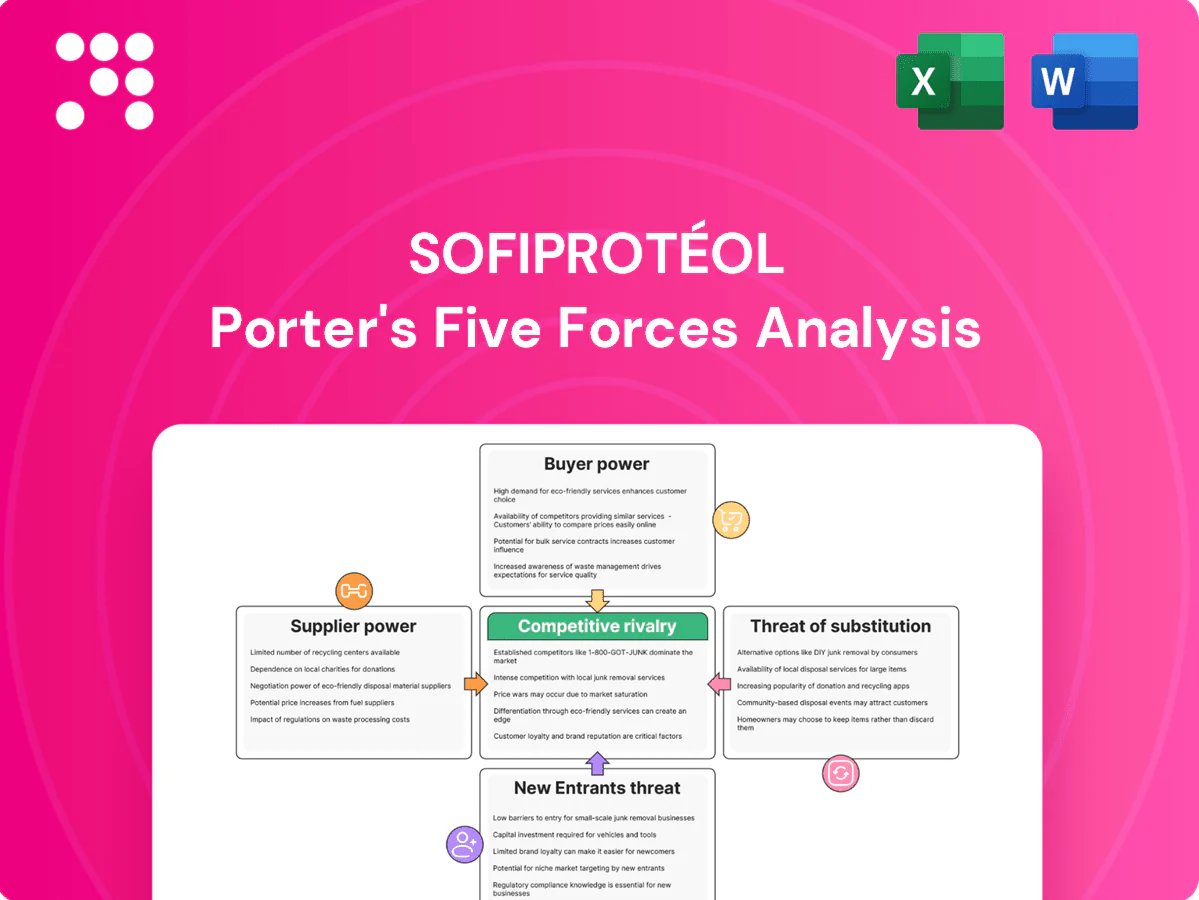
Sofiprotéol Porter's Five Forces Analysis

Elevate Your Analysis with the Complete Porter's Five Forces Analysis
Sofiprotéol faces mixed forces: strong supplier influence from feedstock markets and regulatory shifts, moderate buyer power with large food and energy customers, rising substitute threats from alternative oils and renewables, and intense rivalry amid sector consolidation. Strategic diversification into biofuels and oleochemicals cushions risks but exposes margin pressure. This brief snapshot only scratches the surface. Unlock the full Porter's Five Forces Analysis to explore Sofiprotéol’s competitive dynamics, market pressures, and strategic advantages in detail.
Suppliers Bargaining Power

Concentrated farm and crush input base
Upstream oilseed and protein crop producers and crush/refining operators are relatively concentrated in France and the EU, creating supplier power that can move raw material prices. Supply shocks from weather, policy shifts or phytosanitary measures have historically squeezed margins across Sofiprotéol’s portfolio and can impair project viability and credit metrics. Long-term offtake contracts and agronomic programs reduce but do not eliminate this volatility.
Dependence on capital providers
Sofiprotéol’s suppliers include Avril Group, banks and co-investors that supply capital; shifts in risk appetite, interest rates and green-finance taxonomy can tighten terms. Since 2021 policy rates have risen roughly 3–4 percentage points, which can raise Sofiprotéol’s cost of capital and constrain ticket sizes. Diversifying funding sources and using blended finance structures reduces this supplier leverage.

Technology and input OEMs
Seed genetics and farm machinery supply are highly concentrated—Bayer, Corteva and Syngenta/Adama account for over 50% of proprietary seed volumes (2024), while Novozymes and IFF/DSM dominate industrial enzymes, giving OEMs IP leverage and high switching costs that lift capex/opex bargaining power. Equipment lead times (commonly 6–12 months) and service contracts shape ramp-up and uptime, though strategic partnerships and volume commitments can secure price and lead-time concessions.

Energy and logistics dependencies
- Gas exposure: TTF ~€30/MWh (2024)
- Freight volatility: port bottlenecks pressure margins
- Costs pass-through often immediate; contracts lag
- Hedging and multi-modal logistics reduce but complicate operations
Regulatory gatekeepers as de facto suppliers
Regulatory gatekeepers function as de facto suppliers: access to subsidies, quotas and certifications (RED III, 2023) operates like an input, with authorities and certifiers setting timelines and compliance costs that directly alter project cash flows for renewables and bio‑based projects; EU ETS averaged about €90/ton in 2024, amplifying cost exposure, while proactive compliance and policy engagement reduce that dependency.
- RED III (2023) shapes biofuel quotas and certification timelines
- EU ETS ≈ €90/ton (2024) impacts project economics
- Proactive compliance and policy engagement lower regulatory dependency
Suppliers squeeze margins: TTF €30/MWh, EU ETS €90/t, rates +3-4pp
Suppliers wield medium–high power: concentrated oilseed producers, seed/IP oligopolies (>50% market share) and energy/freight shocks (TTF ≈ €30/MWh, EU ETS ≈ €90/t in 2024) compress margins; rates +3–4pp since 2021 raised funding costs. Long-term contracts, hedges and blended finance mitigate but do not remove leverage.
| Input | 2024 metric | Impact |
|---|---|---|
| Energy | TTF €30/MWh | Raises processing costs |
What is included in the product
 Detailed Word Document
Comprehensive Porter's Five Forces analysis tailored to Sofiprotéol, uncovering competitive drivers, supplier and buyer power, entry barriers, substitutes, and emerging threats that shape its profitability and strategic positioning.

 Customizable Excel Spreadsheet
Concise one-sheet Porter's Five Forces for Sofiprotéol—instantly highlights supplier/customer power, competitive rivalry, substitutes and entry threats to guide rapid strategic decisions and risk mitigation.
Customers Bargaining Power

Professionalized investee base
Agri-food processors, co‑ops and scale‑ups are sophisticated capital buyers who benchmark offers across banks, Bpifrance and private funds, pushing down pricing and tightening expectations on covenants and governance. This professionalized investee base increases bargaining power, making standard capital less competitive. For Sofiprotéol, demonstrated value‑add beyond financing—technical support, market access, ESG expertise—becomes decisive to secure deal flow.
Downstream FMCG and retail consolidation
Downstream consolidation concentrates buying power in a few global chains—Walmart alone reported FY2024 revenue of $611.3bn—enabling aggressive demands on price, quality, and sustainability documentation that compress Sofiprotéol’s oil and meal margins. Frequent contract renegotiations can cascade into weaker debt service capacity for capital-intensive processing assets. Investment in traceability and premium labels (certified sustainable/organic SKUs) helps recapture margin and bargaining leverage.

Farmers and cooperatives as price setters
Producer organizations and cooperatives significantly shape crop supply and farm-gate prices, directly compressing or widening processing spreads and affecting project bankability. They leverage policy instruments and can demand support or risk-sharing tied to the EU CAP budget of €387 billion (2021–2027). Contracted, long-term agronomic support aligns incentives, lowers producer churn, and stabilizes supply for Sofiprotéol.

Public sector programs and tenders
Public sector programs and tenders impose strict KPIs and milestone-linked payments; audit-triggered holdbacks and payment schedules shift bargaining power toward the issuer, increasing control over disbursements. Delays can strain working capital in portfolio companies and, given EU public procurement accounts for about 14% of GDP in 2024, exposure can be material. Structuring contingency liquidity and reserve tranches mitigates this risk.
- KPIs/milestones tighten issuer control
- Audit/payment timing shifts bargaining power
- Delays strain working capital; contingency liquidity reduces exposure
Co-investors and syndicate dynamics
When deals require club structures, lead investors at Sofiprotéol often dictate term sheets and governance, and in 2024 co-invest participation reached roughly 30% of European agrifood PE deals, increasing buyer leverage over structure and valuation. Competing mandates and accelerated timelines make side letters and exit rights key negotiation points, while clear investment theses and proprietary deal flow materially strengthen Sofiprotéol’s position.
Concentrated buyers and CAP rules tighten terms, squeezing producer margins
Sophisticated processors and co‑ops routinely pressure pricing and covenants, raising customer bargaining power and reducing returns. Concentrated retailers (Walmart revenue $611.3bn FY2024) demand strict sustainability and quality, compressing margins. Public tenders and CAP-linked producer leverage (€387bn 2021–27) shift terms toward buyers; co‑invest share ~30% strengthens lead investor control.
| Metric | 2024 |
|---|---|
| Walmart revenue | $611.3bn |
| EU CAP budget | €387bn (2021–27) |
| Co‑invest share | ~30% |
Preview the Actual Deliverable
Sofiprotéol Porter's Five Forces Analysis
This preview is the exact Sofiprotéol Porter’s Five Forces Analysis you’ll receive immediately after purchase—no placeholders or samples. The full document is professionally formatted and ready for use. Upon payment you get instant access to this same file. No surprises, no customization needed.

Elevate Your Analysis with the Complete Porter's Five Forces Analysis
Sofiprotéol faces mixed forces: strong supplier influence from feedstock markets and regulatory shifts, moderate buyer power with large food and energy customers, rising substitute threats from alternative oils and renewables, and intense rivalry amid sector consolidation. Strategic diversification into biofuels and oleochemicals cushions risks but exposes margin pressure. This brief snapshot only scratches the surface. Unlock the full Porter's Five Forces Analysis to explore Sofiprotéol’s competitive dynamics, market pressures, and strategic advantages in detail.
Suppliers Bargaining Power
Concentrated farm and crush input base
Upstream oilseed and protein crop producers and crush/refining operators are relatively concentrated in France and the EU, creating supplier power that can move raw material prices. Supply shocks from weather, policy shifts or phytosanitary measures have historically squeezed margins across Sofiprotéol’s portfolio and can impair project viability and credit metrics. Long-term offtake contracts and agronomic programs reduce but do not eliminate this volatility.
Dependence on capital providers
Sofiprotéol’s suppliers include Avril Group, banks and co-investors that supply capital; shifts in risk appetite, interest rates and green-finance taxonomy can tighten terms. Since 2021 policy rates have risen roughly 3–4 percentage points, which can raise Sofiprotéol’s cost of capital and constrain ticket sizes. Diversifying funding sources and using blended finance structures reduces this supplier leverage.
Technology and input OEMs
Seed genetics and farm machinery supply are highly concentrated—Bayer, Corteva and Syngenta/Adama account for over 50% of proprietary seed volumes (2024), while Novozymes and IFF/DSM dominate industrial enzymes, giving OEMs IP leverage and high switching costs that lift capex/opex bargaining power. Equipment lead times (commonly 6–12 months) and service contracts shape ramp-up and uptime, though strategic partnerships and volume commitments can secure price and lead-time concessions.
Energy and logistics dependencies
- Gas exposure: TTF ~€30/MWh (2024)
- Freight volatility: port bottlenecks pressure margins
- Costs pass-through often immediate; contracts lag
- Hedging and multi-modal logistics reduce but complicate operations
Regulatory gatekeepers as de facto suppliers
Regulatory gatekeepers function as de facto suppliers: access to subsidies, quotas and certifications (RED III, 2023) operates like an input, with authorities and certifiers setting timelines and compliance costs that directly alter project cash flows for renewables and bio‑based projects; EU ETS averaged about €90/ton in 2024, amplifying cost exposure, while proactive compliance and policy engagement reduce that dependency.
- RED III (2023) shapes biofuel quotas and certification timelines
- EU ETS ≈ €90/ton (2024) impacts project economics
- Proactive compliance and policy engagement lower regulatory dependency
Suppliers squeeze margins: TTF €30/MWh, EU ETS €90/t, rates +3-4pp
Suppliers wield medium–high power: concentrated oilseed producers, seed/IP oligopolies (>50% market share) and energy/freight shocks (TTF ≈ €30/MWh, EU ETS ≈ €90/t in 2024) compress margins; rates +3–4pp since 2021 raised funding costs. Long-term contracts, hedges and blended finance mitigate but do not remove leverage.
| Input | 2024 metric | Impact |
|---|---|---|
| Energy | TTF €30/MWh | Raises processing costs |
What is included in the product
Detailed Word Document
Comprehensive Porter's Five Forces analysis tailored to Sofiprotéol, uncovering competitive drivers, supplier and buyer power, entry barriers, substitutes, and emerging threats that shape its profitability and strategic positioning.
Customizable Excel Spreadsheet
Concise one-sheet Porter's Five Forces for Sofiprotéol—instantly highlights supplier/customer power, competitive rivalry, substitutes and entry threats to guide rapid strategic decisions and risk mitigation.
Customers Bargaining Power
Professionalized investee base
Agri-food processors, co‑ops and scale‑ups are sophisticated capital buyers who benchmark offers across banks, Bpifrance and private funds, pushing down pricing and tightening expectations on covenants and governance. This professionalized investee base increases bargaining power, making standard capital less competitive. For Sofiprotéol, demonstrated value‑add beyond financing—technical support, market access, ESG expertise—becomes decisive to secure deal flow.
Downstream FMCG and retail consolidation
Downstream consolidation concentrates buying power in a few global chains—Walmart alone reported FY2024 revenue of $611.3bn—enabling aggressive demands on price, quality, and sustainability documentation that compress Sofiprotéol’s oil and meal margins. Frequent contract renegotiations can cascade into weaker debt service capacity for capital-intensive processing assets. Investment in traceability and premium labels (certified sustainable/organic SKUs) helps recapture margin and bargaining leverage.
Farmers and cooperatives as price setters
Producer organizations and cooperatives significantly shape crop supply and farm-gate prices, directly compressing or widening processing spreads and affecting project bankability. They leverage policy instruments and can demand support or risk-sharing tied to the EU CAP budget of €387 billion (2021–2027). Contracted, long-term agronomic support aligns incentives, lowers producer churn, and stabilizes supply for Sofiprotéol.
Public sector programs and tenders
Public sector programs and tenders impose strict KPIs and milestone-linked payments; audit-triggered holdbacks and payment schedules shift bargaining power toward the issuer, increasing control over disbursements. Delays can strain working capital in portfolio companies and, given EU public procurement accounts for about 14% of GDP in 2024, exposure can be material. Structuring contingency liquidity and reserve tranches mitigates this risk.
- KPIs/milestones tighten issuer control
- Audit/payment timing shifts bargaining power
- Delays strain working capital; contingency liquidity reduces exposure
Co-investors and syndicate dynamics
When deals require club structures, lead investors at Sofiprotéol often dictate term sheets and governance, and in 2024 co-invest participation reached roughly 30% of European agrifood PE deals, increasing buyer leverage over structure and valuation. Competing mandates and accelerated timelines make side letters and exit rights key negotiation points, while clear investment theses and proprietary deal flow materially strengthen Sofiprotéol’s position.
Concentrated buyers and CAP rules tighten terms, squeezing producer margins
Sophisticated processors and co‑ops routinely pressure pricing and covenants, raising customer bargaining power and reducing returns. Concentrated retailers (Walmart revenue $611.3bn FY2024) demand strict sustainability and quality, compressing margins. Public tenders and CAP-linked producer leverage (€387bn 2021–27) shift terms toward buyers; co‑invest share ~30% strengthens lead investor control.
| Metric | 2024 |
|---|---|
| Walmart revenue | $611.3bn |
| EU CAP budget | €387bn (2021–27) |
| Co‑invest share | ~30% |
Preview the Actual Deliverable
Sofiprotéol Porter's Five Forces Analysis
This preview is the exact Sofiprotéol Porter’s Five Forces Analysis you’ll receive immediately after purchase—no placeholders or samples. The full document is professionally formatted and ready for use. Upon payment you get instant access to this same file. No surprises, no customization needed.
Original: $10.00
-65%$10.00
$3.50Description
Elevate Your Analysis with the Complete Porter's Five Forces Analysis
Sofiprotéol faces mixed forces: strong supplier influence from feedstock markets and regulatory shifts, moderate buyer power with large food and energy customers, rising substitute threats from alternative oils and renewables, and intense rivalry amid sector consolidation. Strategic diversification into biofuels and oleochemicals cushions risks but exposes margin pressure. This brief snapshot only scratches the surface. Unlock the full Porter's Five Forces Analysis to explore Sofiprotéol’s competitive dynamics, market pressures, and strategic advantages in detail.
Suppliers Bargaining Power
Concentrated farm and crush input base
Upstream oilseed and protein crop producers and crush/refining operators are relatively concentrated in France and the EU, creating supplier power that can move raw material prices. Supply shocks from weather, policy shifts or phytosanitary measures have historically squeezed margins across Sofiprotéol’s portfolio and can impair project viability and credit metrics. Long-term offtake contracts and agronomic programs reduce but do not eliminate this volatility.
Dependence on capital providers
Sofiprotéol’s suppliers include Avril Group, banks and co-investors that supply capital; shifts in risk appetite, interest rates and green-finance taxonomy can tighten terms. Since 2021 policy rates have risen roughly 3–4 percentage points, which can raise Sofiprotéol’s cost of capital and constrain ticket sizes. Diversifying funding sources and using blended finance structures reduces this supplier leverage.
Technology and input OEMs
Seed genetics and farm machinery supply are highly concentrated—Bayer, Corteva and Syngenta/Adama account for over 50% of proprietary seed volumes (2024), while Novozymes and IFF/DSM dominate industrial enzymes, giving OEMs IP leverage and high switching costs that lift capex/opex bargaining power. Equipment lead times (commonly 6–12 months) and service contracts shape ramp-up and uptime, though strategic partnerships and volume commitments can secure price and lead-time concessions.
Energy and logistics dependencies
- Gas exposure: TTF ~€30/MWh (2024)
- Freight volatility: port bottlenecks pressure margins
- Costs pass-through often immediate; contracts lag
- Hedging and multi-modal logistics reduce but complicate operations
Regulatory gatekeepers as de facto suppliers
Regulatory gatekeepers function as de facto suppliers: access to subsidies, quotas and certifications (RED III, 2023) operates like an input, with authorities and certifiers setting timelines and compliance costs that directly alter project cash flows for renewables and bio‑based projects; EU ETS averaged about €90/ton in 2024, amplifying cost exposure, while proactive compliance and policy engagement reduce that dependency.
- RED III (2023) shapes biofuel quotas and certification timelines
- EU ETS ≈ €90/ton (2024) impacts project economics
- Proactive compliance and policy engagement lower regulatory dependency
Suppliers squeeze margins: TTF €30/MWh, EU ETS €90/t, rates +3-4pp
Suppliers wield medium–high power: concentrated oilseed producers, seed/IP oligopolies (>50% market share) and energy/freight shocks (TTF ≈ €30/MWh, EU ETS ≈ €90/t in 2024) compress margins; rates +3–4pp since 2021 raised funding costs. Long-term contracts, hedges and blended finance mitigate but do not remove leverage.
| Input | 2024 metric | Impact |
|---|---|---|
| Energy | TTF €30/MWh | Raises processing costs |
What is included in the product
Detailed Word Document
Comprehensive Porter's Five Forces analysis tailored to Sofiprotéol, uncovering competitive drivers, supplier and buyer power, entry barriers, substitutes, and emerging threats that shape its profitability and strategic positioning.
Customizable Excel Spreadsheet
Concise one-sheet Porter's Five Forces for Sofiprotéol—instantly highlights supplier/customer power, competitive rivalry, substitutes and entry threats to guide rapid strategic decisions and risk mitigation.
Customers Bargaining Power
Professionalized investee base
Agri-food processors, co‑ops and scale‑ups are sophisticated capital buyers who benchmark offers across banks, Bpifrance and private funds, pushing down pricing and tightening expectations on covenants and governance. This professionalized investee base increases bargaining power, making standard capital less competitive. For Sofiprotéol, demonstrated value‑add beyond financing—technical support, market access, ESG expertise—becomes decisive to secure deal flow.
Downstream FMCG and retail consolidation
Downstream consolidation concentrates buying power in a few global chains—Walmart alone reported FY2024 revenue of $611.3bn—enabling aggressive demands on price, quality, and sustainability documentation that compress Sofiprotéol’s oil and meal margins. Frequent contract renegotiations can cascade into weaker debt service capacity for capital-intensive processing assets. Investment in traceability and premium labels (certified sustainable/organic SKUs) helps recapture margin and bargaining leverage.
Farmers and cooperatives as price setters
Producer organizations and cooperatives significantly shape crop supply and farm-gate prices, directly compressing or widening processing spreads and affecting project bankability. They leverage policy instruments and can demand support or risk-sharing tied to the EU CAP budget of €387 billion (2021–2027). Contracted, long-term agronomic support aligns incentives, lowers producer churn, and stabilizes supply for Sofiprotéol.
Public sector programs and tenders
Public sector programs and tenders impose strict KPIs and milestone-linked payments; audit-triggered holdbacks and payment schedules shift bargaining power toward the issuer, increasing control over disbursements. Delays can strain working capital in portfolio companies and, given EU public procurement accounts for about 14% of GDP in 2024, exposure can be material. Structuring contingency liquidity and reserve tranches mitigates this risk.
- KPIs/milestones tighten issuer control
- Audit/payment timing shifts bargaining power
- Delays strain working capital; contingency liquidity reduces exposure
Co-investors and syndicate dynamics
When deals require club structures, lead investors at Sofiprotéol often dictate term sheets and governance, and in 2024 co-invest participation reached roughly 30% of European agrifood PE deals, increasing buyer leverage over structure and valuation. Competing mandates and accelerated timelines make side letters and exit rights key negotiation points, while clear investment theses and proprietary deal flow materially strengthen Sofiprotéol’s position.
Concentrated buyers and CAP rules tighten terms, squeezing producer margins
Sophisticated processors and co‑ops routinely pressure pricing and covenants, raising customer bargaining power and reducing returns. Concentrated retailers (Walmart revenue $611.3bn FY2024) demand strict sustainability and quality, compressing margins. Public tenders and CAP-linked producer leverage (€387bn 2021–27) shift terms toward buyers; co‑invest share ~30% strengthens lead investor control.
| Metric | 2024 |
|---|---|
| Walmart revenue | $611.3bn |
| EU CAP budget | €387bn (2021–27) |
| Co‑invest share | ~30% |
Preview the Actual Deliverable
Sofiprotéol Porter's Five Forces Analysis
This preview is the exact Sofiprotéol Porter’s Five Forces Analysis you’ll receive immediately after purchase—no placeholders or samples. The full document is professionally formatted and ready for use. Upon payment you get instant access to this same file. No surprises, no customization needed.











