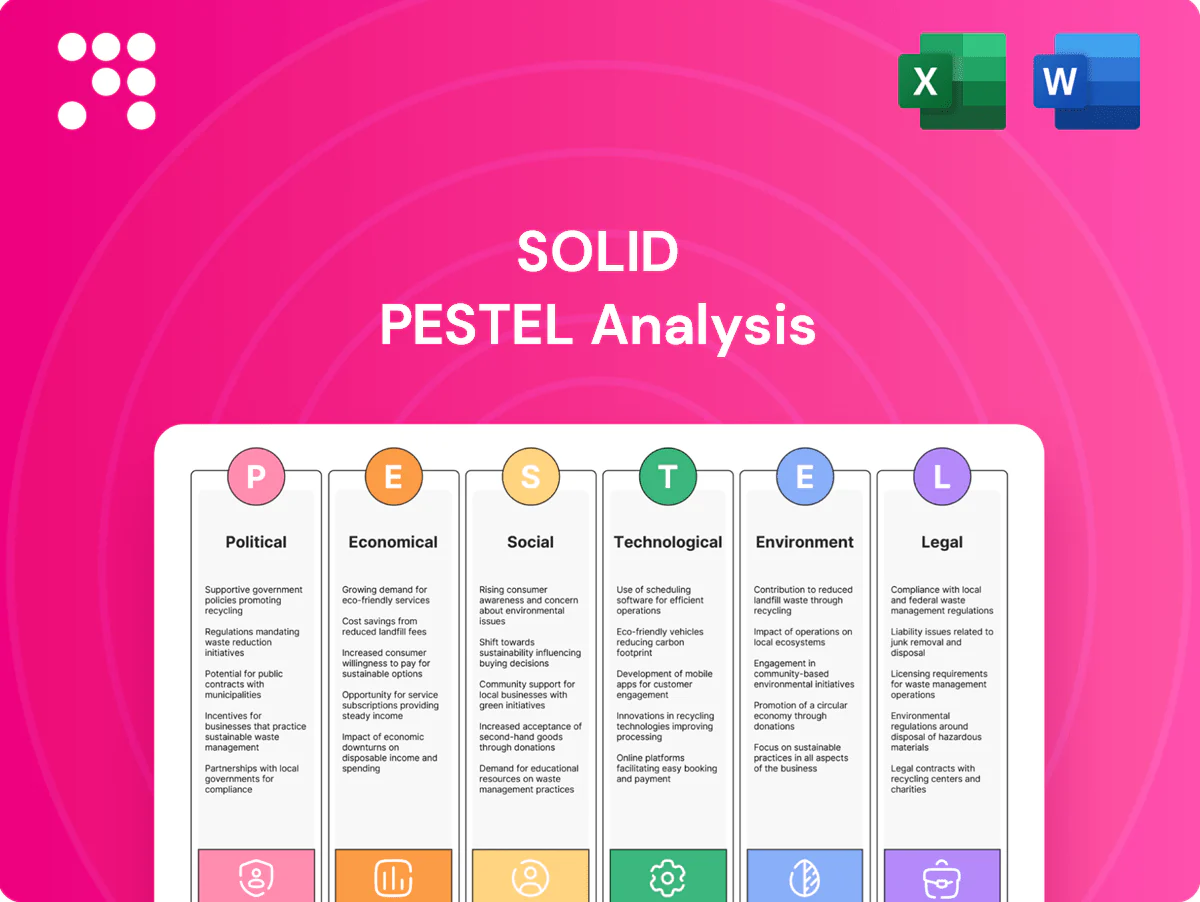
SOLiD PESTLE Analysis

Plan Smarter. Present Sharper. Compete Stronger.
Explore how political shifts, economic cycles, and emerging technologies shape SOLiD’s strategic outlook in our concise PESTLE snapshot. Ideal for investors and strategists, this analysis highlights key risks and growth levers you can act on immediately. Purchase the full PESTLE for the complete, editable deep-dive and actionable recommendations.
Political factors

Spectrum policy and auctions
Allocation and licensing of spectrum—illustrated by the US 3.45 GHz auction that raised about 22.5 billion USD and CBRS PAL auctions exceeding 4.5 billion USD—directly shape operators’ deployment priorities and timelines, driving faster DAS and fronthaul rollouts where mid-band access is secured. Changes in shared, private or mid-band availability can accelerate or delay investments and shift CAPEX toward densification. SOLiD must align product roadmaps with band support and regional licensing cycles and pursue proactive certification for new bands to cut time-to-revenue by several months.
5G funding and public incentives
US BEAD program funding of $42.45 billion and similar national digital-infrastructure grants are driving upgrades to indoor coverage in transport hubs, campuses and public venues. Subsidies and PPPs tied to these funds expand addressable markets for DAS and optical transport, enabling larger-scale rollouts. SOLiD can position compliant solutions for grant mandates and use transparent ROI models to win publicly funded projects.

Geopolitics and trade restrictions
Tariffs (up to 25% under US Section 301 covering about $370bn of Chinese goods), import controls and vendor blacklists directly constrain SOLiD component sourcing and market access. Recent US–China–EU tech policy shifts and semiconductor export curbs have rerouted supply chains, forcing localization. SOLiD needs multi-country manufacturing, BOM-compliant alternatives and at least three supplier regions to mitigate country-of-origin risk.

Critical communications priorities
Policies for public-safety communications, driven by FirstNet and regional mandates, push many jurisdictions toward 90–95% in-building coverage targets, increasing demand for DAS in civic and commercial buildings. Compliance with emergency-responder radio coverage standards directly boosts procurement cycles; SOLiD can tailor solutions for mission-critical bands and reduce retrofit cost. Early engagement with authorities streamlines approvals and shortens deployment timelines.
- Target coverage: 90–95% in-building
- Market impact: higher DAS procurement in civic/commercial projects
- SOLiD strength: mission-critical band tailoring
- Strategy: engage regulators early to speed approvals
Permitting and infrastructure rules
Local permitting and building approvals often slow indoor and campus deployments, despite the FCC's wireless infrastructure shot clocks of 60 days for collocations and 90 days for new structures, which aim to cap review time. Streamlined small-cell and DAS policies shorten project cycles; SOLiD offers low-visibility, code-compliant hardware to improve municipal acceptance and partnering with experienced integrators reduces permitting friction.
- Permitting delays: regulatory bottlenecks vs FCC 60/90-day shot clocks
- Benefit: streamlined small-cell/DAS policies speed rollouts
- SOLiD: low-visibility, code-compliant designs
- Strategy: partner with integrators to minimize municipal friction
Auctions, BEAD grants and tariffs accelerate mid-band densification and supply diversification
Spectrum auctions (US 3.45 GHz $22.5B; CBRS PAL >$4.5B) drive mid-band deployments and shift CAPEX to densification. US BEAD $42.45B and similar grants expand DAS demand in public venues. Tariffs (Section 301 ~25% on $370B), export controls and FirstNet 90–95% coverage targets force supply diversification and mission-critical alignment.
| Factor | 2024/25 metric | Impact | Action |
|---|---|---|---|
| Spectrum | $22.5B/$4.5B | Mid-band rollout | Band certification |
| Funding | $42.45B BEAD | More public projects | Grant-ready solutions |
| Trade/Regs | 25% tariffs on $370B | Supply risk | Multi-region BOM |
What is included in the product
 Detailed Word Document
Explores how macro-environmental factors uniquely affect SOLiD across Political, Economic, Social, Technological, Environmental and Legal dimensions, with data-backed trends and specific sub-points tied to the business and region. Designed for executives and investors, it offers forward-looking insights, scenario planning and ready-to-use content for plans and pitches.

 Customizable Excel Spreadsheet
A clean, visually segmented SOLiD PESTLE summary that alleviates meeting prep by presenting external risks and opportunities in simple language, editable for local context and ready to drop into presentations.
Economic factors

Carrier capex cycles
Operator capex timing drives DAS and fronthaul purchase volumes: global operator capex was about $290bn in 2024 while major US carriers guided 2024 capex at roughly AT&T $22–24bn, Verizon $18–19bn and T‑Mobile $8–9bn, creating discrete buying windows. 5G densification and indoor KPI targets (uplink/downlink latency, coverage) can trigger concentrated spending waves. SOLiD should align pipeline to operator budget cycles and offer flexible financing to smooth projects through down‑cycles.
Macroeconomy, rates, FX
High interest rates (US fed funds ~5.25–5.50% in mid‑2025) and persistent inflation lift customer ROI thresholds and constrain financing for projects. Currency swings (DXY near 103 in mid‑2025) can erode export margins by 5–10% on a 10% move, so targeted hedging and regional pricing stabilize revenue. Deploying cost‑optimized SKUs and localized sourcing preserves competitiveness amid tight consumer budgets and tighter credit conditions.

Enterprise digitization demand
Private 5G and smart-building adoption are driving non-carrier coverage spend, with MarketsandMarkets projecting the private 5G market to reach about 16.2 billion USD by 2028; healthcare, logistics and venues increasingly demand reliable indoor mobility for mission-critical workflows. SOLiD can bundle vertical-specific radios, DAS and managed services to capture this spend, while TCO-focused pitches—highlighting lifecycle OPEX savings—resonate strongly with CFOs.

Component costs and supply chain
Optical, RF, and semiconductor price volatility materially swings SOLiD’s COGS—semiconductor spot prices moved within a ±20% band in 2024, driving margin sensitivity on high-volume modules.
Extended lead-times (peaking near 12 weeks in 2023–24) delayed shipments and revenue recognition for some projects; dual-sourcing and safety-stock reduced fulfillment risk.
Design-for-supply choices (component substitutions and modular BOMs) preserved gross margins during 2024 supply shocks.
- Price volatility: semiconductors ±20% (2024)
- Lead-time peak: ~12 weeks (2023–24)
- Mitigants: dual-sourcing, strategic inventory
- Strategy: design-for-supply to protect margins
Competitive pricing pressures
RFP-driven markets force 10–20% price concessions and heavy multi-vendor comparisons, pressuring margins. SOLiD preserves price integrity by differentiating on performance, 30% better power efficiency in recent models, and faster installs reducing labor costs. Bundled support and analytics can add ~20% ARR and reference deployments lift win rates by ~15%.
- RFP discounts: 10–20%
- Performance/power edge: ~30%
- Support/analytics uplift: ~20% ARR
- Reference deployments: +15% win rate
Auctions, BEAD grants and tariffs accelerate mid-band densification and supply diversification
Operator capex ~$290bn (2024) with US carriers AT&T $22–24bn, Verizon $18–19bn, T‑Mobile $8–9bn drives purchase windows. Fed funds ~5.25–5.50% (mid‑2025) and DXY ~103 raise ROI hurdles; semiconductors ±20% (2024) and 12‑week lead‑times stress COGS/fulfillment. Private 5G ~$16.2bn by 2028 and RFP discounts 10–20% push SOLiD to bundle, hedge, and finance.
| Metric | Value |
|---|---|
| Global operator capex 2024 | $290bn |
| US carrier capex | AT&T $22–24bn; VZ $18–19bn; TMUS $8–9bn |
| Fed funds (mid‑2025) | 5.25–5.50% |
| DXY (mid‑2025) | ~103 |
| Semiconductor volatility 2024 | ±20% |
| Lead‑times peak | ~12 weeks |
| Private 5G by 2028 | $16.2bn |
What You See Is What You Get
SOLiD PESTLE Analysis
The preview shown is the exact SOLiD PESTLE Analysis document you’ll receive after purchase—fully formatted and ready to use. This is the real file with complete content and structure, no placeholders or teasers. After payment you’ll instantly download the same finished document displayed here.

Plan Smarter. Present Sharper. Compete Stronger.
Explore how political shifts, economic cycles, and emerging technologies shape SOLiD’s strategic outlook in our concise PESTLE snapshot. Ideal for investors and strategists, this analysis highlights key risks and growth levers you can act on immediately. Purchase the full PESTLE for the complete, editable deep-dive and actionable recommendations.
Political factors
Spectrum policy and auctions
Allocation and licensing of spectrum—illustrated by the US 3.45 GHz auction that raised about 22.5 billion USD and CBRS PAL auctions exceeding 4.5 billion USD—directly shape operators’ deployment priorities and timelines, driving faster DAS and fronthaul rollouts where mid-band access is secured. Changes in shared, private or mid-band availability can accelerate or delay investments and shift CAPEX toward densification. SOLiD must align product roadmaps with band support and regional licensing cycles and pursue proactive certification for new bands to cut time-to-revenue by several months.
5G funding and public incentives
US BEAD program funding of $42.45 billion and similar national digital-infrastructure grants are driving upgrades to indoor coverage in transport hubs, campuses and public venues. Subsidies and PPPs tied to these funds expand addressable markets for DAS and optical transport, enabling larger-scale rollouts. SOLiD can position compliant solutions for grant mandates and use transparent ROI models to win publicly funded projects.
Geopolitics and trade restrictions
Tariffs (up to 25% under US Section 301 covering about $370bn of Chinese goods), import controls and vendor blacklists directly constrain SOLiD component sourcing and market access. Recent US–China–EU tech policy shifts and semiconductor export curbs have rerouted supply chains, forcing localization. SOLiD needs multi-country manufacturing, BOM-compliant alternatives and at least three supplier regions to mitigate country-of-origin risk.
Critical communications priorities
Policies for public-safety communications, driven by FirstNet and regional mandates, push many jurisdictions toward 90–95% in-building coverage targets, increasing demand for DAS in civic and commercial buildings. Compliance with emergency-responder radio coverage standards directly boosts procurement cycles; SOLiD can tailor solutions for mission-critical bands and reduce retrofit cost. Early engagement with authorities streamlines approvals and shortens deployment timelines.
- Target coverage: 90–95% in-building
- Market impact: higher DAS procurement in civic/commercial projects
- SOLiD strength: mission-critical band tailoring
- Strategy: engage regulators early to speed approvals
Permitting and infrastructure rules
Local permitting and building approvals often slow indoor and campus deployments, despite the FCC's wireless infrastructure shot clocks of 60 days for collocations and 90 days for new structures, which aim to cap review time. Streamlined small-cell and DAS policies shorten project cycles; SOLiD offers low-visibility, code-compliant hardware to improve municipal acceptance and partnering with experienced integrators reduces permitting friction.
- Permitting delays: regulatory bottlenecks vs FCC 60/90-day shot clocks
- Benefit: streamlined small-cell/DAS policies speed rollouts
- SOLiD: low-visibility, code-compliant designs
- Strategy: partner with integrators to minimize municipal friction
Auctions, BEAD grants and tariffs accelerate mid-band densification and supply diversification
Spectrum auctions (US 3.45 GHz $22.5B; CBRS PAL >$4.5B) drive mid-band deployments and shift CAPEX to densification. US BEAD $42.45B and similar grants expand DAS demand in public venues. Tariffs (Section 301 ~25% on $370B), export controls and FirstNet 90–95% coverage targets force supply diversification and mission-critical alignment.
| Factor | 2024/25 metric | Impact | Action |
|---|---|---|---|
| Spectrum | $22.5B/$4.5B | Mid-band rollout | Band certification |
| Funding | $42.45B BEAD | More public projects | Grant-ready solutions |
| Trade/Regs | 25% tariffs on $370B | Supply risk | Multi-region BOM |
What is included in the product
Detailed Word Document
Explores how macro-environmental factors uniquely affect SOLiD across Political, Economic, Social, Technological, Environmental and Legal dimensions, with data-backed trends and specific sub-points tied to the business and region. Designed for executives and investors, it offers forward-looking insights, scenario planning and ready-to-use content for plans and pitches.
Customizable Excel Spreadsheet
A clean, visually segmented SOLiD PESTLE summary that alleviates meeting prep by presenting external risks and opportunities in simple language, editable for local context and ready to drop into presentations.
Economic factors
Carrier capex cycles
Operator capex timing drives DAS and fronthaul purchase volumes: global operator capex was about $290bn in 2024 while major US carriers guided 2024 capex at roughly AT&T $22–24bn, Verizon $18–19bn and T‑Mobile $8–9bn, creating discrete buying windows. 5G densification and indoor KPI targets (uplink/downlink latency, coverage) can trigger concentrated spending waves. SOLiD should align pipeline to operator budget cycles and offer flexible financing to smooth projects through down‑cycles.
Macroeconomy, rates, FX
High interest rates (US fed funds ~5.25–5.50% in mid‑2025) and persistent inflation lift customer ROI thresholds and constrain financing for projects. Currency swings (DXY near 103 in mid‑2025) can erode export margins by 5–10% on a 10% move, so targeted hedging and regional pricing stabilize revenue. Deploying cost‑optimized SKUs and localized sourcing preserves competitiveness amid tight consumer budgets and tighter credit conditions.
Enterprise digitization demand
Private 5G and smart-building adoption are driving non-carrier coverage spend, with MarketsandMarkets projecting the private 5G market to reach about 16.2 billion USD by 2028; healthcare, logistics and venues increasingly demand reliable indoor mobility for mission-critical workflows. SOLiD can bundle vertical-specific radios, DAS and managed services to capture this spend, while TCO-focused pitches—highlighting lifecycle OPEX savings—resonate strongly with CFOs.
Component costs and supply chain
Optical, RF, and semiconductor price volatility materially swings SOLiD’s COGS—semiconductor spot prices moved within a ±20% band in 2024, driving margin sensitivity on high-volume modules.
Extended lead-times (peaking near 12 weeks in 2023–24) delayed shipments and revenue recognition for some projects; dual-sourcing and safety-stock reduced fulfillment risk.
Design-for-supply choices (component substitutions and modular BOMs) preserved gross margins during 2024 supply shocks.
- Price volatility: semiconductors ±20% (2024)
- Lead-time peak: ~12 weeks (2023–24)
- Mitigants: dual-sourcing, strategic inventory
- Strategy: design-for-supply to protect margins
Competitive pricing pressures
RFP-driven markets force 10–20% price concessions and heavy multi-vendor comparisons, pressuring margins. SOLiD preserves price integrity by differentiating on performance, 30% better power efficiency in recent models, and faster installs reducing labor costs. Bundled support and analytics can add ~20% ARR and reference deployments lift win rates by ~15%.
- RFP discounts: 10–20%
- Performance/power edge: ~30%
- Support/analytics uplift: ~20% ARR
- Reference deployments: +15% win rate
Auctions, BEAD grants and tariffs accelerate mid-band densification and supply diversification
Operator capex ~$290bn (2024) with US carriers AT&T $22–24bn, Verizon $18–19bn, T‑Mobile $8–9bn drives purchase windows. Fed funds ~5.25–5.50% (mid‑2025) and DXY ~103 raise ROI hurdles; semiconductors ±20% (2024) and 12‑week lead‑times stress COGS/fulfillment. Private 5G ~$16.2bn by 2028 and RFP discounts 10–20% push SOLiD to bundle, hedge, and finance.
| Metric | Value |
|---|---|
| Global operator capex 2024 | $290bn |
| US carrier capex | AT&T $22–24bn; VZ $18–19bn; TMUS $8–9bn |
| Fed funds (mid‑2025) | 5.25–5.50% |
| DXY (mid‑2025) | ~103 |
| Semiconductor volatility 2024 | ±20% |
| Lead‑times peak | ~12 weeks |
| Private 5G by 2028 | $16.2bn |
What You See Is What You Get
SOLiD PESTLE Analysis
The preview shown is the exact SOLiD PESTLE Analysis document you’ll receive after purchase—fully formatted and ready to use. This is the real file with complete content and structure, no placeholders or teasers. After payment you’ll instantly download the same finished document displayed here.
Original: $10.00
-65%$10.00
$3.50Description
Plan Smarter. Present Sharper. Compete Stronger.
Explore how political shifts, economic cycles, and emerging technologies shape SOLiD’s strategic outlook in our concise PESTLE snapshot. Ideal for investors and strategists, this analysis highlights key risks and growth levers you can act on immediately. Purchase the full PESTLE for the complete, editable deep-dive and actionable recommendations.
Political factors
Spectrum policy and auctions
Allocation and licensing of spectrum—illustrated by the US 3.45 GHz auction that raised about 22.5 billion USD and CBRS PAL auctions exceeding 4.5 billion USD—directly shape operators’ deployment priorities and timelines, driving faster DAS and fronthaul rollouts where mid-band access is secured. Changes in shared, private or mid-band availability can accelerate or delay investments and shift CAPEX toward densification. SOLiD must align product roadmaps with band support and regional licensing cycles and pursue proactive certification for new bands to cut time-to-revenue by several months.
5G funding and public incentives
US BEAD program funding of $42.45 billion and similar national digital-infrastructure grants are driving upgrades to indoor coverage in transport hubs, campuses and public venues. Subsidies and PPPs tied to these funds expand addressable markets for DAS and optical transport, enabling larger-scale rollouts. SOLiD can position compliant solutions for grant mandates and use transparent ROI models to win publicly funded projects.
Geopolitics and trade restrictions
Tariffs (up to 25% under US Section 301 covering about $370bn of Chinese goods), import controls and vendor blacklists directly constrain SOLiD component sourcing and market access. Recent US–China–EU tech policy shifts and semiconductor export curbs have rerouted supply chains, forcing localization. SOLiD needs multi-country manufacturing, BOM-compliant alternatives and at least three supplier regions to mitigate country-of-origin risk.
Critical communications priorities
Policies for public-safety communications, driven by FirstNet and regional mandates, push many jurisdictions toward 90–95% in-building coverage targets, increasing demand for DAS in civic and commercial buildings. Compliance with emergency-responder radio coverage standards directly boosts procurement cycles; SOLiD can tailor solutions for mission-critical bands and reduce retrofit cost. Early engagement with authorities streamlines approvals and shortens deployment timelines.
- Target coverage: 90–95% in-building
- Market impact: higher DAS procurement in civic/commercial projects
- SOLiD strength: mission-critical band tailoring
- Strategy: engage regulators early to speed approvals
Permitting and infrastructure rules
Local permitting and building approvals often slow indoor and campus deployments, despite the FCC's wireless infrastructure shot clocks of 60 days for collocations and 90 days for new structures, which aim to cap review time. Streamlined small-cell and DAS policies shorten project cycles; SOLiD offers low-visibility, code-compliant hardware to improve municipal acceptance and partnering with experienced integrators reduces permitting friction.
- Permitting delays: regulatory bottlenecks vs FCC 60/90-day shot clocks
- Benefit: streamlined small-cell/DAS policies speed rollouts
- SOLiD: low-visibility, code-compliant designs
- Strategy: partner with integrators to minimize municipal friction
Auctions, BEAD grants and tariffs accelerate mid-band densification and supply diversification
Spectrum auctions (US 3.45 GHz $22.5B; CBRS PAL >$4.5B) drive mid-band deployments and shift CAPEX to densification. US BEAD $42.45B and similar grants expand DAS demand in public venues. Tariffs (Section 301 ~25% on $370B), export controls and FirstNet 90–95% coverage targets force supply diversification and mission-critical alignment.
| Factor | 2024/25 metric | Impact | Action |
|---|---|---|---|
| Spectrum | $22.5B/$4.5B | Mid-band rollout | Band certification |
| Funding | $42.45B BEAD | More public projects | Grant-ready solutions |
| Trade/Regs | 25% tariffs on $370B | Supply risk | Multi-region BOM |
What is included in the product
Detailed Word Document
Explores how macro-environmental factors uniquely affect SOLiD across Political, Economic, Social, Technological, Environmental and Legal dimensions, with data-backed trends and specific sub-points tied to the business and region. Designed for executives and investors, it offers forward-looking insights, scenario planning and ready-to-use content for plans and pitches.
Customizable Excel Spreadsheet
A clean, visually segmented SOLiD PESTLE summary that alleviates meeting prep by presenting external risks and opportunities in simple language, editable for local context and ready to drop into presentations.
Economic factors
Carrier capex cycles
Operator capex timing drives DAS and fronthaul purchase volumes: global operator capex was about $290bn in 2024 while major US carriers guided 2024 capex at roughly AT&T $22–24bn, Verizon $18–19bn and T‑Mobile $8–9bn, creating discrete buying windows. 5G densification and indoor KPI targets (uplink/downlink latency, coverage) can trigger concentrated spending waves. SOLiD should align pipeline to operator budget cycles and offer flexible financing to smooth projects through down‑cycles.
Macroeconomy, rates, FX
High interest rates (US fed funds ~5.25–5.50% in mid‑2025) and persistent inflation lift customer ROI thresholds and constrain financing for projects. Currency swings (DXY near 103 in mid‑2025) can erode export margins by 5–10% on a 10% move, so targeted hedging and regional pricing stabilize revenue. Deploying cost‑optimized SKUs and localized sourcing preserves competitiveness amid tight consumer budgets and tighter credit conditions.
Enterprise digitization demand
Private 5G and smart-building adoption are driving non-carrier coverage spend, with MarketsandMarkets projecting the private 5G market to reach about 16.2 billion USD by 2028; healthcare, logistics and venues increasingly demand reliable indoor mobility for mission-critical workflows. SOLiD can bundle vertical-specific radios, DAS and managed services to capture this spend, while TCO-focused pitches—highlighting lifecycle OPEX savings—resonate strongly with CFOs.
Component costs and supply chain
Optical, RF, and semiconductor price volatility materially swings SOLiD’s COGS—semiconductor spot prices moved within a ±20% band in 2024, driving margin sensitivity on high-volume modules.
Extended lead-times (peaking near 12 weeks in 2023–24) delayed shipments and revenue recognition for some projects; dual-sourcing and safety-stock reduced fulfillment risk.
Design-for-supply choices (component substitutions and modular BOMs) preserved gross margins during 2024 supply shocks.
- Price volatility: semiconductors ±20% (2024)
- Lead-time peak: ~12 weeks (2023–24)
- Mitigants: dual-sourcing, strategic inventory
- Strategy: design-for-supply to protect margins
Competitive pricing pressures
RFP-driven markets force 10–20% price concessions and heavy multi-vendor comparisons, pressuring margins. SOLiD preserves price integrity by differentiating on performance, 30% better power efficiency in recent models, and faster installs reducing labor costs. Bundled support and analytics can add ~20% ARR and reference deployments lift win rates by ~15%.
- RFP discounts: 10–20%
- Performance/power edge: ~30%
- Support/analytics uplift: ~20% ARR
- Reference deployments: +15% win rate
Auctions, BEAD grants and tariffs accelerate mid-band densification and supply diversification
Operator capex ~$290bn (2024) with US carriers AT&T $22–24bn, Verizon $18–19bn, T‑Mobile $8–9bn drives purchase windows. Fed funds ~5.25–5.50% (mid‑2025) and DXY ~103 raise ROI hurdles; semiconductors ±20% (2024) and 12‑week lead‑times stress COGS/fulfillment. Private 5G ~$16.2bn by 2028 and RFP discounts 10–20% push SOLiD to bundle, hedge, and finance.
| Metric | Value |
|---|---|
| Global operator capex 2024 | $290bn |
| US carrier capex | AT&T $22–24bn; VZ $18–19bn; TMUS $8–9bn |
| Fed funds (mid‑2025) | 5.25–5.50% |
| DXY (mid‑2025) | ~103 |
| Semiconductor volatility 2024 | ±20% |
| Lead‑times peak | ~12 weeks |
| Private 5G by 2028 | $16.2bn |
What You See Is What You Get
SOLiD PESTLE Analysis
The preview shown is the exact SOLiD PESTLE Analysis document you’ll receive after purchase—fully formatted and ready to use. This is the real file with complete content and structure, no placeholders or teasers. After payment you’ll instantly download the same finished document displayed here.











