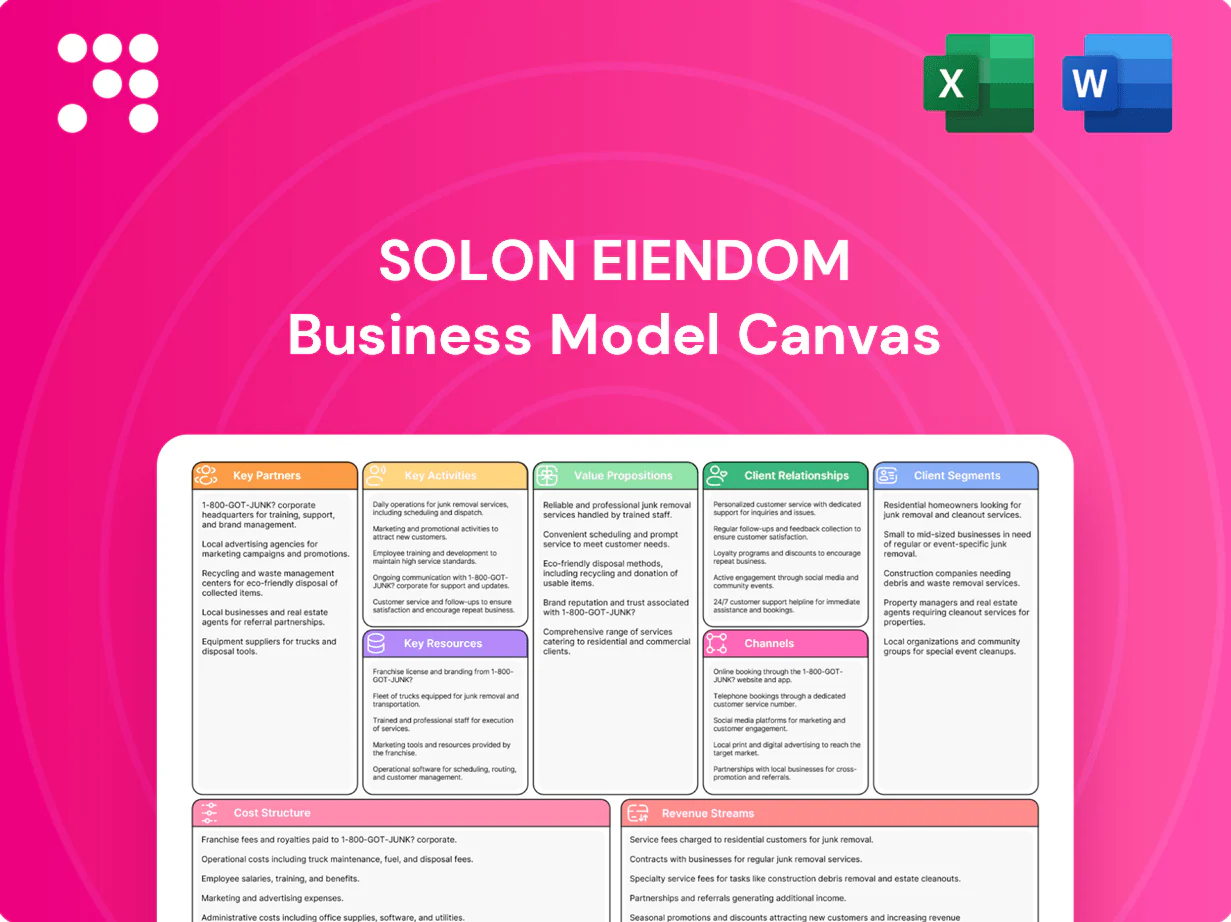
Solon Eiendom Business Model Canvas

Real Estate Business Model Canvas: Strategic blueprint, revenue streams, growth levers
Unlock Solon Eiendom’s strategic blueprint with our Business Model Canvas—three to five clear sentences that map how the company creates and captures value in real estate. This concise preview teases key partnerships, revenue streams, and growth levers. Download the full, editable Canvas to access detailed, company-specific insights for benchmarking, investor pitches, or strategic planning.
Partnerships

Municipalities and planning authorities
Close collaboration with Oslo (population ~709,000 in 2024) and regional authorities accelerates zoning and building permits, shortening timelines versus ad hoc approaches. Early engagement reduces regulatory risk and redesign loops; transparent compliance with Norwegian planning law fosters predictability. Joint urban regeneration initiatives can unlock municipal infrastructure co-investment across Norway’s 356 municipalities (2024).
Construction contractors and subcontractors
Framework agreements with reputable general contractors ensure cost, quality and schedule control and typically secure 70–80% of on-site capacity in tight Nordic labor markets in 2024, while lean construction practices cut waste and rework, improving productivity by up to 15–20%. Partnering guarantees access to scarce skilled crews, and supplier codes embed safety and ESG standards across the value chain.

Architects, urban designers, and engineers
Design partners translate site potential into attractive, buildable concepts that, per industry benchmarks, can reduce days-on-market by ~20% and lift sale prices 5–10%. Integrated BIM workflows—adopted by ~70% of projects in mature markets by 2024—align architecture, structural and MEP early, cutting rework and schedule risk. Good design improves sales velocity and pricing power; sustainability consultants help meet 2030 net-zero targets and deliver 30–50% operational energy reductions.

Banks, lenders, and financing institutions
Project finance and construction loans supply working capital; typical structures use staged drawdowns tied to milestones. Pre-sale thresholds (commonly ~50%) trigger lender drawdowns, de-risking balance sheets. Hedging partners use swaps to cover roughly 60–80% of rate exposure, while green financing in 2024 often reduced margins by about 10–30 bps for certified projects.
- Project finance: working capital
- Pre-sale trigger: ~50%
- Hedging: 60–80% swap coverage
- Green finance: −10–30 bps
Landowners and joint venture partners
Landowners and joint-venture partners secure Solon Eiendom’s pipeline through options and JV structures that limit upfront cash (common equity tranches 20–40%) while revenue-sharing models align incentives and preserve capital; 2024 deal practice often sees 50/50 JVs on large urban sites. Partnerships unlock larger urban transformation projects and vendor cooperation can smooth community relations and approvals, reducing entitlement delays and carrying costs.
- Equity tranches: 20–40%
- Typical JV split: 50/50 (2024)
- Revenue-share aligns incentives
- Vendor cooperation eases approvals
Public-private partners de-risk delivery, speed builds and boost margins (Oslo 2024 data)
Strategic public, contractor, design, finance and landowner partners de-risk entitlement, delivery and liquidity, speeding builds and improving margins. Key 2024 metrics: Oslo pop ~709,000; 356 municipalities; contractor on-site capacity 70–80%; BIM adoption ~70%; pre-sale trigger ~50%; hedging 60–80%; JV splits often 50/50; equity tranches 20–40%; green finance −10–30 bps.
| Partnership | Role | 2024 Metric |
|---|---|---|
| Municipalities | Permits/co-invest | 356 municipalities; Oslo 709,000 |
| Contractors | Execution | 70–80% on-site capacity |
| Design/BIM | Sales velocity | BIM ~70% |
| Finance | Liquidity/hedging | Pre-sale ~50%; hedging 60–80%; green −10–30 bps |
| Landowners/JVs | Pipeline access | JV ~50/50; equity 20–40% |
What is included in the product
 Detailed Word Document
A tailored Business Model Canvas for Solon Eiendom mapping nine BMC blocks—customer segments, value propositions, channels, relationships, revenue, key resources, activities, partners, and cost structure—aligned to its real estate development and asset management strategy, with competitive analysis, SWOT-linked insights, and presentation-ready narratives for investors and strategic planning.

 Customizable Excel Spreadsheet
High-level one-page snapshot of Solon Eiendom’s business model with editable cells to quickly relieve strategic pain points and align teams. Shareable and concise—ideal for fast decision-making, boardroom presentations, and collaborative refinement.
Activities

Land acquisition and zoning
Identifying undervalued plots near transit and services leverages urbanization—by 2024 about 56% of the global population lived in urban areas—boosting long-term demand for well-located sites. Due diligence examines contamination records, title and easements, and achievable density to de-risk acquisitions. Targeted rezoning can materially raise allowable floor area and project NPV by enabling higher unit counts. Proactive community dialogue cuts objection-driven delays and often shortens permitting timelines.
Project design and development management
Coordinating architects, engineers and consultants to finalize feasible designs ensures delivery to brief and budget while aligning with site constraints. Value engineering balances aesthetics, sustainability and cost to protect margins and reduce capex pressure; projects benchmarked against market targets and Norway’s 22% corporate tax in 2024. Permitting is tracked with milestone discipline and weekly status reporting. Comprehensive risk registers guide mitigation through pre-construction.

Construction oversight and quality assurance
We monitor contractors against budget (target variance <5%), schedule (target adherence >95%) and HSE (LTIF <1.0 per million hours), with monthly earned-value reviews. On-site inspections enforce workmanship with QC pass rates above 98% at handover. Formal change control limits scope creep and cost overruns to under 3% of contract value. Commissioning protocols validate systems perform to specifications before final acceptance.

Sales, marketing, and pre-sales
- showrooms & digital tours: increase early leads
- pre-sales: 20–30% target to secure finance
- pricing: tied to absorption & competitor pipeline
- feedback loops: continuous design optimization
Sustainability and compliance management
Implementing energy-efficient systems and responsible materials reduces operational emissions—buildings account for about 40% of global energy use (IEA 2023)—while BREEAM-NOR and equivalent certifications are tracked to demonstrate performance. Compliance with Norwegian TEK17 building rules and EU/CSRD-aligned ESG reporting (phased from 2024) ensures regulatory alignment. Lifecycle assessments inform whole-life cost optimization for buyers.
- BREEAM-NOR tracked
- TEK17 compliance
- CSRD/ESG reporting (from 2024)
- IEA: buildings ~40% energy use (2023)
- Lifecycle assessments → lower long-term buyer costs
Acquire transit-proximate plots, rezone and hit cost targets; secure 20–30% pre-sales
Acquire undervalued transit-proximate plots with strict due diligence and active rezoning to boost NPV. Coordinate design, permitting and value engineering to hit cost, schedule and sustainability targets. Drive pre-sales (20–30% reservation) with showrooms/digital tours and enforce contractor KPIs, QC and HSE monitoring.
| Metric | Target / 2024 |
|---|---|
| Urban population | 56% (2024) |
| Pre-sale target | 20–30% |
| Contractor budget variance | <5% |
| LTIF | <1.0/million hrs |
Preview Before You Purchase
Business Model Canvas
The document you're previewing is the exact Solon Eiendom Business Model Canvas you'll receive after purchase. This is not a mockup—it's the live, fully formatted deliverable, ready to edit and present. Upon purchase you'll download the complete file in Word and Excel.

Real Estate Business Model Canvas: Strategic blueprint, revenue streams, growth levers
Unlock Solon Eiendom’s strategic blueprint with our Business Model Canvas—three to five clear sentences that map how the company creates and captures value in real estate. This concise preview teases key partnerships, revenue streams, and growth levers. Download the full, editable Canvas to access detailed, company-specific insights for benchmarking, investor pitches, or strategic planning.
Partnerships
Municipalities and planning authorities
Close collaboration with Oslo (population ~709,000 in 2024) and regional authorities accelerates zoning and building permits, shortening timelines versus ad hoc approaches. Early engagement reduces regulatory risk and redesign loops; transparent compliance with Norwegian planning law fosters predictability. Joint urban regeneration initiatives can unlock municipal infrastructure co-investment across Norway’s 356 municipalities (2024).
Construction contractors and subcontractors
Framework agreements with reputable general contractors ensure cost, quality and schedule control and typically secure 70–80% of on-site capacity in tight Nordic labor markets in 2024, while lean construction practices cut waste and rework, improving productivity by up to 15–20%. Partnering guarantees access to scarce skilled crews, and supplier codes embed safety and ESG standards across the value chain.
Architects, urban designers, and engineers
Design partners translate site potential into attractive, buildable concepts that, per industry benchmarks, can reduce days-on-market by ~20% and lift sale prices 5–10%. Integrated BIM workflows—adopted by ~70% of projects in mature markets by 2024—align architecture, structural and MEP early, cutting rework and schedule risk. Good design improves sales velocity and pricing power; sustainability consultants help meet 2030 net-zero targets and deliver 30–50% operational energy reductions.
Banks, lenders, and financing institutions
Project finance and construction loans supply working capital; typical structures use staged drawdowns tied to milestones. Pre-sale thresholds (commonly ~50%) trigger lender drawdowns, de-risking balance sheets. Hedging partners use swaps to cover roughly 60–80% of rate exposure, while green financing in 2024 often reduced margins by about 10–30 bps for certified projects.
- Project finance: working capital
- Pre-sale trigger: ~50%
- Hedging: 60–80% swap coverage
- Green finance: −10–30 bps
Landowners and joint venture partners
Landowners and joint-venture partners secure Solon Eiendom’s pipeline through options and JV structures that limit upfront cash (common equity tranches 20–40%) while revenue-sharing models align incentives and preserve capital; 2024 deal practice often sees 50/50 JVs on large urban sites. Partnerships unlock larger urban transformation projects and vendor cooperation can smooth community relations and approvals, reducing entitlement delays and carrying costs.
- Equity tranches: 20–40%
- Typical JV split: 50/50 (2024)
- Revenue-share aligns incentives
- Vendor cooperation eases approvals
Public-private partners de-risk delivery, speed builds and boost margins (Oslo 2024 data)
Strategic public, contractor, design, finance and landowner partners de-risk entitlement, delivery and liquidity, speeding builds and improving margins. Key 2024 metrics: Oslo pop ~709,000; 356 municipalities; contractor on-site capacity 70–80%; BIM adoption ~70%; pre-sale trigger ~50%; hedging 60–80%; JV splits often 50/50; equity tranches 20–40%; green finance −10–30 bps.
| Partnership | Role | 2024 Metric |
|---|---|---|
| Municipalities | Permits/co-invest | 356 municipalities; Oslo 709,000 |
| Contractors | Execution | 70–80% on-site capacity |
| Design/BIM | Sales velocity | BIM ~70% |
| Finance | Liquidity/hedging | Pre-sale ~50%; hedging 60–80%; green −10–30 bps |
| Landowners/JVs | Pipeline access | JV ~50/50; equity 20–40% |
What is included in the product
Detailed Word Document
A tailored Business Model Canvas for Solon Eiendom mapping nine BMC blocks—customer segments, value propositions, channels, relationships, revenue, key resources, activities, partners, and cost structure—aligned to its real estate development and asset management strategy, with competitive analysis, SWOT-linked insights, and presentation-ready narratives for investors and strategic planning.
Customizable Excel Spreadsheet
High-level one-page snapshot of Solon Eiendom’s business model with editable cells to quickly relieve strategic pain points and align teams. Shareable and concise—ideal for fast decision-making, boardroom presentations, and collaborative refinement.
Activities
Land acquisition and zoning
Identifying undervalued plots near transit and services leverages urbanization—by 2024 about 56% of the global population lived in urban areas—boosting long-term demand for well-located sites. Due diligence examines contamination records, title and easements, and achievable density to de-risk acquisitions. Targeted rezoning can materially raise allowable floor area and project NPV by enabling higher unit counts. Proactive community dialogue cuts objection-driven delays and often shortens permitting timelines.
Project design and development management
Coordinating architects, engineers and consultants to finalize feasible designs ensures delivery to brief and budget while aligning with site constraints. Value engineering balances aesthetics, sustainability and cost to protect margins and reduce capex pressure; projects benchmarked against market targets and Norway’s 22% corporate tax in 2024. Permitting is tracked with milestone discipline and weekly status reporting. Comprehensive risk registers guide mitigation through pre-construction.
Construction oversight and quality assurance
We monitor contractors against budget (target variance <5%), schedule (target adherence >95%) and HSE (LTIF <1.0 per million hours), with monthly earned-value reviews. On-site inspections enforce workmanship with QC pass rates above 98% at handover. Formal change control limits scope creep and cost overruns to under 3% of contract value. Commissioning protocols validate systems perform to specifications before final acceptance.
Sales, marketing, and pre-sales
- showrooms & digital tours: increase early leads
- pre-sales: 20–30% target to secure finance
- pricing: tied to absorption & competitor pipeline
- feedback loops: continuous design optimization
Sustainability and compliance management
Implementing energy-efficient systems and responsible materials reduces operational emissions—buildings account for about 40% of global energy use (IEA 2023)—while BREEAM-NOR and equivalent certifications are tracked to demonstrate performance. Compliance with Norwegian TEK17 building rules and EU/CSRD-aligned ESG reporting (phased from 2024) ensures regulatory alignment. Lifecycle assessments inform whole-life cost optimization for buyers.
- BREEAM-NOR tracked
- TEK17 compliance
- CSRD/ESG reporting (from 2024)
- IEA: buildings ~40% energy use (2023)
- Lifecycle assessments → lower long-term buyer costs
Acquire transit-proximate plots, rezone and hit cost targets; secure 20–30% pre-sales
Acquire undervalued transit-proximate plots with strict due diligence and active rezoning to boost NPV. Coordinate design, permitting and value engineering to hit cost, schedule and sustainability targets. Drive pre-sales (20–30% reservation) with showrooms/digital tours and enforce contractor KPIs, QC and HSE monitoring.
| Metric | Target / 2024 |
|---|---|
| Urban population | 56% (2024) |
| Pre-sale target | 20–30% |
| Contractor budget variance | <5% |
| LTIF | <1.0/million hrs |
Preview Before You Purchase
Business Model Canvas
The document you're previewing is the exact Solon Eiendom Business Model Canvas you'll receive after purchase. This is not a mockup—it's the live, fully formatted deliverable, ready to edit and present. Upon purchase you'll download the complete file in Word and Excel.
Description
Real Estate Business Model Canvas: Strategic blueprint, revenue streams, growth levers
Unlock Solon Eiendom’s strategic blueprint with our Business Model Canvas—three to five clear sentences that map how the company creates and captures value in real estate. This concise preview teases key partnerships, revenue streams, and growth levers. Download the full, editable Canvas to access detailed, company-specific insights for benchmarking, investor pitches, or strategic planning.
Partnerships
Municipalities and planning authorities
Close collaboration with Oslo (population ~709,000 in 2024) and regional authorities accelerates zoning and building permits, shortening timelines versus ad hoc approaches. Early engagement reduces regulatory risk and redesign loops; transparent compliance with Norwegian planning law fosters predictability. Joint urban regeneration initiatives can unlock municipal infrastructure co-investment across Norway’s 356 municipalities (2024).
Construction contractors and subcontractors
Framework agreements with reputable general contractors ensure cost, quality and schedule control and typically secure 70–80% of on-site capacity in tight Nordic labor markets in 2024, while lean construction practices cut waste and rework, improving productivity by up to 15–20%. Partnering guarantees access to scarce skilled crews, and supplier codes embed safety and ESG standards across the value chain.
Architects, urban designers, and engineers
Design partners translate site potential into attractive, buildable concepts that, per industry benchmarks, can reduce days-on-market by ~20% and lift sale prices 5–10%. Integrated BIM workflows—adopted by ~70% of projects in mature markets by 2024—align architecture, structural and MEP early, cutting rework and schedule risk. Good design improves sales velocity and pricing power; sustainability consultants help meet 2030 net-zero targets and deliver 30–50% operational energy reductions.
Banks, lenders, and financing institutions
Project finance and construction loans supply working capital; typical structures use staged drawdowns tied to milestones. Pre-sale thresholds (commonly ~50%) trigger lender drawdowns, de-risking balance sheets. Hedging partners use swaps to cover roughly 60–80% of rate exposure, while green financing in 2024 often reduced margins by about 10–30 bps for certified projects.
- Project finance: working capital
- Pre-sale trigger: ~50%
- Hedging: 60–80% swap coverage
- Green finance: −10–30 bps
Landowners and joint venture partners
Landowners and joint-venture partners secure Solon Eiendom’s pipeline through options and JV structures that limit upfront cash (common equity tranches 20–40%) while revenue-sharing models align incentives and preserve capital; 2024 deal practice often sees 50/50 JVs on large urban sites. Partnerships unlock larger urban transformation projects and vendor cooperation can smooth community relations and approvals, reducing entitlement delays and carrying costs.
- Equity tranches: 20–40%
- Typical JV split: 50/50 (2024)
- Revenue-share aligns incentives
- Vendor cooperation eases approvals
Public-private partners de-risk delivery, speed builds and boost margins (Oslo 2024 data)
Strategic public, contractor, design, finance and landowner partners de-risk entitlement, delivery and liquidity, speeding builds and improving margins. Key 2024 metrics: Oslo pop ~709,000; 356 municipalities; contractor on-site capacity 70–80%; BIM adoption ~70%; pre-sale trigger ~50%; hedging 60–80%; JV splits often 50/50; equity tranches 20–40%; green finance −10–30 bps.
| Partnership | Role | 2024 Metric |
|---|---|---|
| Municipalities | Permits/co-invest | 356 municipalities; Oslo 709,000 |
| Contractors | Execution | 70–80% on-site capacity |
| Design/BIM | Sales velocity | BIM ~70% |
| Finance | Liquidity/hedging | Pre-sale ~50%; hedging 60–80%; green −10–30 bps |
| Landowners/JVs | Pipeline access | JV ~50/50; equity 20–40% |
What is included in the product
Detailed Word Document
A tailored Business Model Canvas for Solon Eiendom mapping nine BMC blocks—customer segments, value propositions, channels, relationships, revenue, key resources, activities, partners, and cost structure—aligned to its real estate development and asset management strategy, with competitive analysis, SWOT-linked insights, and presentation-ready narratives for investors and strategic planning.
Customizable Excel Spreadsheet
High-level one-page snapshot of Solon Eiendom’s business model with editable cells to quickly relieve strategic pain points and align teams. Shareable and concise—ideal for fast decision-making, boardroom presentations, and collaborative refinement.
Activities
Land acquisition and zoning
Identifying undervalued plots near transit and services leverages urbanization—by 2024 about 56% of the global population lived in urban areas—boosting long-term demand for well-located sites. Due diligence examines contamination records, title and easements, and achievable density to de-risk acquisitions. Targeted rezoning can materially raise allowable floor area and project NPV by enabling higher unit counts. Proactive community dialogue cuts objection-driven delays and often shortens permitting timelines.
Project design and development management
Coordinating architects, engineers and consultants to finalize feasible designs ensures delivery to brief and budget while aligning with site constraints. Value engineering balances aesthetics, sustainability and cost to protect margins and reduce capex pressure; projects benchmarked against market targets and Norway’s 22% corporate tax in 2024. Permitting is tracked with milestone discipline and weekly status reporting. Comprehensive risk registers guide mitigation through pre-construction.
Construction oversight and quality assurance
We monitor contractors against budget (target variance <5%), schedule (target adherence >95%) and HSE (LTIF <1.0 per million hours), with monthly earned-value reviews. On-site inspections enforce workmanship with QC pass rates above 98% at handover. Formal change control limits scope creep and cost overruns to under 3% of contract value. Commissioning protocols validate systems perform to specifications before final acceptance.
Sales, marketing, and pre-sales
- showrooms & digital tours: increase early leads
- pre-sales: 20–30% target to secure finance
- pricing: tied to absorption & competitor pipeline
- feedback loops: continuous design optimization
Sustainability and compliance management
Implementing energy-efficient systems and responsible materials reduces operational emissions—buildings account for about 40% of global energy use (IEA 2023)—while BREEAM-NOR and equivalent certifications are tracked to demonstrate performance. Compliance with Norwegian TEK17 building rules and EU/CSRD-aligned ESG reporting (phased from 2024) ensures regulatory alignment. Lifecycle assessments inform whole-life cost optimization for buyers.
- BREEAM-NOR tracked
- TEK17 compliance
- CSRD/ESG reporting (from 2024)
- IEA: buildings ~40% energy use (2023)
- Lifecycle assessments → lower long-term buyer costs
Acquire transit-proximate plots, rezone and hit cost targets; secure 20–30% pre-sales
Acquire undervalued transit-proximate plots with strict due diligence and active rezoning to boost NPV. Coordinate design, permitting and value engineering to hit cost, schedule and sustainability targets. Drive pre-sales (20–30% reservation) with showrooms/digital tours and enforce contractor KPIs, QC and HSE monitoring.
| Metric | Target / 2024 |
|---|---|
| Urban population | 56% (2024) |
| Pre-sale target | 20–30% |
| Contractor budget variance | <5% |
| LTIF | <1.0/million hrs |
Preview Before You Purchase
Business Model Canvas
The document you're previewing is the exact Solon Eiendom Business Model Canvas you'll receive after purchase. This is not a mockup—it's the live, fully formatted deliverable, ready to edit and present. Upon purchase you'll download the complete file in Word and Excel.











