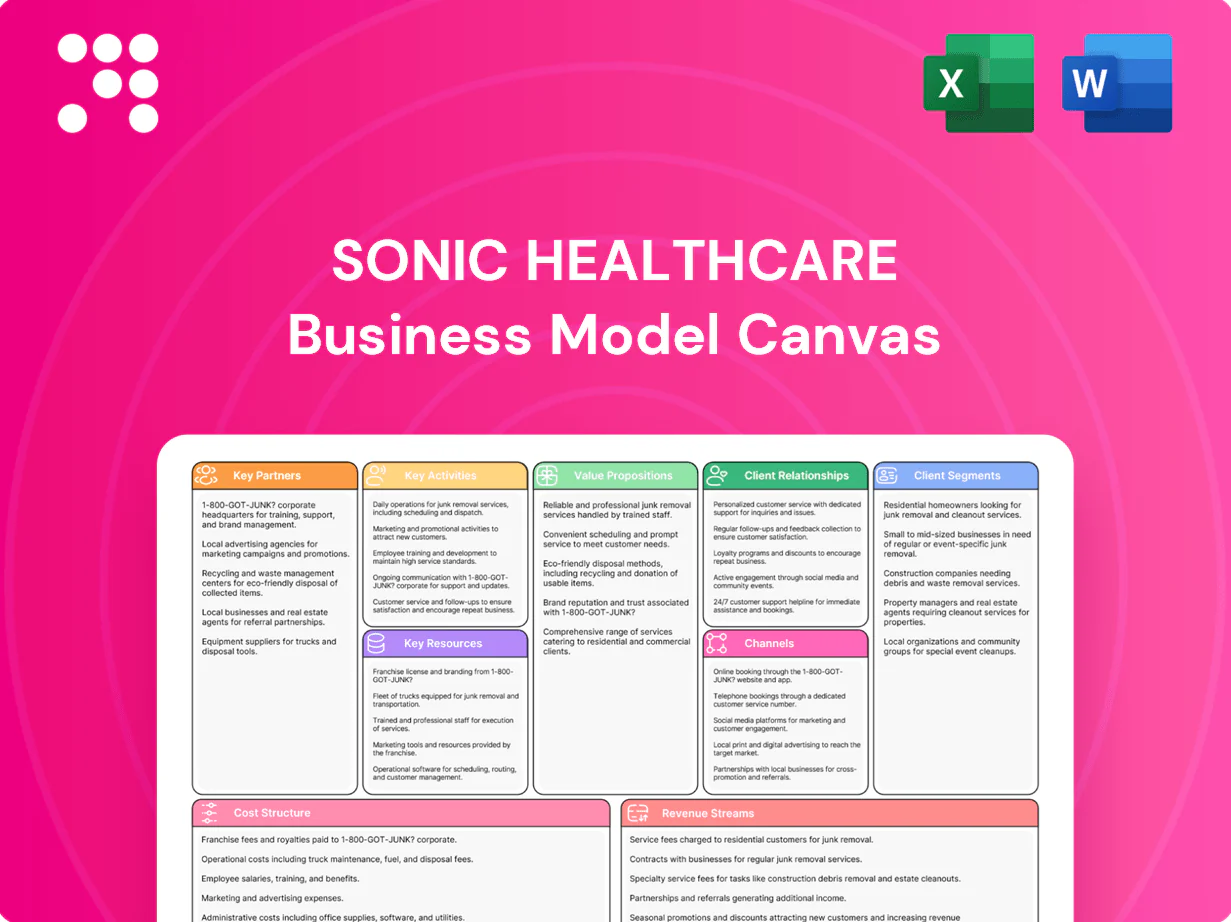
Sonic Healthcare Business Model Canvas

Unlock the diagnostic-services Business Model Canvas for strategic and investor analysis
Unlock the full strategic blueprint behind Sonic Healthcare's business model. This in-depth Business Model Canvas reveals how the company drives value, scales clinical services, and sustains margins through partnerships and diagnostic innovation. Purchase the complete editable Canvas in Word/Excel for benchmarking, investor due diligence, or strategic planning.
Partnerships

Hospitals and Health Systems
Strategic alliances with hospitals secure steady test volumes and integrated care pathways, reinforced by Sonic Healthcare’s ASX-listed operations and FY2024 annual report governance. Co-location of labs and imaging suites improves turnaround times and clinician access, shortening result delivery within clinical workflows. Joint quality initiatives align on accreditation, infection control and utilization management, while multi-year service agreements stabilize demand and enable capacity planning.
Clinician Networks and Primary Care Groups
Contracts with GPs, specialists and group practices form the core referral pipeline for Sonic, supporting its AUD 5.6bn FY2024 revenue base. Embedded electronic ordering tools and on-site consultative services increase clinician loyalty and ordering efficiency. Educational partnerships update clinicians on optimal test selection and interpretation. Practice-level analytics quantify outcomes and cost-savings to demonstrate value to practices.

In-Vitro Diagnostics and Imaging OEMs
Relationships with IVD manufacturers and imaging OEMs secure access to cutting-edge platforms and assays, leveraging a global IVD market approaching USD 100 billion to keep Sonic at the technological forefront. Volume-based pricing and reagent-rental models reduce capital outlay and improve margins by aligning costs with test volumes. Co-development pilots speed validation of new assays and modalities, while service SLAs targeting >99% uptime protect operational continuity.

Payers and Government Health Agencies
Payers and government health agencies underpin predictable reimbursement through a mix of value-based and fee-for-service contracts, while joint coding, compliance and utilization protocols cut claim denials and administrative cost growth. Public health programs in 2024 leveraged Sonic Healthcare lab capacity for screening and surveillance, and formal data-sharing agreements informed policy and epidemiology responses.
- Value-based + FFS contracts reduce revenue volatility
- Coding/compliance collaboration lowers denials and costs
- Public health screening/surveillance partnerships
- Data-sharing supports policy, outbreak monitoring
Academic, Research, and Reference Labs
Partnerships with academic, research and reference labs enable complex esoteric testing and translational research, while shared biobanking and trial support scale scientific impact and patient recruitment. Regular participation in external quality assessment programs elevates benchmarking and operational standards. Co-authored publications and conference presence bolster Sonic Healthcare’s clinical credibility and referral networks.
- esoteric testing access
- biobanking & trial support
- external quality benchmarking
- co-authorship & conferences
Alliances sustain AUD 5.6bn revenue and >99% uptime
Strategic alliances with hospitals, GPs, IVD OEMs, payers and research centres sustain Sonic’s referral pipeline, technological access and public-health role underpinning AUD 5.6bn FY2024 revenue. Volume-based reagent models and service SLAs target >99% uptime to protect continuity. Data-sharing and research partnerships support surveillance and translational trials.
| Metric | Value | Year |
|---|---|---|
| Revenue | AUD 5.6bn | FY2024 |
| Operational SLA | >99% uptime | 2024 |
| Global IVD market | ~USD 100bn | 2024 |
What is included in the product
 Detailed Word Document
A comprehensive Sonic Healthcare Business Model Canvas detailing customer segments (hospitals, GPs, patients, public health), channels (labs, clinics, digital integration), and value propositions (high-quality diagnostic services, national network scale); organized into 9 BMC blocks with competitive advantages, linked SWOT insights, and presentation-ready narratives for investors and analysts.

 Customizable Excel Spreadsheet
Condenses Sonic Healthcare's diagnostics and pathology business model into a digestible one-page format, clarifying revenue streams, referral networks and lab capacity to resolve strategic pain points and speed decision-making.
Activities

High-Throughput Laboratory Operations
End-to-end specimen lifecycle management supports accuracy and speed across millions of tests annually, reducing turnaround times. Automation, robotics and LEAN workflows drive throughput and cost-efficiency. Rigorous quality control programs minimize errors and repeat testing. Integrated logistics optimize collection, transport and chain-of-custody.
Radiology Imaging and Reporting
Acquisition, protocoling and multimodality interpretation deliver diagnostic clarity across outpatient and hospital networks, with centralized subspecialty reads improving accuracy in complex cases. Teleradiology extends coverage and after‑hours capacity, reflecting the global teleradiology market (~USD 1.7bn in 2023) and continued double‑digit CAGR. Structured reporting reduces turnaround and speeds communication to referrers.

Clinical Consultation and Decision Support
Pathologists and radiologists provide consults to guide test ordering and interpretation, supporting clinicians across Sonic’s network (FY2024 revenue AUD 6.7bn; ~40,000 staff). Reflex algorithms and add-on testing boost diagnostic yield and reduce repeat sampling; tumor boards and multidisciplinary meetings integrate pathology/radiology insights across >200 referral sites; targeted educational outreach lowers inappropriate utilization and test volume variability.

Regulatory, Quality, and Accreditation Management
Regulatory, quality and accreditation management ensures continuous compliance with CLIA, ISO, CAP and local standards in 2024, backed by routine proficiency testing and multi-site audits that validate lab performance. Incident tracking and CAPA systems drive measurable improvements, while robust data privacy and security controls protect PHI across networks.
- Continuous CLIA/ISO/CAP compliance (2024)
- Routine proficiency testing & audits
- Incident tracking + CAPA
- PHI encryption, access controls
IT Integration and Data Interoperability
IT integration links LIS/RIS with EMRs to enable electronic ordering and results delivery across Sonic Healthcare networks, improving workflow and reducing manual errors.
Interface management uses HL7 and FHIR standards to support secure, real-time data flows and analytics platforms that report turnaround times and operational KPIs.
Robust cybersecurity frameworks protect uptime and data integrity, ensuring continuity of diagnostic services and regulatory compliance.
- Integration: LIS/RIS ↔ EMR
- Standards: HL7, FHIR
- Analytics: turnaround & performance metrics
- Security: uptime & data integrity
LEAN automation, subspecialty reads and teleradiology speed TATs; FY2024 revenue AUD 6.7bn
End-to-end specimen lifecycle and LEAN automation sustain high-volume accuracy and faster TATs; centralized subspecialty reads, teleradiology and structured reporting extend coverage and diagnostic clarity. Pathologist/radiologist consults, reflex testing and multidisciplinary integration improve yield; rigorous CLIA/ISO/CAP compliance and cybersecurity protect PHI (FY2024 revenue AUD 6.7bn; ~40,000 staff).
| KPI | Value |
|---|---|
| FY2024 revenue | AUD 6.7bn |
| Staff | ~40,000 |
| Teleradiology market (2023) | USD 1.7bn |
| Testing volume | millions/year |
Full Document Unlocks After Purchase
Business Model Canvas
The Business Model Canvas for Sonic Healthcare shown here is the actual deliverable, not a mockup; it’s a direct snapshot of the file you’ll receive after purchase. Upon checkout you’ll get this same, fully editable document ready for presenting, editing, and sharing in Word and Excel.

Unlock the diagnostic-services Business Model Canvas for strategic and investor analysis
Unlock the full strategic blueprint behind Sonic Healthcare's business model. This in-depth Business Model Canvas reveals how the company drives value, scales clinical services, and sustains margins through partnerships and diagnostic innovation. Purchase the complete editable Canvas in Word/Excel for benchmarking, investor due diligence, or strategic planning.
Partnerships
Hospitals and Health Systems
Strategic alliances with hospitals secure steady test volumes and integrated care pathways, reinforced by Sonic Healthcare’s ASX-listed operations and FY2024 annual report governance. Co-location of labs and imaging suites improves turnaround times and clinician access, shortening result delivery within clinical workflows. Joint quality initiatives align on accreditation, infection control and utilization management, while multi-year service agreements stabilize demand and enable capacity planning.
Clinician Networks and Primary Care Groups
Contracts with GPs, specialists and group practices form the core referral pipeline for Sonic, supporting its AUD 5.6bn FY2024 revenue base. Embedded electronic ordering tools and on-site consultative services increase clinician loyalty and ordering efficiency. Educational partnerships update clinicians on optimal test selection and interpretation. Practice-level analytics quantify outcomes and cost-savings to demonstrate value to practices.
In-Vitro Diagnostics and Imaging OEMs
Relationships with IVD manufacturers and imaging OEMs secure access to cutting-edge platforms and assays, leveraging a global IVD market approaching USD 100 billion to keep Sonic at the technological forefront. Volume-based pricing and reagent-rental models reduce capital outlay and improve margins by aligning costs with test volumes. Co-development pilots speed validation of new assays and modalities, while service SLAs targeting >99% uptime protect operational continuity.
Payers and Government Health Agencies
Payers and government health agencies underpin predictable reimbursement through a mix of value-based and fee-for-service contracts, while joint coding, compliance and utilization protocols cut claim denials and administrative cost growth. Public health programs in 2024 leveraged Sonic Healthcare lab capacity for screening and surveillance, and formal data-sharing agreements informed policy and epidemiology responses.
- Value-based + FFS contracts reduce revenue volatility
- Coding/compliance collaboration lowers denials and costs
- Public health screening/surveillance partnerships
- Data-sharing supports policy, outbreak monitoring
Academic, Research, and Reference Labs
Partnerships with academic, research and reference labs enable complex esoteric testing and translational research, while shared biobanking and trial support scale scientific impact and patient recruitment. Regular participation in external quality assessment programs elevates benchmarking and operational standards. Co-authored publications and conference presence bolster Sonic Healthcare’s clinical credibility and referral networks.
- esoteric testing access
- biobanking & trial support
- external quality benchmarking
- co-authorship & conferences
Alliances sustain AUD 5.6bn revenue and >99% uptime
Strategic alliances with hospitals, GPs, IVD OEMs, payers and research centres sustain Sonic’s referral pipeline, technological access and public-health role underpinning AUD 5.6bn FY2024 revenue. Volume-based reagent models and service SLAs target >99% uptime to protect continuity. Data-sharing and research partnerships support surveillance and translational trials.
| Metric | Value | Year |
|---|---|---|
| Revenue | AUD 5.6bn | FY2024 |
| Operational SLA | >99% uptime | 2024 |
| Global IVD market | ~USD 100bn | 2024 |
What is included in the product
Detailed Word Document
A comprehensive Sonic Healthcare Business Model Canvas detailing customer segments (hospitals, GPs, patients, public health), channels (labs, clinics, digital integration), and value propositions (high-quality diagnostic services, national network scale); organized into 9 BMC blocks with competitive advantages, linked SWOT insights, and presentation-ready narratives for investors and analysts.
Customizable Excel Spreadsheet
Condenses Sonic Healthcare's diagnostics and pathology business model into a digestible one-page format, clarifying revenue streams, referral networks and lab capacity to resolve strategic pain points and speed decision-making.
Activities
High-Throughput Laboratory Operations
End-to-end specimen lifecycle management supports accuracy and speed across millions of tests annually, reducing turnaround times. Automation, robotics and LEAN workflows drive throughput and cost-efficiency. Rigorous quality control programs minimize errors and repeat testing. Integrated logistics optimize collection, transport and chain-of-custody.
Radiology Imaging and Reporting
Acquisition, protocoling and multimodality interpretation deliver diagnostic clarity across outpatient and hospital networks, with centralized subspecialty reads improving accuracy in complex cases. Teleradiology extends coverage and after‑hours capacity, reflecting the global teleradiology market (~USD 1.7bn in 2023) and continued double‑digit CAGR. Structured reporting reduces turnaround and speeds communication to referrers.
Clinical Consultation and Decision Support
Pathologists and radiologists provide consults to guide test ordering and interpretation, supporting clinicians across Sonic’s network (FY2024 revenue AUD 6.7bn; ~40,000 staff). Reflex algorithms and add-on testing boost diagnostic yield and reduce repeat sampling; tumor boards and multidisciplinary meetings integrate pathology/radiology insights across >200 referral sites; targeted educational outreach lowers inappropriate utilization and test volume variability.
Regulatory, Quality, and Accreditation Management
Regulatory, quality and accreditation management ensures continuous compliance with CLIA, ISO, CAP and local standards in 2024, backed by routine proficiency testing and multi-site audits that validate lab performance. Incident tracking and CAPA systems drive measurable improvements, while robust data privacy and security controls protect PHI across networks.
- Continuous CLIA/ISO/CAP compliance (2024)
- Routine proficiency testing & audits
- Incident tracking + CAPA
- PHI encryption, access controls
IT Integration and Data Interoperability
IT integration links LIS/RIS with EMRs to enable electronic ordering and results delivery across Sonic Healthcare networks, improving workflow and reducing manual errors.
Interface management uses HL7 and FHIR standards to support secure, real-time data flows and analytics platforms that report turnaround times and operational KPIs.
Robust cybersecurity frameworks protect uptime and data integrity, ensuring continuity of diagnostic services and regulatory compliance.
- Integration: LIS/RIS ↔ EMR
- Standards: HL7, FHIR
- Analytics: turnaround & performance metrics
- Security: uptime & data integrity
LEAN automation, subspecialty reads and teleradiology speed TATs; FY2024 revenue AUD 6.7bn
End-to-end specimen lifecycle and LEAN automation sustain high-volume accuracy and faster TATs; centralized subspecialty reads, teleradiology and structured reporting extend coverage and diagnostic clarity. Pathologist/radiologist consults, reflex testing and multidisciplinary integration improve yield; rigorous CLIA/ISO/CAP compliance and cybersecurity protect PHI (FY2024 revenue AUD 6.7bn; ~40,000 staff).
| KPI | Value |
|---|---|
| FY2024 revenue | AUD 6.7bn |
| Staff | ~40,000 |
| Teleradiology market (2023) | USD 1.7bn |
| Testing volume | millions/year |
Full Document Unlocks After Purchase
Business Model Canvas
The Business Model Canvas for Sonic Healthcare shown here is the actual deliverable, not a mockup; it’s a direct snapshot of the file you’ll receive after purchase. Upon checkout you’ll get this same, fully editable document ready for presenting, editing, and sharing in Word and Excel.
Description
Unlock the diagnostic-services Business Model Canvas for strategic and investor analysis
Unlock the full strategic blueprint behind Sonic Healthcare's business model. This in-depth Business Model Canvas reveals how the company drives value, scales clinical services, and sustains margins through partnerships and diagnostic innovation. Purchase the complete editable Canvas in Word/Excel for benchmarking, investor due diligence, or strategic planning.
Partnerships
Hospitals and Health Systems
Strategic alliances with hospitals secure steady test volumes and integrated care pathways, reinforced by Sonic Healthcare’s ASX-listed operations and FY2024 annual report governance. Co-location of labs and imaging suites improves turnaround times and clinician access, shortening result delivery within clinical workflows. Joint quality initiatives align on accreditation, infection control and utilization management, while multi-year service agreements stabilize demand and enable capacity planning.
Clinician Networks and Primary Care Groups
Contracts with GPs, specialists and group practices form the core referral pipeline for Sonic, supporting its AUD 5.6bn FY2024 revenue base. Embedded electronic ordering tools and on-site consultative services increase clinician loyalty and ordering efficiency. Educational partnerships update clinicians on optimal test selection and interpretation. Practice-level analytics quantify outcomes and cost-savings to demonstrate value to practices.
In-Vitro Diagnostics and Imaging OEMs
Relationships with IVD manufacturers and imaging OEMs secure access to cutting-edge platforms and assays, leveraging a global IVD market approaching USD 100 billion to keep Sonic at the technological forefront. Volume-based pricing and reagent-rental models reduce capital outlay and improve margins by aligning costs with test volumes. Co-development pilots speed validation of new assays and modalities, while service SLAs targeting >99% uptime protect operational continuity.
Payers and Government Health Agencies
Payers and government health agencies underpin predictable reimbursement through a mix of value-based and fee-for-service contracts, while joint coding, compliance and utilization protocols cut claim denials and administrative cost growth. Public health programs in 2024 leveraged Sonic Healthcare lab capacity for screening and surveillance, and formal data-sharing agreements informed policy and epidemiology responses.
- Value-based + FFS contracts reduce revenue volatility
- Coding/compliance collaboration lowers denials and costs
- Public health screening/surveillance partnerships
- Data-sharing supports policy, outbreak monitoring
Academic, Research, and Reference Labs
Partnerships with academic, research and reference labs enable complex esoteric testing and translational research, while shared biobanking and trial support scale scientific impact and patient recruitment. Regular participation in external quality assessment programs elevates benchmarking and operational standards. Co-authored publications and conference presence bolster Sonic Healthcare’s clinical credibility and referral networks.
- esoteric testing access
- biobanking & trial support
- external quality benchmarking
- co-authorship & conferences
Alliances sustain AUD 5.6bn revenue and >99% uptime
Strategic alliances with hospitals, GPs, IVD OEMs, payers and research centres sustain Sonic’s referral pipeline, technological access and public-health role underpinning AUD 5.6bn FY2024 revenue. Volume-based reagent models and service SLAs target >99% uptime to protect continuity. Data-sharing and research partnerships support surveillance and translational trials.
| Metric | Value | Year |
|---|---|---|
| Revenue | AUD 5.6bn | FY2024 |
| Operational SLA | >99% uptime | 2024 |
| Global IVD market | ~USD 100bn | 2024 |
What is included in the product
Detailed Word Document
A comprehensive Sonic Healthcare Business Model Canvas detailing customer segments (hospitals, GPs, patients, public health), channels (labs, clinics, digital integration), and value propositions (high-quality diagnostic services, national network scale); organized into 9 BMC blocks with competitive advantages, linked SWOT insights, and presentation-ready narratives for investors and analysts.
Customizable Excel Spreadsheet
Condenses Sonic Healthcare's diagnostics and pathology business model into a digestible one-page format, clarifying revenue streams, referral networks and lab capacity to resolve strategic pain points and speed decision-making.
Activities
High-Throughput Laboratory Operations
End-to-end specimen lifecycle management supports accuracy and speed across millions of tests annually, reducing turnaround times. Automation, robotics and LEAN workflows drive throughput and cost-efficiency. Rigorous quality control programs minimize errors and repeat testing. Integrated logistics optimize collection, transport and chain-of-custody.
Radiology Imaging and Reporting
Acquisition, protocoling and multimodality interpretation deliver diagnostic clarity across outpatient and hospital networks, with centralized subspecialty reads improving accuracy in complex cases. Teleradiology extends coverage and after‑hours capacity, reflecting the global teleradiology market (~USD 1.7bn in 2023) and continued double‑digit CAGR. Structured reporting reduces turnaround and speeds communication to referrers.
Clinical Consultation and Decision Support
Pathologists and radiologists provide consults to guide test ordering and interpretation, supporting clinicians across Sonic’s network (FY2024 revenue AUD 6.7bn; ~40,000 staff). Reflex algorithms and add-on testing boost diagnostic yield and reduce repeat sampling; tumor boards and multidisciplinary meetings integrate pathology/radiology insights across >200 referral sites; targeted educational outreach lowers inappropriate utilization and test volume variability.
Regulatory, Quality, and Accreditation Management
Regulatory, quality and accreditation management ensures continuous compliance with CLIA, ISO, CAP and local standards in 2024, backed by routine proficiency testing and multi-site audits that validate lab performance. Incident tracking and CAPA systems drive measurable improvements, while robust data privacy and security controls protect PHI across networks.
- Continuous CLIA/ISO/CAP compliance (2024)
- Routine proficiency testing & audits
- Incident tracking + CAPA
- PHI encryption, access controls
IT Integration and Data Interoperability
IT integration links LIS/RIS with EMRs to enable electronic ordering and results delivery across Sonic Healthcare networks, improving workflow and reducing manual errors.
Interface management uses HL7 and FHIR standards to support secure, real-time data flows and analytics platforms that report turnaround times and operational KPIs.
Robust cybersecurity frameworks protect uptime and data integrity, ensuring continuity of diagnostic services and regulatory compliance.
- Integration: LIS/RIS ↔ EMR
- Standards: HL7, FHIR
- Analytics: turnaround & performance metrics
- Security: uptime & data integrity
LEAN automation, subspecialty reads and teleradiology speed TATs; FY2024 revenue AUD 6.7bn
End-to-end specimen lifecycle and LEAN automation sustain high-volume accuracy and faster TATs; centralized subspecialty reads, teleradiology and structured reporting extend coverage and diagnostic clarity. Pathologist/radiologist consults, reflex testing and multidisciplinary integration improve yield; rigorous CLIA/ISO/CAP compliance and cybersecurity protect PHI (FY2024 revenue AUD 6.7bn; ~40,000 staff).
| KPI | Value |
|---|---|
| FY2024 revenue | AUD 6.7bn |
| Staff | ~40,000 |
| Teleradiology market (2023) | USD 1.7bn |
| Testing volume | millions/year |
Full Document Unlocks After Purchase
Business Model Canvas
The Business Model Canvas for Sonic Healthcare shown here is the actual deliverable, not a mockup; it’s a direct snapshot of the file you’ll receive after purchase. Upon checkout you’ll get this same, fully editable document ready for presenting, editing, and sharing in Word and Excel.











