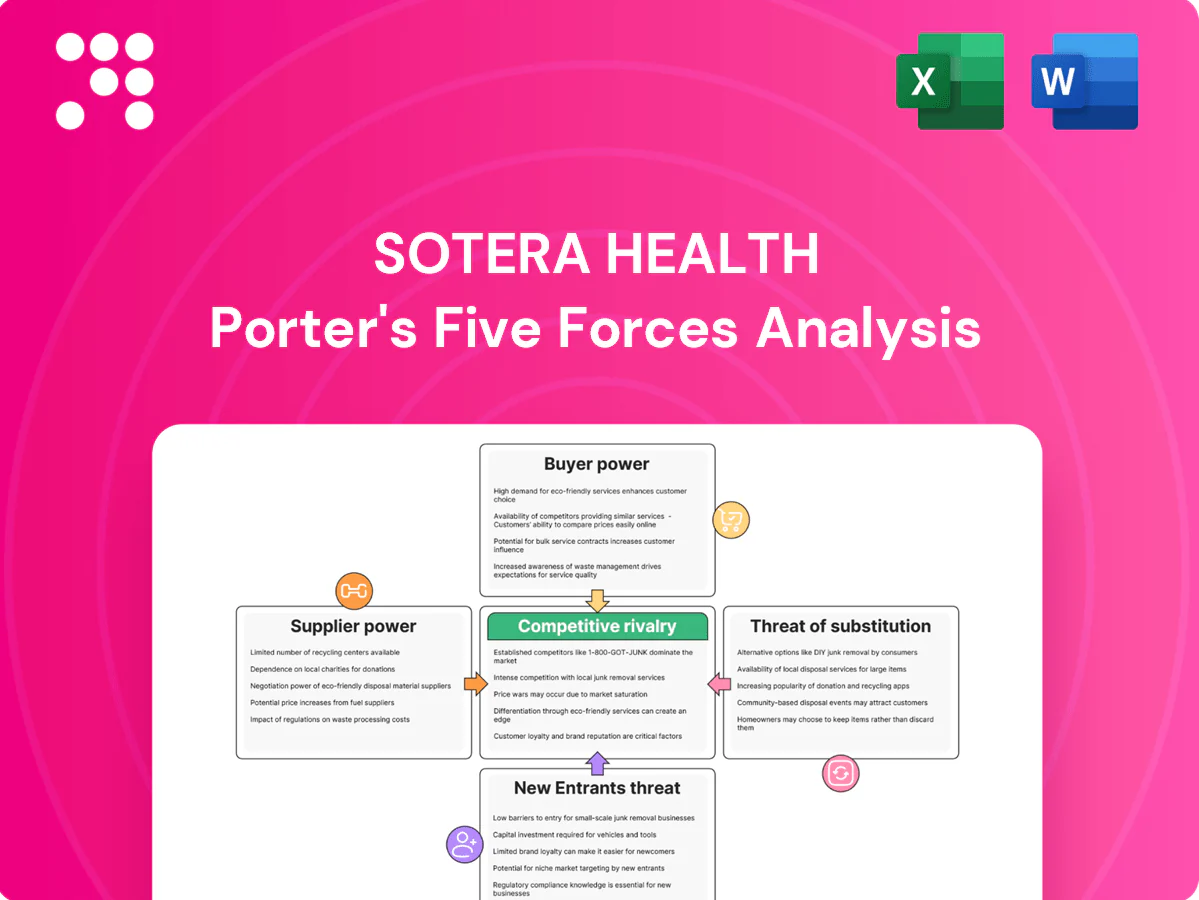
Sotera Health Porter's Five Forces Analysis

Don't Miss the Bigger Picture
Sotera Health’s Porter's Five Forces snapshot highlights moderate supplier power, intense buyer scrutiny, and evolving substitute and entrant risks driven by regulatory and tech shifts. This concise view surfaces strategic pressure points and competitive levers. Unlock the full Porter's Five Forces Analysis to access force-by-force ratings, visuals, and actionable recommendations.
Suppliers Bargaining Power

Constrained Co-60 isotope supply
Gamma sterilization depends on cobalt-60 from a handful of nuclear reactors and discrete harvest cycles, creating structural scarcity. Sotera’s Nordion vertically integrates part of this chain but remains exposed to reactor uptime and utility availability. Limited substitutes and lead times often exceeding 12 months elevate supplier leverage. Any reactor outages or regulatory delays can sharply tighten supply and lift costs.
Limited EtO and specialty equipment vendors
In 2024, EtO supply remained concentrated among a few chemical producers and sterilization chambers/e-beam/X-ray systems are sourced from a small set of OEMs, creating supplier concentration. Multi-year replacement cycles (typically 5–10+ years) and high qualification/validation costs raise switching costs and lock buyers in. This entrenchment gives suppliers pricing power and can extend delivery timelines, increasing operational risk for Sotera Health.

High, volatile energy inputs
E-beam and X-ray sterilization are electricity intensive, making margins sensitive to power-price swings—energy can represent roughly 5–10% of sterilization OPEX; US industrial rates averaged about $0.08/kWh in 2024 while European wholesale spikes exceeded €100–150/MWh in prior years. Long-term contracts reduce but do not remove volatility; regional grid constraints can force throughput cuts or higher spot costs, and providers of backup generation and maintenance gain pricing leverage in tight markets.

Specialized consumables and reagents
Nelson Labs depends on validated reagents, media, and disposables that meet GMP/ISO standards, so substituting inputs forces costly revalidation and gives specialized suppliers bargaining room. For GMP-critical assays in 2024, lead-time reliability often outweighs price, making continuity of supply a strategic procurement priority. Shortages propagate directly into longer turnaround times and degraded service levels.
- Revalidation burden increases switching costs
- Lead-time > price for GMP assays
- Shortages drive TAT and SLA risk
Skilled labor and compliance expertise
Certified radiation engineers, microbiologists and quality professionals remain scarce, giving staffing firms and incumbent experts quasi-supplier power; tight labor markets (US unemployment averaged 3.7% in 2024, BLS) and rising regulatory compliance increase wage pressure and hiring difficulty for Sotera Health. Training and validation know-how concentrate value in key employees, raising retention costs and knowledge-transfer risk that heightens operational dependence.
- Scarcity: certified radiation/microbiology/quality experts
- Labor tightness: US unemployment 3.7% (2024, BLS)
- Quasi-supplier power: staffing firms/key employees
- Risks: higher retention costs, knowledge-transfer exposure
Cobalt-60 scarcity and >12m lead times amplify supplier power; energy 5–10%
Cobalt-60 scarcity and reactor uptime concentrate supplier power; lead times >12 months raise risk. EtO and sterilization-equipment suppliers remain concentrated, raising switching costs and multi-year replacement risk. Energy sensitivity (5–10% OPEX; US industrial ~$0.08/kWh in 2024) and tight lab labor (US unemployment 3.7% in 2024) further amplify supplier leverage.
| Factor | 2024 datapoint |
|---|---|
| Cobalt-60 supply | Few reactors; >12m lead-time |
| EtO/OEM concentration | High; multi-year replacements |
| Energy | 5–10% OPEX; ~$0.08/kWh US |
| Labor | US unemployment 3.7% |
What is included in the product
 Detailed Word Document
Tailored Porter's Five Forces analysis for Sotera Health that assesses competitive rivalry, supplier and buyer power, threat of new entrants and substitutes, and identifies regulatory, technological, and cost pressures shaping pricing, margins, and strategic defensibility.

 Customizable Excel Spreadsheet
Concise one-sheet Porter's Five Forces for Sotera Health that highlights regulatory, supplier, buyer, entrant, and rivalry pressures—ideal for quick strategic fixes. Easy to customize and drop into decks to instantly pinpoint pain points and mitigation actions.
Customers Bargaining Power

Large medtech and pharma buyers
Top OEMs aggregate large volumes and secure multi-year contracts, often representing a substantial share of supplier throughput and driving tough price negotiations in 2024. Dual-sourcing strategies among OEMs amplify pricing pressure and reduce supplier leverage. Service criticality and limited qualified sterilization capacity restrain aggressive discounting, while preferred-provider status in 2024 depends squarely on reliability and regulatory compliance.
High switching and revalidation costs
Changing sterilization or lab partners triggers requalification, regulatory filings and potential FDA/EMA interactions — FDA 510(k) review goal is 90 days and EMA centralized review runs up to 210 days — frictions that reduce buyer willingness to switch on price alone. Incumbency and audit history (documented supplier audits, CAPA records) carry heavy weight, softening buyer power even for large purchasers.

Demand for multimodality and global footprint
Customers value access to EtO, gamma, e-beam and X-ray modalities plus geographically proximate sites, giving preference to providers with full multimodality coverage. Providers offering breadth can bundle services and capture greater share-of-wallet, lowering buyers’ leverage versus niche specialists. Network capacity during surges, as seen in the COVID-19 2020–21 sterilization constraints, further strengthens supplier negotiating position.

Strict SLAs, quality, and turnaround expectations
Strict SLAs, quality, and turnaround expectations give customers leverage: late deliveries can halt product launches or cause stock-outs, triggering penalty clauses and performance-based pricing; in 2024 many contracts tightened audit rights and KPI-linked fees. Continuous improvement, real-time data transparency, and compliance documentation are table stakes; failure risks rapid lane reallocation to competitors.
- SLA penalties drive pricing leverage
- Audit rights enable performance billing
- Data transparency now required
- One failure = rapid customer shift
Emerging sustainability and risk mandates
Bargaining power of customers: ESG scrutiny over EtO emissions and cobalt sourcing is reshaping vendor selection, with buyers demanding emissions controls, alternative sterilization modalities, and stronger supply-chain resilience. These mandates often force providers into capex concessions or price holds to retain contracts. Providers that present credible decarbonization and sourcing roadmaps can shift negotiations toward value-based, longer-term contracts.
OEMs shift to value-focused long-term deals as requalification and ESG raise switching costs
Top OEMs use multi-year contracts and dual-sourcing to push prices, but requalification frictions (FDA 510(k) goal 90 days; EMA centralized up to 210 days) and audit history limit pure price-driven switching. Multimodality (EtO, gamma, e-beam, X-ray) and regional capacity reduce buyer leverage; stricter 2024 SLAs and ESG demands (emissions controls, decarbonization roadmaps) shift negotiations toward value-based, longer-term deals.
| Metric | Value |
|---|---|
| FDA 510(k) goal | 90 days |
| EMA centralized review | up to 210 days |
| COVID-19 surge years | 2020–21 |
Preview Before You Purchase
Sotera Health Porter's Five Forces Analysis
This preview shows the exact Sotera Health Porter's Five Forces analysis you'll receive immediately after purchase—no surprises or placeholders. The document is fully formatted, professionally written, and ready for download and use the moment you buy. What you see here is the actual deliverable you'll get instantly upon payment.

Don't Miss the Bigger Picture
Sotera Health’s Porter's Five Forces snapshot highlights moderate supplier power, intense buyer scrutiny, and evolving substitute and entrant risks driven by regulatory and tech shifts. This concise view surfaces strategic pressure points and competitive levers. Unlock the full Porter's Five Forces Analysis to access force-by-force ratings, visuals, and actionable recommendations.
Suppliers Bargaining Power
Constrained Co-60 isotope supply
Gamma sterilization depends on cobalt-60 from a handful of nuclear reactors and discrete harvest cycles, creating structural scarcity. Sotera’s Nordion vertically integrates part of this chain but remains exposed to reactor uptime and utility availability. Limited substitutes and lead times often exceeding 12 months elevate supplier leverage. Any reactor outages or regulatory delays can sharply tighten supply and lift costs.
Limited EtO and specialty equipment vendors
In 2024, EtO supply remained concentrated among a few chemical producers and sterilization chambers/e-beam/X-ray systems are sourced from a small set of OEMs, creating supplier concentration. Multi-year replacement cycles (typically 5–10+ years) and high qualification/validation costs raise switching costs and lock buyers in. This entrenchment gives suppliers pricing power and can extend delivery timelines, increasing operational risk for Sotera Health.
High, volatile energy inputs
E-beam and X-ray sterilization are electricity intensive, making margins sensitive to power-price swings—energy can represent roughly 5–10% of sterilization OPEX; US industrial rates averaged about $0.08/kWh in 2024 while European wholesale spikes exceeded €100–150/MWh in prior years. Long-term contracts reduce but do not remove volatility; regional grid constraints can force throughput cuts or higher spot costs, and providers of backup generation and maintenance gain pricing leverage in tight markets.
Specialized consumables and reagents
Nelson Labs depends on validated reagents, media, and disposables that meet GMP/ISO standards, so substituting inputs forces costly revalidation and gives specialized suppliers bargaining room. For GMP-critical assays in 2024, lead-time reliability often outweighs price, making continuity of supply a strategic procurement priority. Shortages propagate directly into longer turnaround times and degraded service levels.
- Revalidation burden increases switching costs
- Lead-time > price for GMP assays
- Shortages drive TAT and SLA risk
Skilled labor and compliance expertise
Certified radiation engineers, microbiologists and quality professionals remain scarce, giving staffing firms and incumbent experts quasi-supplier power; tight labor markets (US unemployment averaged 3.7% in 2024, BLS) and rising regulatory compliance increase wage pressure and hiring difficulty for Sotera Health. Training and validation know-how concentrate value in key employees, raising retention costs and knowledge-transfer risk that heightens operational dependence.
- Scarcity: certified radiation/microbiology/quality experts
- Labor tightness: US unemployment 3.7% (2024, BLS)
- Quasi-supplier power: staffing firms/key employees
- Risks: higher retention costs, knowledge-transfer exposure
Cobalt-60 scarcity and >12m lead times amplify supplier power; energy 5–10%
Cobalt-60 scarcity and reactor uptime concentrate supplier power; lead times >12 months raise risk. EtO and sterilization-equipment suppliers remain concentrated, raising switching costs and multi-year replacement risk. Energy sensitivity (5–10% OPEX; US industrial ~$0.08/kWh in 2024) and tight lab labor (US unemployment 3.7% in 2024) further amplify supplier leverage.
| Factor | 2024 datapoint |
|---|---|
| Cobalt-60 supply | Few reactors; >12m lead-time |
| EtO/OEM concentration | High; multi-year replacements |
| Energy | 5–10% OPEX; ~$0.08/kWh US |
| Labor | US unemployment 3.7% |
What is included in the product
Detailed Word Document
Tailored Porter's Five Forces analysis for Sotera Health that assesses competitive rivalry, supplier and buyer power, threat of new entrants and substitutes, and identifies regulatory, technological, and cost pressures shaping pricing, margins, and strategic defensibility.
Customizable Excel Spreadsheet
Concise one-sheet Porter's Five Forces for Sotera Health that highlights regulatory, supplier, buyer, entrant, and rivalry pressures—ideal for quick strategic fixes. Easy to customize and drop into decks to instantly pinpoint pain points and mitigation actions.
Customers Bargaining Power
Large medtech and pharma buyers
Top OEMs aggregate large volumes and secure multi-year contracts, often representing a substantial share of supplier throughput and driving tough price negotiations in 2024. Dual-sourcing strategies among OEMs amplify pricing pressure and reduce supplier leverage. Service criticality and limited qualified sterilization capacity restrain aggressive discounting, while preferred-provider status in 2024 depends squarely on reliability and regulatory compliance.
High switching and revalidation costs
Changing sterilization or lab partners triggers requalification, regulatory filings and potential FDA/EMA interactions — FDA 510(k) review goal is 90 days and EMA centralized review runs up to 210 days — frictions that reduce buyer willingness to switch on price alone. Incumbency and audit history (documented supplier audits, CAPA records) carry heavy weight, softening buyer power even for large purchasers.
Demand for multimodality and global footprint
Customers value access to EtO, gamma, e-beam and X-ray modalities plus geographically proximate sites, giving preference to providers with full multimodality coverage. Providers offering breadth can bundle services and capture greater share-of-wallet, lowering buyers’ leverage versus niche specialists. Network capacity during surges, as seen in the COVID-19 2020–21 sterilization constraints, further strengthens supplier negotiating position.
Strict SLAs, quality, and turnaround expectations
Strict SLAs, quality, and turnaround expectations give customers leverage: late deliveries can halt product launches or cause stock-outs, triggering penalty clauses and performance-based pricing; in 2024 many contracts tightened audit rights and KPI-linked fees. Continuous improvement, real-time data transparency, and compliance documentation are table stakes; failure risks rapid lane reallocation to competitors.
- SLA penalties drive pricing leverage
- Audit rights enable performance billing
- Data transparency now required
- One failure = rapid customer shift
Emerging sustainability and risk mandates
Bargaining power of customers: ESG scrutiny over EtO emissions and cobalt sourcing is reshaping vendor selection, with buyers demanding emissions controls, alternative sterilization modalities, and stronger supply-chain resilience. These mandates often force providers into capex concessions or price holds to retain contracts. Providers that present credible decarbonization and sourcing roadmaps can shift negotiations toward value-based, longer-term contracts.
OEMs shift to value-focused long-term deals as requalification and ESG raise switching costs
Top OEMs use multi-year contracts and dual-sourcing to push prices, but requalification frictions (FDA 510(k) goal 90 days; EMA centralized up to 210 days) and audit history limit pure price-driven switching. Multimodality (EtO, gamma, e-beam, X-ray) and regional capacity reduce buyer leverage; stricter 2024 SLAs and ESG demands (emissions controls, decarbonization roadmaps) shift negotiations toward value-based, longer-term deals.
| Metric | Value |
|---|---|
| FDA 510(k) goal | 90 days |
| EMA centralized review | up to 210 days |
| COVID-19 surge years | 2020–21 |
Preview Before You Purchase
Sotera Health Porter's Five Forces Analysis
This preview shows the exact Sotera Health Porter's Five Forces analysis you'll receive immediately after purchase—no surprises or placeholders. The document is fully formatted, professionally written, and ready for download and use the moment you buy. What you see here is the actual deliverable you'll get instantly upon payment.
Original: $10.00
-65%$10.00
$3.50Description
Don't Miss the Bigger Picture
Sotera Health’s Porter's Five Forces snapshot highlights moderate supplier power, intense buyer scrutiny, and evolving substitute and entrant risks driven by regulatory and tech shifts. This concise view surfaces strategic pressure points and competitive levers. Unlock the full Porter's Five Forces Analysis to access force-by-force ratings, visuals, and actionable recommendations.
Suppliers Bargaining Power
Constrained Co-60 isotope supply
Gamma sterilization depends on cobalt-60 from a handful of nuclear reactors and discrete harvest cycles, creating structural scarcity. Sotera’s Nordion vertically integrates part of this chain but remains exposed to reactor uptime and utility availability. Limited substitutes and lead times often exceeding 12 months elevate supplier leverage. Any reactor outages or regulatory delays can sharply tighten supply and lift costs.
Limited EtO and specialty equipment vendors
In 2024, EtO supply remained concentrated among a few chemical producers and sterilization chambers/e-beam/X-ray systems are sourced from a small set of OEMs, creating supplier concentration. Multi-year replacement cycles (typically 5–10+ years) and high qualification/validation costs raise switching costs and lock buyers in. This entrenchment gives suppliers pricing power and can extend delivery timelines, increasing operational risk for Sotera Health.
High, volatile energy inputs
E-beam and X-ray sterilization are electricity intensive, making margins sensitive to power-price swings—energy can represent roughly 5–10% of sterilization OPEX; US industrial rates averaged about $0.08/kWh in 2024 while European wholesale spikes exceeded €100–150/MWh in prior years. Long-term contracts reduce but do not remove volatility; regional grid constraints can force throughput cuts or higher spot costs, and providers of backup generation and maintenance gain pricing leverage in tight markets.
Specialized consumables and reagents
Nelson Labs depends on validated reagents, media, and disposables that meet GMP/ISO standards, so substituting inputs forces costly revalidation and gives specialized suppliers bargaining room. For GMP-critical assays in 2024, lead-time reliability often outweighs price, making continuity of supply a strategic procurement priority. Shortages propagate directly into longer turnaround times and degraded service levels.
- Revalidation burden increases switching costs
- Lead-time > price for GMP assays
- Shortages drive TAT and SLA risk
Skilled labor and compliance expertise
Certified radiation engineers, microbiologists and quality professionals remain scarce, giving staffing firms and incumbent experts quasi-supplier power; tight labor markets (US unemployment averaged 3.7% in 2024, BLS) and rising regulatory compliance increase wage pressure and hiring difficulty for Sotera Health. Training and validation know-how concentrate value in key employees, raising retention costs and knowledge-transfer risk that heightens operational dependence.
- Scarcity: certified radiation/microbiology/quality experts
- Labor tightness: US unemployment 3.7% (2024, BLS)
- Quasi-supplier power: staffing firms/key employees
- Risks: higher retention costs, knowledge-transfer exposure
Cobalt-60 scarcity and >12m lead times amplify supplier power; energy 5–10%
Cobalt-60 scarcity and reactor uptime concentrate supplier power; lead times >12 months raise risk. EtO and sterilization-equipment suppliers remain concentrated, raising switching costs and multi-year replacement risk. Energy sensitivity (5–10% OPEX; US industrial ~$0.08/kWh in 2024) and tight lab labor (US unemployment 3.7% in 2024) further amplify supplier leverage.
| Factor | 2024 datapoint |
|---|---|
| Cobalt-60 supply | Few reactors; >12m lead-time |
| EtO/OEM concentration | High; multi-year replacements |
| Energy | 5–10% OPEX; ~$0.08/kWh US |
| Labor | US unemployment 3.7% |
What is included in the product
Detailed Word Document
Tailored Porter's Five Forces analysis for Sotera Health that assesses competitive rivalry, supplier and buyer power, threat of new entrants and substitutes, and identifies regulatory, technological, and cost pressures shaping pricing, margins, and strategic defensibility.
Customizable Excel Spreadsheet
Concise one-sheet Porter's Five Forces for Sotera Health that highlights regulatory, supplier, buyer, entrant, and rivalry pressures—ideal for quick strategic fixes. Easy to customize and drop into decks to instantly pinpoint pain points and mitigation actions.
Customers Bargaining Power
Large medtech and pharma buyers
Top OEMs aggregate large volumes and secure multi-year contracts, often representing a substantial share of supplier throughput and driving tough price negotiations in 2024. Dual-sourcing strategies among OEMs amplify pricing pressure and reduce supplier leverage. Service criticality and limited qualified sterilization capacity restrain aggressive discounting, while preferred-provider status in 2024 depends squarely on reliability and regulatory compliance.
High switching and revalidation costs
Changing sterilization or lab partners triggers requalification, regulatory filings and potential FDA/EMA interactions — FDA 510(k) review goal is 90 days and EMA centralized review runs up to 210 days — frictions that reduce buyer willingness to switch on price alone. Incumbency and audit history (documented supplier audits, CAPA records) carry heavy weight, softening buyer power even for large purchasers.
Demand for multimodality and global footprint
Customers value access to EtO, gamma, e-beam and X-ray modalities plus geographically proximate sites, giving preference to providers with full multimodality coverage. Providers offering breadth can bundle services and capture greater share-of-wallet, lowering buyers’ leverage versus niche specialists. Network capacity during surges, as seen in the COVID-19 2020–21 sterilization constraints, further strengthens supplier negotiating position.
Strict SLAs, quality, and turnaround expectations
Strict SLAs, quality, and turnaround expectations give customers leverage: late deliveries can halt product launches or cause stock-outs, triggering penalty clauses and performance-based pricing; in 2024 many contracts tightened audit rights and KPI-linked fees. Continuous improvement, real-time data transparency, and compliance documentation are table stakes; failure risks rapid lane reallocation to competitors.
- SLA penalties drive pricing leverage
- Audit rights enable performance billing
- Data transparency now required
- One failure = rapid customer shift
Emerging sustainability and risk mandates
Bargaining power of customers: ESG scrutiny over EtO emissions and cobalt sourcing is reshaping vendor selection, with buyers demanding emissions controls, alternative sterilization modalities, and stronger supply-chain resilience. These mandates often force providers into capex concessions or price holds to retain contracts. Providers that present credible decarbonization and sourcing roadmaps can shift negotiations toward value-based, longer-term contracts.
OEMs shift to value-focused long-term deals as requalification and ESG raise switching costs
Top OEMs use multi-year contracts and dual-sourcing to push prices, but requalification frictions (FDA 510(k) goal 90 days; EMA centralized up to 210 days) and audit history limit pure price-driven switching. Multimodality (EtO, gamma, e-beam, X-ray) and regional capacity reduce buyer leverage; stricter 2024 SLAs and ESG demands (emissions controls, decarbonization roadmaps) shift negotiations toward value-based, longer-term deals.
| Metric | Value |
|---|---|
| FDA 510(k) goal | 90 days |
| EMA centralized review | up to 210 days |
| COVID-19 surge years | 2020–21 |
Preview Before You Purchase
Sotera Health Porter's Five Forces Analysis
This preview shows the exact Sotera Health Porter's Five Forces analysis you'll receive immediately after purchase—no surprises or placeholders. The document is fully formatted, professionally written, and ready for download and use the moment you buy. What you see here is the actual deliverable you'll get instantly upon payment.











