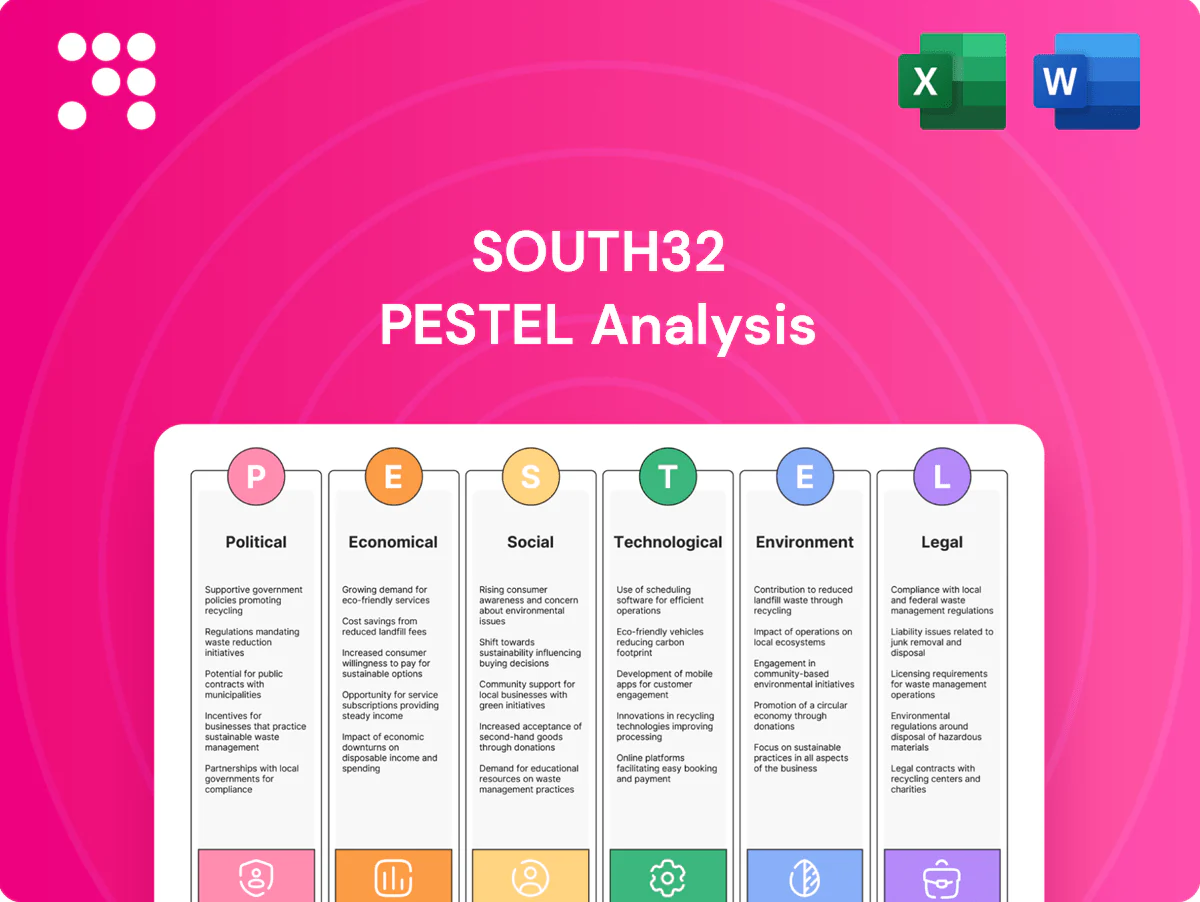
South32 PESTLE Analysis

Plan Smarter. Present Sharper. Compete Stronger.
Our PESTLE analysis of South32 reveals how politics, economics, social trends, technology, legal shifts, and environmental pressures converge to shape the miner’s strategic outlook; this concise briefing pinpoints risks and opportunities you can act on now. Ideal for investors and strategists, it’s research-ready and decision-focused. Purchase the full PESTLE to access the complete, editable report instantly.
Political factors

Resource nationalism
Operations in South Africa, Mozambique and South America face risks such as royalty hikes, export controls and local ownership pressures; South32 operates key assets across these regions and reported group revenue of about US$5bn in FY2024, so mid-cycle changes to mining codes or fiscal terms could materially affect earnings. The company must scenario-plan for policy volatility and bolster stakeholder ties, while stable Australian and US jurisdictions help offset geopolitical exposure.
Permitting and approvals
Project timelines hinge on state and federal permitting in Australia and the U.S. (Arizona), and on provincial approvals in Southern Africa. Lengthy environmental and community review processes commonly add 12–36 months to capital deployment. Early engagement and robust baseline studies demonstrably reduce approval risk. Running parallel-path workstreams can compress the critical path and shorten delivery time.

Energy and industrial policy
Power pricing and reliability policies materially affect aluminium smelters and other energy‑intensive assets in Southern Africa, where grid constraints raise operating costs and curtail production risk. National decarbonization commitments by over 130 countries drive incentives for renewables and grid reform, shifting cost curves for mining and smelting. U.S. critical‑minerals policy lists manganese and the 2022 Inflation Reduction Act (roughly $369bn climate/energy) supports battery‑grade supply, and aligned policy can unlock grants, offtakes and cheaper capital.

Trade and sanctions
Tariffs, sanctions and export controls can rapidly reshape aluminium, manganese and base‑metal flows, with China accounting for about 60% of global primary aluminium output (2023–24) intensifying sensitivity to trade limits. Shifts in US–China–EU relations alter premiums and customer access; compliance agility is required to reroute sales and supply chains. Hedging and diversified markets mitigate disruption.
- Tariff exposure: reroute sales
- Sanctions risk: customer access loss
- Compliance agility: supply‑chain reroute
- Mitigation: hedging + market diversification
Community and local content
Host-country expectations for jobs, procurement and infrastructure are rising, making robust local content strategies essential for South32 to maintain social licence and political goodwill; gaps can trigger protests, project delays or additional permit conditions.
- Local hiring and procurement focus
- Community investment transparency
- Risk: protests/permits
Geopolitical, permitting and trade risks threaten mining earnings and battery supply chains
South32 faces fiscal and ownership risks in South Africa, Mozambique and South America that could dent earnings (group revenue ~US$5bn in FY2024); Australia and US assets partially offset geopolitical exposure. Permitting delays often add 12–36 months to projects, while energy policy and US critical‑minerals incentives (IRA ~$369bn) shift costs and support battery‑grade supply. Trade measures matter: China ~60% of primary aluminium output (2023–24), heightening tariff/sanctions sensitivity.
| Risk | Impact | Metric |
|---|---|---|
| Fiscal/ownership | Earnings volatility | US$5bn rev (FY2024) |
| Permitting | Capex delay | +12–36 months |
| Trade/energy | Market access/costs | China 60% aluminium, IRA $369bn |
What is included in the product
 Detailed Word Document
Explores how external macro-environmental factors uniquely affect South32 across Political, Economic, Social, Technological, Environmental and Legal dimensions, with data-backed trends and region-specific examples to identify risks and opportunities. Designed for executives and investors, it offers forward-looking insights ready for reports and strategy planning.

 Customizable Excel Spreadsheet
A concise, visually segmented PESTLE summary of South32 that simplifies external risk and market positioning for meetings or presentations, easily shared and dropped into reports to speed team alignment and decision-making.
Economic factors

Commodity price cycles
Earnings at South32 are highly sensitive to alumina/aluminium, manganese, zinc/lead/silver, nickel and metallurgical coal prices, with China accounting for roughly 60% of global aluminium demand (World Aluminium 2024) and driving price swings. US reindustrialisation and energy costs add volatility to 2024–25 cycles. Disciplined capital allocation and hedging have smoothed cash flows. Counter‑cyclical investment during troughs can capture outsized value.
FX and inflation
South32 faces translation and transaction risk as costs and revenues span AUD, ZAR, USD and other currencies; AUD averaged about 0.65 USD in 2024 and ZAR about 0.054 USD, amplifying P&L volatility.
Sticky mining inflation—labour, explosives, power and reagents—ran near 6–8% in 2024, pressuring unit costs; currency diversification provides partial natural hedges across assets.
Active treasury hedging and centralized procurement strategies in 2024 helped protect margins against FX swings and input-cost inflation.

Energy and input costs
Smelting and refining are energy intensive—aluminium smelting typically uses about 13–15 MWh per tonne and electricity can represent roughly 15–30% of unit cash costs. Power tariffs and fuel prices therefore materially influence margins, with short-term price spikes compressing earnings. Transitioning to renewables (utility‑scale solar LCOE ~USD 30–40/MWh in 2024) can lower long‑run costs and volatility. Long‑term PPAs and self‑generation stabilize supply and economics.

Capital intensity and returns
South32 balances capital intensity by prioritising brownfield debottlenecking and selective greenfield (notably US critical minerals) projects, with rigorous hurdle rates and stage-gated approvals to protect ROIC and allow pausing or phasing to mitigate cyclical risk.
- Portfolio pruning recycles capital to highest-return assets
- Stage gates enforce go/no-go and protect returns
- Flexibility to pause or phase reduces cycle exposure
Customer and offtake dynamics
Automotive, construction and battery supply chains are key demand drivers for South32 aluminium and manganese; global EV stock reached about 26 million vehicles at end‑2023 (IEA), boosting battery-related manganese demand. Major OEMs have 2030–2040 decarbonization targets that support premiums for low‑carbon metals. Long‑term offtakes help underwrite project financing, and a diversified customer base mitigates concentration risk.
- IEA: 26M EVs end‑2023
- OEMs: 2030–2040 decarbonization targets
- Long‑term offtakes underwrite finance
- Diversified customer base lowers concentration risk
Geopolitical, permitting and trade risks threaten mining earnings and battery supply chains
Earnings at South32 track aluminium, manganese, zinc, nickel and coal prices; China ~60% of aluminium demand (World Aluminium 2024). FX: AUD ~0.65 USD (2024), ZAR ~0.054 USD; mining inflation ~6–8% (2024). Power: aluminium smelt 13–15 MWh/t; electricity 15–30% of cash costs; solar LCOE USD30–40/MWh (2024).
| Metric | 2024 |
|---|---|
| China share aluminium demand | ~60% |
| AUD/USD | ~0.65 |
| ZAR/USD | ~0.054 |
| Mining inflation | 6–8% |
| Smelt energy | 13–15 MWh/t |
| Solar LCOE | USD30–40/MWh |
What You See Is What You Get
South32 PESTLE Analysis
The South32 PESTLE Analysis preview shown here is the exact document you’ll receive after purchase—fully formatted and ready to use. This is a real screenshot of the product with no placeholders or teasers, delivered exactly as shown. The content, layout, and structure visible here are the final file you’ll download immediately after checkout.

Plan Smarter. Present Sharper. Compete Stronger.
Our PESTLE analysis of South32 reveals how politics, economics, social trends, technology, legal shifts, and environmental pressures converge to shape the miner’s strategic outlook; this concise briefing pinpoints risks and opportunities you can act on now. Ideal for investors and strategists, it’s research-ready and decision-focused. Purchase the full PESTLE to access the complete, editable report instantly.
Political factors
Resource nationalism
Operations in South Africa, Mozambique and South America face risks such as royalty hikes, export controls and local ownership pressures; South32 operates key assets across these regions and reported group revenue of about US$5bn in FY2024, so mid-cycle changes to mining codes or fiscal terms could materially affect earnings. The company must scenario-plan for policy volatility and bolster stakeholder ties, while stable Australian and US jurisdictions help offset geopolitical exposure.
Permitting and approvals
Project timelines hinge on state and federal permitting in Australia and the U.S. (Arizona), and on provincial approvals in Southern Africa. Lengthy environmental and community review processes commonly add 12–36 months to capital deployment. Early engagement and robust baseline studies demonstrably reduce approval risk. Running parallel-path workstreams can compress the critical path and shorten delivery time.
Energy and industrial policy
Power pricing and reliability policies materially affect aluminium smelters and other energy‑intensive assets in Southern Africa, where grid constraints raise operating costs and curtail production risk. National decarbonization commitments by over 130 countries drive incentives for renewables and grid reform, shifting cost curves for mining and smelting. U.S. critical‑minerals policy lists manganese and the 2022 Inflation Reduction Act (roughly $369bn climate/energy) supports battery‑grade supply, and aligned policy can unlock grants, offtakes and cheaper capital.
Trade and sanctions
Tariffs, sanctions and export controls can rapidly reshape aluminium, manganese and base‑metal flows, with China accounting for about 60% of global primary aluminium output (2023–24) intensifying sensitivity to trade limits. Shifts in US–China–EU relations alter premiums and customer access; compliance agility is required to reroute sales and supply chains. Hedging and diversified markets mitigate disruption.
- Tariff exposure: reroute sales
- Sanctions risk: customer access loss
- Compliance agility: supply‑chain reroute
- Mitigation: hedging + market diversification
Community and local content
Host-country expectations for jobs, procurement and infrastructure are rising, making robust local content strategies essential for South32 to maintain social licence and political goodwill; gaps can trigger protests, project delays or additional permit conditions.
- Local hiring and procurement focus
- Community investment transparency
- Risk: protests/permits
Geopolitical, permitting and trade risks threaten mining earnings and battery supply chains
South32 faces fiscal and ownership risks in South Africa, Mozambique and South America that could dent earnings (group revenue ~US$5bn in FY2024); Australia and US assets partially offset geopolitical exposure. Permitting delays often add 12–36 months to projects, while energy policy and US critical‑minerals incentives (IRA ~$369bn) shift costs and support battery‑grade supply. Trade measures matter: China ~60% of primary aluminium output (2023–24), heightening tariff/sanctions sensitivity.
| Risk | Impact | Metric |
|---|---|---|
| Fiscal/ownership | Earnings volatility | US$5bn rev (FY2024) |
| Permitting | Capex delay | +12–36 months |
| Trade/energy | Market access/costs | China 60% aluminium, IRA $369bn |
What is included in the product
Detailed Word Document
Explores how external macro-environmental factors uniquely affect South32 across Political, Economic, Social, Technological, Environmental and Legal dimensions, with data-backed trends and region-specific examples to identify risks and opportunities. Designed for executives and investors, it offers forward-looking insights ready for reports and strategy planning.
Customizable Excel Spreadsheet
A concise, visually segmented PESTLE summary of South32 that simplifies external risk and market positioning for meetings or presentations, easily shared and dropped into reports to speed team alignment and decision-making.
Economic factors
Commodity price cycles
Earnings at South32 are highly sensitive to alumina/aluminium, manganese, zinc/lead/silver, nickel and metallurgical coal prices, with China accounting for roughly 60% of global aluminium demand (World Aluminium 2024) and driving price swings. US reindustrialisation and energy costs add volatility to 2024–25 cycles. Disciplined capital allocation and hedging have smoothed cash flows. Counter‑cyclical investment during troughs can capture outsized value.
FX and inflation
South32 faces translation and transaction risk as costs and revenues span AUD, ZAR, USD and other currencies; AUD averaged about 0.65 USD in 2024 and ZAR about 0.054 USD, amplifying P&L volatility.
Sticky mining inflation—labour, explosives, power and reagents—ran near 6–8% in 2024, pressuring unit costs; currency diversification provides partial natural hedges across assets.
Active treasury hedging and centralized procurement strategies in 2024 helped protect margins against FX swings and input-cost inflation.
Energy and input costs
Smelting and refining are energy intensive—aluminium smelting typically uses about 13–15 MWh per tonne and electricity can represent roughly 15–30% of unit cash costs. Power tariffs and fuel prices therefore materially influence margins, with short-term price spikes compressing earnings. Transitioning to renewables (utility‑scale solar LCOE ~USD 30–40/MWh in 2024) can lower long‑run costs and volatility. Long‑term PPAs and self‑generation stabilize supply and economics.
Capital intensity and returns
South32 balances capital intensity by prioritising brownfield debottlenecking and selective greenfield (notably US critical minerals) projects, with rigorous hurdle rates and stage-gated approvals to protect ROIC and allow pausing or phasing to mitigate cyclical risk.
- Portfolio pruning recycles capital to highest-return assets
- Stage gates enforce go/no-go and protect returns
- Flexibility to pause or phase reduces cycle exposure
Customer and offtake dynamics
Automotive, construction and battery supply chains are key demand drivers for South32 aluminium and manganese; global EV stock reached about 26 million vehicles at end‑2023 (IEA), boosting battery-related manganese demand. Major OEMs have 2030–2040 decarbonization targets that support premiums for low‑carbon metals. Long‑term offtakes help underwrite project financing, and a diversified customer base mitigates concentration risk.
- IEA: 26M EVs end‑2023
- OEMs: 2030–2040 decarbonization targets
- Long‑term offtakes underwrite finance
- Diversified customer base lowers concentration risk
Geopolitical, permitting and trade risks threaten mining earnings and battery supply chains
Earnings at South32 track aluminium, manganese, zinc, nickel and coal prices; China ~60% of aluminium demand (World Aluminium 2024). FX: AUD ~0.65 USD (2024), ZAR ~0.054 USD; mining inflation ~6–8% (2024). Power: aluminium smelt 13–15 MWh/t; electricity 15–30% of cash costs; solar LCOE USD30–40/MWh (2024).
| Metric | 2024 |
|---|---|
| China share aluminium demand | ~60% |
| AUD/USD | ~0.65 |
| ZAR/USD | ~0.054 |
| Mining inflation | 6–8% |
| Smelt energy | 13–15 MWh/t |
| Solar LCOE | USD30–40/MWh |
What You See Is What You Get
South32 PESTLE Analysis
The South32 PESTLE Analysis preview shown here is the exact document you’ll receive after purchase—fully formatted and ready to use. This is a real screenshot of the product with no placeholders or teasers, delivered exactly as shown. The content, layout, and structure visible here are the final file you’ll download immediately after checkout.
Description
Plan Smarter. Present Sharper. Compete Stronger.
Our PESTLE analysis of South32 reveals how politics, economics, social trends, technology, legal shifts, and environmental pressures converge to shape the miner’s strategic outlook; this concise briefing pinpoints risks and opportunities you can act on now. Ideal for investors and strategists, it’s research-ready and decision-focused. Purchase the full PESTLE to access the complete, editable report instantly.
Political factors
Resource nationalism
Operations in South Africa, Mozambique and South America face risks such as royalty hikes, export controls and local ownership pressures; South32 operates key assets across these regions and reported group revenue of about US$5bn in FY2024, so mid-cycle changes to mining codes or fiscal terms could materially affect earnings. The company must scenario-plan for policy volatility and bolster stakeholder ties, while stable Australian and US jurisdictions help offset geopolitical exposure.
Permitting and approvals
Project timelines hinge on state and federal permitting in Australia and the U.S. (Arizona), and on provincial approvals in Southern Africa. Lengthy environmental and community review processes commonly add 12–36 months to capital deployment. Early engagement and robust baseline studies demonstrably reduce approval risk. Running parallel-path workstreams can compress the critical path and shorten delivery time.
Energy and industrial policy
Power pricing and reliability policies materially affect aluminium smelters and other energy‑intensive assets in Southern Africa, where grid constraints raise operating costs and curtail production risk. National decarbonization commitments by over 130 countries drive incentives for renewables and grid reform, shifting cost curves for mining and smelting. U.S. critical‑minerals policy lists manganese and the 2022 Inflation Reduction Act (roughly $369bn climate/energy) supports battery‑grade supply, and aligned policy can unlock grants, offtakes and cheaper capital.
Trade and sanctions
Tariffs, sanctions and export controls can rapidly reshape aluminium, manganese and base‑metal flows, with China accounting for about 60% of global primary aluminium output (2023–24) intensifying sensitivity to trade limits. Shifts in US–China–EU relations alter premiums and customer access; compliance agility is required to reroute sales and supply chains. Hedging and diversified markets mitigate disruption.
- Tariff exposure: reroute sales
- Sanctions risk: customer access loss
- Compliance agility: supply‑chain reroute
- Mitigation: hedging + market diversification
Community and local content
Host-country expectations for jobs, procurement and infrastructure are rising, making robust local content strategies essential for South32 to maintain social licence and political goodwill; gaps can trigger protests, project delays or additional permit conditions.
- Local hiring and procurement focus
- Community investment transparency
- Risk: protests/permits
Geopolitical, permitting and trade risks threaten mining earnings and battery supply chains
South32 faces fiscal and ownership risks in South Africa, Mozambique and South America that could dent earnings (group revenue ~US$5bn in FY2024); Australia and US assets partially offset geopolitical exposure. Permitting delays often add 12–36 months to projects, while energy policy and US critical‑minerals incentives (IRA ~$369bn) shift costs and support battery‑grade supply. Trade measures matter: China ~60% of primary aluminium output (2023–24), heightening tariff/sanctions sensitivity.
| Risk | Impact | Metric |
|---|---|---|
| Fiscal/ownership | Earnings volatility | US$5bn rev (FY2024) |
| Permitting | Capex delay | +12–36 months |
| Trade/energy | Market access/costs | China 60% aluminium, IRA $369bn |
What is included in the product
Detailed Word Document
Explores how external macro-environmental factors uniquely affect South32 across Political, Economic, Social, Technological, Environmental and Legal dimensions, with data-backed trends and region-specific examples to identify risks and opportunities. Designed for executives and investors, it offers forward-looking insights ready for reports and strategy planning.
Customizable Excel Spreadsheet
A concise, visually segmented PESTLE summary of South32 that simplifies external risk and market positioning for meetings or presentations, easily shared and dropped into reports to speed team alignment and decision-making.
Economic factors
Commodity price cycles
Earnings at South32 are highly sensitive to alumina/aluminium, manganese, zinc/lead/silver, nickel and metallurgical coal prices, with China accounting for roughly 60% of global aluminium demand (World Aluminium 2024) and driving price swings. US reindustrialisation and energy costs add volatility to 2024–25 cycles. Disciplined capital allocation and hedging have smoothed cash flows. Counter‑cyclical investment during troughs can capture outsized value.
FX and inflation
South32 faces translation and transaction risk as costs and revenues span AUD, ZAR, USD and other currencies; AUD averaged about 0.65 USD in 2024 and ZAR about 0.054 USD, amplifying P&L volatility.
Sticky mining inflation—labour, explosives, power and reagents—ran near 6–8% in 2024, pressuring unit costs; currency diversification provides partial natural hedges across assets.
Active treasury hedging and centralized procurement strategies in 2024 helped protect margins against FX swings and input-cost inflation.
Energy and input costs
Smelting and refining are energy intensive—aluminium smelting typically uses about 13–15 MWh per tonne and electricity can represent roughly 15–30% of unit cash costs. Power tariffs and fuel prices therefore materially influence margins, with short-term price spikes compressing earnings. Transitioning to renewables (utility‑scale solar LCOE ~USD 30–40/MWh in 2024) can lower long‑run costs and volatility. Long‑term PPAs and self‑generation stabilize supply and economics.
Capital intensity and returns
South32 balances capital intensity by prioritising brownfield debottlenecking and selective greenfield (notably US critical minerals) projects, with rigorous hurdle rates and stage-gated approvals to protect ROIC and allow pausing or phasing to mitigate cyclical risk.
- Portfolio pruning recycles capital to highest-return assets
- Stage gates enforce go/no-go and protect returns
- Flexibility to pause or phase reduces cycle exposure
Customer and offtake dynamics
Automotive, construction and battery supply chains are key demand drivers for South32 aluminium and manganese; global EV stock reached about 26 million vehicles at end‑2023 (IEA), boosting battery-related manganese demand. Major OEMs have 2030–2040 decarbonization targets that support premiums for low‑carbon metals. Long‑term offtakes help underwrite project financing, and a diversified customer base mitigates concentration risk.
- IEA: 26M EVs end‑2023
- OEMs: 2030–2040 decarbonization targets
- Long‑term offtakes underwrite finance
- Diversified customer base lowers concentration risk
Geopolitical, permitting and trade risks threaten mining earnings and battery supply chains
Earnings at South32 track aluminium, manganese, zinc, nickel and coal prices; China ~60% of aluminium demand (World Aluminium 2024). FX: AUD ~0.65 USD (2024), ZAR ~0.054 USD; mining inflation ~6–8% (2024). Power: aluminium smelt 13–15 MWh/t; electricity 15–30% of cash costs; solar LCOE USD30–40/MWh (2024).
| Metric | 2024 |
|---|---|
| China share aluminium demand | ~60% |
| AUD/USD | ~0.65 |
| ZAR/USD | ~0.054 |
| Mining inflation | 6–8% |
| Smelt energy | 13–15 MWh/t |
| Solar LCOE | USD30–40/MWh |
What You See Is What You Get
South32 PESTLE Analysis
The South32 PESTLE Analysis preview shown here is the exact document you’ll receive after purchase—fully formatted and ready to use. This is a real screenshot of the product with no placeholders or teasers, delivered exactly as shown. The content, layout, and structure visible here are the final file you’ll download immediately after checkout.











