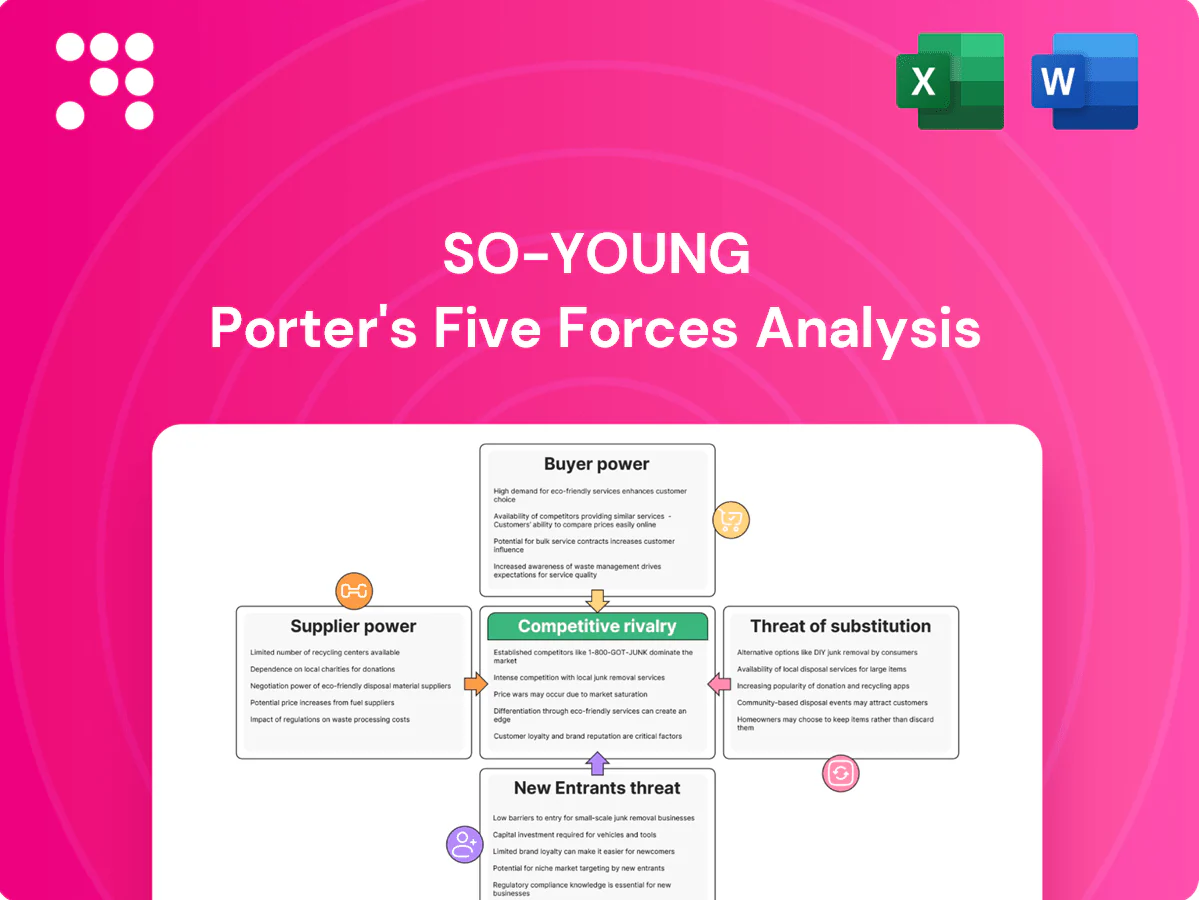
So-Young Porter's Five Forces Analysis

Go Beyond the Preview—Access the Full Strategic Report
So-Young faces a mix of strong buyer power, moderate supplier influence, and rising competitive threats that together shape its strategic choices and margins. This snapshot highlights key tensions—yet the full Porter's Five Forces Analysis uncovers force-by-force ratings, visuals, and implications you need to act. Unlock the complete report to convert these insights into clear strategic or investment decisions.
Suppliers Bargaining Power

Fragmented clinics dilute leverage
China’s medical aesthetics market exceeded RMB 300 billion in 2023, but providers remain numerous and regionally fragmented, limiting collective supplier leverage against platform leaders. So-Young can curate, rate and rotate listings to balance supply influence and manage price discovery. Top-tier hospitals and chains still command material premiums, preserving pockets of supplier power.
Star doctors and KOLs have clout
Renowned surgeons and KOLs are scarce, concentrating demand and amplifying bargaining power as top talent drives platform credibility; influencer marketing reached about 21.1 billion USD in 2024, underscoring their economic weight. They can extract premium placement and fee terms, and losing key KOLs risks measurable traffic and conversion falls. So-Young must offer enhanced visibility and granular data insights to retain them.

Device and product brands influence offerings
Premium device makers and injectable brands heavily shape clinic service menus, with 2024 market dynamics showing brand-led offerings driving patient demand and platform listings. Co-marketing funds and certification requirements frequently determine visibility on platforms, shifting promotional emphasis toward sponsored partners. Access to brand-backed campaigns can materially increase suppliers’ bargaining power. So-Young mitigates this by offering multi-brand breadth and running performance-based ad placements tied to ROI.

Regulatory-licensed providers set constraints
Regulatory-licensed providers constrain So-Young by limiting eligible clinics and doctors, concentrating supply in licensed facilities; China had about 3.1 licensed physicians per 1,000 people in 2024, tightening pools in high-demand specialties. Scarcity in areas like cosmetic dermatology raises supplier leverage; audits and credential checks extend onboarding timelines and costs. Quality controls and verified credentials partially offset power by signaling trust to patients and payers.
- Compliance limits eligible providers
- 3.1 licensed physicians per 1,000 (China, 2024)
- Specialty scarcity increases leverage
- Audits add onboarding friction
- Quality controls signal trust
Multi-homing by clinics reduces dependence
Multi-homing by clinics—listing across apps and social channels—lowers their switching costs and weakens So-Young’s negotiating position, making exclusive contracts difficult without financial or lead-quality incentives.
- Providers multi-listing reduces So-Young leverage
- Exclusive deals require subsidies or superior lead quality
- Data tools and CRM-based lead attribution improve stickiness
RMB 300B med-aesthetics: KOLs wield USD 21.1B
Supplier power is mixed: a RMB 300 billion medical aesthetics market (2023) and fragmented providers limit collective leverage, but top hospitals, scarce KOLs and brand-backed devices preserve pockets of power. Influencer marketing reached 21.1 billion USD (2024), raising KOL bargaining leverage. Regulatory limits (3.1 licensed physicians/1,000 people, China 2024) tighten specialty supply and onboarding costs.
| Metric | Value | Implication |
|---|---|---|
| Market size | RMB 300B (2023) | Large but fragmented supply |
| Influencer spend | USD 21.1B (2024) | High KOL leverage |
| Physicians | 3.1/1,000 (China, 2024) | Specialty scarcity |
What is included in the product
 Detailed Word Document
Tailored Porter's Five Forces analysis for So-Young, identifying competitive rivalry, buyer and supplier power, threat of new entrants, and substitutes that shape its pricing and margins. Highlights key disruptive threats and entry barriers with strategic commentary for investor and internal use.

 Customizable Excel Spreadsheet
A concise one-sheet Porter's Five Forces for So-Young—quickly spot competitive pressures, prioritize strategic actions, and eliminate analysis bottlenecks for faster decision-making.
Customers Bargaining Power

Highly informed, price-sensitive consumers
Users can compare clinics, prices and reviews instantly; 2024 surveys show about 9 in 10 consumers consult online reviews before elective procedures, amplifying price sensitivity. Transparent outcomes and abundant before/after content intensify price pressure, while promotions and group-buying drive a double-digit share of bookings on many platforms. So-Young must differentiate through trust signals, standardized outcome metrics, and paid assurance programs to reduce churn.
Low switching costs across platforms
Low switching costs let consumers comparison-shop across Meituan (≈650 million users in 2024), Xiaohongshu (≈200 million MAU in 2024) or clinic sites within minutes; uninstall/reinstall friction is negligible. Cross-platform coupons and flash promotions drive hopping, while loyalty programs, membership tiers and service guarantees are the primary levers clinics use to retain patients and reduce churn.

Outcome risk elevates demand for assurance
Complications risk drives buyers to demand refunds, insurance, and robust aftercare, with 72% of patients in 2024 surveys saying guarantees or clear refund policies influence provider choice. Strong protections and escrow-like payment terms become negotiation levers to push down fees and transfer liability. Verified reviews and documented doctor credentials cut perceived risk and shorten sales cycles, shifting bargaining power toward increasingly cautious buyers.

Social proof drives decision power
User-generated content and influencer posts increasingly sway patient choices for So-Young, with influencer marketing a $21.1 billion industry in 2024; viral posts can redirect demand within hours and community narratives can swiftly punish poor providers (Harvard study: 1-star change can shift revenue ~5–9%). So-Young must curate and moderate content to maintain credibility and mitigate rapid reputation risks.
- UGC and influencers: $21.1B influencer market (2024)
- Viral reach: demand shifts within hours
- Reputation impact: ~5–9% revenue per star change
Segment diversity complicates pricing
As of 2024, segment diversity complicates pricing for So-Young: entry-level patients press for discounts while premium seekers prioritize quality, forcing flexible pricing, bundles and tiered service lines to retain margins. Buyers also exploit seasonal promos and 11.11 events, shifting leverage toward consumers.
- Entry-level: discount-driven
- Premium: quality-focused
- Seasonal promos/11.11 amplify buyer power
- Tiered offerings restore pricing balance
90% check reviews; promotions lift bookings; 1-star swings rev 5-9%
High transparency means 9 in 10 consumers consult reviews before elective procedures (2024), driving price sensitivity and double-digit booking share from promotions. Low switching costs across Meituan (≈650M users) and Xiaohongshu (≈200M MAU) empower hopping; loyalty tiers and guarantees are critical. 72% cite refund/guarantee importance; influencer market $21.1B and a 1-star change shifts revenue ~5–9%.
| Metric | 2024 Value |
|---|---|
| Review consult rate | 90% |
| Meituan users | ≈650M |
| Xiaohongshu MAU | ≈200M |
| Influencer market | $21.1B |
| Refund importance | 72% |
| Revenue per star | ~5–9% |
Full Version Awaits
So-Young Porter's Five Forces Analysis
This preview shows the exact So-Young Porter's Five Forces Analysis you'll receive immediately after purchase—no surprises, no placeholders. The document is fully formatted, professionally written and ready for use. Once you complete payment you’ll get instant access to this same file.

Go Beyond the Preview—Access the Full Strategic Report
So-Young faces a mix of strong buyer power, moderate supplier influence, and rising competitive threats that together shape its strategic choices and margins. This snapshot highlights key tensions—yet the full Porter's Five Forces Analysis uncovers force-by-force ratings, visuals, and implications you need to act. Unlock the complete report to convert these insights into clear strategic or investment decisions.
Suppliers Bargaining Power
Fragmented clinics dilute leverage
China’s medical aesthetics market exceeded RMB 300 billion in 2023, but providers remain numerous and regionally fragmented, limiting collective supplier leverage against platform leaders. So-Young can curate, rate and rotate listings to balance supply influence and manage price discovery. Top-tier hospitals and chains still command material premiums, preserving pockets of supplier power.
Star doctors and KOLs have clout
Renowned surgeons and KOLs are scarce, concentrating demand and amplifying bargaining power as top talent drives platform credibility; influencer marketing reached about 21.1 billion USD in 2024, underscoring their economic weight. They can extract premium placement and fee terms, and losing key KOLs risks measurable traffic and conversion falls. So-Young must offer enhanced visibility and granular data insights to retain them.
Device and product brands influence offerings
Premium device makers and injectable brands heavily shape clinic service menus, with 2024 market dynamics showing brand-led offerings driving patient demand and platform listings. Co-marketing funds and certification requirements frequently determine visibility on platforms, shifting promotional emphasis toward sponsored partners. Access to brand-backed campaigns can materially increase suppliers’ bargaining power. So-Young mitigates this by offering multi-brand breadth and running performance-based ad placements tied to ROI.
Regulatory-licensed providers set constraints
Regulatory-licensed providers constrain So-Young by limiting eligible clinics and doctors, concentrating supply in licensed facilities; China had about 3.1 licensed physicians per 1,000 people in 2024, tightening pools in high-demand specialties. Scarcity in areas like cosmetic dermatology raises supplier leverage; audits and credential checks extend onboarding timelines and costs. Quality controls and verified credentials partially offset power by signaling trust to patients and payers.
- Compliance limits eligible providers
- 3.1 licensed physicians per 1,000 (China, 2024)
- Specialty scarcity increases leverage
- Audits add onboarding friction
- Quality controls signal trust
Multi-homing by clinics reduces dependence
Multi-homing by clinics—listing across apps and social channels—lowers their switching costs and weakens So-Young’s negotiating position, making exclusive contracts difficult without financial or lead-quality incentives.
- Providers multi-listing reduces So-Young leverage
- Exclusive deals require subsidies or superior lead quality
- Data tools and CRM-based lead attribution improve stickiness
RMB 300B med-aesthetics: KOLs wield USD 21.1B
Supplier power is mixed: a RMB 300 billion medical aesthetics market (2023) and fragmented providers limit collective leverage, but top hospitals, scarce KOLs and brand-backed devices preserve pockets of power. Influencer marketing reached 21.1 billion USD (2024), raising KOL bargaining leverage. Regulatory limits (3.1 licensed physicians/1,000 people, China 2024) tighten specialty supply and onboarding costs.
| Metric | Value | Implication |
|---|---|---|
| Market size | RMB 300B (2023) | Large but fragmented supply |
| Influencer spend | USD 21.1B (2024) | High KOL leverage |
| Physicians | 3.1/1,000 (China, 2024) | Specialty scarcity |
What is included in the product
Detailed Word Document
Tailored Porter's Five Forces analysis for So-Young, identifying competitive rivalry, buyer and supplier power, threat of new entrants, and substitutes that shape its pricing and margins. Highlights key disruptive threats and entry barriers with strategic commentary for investor and internal use.
Customizable Excel Spreadsheet
A concise one-sheet Porter's Five Forces for So-Young—quickly spot competitive pressures, prioritize strategic actions, and eliminate analysis bottlenecks for faster decision-making.
Customers Bargaining Power
Highly informed, price-sensitive consumers
Users can compare clinics, prices and reviews instantly; 2024 surveys show about 9 in 10 consumers consult online reviews before elective procedures, amplifying price sensitivity. Transparent outcomes and abundant before/after content intensify price pressure, while promotions and group-buying drive a double-digit share of bookings on many platforms. So-Young must differentiate through trust signals, standardized outcome metrics, and paid assurance programs to reduce churn.
Low switching costs across platforms
Low switching costs let consumers comparison-shop across Meituan (≈650 million users in 2024), Xiaohongshu (≈200 million MAU in 2024) or clinic sites within minutes; uninstall/reinstall friction is negligible. Cross-platform coupons and flash promotions drive hopping, while loyalty programs, membership tiers and service guarantees are the primary levers clinics use to retain patients and reduce churn.
Outcome risk elevates demand for assurance
Complications risk drives buyers to demand refunds, insurance, and robust aftercare, with 72% of patients in 2024 surveys saying guarantees or clear refund policies influence provider choice. Strong protections and escrow-like payment terms become negotiation levers to push down fees and transfer liability. Verified reviews and documented doctor credentials cut perceived risk and shorten sales cycles, shifting bargaining power toward increasingly cautious buyers.
Social proof drives decision power
User-generated content and influencer posts increasingly sway patient choices for So-Young, with influencer marketing a $21.1 billion industry in 2024; viral posts can redirect demand within hours and community narratives can swiftly punish poor providers (Harvard study: 1-star change can shift revenue ~5–9%). So-Young must curate and moderate content to maintain credibility and mitigate rapid reputation risks.
- UGC and influencers: $21.1B influencer market (2024)
- Viral reach: demand shifts within hours
- Reputation impact: ~5–9% revenue per star change
Segment diversity complicates pricing
As of 2024, segment diversity complicates pricing for So-Young: entry-level patients press for discounts while premium seekers prioritize quality, forcing flexible pricing, bundles and tiered service lines to retain margins. Buyers also exploit seasonal promos and 11.11 events, shifting leverage toward consumers.
- Entry-level: discount-driven
- Premium: quality-focused
- Seasonal promos/11.11 amplify buyer power
- Tiered offerings restore pricing balance
90% check reviews; promotions lift bookings; 1-star swings rev 5-9%
High transparency means 9 in 10 consumers consult reviews before elective procedures (2024), driving price sensitivity and double-digit booking share from promotions. Low switching costs across Meituan (≈650M users) and Xiaohongshu (≈200M MAU) empower hopping; loyalty tiers and guarantees are critical. 72% cite refund/guarantee importance; influencer market $21.1B and a 1-star change shifts revenue ~5–9%.
| Metric | 2024 Value |
|---|---|
| Review consult rate | 90% |
| Meituan users | ≈650M |
| Xiaohongshu MAU | ≈200M |
| Influencer market | $21.1B |
| Refund importance | 72% |
| Revenue per star | ~5–9% |
Full Version Awaits
So-Young Porter's Five Forces Analysis
This preview shows the exact So-Young Porter's Five Forces Analysis you'll receive immediately after purchase—no surprises, no placeholders. The document is fully formatted, professionally written and ready for use. Once you complete payment you’ll get instant access to this same file.
Original: $10.00
-65%$10.00
$3.50Description
Go Beyond the Preview—Access the Full Strategic Report
So-Young faces a mix of strong buyer power, moderate supplier influence, and rising competitive threats that together shape its strategic choices and margins. This snapshot highlights key tensions—yet the full Porter's Five Forces Analysis uncovers force-by-force ratings, visuals, and implications you need to act. Unlock the complete report to convert these insights into clear strategic or investment decisions.
Suppliers Bargaining Power
Fragmented clinics dilute leverage
China’s medical aesthetics market exceeded RMB 300 billion in 2023, but providers remain numerous and regionally fragmented, limiting collective supplier leverage against platform leaders. So-Young can curate, rate and rotate listings to balance supply influence and manage price discovery. Top-tier hospitals and chains still command material premiums, preserving pockets of supplier power.
Star doctors and KOLs have clout
Renowned surgeons and KOLs are scarce, concentrating demand and amplifying bargaining power as top talent drives platform credibility; influencer marketing reached about 21.1 billion USD in 2024, underscoring their economic weight. They can extract premium placement and fee terms, and losing key KOLs risks measurable traffic and conversion falls. So-Young must offer enhanced visibility and granular data insights to retain them.
Device and product brands influence offerings
Premium device makers and injectable brands heavily shape clinic service menus, with 2024 market dynamics showing brand-led offerings driving patient demand and platform listings. Co-marketing funds and certification requirements frequently determine visibility on platforms, shifting promotional emphasis toward sponsored partners. Access to brand-backed campaigns can materially increase suppliers’ bargaining power. So-Young mitigates this by offering multi-brand breadth and running performance-based ad placements tied to ROI.
Regulatory-licensed providers set constraints
Regulatory-licensed providers constrain So-Young by limiting eligible clinics and doctors, concentrating supply in licensed facilities; China had about 3.1 licensed physicians per 1,000 people in 2024, tightening pools in high-demand specialties. Scarcity in areas like cosmetic dermatology raises supplier leverage; audits and credential checks extend onboarding timelines and costs. Quality controls and verified credentials partially offset power by signaling trust to patients and payers.
- Compliance limits eligible providers
- 3.1 licensed physicians per 1,000 (China, 2024)
- Specialty scarcity increases leverage
- Audits add onboarding friction
- Quality controls signal trust
Multi-homing by clinics reduces dependence
Multi-homing by clinics—listing across apps and social channels—lowers their switching costs and weakens So-Young’s negotiating position, making exclusive contracts difficult without financial or lead-quality incentives.
- Providers multi-listing reduces So-Young leverage
- Exclusive deals require subsidies or superior lead quality
- Data tools and CRM-based lead attribution improve stickiness
RMB 300B med-aesthetics: KOLs wield USD 21.1B
Supplier power is mixed: a RMB 300 billion medical aesthetics market (2023) and fragmented providers limit collective leverage, but top hospitals, scarce KOLs and brand-backed devices preserve pockets of power. Influencer marketing reached 21.1 billion USD (2024), raising KOL bargaining leverage. Regulatory limits (3.1 licensed physicians/1,000 people, China 2024) tighten specialty supply and onboarding costs.
| Metric | Value | Implication |
|---|---|---|
| Market size | RMB 300B (2023) | Large but fragmented supply |
| Influencer spend | USD 21.1B (2024) | High KOL leverage |
| Physicians | 3.1/1,000 (China, 2024) | Specialty scarcity |
What is included in the product
Detailed Word Document
Tailored Porter's Five Forces analysis for So-Young, identifying competitive rivalry, buyer and supplier power, threat of new entrants, and substitutes that shape its pricing and margins. Highlights key disruptive threats and entry barriers with strategic commentary for investor and internal use.
Customizable Excel Spreadsheet
A concise one-sheet Porter's Five Forces for So-Young—quickly spot competitive pressures, prioritize strategic actions, and eliminate analysis bottlenecks for faster decision-making.
Customers Bargaining Power
Highly informed, price-sensitive consumers
Users can compare clinics, prices and reviews instantly; 2024 surveys show about 9 in 10 consumers consult online reviews before elective procedures, amplifying price sensitivity. Transparent outcomes and abundant before/after content intensify price pressure, while promotions and group-buying drive a double-digit share of bookings on many platforms. So-Young must differentiate through trust signals, standardized outcome metrics, and paid assurance programs to reduce churn.
Low switching costs across platforms
Low switching costs let consumers comparison-shop across Meituan (≈650 million users in 2024), Xiaohongshu (≈200 million MAU in 2024) or clinic sites within minutes; uninstall/reinstall friction is negligible. Cross-platform coupons and flash promotions drive hopping, while loyalty programs, membership tiers and service guarantees are the primary levers clinics use to retain patients and reduce churn.
Outcome risk elevates demand for assurance
Complications risk drives buyers to demand refunds, insurance, and robust aftercare, with 72% of patients in 2024 surveys saying guarantees or clear refund policies influence provider choice. Strong protections and escrow-like payment terms become negotiation levers to push down fees and transfer liability. Verified reviews and documented doctor credentials cut perceived risk and shorten sales cycles, shifting bargaining power toward increasingly cautious buyers.
Social proof drives decision power
User-generated content and influencer posts increasingly sway patient choices for So-Young, with influencer marketing a $21.1 billion industry in 2024; viral posts can redirect demand within hours and community narratives can swiftly punish poor providers (Harvard study: 1-star change can shift revenue ~5–9%). So-Young must curate and moderate content to maintain credibility and mitigate rapid reputation risks.
- UGC and influencers: $21.1B influencer market (2024)
- Viral reach: demand shifts within hours
- Reputation impact: ~5–9% revenue per star change
Segment diversity complicates pricing
As of 2024, segment diversity complicates pricing for So-Young: entry-level patients press for discounts while premium seekers prioritize quality, forcing flexible pricing, bundles and tiered service lines to retain margins. Buyers also exploit seasonal promos and 11.11 events, shifting leverage toward consumers.
- Entry-level: discount-driven
- Premium: quality-focused
- Seasonal promos/11.11 amplify buyer power
- Tiered offerings restore pricing balance
90% check reviews; promotions lift bookings; 1-star swings rev 5-9%
High transparency means 9 in 10 consumers consult reviews before elective procedures (2024), driving price sensitivity and double-digit booking share from promotions. Low switching costs across Meituan (≈650M users) and Xiaohongshu (≈200M MAU) empower hopping; loyalty tiers and guarantees are critical. 72% cite refund/guarantee importance; influencer market $21.1B and a 1-star change shifts revenue ~5–9%.
| Metric | 2024 Value |
|---|---|
| Review consult rate | 90% |
| Meituan users | ≈650M |
| Xiaohongshu MAU | ≈200M |
| Influencer market | $21.1B |
| Refund importance | 72% |
| Revenue per star | ~5–9% |
Full Version Awaits
So-Young Porter's Five Forces Analysis
This preview shows the exact So-Young Porter's Five Forces Analysis you'll receive immediately after purchase—no surprises, no placeholders. The document is fully formatted, professionally written and ready for use. Once you complete payment you’ll get instant access to this same file.











