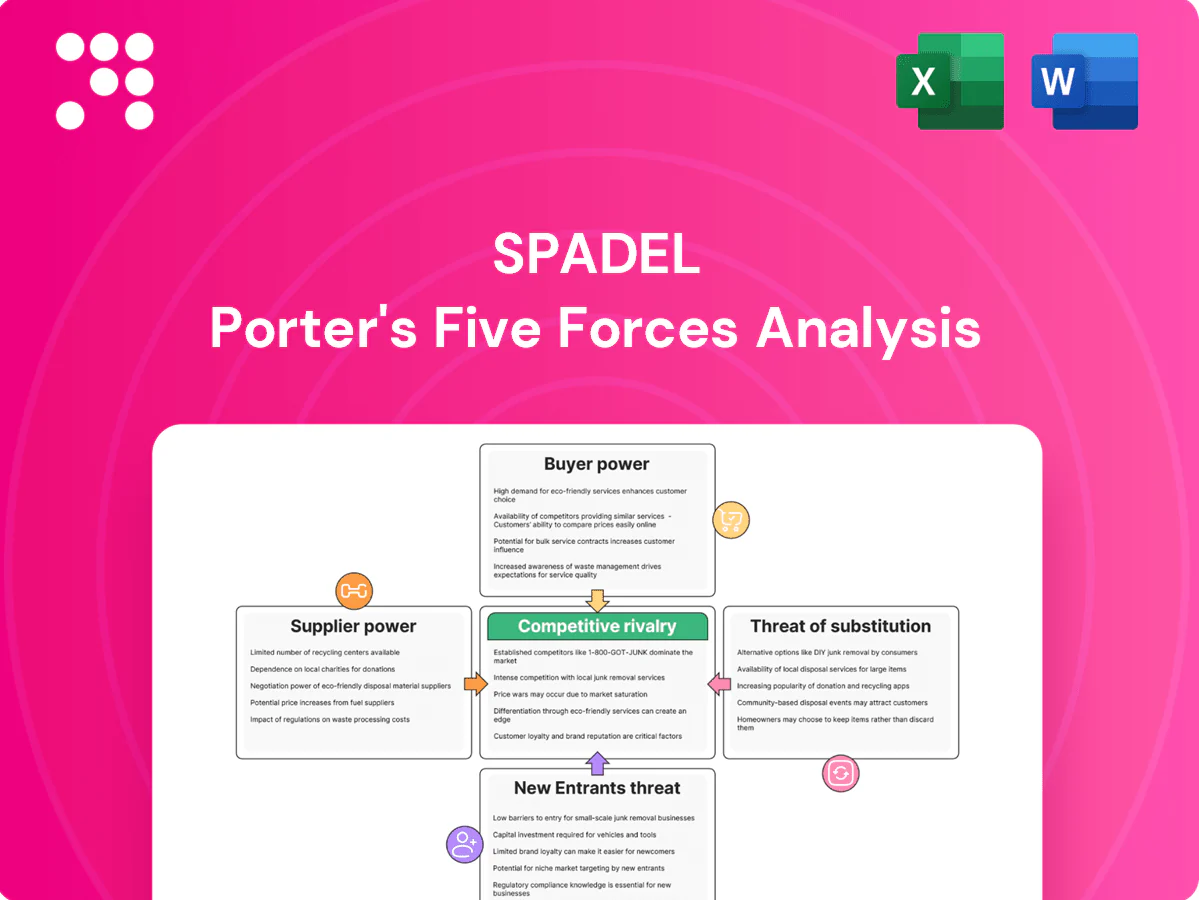
Spadel Porter's Five Forces Analysis

A Must-Have Tool for Decision-Makers
Spadel faces moderate supplier power and steady buyer demand, while brand loyalty and strong distribution help blunt substitute threats; rivalry is pronounced among regional bottlers and barriers to entry are moderate given capital and regulatory needs. This snapshot highlights key tensions affecting margins and growth. The full Porter's Five Forces Analysis reveals force-by-force ratings, visuals, and actionable implications tailored to Spadel—unlock it to inform strategy and investments.
Suppliers Bargaining Power

Scarcity of protected springs
High-quality mineral and spring water sources are geographically scarce and tightly regulated, with only about 2.5% of global freshwater and under 1% readily accessible, concentrating valuable terroirs like Spa and Bru. Concessions, hydrological stewardship and community agreements grant spring owners and public authorities strong leverage over access and pricing. Spadel’s dependence on specific source-rights limits easy supplier switching and raises supplier bargaining power.
Constrained rPET and packaging inputs
As of 2024 food-grade rPET supply in Europe remains tight with relatively few qualified recyclers, elevating supplier leverage. Volatility in resin, caps, labels and glass prices has spiked input costs, pressuring margins. Spadel’s sustainability targets requiring rPET limit sourcing optionality. Long-term supply contracts can secure volumes but reduce short-term flexibility and potential cost savings.

Energy and transport cost pass-through
Electricity, gas and diesel materially affect bottling and logistics costs for Spadel, typically representing a meaningful share of COGS in beverages; surcharges from utilities and carriers can be passed through and compress margins. EU carbon (ETS) averaged around €100/t in 2024, adding direct cost pressure while low-emission mandates raise capex. During peak demand periods limited alternatives increase supplier leverage and volatility risk.

Specialized equipment and maintenance
Compliance and sustainability constraints
Compliance and sustainability constraints—certifications such as ISO 22000, FSSC 22000 and ISO 14001 plus full traceability—raise supplier qualification thresholds for Spadel, shrinking the pool of eligible suppliers and strengthening those certified partners. Any lapse risks interruption given strict EU and national drinking-water standards, increasing dependence on vetted suppliers.
- Fewer certified suppliers = higher supplier bargaining power
- Traceability requirements limit switching options
- Regulatory lapses can halt operations
Water scarcity, tight rPET supply and OEM concentration amplify PET price risk
Spring sources scarce (≈2.5% freshwater, <1% accessible), concentrating rights and pricing power.
European food‑grade rPET met only ~15% of PET demand in 2024, tightening supply and raising costs.
OEM concentration (Krones/Sidel/KHS) and EU ETS ≈€100/t (2024) increase switching costs and input price risk.
| Supplier | 2024 metric | Impact |
|---|---|---|
| Springs | 2.5% freshwater,<1% accessible | High leverage |
| rPET | ~15% supply | Limited optionality |
| OEMs | 3 dominant | Vendor lock‑in |
What is included in the product
 Detailed Word Document
Provides a concise Porter's Five Forces overview for Spadel, uncovering competitive intensity, buyer and supplier power, threat of substitutes and new entrants, and rivalry; highlights disruptive threats, entry barriers and strategic implications for pricing, margins and market positioning.

 Customizable Excel Spreadsheet
A concise one-sheet Porter's Five Forces for Spadel—quickly spot supplier, buyer, rival, entrant and substitution pressures to guide pricing, M&A and operational decisions.
Customers Bargaining Power

Consolidated retail chains
Consolidated retail chains in Belgium, the Netherlands and France control over 70% of grocery sales, giving chains like Ahold Delhaize, Carrefour, Colruyt and Jumbo leverage to push prices, promotions and shelf placement; private labels now represent a growing share of sales. Delistings can knock regional volumes by double-digit percentages for suppliers, so retailer bargaining power is high, especially in commoditized bottled-water formats.
Private label substitution
Supermarket own-brands—accounting for about 38% of EU grocery volumes in 2024—offer lower prices (typically 20–40% cheaper) with acceptable quality, making switching easy and boosting buyer leverage; Spadel must defend with provenance, strong brand equity and verifiable sustainability credentials as 60% of consumers say sustainability influences purchase decisions, while price gaps intensify promotional pressure and margin compression.

HoReCa volume leverage
Restaurants and hotels prize premium cues Spa and Bru but still negotiate terms; in 2024 HoReCa accounted for roughly 15% of channel volumes for Belgian bottled water, driving frequent margin concessions. Menu placement and exclusivity deals commonly exchange 5–15% margin for visibility and category leadership. Switching costs remain modest with many local alternatives, leaving buyer power moderate despite strong brand cachet.

Low end-consumer switching costs
Shoppers switch among waters and formats with minimal friction, keeping switching costs low; in 2024 promotion-driven volumes accounted for roughly 20% of retail bottled-water sales in key Benelux markets, boosting promo elasticity during inflationary spikes (EU inflation ~2.8% in 2024). Brand loyalty exists for premium local labels but is not universal, sustaining persistent margin pressure.
- Low switching costs
- Promo share ~20% (2024)
- EU inflation ~2.8% (2024)
- Segmented brand loyalty
Demand for sustainability proof
Buyers increasingly demand rPET content, quantified CO2 reductions and local sourcing claims, with EU policy pushing recycled-PET targets (proposals toward 30% by 2030) amplifying pressure. Retailer sustainability scorecards now act as gating tools, shifting negotiation power to buyers: failure to meet thresholds risks delisting or commercial penalties, making compliance a key bargaining lever.
- rPET targets: EU proposals ~30% by 2030
- Scorecards = gating factors
- Delisting/penalties risk
- Compliance = negotiation leverage
Retail oligopoly >70% and own-brands ~38% squeeze margins
Consolidated retail chains in BE/NL/FR control >70% grocery sales, giving high leverage over Spadel on price, placement and delistings. Supermarket own-brands ~38% EU volumes (2024) and promo share ~20% compress margins; HoReCa ~15% channel volume in Belgium (2024) negotiates 5–15% margin concessions. rPET targets (~30% by 2030) and retailer scorecards shift power to buyers.
| Metric | Value |
|---|---|
| Retail concentration (BE/NL/FR) | >70% |
| Own-brand EU volumes (2024) | ~38% |
| Promo share (retail, 2024) | ~20% |
| HoReCa share (BE, 2024) | ~15% |
Preview the Actual Deliverable
Spadel Porter's Five Forces Analysis
This preview shows the exact Spadel Porter's Five Forces Analysis you'll receive immediately after purchase—no surprises, no placeholders. The document displayed is fully formatted, professional and ready to use. Once you buy, you'll get instant access to this identical file for download.

A Must-Have Tool for Decision-Makers
Spadel faces moderate supplier power and steady buyer demand, while brand loyalty and strong distribution help blunt substitute threats; rivalry is pronounced among regional bottlers and barriers to entry are moderate given capital and regulatory needs. This snapshot highlights key tensions affecting margins and growth. The full Porter's Five Forces Analysis reveals force-by-force ratings, visuals, and actionable implications tailored to Spadel—unlock it to inform strategy and investments.
Suppliers Bargaining Power
Scarcity of protected springs
High-quality mineral and spring water sources are geographically scarce and tightly regulated, with only about 2.5% of global freshwater and under 1% readily accessible, concentrating valuable terroirs like Spa and Bru. Concessions, hydrological stewardship and community agreements grant spring owners and public authorities strong leverage over access and pricing. Spadel’s dependence on specific source-rights limits easy supplier switching and raises supplier bargaining power.
Constrained rPET and packaging inputs
As of 2024 food-grade rPET supply in Europe remains tight with relatively few qualified recyclers, elevating supplier leverage. Volatility in resin, caps, labels and glass prices has spiked input costs, pressuring margins. Spadel’s sustainability targets requiring rPET limit sourcing optionality. Long-term supply contracts can secure volumes but reduce short-term flexibility and potential cost savings.
Energy and transport cost pass-through
Electricity, gas and diesel materially affect bottling and logistics costs for Spadel, typically representing a meaningful share of COGS in beverages; surcharges from utilities and carriers can be passed through and compress margins. EU carbon (ETS) averaged around €100/t in 2024, adding direct cost pressure while low-emission mandates raise capex. During peak demand periods limited alternatives increase supplier leverage and volatility risk.
Specialized equipment and maintenance
Compliance and sustainability constraints
Compliance and sustainability constraints—certifications such as ISO 22000, FSSC 22000 and ISO 14001 plus full traceability—raise supplier qualification thresholds for Spadel, shrinking the pool of eligible suppliers and strengthening those certified partners. Any lapse risks interruption given strict EU and national drinking-water standards, increasing dependence on vetted suppliers.
- Fewer certified suppliers = higher supplier bargaining power
- Traceability requirements limit switching options
- Regulatory lapses can halt operations
Water scarcity, tight rPET supply and OEM concentration amplify PET price risk
Spring sources scarce (≈2.5% freshwater, <1% accessible), concentrating rights and pricing power.
European food‑grade rPET met only ~15% of PET demand in 2024, tightening supply and raising costs.
OEM concentration (Krones/Sidel/KHS) and EU ETS ≈€100/t (2024) increase switching costs and input price risk.
| Supplier | 2024 metric | Impact |
|---|---|---|
| Springs | 2.5% freshwater,<1% accessible | High leverage |
| rPET | ~15% supply | Limited optionality |
| OEMs | 3 dominant | Vendor lock‑in |
What is included in the product
Detailed Word Document
Provides a concise Porter's Five Forces overview for Spadel, uncovering competitive intensity, buyer and supplier power, threat of substitutes and new entrants, and rivalry; highlights disruptive threats, entry barriers and strategic implications for pricing, margins and market positioning.
Customizable Excel Spreadsheet
A concise one-sheet Porter's Five Forces for Spadel—quickly spot supplier, buyer, rival, entrant and substitution pressures to guide pricing, M&A and operational decisions.
Customers Bargaining Power
Consolidated retail chains
Consolidated retail chains in Belgium, the Netherlands and France control over 70% of grocery sales, giving chains like Ahold Delhaize, Carrefour, Colruyt and Jumbo leverage to push prices, promotions and shelf placement; private labels now represent a growing share of sales. Delistings can knock regional volumes by double-digit percentages for suppliers, so retailer bargaining power is high, especially in commoditized bottled-water formats.
Private label substitution
Supermarket own-brands—accounting for about 38% of EU grocery volumes in 2024—offer lower prices (typically 20–40% cheaper) with acceptable quality, making switching easy and boosting buyer leverage; Spadel must defend with provenance, strong brand equity and verifiable sustainability credentials as 60% of consumers say sustainability influences purchase decisions, while price gaps intensify promotional pressure and margin compression.
HoReCa volume leverage
Restaurants and hotels prize premium cues Spa and Bru but still negotiate terms; in 2024 HoReCa accounted for roughly 15% of channel volumes for Belgian bottled water, driving frequent margin concessions. Menu placement and exclusivity deals commonly exchange 5–15% margin for visibility and category leadership. Switching costs remain modest with many local alternatives, leaving buyer power moderate despite strong brand cachet.
Low end-consumer switching costs
Shoppers switch among waters and formats with minimal friction, keeping switching costs low; in 2024 promotion-driven volumes accounted for roughly 20% of retail bottled-water sales in key Benelux markets, boosting promo elasticity during inflationary spikes (EU inflation ~2.8% in 2024). Brand loyalty exists for premium local labels but is not universal, sustaining persistent margin pressure.
- Low switching costs
- Promo share ~20% (2024)
- EU inflation ~2.8% (2024)
- Segmented brand loyalty
Demand for sustainability proof
Buyers increasingly demand rPET content, quantified CO2 reductions and local sourcing claims, with EU policy pushing recycled-PET targets (proposals toward 30% by 2030) amplifying pressure. Retailer sustainability scorecards now act as gating tools, shifting negotiation power to buyers: failure to meet thresholds risks delisting or commercial penalties, making compliance a key bargaining lever.
- rPET targets: EU proposals ~30% by 2030
- Scorecards = gating factors
- Delisting/penalties risk
- Compliance = negotiation leverage
Retail oligopoly >70% and own-brands ~38% squeeze margins
Consolidated retail chains in BE/NL/FR control >70% grocery sales, giving high leverage over Spadel on price, placement and delistings. Supermarket own-brands ~38% EU volumes (2024) and promo share ~20% compress margins; HoReCa ~15% channel volume in Belgium (2024) negotiates 5–15% margin concessions. rPET targets (~30% by 2030) and retailer scorecards shift power to buyers.
| Metric | Value |
|---|---|
| Retail concentration (BE/NL/FR) | >70% |
| Own-brand EU volumes (2024) | ~38% |
| Promo share (retail, 2024) | ~20% |
| HoReCa share (BE, 2024) | ~15% |
Preview the Actual Deliverable
Spadel Porter's Five Forces Analysis
This preview shows the exact Spadel Porter's Five Forces Analysis you'll receive immediately after purchase—no surprises, no placeholders. The document displayed is fully formatted, professional and ready to use. Once you buy, you'll get instant access to this identical file for download.
Description
A Must-Have Tool for Decision-Makers
Spadel faces moderate supplier power and steady buyer demand, while brand loyalty and strong distribution help blunt substitute threats; rivalry is pronounced among regional bottlers and barriers to entry are moderate given capital and regulatory needs. This snapshot highlights key tensions affecting margins and growth. The full Porter's Five Forces Analysis reveals force-by-force ratings, visuals, and actionable implications tailored to Spadel—unlock it to inform strategy and investments.
Suppliers Bargaining Power
Scarcity of protected springs
High-quality mineral and spring water sources are geographically scarce and tightly regulated, with only about 2.5% of global freshwater and under 1% readily accessible, concentrating valuable terroirs like Spa and Bru. Concessions, hydrological stewardship and community agreements grant spring owners and public authorities strong leverage over access and pricing. Spadel’s dependence on specific source-rights limits easy supplier switching and raises supplier bargaining power.
Constrained rPET and packaging inputs
As of 2024 food-grade rPET supply in Europe remains tight with relatively few qualified recyclers, elevating supplier leverage. Volatility in resin, caps, labels and glass prices has spiked input costs, pressuring margins. Spadel’s sustainability targets requiring rPET limit sourcing optionality. Long-term supply contracts can secure volumes but reduce short-term flexibility and potential cost savings.
Energy and transport cost pass-through
Electricity, gas and diesel materially affect bottling and logistics costs for Spadel, typically representing a meaningful share of COGS in beverages; surcharges from utilities and carriers can be passed through and compress margins. EU carbon (ETS) averaged around €100/t in 2024, adding direct cost pressure while low-emission mandates raise capex. During peak demand periods limited alternatives increase supplier leverage and volatility risk.
Specialized equipment and maintenance
Compliance and sustainability constraints
Compliance and sustainability constraints—certifications such as ISO 22000, FSSC 22000 and ISO 14001 plus full traceability—raise supplier qualification thresholds for Spadel, shrinking the pool of eligible suppliers and strengthening those certified partners. Any lapse risks interruption given strict EU and national drinking-water standards, increasing dependence on vetted suppliers.
- Fewer certified suppliers = higher supplier bargaining power
- Traceability requirements limit switching options
- Regulatory lapses can halt operations
Water scarcity, tight rPET supply and OEM concentration amplify PET price risk
Spring sources scarce (≈2.5% freshwater, <1% accessible), concentrating rights and pricing power.
European food‑grade rPET met only ~15% of PET demand in 2024, tightening supply and raising costs.
OEM concentration (Krones/Sidel/KHS) and EU ETS ≈€100/t (2024) increase switching costs and input price risk.
| Supplier | 2024 metric | Impact |
|---|---|---|
| Springs | 2.5% freshwater,<1% accessible | High leverage |
| rPET | ~15% supply | Limited optionality |
| OEMs | 3 dominant | Vendor lock‑in |
What is included in the product
Detailed Word Document
Provides a concise Porter's Five Forces overview for Spadel, uncovering competitive intensity, buyer and supplier power, threat of substitutes and new entrants, and rivalry; highlights disruptive threats, entry barriers and strategic implications for pricing, margins and market positioning.
Customizable Excel Spreadsheet
A concise one-sheet Porter's Five Forces for Spadel—quickly spot supplier, buyer, rival, entrant and substitution pressures to guide pricing, M&A and operational decisions.
Customers Bargaining Power
Consolidated retail chains
Consolidated retail chains in Belgium, the Netherlands and France control over 70% of grocery sales, giving chains like Ahold Delhaize, Carrefour, Colruyt and Jumbo leverage to push prices, promotions and shelf placement; private labels now represent a growing share of sales. Delistings can knock regional volumes by double-digit percentages for suppliers, so retailer bargaining power is high, especially in commoditized bottled-water formats.
Private label substitution
Supermarket own-brands—accounting for about 38% of EU grocery volumes in 2024—offer lower prices (typically 20–40% cheaper) with acceptable quality, making switching easy and boosting buyer leverage; Spadel must defend with provenance, strong brand equity and verifiable sustainability credentials as 60% of consumers say sustainability influences purchase decisions, while price gaps intensify promotional pressure and margin compression.
HoReCa volume leverage
Restaurants and hotels prize premium cues Spa and Bru but still negotiate terms; in 2024 HoReCa accounted for roughly 15% of channel volumes for Belgian bottled water, driving frequent margin concessions. Menu placement and exclusivity deals commonly exchange 5–15% margin for visibility and category leadership. Switching costs remain modest with many local alternatives, leaving buyer power moderate despite strong brand cachet.
Low end-consumer switching costs
Shoppers switch among waters and formats with minimal friction, keeping switching costs low; in 2024 promotion-driven volumes accounted for roughly 20% of retail bottled-water sales in key Benelux markets, boosting promo elasticity during inflationary spikes (EU inflation ~2.8% in 2024). Brand loyalty exists for premium local labels but is not universal, sustaining persistent margin pressure.
- Low switching costs
- Promo share ~20% (2024)
- EU inflation ~2.8% (2024)
- Segmented brand loyalty
Demand for sustainability proof
Buyers increasingly demand rPET content, quantified CO2 reductions and local sourcing claims, with EU policy pushing recycled-PET targets (proposals toward 30% by 2030) amplifying pressure. Retailer sustainability scorecards now act as gating tools, shifting negotiation power to buyers: failure to meet thresholds risks delisting or commercial penalties, making compliance a key bargaining lever.
- rPET targets: EU proposals ~30% by 2030
- Scorecards = gating factors
- Delisting/penalties risk
- Compliance = negotiation leverage
Retail oligopoly >70% and own-brands ~38% squeeze margins
Consolidated retail chains in BE/NL/FR control >70% grocery sales, giving high leverage over Spadel on price, placement and delistings. Supermarket own-brands ~38% EU volumes (2024) and promo share ~20% compress margins; HoReCa ~15% channel volume in Belgium (2024) negotiates 5–15% margin concessions. rPET targets (~30% by 2030) and retailer scorecards shift power to buyers.
| Metric | Value |
|---|---|
| Retail concentration (BE/NL/FR) | >70% |
| Own-brand EU volumes (2024) | ~38% |
| Promo share (retail, 2024) | ~20% |
| HoReCa share (BE, 2024) | ~15% |
Preview the Actual Deliverable
Spadel Porter's Five Forces Analysis
This preview shows the exact Spadel Porter's Five Forces Analysis you'll receive immediately after purchase—no surprises, no placeholders. The document displayed is fully formatted, professional and ready to use. Once you buy, you'll get instant access to this identical file for download.











