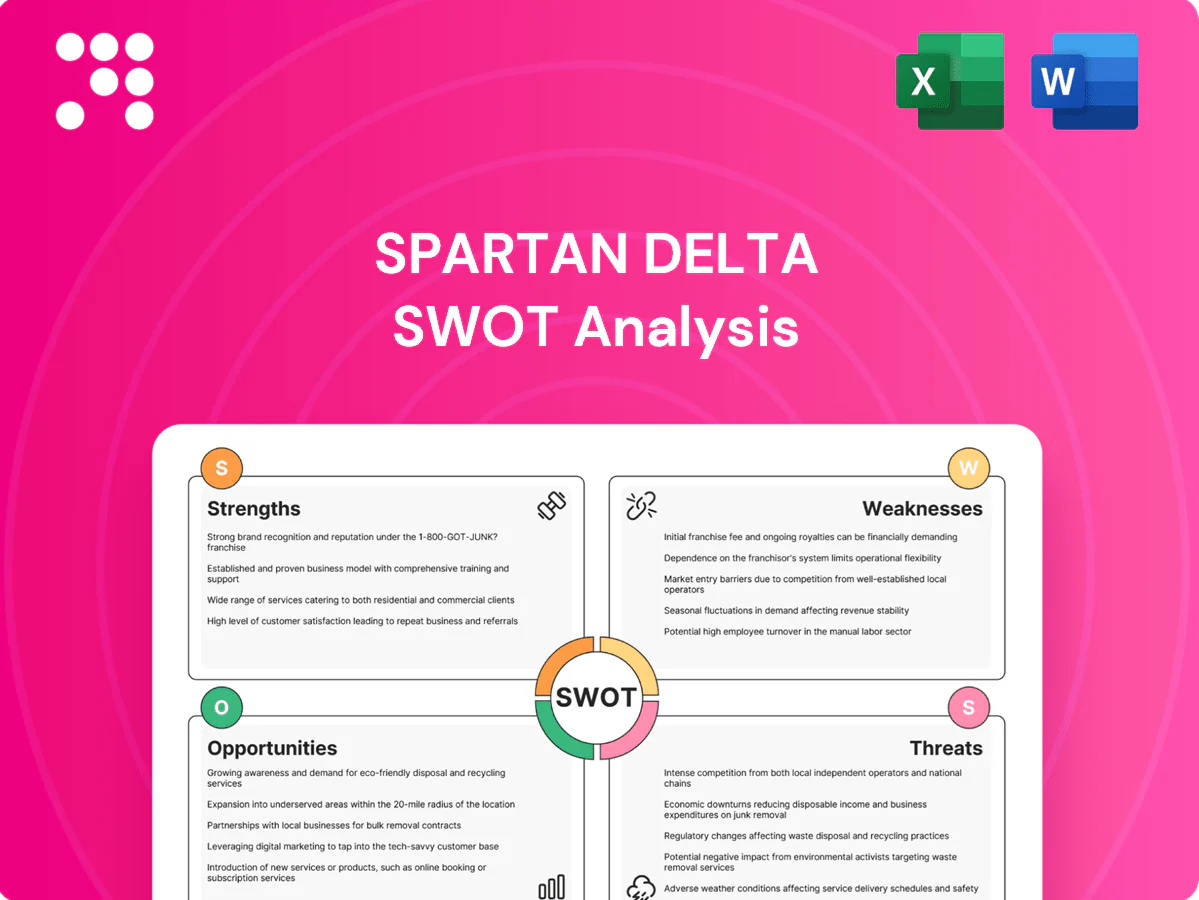
Spartan Delta SWOT Analysis

Go Beyond the Preview—Access the Full Strategic Report
Explore Spartan Delta’s competitive edge, operational risks, and strategic opportunities in our concise SWOT snapshot—insightful for investors and strategists alike. Want the full picture with data-backed analysis and actionable recommendations? Purchase the complete SWOT to receive a professionally formatted Word report and editable Excel matrix for planning and pitches.
Strengths

Montney technical expertise
Deep Montney expertise underpins repeatable drilling and completions outcomes, supporting high-return well inventories and reduced cycle times; the Montney is estimated to contain about 449 Tcf of marketable gas (Natural Resources Canada), enhancing the value of reliable type curves for planning and hedging. The spinout structure preserved that technical capability within focused entities, maintaining operational continuity and execution confidence.
Proven M&A value creation
Spartan Delta repeatedly used strategic acquisitions to assemble contiguous, scalable positions, culminating in a concentrated asset base by 2024. Integration discipline and captured synergies translated into materially improved free funds flow and lower unit costs. Its buy-build-optimize model accelerated inventory depth and infrastructure leverage across core plays. This track record supported premium exit and spinout optionality for stakeholders.

Operational efficiency focus
Operational discipline through lean pad development and tight cost controls improved capital efficiency, while centralized facilities and infrastructure sharing materially lowered lifting costs; strong execution sustained positive free funds flow through multiple commodity cycles, enhancing resilience during price volatility.

Capital discipline and FFF orientation
Management in 2024 emphasized sustainable free funds flow and returns over pure growth, using hedging and measured reinvestment to reduce cash flow volatility and support shareholder-focused actions such as strategic reorganization. This capital discipline signaled prudent stewardship to capital providers and enabled targeted buybacks and debt management.
- 2024 focus: FFF and returns
- Hedging lowered volatility
- Measured reinvestment rates
- Enabled reorganization and shareholder actions
ESG and stewardship mindset
Spartan Delta’s ESG and stewardship mindset emphasizes responsible resource development and environmental stewardship, focusing on emissions, water, and land practices to lower regulatory and reputational risk. Continuous improvements in methane management have supported both cost control and compliance. This positioning has helped secure stakeholder acceptance across Western Canada.
- Emissions, water, land focus reduces regulatory/reputational risk
- Ongoing methane controls cut compliance costs
- Stronger stakeholder acceptance in Western Canada
Deep Montney expertise: repeatable high-return wells, lower costs, 449 Tcf upside
Deep Montney expertise delivers repeatable high‑return wells and reduced cycle times, leveraging the Montney’s ~449 Tcf marketable gas (Natural Resources Canada). Strategic acquisitions created a concentrated, scalable asset base by 2024, driving lower unit costs and stronger free funds flow. Management’s 2024 emphasis on free funds flow and hedging reduced cashflow volatility and enabled shareholder actions.
| Metric | 2024/Source |
|---|---|
| Montney marketable gas | 449 Tcf (Natural Resources Canada) |
| Strategic focus | FFF & returns (2024 company disclosures) |
What is included in the product
 Detailed Word Document
Provides a concise SWOT analysis of Spartan Delta, highlighting core strengths and weaknesses while mapping growth opportunities and external threats to clarify strategic priorities and competitive positioning.

 Customizable Excel Spreadsheet
Provides a concise, Spartan Delta–focused SWOT matrix that quickly isolates strategic pain points for fast remediation and stakeholder alignment.
Weaknesses

Commodity price dependence
Revenue and cash flow remain highly sensitive to oil and gas prices, with WCS heavy crude often trading at double-digit discounts to WTI and AECO averaging roughly 2–3 CAD/GJ in 2024, which can materially squeeze realized pricing. AECO and WCS differentials can erode revenues despite production volumes. Hedging mitigates but cannot eliminate exposure to prolonged commodity moves. Planning uncertainty complicates capital allocation and investment timing.
Capital intensity and decline rates
Unconventional development requires continuous reinvestment to offset steep declines—first‑year decline rates in U.S. shale commonly run about 60–70% per EIA analyses. Sustaining capital needs can consume a large share of free cash flow, often exceeding half in low‑price environments and pressuring liquidity. Liquidity plans must balance drilling cadence and maintenance; deferring activity risks production slippage and unit‑cost creep.

Concentration risk in Western Canada
Geographic concentration in Western Canada leaves Spartan Delta exposed to regional bottlenecks and policy shifts, with pipeline constraints and curtailments historically forcing shut-ins exceeding 100,000 bbl/d during severe wildfire and takeaway events. Local service market tightness can spike drilling and completion costs versus global peers, and limited geographic diversification reduces the companys ability to absorb price or operational shocks.

Decommissioning and environmental liabilities
Decommissioning and environmental liabilities create long-dated cash commitments through asset retirement obligations, raising balance-sheet pressure and tying up capital that could otherwise fund growth.
Tightening regulatory standards and rising remediation cost benchmarks increase future outlays, while historical underinvestment in closure programs creates a deferred liability overhang and operational uncertainty.
Heightened stakeholder and investor scrutiny elevates compliance demands, increasing reporting, insurance and remediation governance costs.
- Long-dated AROs: sustained cash drain
- Tighter regs: higher remediation unit costs
- Underinvestment: future liability overhang
- Stakeholder scrutiny: higher compliance expense
Post-spin organizational complexity
Post-spin organizational complexity from the 2024 reorganization fragmented the legacy platform, creating parallel systems and unclear ownership across product, IT, and finance functions. Transition execution risks center on systems integration gaps, people retention and role clarity, and incomplete governance handoffs that can delay roadmap delivery. Public market visibility fell after the parent’s wind-down, threatening investor continuity and sell-side coverage.
- systems fragmentation
- people/retention risk
- governance handoffs
- reduced investor coverage
Western Canada margins squeezed: AECO 2–3 CAD/GJ; WCS discounts; declines 60–70%
Revenue and cash flow are highly sensitive to commodity differentials (WCS often at double‑digit discounts to WTI; AECO ~2–3 CAD/GJ in 2024), squeezing realized pricing. Unconventional wells show steep declines (first‑year ~60–70% per EIA), forcing high reinvestment and liquidity pressure. Western Canada concentration risks takeaway constraints and historical shut‑ins >100,000 bbl/d. Long‑dated AROs and tightening regs raise future cash outlays.
| Metric | Value / Source |
|---|---|
| AECO 2024 | ~2–3 CAD/GJ |
| WCS vs WTI | double‑digit discounts |
| First‑year decline | ~60–70% (EIA) |
| Historical shut‑ins | >100,000 bbl/d (takeaway/wildfire) |
What You See Is What You Get
Spartan Delta SWOT Analysis
This is the actual SWOT analysis document you’ll receive upon purchase—no surprises, just professional quality. The preview below is taken directly from the full Spartan Delta SWOT report you'll get, so what you see is the real content. Purchase unlocks the complete, editable version ready for immediate download.

Go Beyond the Preview—Access the Full Strategic Report
Explore Spartan Delta’s competitive edge, operational risks, and strategic opportunities in our concise SWOT snapshot—insightful for investors and strategists alike. Want the full picture with data-backed analysis and actionable recommendations? Purchase the complete SWOT to receive a professionally formatted Word report and editable Excel matrix for planning and pitches.
Strengths
Montney technical expertise
Deep Montney expertise underpins repeatable drilling and completions outcomes, supporting high-return well inventories and reduced cycle times; the Montney is estimated to contain about 449 Tcf of marketable gas (Natural Resources Canada), enhancing the value of reliable type curves for planning and hedging. The spinout structure preserved that technical capability within focused entities, maintaining operational continuity and execution confidence.
Proven M&A value creation
Spartan Delta repeatedly used strategic acquisitions to assemble contiguous, scalable positions, culminating in a concentrated asset base by 2024. Integration discipline and captured synergies translated into materially improved free funds flow and lower unit costs. Its buy-build-optimize model accelerated inventory depth and infrastructure leverage across core plays. This track record supported premium exit and spinout optionality for stakeholders.
Operational efficiency focus
Operational discipline through lean pad development and tight cost controls improved capital efficiency, while centralized facilities and infrastructure sharing materially lowered lifting costs; strong execution sustained positive free funds flow through multiple commodity cycles, enhancing resilience during price volatility.
Capital discipline and FFF orientation
Management in 2024 emphasized sustainable free funds flow and returns over pure growth, using hedging and measured reinvestment to reduce cash flow volatility and support shareholder-focused actions such as strategic reorganization. This capital discipline signaled prudent stewardship to capital providers and enabled targeted buybacks and debt management.
- 2024 focus: FFF and returns
- Hedging lowered volatility
- Measured reinvestment rates
- Enabled reorganization and shareholder actions
ESG and stewardship mindset
Spartan Delta’s ESG and stewardship mindset emphasizes responsible resource development and environmental stewardship, focusing on emissions, water, and land practices to lower regulatory and reputational risk. Continuous improvements in methane management have supported both cost control and compliance. This positioning has helped secure stakeholder acceptance across Western Canada.
- Emissions, water, land focus reduces regulatory/reputational risk
- Ongoing methane controls cut compliance costs
- Stronger stakeholder acceptance in Western Canada
Deep Montney expertise: repeatable high-return wells, lower costs, 449 Tcf upside
Deep Montney expertise delivers repeatable high‑return wells and reduced cycle times, leveraging the Montney’s ~449 Tcf marketable gas (Natural Resources Canada). Strategic acquisitions created a concentrated, scalable asset base by 2024, driving lower unit costs and stronger free funds flow. Management’s 2024 emphasis on free funds flow and hedging reduced cashflow volatility and enabled shareholder actions.
| Metric | 2024/Source |
|---|---|
| Montney marketable gas | 449 Tcf (Natural Resources Canada) |
| Strategic focus | FFF & returns (2024 company disclosures) |
What is included in the product
Detailed Word Document
Provides a concise SWOT analysis of Spartan Delta, highlighting core strengths and weaknesses while mapping growth opportunities and external threats to clarify strategic priorities and competitive positioning.
Customizable Excel Spreadsheet
Provides a concise, Spartan Delta–focused SWOT matrix that quickly isolates strategic pain points for fast remediation and stakeholder alignment.
Weaknesses
Commodity price dependence
Revenue and cash flow remain highly sensitive to oil and gas prices, with WCS heavy crude often trading at double-digit discounts to WTI and AECO averaging roughly 2–3 CAD/GJ in 2024, which can materially squeeze realized pricing. AECO and WCS differentials can erode revenues despite production volumes. Hedging mitigates but cannot eliminate exposure to prolonged commodity moves. Planning uncertainty complicates capital allocation and investment timing.
Capital intensity and decline rates
Unconventional development requires continuous reinvestment to offset steep declines—first‑year decline rates in U.S. shale commonly run about 60–70% per EIA analyses. Sustaining capital needs can consume a large share of free cash flow, often exceeding half in low‑price environments and pressuring liquidity. Liquidity plans must balance drilling cadence and maintenance; deferring activity risks production slippage and unit‑cost creep.
Concentration risk in Western Canada
Geographic concentration in Western Canada leaves Spartan Delta exposed to regional bottlenecks and policy shifts, with pipeline constraints and curtailments historically forcing shut-ins exceeding 100,000 bbl/d during severe wildfire and takeaway events. Local service market tightness can spike drilling and completion costs versus global peers, and limited geographic diversification reduces the companys ability to absorb price or operational shocks.
Decommissioning and environmental liabilities
Decommissioning and environmental liabilities create long-dated cash commitments through asset retirement obligations, raising balance-sheet pressure and tying up capital that could otherwise fund growth.
Tightening regulatory standards and rising remediation cost benchmarks increase future outlays, while historical underinvestment in closure programs creates a deferred liability overhang and operational uncertainty.
Heightened stakeholder and investor scrutiny elevates compliance demands, increasing reporting, insurance and remediation governance costs.
- Long-dated AROs: sustained cash drain
- Tighter regs: higher remediation unit costs
- Underinvestment: future liability overhang
- Stakeholder scrutiny: higher compliance expense
Post-spin organizational complexity
Post-spin organizational complexity from the 2024 reorganization fragmented the legacy platform, creating parallel systems and unclear ownership across product, IT, and finance functions. Transition execution risks center on systems integration gaps, people retention and role clarity, and incomplete governance handoffs that can delay roadmap delivery. Public market visibility fell after the parent’s wind-down, threatening investor continuity and sell-side coverage.
- systems fragmentation
- people/retention risk
- governance handoffs
- reduced investor coverage
Western Canada margins squeezed: AECO 2–3 CAD/GJ; WCS discounts; declines 60–70%
Revenue and cash flow are highly sensitive to commodity differentials (WCS often at double‑digit discounts to WTI; AECO ~2–3 CAD/GJ in 2024), squeezing realized pricing. Unconventional wells show steep declines (first‑year ~60–70% per EIA), forcing high reinvestment and liquidity pressure. Western Canada concentration risks takeaway constraints and historical shut‑ins >100,000 bbl/d. Long‑dated AROs and tightening regs raise future cash outlays.
| Metric | Value / Source |
|---|---|
| AECO 2024 | ~2–3 CAD/GJ |
| WCS vs WTI | double‑digit discounts |
| First‑year decline | ~60–70% (EIA) |
| Historical shut‑ins | >100,000 bbl/d (takeaway/wildfire) |
What You See Is What You Get
Spartan Delta SWOT Analysis
This is the actual SWOT analysis document you’ll receive upon purchase—no surprises, just professional quality. The preview below is taken directly from the full Spartan Delta SWOT report you'll get, so what you see is the real content. Purchase unlocks the complete, editable version ready for immediate download.
Original: $10.00
-65%$10.00
$3.50Description
Go Beyond the Preview—Access the Full Strategic Report
Explore Spartan Delta’s competitive edge, operational risks, and strategic opportunities in our concise SWOT snapshot—insightful for investors and strategists alike. Want the full picture with data-backed analysis and actionable recommendations? Purchase the complete SWOT to receive a professionally formatted Word report and editable Excel matrix for planning and pitches.
Strengths
Montney technical expertise
Deep Montney expertise underpins repeatable drilling and completions outcomes, supporting high-return well inventories and reduced cycle times; the Montney is estimated to contain about 449 Tcf of marketable gas (Natural Resources Canada), enhancing the value of reliable type curves for planning and hedging. The spinout structure preserved that technical capability within focused entities, maintaining operational continuity and execution confidence.
Proven M&A value creation
Spartan Delta repeatedly used strategic acquisitions to assemble contiguous, scalable positions, culminating in a concentrated asset base by 2024. Integration discipline and captured synergies translated into materially improved free funds flow and lower unit costs. Its buy-build-optimize model accelerated inventory depth and infrastructure leverage across core plays. This track record supported premium exit and spinout optionality for stakeholders.
Operational efficiency focus
Operational discipline through lean pad development and tight cost controls improved capital efficiency, while centralized facilities and infrastructure sharing materially lowered lifting costs; strong execution sustained positive free funds flow through multiple commodity cycles, enhancing resilience during price volatility.
Capital discipline and FFF orientation
Management in 2024 emphasized sustainable free funds flow and returns over pure growth, using hedging and measured reinvestment to reduce cash flow volatility and support shareholder-focused actions such as strategic reorganization. This capital discipline signaled prudent stewardship to capital providers and enabled targeted buybacks and debt management.
- 2024 focus: FFF and returns
- Hedging lowered volatility
- Measured reinvestment rates
- Enabled reorganization and shareholder actions
ESG and stewardship mindset
Spartan Delta’s ESG and stewardship mindset emphasizes responsible resource development and environmental stewardship, focusing on emissions, water, and land practices to lower regulatory and reputational risk. Continuous improvements in methane management have supported both cost control and compliance. This positioning has helped secure stakeholder acceptance across Western Canada.
- Emissions, water, land focus reduces regulatory/reputational risk
- Ongoing methane controls cut compliance costs
- Stronger stakeholder acceptance in Western Canada
Deep Montney expertise: repeatable high-return wells, lower costs, 449 Tcf upside
Deep Montney expertise delivers repeatable high‑return wells and reduced cycle times, leveraging the Montney’s ~449 Tcf marketable gas (Natural Resources Canada). Strategic acquisitions created a concentrated, scalable asset base by 2024, driving lower unit costs and stronger free funds flow. Management’s 2024 emphasis on free funds flow and hedging reduced cashflow volatility and enabled shareholder actions.
| Metric | 2024/Source |
|---|---|
| Montney marketable gas | 449 Tcf (Natural Resources Canada) |
| Strategic focus | FFF & returns (2024 company disclosures) |
What is included in the product
Detailed Word Document
Provides a concise SWOT analysis of Spartan Delta, highlighting core strengths and weaknesses while mapping growth opportunities and external threats to clarify strategic priorities and competitive positioning.
Customizable Excel Spreadsheet
Provides a concise, Spartan Delta–focused SWOT matrix that quickly isolates strategic pain points for fast remediation and stakeholder alignment.
Weaknesses
Commodity price dependence
Revenue and cash flow remain highly sensitive to oil and gas prices, with WCS heavy crude often trading at double-digit discounts to WTI and AECO averaging roughly 2–3 CAD/GJ in 2024, which can materially squeeze realized pricing. AECO and WCS differentials can erode revenues despite production volumes. Hedging mitigates but cannot eliminate exposure to prolonged commodity moves. Planning uncertainty complicates capital allocation and investment timing.
Capital intensity and decline rates
Unconventional development requires continuous reinvestment to offset steep declines—first‑year decline rates in U.S. shale commonly run about 60–70% per EIA analyses. Sustaining capital needs can consume a large share of free cash flow, often exceeding half in low‑price environments and pressuring liquidity. Liquidity plans must balance drilling cadence and maintenance; deferring activity risks production slippage and unit‑cost creep.
Concentration risk in Western Canada
Geographic concentration in Western Canada leaves Spartan Delta exposed to regional bottlenecks and policy shifts, with pipeline constraints and curtailments historically forcing shut-ins exceeding 100,000 bbl/d during severe wildfire and takeaway events. Local service market tightness can spike drilling and completion costs versus global peers, and limited geographic diversification reduces the companys ability to absorb price or operational shocks.
Decommissioning and environmental liabilities
Decommissioning and environmental liabilities create long-dated cash commitments through asset retirement obligations, raising balance-sheet pressure and tying up capital that could otherwise fund growth.
Tightening regulatory standards and rising remediation cost benchmarks increase future outlays, while historical underinvestment in closure programs creates a deferred liability overhang and operational uncertainty.
Heightened stakeholder and investor scrutiny elevates compliance demands, increasing reporting, insurance and remediation governance costs.
- Long-dated AROs: sustained cash drain
- Tighter regs: higher remediation unit costs
- Underinvestment: future liability overhang
- Stakeholder scrutiny: higher compliance expense
Post-spin organizational complexity
Post-spin organizational complexity from the 2024 reorganization fragmented the legacy platform, creating parallel systems and unclear ownership across product, IT, and finance functions. Transition execution risks center on systems integration gaps, people retention and role clarity, and incomplete governance handoffs that can delay roadmap delivery. Public market visibility fell after the parent’s wind-down, threatening investor continuity and sell-side coverage.
- systems fragmentation
- people/retention risk
- governance handoffs
- reduced investor coverage
Western Canada margins squeezed: AECO 2–3 CAD/GJ; WCS discounts; declines 60–70%
Revenue and cash flow are highly sensitive to commodity differentials (WCS often at double‑digit discounts to WTI; AECO ~2–3 CAD/GJ in 2024), squeezing realized pricing. Unconventional wells show steep declines (first‑year ~60–70% per EIA), forcing high reinvestment and liquidity pressure. Western Canada concentration risks takeaway constraints and historical shut‑ins >100,000 bbl/d. Long‑dated AROs and tightening regs raise future cash outlays.
| Metric | Value / Source |
|---|---|
| AECO 2024 | ~2–3 CAD/GJ |
| WCS vs WTI | double‑digit discounts |
| First‑year decline | ~60–70% (EIA) |
| Historical shut‑ins | >100,000 bbl/d (takeaway/wildfire) |
What You See Is What You Get
Spartan Delta SWOT Analysis
This is the actual SWOT analysis document you’ll receive upon purchase—no surprises, just professional quality. The preview below is taken directly from the full Spartan Delta SWOT report you'll get, so what you see is the real content. Purchase unlocks the complete, editable version ready for immediate download.











