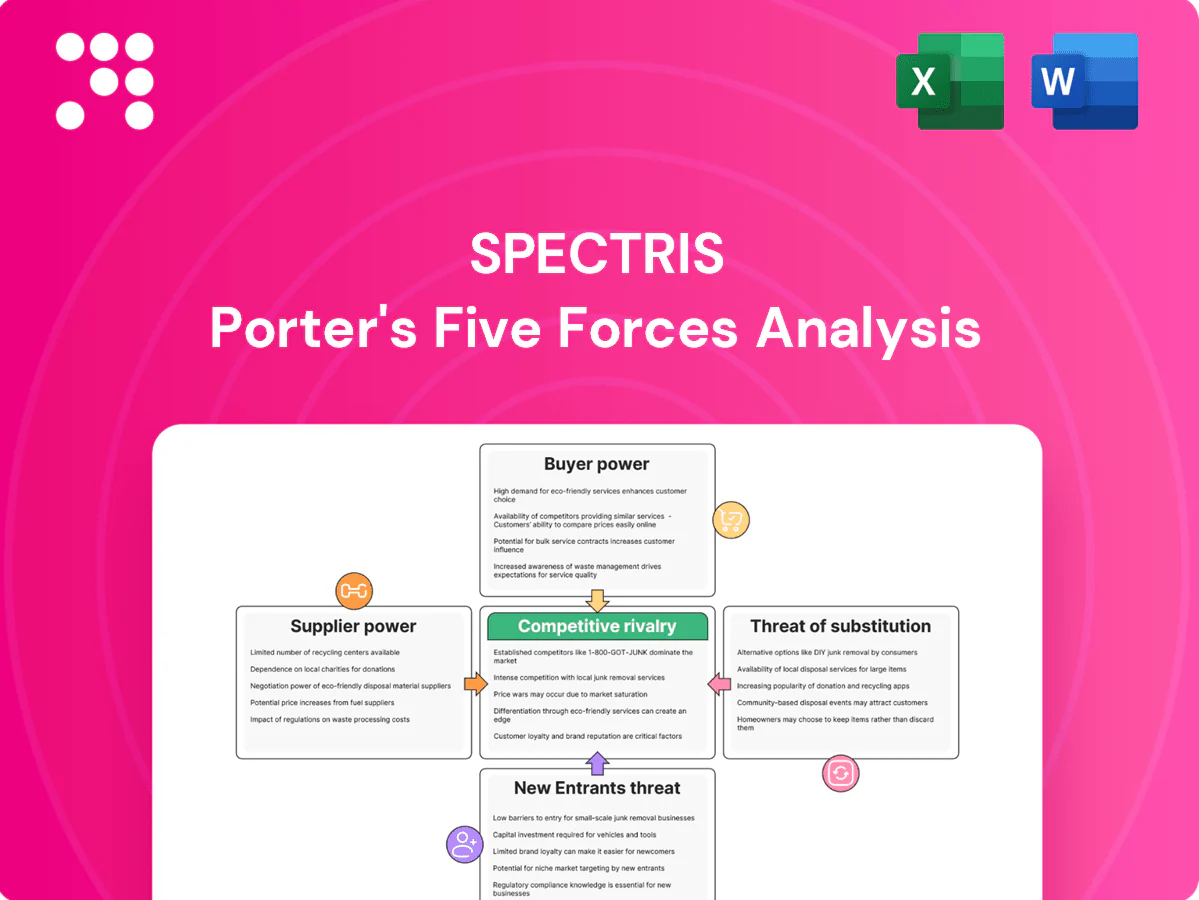
Spectris Porter's Five Forces Analysis

Don't Miss the Bigger Picture
Spectris’s Porter's Five Forces snapshot highlights supplier concentration, moderate buyer power, and niche substitute threats shaping its precision-instrument markets. Competitive rivalry and barriers to entry are assessed with industry context and product differentiation in mind. This brief only scratches the surface—unlock the full Porter's Five Forces Analysis for force-by-force ratings, visuals, and actionable strategic insights.
Suppliers Bargaining Power

Specialized component dependence
In 2024, precision instruments still depended on niche optics, sensors, semiconductors and specialty materials with few qualified suppliers, keeping supplier leverage high over pricing and extended lead times vs pre-2020 norms. Custom specifications force long qualification cycles that can lock Spectris into single-source relationships. Dual-sourcing reduces risk but adds significant cost and months-to-years of validation.
Custom electronics and firmware
Custom ASICs, FPGAs and embedded firmware tailored to measurement performance create strong vendor lock-in (ASIC NRE often >$1m), while engineering change orders and requalification typically add 6–18 months and $0.5–5m in cost, raising switching barriers. Suppliers shape roadmaps through component availability and specialty lead times (often 20+ weeks in 2024). Long industrial lifecycles (10–20 years) deepen dependence on legacy parts.

Metrology-grade calibration inputs
Traceable standards, reference materials and accredited ISO/IEC 17025 calibration services are concentrated among specialized providers, narrowing Spectris's supplier choices. Compliance with ISO/IEC and ILAC-recognized accreditations and industry-specific norms restricts the pool to certified labs. Disruptions can delay shipments and service SLAs by weeks, and premium pricing for certified inputs is common.

Software and cloud stack reliance
Reliance on OS, middleware, analytics libraries and hyperscalers shifts bargaining power upstream; in 2024 AWS ~31%, Azure ~23%, GCP ~10% centralize leverage and contract terms. Licensing changes and usage-based fees compressed software-led margins as subscription/SaaS models comprised ~75% of vendor revenue in 2024. Data residency and security rules materially limit switching; co-innovation partnerships can partially rebalance power.
- Hyperscaler share 2024: AWS 31% / Azure 23% / GCP 10%
- Subscription/SaaS ~75% of vendor revenue (2024)
- Data residency reduces switchability
- Co-innovation offsets supplier leverage
Geopolitical and logistics exposure
Regional concentration in East Asian advanced-manufacturing hubs elevates supplier leverage and single-point geopolitical risk for Spectris; export controls and compliance since 2022 have narrowed eligible suppliers, tightening sourcing. Freight volatility — spot container rates swung roughly 60% from 2021 highs to 2024 averages — threatens time-critical high-value module deliveries. Strategic nearshoring and buffer inventory mitigate risk but raise working-capital intensity.
- Regional concentration: high
- Export controls: reduced supplier pool
- Freight volatility: ~60% swing to 2024
- Mitigation: nearshoring/inventory = higher WC
Suppliers wield leverage: lead times 20+wks, ASIC NRE > $1m, freight ~60%
Suppliers hold high leverage over Spectris in 2024 due to scarce optics/sensors, custom ASICs (NRE >$1m) and long lead times (20+ weeks) that create vendor lock-in; requalification typically costs $0.5–5m and 6–18 months. Hyperscalers centralize cloud power (AWS 31%/Azure 23%/GCP 10%) and subscription models (~75% vendor revenue) compress margins. Regional concentration and export controls plus ~60% freight volatility raise supply disruption risk.
| Metric | 2024 |
|---|---|
| ASIC NRE | >$1m |
| Requal cost/time | $0.5–5m / 6–18m |
| Lead times | 20+ weeks |
| Hyperscaler share | AWS31%/AZ23%/GCP10% |
| Subscription revenue | ~75% |
| Freight swing | ~60% |
What is included in the product
 Detailed Word Document
Uncovers key drivers of competition, customer influence, supplier power, substitutes and entry risks tailored to Spectris, highlighting disruptive threats and market dynamics that shape pricing and profitability. Detailed, strategic commentary in fully editable Word format—easily customize for reports, investor decks or internal strategy use.

 Customizable Excel Spreadsheet
A concise one-sheet Porter's Five Forces for Spectris that quantifies competitive pressures and lets you toggle scenarios—instantly revealing strategic threats, supplier/customer leverage, and opportunity areas for quick, board-ready decisions.
Customers Bargaining Power

Diversified blue-chip customer base
Spectris serves large OEMs, labs and industrials that buy in volume and run competitive tenders, with FY2024 revenue of about £1.7bn highlighting scale; professional procurement teams routinely press on price and contract terms. Referenceability and strategic wins drive willingness to concede discounts to secure long-term deals. Broad customer diversification reduces single-customer revenue risk but not buyer sophistication or bargaining power.
High switching costs from installed base
Integration into workflows, validated methods, and data ecosystems raise exit barriers for Spectris customers, making operational switchover costly and slow; Spectris reported group revenue of about £1.38bn in FY2023, underscoring scale of its installed base. Retraining, revalidation and downtime typically deter switching despite price pressure, and cross-selling of services and software deepens lock-in. Buyers often leverage future deal prospects to secure service credits and concessions.

Performance-critical use cases
In performance-critical use cases accuracy, repeatability and compliance often outweigh unit price, forcing buyers to demand demos, pilots and ROI analyses before procurement. Framing decisions around total cost of ownership shifts focus to lifecycle value and service SLAs. Failures carry reputational and regulatory costs (IBM 2024 cites average breach cost near $4.45m), which moderates buyer leverage.

Cyclical capex and budget constraints
Industrial and R&D cycles cause batch purchasing and frequent deferrals, increasing buyers’ leverage as they time orders to capex peaks and troughs; in downturns customers demand deeper discounts and longer payment terms, and as-a-service proposals face extra scrutiny over multi-year commitments. Framework agreements enable customers to lock in standardized, lower pricing across sites, compressing supplier margins.
- Batch buying raises negotiation leverage
- Downturns drive discounting and extended terms
- As-a-service faces multi-year scrutiny
- Frameworks standardize lower prices
Availability of credible alternatives
Multiple global rivals offer comparable instruments and software bundles, and Spectris reported FY 2024 revenue of £1,648m as competition pressures ASPs; buyers use benchmark specs and bake-offs that can compress margins by double digits. Interoperability standards permit partial substitution, so differentiation via application expertise and rapid service responsiveness is essential to resist price erosion.
High-value instruments face heavy buyer pressure despite installed-base lock-in
Spectris sells high-value instruments to volume-buying OEMs and labs (FY2024 revenue £1,648m) where professional procurement drives price pressure; installed-base lock-in raises switching costs (group revenue FY2023 £1,380m). Buyers use bake-offs, batch timing and framework agreements to extract discounts, while critical performance and service SLAs preserve some pricing power.
| Metric | Value/Impact |
|---|---|
| FY2024 revenue | £1,648m |
| FY2023 revenue | £1,380m |
| Buyer leverage | High (tenders, batch buying, frameworks) |
What You See Is What You Get
Spectris Porter's Five Forces Analysis
This preview is the exact Spectris Porter's Five Forces analysis you'll receive after purchase—no placeholders or mockups. The final document is fully written, professionally formatted, and ready for immediate download and use the moment you buy.

Don't Miss the Bigger Picture
Spectris’s Porter's Five Forces snapshot highlights supplier concentration, moderate buyer power, and niche substitute threats shaping its precision-instrument markets. Competitive rivalry and barriers to entry are assessed with industry context and product differentiation in mind. This brief only scratches the surface—unlock the full Porter's Five Forces Analysis for force-by-force ratings, visuals, and actionable strategic insights.
Suppliers Bargaining Power
Specialized component dependence
In 2024, precision instruments still depended on niche optics, sensors, semiconductors and specialty materials with few qualified suppliers, keeping supplier leverage high over pricing and extended lead times vs pre-2020 norms. Custom specifications force long qualification cycles that can lock Spectris into single-source relationships. Dual-sourcing reduces risk but adds significant cost and months-to-years of validation.
Custom electronics and firmware
Custom ASICs, FPGAs and embedded firmware tailored to measurement performance create strong vendor lock-in (ASIC NRE often >$1m), while engineering change orders and requalification typically add 6–18 months and $0.5–5m in cost, raising switching barriers. Suppliers shape roadmaps through component availability and specialty lead times (often 20+ weeks in 2024). Long industrial lifecycles (10–20 years) deepen dependence on legacy parts.
Metrology-grade calibration inputs
Traceable standards, reference materials and accredited ISO/IEC 17025 calibration services are concentrated among specialized providers, narrowing Spectris's supplier choices. Compliance with ISO/IEC and ILAC-recognized accreditations and industry-specific norms restricts the pool to certified labs. Disruptions can delay shipments and service SLAs by weeks, and premium pricing for certified inputs is common.
Software and cloud stack reliance
Reliance on OS, middleware, analytics libraries and hyperscalers shifts bargaining power upstream; in 2024 AWS ~31%, Azure ~23%, GCP ~10% centralize leverage and contract terms. Licensing changes and usage-based fees compressed software-led margins as subscription/SaaS models comprised ~75% of vendor revenue in 2024. Data residency and security rules materially limit switching; co-innovation partnerships can partially rebalance power.
- Hyperscaler share 2024: AWS 31% / Azure 23% / GCP 10%
- Subscription/SaaS ~75% of vendor revenue (2024)
- Data residency reduces switchability
- Co-innovation offsets supplier leverage
Geopolitical and logistics exposure
Regional concentration in East Asian advanced-manufacturing hubs elevates supplier leverage and single-point geopolitical risk for Spectris; export controls and compliance since 2022 have narrowed eligible suppliers, tightening sourcing. Freight volatility — spot container rates swung roughly 60% from 2021 highs to 2024 averages — threatens time-critical high-value module deliveries. Strategic nearshoring and buffer inventory mitigate risk but raise working-capital intensity.
- Regional concentration: high
- Export controls: reduced supplier pool
- Freight volatility: ~60% swing to 2024
- Mitigation: nearshoring/inventory = higher WC
Suppliers wield leverage: lead times 20+wks, ASIC NRE > $1m, freight ~60%
Suppliers hold high leverage over Spectris in 2024 due to scarce optics/sensors, custom ASICs (NRE >$1m) and long lead times (20+ weeks) that create vendor lock-in; requalification typically costs $0.5–5m and 6–18 months. Hyperscalers centralize cloud power (AWS 31%/Azure 23%/GCP 10%) and subscription models (~75% vendor revenue) compress margins. Regional concentration and export controls plus ~60% freight volatility raise supply disruption risk.
| Metric | 2024 |
|---|---|
| ASIC NRE | >$1m |
| Requal cost/time | $0.5–5m / 6–18m |
| Lead times | 20+ weeks |
| Hyperscaler share | AWS31%/AZ23%/GCP10% |
| Subscription revenue | ~75% |
| Freight swing | ~60% |
What is included in the product
Detailed Word Document
Uncovers key drivers of competition, customer influence, supplier power, substitutes and entry risks tailored to Spectris, highlighting disruptive threats and market dynamics that shape pricing and profitability. Detailed, strategic commentary in fully editable Word format—easily customize for reports, investor decks or internal strategy use.
Customizable Excel Spreadsheet
A concise one-sheet Porter's Five Forces for Spectris that quantifies competitive pressures and lets you toggle scenarios—instantly revealing strategic threats, supplier/customer leverage, and opportunity areas for quick, board-ready decisions.
Customers Bargaining Power
Diversified blue-chip customer base
Spectris serves large OEMs, labs and industrials that buy in volume and run competitive tenders, with FY2024 revenue of about £1.7bn highlighting scale; professional procurement teams routinely press on price and contract terms. Referenceability and strategic wins drive willingness to concede discounts to secure long-term deals. Broad customer diversification reduces single-customer revenue risk but not buyer sophistication or bargaining power.
High switching costs from installed base
Integration into workflows, validated methods, and data ecosystems raise exit barriers for Spectris customers, making operational switchover costly and slow; Spectris reported group revenue of about £1.38bn in FY2023, underscoring scale of its installed base. Retraining, revalidation and downtime typically deter switching despite price pressure, and cross-selling of services and software deepens lock-in. Buyers often leverage future deal prospects to secure service credits and concessions.
Performance-critical use cases
In performance-critical use cases accuracy, repeatability and compliance often outweigh unit price, forcing buyers to demand demos, pilots and ROI analyses before procurement. Framing decisions around total cost of ownership shifts focus to lifecycle value and service SLAs. Failures carry reputational and regulatory costs (IBM 2024 cites average breach cost near $4.45m), which moderates buyer leverage.
Cyclical capex and budget constraints
Industrial and R&D cycles cause batch purchasing and frequent deferrals, increasing buyers’ leverage as they time orders to capex peaks and troughs; in downturns customers demand deeper discounts and longer payment terms, and as-a-service proposals face extra scrutiny over multi-year commitments. Framework agreements enable customers to lock in standardized, lower pricing across sites, compressing supplier margins.
- Batch buying raises negotiation leverage
- Downturns drive discounting and extended terms
- As-a-service faces multi-year scrutiny
- Frameworks standardize lower prices
Availability of credible alternatives
Multiple global rivals offer comparable instruments and software bundles, and Spectris reported FY 2024 revenue of £1,648m as competition pressures ASPs; buyers use benchmark specs and bake-offs that can compress margins by double digits. Interoperability standards permit partial substitution, so differentiation via application expertise and rapid service responsiveness is essential to resist price erosion.
High-value instruments face heavy buyer pressure despite installed-base lock-in
Spectris sells high-value instruments to volume-buying OEMs and labs (FY2024 revenue £1,648m) where professional procurement drives price pressure; installed-base lock-in raises switching costs (group revenue FY2023 £1,380m). Buyers use bake-offs, batch timing and framework agreements to extract discounts, while critical performance and service SLAs preserve some pricing power.
| Metric | Value/Impact |
|---|---|
| FY2024 revenue | £1,648m |
| FY2023 revenue | £1,380m |
| Buyer leverage | High (tenders, batch buying, frameworks) |
What You See Is What You Get
Spectris Porter's Five Forces Analysis
This preview is the exact Spectris Porter's Five Forces analysis you'll receive after purchase—no placeholders or mockups. The final document is fully written, professionally formatted, and ready for immediate download and use the moment you buy.
Original: $10.00
-65%$10.00
$3.50Description
Don't Miss the Bigger Picture
Spectris’s Porter's Five Forces snapshot highlights supplier concentration, moderate buyer power, and niche substitute threats shaping its precision-instrument markets. Competitive rivalry and barriers to entry are assessed with industry context and product differentiation in mind. This brief only scratches the surface—unlock the full Porter's Five Forces Analysis for force-by-force ratings, visuals, and actionable strategic insights.
Suppliers Bargaining Power
Specialized component dependence
In 2024, precision instruments still depended on niche optics, sensors, semiconductors and specialty materials with few qualified suppliers, keeping supplier leverage high over pricing and extended lead times vs pre-2020 norms. Custom specifications force long qualification cycles that can lock Spectris into single-source relationships. Dual-sourcing reduces risk but adds significant cost and months-to-years of validation.
Custom electronics and firmware
Custom ASICs, FPGAs and embedded firmware tailored to measurement performance create strong vendor lock-in (ASIC NRE often >$1m), while engineering change orders and requalification typically add 6–18 months and $0.5–5m in cost, raising switching barriers. Suppliers shape roadmaps through component availability and specialty lead times (often 20+ weeks in 2024). Long industrial lifecycles (10–20 years) deepen dependence on legacy parts.
Metrology-grade calibration inputs
Traceable standards, reference materials and accredited ISO/IEC 17025 calibration services are concentrated among specialized providers, narrowing Spectris's supplier choices. Compliance with ISO/IEC and ILAC-recognized accreditations and industry-specific norms restricts the pool to certified labs. Disruptions can delay shipments and service SLAs by weeks, and premium pricing for certified inputs is common.
Software and cloud stack reliance
Reliance on OS, middleware, analytics libraries and hyperscalers shifts bargaining power upstream; in 2024 AWS ~31%, Azure ~23%, GCP ~10% centralize leverage and contract terms. Licensing changes and usage-based fees compressed software-led margins as subscription/SaaS models comprised ~75% of vendor revenue in 2024. Data residency and security rules materially limit switching; co-innovation partnerships can partially rebalance power.
- Hyperscaler share 2024: AWS 31% / Azure 23% / GCP 10%
- Subscription/SaaS ~75% of vendor revenue (2024)
- Data residency reduces switchability
- Co-innovation offsets supplier leverage
Geopolitical and logistics exposure
Regional concentration in East Asian advanced-manufacturing hubs elevates supplier leverage and single-point geopolitical risk for Spectris; export controls and compliance since 2022 have narrowed eligible suppliers, tightening sourcing. Freight volatility — spot container rates swung roughly 60% from 2021 highs to 2024 averages — threatens time-critical high-value module deliveries. Strategic nearshoring and buffer inventory mitigate risk but raise working-capital intensity.
- Regional concentration: high
- Export controls: reduced supplier pool
- Freight volatility: ~60% swing to 2024
- Mitigation: nearshoring/inventory = higher WC
Suppliers wield leverage: lead times 20+wks, ASIC NRE > $1m, freight ~60%
Suppliers hold high leverage over Spectris in 2024 due to scarce optics/sensors, custom ASICs (NRE >$1m) and long lead times (20+ weeks) that create vendor lock-in; requalification typically costs $0.5–5m and 6–18 months. Hyperscalers centralize cloud power (AWS 31%/Azure 23%/GCP 10%) and subscription models (~75% vendor revenue) compress margins. Regional concentration and export controls plus ~60% freight volatility raise supply disruption risk.
| Metric | 2024 |
|---|---|
| ASIC NRE | >$1m |
| Requal cost/time | $0.5–5m / 6–18m |
| Lead times | 20+ weeks |
| Hyperscaler share | AWS31%/AZ23%/GCP10% |
| Subscription revenue | ~75% |
| Freight swing | ~60% |
What is included in the product
Detailed Word Document
Uncovers key drivers of competition, customer influence, supplier power, substitutes and entry risks tailored to Spectris, highlighting disruptive threats and market dynamics that shape pricing and profitability. Detailed, strategic commentary in fully editable Word format—easily customize for reports, investor decks or internal strategy use.
Customizable Excel Spreadsheet
A concise one-sheet Porter's Five Forces for Spectris that quantifies competitive pressures and lets you toggle scenarios—instantly revealing strategic threats, supplier/customer leverage, and opportunity areas for quick, board-ready decisions.
Customers Bargaining Power
Diversified blue-chip customer base
Spectris serves large OEMs, labs and industrials that buy in volume and run competitive tenders, with FY2024 revenue of about £1.7bn highlighting scale; professional procurement teams routinely press on price and contract terms. Referenceability and strategic wins drive willingness to concede discounts to secure long-term deals. Broad customer diversification reduces single-customer revenue risk but not buyer sophistication or bargaining power.
High switching costs from installed base
Integration into workflows, validated methods, and data ecosystems raise exit barriers for Spectris customers, making operational switchover costly and slow; Spectris reported group revenue of about £1.38bn in FY2023, underscoring scale of its installed base. Retraining, revalidation and downtime typically deter switching despite price pressure, and cross-selling of services and software deepens lock-in. Buyers often leverage future deal prospects to secure service credits and concessions.
Performance-critical use cases
In performance-critical use cases accuracy, repeatability and compliance often outweigh unit price, forcing buyers to demand demos, pilots and ROI analyses before procurement. Framing decisions around total cost of ownership shifts focus to lifecycle value and service SLAs. Failures carry reputational and regulatory costs (IBM 2024 cites average breach cost near $4.45m), which moderates buyer leverage.
Cyclical capex and budget constraints
Industrial and R&D cycles cause batch purchasing and frequent deferrals, increasing buyers’ leverage as they time orders to capex peaks and troughs; in downturns customers demand deeper discounts and longer payment terms, and as-a-service proposals face extra scrutiny over multi-year commitments. Framework agreements enable customers to lock in standardized, lower pricing across sites, compressing supplier margins.
- Batch buying raises negotiation leverage
- Downturns drive discounting and extended terms
- As-a-service faces multi-year scrutiny
- Frameworks standardize lower prices
Availability of credible alternatives
Multiple global rivals offer comparable instruments and software bundles, and Spectris reported FY 2024 revenue of £1,648m as competition pressures ASPs; buyers use benchmark specs and bake-offs that can compress margins by double digits. Interoperability standards permit partial substitution, so differentiation via application expertise and rapid service responsiveness is essential to resist price erosion.
High-value instruments face heavy buyer pressure despite installed-base lock-in
Spectris sells high-value instruments to volume-buying OEMs and labs (FY2024 revenue £1,648m) where professional procurement drives price pressure; installed-base lock-in raises switching costs (group revenue FY2023 £1,380m). Buyers use bake-offs, batch timing and framework agreements to extract discounts, while critical performance and service SLAs preserve some pricing power.
| Metric | Value/Impact |
|---|---|
| FY2024 revenue | £1,648m |
| FY2023 revenue | £1,380m |
| Buyer leverage | High (tenders, batch buying, frameworks) |
What You See Is What You Get
Spectris Porter's Five Forces Analysis
This preview is the exact Spectris Porter's Five Forces analysis you'll receive after purchase—no placeholders or mockups. The final document is fully written, professionally formatted, and ready for immediate download and use the moment you buy.











