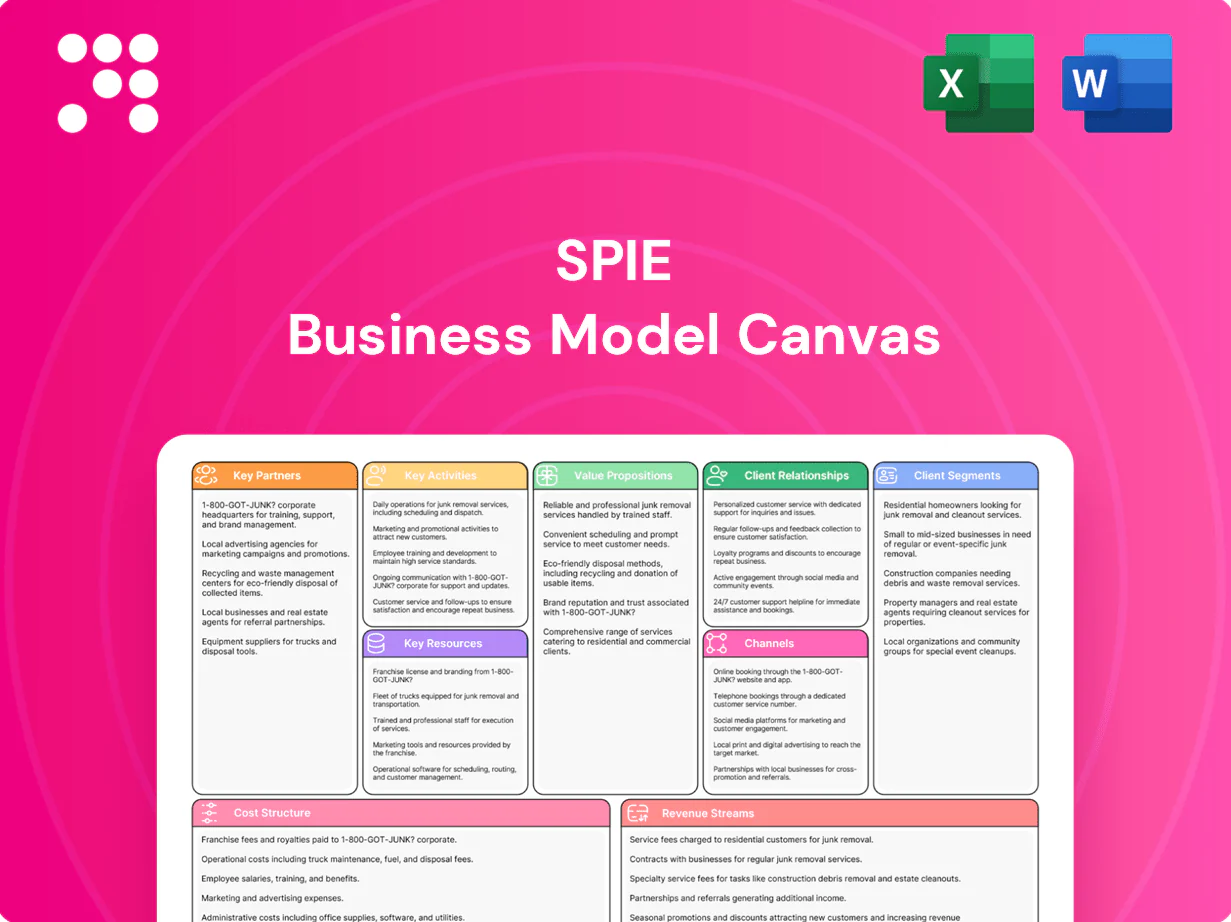
SPIE Business Model Canvas

Business Model Canvas: Strategic Blueprint to Scale Market Share and Boost Profitability
Unlock the strategic blueprint behind SPIE with our Business Model Canvas that maps customer segments, value propositions, key partners and revenue drivers. This concise, actionable snapshot reveals how SPIE captures market share and scales profitably. Purchase the full Word/Excel canvas to benchmark, plan, or present with confidence.
Partnerships

OEMs and Technology Vendors
Strategic alliances with HVAC, electrical, automation and ICT OEMs secure certified components and up-to-date firmware, enabling compliant turnkey offers; joint development and preferred pricing speed time-to-market and strengthen bid competitiveness. Vendor training and co-marketing accelerate deployment and reduce lifecycle risk in a sector where buildings account for about 40% of global energy use (IEA). Multi-year support agreements ensure spare parts availability and uptime SLAs commonly targeted at 99.5%.
Energy Utilities and Grid Operators
Partnerships with energy utilities and grid operators enable energy performance contracts, demand response and grid integration, with demand response proven to cut peak load by about 10–20% in practical pilots. Data sharing improves audits and decarbonization roadmaps, boosting measured savings and enabling CAPEX planning. Co-deployment of smart meters, EV chargers and DERs scales uptake; joint tenders increase credibility in public and industrial projects.

Construction Firms and EPC Contractors
Collaborations with construction firms and EPC contractors embed SPIE as the MEP/ICT specialist in design‑build and large infrastructure projects, securing early BIM workflows where 71% of firms report active BIM use (NBS 2024). Early involvement reduces rework—often up to 10% of project costs—while risk‑sharing contracts align timelines and quality outcomes. Improved pipeline visibility enables better resource planning and wider geographic coverage.

Software Platforms and Cybersecurity Partners
Alliances with BMS, SCADA, IoT and cybersecurity vendors enable integrated digital services, with APIs and interoperability feeding centralized data lakes and analytics to drive insights; co-innovation accelerates digital twin, predictive maintenance and asset management rollouts, while certifications (eg IEC 62443, ISO 27001) bolster compliance in critical environments and support procurement requirements in 2024.
- 2024 cybersecurity market ≈ $200B
- APIs enable unified data lakes for real-time analytics
- Certifications: IEC 62443, ISO 27001
Public Bodies and Compliance Agencies
Engagement with municipalities, regulators and standards bodies ensures SPIE aligns with EU directives such as the Energy Performance of Buildings Directive and Fit for 55, meeting legal and safety requirements. Access to NextGenerationEU funding (€806.9 billion) and Renovation Wave programmes increases client ROI through subsidies and green financing. Participation in EU pilots delivers verifiable reference projects, while policy insight informs productization of energy-efficiency services.
- Adherence: EPBD, Fit for 55
- Funding: NextGenerationEU €806.9 billion
- Target: Renovation Wave – double renovation rate by 2030
- Value: pilots → reference projects; policy-driven productization
OEM and utility alliances cut peak loads 10–20% and secure 99.5% SLA
Strategic OEM and vendor alliances secure certified components, preferred pricing and co‑innovation to shorten time‑to‑market and hit 99.5% uptime SLAs. Utility and DER partnerships enable demand response and energy performance contracts, cutting peak load ~10–20%. EPC, BMS, cybersecurity and public‑sector links embed SPIE in BIM workflows, access NextGenerationEU funding and deliver verifiable decarbonization pilots.
| Partner | Value | 2024 metric |
|---|---|---|
| OEMs/vendors | Turnkey offers | 99.5% SLA |
| Utilities | Demand response | 10–20% peak cut |
| Public/EPC | Funding & pilots | NextGenerationEU €806.9B |
What is included in the product
 Detailed Word Document
A comprehensive SPIE Business Model Canvas detailing customer segments, value propositions, channels, revenue streams, key resources/partners, activities, cost structure and customer relationships across the 9 classic BMC blocks; includes SWOT, competitive advantages and polished narratives for presentations, funding and strategic decisions.

 Customizable Excel Spreadsheet
Streamlines SPIE’s complex service and engineering offerings into an editable one-page canvas, relieving time-consuming structuring and aligning cross-functional teams for faster decision-making and clear strategy communication.
Activities

Design and Engineering
Concept, basic and detailed engineering for HVAC, electrical, automation and ICT systems, delivering integrated designs and BIM/digital twin models to de-risk construction and shorten timelines. 2024 compliance focus aligns designs with NIS2 and CSRD requirements. Grid connection studies and energy models target lifecycle cost reductions and peak-demand optimization. Safety, cybersecurity and sustainability standards are embedded across all design phases.
Installation and Commissioning
On-site deployment of MEP, OT/IT networks and control systems ensures coordinated installation across construction, electrical and automation teams, with factory and site acceptance testing validating performance against contractual specifications. System integration harmonizes legacy assets and new equipment via protocol translation and middleware to preserve uptime. Handover includes comprehensive documentation, operator training and as-built records to support maintenance and regulatory compliance.

Maintenance and Operations
Preventive, predictive and corrective maintenance combine to maximize uptime, with predictive programs shown to cut maintenance costs by up to 40% and unplanned downtime by up to 50% in industry studies. 24/7 remote monitoring and rapid field-service dispatch ensure SLA targets (commonly 99.5%+ uptime) are met. Energy management ties consumption to KPIs and SLAs, enabling cost and carbon reductions. Spare-parts logistics and lifecycle refurbishment planning extend asset life and reduce capex needs.

Energy Performance Contracting
- Audit & baselining
- Guaranteed savings (IPMVP)
- Implementation & metering
- Shared-savings 5–15 yr
Digital Solutions and Integration
Digital Solutions and Integration drives SPIE’s IoT sensorization, asset and facilities data integration, and analytics to enable predictive maintenance and uptime; global IoT connections reached about 18 billion in 2024 (Statista). Cybersecure OT–IT connectivity reduces attack surface while feeding dashboards, CMMS, and BMS optimization workflows to cut lifecycle costs. API-enabled services open partner and client ecosystems for scalable, modular service delivery.
- IoT sensorization
- Data integration & analytics
- Cybersecure OT–IT
- Dashboards, CMMS, BMS optimization
- API-enabled partner services
Integrated engineering, BIM/Digital Twins & NIS2/CSRD cut timelines; IoT 18bn
Integrated engineering, BIM/digital twins and NIS2/CSRD-aligned designs de-risk projects and shorten timelines. Turnkey MEP/OT/IT deployment with FAT/SAT and training ensures compliant handover. Predictive maintenance, 24/7 monitoring and EPC shared-savings (5–15 yr) cut downtime and costs; 2024 IoT connections ~18bn.
| Metric | Value |
|---|---|
| IoT connections (2024) | 18bn |
| Typical EPC term | 5–15 yr |
Full Document Unlocks After Purchase
Business Model Canvas
The document you're previewing is the exact SPIE Business Model Canvas you’ll receive after purchase, not a mockup or sample. When you complete your order, you’ll get this same professionally formatted file—ready to edit, present, and share—in Word and Excel formats. No surprises, just the full deliverable.

Business Model Canvas: Strategic Blueprint to Scale Market Share and Boost Profitability
Unlock the strategic blueprint behind SPIE with our Business Model Canvas that maps customer segments, value propositions, key partners and revenue drivers. This concise, actionable snapshot reveals how SPIE captures market share and scales profitably. Purchase the full Word/Excel canvas to benchmark, plan, or present with confidence.
Partnerships
OEMs and Technology Vendors
Strategic alliances with HVAC, electrical, automation and ICT OEMs secure certified components and up-to-date firmware, enabling compliant turnkey offers; joint development and preferred pricing speed time-to-market and strengthen bid competitiveness. Vendor training and co-marketing accelerate deployment and reduce lifecycle risk in a sector where buildings account for about 40% of global energy use (IEA). Multi-year support agreements ensure spare parts availability and uptime SLAs commonly targeted at 99.5%.
Energy Utilities and Grid Operators
Partnerships with energy utilities and grid operators enable energy performance contracts, demand response and grid integration, with demand response proven to cut peak load by about 10–20% in practical pilots. Data sharing improves audits and decarbonization roadmaps, boosting measured savings and enabling CAPEX planning. Co-deployment of smart meters, EV chargers and DERs scales uptake; joint tenders increase credibility in public and industrial projects.
Construction Firms and EPC Contractors
Collaborations with construction firms and EPC contractors embed SPIE as the MEP/ICT specialist in design‑build and large infrastructure projects, securing early BIM workflows where 71% of firms report active BIM use (NBS 2024). Early involvement reduces rework—often up to 10% of project costs—while risk‑sharing contracts align timelines and quality outcomes. Improved pipeline visibility enables better resource planning and wider geographic coverage.
Software Platforms and Cybersecurity Partners
Alliances with BMS, SCADA, IoT and cybersecurity vendors enable integrated digital services, with APIs and interoperability feeding centralized data lakes and analytics to drive insights; co-innovation accelerates digital twin, predictive maintenance and asset management rollouts, while certifications (eg IEC 62443, ISO 27001) bolster compliance in critical environments and support procurement requirements in 2024.
- 2024 cybersecurity market ≈ $200B
- APIs enable unified data lakes for real-time analytics
- Certifications: IEC 62443, ISO 27001
Public Bodies and Compliance Agencies
Engagement with municipalities, regulators and standards bodies ensures SPIE aligns with EU directives such as the Energy Performance of Buildings Directive and Fit for 55, meeting legal and safety requirements. Access to NextGenerationEU funding (€806.9 billion) and Renovation Wave programmes increases client ROI through subsidies and green financing. Participation in EU pilots delivers verifiable reference projects, while policy insight informs productization of energy-efficiency services.
- Adherence: EPBD, Fit for 55
- Funding: NextGenerationEU €806.9 billion
- Target: Renovation Wave – double renovation rate by 2030
- Value: pilots → reference projects; policy-driven productization
OEM and utility alliances cut peak loads 10–20% and secure 99.5% SLA
Strategic OEM and vendor alliances secure certified components, preferred pricing and co‑innovation to shorten time‑to‑market and hit 99.5% uptime SLAs. Utility and DER partnerships enable demand response and energy performance contracts, cutting peak load ~10–20%. EPC, BMS, cybersecurity and public‑sector links embed SPIE in BIM workflows, access NextGenerationEU funding and deliver verifiable decarbonization pilots.
| Partner | Value | 2024 metric |
|---|---|---|
| OEMs/vendors | Turnkey offers | 99.5% SLA |
| Utilities | Demand response | 10–20% peak cut |
| Public/EPC | Funding & pilots | NextGenerationEU €806.9B |
What is included in the product
Detailed Word Document
A comprehensive SPIE Business Model Canvas detailing customer segments, value propositions, channels, revenue streams, key resources/partners, activities, cost structure and customer relationships across the 9 classic BMC blocks; includes SWOT, competitive advantages and polished narratives for presentations, funding and strategic decisions.
Customizable Excel Spreadsheet
Streamlines SPIE’s complex service and engineering offerings into an editable one-page canvas, relieving time-consuming structuring and aligning cross-functional teams for faster decision-making and clear strategy communication.
Activities
Design and Engineering
Concept, basic and detailed engineering for HVAC, electrical, automation and ICT systems, delivering integrated designs and BIM/digital twin models to de-risk construction and shorten timelines. 2024 compliance focus aligns designs with NIS2 and CSRD requirements. Grid connection studies and energy models target lifecycle cost reductions and peak-demand optimization. Safety, cybersecurity and sustainability standards are embedded across all design phases.
Installation and Commissioning
On-site deployment of MEP, OT/IT networks and control systems ensures coordinated installation across construction, electrical and automation teams, with factory and site acceptance testing validating performance against contractual specifications. System integration harmonizes legacy assets and new equipment via protocol translation and middleware to preserve uptime. Handover includes comprehensive documentation, operator training and as-built records to support maintenance and regulatory compliance.
Maintenance and Operations
Preventive, predictive and corrective maintenance combine to maximize uptime, with predictive programs shown to cut maintenance costs by up to 40% and unplanned downtime by up to 50% in industry studies. 24/7 remote monitoring and rapid field-service dispatch ensure SLA targets (commonly 99.5%+ uptime) are met. Energy management ties consumption to KPIs and SLAs, enabling cost and carbon reductions. Spare-parts logistics and lifecycle refurbishment planning extend asset life and reduce capex needs.
Energy Performance Contracting
- Audit & baselining
- Guaranteed savings (IPMVP)
- Implementation & metering
- Shared-savings 5–15 yr
Digital Solutions and Integration
Digital Solutions and Integration drives SPIE’s IoT sensorization, asset and facilities data integration, and analytics to enable predictive maintenance and uptime; global IoT connections reached about 18 billion in 2024 (Statista). Cybersecure OT–IT connectivity reduces attack surface while feeding dashboards, CMMS, and BMS optimization workflows to cut lifecycle costs. API-enabled services open partner and client ecosystems for scalable, modular service delivery.
- IoT sensorization
- Data integration & analytics
- Cybersecure OT–IT
- Dashboards, CMMS, BMS optimization
- API-enabled partner services
Integrated engineering, BIM/Digital Twins & NIS2/CSRD cut timelines; IoT 18bn
Integrated engineering, BIM/digital twins and NIS2/CSRD-aligned designs de-risk projects and shorten timelines. Turnkey MEP/OT/IT deployment with FAT/SAT and training ensures compliant handover. Predictive maintenance, 24/7 monitoring and EPC shared-savings (5–15 yr) cut downtime and costs; 2024 IoT connections ~18bn.
| Metric | Value |
|---|---|
| IoT connections (2024) | 18bn |
| Typical EPC term | 5–15 yr |
Full Document Unlocks After Purchase
Business Model Canvas
The document you're previewing is the exact SPIE Business Model Canvas you’ll receive after purchase, not a mockup or sample. When you complete your order, you’ll get this same professionally formatted file—ready to edit, present, and share—in Word and Excel formats. No surprises, just the full deliverable.
Original: $10.00
-65%$10.00
$3.50Description
Business Model Canvas: Strategic Blueprint to Scale Market Share and Boost Profitability
Unlock the strategic blueprint behind SPIE with our Business Model Canvas that maps customer segments, value propositions, key partners and revenue drivers. This concise, actionable snapshot reveals how SPIE captures market share and scales profitably. Purchase the full Word/Excel canvas to benchmark, plan, or present with confidence.
Partnerships
OEMs and Technology Vendors
Strategic alliances with HVAC, electrical, automation and ICT OEMs secure certified components and up-to-date firmware, enabling compliant turnkey offers; joint development and preferred pricing speed time-to-market and strengthen bid competitiveness. Vendor training and co-marketing accelerate deployment and reduce lifecycle risk in a sector where buildings account for about 40% of global energy use (IEA). Multi-year support agreements ensure spare parts availability and uptime SLAs commonly targeted at 99.5%.
Energy Utilities and Grid Operators
Partnerships with energy utilities and grid operators enable energy performance contracts, demand response and grid integration, with demand response proven to cut peak load by about 10–20% in practical pilots. Data sharing improves audits and decarbonization roadmaps, boosting measured savings and enabling CAPEX planning. Co-deployment of smart meters, EV chargers and DERs scales uptake; joint tenders increase credibility in public and industrial projects.
Construction Firms and EPC Contractors
Collaborations with construction firms and EPC contractors embed SPIE as the MEP/ICT specialist in design‑build and large infrastructure projects, securing early BIM workflows where 71% of firms report active BIM use (NBS 2024). Early involvement reduces rework—often up to 10% of project costs—while risk‑sharing contracts align timelines and quality outcomes. Improved pipeline visibility enables better resource planning and wider geographic coverage.
Software Platforms and Cybersecurity Partners
Alliances with BMS, SCADA, IoT and cybersecurity vendors enable integrated digital services, with APIs and interoperability feeding centralized data lakes and analytics to drive insights; co-innovation accelerates digital twin, predictive maintenance and asset management rollouts, while certifications (eg IEC 62443, ISO 27001) bolster compliance in critical environments and support procurement requirements in 2024.
- 2024 cybersecurity market ≈ $200B
- APIs enable unified data lakes for real-time analytics
- Certifications: IEC 62443, ISO 27001
Public Bodies and Compliance Agencies
Engagement with municipalities, regulators and standards bodies ensures SPIE aligns with EU directives such as the Energy Performance of Buildings Directive and Fit for 55, meeting legal and safety requirements. Access to NextGenerationEU funding (€806.9 billion) and Renovation Wave programmes increases client ROI through subsidies and green financing. Participation in EU pilots delivers verifiable reference projects, while policy insight informs productization of energy-efficiency services.
- Adherence: EPBD, Fit for 55
- Funding: NextGenerationEU €806.9 billion
- Target: Renovation Wave – double renovation rate by 2030
- Value: pilots → reference projects; policy-driven productization
OEM and utility alliances cut peak loads 10–20% and secure 99.5% SLA
Strategic OEM and vendor alliances secure certified components, preferred pricing and co‑innovation to shorten time‑to‑market and hit 99.5% uptime SLAs. Utility and DER partnerships enable demand response and energy performance contracts, cutting peak load ~10–20%. EPC, BMS, cybersecurity and public‑sector links embed SPIE in BIM workflows, access NextGenerationEU funding and deliver verifiable decarbonization pilots.
| Partner | Value | 2024 metric |
|---|---|---|
| OEMs/vendors | Turnkey offers | 99.5% SLA |
| Utilities | Demand response | 10–20% peak cut |
| Public/EPC | Funding & pilots | NextGenerationEU €806.9B |
What is included in the product
Detailed Word Document
A comprehensive SPIE Business Model Canvas detailing customer segments, value propositions, channels, revenue streams, key resources/partners, activities, cost structure and customer relationships across the 9 classic BMC blocks; includes SWOT, competitive advantages and polished narratives for presentations, funding and strategic decisions.
Customizable Excel Spreadsheet
Streamlines SPIE’s complex service and engineering offerings into an editable one-page canvas, relieving time-consuming structuring and aligning cross-functional teams for faster decision-making and clear strategy communication.
Activities
Design and Engineering
Concept, basic and detailed engineering for HVAC, electrical, automation and ICT systems, delivering integrated designs and BIM/digital twin models to de-risk construction and shorten timelines. 2024 compliance focus aligns designs with NIS2 and CSRD requirements. Grid connection studies and energy models target lifecycle cost reductions and peak-demand optimization. Safety, cybersecurity and sustainability standards are embedded across all design phases.
Installation and Commissioning
On-site deployment of MEP, OT/IT networks and control systems ensures coordinated installation across construction, electrical and automation teams, with factory and site acceptance testing validating performance against contractual specifications. System integration harmonizes legacy assets and new equipment via protocol translation and middleware to preserve uptime. Handover includes comprehensive documentation, operator training and as-built records to support maintenance and regulatory compliance.
Maintenance and Operations
Preventive, predictive and corrective maintenance combine to maximize uptime, with predictive programs shown to cut maintenance costs by up to 40% and unplanned downtime by up to 50% in industry studies. 24/7 remote monitoring and rapid field-service dispatch ensure SLA targets (commonly 99.5%+ uptime) are met. Energy management ties consumption to KPIs and SLAs, enabling cost and carbon reductions. Spare-parts logistics and lifecycle refurbishment planning extend asset life and reduce capex needs.
Energy Performance Contracting
- Audit & baselining
- Guaranteed savings (IPMVP)
- Implementation & metering
- Shared-savings 5–15 yr
Digital Solutions and Integration
Digital Solutions and Integration drives SPIE’s IoT sensorization, asset and facilities data integration, and analytics to enable predictive maintenance and uptime; global IoT connections reached about 18 billion in 2024 (Statista). Cybersecure OT–IT connectivity reduces attack surface while feeding dashboards, CMMS, and BMS optimization workflows to cut lifecycle costs. API-enabled services open partner and client ecosystems for scalable, modular service delivery.
- IoT sensorization
- Data integration & analytics
- Cybersecure OT–IT
- Dashboards, CMMS, BMS optimization
- API-enabled partner services
Integrated engineering, BIM/Digital Twins & NIS2/CSRD cut timelines; IoT 18bn
Integrated engineering, BIM/digital twins and NIS2/CSRD-aligned designs de-risk projects and shorten timelines. Turnkey MEP/OT/IT deployment with FAT/SAT and training ensures compliant handover. Predictive maintenance, 24/7 monitoring and EPC shared-savings (5–15 yr) cut downtime and costs; 2024 IoT connections ~18bn.
| Metric | Value |
|---|---|
| IoT connections (2024) | 18bn |
| Typical EPC term | 5–15 yr |
Full Document Unlocks After Purchase
Business Model Canvas
The document you're previewing is the exact SPIE Business Model Canvas you’ll receive after purchase, not a mockup or sample. When you complete your order, you’ll get this same professionally formatted file—ready to edit, present, and share—in Word and Excel formats. No surprises, just the full deliverable.











